
 Back to all posts

Organic SEO is search engine optimisation for the unpaid results. It is the work that helps a search engine find a page, understand what it is about and show it when the query fits, and it is the reason a page can keep sending clicks after the work is done.
This page covers what organic SEO is, how it differs from paid search, and how Google ranks the unpaid results. It then works through the four parts of a strategy, with the off-page part written from placement work, before turning to the common problems, how to measure progress, and whether to do it yourself or hire help.
Nothing here promises a ranking.
What is organic SEO?
It is the practical work that helps a search engine understand what a page is about, who it helps and why it deserves to appear for a query. That work can include Keyword research, page planning, content editing, internal linking, crawl and index checks, site speed fixes, structured data, redirects, link earning and performance tracking. The mix changes by site. A large ecommerce site may need technical clean-up before it needs another guide. A small service site may need clearer service pages and stronger local proof before it needs more blog posts.
Google draws the boundary between the channels in its own words. Its Search Central page Do you need an SEO? (last updated 5 June 2026) states: "Advertising with Google won't have any effect on your site's presence in our search results." The same page adds: "Google never accepts money to include or rank sites in our search results, and it costs nothing to appear in our organic search results." Google Ads Help says the same thing from the ads side: "Google’s search results are independent of Google’s advertising programs."
That boundary matters because the two channels behave differently. Paid search lets you bid for attention. Organic SEO asks whether your page is the best unpaid answer Google can show.
Organic SEO vs paid search
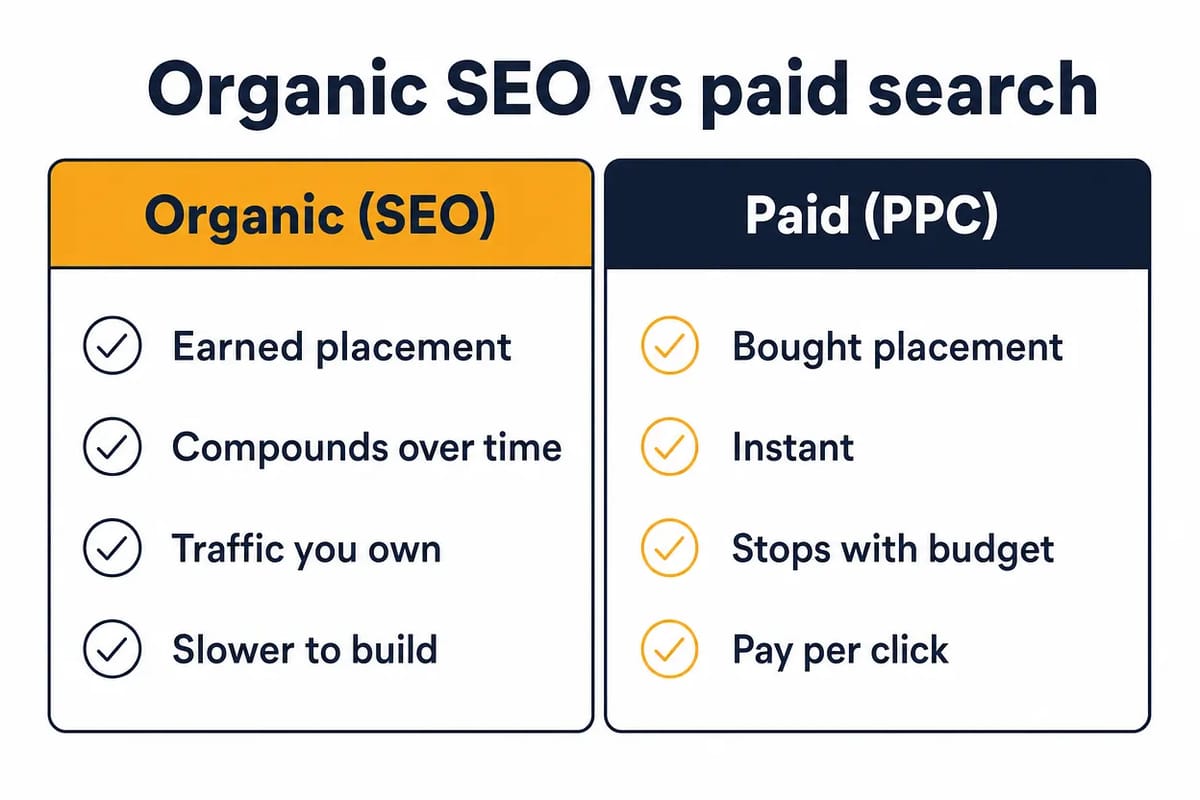
Paid search and organic SEO are often grouped under "search", but they solve different problems.
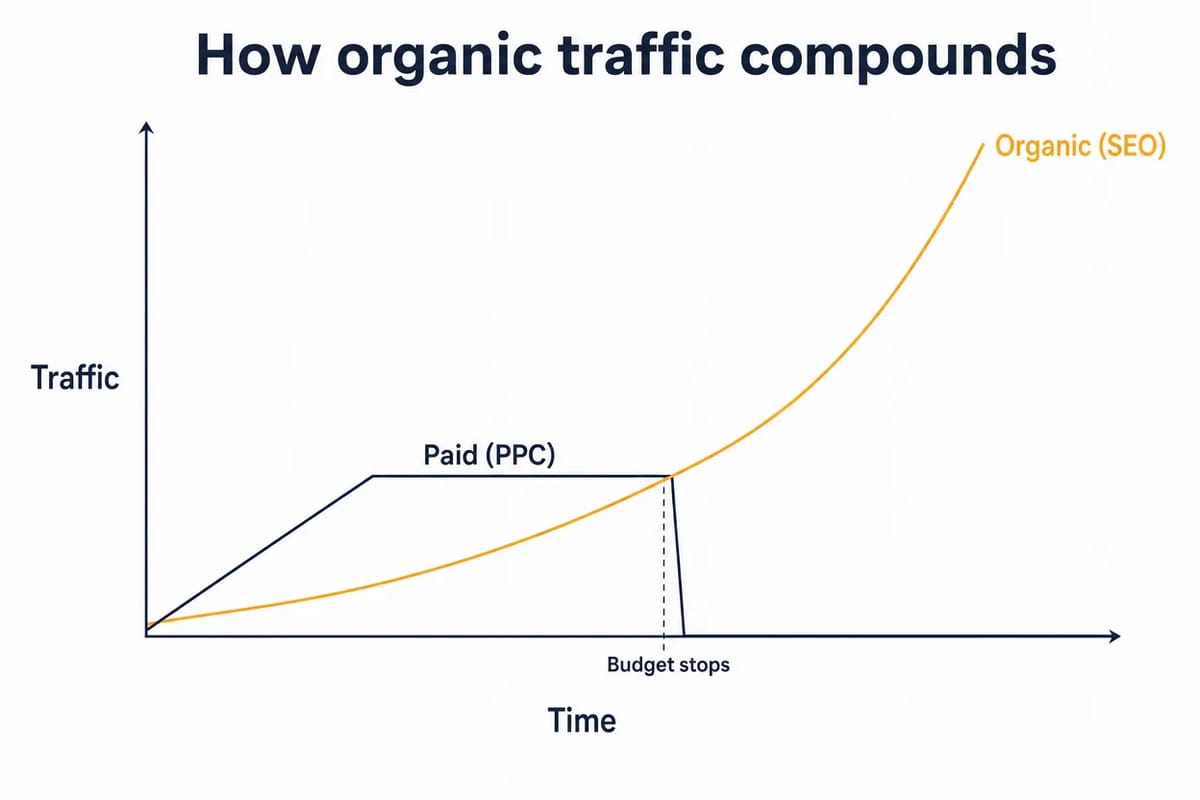
Paid search is useful when you need controlled visibility for a known set of commercial queries. You choose keywords, write ads, set bids, define budgets and measure conversion value. If the economics work, you can scale spend. If the budget pauses, the paid traffic usually pauses too.
Organic SEO is less direct. You can choose the pages to improve and the queries to target, but you cannot buy an organic ranking. The return depends on whether the page satisfies search intent, whether the site can be crawled and indexed, whether competitors are stronger, and whether the wider site supports the page.
The trade-off:
- PPC gives faster testing and clearer budget control.
- Organic SEO can keep sending unpaid clicks after the original work is done.
- PPC is useful for offers, launches and bottom-funnel tests.
- Organic SEO is better for building durable coverage across recurring search demand.
Many businesses run both. PPC shows which messages convert, and organic SEO turns stable demand into pages that keep working without a media cost for every click. Treat that as two jobs: paid search buys tests and reach; organic SEO builds assets.
How Google ranks organic results
Google uses automated ranking systems to decide which organic results to show. Google's Search Central guide to ranking systems (last updated 10 December 2025) opens: "This page is a guide to understanding some of our more notable ranking systems." It is a list of named systems, not a checklist. One of them, PageRank, is quoted in the links section below.
In practice, the better question is not "which box can be ticked off?" It is: what would make the target page a better result for that query?
Google's page Creating helpful, reliable, people-first content (last updated 10 December 2025) asks of a page: "Does the content provide original information, reporting, research, or analysis?" That is a question about the page, and the mechanics below exist to make a page that answers it clear to a search engine.
For organic SEO, that gives you four recurring jobs:
- Match your page to a real search intent.
- Make your content clear, useful and specific.
- Remove technical barriers that stop crawling, indexing or use.
- Get the page linked from relevant, indexed, read publications.
If one of those jobs is missing, the page may struggle even if the other parts look polished.
The main parts of an organic SEO strategy
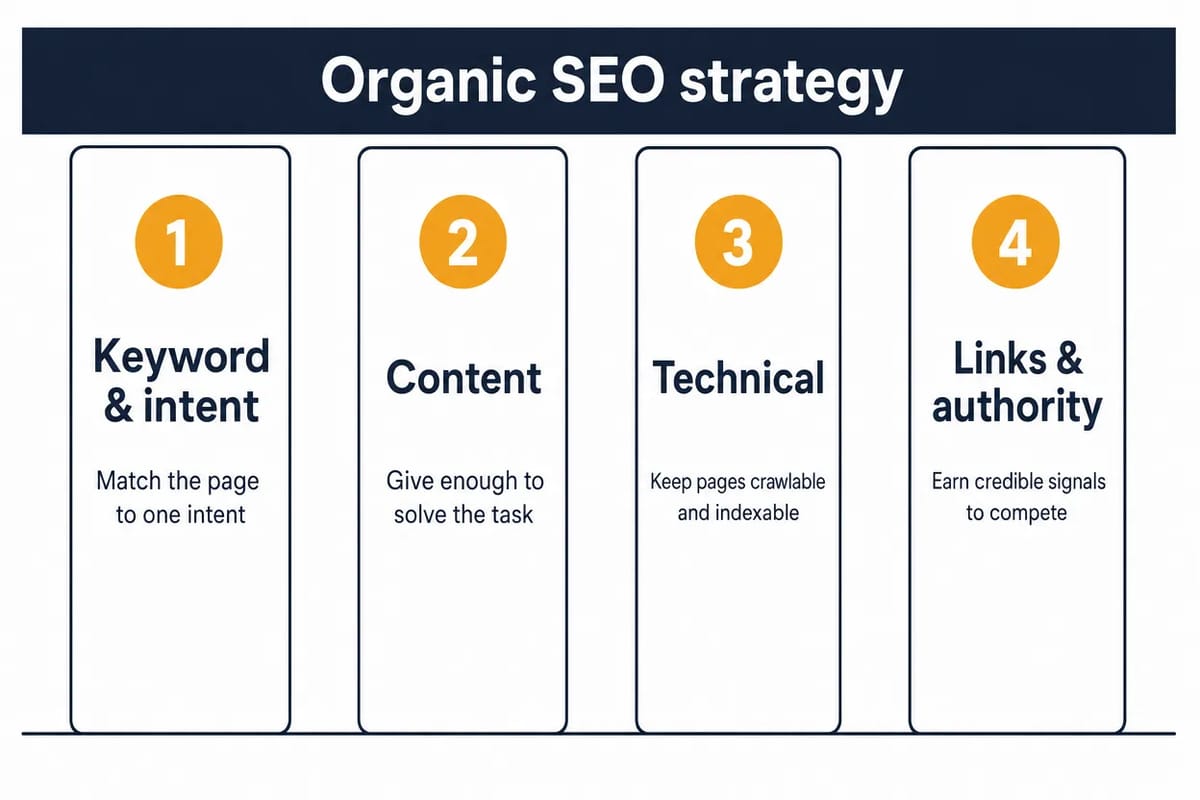
A clean organic SEO strategy is not a list of random tactics. It is a set of connected choices about which searches matter, which pages should answer them, and what has to change before those pages can win. Written down, that is a short list of target pages, each with the query it should answer, which of the four jobs it still lacks, and the month you will check it again in Search Console.
1. Keyword and intent choices
Keyword research is still useful, but you should not treat it as a perfect record of what every buyer wants. Search Console, keyword tools and competitor pages can show query patterns. They cannot fully explain the reader's context.
Start by grouping terms by intent. Some queries ask for a definition. Some compare options. Some look for a service. Some are troubleshooting a specific problem. A page that tries to serve all of those at once usually becomes vague.
Match the page to the one job the query implies. Someone searching "how to fix a 404 error" needs steps, checks and likely causes, not the history of HTTP status codes. Someone searching "what is a canonical tag" needs a clear definition before edge cases. Put tangents on their own pages. Scope matters.
Long-tail keywords can help when they reveal specific needs, but do not assume they are always easier or better converting. Some are low-value variations. Some are signs that the reader needs a different page. Use them to sharpen the answer, not to stuff headings.
2. Content that earns the query
Good organic content gives the searcher enough substance to solve the task that brought them there. That does not mean every page needs to be long. Google's SEO starter guide (last updated 10 December 2025), under its heading on content length, says "The length of the content alone doesn't matter for" ranking, and that there is "no magical word count target, minimum or maximum". A short answer can be the best result for a narrow question; a detailed guide can be the best result for a complex one.
Your page should make its purpose obvious. Use a title that matches the query, headings that show the structure, and copy that answers before it explains. If the topic needs examples, add examples. If a claim needs a source, cite one. If the content is out of date, update it or remove the stale part.
On-page SEO is mostly clarity. Title links, headings, snippets, URLs and internal links help search engines and readers understand the page. Google's snippet documentation (last updated 20 April 2026) notes that Google may use the "meta description element when it describes the page better than" other parts of the content, so a clear description is still worth writing. A good snippet helps the right person choose the result.
3. Technical SEO that keeps pages eligible
Technical SEO is the part many organic SEO explainers underplay. It is not a separate channel. It is the foundation that decides whether good pages can be crawled, indexed, rendered and used. The Rhino Rank guide to how a search engine works covers how crawling, indexing and serving fit together.
Three checks come first. Important pages should not be blocked by robots.txt or a noindex tag. The sitemap should list the pages you want indexed and nothing you do not. A useful page that has moved gets a redirect rather than a 404. Keep internal links clean enough that important pages are not buried five clicks deep.
User experience belongs here too, but with care. Faster, stable, mobile-friendly pages help users and can support search performance. Do not turn that into a claim that every speed score point will move rankings. The better standard is practical: your page should load reliably, work on mobile, avoid intrusive elements and make the main content easy to reach.
4. Links and authority
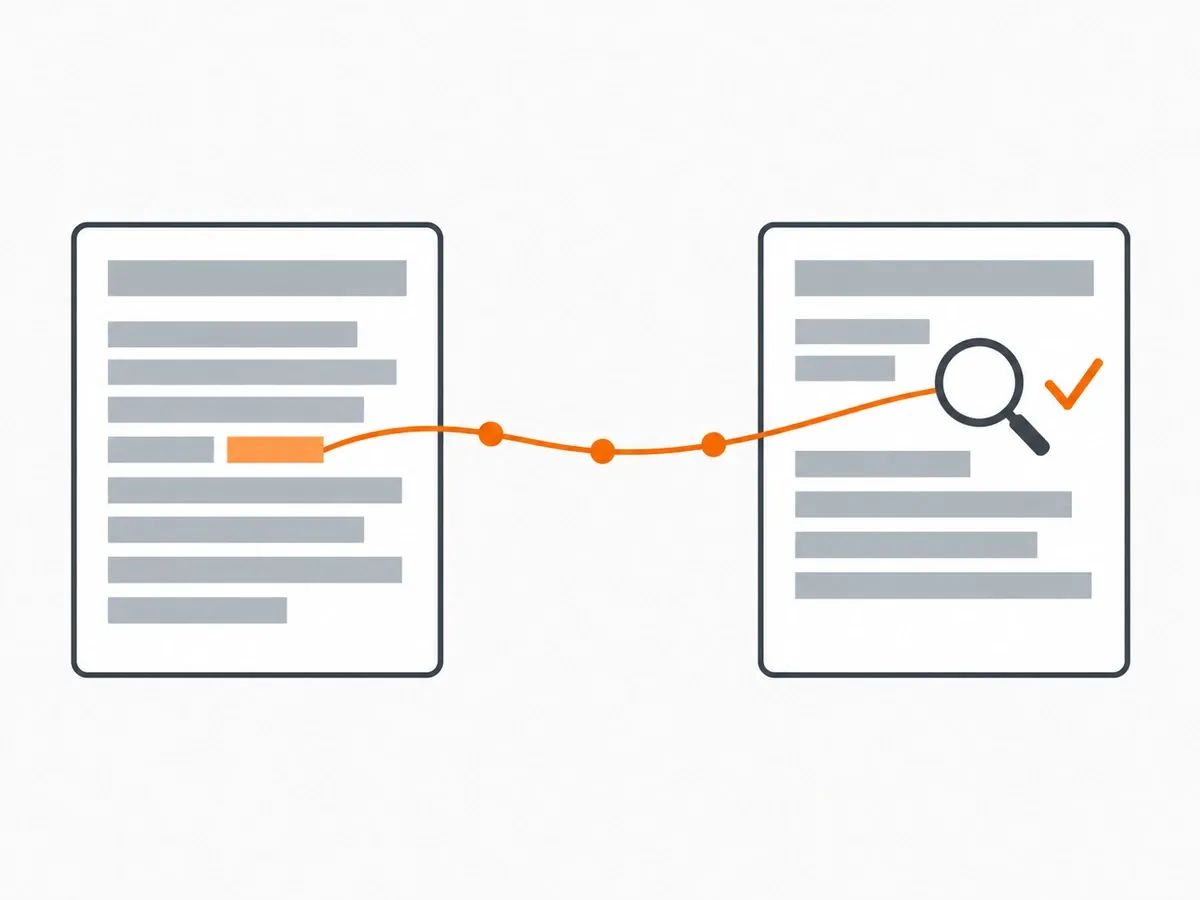
Google's guide to how Search works (last updated 18 December 2025) describes how new pages are found: "Other pages are discovered when Google extracts a link from a known page to a new page: for example, a hub page, such as a category page, links to a new blog post." Google's Search Central guide to ranking systems (10 December 2025) goes further: "We have various systems that understand how pages link to each other as a way to determine what pages are about and which might be most helpful in response to a query." The guide names "PageRank, one of our core ranking systems used when Google first launched." It adds: "How PageRank works has evolved a lot since then, and it continues to be part of our core ranking systems."
Practitioner evidence points the same way. Cyrus Shepard and Dawn Shepard published an expert survey of ranking factors on 9 September 2026. "We asked 131 SEOs", they write, and the survey gathered "13,665 ranking-factor data points". In it, 54.8% of respondents selected backlinks as a top-three factor. Their conclusion: "The rumor of the death of backlinks has been greatly exaggerated. In fact, respondents rated links from trusted, relevant sites as one of the most important factors." Brian Dean's analysis at Backlinko, last updated 14 April 2025, reports: "We recently analyzed 11.8 million Google search results" and "the #1 result in Google has an average of 3.8x more backlinks than positions #2-#10." His takeaway: "it appears that backlinks remain a critical ranking signal."
Start with internal links because they are fully within your control. Important pages should receive links from relevant supporting pages, menus, hub pages and related articles. Anchor text should describe the destination naturally. If every internal link uses the same forced phrase, you have stopped helping the reader. Cyrus Shepard's internal-link study on zyppy.com, updated 23 February 2026, sets out its sample: "For this study, we analyzed 23 million internal links across 1,800 websites, totaling approximately 520,000 individual URLs." Its internal-link finding: "URLs with 0-4 internal links received an average of 2 clicks from Google Search, while URLs with 40-44 internal links received 4 times that many." He also notes it is generally understood that "external links (links from other websites) are typically more powerful than internal links (links from your website.)"
The external link is the part we place for clients, and the checks are ours. Before a placement goes out on a Rhino Rank order, we check the HTTP status code the target URL returns: no dead pages, no redirect chains. We check the publication before we place anything on it: indexed pages, organic traffic and its trend, Moz DA cross-checked against Domain Rating (DR), referring domains, weighed together; no networks; the link goes in the body copy; a person signs it off. A high DA figure on a site with no traffic is turned away. The checks are listed on our link building quality assurance page.
After publication we check that the page is live, that the link sits in the body copy, that the anchor and the target URL match the order, and that the page is indexable; only then is the URL reported to the dashboard. If a delivered link is removed or its page is taken down within 12 months, it is replaced like for like. How long that takes to show in rankings is covered in the Rhino Rank guide to how long link building takes.
Strong assets, useful data, original explanations, digital PR, partnerships and expert contributions can all create reasons for links. A broken link building approach fits when a dead page on a relevant site once earned links; a Rhino Rank Guest Post puts a 750+ word article with the link in its body on a site in the minimum Moz DA tier you pick at checkout. Our guide to link authority covers what a page's links say about it over time, and our guide to what a backlink profile is covers how to read a site's links as a whole.
Common organic SEO problems
Organic SEO gets messy because search visibility depends on several moving parts at once. A page can miss because the intent is wrong, the content is thin, the site is slow, the internal links are weak, or the competitors have far stronger authority.
The common mistake is to treat the latest visible problem as the only problem. If your rankings drop after a redesign, technical checks come first. If impressions are high but clicks are weak, title links and snippets may need work. If a page ranks for the wrong queries, the content may be too broad. If a good page cannot break into the top results, authority or topical support may be the gap. The Rhino Rank guide to improving Google rankings covers what to do with an indexed page that ranks below where it should.
Organic SEO also has a slower feedback loop than paid search. Some changes can show movement quickly, especially on established pages. New sites and new topics often need longer because Google has less evidence to work with. Forecasts can guide planning, but no one should sell you a fixed ranking date.
How to measure organic SEO
Measurement should separate activity from results. Publishing ten pages is activity. Cleaning a sitemap is activity. The result is whether the right pages earn more qualified impressions, clicks, enquiries, sales or assisted conversions.
Google Search Console is the main source for organic search performance. Its performance report, described in Google's Search Console documentation, shows four metrics: impressions ("How often someone saw a link to your site on Google."), clicks ("How often someone clicked a link from Google to your site."), click-through rate and average position. You can use those numbers to spot pages gaining visibility, queries with weak click-through, and content that ranks just outside useful positions.
Position shapes how much of that visibility becomes clicks. Advanced Web Ranking's organic CTR study, by Iulia Lacriceanu, dated 14 September 2026, is drawn from "more than 1.75 million US SERPs each month". It reports: "In July 2026, on Google US desktop, the average organic result earned a 20.02% CTR at position 1, 10.36% at position 2, and 3.89% at position 3". On results pages with an AI Overview, the position 1 figure was "9.69%". The study stops at position 20, so a page at position 25 sits below every figure it reports. The Search Console position column shows where each of your pages sits.
Analytics tools add what happens after the click: which organic sessions turn into enquiries, sign-ups or sales. That matters because not all organic traffic is equally valuable. Your page can win more clicks and still do little for the business.
Rank tracking tools such as Semrush, Advanced Web Ranking, SEOmonitor and Mangools can help you monitor target queries, competitors and SERP features. Treat those reports as directional. Rankings vary by location, device, personalisation and result type, so one daily position is never the whole truth. Review the data on a rhythm you can keep. Monthly is often enough for strategic decisions. Weekly can help during migrations, launches or recovery work. Daily checks are useful only when something is actively changing.
DIY organic SEO vs hiring help
DIY organic SEO can work when the site is small, the owner knows the audience well, and the technical setup is simple. You get direct control and you learn which queries, pages and offers matter. The downside is time. SEO work touches research, copy, CMS structure, analytics, technical fixes and link earning. That can pull focus from the actual business.
Hiring help makes sense when your site has technical debt, the opportunity is large enough to justify the cost, or the team lacks specialist time. For a market anchor, Backlinko's SEO pricing survey, by Michael Ofei, last updated 29 December 2025, reports: "We surveyed over 300 SEO professionals with experience ranging from 1 to 10+ years." Its headline figure: "The average monthly cost for SEO is $1,000-$2,500". Its note on the matching tier: "Mid-tier ($1,001-$2,500/month): The most common range", but one survey is not a quote for your site. For comparison, the Rhino Rank Managed Service starts at $250 per month.
A good freelancer or agency should explain the work, show what they will measure, and be honest about uncertainty. Google's page Do you need an SEO?, already named above, puts the limit in one line: "No one can guarantee a #1 ranking on Google."
Treat "DIY or agency" as a workload decision, not a forever decision. Many businesses use a mixed model. Keep strategy, subject expertise and approvals in-house. Bring in specialists for audits, technical fixes, content production, digital PR or outsourcing SEO when the workload passes what the team can handle.
Before you hire, ask what will change in the first 90 days, which pages or templates are the priority, what access is needed, how results will be reported, and what would make the plan change. If the answer is only "more content and more links", keep asking.
Frequently asked questions
What is organic SEO?
Organic SEO is the process of improving your website's unpaid search visibility. It covers content, technical SEO, internal links, backlinks and measurement so search engines can understand and rank useful pages.
What is the difference between organic SEO and paid search?
Organic SEO works on unpaid search results. Paid search buys ad placement through a platform such as Google Ads. Ads can create faster visibility, while organic SEO aims to earn rankings that can keep producing traffic for you without a per-click media cost.
How does Google rank organic results?
Google uses automated ranking systems to decide which unpaid results to show. Its public documentation describes a list of named systems rather than a fixed checklist, and PageRank is among the core ones. For any one page, the practical question is whether it is the best unpaid answer for the query.
How long does organic SEO take to work?
It depends on your site, the query, the competition and the type of work. Established pages can respond faster than new sites, but no one should promise a fixed ranking date. Track impressions, clicks and conversions instead of judging by time alone.
What are the main parts of organic SEO?
The main parts are keyword and intent planning, useful content, technical SEO, internal linking, backlinks and performance measurement. Weakness in any one part can hold your organic SEO back.
Should I do organic SEO myself or hire someone?
Do it yourself if the site is simple and you have time to learn the work. Hire help when technical issues, content volume, analytics or link earning need skills your team does not have.
related Blog Posts




Join 7,000+ Clients Growing with Rhino Rank
Sign Up


Stay ahead of the SEO curve
Get the latest link building strategies, SEO tips and industry insights delivered straight to your inbox.