
 Back to all posts

What is a backlink profile?
A backlink profile is the full set of inbound links pointing at your site or at one specific page. A healthy profile is not a neat ratio. It is a pattern of relevant links from real editorial sites, varied anchor text, sensible follow and nofollow signals, and growth that makes sense over time.
If you only look at total link volume, you will miss the point. Search engines assess links in context, and SEO tools give you extra diagnostics that can help you spot risk, strength, and gaps. Those tool scores are useful, but they are not Google scores. That difference matters.
Key takeaways
- Your backlink profile includes the pages, sites, anchors, and link attributes attached to inbound links.
- Referring domains matter because ten links from one site are not the same as ten links from ten real sites.
- Anchor text should read naturally and vary by context. Forced exact-match anchors are a warning sign.
- Moz Domain Authority, Ahrefs Domain Rating, spam scores, and toxicity labels are third-party metrics, not Google ranking scores.
- There is no verified healthy ratio for dofollow links, nofollow links, anchors, or authority tiers.
- Disavow is a narrow, last-resort tool for serious artificial link risk, not routine clean-up.
What a backlink profile includes
A backlink profile is your link footprint. It shows which external pages link to you, which pages on your site receive those links, what anchor text is used, and whether each link is followed, nofollowed, sponsored, or user-generated.
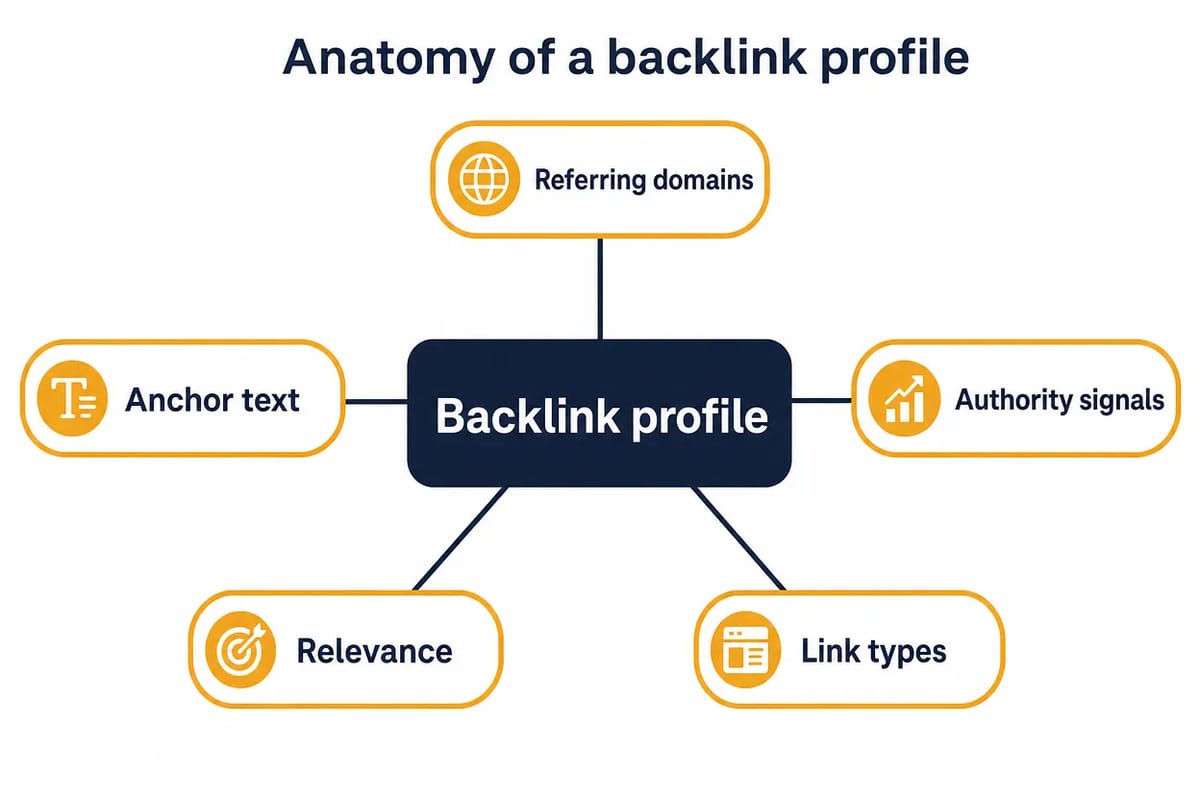
Most SEO tools also add their own view of link quality. You will usually see referring domains, linked pages, anchor text, first-seen dates, lost links, spam indicators, and authority-style scores. Those are key link building metrics, but they need interpretation.
The catch: a profile is not a simple pass or fail report. A small site can have a healthy link profile with a modest number of relevant mentions. A large site can have thousands of links and still carry obvious problems if the links come from thin, unrelated, or manipulative sources.
The profile can also be read at two levels. The domain-level view shows what the whole site has earned. The page-level view shows whether the pages that need to rank have enough relevant support. A blog post may attract links while a commercial page has none, which changes the next action.
Why backlinks still matter
Links help search engines discover pages and understand how pages connect across the web. Google has long used link analysis as part of its ranking systems, but links sit beside many other signals. Content quality, relevance, page intent, technical access, and user usefulness still matter.
That means a stronger link profile can support your organic performance, but it does not guarantee rankings on its own. If your page does not satisfy the search intent, better links may not be enough. If the links are manipulative, they can create risk instead of strength.
Good links act like contextual recommendations. They make most sense when a relevant page refers readers to your page because it adds value. That is the kind of signal you want more of.
This is also why a link profile should be judged against the page's job. A homepage, a category page, a statistics page, and a local service page will not attract the same types of links. The question is whether the profile looks credible for that page and market.
What shapes a strong link profile
A good profile is shaped by several signals working together. None of them should be treated as a magic formula, and none should be judged in isolation. Look for patterns across sources, anchors, topics, and timing.
Referring domains
Referring domains are the unique websites linking to you. If one publisher links to your guide from five pages, that is five backlinks but one referring domain. If five separate publishers link once each, that is five referring domains.
You should care about this distinction because source variety gives you a cleaner view of reach. A profile built from a small set of repeated domains can still be useful, but it is usually less persuasive than a profile that earns mentions from many relevant sites.
When you review referring domains, check what each site is and why it links. A supplier directory, a trade publication, a partner article, and a scraped copy of your content all show up as referring domains, but they do not carry the same meaning.
Do not turn this into a volume race. More referring domains are not automatically better if the new domains are irrelevant, low quality, or built only to place links. Quality still leads when the extra domains are weak.
Anchor text
Anchor text is the clickable text used in the link. It helps readers and search engines understand what the linked page is about, so it is one of the most useful parts of a backlink review.
In practice: natural anchor text varies. You might see branded anchors, page titles, partial-match phrases, plain URLs, and generic anchors such as "this guide" or "source". That mix is normal because different writers link in different ways.
The risk appears when anchors look controlled. If too many links use the same commercial phrase, or the anchor does not fit the sentence around it, the pattern can look forced. In profiles we review, repeated commercial anchors usually say more than one awkward generic link ever will. This is especially common in low-quality placements and some black hat SEO tactics.
You do not need a fixed anchor ratio. You need anchors that make sense in the article where they appear.
A useful anchor review separates brand, URL, page-title, partial-match, exact-match, and generic anchors. That grouping helps you see whether commercial anchors are carrying too much of the profile. It also shows whether important pages are only being linked with vague text that gives little context.
Authority and third-party metrics
Authority is useful as a broad idea, but be careful with the numbers. Moz Domain Authority, Ahrefs Domain Rating, Majestic metrics, Semrush Authority Score, spam scores, and toxicity labels are third-party tool metrics. They are not Google ranking scores.
That does not make them useless. They can help you compare sites inside a tool, spot very weak sources, and prioritise review work. They become misleading when you treat them as direct measures of how Google values a link.
Use these metrics as filters, not verdicts. A relevant industry site with a modest tool score may be more valuable than a high-scoring site with no topical fit. When we vet link opportunities, a score can move a page into the review pile, but it does not replace reading the page. Context wins.
Tool metrics may also disagree. Ahrefs, Moz, Semrush, and Majestic use different crawlers, data sets, and scoring models. When comparing opportunities, use one tool consistently for that comparison, then make the final call by reading the page.
Relevance
Relevance is one of the clearest signs of a useful link. A link from a page that discusses your topic, serves a related audience, and gives readers a real reason to click is easier to trust than a random sidebar link from an unrelated site.
This is why authoritative websites should not be judged by score alone. A strong publisher in your niche, a trade body, a supplier, a partner, or a respected specialist blog can all be useful when the link fits the page.
The link should also fit the page around it. A relevant domain is good, but the actual article, paragraph, and anchor still matter.
Dofollow, nofollow, sponsored, and UGC links
Followed links can pass ranking signals. Nofollow, sponsored, and UGC attributes tell search engines more about the relationship behind a link. For example, sponsored is used for paid or sponsored placements, while UGC is used for user-generated content.
A natural profile may contain both followed and qualified links. That is fine. Avoid made-up rules such as "70% dofollow is healthy" or "nofollow links are worthless". There is no verified healthy percentage.
Judge the link label against the context. A paid placement marked sponsored is cleaner than a paid placement pretending to be an unpaid editorial citation. A nofollow link from a relevant publication can still send referral traffic and brand exposure.
What a healthy backlink profile looks like
A healthy profile is qualitative before it is numerical. It has links from real sites, on pages that exist for readers, with anchors that fit the sentence, and growth that does not look manufactured.
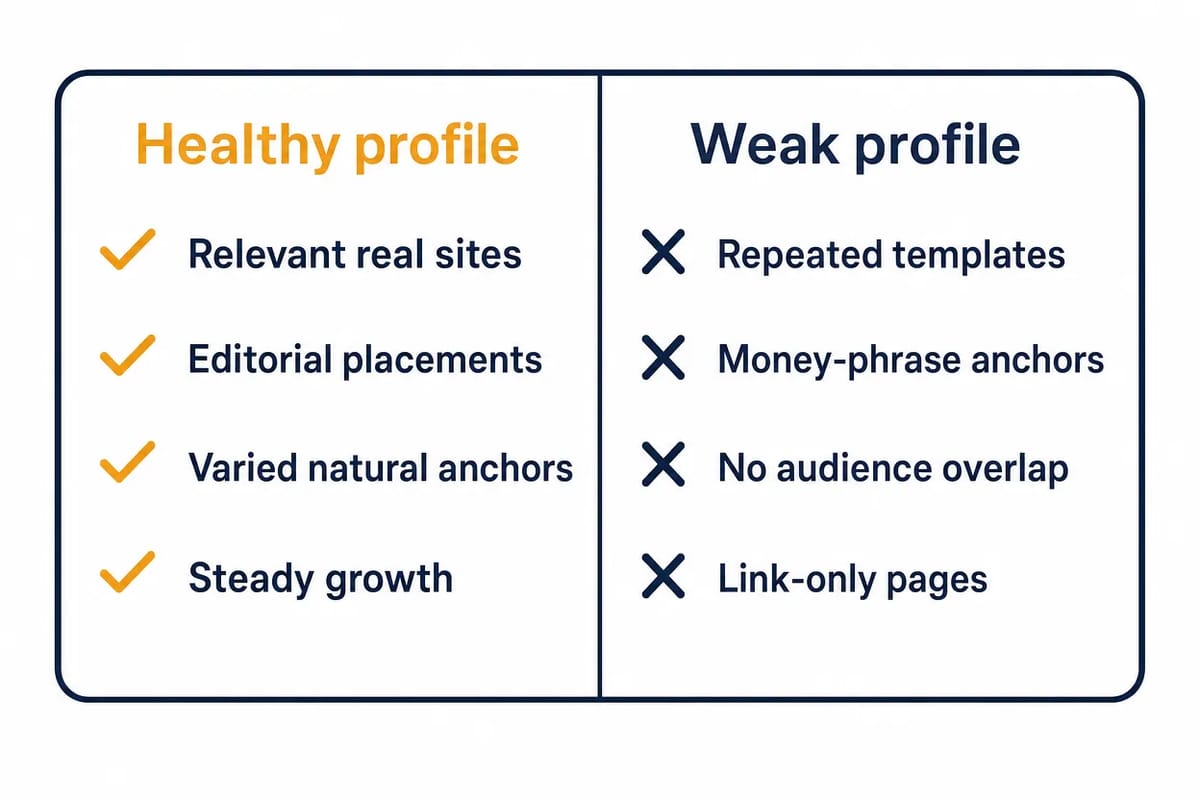
The most reliable signs are simple. The linking sites are relevant. The pages are indexed and readable. The link placement is editorial rather than hidden or spammed. The anchor text varies. The profile grows through a mix of earned mentions, partnerships, PR, content promotion, and careful outreach.
No magic ratio exists. A healthy SaaS profile, ecommerce profile, local business profile, and affiliate profile can all look different because the market, content, and link opportunities differ. The healthier profiles we audit are usually boring in the right way: relevant sources, mixed anchors, and growth that matches the site.
This is where high quality backlinks differ from link volume. A single relevant editorial link can tell you more about market trust than a batch of links from sites built only to sell placements.
Weak profiles often have a different feel. You may see many links from the same templates, anchors that repeat the same money phrase, sources with no audience overlap, or placements buried in articles that exist only to host outbound links. One weak signal is not proof. Repeated signals are the problem.
How to view your backlink profile
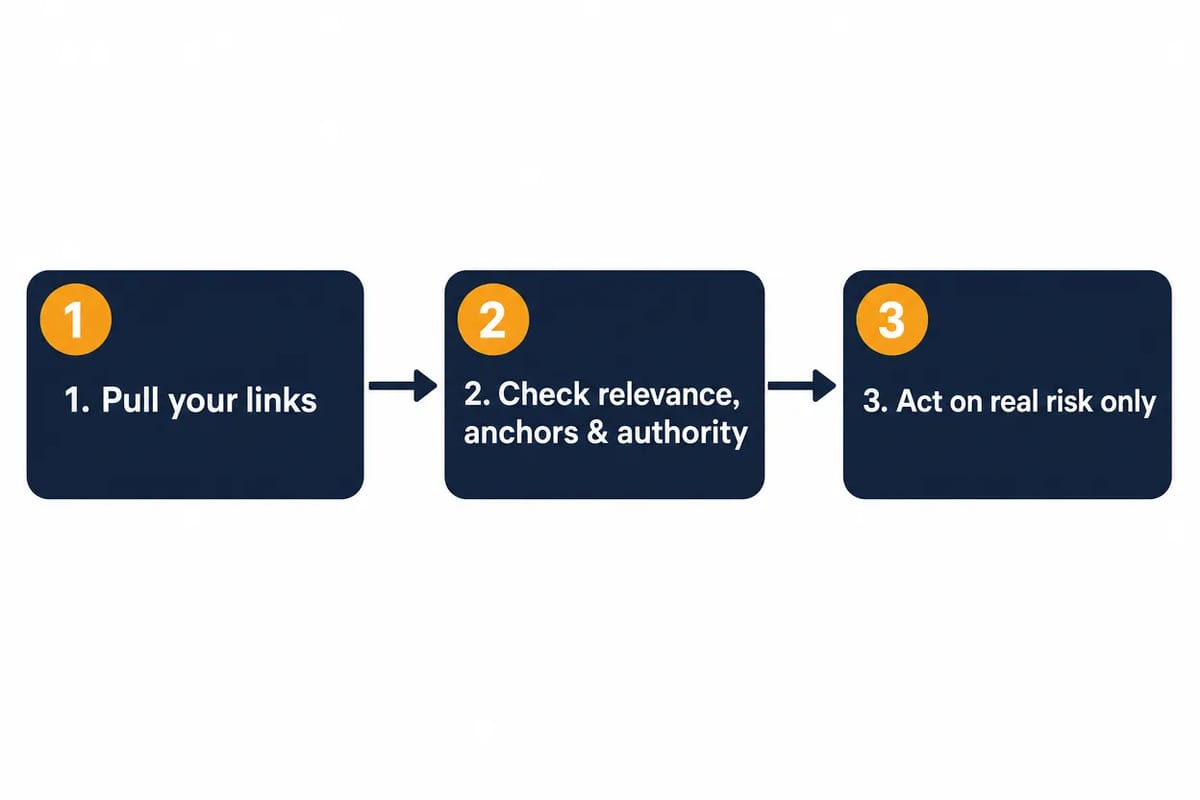
You can start with Google Search Console, then use third-party tools for wider discovery. Search Console shows links Google reports for your property. Tools such as Ahrefs, Semrush, Moz Link Explorer, and Majestic maintain their own link indexes and add extra filters.
No tool has a perfect copy of the web. If one tool misses a link and another finds it, that does not prove either is wrong. It usually means their crawlers and indexes differ.
For a practical backlink audit, export the main data points and group them by question:
- Which pages on your site attract the most links?
- Which referring domains appear most often?
- Which anchors are used, and do any look forced?
- Which links are followed, nofollowed, sponsored, or UGC?
- Which sources are relevant to your topic or audience?
- Which tool scores or spam indicators need manual review?
- Which links were gained or lost during the period you are checking?
Once you have that view, read samples manually. A spreadsheet can show patterns, but it cannot always tell whether a link belongs in a sentence or whether the article is useful. Manual review keeps the audit honest.
Prioritise the pages that matter most. If your homepage has a broad mix of links but your commercial pages have only exact-match anchors from weak sites, the average profile view can hide the risk. Review the pages that drive revenue, leads, and strategic visibility before you spend time on minor URLs.
How to improve a weak profile
If your profile is thin, start with linkable assets and relevant outreach. Build pages worth citing, then promote them to people who publish on that subject. That might mean data pages, useful guides, comparison resources, original commentary, or tools that solve a specific problem.
Use competitor analysis for ideas, not cloning. If several competitors have links from trade publications, resource pages, podcasts, or supplier lists, those sources may reveal the types of citations your market accepts. You still need a reason for the publisher to link to your page.
Guest posting can help when the article is useful, the site is relevant, and the link is natural. Guest posts should not be treated as a way to repeat exact-match anchors at scale. They work best when the host site would still want the article without the link.
Curated links can also fit a clean profile when they are placed in existing relevant content and the link adds value for the reader. The quality test is the same: real site, real audience, sensible anchor, and a page where the citation belongs.
Networking and digital PR can support the same goal. If you have a useful source, strong opinion, or helpful data point, publishers have a reason to cite you. Without that reason, outreach turns into begging for links.
The trade-off: slower link growth is often safer. A profile that grows through relevant opportunities tends to age better than a sudden batch of similar links from unrelated sites.
What to do about spammy links
Every established site picks up odd links. Scrapers, low-quality directories, auto-generated pages, and irrelevant sites can link to you without your involvement. That does not mean you need to panic or disavow every strange domain.
Start by separating nuisance links from serious patterns. A few low-quality links in a large profile are usually background noise. We see far more risk in old controlled link building patterns than in random scraper links. A concentrated pattern of artificial, paid, or manipulative links is different, especially if you built them or inherited a site that used risky tactics.
Watch for links from obvious link farms, hacked pages, irrelevant foreign-language sites with no audience fit, pages with spun content, and networks that link out heavily to unrelated commercial pages. Private Blog Networks (PBNs) can also create risk when they exist mainly to control links for ranking purposes.
Disavow is a last resort. Google describes it as an advanced tool for cases where you have a considerable number of spammy, artificial, or low-quality links and the site has, or is likely to have, a manual action. Try to remove links where practical before using it, and do not use it as routine housekeeping.
If you recently bought a domain, changed agencies, or found old paid-link work, take more care. Historical link building can leave patterns that the current team did not create. In that case, your job is to understand the risk before you add more links on top of it.
If you are unsure, document the pattern first. Export the links, keep examples, note why they are risky, and decide whether the issue is large enough to justify action. Guesswork can do more harm than good.
How often should you review your profile?
For most sites, a monthly or quarterly review is enough. You are looking for new referring domains, lost links, unusual anchor patterns, sudden spikes, and links to important commercial pages.
Review more often if you are running active campaigns, buying a site, recovering from poor link building, or seeing a sudden ranking drop. In those cases, link data can help you separate a profile issue from content, technical, or SERP changes.
Keep the review focused on meaningful changes, not daily noise. You do not need to inspect every link every week. You need to spot meaningful changes before they turn into expensive problems.
Frequently asked questions
What is a backlink?
A backlink is a link from one website to another. In this context, it means another site links to your site or to one of your pages. Backlinks can help search engines discover pages and can support rankings when they are relevant and editorially placed.
What is a backlink profile?
A backlink profile is the full collection of backlinks pointing to your site or page. It includes referring domains, linked pages, anchor text, link attributes, link dates, and third-party tool metrics such as DA, DR, spam scores, or toxicity labels.
What makes a backlink profile healthy?
A healthy profile has relevant links from real editorial sites, natural anchor variety, sensible link attributes, and growth that fits the site. It is not defined by a fixed dofollow percentage, anchor split, DA/DR mix, or spam-link allowance.
Are DA and DR Google ranking factors?
No. Domain Authority is a Moz metric, and Domain Rating is an Ahrefs metric. They can help you compare sites inside those tools, but they are not Google scores and should not be treated as direct ranking factors.
Should I disavow bad backlinks?
Only in narrow cases. Disavow is for serious artificial or spammy link patterns where there is manual-action risk, not for every low-quality link you find. If possible, remove risky links first and keep records of what you reviewed.
How do I build a better backlink profile?
Create assets worth citing, promote them to relevant publishers, use outreach carefully, and keep anchor text natural. Guest posts, digital PR, partnerships, and curated placements can all help when the link belongs on the page and serves the reader.
How many backlinks do I need?
There is no universal number. You need enough relevant support to compete for the queries and pages you care about, but that threshold depends on the market. Compare your profile with the pages that already rank, then judge quality, relevance, and intent rather than copying their link count.
Every fact and commercial claim in this guide was fact checked and verified on 16 July 2026.
related Blog Posts



Join 2,600+ Businesses Growing with Rhino Rank
Sign Up
Stay ahead of the SEO curve
Get the latest link building strategies, SEO tips and industry insights delivered straight to your inbox.