
 Back to all posts

PBN backlinks: what they are and why they are risky
PBN backlinks are links from privately controlled sites that exist mainly to push another site up the search results. If you are weighing them up, the honest verdict is simple: they are a risk, not a shortcut. They can look tidy on a link report, but they sit inside Google's link-spam territory and can lead to ignored links, wasted spend, ranking drops or deindexing.
Short summary
- PBN links are built to pass ranking signals from controlled sites, rather than earned through editorial choice.
- Google Search Essentials' spam policies treat links created primarily to manipulate rankings as link spam.
- The main risks are manual actions, links being ignored, obvious footprints, deindexing and money spent on links that do nothing.
- Third-party backlink tools can help you review suspicious patterns, but their risk scores are signals, not Google verdicts.
- If you want durable links, focus on useful content, editorial outreach, relevant placements and relationships with real sites.
What are PBN backlinks?
PBN stands for private blog network. In SEO, it usually means a group of sites controlled by the same person, seller or small group, used to link to a target website. A PBN backlink is one of those links.
That makes it a black hat SEO tactic when the network exists to manipulate search rankings. The word "private" does a lot of work. The sites may not openly say they are connected, and the target site may appear to be receiving an independent editorial link. That is the point, and also the problem.
A normal backlink is a citation, recommendation or reference from one site to another. A PBN link is different because the relationship is usually controlled. The link is placed because the owner wants to influence search engines, not because an editor independently found the target page useful for readers.
PBNs are not new. They became popular because links matter, older domains can have existing backlink history, and some site owners want more control than ordinary outreach gives them. That does not make the tactic safe. It just explains why it keeps coming back under new labels.
How PBNs usually work
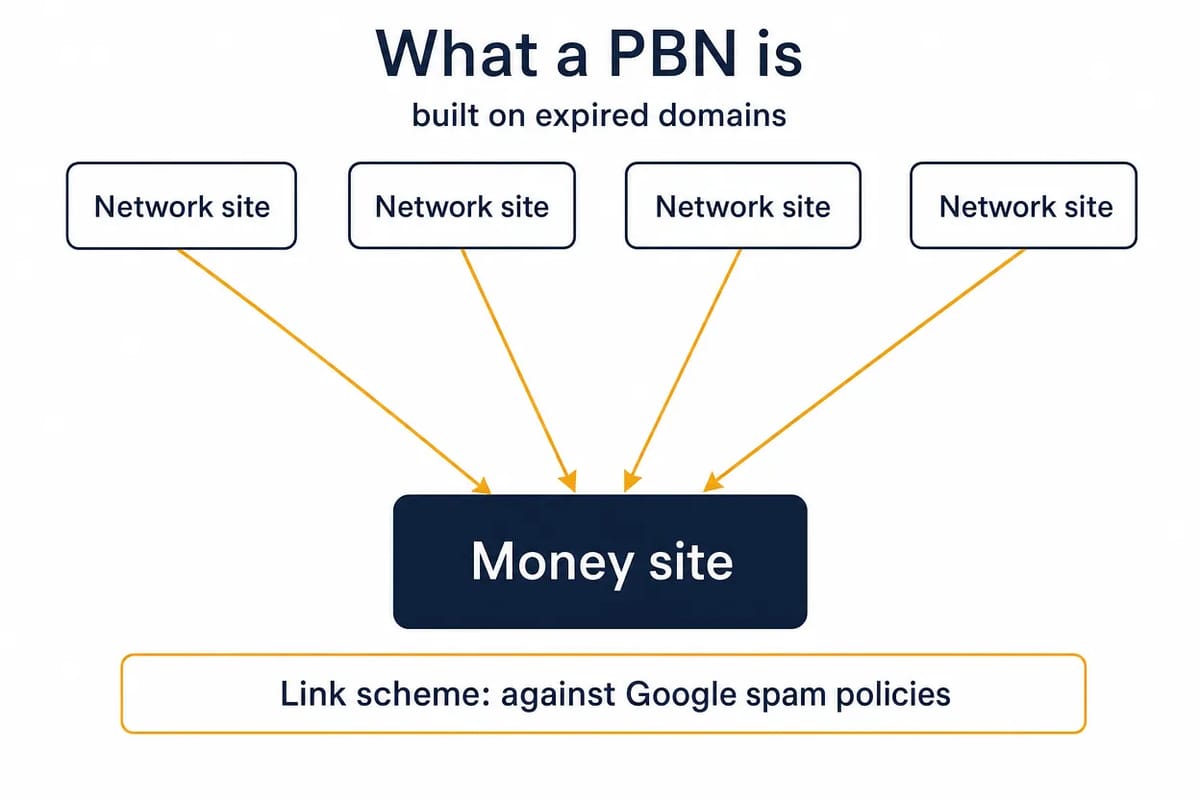
You do not need a recipe to understand the risk. A PBN usually relies on a simple idea: create or acquire several sites, place content on them, and use those sites to link to the page that needs ranking help.
Some networks are built around expired domains. An expired domain is a domain name that was registered before, then not renewed by its owner. When that domain is repurposed mainly to manipulate search rankings, Google describes that kind of behaviour as expired domain abuse.
That matters because the old domain may still have links from other websites. A PBN operator is trying to redirect that inherited authority into new links for a different site. The mechanics can vary, but the search-quality issue is the same: the network is being used as a link scheme, not as a set of independent publications.
A link scheme is any arrangement where the main purpose of the link is to influence rankings rather than serve the reader. In current Google wording, the relevant policy bucket is link spam. If the link was created mainly to manipulate Google Search results, it can fall on the wrong side of that policy.
Why PBN links are risky
The risk is not that a search engine sees the letters PBN and presses a large red button. The risk is that the pattern behind the links can look manipulative.
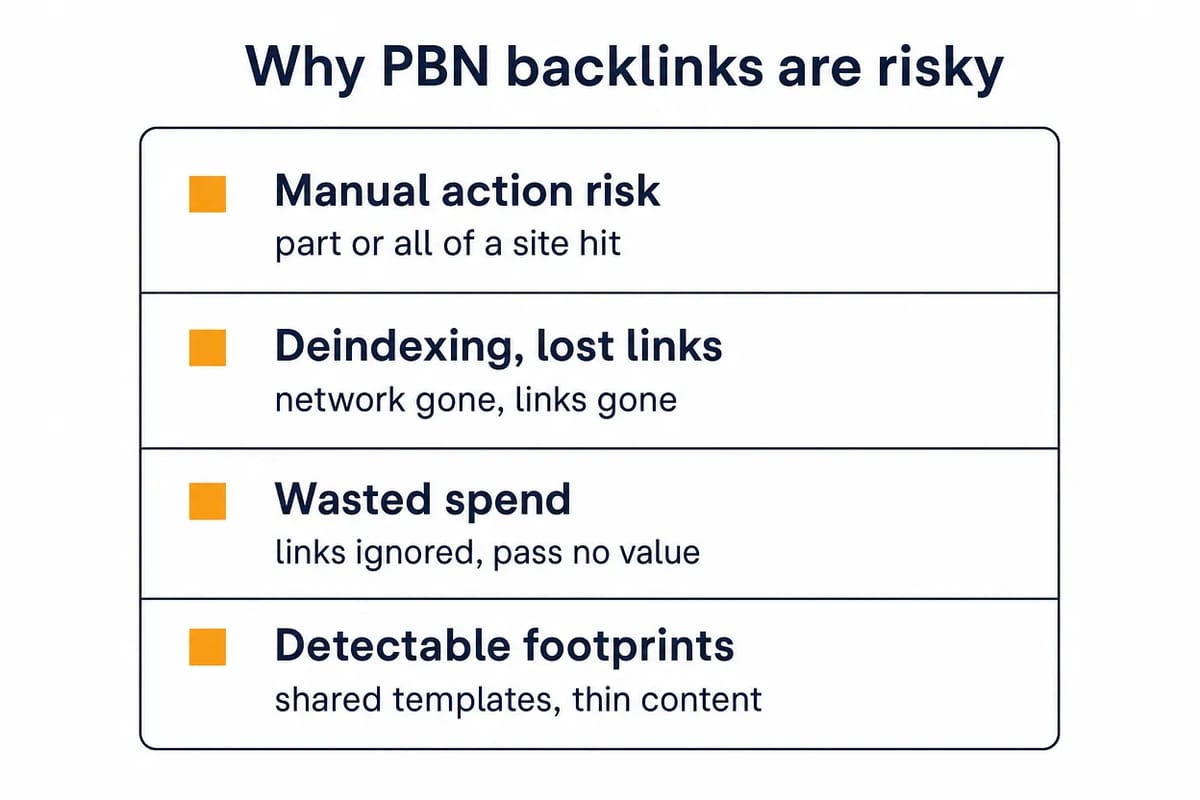
Google's spam policies say links intended to manipulate rankings may be considered link spam. Google also says sites that violate spam policies may rank lower or may not appear in results at all. Manual actions can affect part of a site or an entire site, depending on the issue.
That gives you three practical risks.
First, the links may be ignored. This is the quiet failure. You pay for links, the report looks busy, and the links pass little or no value. Nothing dramatic happens. Nothing useful happens either.
Second, your site can lose visibility. If Google decides the links are part of a manipulative pattern, rankings can drop. For a commercial site, that is not an abstract SEO concern. It can mean fewer leads, fewer enquiries and a harder recovery job.
Third, the network itself can disappear from the index. If the linking sites are deindexed, the links vanish as ranking assets. Any short-term movement you thought you had bought is then tied to sites that no longer appear in search.
The extra nuisance is footprint risk. Networks often leave patterns: similar templates, repeated topics, thin content, awkward outbound links, matching ownership clues, odd traffic profiles, or pages that seem to exist only to host paid links. You do not need every clue to be present. Enough weak signals can make the links hard to defend.
Why people still try PBNs
This is the honest part. If you are wondering why people still try PBN links, it is because the pitch is attractive.
You get control over placement, page choice and the anchor text used for your link. You do not have to wait for an editor to reply. You can ask for a link to a commercial page that a normal publication may not want to cite. If you are trying to rank in a highly competitive niche, the promise of fast, controlled links can feel easier than months of outreach.
That explains the demand. It does not remove the risk.
The "it depends" part is usually about risk appetite. If someone is testing disposable domains, accepts that sites may burn out, and treats search visibility as a short-term churn game, they may view PBNs differently. Most businesses are not in that position. If your domain carries brand value, sales history, customer trust and future plans, gambling it on opaque links is a poor trade.
There is also a quality problem. The better a private network becomes at looking real, the more expensive it is to maintain. The cheaper it is, the more obvious it often becomes. Somewhere in the middle, you are still relying on a tactic that cannot be honest about its true purpose.
That is the part many pitches hope you skip.
Are there any advantages?
There can be short-term advantages if your goal is narrow enough, which is why the tactic has not died.
PBN links give buyers a sense of control. You can often choose the target page, anchor text, timing and link volume. That can be tempting when organic outreach feels slow or unpredictable.
They can also appear to solve awkward link-building problems. If you are promoting a commercial page, it is harder to earn links than it is for research, tools, guides or genuinely useful assets. Regulated, adult, gambling and other restricted niches can face extra publisher resistance. A private network may look like a way around those barriers.
But "can look useful" is not the same as "is a good strategy". The benefit is mainly convenience. The cost is uncertainty. You may not know who else is linked from the same network, how many sites share ownership, whether the content has a real audience, or whether previous buyers have already made the pattern obvious.
If you cannot inspect the editorial standards, traffic quality and ownership risk behind a link, you are buying trust in someone else's hidden system. That is a lot of trust to place in a shortcut.
Common signs of PBN-style links
No single sign proves that a backlink came from a private network. If you are reviewing a link profile, treat these as red flags for review, not courtroom evidence.
- The linking site has thin, dated or generic content.
- Several sites share the same design, structure or writing style.
- Pages have little topical focus but many commercial outbound links.
- The site has very little real traffic or visible audience.
- The link appears in content that does not naturally need to mention your page.
- Exact-match anchors appear more often than a normal editorial pattern would suggest.
- The site exists across many unrelated niches without clear editorial reason.
- The domain has old links from one topic, but the current site has been rebuilt into another.
The last point is where expired domains often show up. A domain can be legitimate after changing hands. The issue is repurposing it mainly to pass ranking signals. If an old local charity domain suddenly hosts thin articles about payday loans, crypto casinos and kitchen tiles, the pattern is not hard to spot.
How to check whether your site has PBN links
Start with your backlink data. Google Search Console can show links Google reports to your site. Third-party tools such as Ahrefs Site Explorer, Ahrefs Backlink Checker and Semrush Backlink Audit can give you wider backlink views, anchor data, referring pages and trend information.
Use those tools to build a review list, then inspect the pages manually. The tool can tell you where the link exists. It cannot always tell you why it exists.
Look for patterns across domains. As you compare links, ask whether several use similar anchors, whether the linking pages follow the same article format, and whether the sites are thin, inactive or wildly unfocused. Does the link sit in a paragraph that could have been written for almost any buyer? Those are the questions that matter.
Be careful with third-party risk labels. Some tools use spam, toxicity or authority scores to help prioritise review. Those labels are useful triage signals. They are not Google telling you that a specific link is toxic, safe or ignored.
You should also separate inherited risk from active buying. A site can pick up odd links without asking for them. Scrapers, low-quality directories and automated sites link out all the time. Do not panic because one strange domain appears in a report. The concern is a pattern of manipulative links, especially if you or a previous agency paid for them.
What to do if you find suspicious links
First, document what you have found. Keep the linking page, target page, anchor text, date found and why the link looks suspicious. If an agency or seller built the links, ask for a plain explanation of where they came from.
Second, stop adding more of the same. This sounds obvious, but many sites try to fix a risky link profile while still buying the links that caused the problem. If you keep the tap on, the mopping is mostly theatre.
Third, decide whether removal is realistic. If you control the linking sites, remove the manipulative links. If a supplier placed them, ask for removal. If the sites are anonymous, abandoned or unresponsive, removal may not be possible.
Fourth, use Google's disavow tool only when it fits Google's own guidance. Google describes disavow as an advanced feature and says it is usually only needed when you have a large number of spammy, artificial or low-quality links and those links have caused, or are likely to cause, a manual action. A disavow file asks Google to ignore listed links or domains. It does not prove innocence, remove links from the web, or guarantee a recovery.
If you already have a manual action, follow the manual-action guidance in Search Console, clean up what you can, document the work, and submit the reconsideration request there. If you do not have a manual action, be measured. Over-disavowing every link that looks odd can create its own mess.
Better alternatives to PBN backlinks
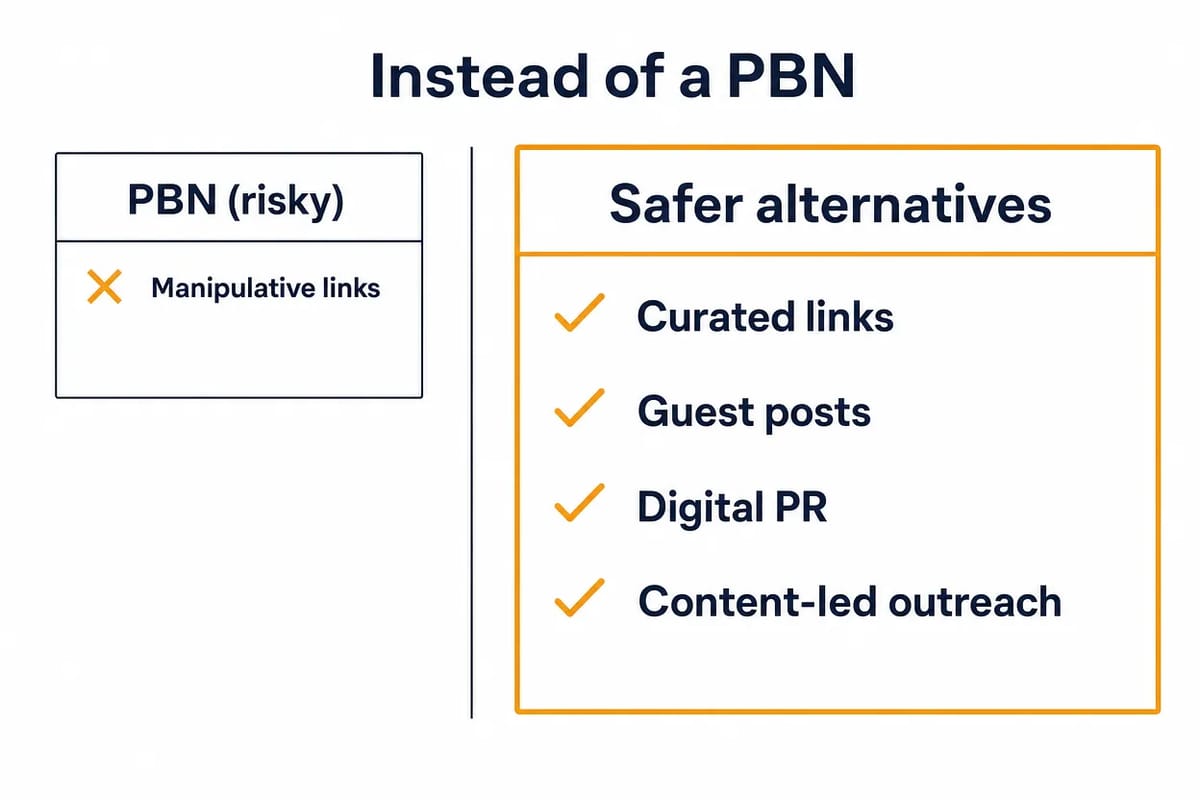
The safer path is not mysterious. It is not as quick as buying a report full of links. It is slower, more editorial and less neat on a spreadsheet. Annoying, yes. Also much easier to defend.
Curated link building is one route when the placement is on a real, relevant page and the link genuinely fits the existing content. The value is not that a link exists. The value is that the page has topical reason to mention you.
Content-led outreach is another. Useful guides, data, tools, templates and original explanations give publishers a reason to cite you. That does not mean every article needs to be a grand research project. It means the page should solve a problem well enough that another site can point readers to it without embarrassment.
Guest posting can also work when you keep it editorially clean: relevant publication, useful article, natural author fit, and links that make sense for the reader. It becomes risky when it turns into paid anchor-text placement at scale. Google is clear that links in guest posts can be link spam if they are stuffed with keyword-rich anchors or created mainly to manipulate rankings.
Digital PR, expert commentary, partnerships, resource-page updates and link reclamation can all fit the same principle. The link should have a reason beyond "we wanted one". That sentence will save you from a surprising number of bad ideas.
PBN backlinks vs link farms
PBNs and link farms are related, but they are not the same thing.
A link farm is usually a group of sites or pages that link heavily to each other or to many external sites with little editorial purpose. You will often see a broader and noisier pattern.
A private network is usually more targeted. It is set up to pass links to one or more chosen sites while trying to look independent. When you inspect it, the linking sites may not openly link to each other, and the target site may sit outside the network.
For the reader making a decision, the distinction matters less than the shared problem. Both tactics create links mainly for ranking manipulation. Both can sit inside link-spam territory. Neither is where you want your main brand domain to live.
Summary
PBN backlinks promise control, speed and easy placement. It helps to separate that appeal from the cost. The trouble is that the same features make them hard to square with Google's link-spam policies.
If you are reviewing an old backlink profile, look for patterns rather than panicking over one strange domain. If you are considering buying PBN links now, treat the hidden ownership, footprint risk and possible wasted spend as part of the price.
For a real business, the safer answer is boring in the right way: earn and place links where the page, publication and reader need the reference. It takes longer. It is also much easier to explain without lowering your voice.
Frequently asked questions
What is a PBN?
A PBN, or private blog network, is a group of websites controlled by the same owner or seller and used to link to a target website. In SEO, the term usually refers to networks built mainly to influence rankings.
What are PBN links?
PBN links are backlinks from private-network sites. They are usually placed to pass ranking signals to a target page, rather than earned through a normal editorial decision.
Are PBN links good for SEO?
They are not a good long-term choice for a brand you care about. They may appear to offer control or short-term movement, but they carry link-spam risk and may be ignored, devalued or linked to manual-action problems.
Why do people use PBN backlinks?
People use them because they want control over placement, anchors and timing. They also appeal when you are in a niche where editorial links are hard to earn. That explains the tactic, but it does not make it safe.
What risks are associated with PBN backlinks?
The main risks are wasted spend, ignored links, ranking drops, manual actions, deindexing of linking sites, and a backlink profile you may have to clean up later.
Should I disavow PBN links?
Only use disavow when the situation fits Google's guidance. If you have many spammy, artificial or low-quality links that have caused, or are likely to cause, a manual action, it may be appropriate. For isolated odd links, manual review and restraint are usually better.
What is the difference between a PBN and a link farm?
A PBN is usually a controlled network used to send links to selected target sites. A link farm is usually a broader group of sites or pages created to exchange or generate many low-quality links. Both can put your site at risk when the links exist mainly to affect rankings.
Every fact and commercial claim in this guide was fact checked and verified on 16 July 2026.
related Blog Posts



Join 2,600+ Businesses Growing with Rhino Rank
Sign Up
Stay ahead of the SEO curve
Get the latest link building strategies, SEO tips and industry insights delivered straight to your inbox.