
 Back to all posts

A link farm is a group of sites or pages that exist to hold links: no audience, no editorial focus, sites that link to each other in a closed circle, directory pages that accept anything. The test we apply is readers, not a receipt. A page nobody visits, built to carry outbound links, is a farm whether or not anyone was invoiced; a publication with readers that carries an editorial mention is not. This page explains where farms came from, what Google did about them, and how we tell a farm from a publication before a link goes live.
Quick answer
The simple version: a link farm exists for links first and readers second.
The pages may publish thin articles, list unrelated businesses, swap links in bulk or point at commercial pages with no editorial reason.
You do not need to prove intent. If the site has no audience, no clear topic and a long list of unrelated outbound links, it is a farm, and we do not place on it.
What makes a site a link farm
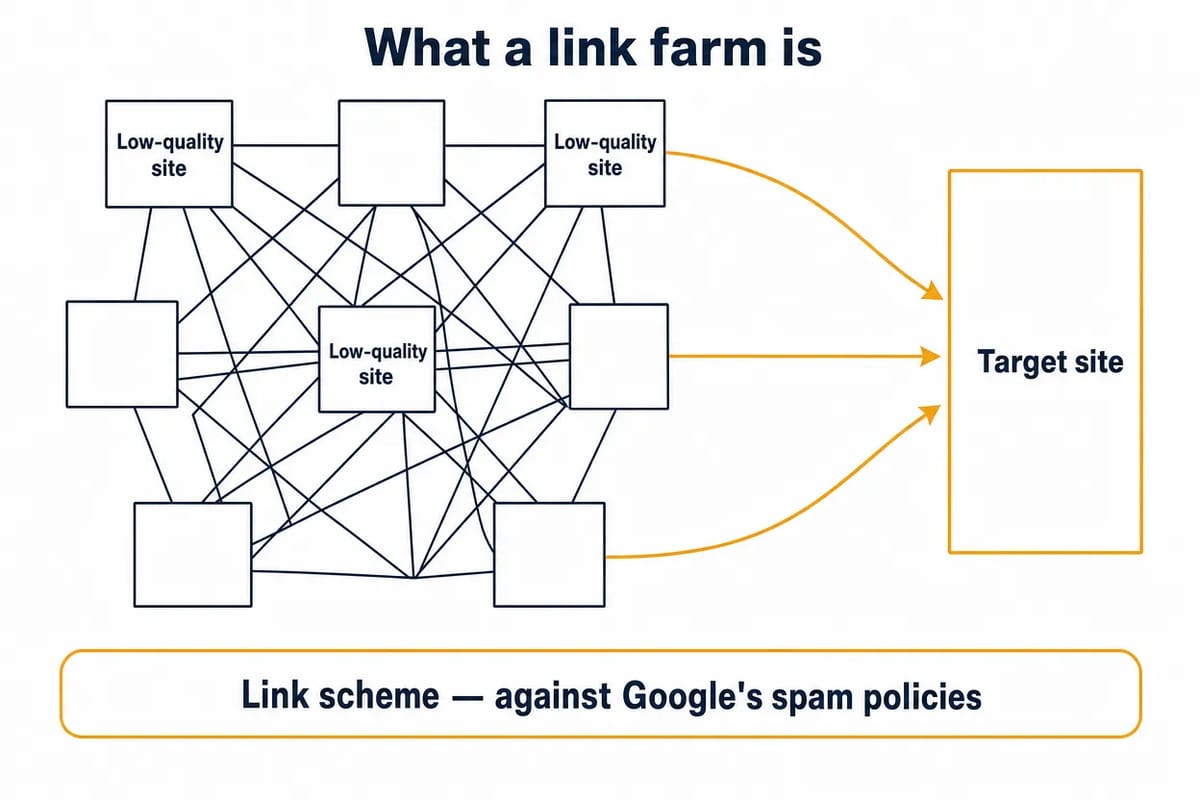
There is no neat public Google label you can check that says, "this domain is a link farm". The term describes a pattern, and Wikipedia states the pattern plainly: "a link farm is any group of websites that all hyperlink to other sites in the group for the purpose of increasing SEO rankings."
Older farms were blunt: sites linking to each other, partner pages made only for cross-linking, directories that accepted any listing. Newer ones look tidier: generic blog posts, resource pages, niche-looking directories. The common thread is that the page still has no readers.
A normal site can link out a lot without being a farm. News sites, trade bodies, research pages and real directories link out because a reader needs the reference. The difference is whether the page has a job besides holding the link.
The quickest independent check is whether the site has visitors. Ahrefs' glossary entry on link farms puts it this way: "A better metric to look at is a site's organic search traffic as well as its organic traffic history. This gives you an idea of the site's growth process and if it actually gets visitors." That is the same test as our traffic floor.
Where link farms came from
Wikipedia records that link farms were first developed by search engine optimisers in 1999 to take advantage of the Inktomi search engine's dependence upon link popularity. Inktomi's index dropped pages with few inbound links, so a site with nothing pointing at it could fall out of the results.
According to Wikipedia's account, Inktomi kept two indexes at the time, and results came from the primary index, which was limited to about 100 million listings; pages with few inbound links fell out of that index monthly. Inktomi was worth manipulating because several popular search engines used its results, and Yahoo!, then the most popular search service, used Inktomi results to supplement its directory search. The farms kept listings stable, mainly for online business sites with few natural links from larger sites.
Site owners answered by trading reciprocal links, first by hand and then through automated link pages run as a service. The exchanges existed to keep pages indexed, not to help a reader.
When PageRank weighted links instead of counting them, farms adapted to pass weight rather than volume. The shapes changed; the absence of an audience did not.
What Google did about the pattern
On Tuesday 24 April 2012, Matt Cutts announced on the Google webmaster blog "an important algorithm change targeted at webspam", naming "keyword stuffing to link schemes that attempt to propel sites higher in rankings". Google said it affected about 3.1% of English queries to a degree a regular user might notice. The post never used the word Penguin; the nickname came later.
On Friday 23 September 2016, Gary Illyes wrote that "Penguin is now real-time" and that "Penguin now devalues spam by adjusting ranking based on spam signals, rather than affecting ranking of the whole site."
Today, Google's guide to its ranking systems, checked 13 September 2026, lists Penguin under retired systems, folded into the core ranking systems in 2016, and still lists PageRank as "one of our core ranking systems used when Google first launched". In October 2022, Google folded its separate link schemes documentation into a single link spam section of its spam policies. Google's spam policies describe the farm pattern in three examples: excessive link exchanges or partner pages exclusively for the sake of cross-linking, low-quality directory or bookmark site links, and creating low-value content primarily for the purposes of manipulating linking and ranking signals. The policies state the consequence plainly: "Sites that violate our policies may rank lower in results or not appear in results at all." The pattern Google acts on is the farm pattern, sites and pages with no readers built to trade links; followed links from read, relevant publications remain one of the strongest ranking levers, which is why we vet the publication rather than the invoice.
A link farm, a PBN and a publication
All three can carry links, but they are different shapes, and only one of them has readers. A link farm is the noisy shape: many weak pages, reciprocal circles, directories that accept anything, and no audience.
A PBN is usually a privately controlled network used to place links to selected targets. It often tries to hide common control. We have a separate guide to private blog networks. Ahrefs' glossary draws the line at where the links point: a PBN sends links outside the network, while a farm's sites link to each other. In practice a farm often points at a money site too, so we treat the absence of readers as the line, not the direction of the links.
A publication is a site with readers, an editorial focus and a person who decides what gets published. A publication with readers that takes a paid placement is still a publication; the readers are the difference.
Link farm | PBN | Publication | |
|---|---|---|---|
Readers | None | None, or a thin veneer | A real audience with organic traffic |
Who controls it | Loose network, often reciprocal | One owner hiding common control | An editor who decides what runs |
Where the links point | Each other, sometimes a money site | Chosen target sites outside the network | Wherever a reader needs the reference |
What we do | Never place | Never place | Vet with our QA checks, then place in-body |
Before a Curated Link or Guest Post goes live, we run the same checks on every publisher: a traffic floor (does the site have readers?), a DR/DA cross-check that is a sorting aid rather than a gate, no PBNs or networks, in-body placement on an existing indexed page, human sign-off, a post-publication check, and 12-month replacement cover if the link drops. The full list is on our link building quality assurance page.
If you are weighing vendors, compare link building services by how each vendor checks the publisher: readers, in-body placement, no networks.
Five signs we use when we vet a publisher
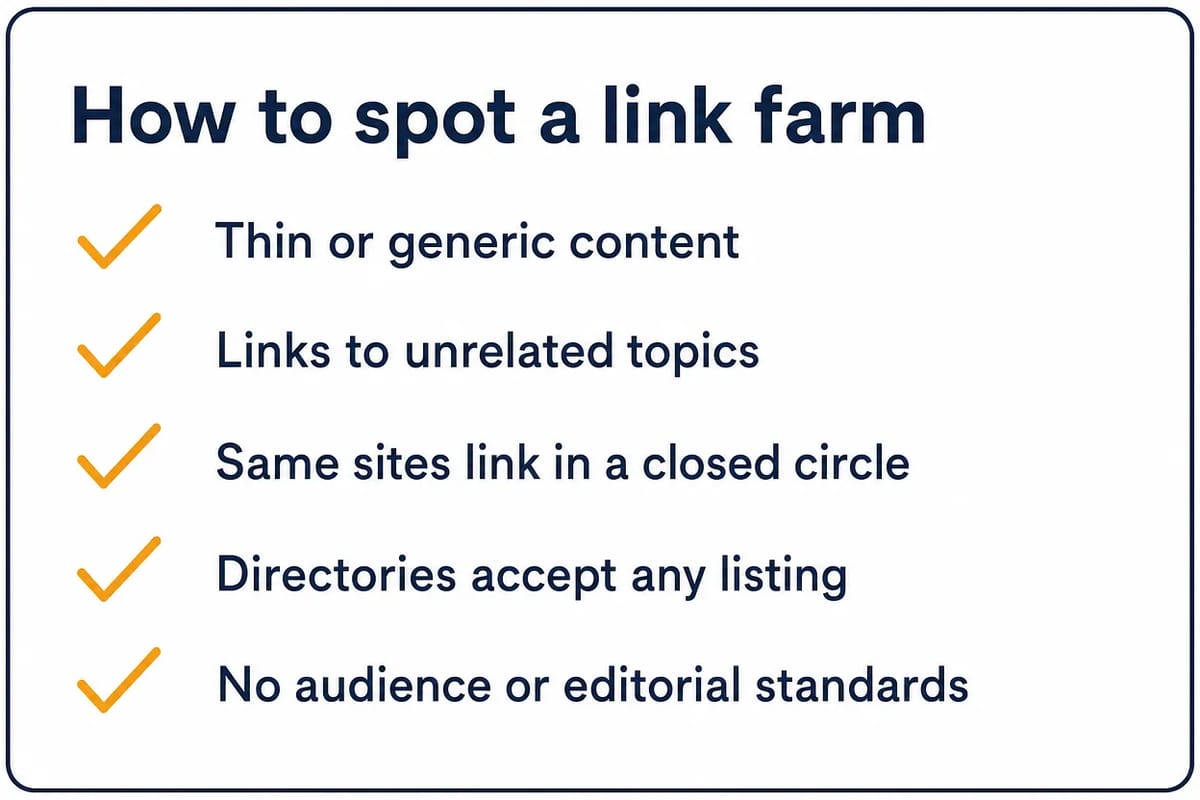
- No editorial focus: unrelated topics on one site.
- Holding-pen content: thin, copied or generic text that exists to carry outbound links.
- A closed circle: the same sites link to each other again and again.
- A directory that accepts anything, with no screening, context or audience.
- No visible audience, ownership or editorial standards.
One sign is a prompt; a pattern is a farm.
Tool scores help with triage, not verdicts; the figures here were checked 13 September 2026. Moz's Spam Score is the share of sites with similar features that Moz found penalised or banned, built from 27 signals, and Moz says a high score does not mean a site is necessarily spammy. Moz bands the score as Low at 1% to 30%, Medium at 31% to 60% and High at 61% to 100%, and updates it quarterly. Semrush's Backlink Audit gives a Toxicity Score from 0 to 100 built from more than 45 markers. Semrush then grades the whole profile High if more than 10% of backlinks are marked toxic, Medium at 3% to 9% and Low below 3%. Ahrefs publishes no spam or toxicity score at all, and says so in its help centre.
Marie Haynes put it plainly on her own site on 1 March 2022: "The links Semrush has marked as toxic are almost completely spam links we believe Google is ignoring." That matches what we see: a toxic-score report is where a review starts, not where it ends.
If farm links already point at your site
Stay measured: most odd links are ignored, and the disavow tool exists for two narrow conditions. Most sites attract links they never asked for, from scrapers, automated pages and weak directories. Google's disavow help page says that in most cases Google can assess which links to trust without additional guidance, so most sites will not need to use the tool. It lists two conditions for using it: a considerable number of spammy, artificial or low-quality links, and links that have caused or are likely to cause a manual action.
A manual action is a different thing: Google's manual actions help page says Google issues one when a human reviewer at Google has determined that pages on the site are not compliant with its spam policies. It can cover a subset of pages or the entire site. The fix is to correct the affected pages and submit a reconsideration request from Search Console; Google says most reviews take several days or weeks, with link-related requests sometimes longer. That is a notice with a ticket, not the default outcome of a few farm links, which Google mostly ignores.
Patrick Stox, writing on the Ahrefs blog on 9 December 2021 after disavowing and then restoring his own site's links: "Spoiler alert: Links still matter. Traffic and ranking keywords were down after I disavowed the links and up after I removed the disavow file." We do not disavow farm noise by default. We run a link audit first, separate the unread directories and reciprocal circles from real citations (our guide to spam links shows the sorting), and only file a disavow when the two conditions above are met.
Frequently asked questions
What is a link farm?
A link farm is a group of sites or pages that exist to hold links: no audience, no editorial focus, sites that link to each other in a closed circle, or directory pages that accept anything. The test is the absence of readers, not whether money changed hands.
What is link farming in SEO?
Link farming is the practice of creating or using link farm pages, sites with no readers that exist to hold links, to build backlinks. In SEO the term covers bulk reciprocal swaps, closed circles of sites and directories that exist to carry links rather than serve readers.
What is a backlink farm?
A backlink farm is a link farm under another name: a set of pages with no readers that exist to carry backlinks. The test is still readers.
Are link farms against Google policy?
Google's spam policies list excessive link exchanges, partner pages exclusively for cross-linking and low-quality directory links as link spam. That is the farm pattern, and it is the pattern we screen for before a link goes live.
Can a link farm get my site penalised?
The common outcome is that Google ignores the links. A manual action needs a human reviewer at Google and arrives as a notice in Search Console. We do not buy farm pages, so the question does not arise on the orders we fulfil.
Are all directories link farms?
No. A real directory can help users find relevant businesses, members, tools or resources. A directory starts to look like a farm when it accepts almost anything, adds little context, has no real audience and appears to exist mainly to carry links.
Are reciprocal links always bad?
No. Natural links between related sites are normal. The example Google lists is excessive link exchanges and partner pages that exist only for cross-linking.
Should I disavow link farm backlinks?
Only under Google's two conditions: a considerable number of spammy, artificial or low-quality links, and links that have caused or are likely to cause a manual action. For anything short of that, review first rather than file.
What is the difference between a link farm and a PBN?
The difference is shape. A link farm has no readers and often no single target, while a PBN is privately controlled, hides common ownership and points links at chosen sites. We use neither.
related Blog Posts



Join 7,000+ Clients Growing with Rhino Rank
Sign Up



Stay ahead of the SEO curve
Get the latest link building strategies, SEO tips and industry insights delivered straight to your inbox.