
 Back to all posts

Outsource the SEO work that needs a system you cannot build for one site: publisher relationships, outreach, screening and specialist audits. Keep the decisions in-house: which pages matter, which terms are worth winning and what gets approved.
That split is what makes outsourcing work. The provider brings the fulfilment machine; you bring the commercial judgement. The link-building piece is the clearest case, and it is bought two ways: per placement at published prices, or managed from $250 a month.
What SEO outsourcing means
SEO outsourcing means hiring an external provider to plan, manage or deliver search work for your business. The provider might be a full-service SEO agency, a freelance consultant, a content partner, a technical specialist, an outreach team or a white-label supplier that works under your brand.
The mistake is treating all of those models as the same thing.
A full-service agency may own the audit, strategy, content calendar, on-page work, reporting and off-page campaign. A component provider may only handle one defined task, such as content production, technical fixes or link acquisition. Both can work. Both can fail if the handover is loose.
The cleanest setup starts with ownership. Your business should still know which pages matter, what a lead is worth, which terms are commercially useful, which placements you will approve and who signs off the work. The outsourced team then works inside those boundaries.
If no one on your side can make those calls, outsourcing turns into delegation without direction.
Should you keep SEO in-house or outsource it?
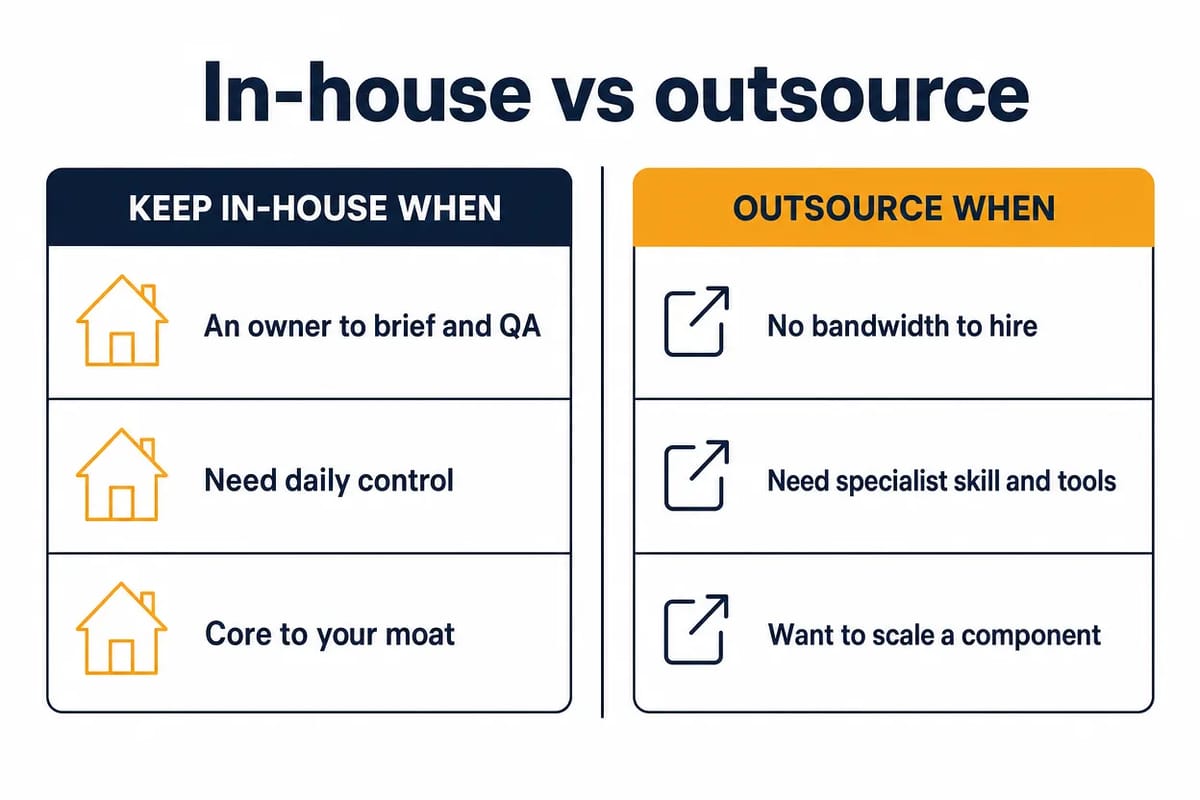
Keep SEO in-house when the work needs constant access to product, sales, legal, engineering or leadership. That is common in regulated markets, complex SaaS, founder-led brands and businesses where search decisions affect positioning as much as rankings.
In-house also wins when SEO is a core capability you want to own. If the company expects to publish daily, test landing pages often, rewrite product messaging or tie SEO tightly to demand generation, an internal lead can move faster than an outside team waiting for approvals.
Outsourcing wins when the work is important, but the fixed cost of hiring is hard to justify. IT Jobs Watch puts the median advertised UK SEO Manager salary at £49,536 a year, from vacancies posted in the six months to 24 September 2026 (108 permanent jobs, 85 salaries quoted), and £40,000 outside London; these are advertised vacancies, not a survey of people in post. Building tools, content support, technical knowledge, outreach systems and reporting inside a small team can be slower and more expensive than buying the right slice from a specialist.
The hybrid model is often the best first step. You keep strategy, approvals and commercial judgement. The provider handles fulfilment: audits, content instructions, technical tickets, content drafts, local citations, reporting or link-building delivery. If the provider proves it can think clearly, you can hand over more later.
Full-service SEO outsourcing vs component outsourcing
Full-service SEO outsourcing means one provider runs most of the campaign. This can suit a business that has no SEO lead, no reporting rhythm and no internal team to coordinate content, technical work and links. The benefit is simplicity. The limit is that one provider holds the campaign.
If you choose full-service, ask what the agency controls and what you approve. A good agency can explain the first audit, priority order, reporting cadence, content workflow, technical handoff and link policy. A weak one hides behind activity.
Component outsourcing is narrower. You might hire a technical SEO to audit templates, a writer to produce content, a developer to fix crawl issues, or a link-building provider to deliver placements. This gives you more control, but it also requires a stronger internal owner.
For agencies, there is a third model: white-label fulfilment. If you sell SEO but need outside delivery under your own brand, compare the provider's reporting, support, approval flow and margin room before using an SEO reseller model. Our reseller programme is 100% white label, pays 10% lifetime commission and sends monthly PayPal payouts once the balance reaches $50. Your client will judge the work as yours.
None of these models removes the need for an owner. Full-service can be useful when you need one accountable partner. Component outsourcing works when you already know the job. White-label can work when your client process is tight. The wrong model is the one that lets nobody own the outcome.
What SEO services can you outsource?
You can outsource almost any SEO task, but you should not outsource every decision.
Technical SEO is often a good fit when your site has crawl, indexation, speed, structured data, internal linking or template issues. The external specialist audits the site, prioritises fixes and works with your developer, while your team decides what ships and when.
Content strategy can be partly outsourced: a provider can research topics, map search intent, write content instructions, draft copy and refresh old pages. The buyer still supplies product knowledge, proof points, positioning and approval, because search content without business context reads thin.
On-page SEO can be outsourced when the rules are clear: title tags, headings, internal links, schema and page clean-up. Give the provider priority URLs, target themes and conversion constraints.
Local SEO can also sit outside the core team, from Google Business Profile updates to citation clean-up, location-page checks and local link outreach. Someone internal still owns opening hours, service areas, reviews and brand details.
Link building is the component with the strongest case for buying in, and the surveys show how split the market is. Editorial.Link surveyed 518 SEO professionals (25 March 2026): "56% of respondents outsource at least part of their link-building tasks, while 44% handle everything in-house." The same survey found "55.2% consider link building the most challenging part of SEO." Citation Labs and BuzzStream surveyed more than 300 SEOs (28 January 2025) and found that, of roughly 150 respondents working in-house, 61% "manage link building entirely in-house". The two surveys asked different questions of different samples, so their figures should not be combined.
Search Engine Journal (26 August 2024), reporting Aleyda Solis's SEOFOMO survey of a self-selected group of 337 respondents, found: "Only 14% of respondents answered that they build links for clients." Our view: link building needs a publisher network, outreach staff and screening that only pay off across many campaigns, which is why it is the piece most worth buying in.
If you want to outsource link building, the provider should show how it finds sites, what it rejects and what you receive after each placement. For campaigns built around visual assets, Image link building services need the same checks on publisher fit, surrounding copy and final reporting.
What does SEO outsourcing cost?
In the clearest public benchmark, most agencies charge under $1,000 a month for SEO work. That benchmark is SE Ranking's agency pricing survey, run with Duda and published on 13 December 2024: "a dataset pulled from 260 agencies". Of the agencies surveyed, 94% focus on small or local businesses and 78% have fewer than 10 people. The survey carries its own caveat: the sample "may not be large enough to reach statistical significance".
The headline figures: "64% of agencies charge below $1,000 per month, 60% set their hourly rates below $100, and 66% charge under $2,000 per project." 30% charge less than $500 a month. On hourly billing, "The majority of agencies, 45%, set their hourly rates between $50 and $100". Location splits the market: "40% of agencies in the US and Canada charge over $125 per hour. Only 6% of European agencies charge the same fee."
For agency owners, SE Ranking's separate margin survey (18 April 2025, 115 agencies) found 84 of the 115 agencies reporting profit margins of 11% or higher, with 58 at 21% or more.
For the link-building piece, our Curated Links start at $60 per link, tiered by the placement site's referring domains, and Guest Posts start at $75 per post, tiered by minimum Moz DA, up to $400 for DA60+. Managed service starts at $250 a month. The full price list sets out every tier.
Agency, freelancer or white-label provider?
Choose an agency when you need coordination across technical SEO, content, reporting and off-page work. Agencies carry more process and coverage than a single consultant, but they can feel slow if your scope is small or too many account layers sit between you and the people doing the work.
Choose a freelancer when the task is defined and you know how to judge it: audits, content instructions, content refreshes, schema clean-up or specific technical reviews. A freelancer is less suitable when you need a full delivery system, cover during absence or broad campaign management.
Choose a white-label provider when you already sell SEO and need fulfilment capacity under your own brand: unbranded reports, predictable pricing, clear support and a handoff your account managers can explain to clients. Ishant Sharma, founder and CEO of Hustle Marketers, described his own agency's set-up on 1 June 2026: "A specialist white-label SEO partner handles technical audit execution, on-page recommendation rollout, and link building." Our rundown of white-label link building providers lists the main options.
Whatever the model, ask the same basic questions:
- What work do you do yourself, and what do you subcontract?
- What inputs do you need from us before the campaign starts?
- What do you refuse to do?
- What will the report show?
- Who owns strategy, approvals and performance judgement?
If the answers are vague, you still own the outcome.
How to choose an outsource SEO provider
Do not choose from a pitch deck alone. Ask to see the operating model.
First, check fit: the provider should understand your market, site type, sales cycle and what you will approve. Industry experience helps, but a provider that asks sharp questions about your business can learn a niche faster than one that assumes it.
Second, check proof: case studies beat broad claims when they name the service used, the starting point, the time period and the result. Testimonials help, but they should not replace evidence of how the work is delivered.
Third, check reporting: a useful SEO report shows the work completed, the pages affected, the reason it matters, what changed in search data and what happens next. Vanity metrics can fill space without answering whether the campaign is healthier.
Fourth, check communication: you need one owner on the provider side and one on your side. Missed decisions should not sit unnoticed until the next report.
Finally, check incentives: our position is that no provider can guarantee rankings, instant traffic or a fixed result from a fixed number of tasks, because search results depend on your site, rivals, content quality, technical health, links and time. If you resell SEO, the same conversation covers margin, so read how to price the work for your own clients before you set your rates.
How we handle outsourced link building
We only do the links. Strategy, technical fixes, on-page work and content stay with you; that is the scope we sell, so you can plan the rest of the campaign around it.
There are two ways to buy from us. If you already know the pages you want to move, you order Curated Links or Guest Posts at the published tier. If you want the plan done for you, our managed service gives you a dedicated account manager, and every campaign includes a full backlink audit, keyword research, competitor analysis and monthly white-label reporting. We send a proposal within 48 hours of the onboarding form (budget, URL, keywords and goals), and pricing starts from $250 a month on a rolling monthly subscription you can cancel any time, with no setup or admin fees.
Prices are public. Curated Links start at $60 per link, tiered by the placement site's referring domains. Guest Posts start at $75 per post, tiered by the site's minimum Moz DA, up to $400 for a DA60+ placement, and each post is a 750+ word article. There are no contracts and no minimums, and Curated Links come with a white-label report.
Before any placement, we check the site: indexed pages, organic traffic and its trend, Moz DA cross-checked against Ahrefs DR, and referring domains, weighed together. We do not place on PBNs or networks, every link sits in the body copy and a human signs off each placement. We also check the status code your target URL returns before anything goes out, so no dead pages and no redirect chains. The full list is in our published QA standard.
After publication, we check the page is live, the link sits in the body copy, the anchor and target URL match the order and the page is indexable; only then do we report the URL to you. If a delivered link is removed, or its page is taken down, within 12 months, we replace it like for like. Your first order also carries a no-questions-asked refund, up to $550.
More than 7,000 clients trust us with this work.
Who should NOT outsource SEO
Do not outsource SEO if no one inside the business can own the scope: a provider needs target pages, commercial priorities, brand rules, approval routes and feedback, and without them the work stalls or guesses. Do not outsource before the offer is proven, because search can find demand but it cannot fix a weak offer, unclear positioning or a page nobody trusts. Do not outsource if you need daily control of every sentence, publisher, technical ticket or keyword move, because that level of control belongs in-house.
How to monitor an outsourced SEO campaign
Monitor delivery before you judge performance. Are audits delivered when promised? Are recommendations clear? Are content instructions usable? Are technical tickets precise? Are links live and relevant? Are reports understandable? If delivery is messy, performance data will be hard to trust.
Then monitor search movement with patience. Google's SEO Starter Guide (last updated 10 December 2025) puts it plainly: "Some changes might take effect in a few hours, others could take several months. In general, you likely want to wait a few weeks to assess whether your work had beneficial effects in Google Search results." Treat early reporting as a pattern, not a verdict, and look for crawl improvements, indexation fixes, stronger internal links, cleaner content coverage, relevant referring domains, non-brand query movement and conversion changes on priority pages. We cover how long link building takes in a separate guide.
Your core tools will usually be Google Search Console, Google Analytics and a third-party SEO platform such as Ahrefs or Semrush. Use them to ask better questions, not to force single-cause explanations. One link, title change or article rarely explains a whole ranking movement on its own.
The commercial check is simpler. Is the provider saving meaningful time? Is the work getting approved with less friction? Are priority pages gaining visibility? Are reports making the next decision easier? If every update creates more admin for your team, the provider is exporting work back to you.
Common SEO outsourcing mistakes
The common mistakes are buying activity instead of outcomes, handing over vague instructions and leaving communication until the report. 'Improve rankings' is not a usable scope: a useful handover names target pages, commercial goals, priority topics, competitors, approval rules and the data that will judge whether the work is improving. We do not place Curated Links or Guest Posts on PBNs, hacked pages or sites with no topical fit, and neither should any provider you brief, because that is where black hat link building starts. If you run an agency, read the mistakes agencies make when outsourcing SEO before briefing a supplier.
What proof should you ask for?
Ask for proof that connects the service to the result. A chart is useful only when you can see the service used, the time frame, the starting point and why the case is relevant to your situation.
Our AI Technology case study covers 12 months of Curated Links and Guest Posts from Rhino Rank at $3,200 a month: a 263% increase in organic traffic and an organic traffic value of $98,000 a month, up 513% year on year.

Our Marketing Agency case study covers six months of Curated Links at $1,500 a month: ranking keywords up 133% to over 2,800.

Read any provider's case study the same way: check the service used, the site type, the campaign length and whether the starting point looks anything like your own.
Frequently asked questions
What is outsourced SEO?
Outsourced SEO is the use of an external agency, freelancer or fulfilment partner to handle defined SEO work. That work can include audits, content, on-page updates, technical fixes, local SEO, link building, reporting or full campaign management.
When should I outsource SEO?
Outsource SEO when you know the business goal, have someone internal to own approvals and can define the work clearly. It is a strong fit when the provider's specialist process is better than what your team can build quickly.
How many SEOs outsource link building?
In an Editorial.Link survey published in March 2026 of 518 SEO professionals, 56% said they outsource at least part of their link-building tasks. In a Citation Labs and BuzzStream survey published in January 2025 of more than 300 SEOs, 61% said they keep link building entirely in-house; the two surveys asked different questions of different samples.
How do I choose the right SEO outsourcing partner?
Choose the partner that can explain its process, reporting, refusal points, proof and communication model before you buy. The right provider should make the work easier to judge, not harder.
How long before outsourced SEO shows results?
Google's SEO Starter Guide says "you likely want to wait a few weeks to assess whether your work had beneficial effects in Google Search results", and notes some changes take several months. Judge delivery before rankings: if the agreed work is not arriving as promised, the search data will not tell you much.
related Blog Posts




Join 7,000+ Clients Growing with Rhino Rank
Sign Up



Stay ahead of the SEO curve
Get the latest link building strategies, SEO tips and industry insights delivered straight to your inbox.