
 Back to all posts

SEO Reseller Services and White Label SEO
SEO reseller services let an agency sell SEO under its own brand while another provider handles delivery, QA and reporting. The model works when you need steady SEO work without hiring a full team. It fails when the provider cannot brief cleanly, report without brand friction, or protect your margin.
Disclosure: Rhino Rank sells white-label link building and managed SEO fulfilment.
Key Takeaways
- An SEO reseller gives agencies a way to sell SEO without building the whole delivery team in-house.
- White label SEO is the same operating model from the client's view: your brand owns the relationship, the fulfilment partner works behind the scenes.
- The best use case is uneven or specialist demand, where hiring full-time staff would leave margin trapped in salaries, tools and training.
- The weak points are briefing, approvals, monthly reporting, client disclosure and commercial control. If those are loose, the model becomes expensive admin.
What SEO reseller services mean
SEO reseller services are outsourced SEO work packaged for resale by another agency. The agency sells the work, manages the client and controls the paid relationship. The delivery partner handles the SEO tasks agreed in the scope.
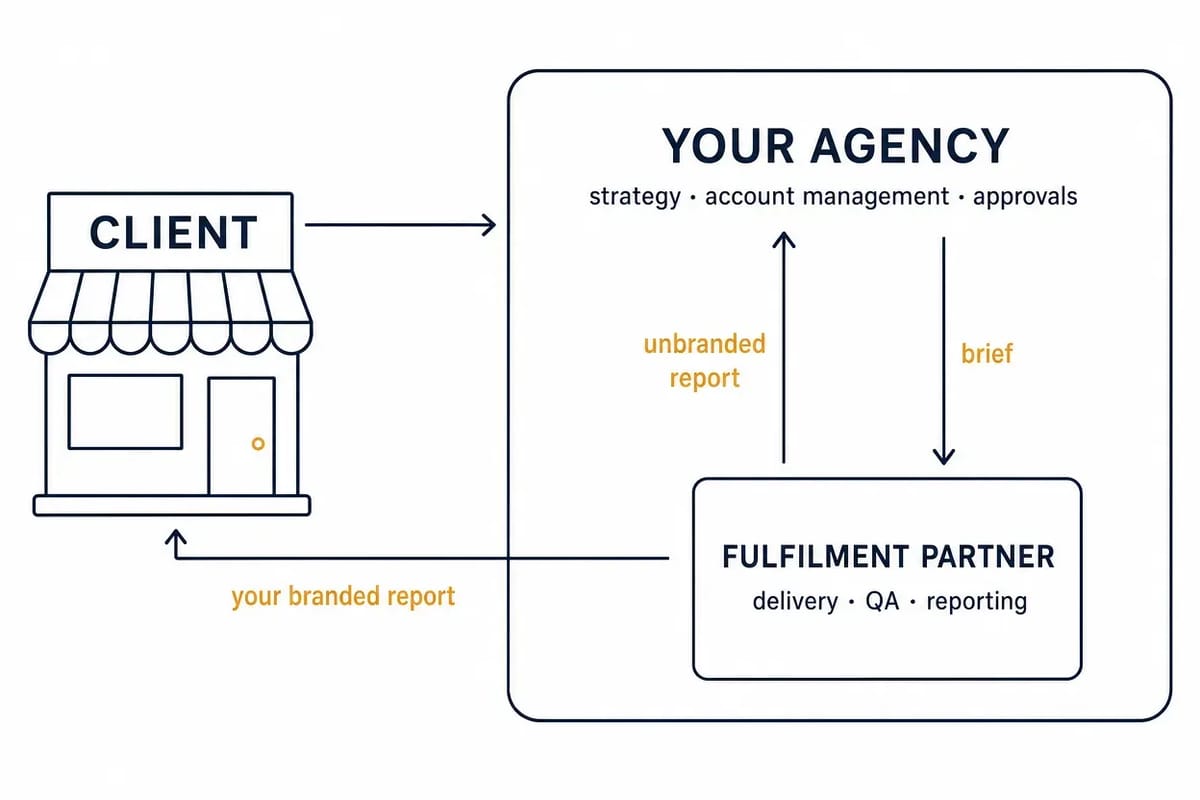
The phrase white label SEO services describes the brand layer of the same model. The work is produced by a third party, but the client sees your agency's process, reporting and account management. In a good setup, the client does not feel passed between companies.
That distinction matters. Reselling is not the same as sending a client to another supplier and taking a referral fee. With reseller SEO, your agency is still accountable for strategy fit, timelines, approvals and results. The fulfilment partner is invisible or lightly visible, depending on what you have promised the client.
Where we see this go wrong most often: agencies sell a broad SEO retainer, then brief the partner as if they bought a single task. No fulfilment team can infer sales goals from a vague note about "more traffic". They need target pages, keywords, location, exclusions, tone, approval rules and the client's risk appetite.
How white label SEO fulfilment works
White label SEO fulfilment usually follows a simple chain. The agency scopes the client need. The fulfilment partner checks the brief, delivers the work, completes QA and sends the report back to the agency.
The practical part is less tidy.
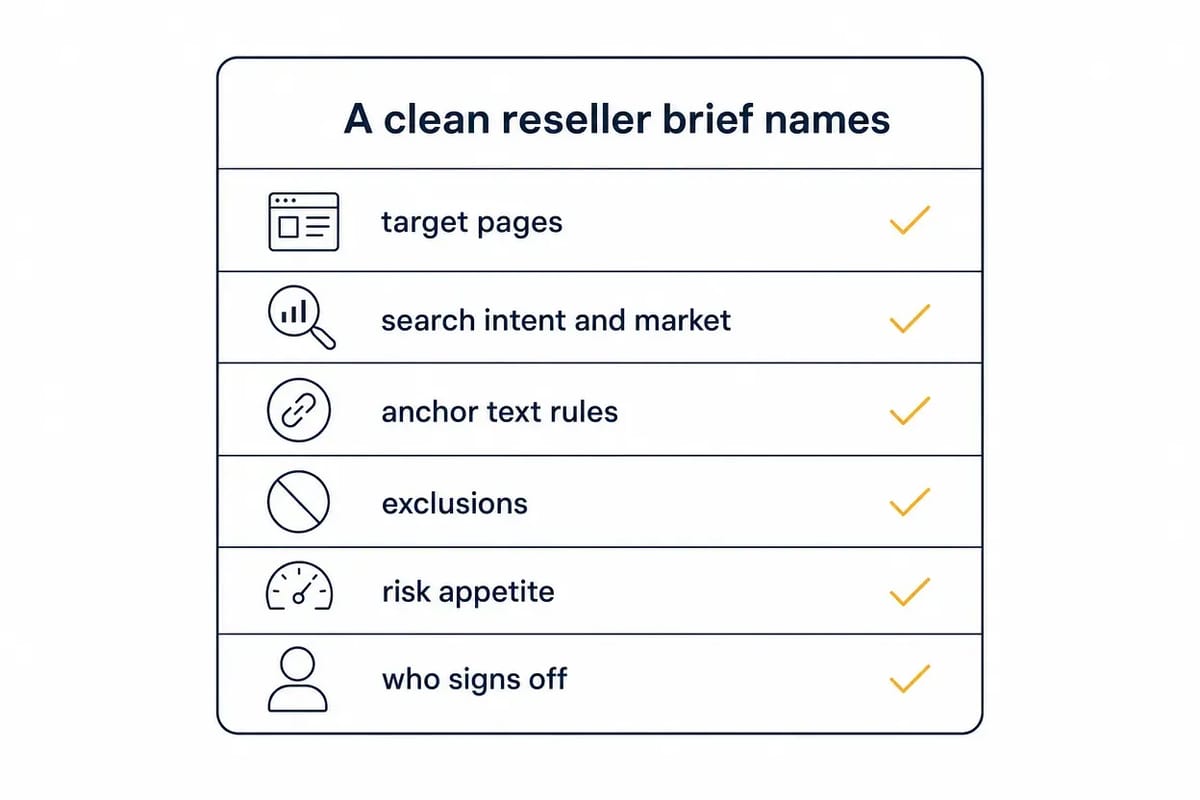
Good briefs are boring in the right way. They name the target URL, search intent, market, anchor constraints, content limits, competitors to avoid and who signs off changes. Bad briefs forward a client email and ask the partner to "do SEO". That creates drift, because the fulfilment team starts making assumptions the agency should have settled.
Reporting is the other common break point. A white-label report must be useful to the client and safe for the agency. It should show what was done, why it matters, what changed, what is next and where the limits are. A raw export full of supplier language may be true, but it forces the agency to rewrite the story every month.
Ask for a sample report before you sell the service. Read it as your account manager would read it late in the day before a client call. Can they explain the work and the next step without chasing the supplier? If not, the report is not white label enough. This is why we strip supplier branding from every order report by default rather than on request — a report you have to edit before forwarding is unfinished work.
Rhino Rank's current product pages support that handoff in a few ways. Curated Links and Guest Posts pages state the links can deliver up to 150% ROI. Those pages also describe per-order unbranded reports for white-label delivery. The reseller programme page states a 10% lifetime commission and says 700+ people already resell Rhino Rank services.
That is the commercial proof. The buyer still needs to judge fit.
When reselling beats hiring, and when it does not
Reselling works best when client demand is real but uneven. If a few clients ask for audits, links, local SEO or content support, hiring a full-time team can turn useful work into a fixed-cost problem.
It also works when the work is operationally heavy. Link prospecting, publisher vetting, outreach, placement QA, citation checks and monthly report assembly all eat hours. A fulfilment partner can make that work predictable if their process is clear.
In-house hiring wins when SEO is the centre of your agency's strategy. If your clients need daily technical input, deep product knowledge or direct access to specialists, a hidden partner may slow the work down. It can still support overflow, but it should not become the whole model.
Do not use a reseller to hide a skills gap in strategy. Across the agencies reselling our services, the partnerships that last are the ones where the agency can judge the work it resells. If no one on your team can do that, you are not reselling. You are guessing.
The disclosure question depends on the promise you made. If your contract says your in-house team performs every task, hiding outsourced fulfilment is a problem. If your agency sells outcomes, account management and quality control, a white-label partner can sit behind your brand. Put that clearly in your own terms before the client asks.
No model fixes weak account management. If you cannot turn a client's goal into a clean brief, reselling only moves the confusion to another inbox.
What SEO services get resold
Most reseller SEO work falls into a few repeatable service lines. The exact mix depends on what your agency sells and how much strategic control you want to keep.
Service | Typical work | Good fit | Watch |
|---|---|---|---|
Audits | Technical, content and keyword checks | One-off diagnosis | Generic checklists |
On-page SEO | Metadata, briefs and internal links | Site clean-up | No dev access |
Link building | Outreach, placements and QA | Authority gaps | Publisher quality |
Local SEO | GBP, citations and location pages | Local clients | NAP drift |
Reporting | Monthly dashboards and notes | Retainers | Supplier jargon |
On-page work is often the cleanest starting point. The agency can keep strategy and client contact. The fulfilment team can handle audits, page briefs, metadata, internal links and content updates.
Link building needs more care because risk lives in the details. A partner should explain publisher vetting, anchor controls, replacement rules and reporting. For link-only buying, a comparison of white-label link-building partners is more useful than a broad reseller model discussion.
Local work is more process-led. It can include local SEO strategies, creating citations and regularly auditing your citations. The aim is clean name, address and phone data across key directories.
Specialist niches need extra caution. Sectors such as gambling or adult can need stricter publisher exclusions, content review and risk notes. If the partner treats every industry the same, the agency will carry the fallout.
Content, keyword research and competitor checks can also be resold, but keep the ownership clear. The agency should decide the client strategy. The fulfilment partner should support it with the agreed research, production and QA.
How to choose an SEO reseller partner
Do not choose a partner from a price sheet alone. The real question is whether their operating model fits your client promises, margin and approval process.
Start with service depth. The best SEO reseller partner can say which tasks are delivered in-house, which are subcontracted, and where QA sits. A reseller can still use specialists, but you need to know who is accountable when work is late, rejected or below standard.
Then test the briefing process. A strong partner asks awkward questions early: what the client sells, what pages matter, what risk is acceptable, what approvals are needed and what must never appear in reporting. We ask these before taking a reseller order on, and the agencies that answer them quickly are the ones whose campaigns run quietly. Awkward questions at the start are the partner protecting your account before the work exists.
Ask what a normal month looks like, not the best month. You want to see how late assets, rejected work and client changes are handled. Anyone can send a polished case study. Monthly delivery is where the small faults show.
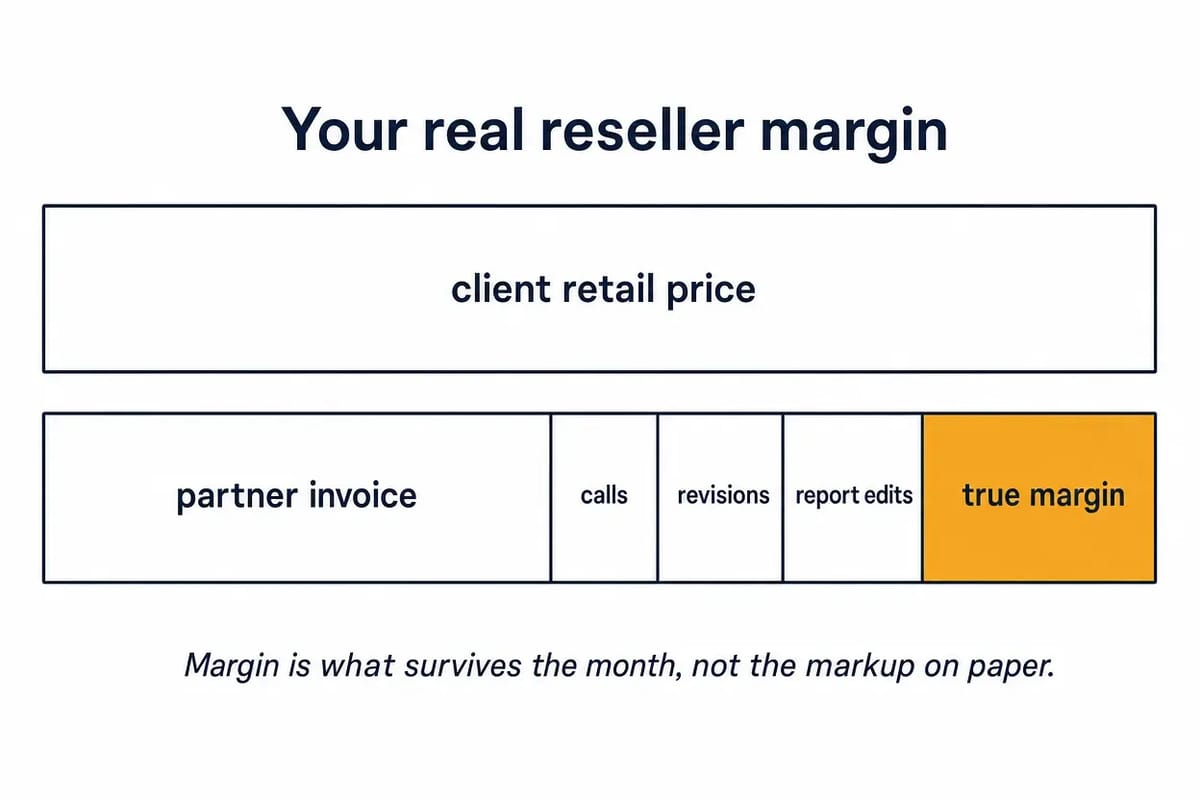
SEO reseller pricing needs the same scrutiny, and this is where we tell prospective resellers to slow down. Your margin is not the gap between your retail price and their invoice. It is that gap after calls, revisions, client education and report edits. If the partner's work creates extra admin every month, the apparent markup disappears.
Look at communication style before volume. You need clear updates when work is moving and when it is stuck. Silence is worse than bad news, because it leaves your account manager with nothing useful to say.
Reputation still matters, but read it like an operator. Check recent reviews on Trustpilot and Reviews.io, then ask what the complaints imply. Slow replies, unclear reports and missed expectations are more relevant to reselling than a generic praise line.
Finally, check brand ownership. The partner should be able to remove supplier branding, match your reporting cadence and avoid language that exposes the fulfilment chain. White-label SEO is partly delivery, partly theatre. The client should see a calm agency process, not the wiring behind it.
How we run reselling at Rhino Rank
Everything above is the buying checklist. Here is how we answer it ourselves.
Pricing is fixed and public, so an agency can quote a client before ordering: curated link placements start at $60 per link by referring-domain tier and guest posts at $75 per post by DA tier with the article included, per our product pages. There are no minimum orders and no contracts, so a reseller can test with one placement and scale when the client relationship justifies it.
Every order ships with an unbranded report by default. Nothing needs stripping or rewriting before it reaches your client, and the managed service adds monthly white-label reporting for retainer work.
Risk sits with us, not between you and your client: placements carry a 12-month replacement term, and a first-order money-back guarantee covers up to $550, both stated on our product pages. Our screening standards are published too — what we reject includes PBN footprints, spun or AI content and traffic manipulation — so your account manager can show a client the standard rather than assert it.
The reseller programme itself pays a 10% lifetime commission. We built the model around one idea: the agency owns the client, and our job is to make that ownership easy to keep.
Reporting, margins and monthly performance
Monthly reporting is where a reseller relationship either earns trust or drains time. A useful report is not a file dump. It connects work completed to the client's goals and gives the account manager a clear next conversation.
For a monthly retainer, the agency should track three layers of performance: delivery, SEO movement and commercial health. Delivery covers tasks completed, placements live, content published, fixes made and blockers. SEO movement covers rankings, organic traffic, conversions, crawl issues and link quality. Commercial health covers margin, rework, client satisfaction and whether the scope still matches the fee.
That last layer is easy to miss. A campaign can look fine in Google Analytics while the agency loses margin through reporting edits, extra calls and unclear responsibilities. The reseller's job is not only to deliver SEO work. It should also make the service easier to sell and renew.
Use tools that match the client promise. Google Analytics and Google Search Console support traffic, conversion and query checks. Ahrefs and Moz can support link and authority review. The tool name matters less than the reporting habit: measure SEO metrics that explain progress without pretending every monthly movement is caused by the reseller.
Attribution needs restraint. Search volume changes, seasonality, site changes and competitor movement can all affect the readout. Our own reports flag those limits rather than claim every movement — we would rather under-claim a good month than defend an inflated one in a bad month. Good reseller reporting works the same way.
Frequently Asked Questions
What is an SEO reseller?
An SEO reseller is a company or programme that lets another agency buy SEO delivery and resell it to its own clients. The agency owns the client relationship. The fulfilment partner handles agreed SEO work behind the scenes.
What is white label SEO?
White label SEO is SEO fulfilment delivered under the agency's brand. The client receives reports, updates and account management from the agency, even when a third-party partner performs the delivery work.
What is a white label SEO company?
A white label SEO company is the fulfilment partner behind the agency. It may provide audits, link building, content support, local SEO, reporting or wider managed SEO work without putting its own brand in front of the end client.
What services do SEO resellers offer?
SEO resellers can offer audits, on-page work, content briefs, keyword research, local SEO, citation work and outsourced link building. The best mix depends on what your agency can manage well in front of the client.
Is an SEO reseller cheaper than hiring in-house?
It can be cheaper when demand is uneven or specialist. It may cost more when your agency needs daily technical input, direct specialist access or full control over every task.
Should an agency tell clients it uses a white-label partner?
It depends on the contract and the client promise. If you sold an in-house team, disclose the delivery model. If you sold managed outcomes under your agency's process, a white-label partner can sit behind the brand as long as quality and data handling are clear.
How do I measure SEO reseller performance?
Measure delivery, SEO movement and commercial fit. That means completed work, live assets, rankings, organic traffic, conversions, report quality, margin, rework and client retention signals. Do not judge a reseller only by a monthly ranking chart.
Every fact and commercial claim in this guide was fact checked and verified on 8 July 2026.
related Blog Posts




Join 7,000+ Clients Growing with Rhino Rank
Sign Up


Stay ahead of the SEO curve
Get the latest link building strategies, SEO tips and industry insights delivered straight to your inbox.