
 Back to all posts

Local SEO strategies: 8 ways to improve local visibility
The best local SEO strategies make your business easier to match, trust, and choose in nearby searches. Start with an accurate Google Business Profile, keep your NAP consistent, earn genuine reviews, build useful location pages, win relevant local links, and track map-pack visibility by area. Relevance wins.
These are practical controls, not hacks. They are the parts of local search you can manage without pretending you can buy proximity or force Google Maps to prefer you.
Key takeaways
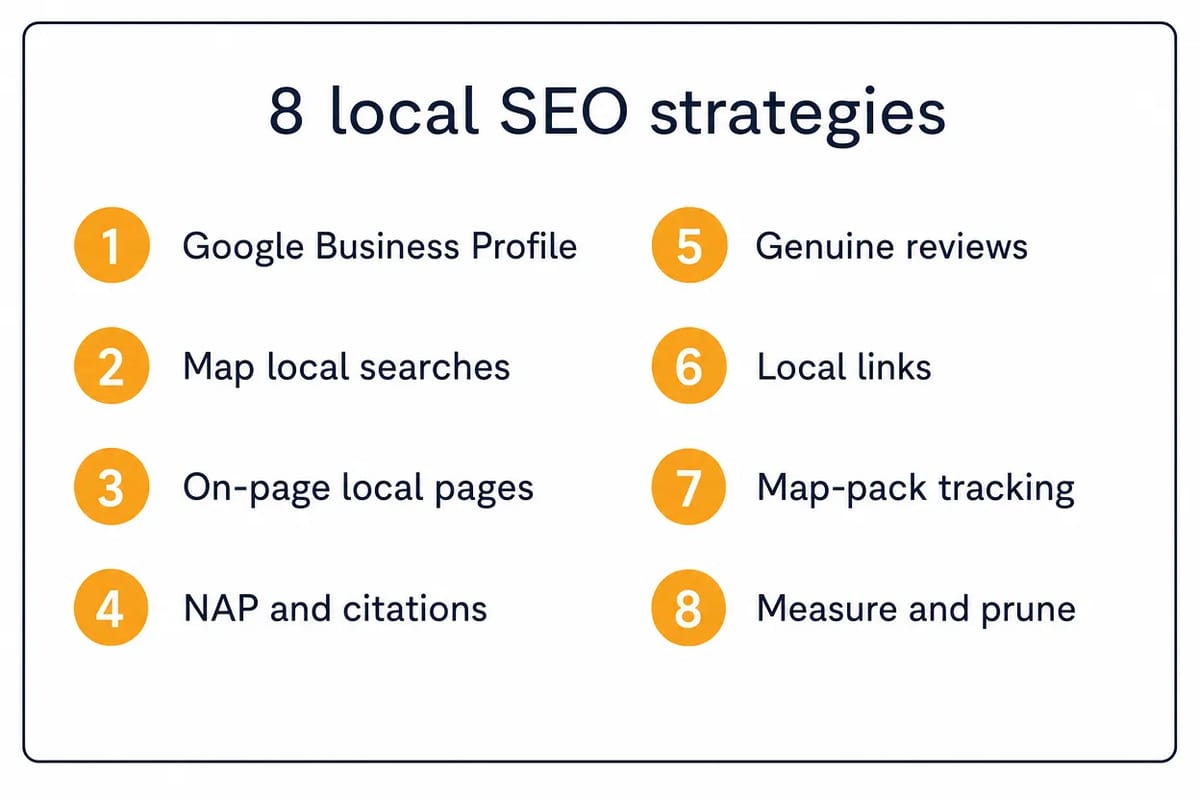
- Your Google Business Profile should describe the real business clearly: category, address or service area, hours, phone number, services, photos, and current details.
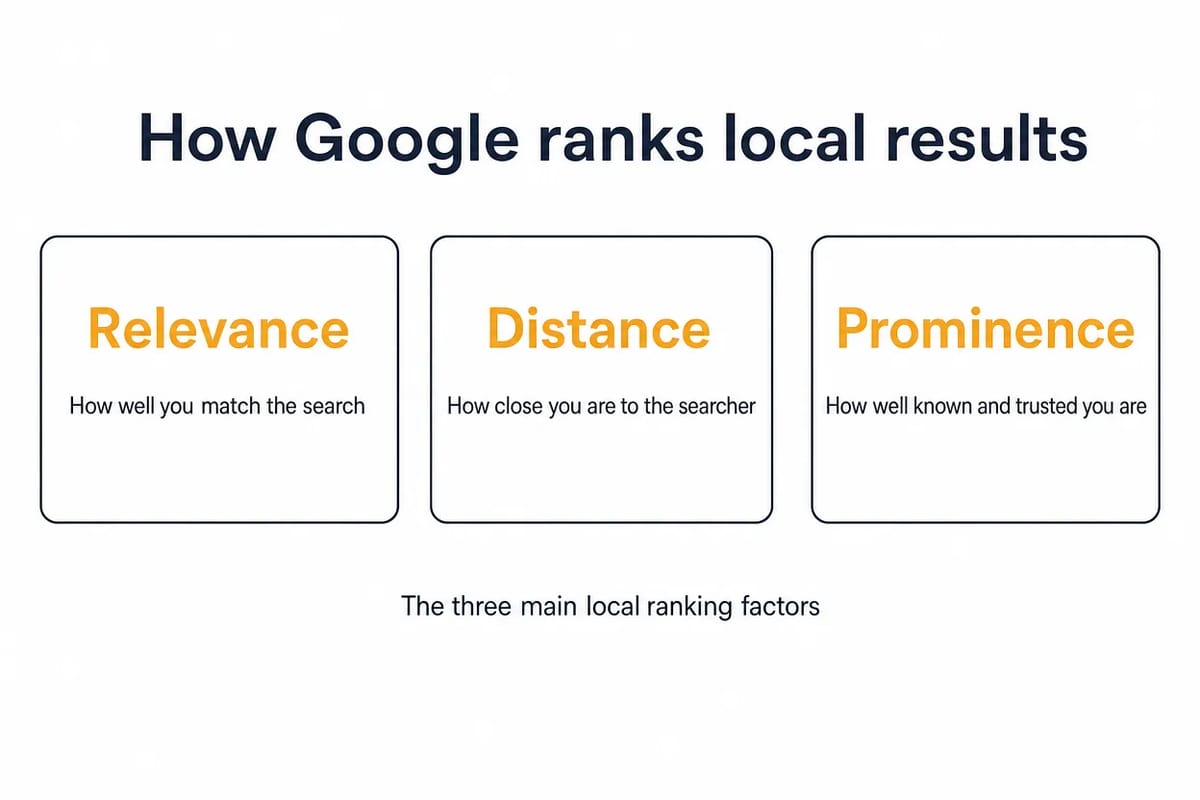
- Google says local results are mainly based on relevance, distance, and prominence. Your strategy should map to those three factors.
- Reviews help when they are genuine. Ask customers neutrally, never gate feedback, and do not offer incentives.
- Citations matter most when they keep your business identity accurate across places customers and search engines already trust.
- Local links should prove real local relevance. Avoid links built mainly to manipulate rankings.
- The map pack needs its own tracking because website rankings and Maps visibility often move differently.
Start with the local ranking model
Local search is not only a set of website tasks. When someone searches from a phone, Google can show a local pack or map pack above the organic results, and that block is shaped by the business profile, the searcher’s location, reviews, links, and what Google understands about your services.
Google’s public local guidance names three main factors: relevance, distance, and prominence. Relevance is how well your profile and pages match the query. Distance is how close you are to the searcher or the place named in the search. Prominence is how well known and trusted the business appears to be, online and offline.
The catch: you cannot optimise distance away. If your plumber is in Bristol, a perfect page will not make the map pack treat you like a business in Leeds. Your job is to make the strongest possible case in the areas you genuinely serve.
Do not build your plan on old headline proof. Older local search stat round-ups, a voice-search study, and historic mobile store-visit data can give context, but your current decisions should come from live queries, profile performance, calls, bookings, and local ranking checks.
1. Optimise your Google Business Profile
Your Google Business Profile is the main local search asset for Maps and local-pack visibility. Treat it like a public branch record, not a set-and-forget directory listing.
Start by checking the accuracy of the record. Use the real-world business name, the correct address or service area, the current phone number, accurate hours, and the fewest categories needed to describe your core business. If your category choice is vague, Google has less to match. If your details are wrong, customers lose trust before they reach your site.
Add the details that help a searcher decide. Your services, products, appointment links, photos, accessibility details, opening hours, and holiday hours all reduce friction. Photos and updates can help customers understand what you offer; they should not be treated as a magic ranking lever.
Keep the profile aligned with the website. If your profile says emergency locksmiths and your service page says general property maintenance, you are making Google and customers connect the dots for you.
Watch for drift in the profile over time. Businesses often change opening hours, add services, move staff, alter service areas, or update phone routing without changing the public profile. Those small gaps create bad calls and weak engagement signals. Put the profile on the same checklist as your website edits so the two do not slowly split apart.
2. Map the searches you can actually serve
Local keyword research is useful when it tells you how people describe the job, the place, and the urgency. It is less useful when it turns into a list of city names you do not genuinely serve.
Group the searches by the intent behind them. Some people name the place, such as “family solicitor in Manchester”. Others imply it, such as “family solicitor near me”. Your content can cover both, but the map pack will still weigh proximity heavily.
Look for terms that match real services, real locations, and real buying stages. A dentist might need separate pages for dental implants, hygienist appointments, emergency care, and children’s dentistry if those services are meaningful parts of the practice. A single page with every town in the county is usually a weak answer.
Intent decides. If a query needs a nearby visit, your profile and reviews may matter more than a long article. If the query needs comparison or detail, your website has more room to help.
Use your own data before expanding. Search Console can show service queries that already earn impressions. Call logs and form submissions can show the language customers use when they ask for help. If those inputs point to the same service-location pair, you have a stronger reason to build or improve a page.
3. Build local pages that deserve to rank
On-page local work should make each important page clearer, not noisier. Your service page needs a plain title, a useful heading, the real service area, practical proof, and enough detail for a customer to know whether you are a fit.
Keep title tags and meta descriptions concise and accurate. A good title can include the service and location, but do not cram in three place names just because a tool surfaced them. Google’s spam policies call out blocks of cities and repeated terms as keyword-stuffing risk.
Use LocalBusiness structured data where it fits the page and the business. Schema can help Google understand your name, address, opening hours, and business type, and it can make a page eligible for rich results. It is not a shortcut around weak content or a poor profile.
Location pages need a real reason to exist. Use them when you have a branch, a staffed service area, local proof, local pricing differences, delivery constraints, or examples from that area. If twenty pages swap only the town name and all funnel people to the same generic form, you are moving towards doorway-page risk.
In practice: write the page you would send to a customer from that area before you worry about the keyword. The local details should help them decide, not decorate the page.
Good local pages usually answer practical questions. Tell the reader which services are available there, how far you travel, what affects price, how booking works, and what proof you have in that area. A short page with specific detail is stronger than a long page full of generic promises.
4. Tighten NAP and citations
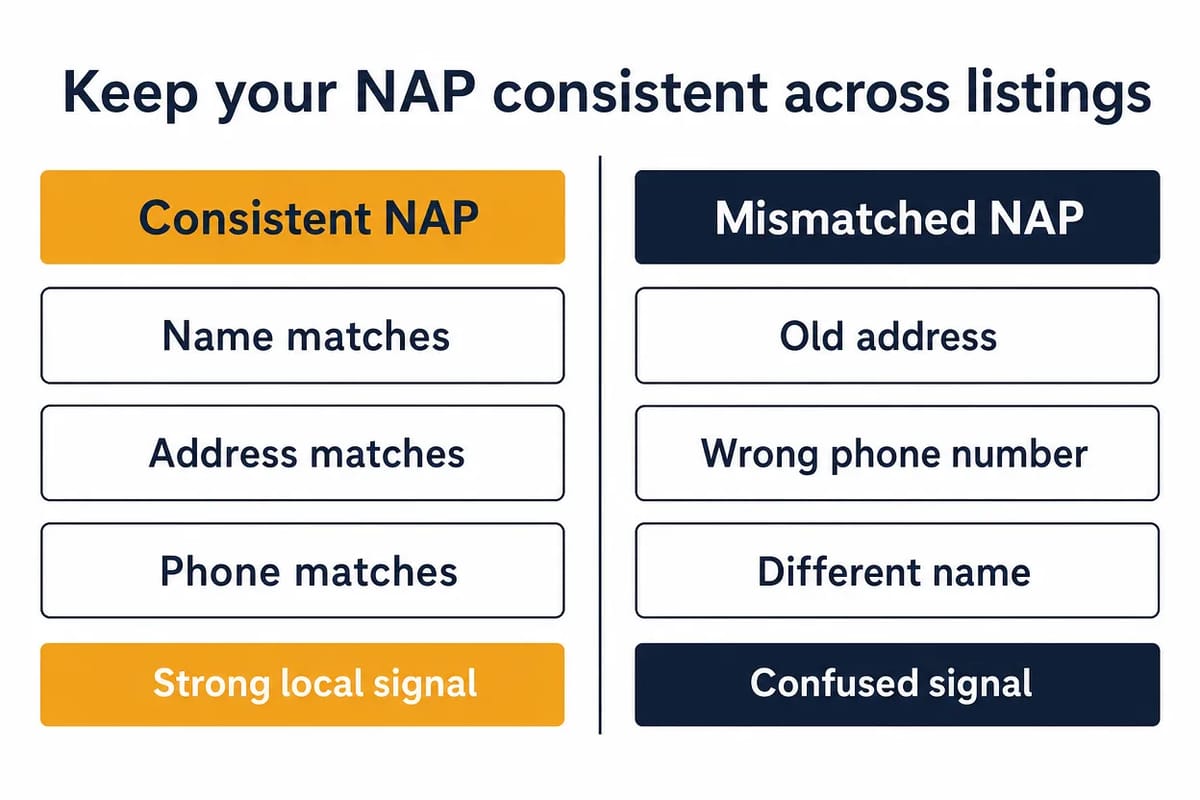
Local citations are mentions of your name, address, and phone number on business directories, social profiles, review sites, local chambers, industry bodies, and other public listings.
The goal is accuracy, not volume. Your NAP should match the real business across the places customers are likely to check. If your old phone number sits on a trade directory, or an old address remains on a local chamber page, you have a trust problem as much as a search problem.
Citation volume alone is noise. Fifty weak listings do not beat a clean set of accurate, relevant profiles. Prioritise Google Business Profile, Apple Business Connect, Bing Places, major review platforms, key industry directories, and genuinely local listings.
Audit citations after a rebrand, relocation, phone-number change, merger, or branch closure. Those are the moments when old data keeps circulating and customers end up calling the wrong number.
5. Build a review process that stays inside Google’s rules
Online reviews affect how customers judge you, and Google says review count and positive ratings can help local ranking. That does not mean you should chase only praise.
Ask every customer in the same neutral way. You can send a review link or QR code after a job, but you should not ask only happy customers, pre-screen sentiment, offer a discount, or ask people to change or remove negative feedback. No gating.
Your reply process matters too. Thank people when the review is clear, answer practical questions, and handle complaints without personal details or arguments. Short, specific replies are usually better than a copied paragraph under every review.
The trade-off: a mixed review profile can look more believable than a wall of perfect ratings. You want real customer feedback, handled well, because that is what future customers read before they call.
6. Earn local links that prove prominence
Local link building works best when the link would make sense even if rankings did not exist. Google can use links as part of prominence, but Google’s spam policies also warn against links created mainly to manipulate search rankings.
Start close to the business. Local newspapers, supplier pages, neighbourhood associations, charities you actually support, event pages, trade bodies, and useful local guides can all be relevant. The link should sit in context and point to the page that helps the reader.
If you sponsor an event, make the sponsorship real and disclose it where needed. If you offer a scholarship, it should be a genuine programme, not a thin link exchange. If you reclaim an unlinked brand mention, ask because it helps readers find the named business.
For teams that need help finding relevant placements, curated link building can fit the local-link tactic — as long as you hold it to strict topical relevance, real sites, and natural anchors. The point is not to buy a shortcut; it is to earn mentions that look at home in the local context.
7. Improve map-pack visibility on purpose
Map-pack tracking needs more care than ordinary rank tracking. Your visibility can change by postcode, device, category, time, and the searcher’s precise location. A single city-level rank check can hide the areas where you are strong and the streets where you disappear.
Track the searches that drive calls, directions, bookings, and quote requests. For each one, check whether you appear in the local pack, whether the profile details are right, and which competitors show up with stronger reviews, better categories, closer locations, or clearer service pages.
You can improve relevance with better categories, services, profile content, and matching pages. You can improve prominence with real reviews, local coverage, and links. You cannot move your address closer to every searcher. That boundary should shape your expectations.
When relevance is clearer, the choice is easier. If two nearby businesses are similar, the one with clearer services, stronger proof, and a cleaner profile gives Google and the customer less work to do.
Check the search results manually as well as through tools. Look at which profiles have photos, which categories they use, how recent the reviews are, and whether the linked page answers the query. Your next action is often visible in that comparison before it shows up in a dashboard.
8. Measure what changes and prune what does not
Tools help you see patterns, but they do not improve rankings by themselves. Use Google Search Console for queries and pages, Google Business Profile performance for calls and direction requests, a rank tracker for local-pack movement, and call or form tracking for actual leads.
Google Keyword Planner can help you estimate demand by area, but use it as a planning input rather than a promise. Ahrefs Rank Tracker or similar tools can monitor locations over time, but you still need to compare that data with leads, booked jobs, and revenue.
Set a monthly review rhythm that someone owns. Check profile changes, review trends, citation errors, local-pack movement, website queries, page conversions, and competitor movement. Keep what helps customers choose you. Remove pages, listings, or link tactics that only exist because someone once called them SEO.
Your best local SEO tips will usually be boring to execute: keep details accurate, answer the real search intent, ask for honest reviews, and earn local proof. That is fine.
Frequently asked questions
What is the difference between local SEO and regular SEO?
Regular SEO can target national or informational visibility. Local SEO targets visibility for searches where place matters, especially Google Maps, the local pack, service-area queries, and location-specific organic results.
Is local SEO free?
Some parts are free to manage yourself, including your Google Business Profile, basic citation fixes, review requests, and Search Console checks. You may still pay for tools, content, technical work, citation cleanup, or link acquisition if you need speed or specialist help.
Is local SEO worth it?
It is worth it when nearby customers already search for your service and your business can serve the areas you target. It is weaker when you have no real local demand, no eligible profile, or pages aimed at places you cannot serve well.
Why is local SEO important now?
Local search puts high-intent customers close to a decision. If your profile is inaccurate, your reviews look unmanaged, or your pages do not explain where you work, a nearby competitor can win the call before your site gets a serious read.
How can I optimise my Google Business Profile?
Use the real business name, choose accurate categories, verify the profile, keep hours current, add services and photos, define the address or service area correctly, ask all customers neutrally for reviews, and reply in a useful, calm way.
Every fact and commercial claim in this guide was fact checked and verified on 16 July 2026.
related Blog Posts



Join 7,000+ Clients Growing with Rhino Rank
Sign Up


Stay ahead of the SEO curve
Get the latest link building strategies, SEO tips and industry insights delivered straight to your inbox.