
 Back to all posts

Local citation building is the work of finding, fixing, and creating accurate local business citations. These are mentions of your name, address, phone number, website, hours, categories, and services across directories, maps, apps, review sites, and local publishers. Start with an audit, clean your NAP, claim the core profiles, add niche citations, then monitor them.
If your local SEO strategy depends on nearby customers finding the right branch, phone number, or service area, citations keep the record of your business accurate wherever it is shown. They sit beside reviews, links and a complete Google Business Profile.
What citation building means
A local citation is any online mention of your business details. The minimum is usually NAP: name, address, and phone number. Many listings also carry your website, opening hours, categories, and photos. They may also include service areas, appointment links, products, and review prompts.
Citation building is the process you use to control those mentions. You audit what already exists, correct wrong data, and remove duplicates where you can. Then you claim the profiles that matter and add new citations on sites that fit your market.
That last phrase matters. A listing on a site people use, such as Google, Apple, Bing, Yelp, Tripadvisor, Angi, a chamber of commerce or a respected trade directory, is the one to claim first.
The catch: you are rarely starting with a blank slate. Old addresses, tracking numbers, rebrands, duplicate profiles, practitioner listings, and third-party edits can all create conflicting citations before you have built a single new one.
Why local citations matter
Google's help pages say local results are mainly based on relevance, distance and popularity. Citations help search systems and customers understand what your business is and where it operates. They also show whether other sources describe it in the same way.
Accurate citations stop avoidable confusion about who you are and where you are.
For customers, the value is even plainer. If your hours are wrong on Apple Maps, your old number is live on Yelp, or your address is split across two formats, people hesitate. Some call the wrong place, while others choose a competitor before you know the data failed.
Whitespark's Local Search Ranking Factors survey, published 6 November 2025, describes its method: "47 of the best and the brightest local search experts are invited to complete a comprehensive 2-hour survey, weighing and scoring 187 factors and answering open-ended questions about what they see driving local search rankings today." It also states its limit: "None of the experts have special access to the internal workings of Google’s local search algorithm." The survey is expert opinion, and Whitespark sells local SEO software and a citation service.
Darren Shaw, who runs the survey, gives his view on why accuracy matters: "If your information is inaccurate on your website, Facebook, BBB, Yelp, TripAdvisor, or any prominent sites in your industry, Google is very likely to automatically update your GBP with that inaccurate data, and it can cause problems with verification as well." On AI search, his view is: "In AI SEO, mentions (citations) are the new link."
A citation is a mention of your business that often carries a link, so citation building sits beside link building as part of off-page SEO. A directory profile and a link placed on a relevant page each do their own job. A link-building campaign does not clean up your NAP by itself.
The citation building workflow
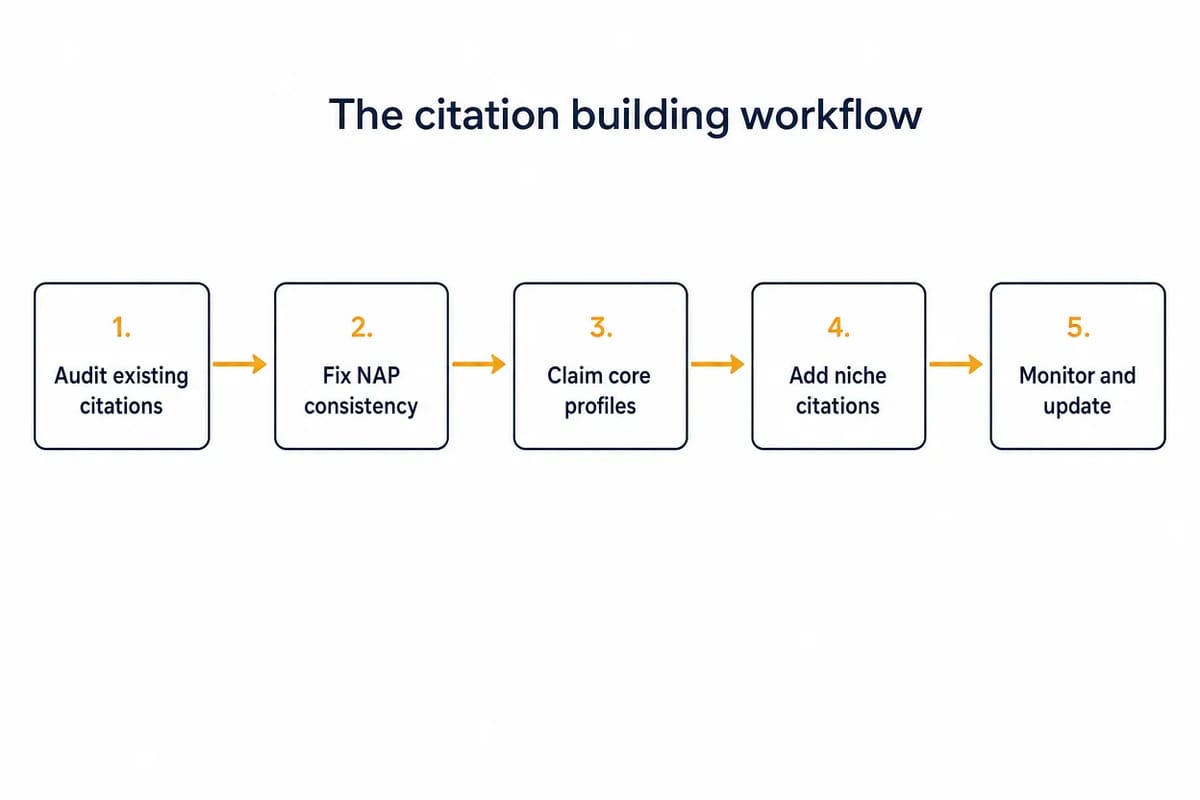
Use this order. It keeps the work practical and stops you adding new listings before the existing mess is under control.
1. Audit your existing citations
Start by searching for every version of your business that may already be online. Use your current name, previous names, old addresses, old phone numbers, practitioner names, branch names, and common misspellings.
You want a simple working list:
- the citation source.
- the live URL, if there is one.
- business name shown.
- address or service area shown.
- phone number shown.
- website URL shown.
- status: correct, wrong, duplicate, unclaimed, or needs review.
Do not stop at page one of Google. Search maps, review platforms, local directories, trade directories, social profiles, and local press mentions. Tools such as BrightLocal Citation Tracker, Whitespark Local Citation Finder, and Moz Local can speed this up. You still need to check the awkward listings manually.
If you already know you have moved premises, changed numbers, combined offices, or switched trading names, run a deeper citation audit. Do this before you build new citations. New listings will not fix old conflicts.
2. Fix NAP consistency
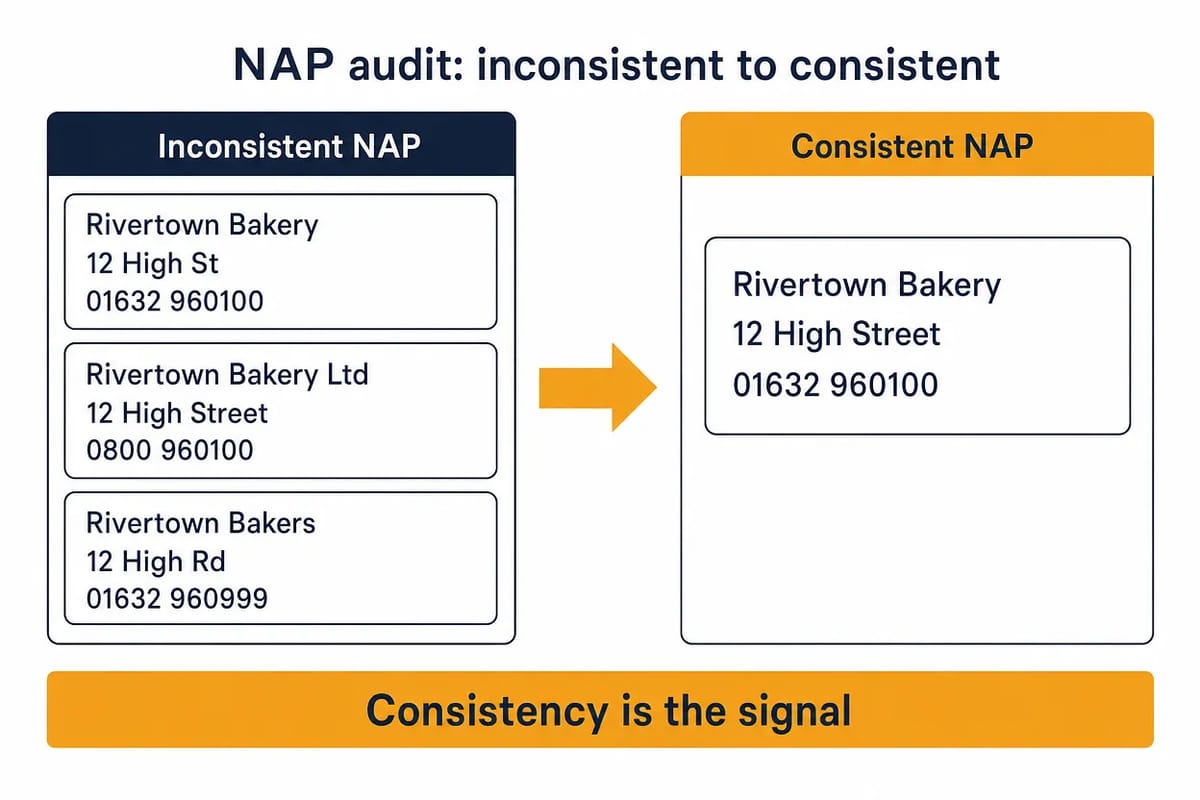
Decide the exact version of your NAP before you edit anything. Use the real-world business name. Use the address format from your website and signage. Use a phone number controlled by the business.
Do not add keywords to your business name unless they are part of the real name customers see in the real world. Google’s Business Profile guidelines say the name should match the business as represented on signage, stationery, website branding, and customer-facing materials. Extra service terms can trigger edits or suspension. City terms can cause the same problem.
Use the same format everywhere you can. If your address is "Suite 4, 18 King Street" on your website, do not scatter "Unit 4", "Ste 4", and "18 King St." across directories unless a platform forces a format.
Service-area businesses need extra care. If you do not serve customers at your address, follow each platform’s service-area rules. Do not force a public street address into every citation.
That is the catch.
3. Claim your core citations
Your first new or corrected citations should be the sources that customers and data systems are most likely to touch.
Claim and complete your Google Business Profile first. Add the right primary category and a careful set of secondary categories. Fill in accurate hours, special hours, service areas, products or services, photos, and a short description that matches what you actually offer.
Then work through the main map, search, and review sources that fit your business:
- Bing Places for Business.
- Apple Business.
- Yelp for Business.
- Facebook or Meta business pages.
- Yellowpages.com.
- Tripadvisor, for hospitality, food, travel, and attractions.
- Angi, for home-service businesses.
Apple announced on 24 March 2026 that Apple Business replaces Apple Business Connect: "Starting April 14, Apple Business will be available as a free service in the U.S. and 200+ countries and regions to new and existing users of Apple Business Connect, Apple Business Essentials, and Apple Business Manager." If you claimed your location under the old name, sign in and check the details carried over.
You do not need every platform on that list. A law firm does not need Tripadvisor, while a restaurant has a much stronger case for it. A plumber should care more about Angi than a medical practice would.
For each listing, fill in the fields properly. Category choice, hours, service descriptions, photos, and review links help customers decide whether your business fits the search. Thin profiles look neglected, even when the NAP is technically correct.
4. Add niche and local citations
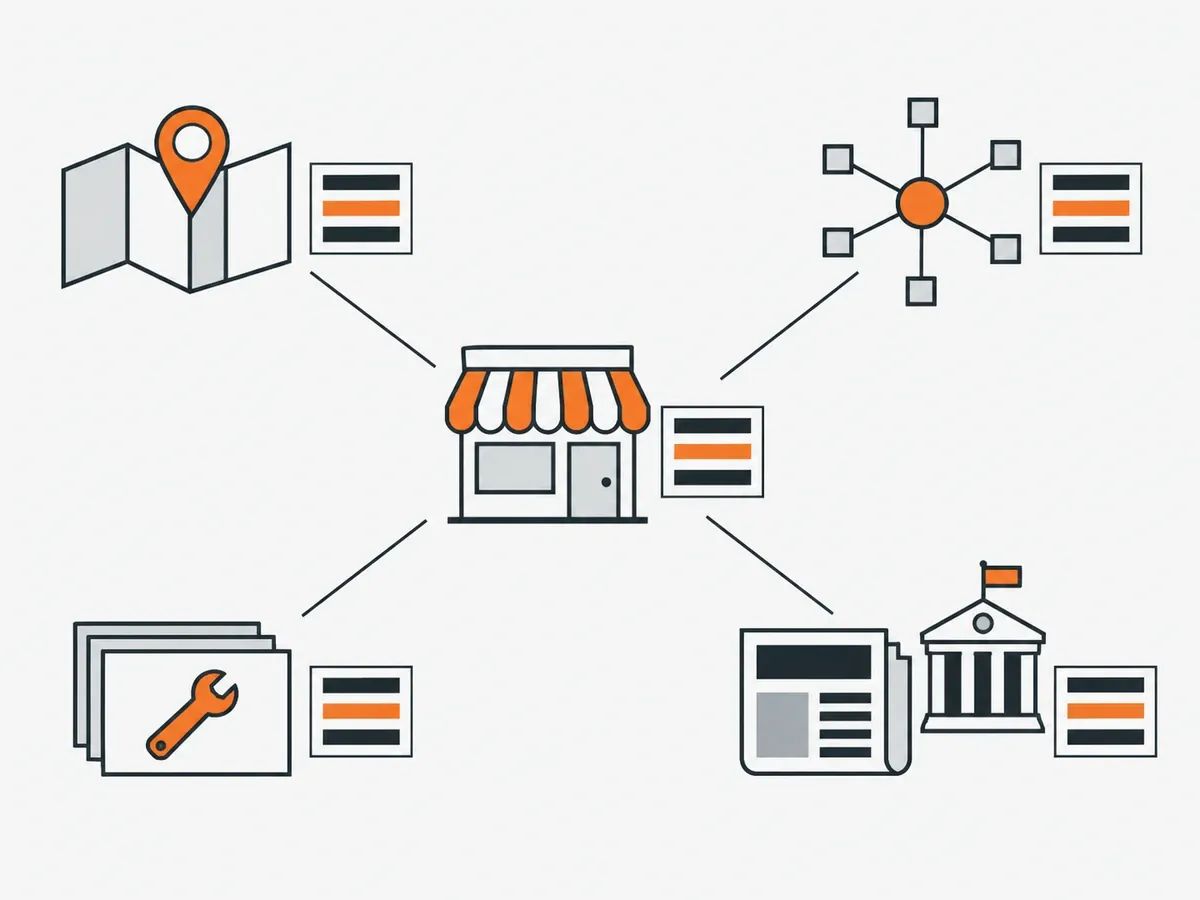
Once the core citations are clean, move to sources that prove local and industry relevance. The niche sources worth claiming are the local, industry and topical sites your customers use.
Look for:
- local chamber of commerce directories.
- council, town, or business-improvement district listings.
- trade bodies and professional associations.
- supplier, partner, or manufacturer dealer pages.
- local newspaper, magazine, and community resource pages.
- niche review or appointment platforms.
The best niche citations match how customers choose a provider. A healthcare practice may need Vitals, Healthgrades, RateMDs, and local clinic directories. If you are comparing this with broader healthcare link building, a listing confirms the practice's details, and a placement carries readers and authority to its pages.
For restaurants, hotels, and attractions, Tripadvisor, Yelp, Apple Maps, Google, local food guides, venue guides, and booking platforms may matter more than generic directories. For trades, check trade bodies, licence databases, home-service platforms, and supplier find-a-pro pages.
Build fewer, better citations. If a site has no editorial control, local audience, topical fit, or clear customer use, leave it out.
5. Treat reviews and social profiles as support
Reviews are not citations in the strict NAP sense, but review platforms often carry the same business data and affect how people judge your listing. Ask customers for reviews in a neutral way, make the review path easy, and respond to useful feedback.
Do not offer discounts, free goods, payments, or other incentives for Google reviews. Ask for honest reviews from real customers and let the rating land where it lands.
Social profiles can support citation consistency too. Your Facebook page, Instagram profile, LinkedIn page, and other active profiles should use the same business name, location, phone number, and website where the platform allows it. If your wider campaign includes social media link building, clean the profile data before you try to earn attention from those channels.
In practice: give social profiles the same name, address, phone number and website as your map, directory and industry citations.
6. Check data providers without using stale lists
Data aggregators and location-data providers can feed business information into directories, apps, navigation systems, and local search products. Old citation advice often says to submit to the same fixed list every time. That list is now easy to get wrong.
Use current provider names and products when you check coverage. Each fact below comes from the provider's own page, read on 3 October 2026. Data Axle says its Local Listings service is free for 1 to 10 listings. TransUnion announced the launch of Digital Business Profile on 23 April 2026, and it says updates are automatically distributed across more than 80 directories, maps, apps and social platforms. Foursquare lists business listings among its location-data products. In the UK, 118 Information says it contacts over 2 million UK businesses every year to make sure their listing details are correct.
You do not always need to submit directly to each data provider. Many listing-management tools push data into the larger networks for you. What matters is that you know which tool or source is changing your data. A bad push can create bad citations at scale.
7. Monitor and update citations
Citation building is maintenance work. Keep a short quarterly check for normal businesses and a monthly check for multi-location businesses, franchises, or brands that change hours often.
Check for:
- wrong phone numbers.
- old addresses.
- duplicate Google, Yelp, or directory profiles.
- missing special hours.
- category drift.
- closed locations still marked open.
- practitioner profiles attached to the wrong office.
- tracking numbers replacing the public business number.
Update citations before a change goes live where possible. Create a citation update plan before a major change. That includes moving, rebranding, opening a branch, closing a branch, or changing a main phone number.
What every good citation should include
The exact fields vary by platform, but your core citation record should be ready before you start building.
Use your real business name. Match signage, website branding, stationery, legal trading context, and the name customers know. Do not stuff service keywords into the name field.
Use a precise address or service area. Storefronts need a real location. Service-area businesses should follow platform rules for hidden addresses, service-area boundaries, and staffed locations.
Use a controlled phone number. A local number is often clearer for customers than a call-centre number, but the main rule is control. Do not use a number that routes to another business. Keep one main phone number on every listing.
Use the correct website URL. For multi-location businesses, send each branch citation to the most relevant location page where possible, not always the homepage.
Set accurate hours, including holiday hours and temporary closures. Wrong hours create real customer friction.
Choose categories carefully and keep them narrow. Pick the fewest accurate categories needed to describe the business. Do not use categories as keyword storage.
Add useful photos where the platform supports them. Photos should help customers recognise the place, product, team, or service area, not act as generic decoration.
Common citation building mistakes
The fastest way to waste citation work is to build before you clean. If your old address is still live across twenty sources, do not add twenty new profiles yet. That only gives search systems and customers more conflicting records to process.
Another common mistake is treating all citations as equal. Claim the map, review and trade sources your customers use first: Google Business Profile, Apple Business, Bing Places, Yelp, and a strong niche directory.
Avoid changing NAP for tracking convenience. Call tracking can be useful. Careless number swaps can break citation consistency. Use a setup that preserves the main business number where citations need it.
Do not create duplicate profiles for the same location. If a duplicate already exists, claim, merge, suppress, or report it through the platform’s process.
Do not let agencies build citations without a handover. You need the logins, URLs, submission list, data used, and any tool pushing updates. Otherwise, your next audit starts from guesswork.
What a citation building service charges
A citation building service submits and corrects listings for you. These are two vendors' published prices as read on 3 October 2026, in US dollars.
BrightLocal's Citation Builder says its manual citation building is "a pay-as-you-go service starting at just $3.20 per listing (or as low as $2 with bulk credits)". It also lists "Expand your reach through 5 Local Data Aggregator Networks for just $30 each."
Whitespark's Listings Service lists "Packages starting at $20 | one-time fee". Whitespark's own statement about results: "Typically, about 30% of our submissions will be live when we send you your report, and they will continue to trickle in over the next few months."
The free routes: Apple Business is free, and Data Axle's free tier covers 1 to 10 listings.
Local citations and local links
Claire Carlile, Local Visibility Expert at Whitespark, answered questions in a Women in Tech SEO Ask Me Anything, on a page last updated 14 November 2025. Her take: "Links matter - especially when they drive traffic. Same with citations!" And on local links: "I love building local links - think relationships first and make a note of all of these."
Joy Hawkins of Sterling Sky, answering the Whitespark survey's question on what is working, said: "Adding new content is still working very well but coming up with topics to write about is harder than it used to be. Link building still works very well as well."
A directory profile is one of the types of backlinks a local business can hold, and a link from a local newspaper or a supplier's site is another. Together they make up part of the business's backlink profile. Links earned from local press and partners are editorial links.
Before a placement goes out we check the publication's indexed pages, organic traffic and its trend, Moz DA, Ahrefs DR and referring domains together, and we check the HTTP status code the target URL returns. After publication, our quality assurance check confirms the page is live, the link is in the body copy, the anchor and target URL match the order and the page is indexable, and only then is the URL reported to the dashboard. Our view: a mention, whether a directory listing or a placement, does its work where the page it sits on can be found, so check the page first.
Citation building FAQs
What is citation building in SEO?
Local citation building in SEO is the process of creating and correcting online business listings that mention your name, address, phone number, website, category, hours, and services. For local businesses, citation building helps keep business data consistent across maps, directories, review sites, apps, and local publishers.
What are examples of local citations?
Local citations include Google Business Profile, Bing Places for Business, Apple Business, Yelp, Yellowpages.com, Tripadvisor, Angi, and Facebook pages. They also include chamber of commerce listings, trade directories, local press mentions, and niche platforms such as Vitals, Healthgrades, or RateMDs for healthcare providers.
How do I build citations for a business?
Start with an audit of existing citations. Fix NAP consistency, claim your core profiles, add relevant niche and local citations, then monitor the listings for changes. If you skip the audit, you may build new citations while old incorrect listings keep spreading bad data.
Are local citations important for SEO?
Local citations support local SEO because they confirm accurate business details and create consistent references across the web. In Whitespark's survey of 47 local search experts, published in November 2025, citation factors are among the 187 factors scored. Citation building works alongside reviews, links and complete profiles.
What is the difference between citations and link building?
A citation is a mention of your business details and may or may not include a hyperlink. Link building earns links from other websites to your pages. A local directory profile can carry both, and each does its own job.
Should I use a citation building service?
A citation building service can help if you have many locations, old NAP conflicts, duplicate listings, or no time to submit and monitor listings yourself. Ask for the citation source list, logins, submission data, and post-build report. Keep profile ownership wherever the platform allows it.
related Blog Posts



Join 7,000+ Clients Growing with Rhino Rank
Sign Up



Stay ahead of the SEO curve
Get the latest link building strategies, SEO tips and industry insights delivered straight to your inbox.