
 Back to all posts

Off-page SEO is the work done on other people's sites, away from our own pages, so that a search engine can find our page and has a reason to show it to searchers. Links are the spine of that work, and every other channel leaves one of four things on a site we do not control: a link, a mention, a review or a citation. This page sets out what each of those parts produces and what each one is for, the order we run the work in on a Rhino Rank order, and how to check that the work is doing its job once it is live on the other site. Nothing on this page promises a ranking or a position.
What off-page SEO is
Edwin Toonen at Yoast, on a page dated 18 July 2025, defines the term in one line: "Off-page SEO is everything you do outside of your website to help it rank better in the SERPs." He draws the line against on-page work in the same breath: "On-page SEO focuses on content, site structure, and technical improvements, but off-page SEO looks at building credibility from outside." Put in our terms: on-page is what we do to our page, and off-page is what other sites say about it. The two halves sit in different places, and only one of them is ours to edit.
A link on another site is also how a search engine comes across a page in the first place, and the search engine's own documentation says so. Google Search Central's SEO starter guide, last updated 10 December 2025, puts the discovery side of links in these words: "Google primarily finds pages through links from other pages it already crawled. In many cases, these are other websites that are linking to your pages." A page with links pointing at it is a page the search engine already has a path to.

What SEO is as a whole is the Rhino Rank guide to what SEO is, and the organic results and their four jobs are the Rhino Rank guide to organic SEO. This page takes the off-page part on its own.
Links are the spine
The link is the one thing on another site that points back at our page. It is how a search engine is pointed at the page, and how the page is shown to be worth showing. Toonen, on the same Yoast page, puts that second part in a single sentence: "Links from other websites tell search engines that your content is worth showing." Everything else in off-page SEO either ends in one of those links or leaves something else behind on the other site.
Editorial.Link, a link-building agency, surveyed 518 SEO professionals for a report dated 25 March 2026, and reports of those respondents: "73.2% believe backlinks influence the chance of appearing in AI search results." That is a belief, held by 73.2% of those respondents.

The two building blocks have their own guides. What link building is as a discipline is the Rhino Rank guide to what link building is, and the unit that discipline works with is the Rhino Rank guide to what a backlink is.
What each channel produces
Each channel is judged by what it leaves behind on a site we do not control: a link, a mention, a review or a citation. The table maps the six channels to those four results and points to the page that covers each one in depth.
What each off-page channel leaves on the other site

Channel | What it leaves on the other site | Where to read more |
|---|---|---|
Digital PR | a link or a mention | this page, below |
Brand mentions | a mention | |
Reviews | a review | |
Citations | a citation | |
Social | a link or a mention, when someone picks the post up | |
Guest posts | a link |
Digital PR
Digital PR leaves a link or a mention, sometimes both. The work is a story placed on news or trade sites: a study, a dataset, an expert comment, something a journalist can use. When the piece runs, it either carries a link back to our page or it names the brand without one, and we count those as two different results. The story is the work. The link or the mention is the result.
In the same survey of 518 SEO professionals dated 25 March 2026, Editorial.Link reports: "48.6% think digital PR is the most effective link-building tactic in 2026." That is a belief about which tactic produces links, held by just under half of those respondents. It is not a measurement of what any campaign produced.
What one campaign produced is on the agency's own page. JBH, a digital PR agency, reports on its Nature's Best campaign page, which prints the year 2026 and lists the campaign type as digital PR and SEO: "Estimated coverage views across major titles reached 4.12 million over the reporting period." For the six-month period the page reports, it adds: "AI citations increased from 784 to 1,307 (+66%)" and "AI impressions increased from 66,980 to 521,511 (+600%)".
Those are the agency's own figures for one campaign, published on a page written to show the work. The windows matter as well: the coverage figure belongs to the reporting period, and the two AI lines belong to the six-month period the page reports. We read them as that campaign's account of itself, and the same contract also covered SEO work, including generative engine optimisation. They do not say what the same work would leave for any other brand.
Brand mentions
A brand mention is our name on another site with no link attached. The site says who we are and does not point at our page. We record a mention as a different result from a link, because it does a different job: the name is out there and read, but nothing on the page leads back to ours.
Reviews
A review sits on a review site or a map listing we do not control, and it shapes whether a searcher picks the business. The review is written by a customer, published on a platform owned by someone else, and read there.
The evidence here is BrightLocal's Local Consumer Review Survey 2026, dated 11 February 2026. The survey says of its sample: "The Local Consumer Review Survey 2026 was conducted using a representative panel of 1,002 US adult consumers via SurveyMonkey."
Myles Anderson, co-founder and CEO of BrightLocal, writes on that page: "Looking at the data from our 2026 survey, what strikes me most isn’t a radical shift in consumer use and attitudes, but rather how remarkably stable and sticky the value of reviews has become." He puts a number against that stability: "Even in a world where people are more aware and more frustrated by the scourge of fake reviews, 97% of consumers still lean on reviews to guide their purchase decisions."
The rest of the figures come from the same 2026 survey of 1,002 US adults. In that survey, 41% of consumers always read reviews when browsing for businesses, up from 29% the year before. The same survey found 31% will only use a business with 4.5 stars or more, up from 17%, and 68% will only use a business with four or more stars, up from 55%. The 2026 survey also recorded use of ChatGPT and other generative AI tools for local recommendations rising from 6% to 45%. And in the same survey, 89% of consumers expect business owners to respond to reviews.
For us, a review is an off-page result in its own right. It sits on the other site, it is read there, and it is counted there, separately from any link. The survey's figures are about consumers in the US, and we treat them as that, not as a count of our own customers.
Citations
A citation is the business's name and details listed on a directory or a data site. It leaves a citation on that site, usually without a link, and it matters most for a business that serves a place. Nothing on the directory page needs to point back at ours for the citation to count. The details have to be the same wherever they appear, because the citation is the same business stated again on another site.
The clearest description comes from Whitespark's 2026 local search report, by Darren Shaw, published 6 November 2025, which sums up citations as "Location data, NAP consistency, citation volume, etc."
Shaw's own view, in his words on that page: "Personally, I believe that AI is revealing how important and foundational citations are for traditional local SEO as well." For us the practical point is simpler. A citation is a result on a site we do not control, it is not a link, and we count it on its own.
Social
A social post lives on a platform we do not control, and the post itself is not the result we count. What we count is what the post starts: someone picks it up, and that pickup becomes a link on their site or a mention of our name there. The link or the mention is the off-page result. The post is the path to it.
When a post does lead to a link, the link is counted with the other links. When it leads to a mention, the mention is counted with the other mentions. We put no figure on social, and we do not claim that a share or a follower count does anything on its own.
Guest posts
A guest post is an article written for another site, and it leaves a link. The article sits on that site's pages, under that site's name, and the link points from the body of the article back to our page.
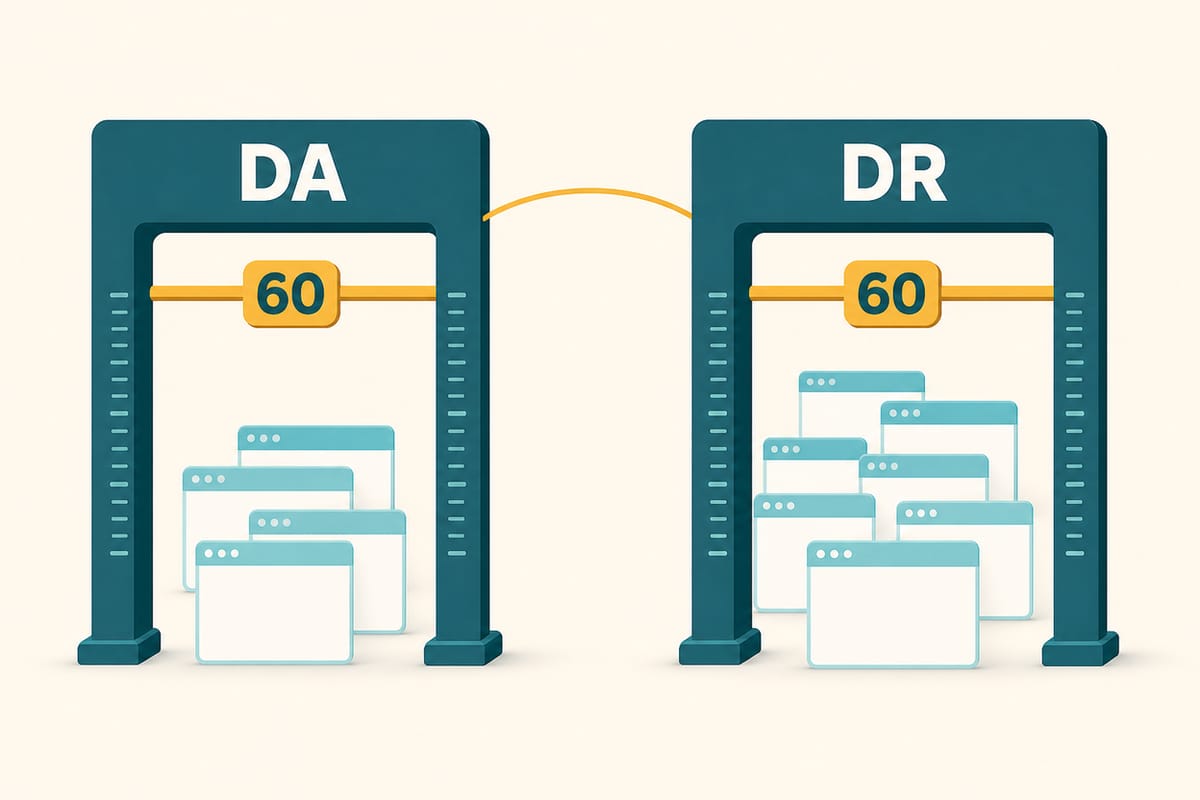
A Rhino Rank Guest Post is a 750+ word article placed on a site from the minimum Moz DA tier chosen at checkout. The link sits in the body of the article, not in a footer or an author box. A person signs the placement off before it goes out, and after publication we check the page and the link against the order.
The result is an article with the link in its body, on a site we have vetted. What the site is chosen by, and what the placement is checked against before and after it goes live, is set out in the measurement section below.
The order we run it in
This is how we run off-page work on a Rhino Rank order.
First, the target. Before any placement goes out on a Rhino Rank order, we check the HTTP status code the client's target URL returns. No dead pages, no redirect chains. A link that points at a broken page is a wasted placement, and a link that points through a chain of redirects is not the link the order describes. The check runs before every placement, not just the first one on an order.
Second, the link. A Rhino Rank Curated Link places the link in an article that already exists on the host site, chosen because the article and the site fit the client's page. A Rhino Rank Guest Post places the link in a new article written for the host site. Either way, the site is one we have vetted, the link sits in the body of the page, and the anchor and the target match the order.
Our published campaigns show the mix, not the order. Of the 34 campaigns published as case studies on our site, and they are the campaigns we chose to publish, not every campaign we have run, Curated Links appear on 30, and 9 name more than one product. The rows describe what those campaigns contained, not the order the work ran in. The 31 of those campaigns that state a length ran for a median of 12 months, which says how long those campaigns ran and says nothing about how quickly any page moved. The stories behind those rows are our published campaign results.
How to see it working
Look at the other site. That is where off-page work lives, so that is where it is checked. For every placement, every story and every listing, the question is the same: what did the other site end up carrying? Is there a link on it that points at our page, or is there only a mention, a review or a citation? Those are different results, they do different jobs, and each is counted on its own.
Greg Jarboe, President and co-founder at SEO-PR, writing in Search Engine Journal on 25 May 2026, describes how the measurement side of this work has widened: "In August 2022, measurement meant organic traffic, impressions, and backlinks. Today, it requires tracking citation frequency in AI-generated answers, monitoring brand mentions in AI Overviews, and separating AI assistant referral traffic from traditional organic."

We look at the other site for a link that points at our page, and we look for a mention, a review or a citation that does not. They are not the same result, and we record them separately. A link can be followed back to the page it points at. A mention, a review or a citation cannot. The two counts answer two different questions: does anything point at the page, and is anything said about it. We keep the two counts apart from the first placement of a campaign to the last.
The checking starts before anything is placed. Before a placement, we weigh the site's indexed pages, its organic traffic and the trend of that traffic, its Moz DA and Ahrefs DR, and its referring domains, together. No single one of those settles the decision on its own. We do not work through networks. The link sits in the body copy of the page, and a person signs the placement off.
After publication, we check the page is live, the link is in the body, the anchor and the target URL match the order, and the page is indexable. Only then is the URL reported to the dashboard. If a delivered link is removed or its page is taken down within 12 months, it is replaced like for like. Guest Posts are tiered by the minimum Moz DA of the site, and Curated Links by the host site's referring domains.
The full list of checks is on our page about link building quality assurance. How to read the numbers over a whole campaign, rather than placement by placement, is the Rhino Rank guide to how to measure a link building campaign.
Where to start
Start with the link, on a page that is ready for it. A page that answers, that is indexed and that deserves to be shown is the page a link can help. A Rhino Rank Curated Link places that link in an article that already exists on a site we have vetted, and the product page's own line is "From just $60 per link". The starting point is one link, in one existing article, pointing at one page that is ready.
Frequently asked questions
What is an example of off-page SEO?
A link to our page inside an article on another site is the clearest example, and a Rhino Rank Curated Link is that link placed in an article that already exists: the article lives on that site, and the link points back to ours. A review of the business on a review site is another. A listing of the business's details on a directory is another. So is the business's name in a news story with no link attached.
Which is more important, on-page or off-page SEO?
Neither replaces the other, because they do different jobs. On-page work makes our page worth showing: the content, the structure and the technical state of it. Off-page work is other sites pointing at that page and vouching for it. A strong page with no vouching struggles to be seen, and vouching aimed at a weak page is wasted.
How can I earn backlinks?
Keep the link as the thing that counts. The routes are a Rhino Rank Curated Link placed in an article that already exists on another site, a Rhino Rank Guest Post written for that site, and a story that ends in a link. In each case the result is the same: a link in the body of a page we do not control, pointing at ours.
How do I check off-page SEO?
Look at the other site. Check whether it carries a link that points at your page, or only a mention, a review or a citation, and track each kind separately. Greg Jarboe's measurement list, in our words: citations in AI answers, brand mentions in AI Overviews, and referral traffic from AI assistants kept apart from ordinary organic traffic.
Where do reviews and local listings fit?
They leave a review or a citation on a site we do not control, so they belong in off-page SEO. The review sits on a review site or a map listing; the citation sits on a directory or a data site. In BrightLocal's 2026 survey of 1,002 US adults, 97% of consumers lean on reviews to guide a purchase, so the review is a result in its own right.
Why does off-page SEO matter?
Because links from other sites tell a search engine that a page is worth showing, as Yoast puts it, and they are how the search engine finds the page in the first place. The rest of the work leaves the brand's name, its reviews and its details on sites the searcher already uses. The work happens elsewhere; the effect lands on our page.
related Blog Posts



Join 7,000+ Clients Growing with Rhino Rank
Sign Up
Stay ahead of the SEO curve
Get the latest link building strategies, SEO tips and industry insights delivered straight to your inbox.