
 Back to all posts
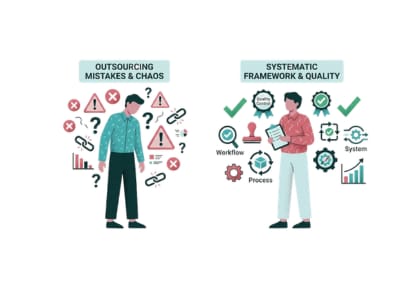
Outsourcing SEO is one of the biggest operational decisions an agency makes. Done well, it extends capacity, accelerates client results, and lets your team stay focused on strategy and relationships. Done poorly, it creates ranking liability, burns retainer budget, and leaves you defending decisions you didn't make to clients who are running out of patience. The gap between those two outcomes often isn't vendor quality. It's the system the agency built around the vendor.
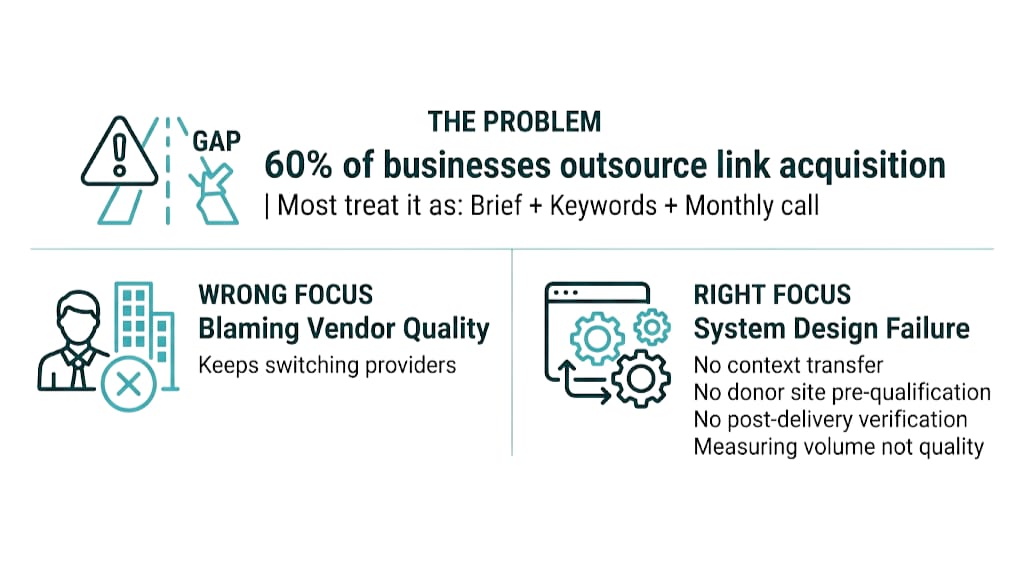
According to Aira's State of Link Building report, approximately 60% of businesses outsource link acquisition. That's most of the market relying on external partners for one of the most technically sensitive, Google-scrutinized parts of SEO. Yet a lot of agencies still treat the handoff as a brief, a keyword list, and a monthly check-in call. The failures that follow aren't surprises. They're predictable.
The bottom line: The most damaging outsourcing SEO mistakes aren't vendor selection errors - they're system design failures. Agencies that hand over execution without transferring context, skip pre-qualification of donor sites, accept deliverables without post-delivery verification, and measure link volume instead of signal quality will plateau regardless of how reputable their provider is. This article diagnoses each failure mode in operational detail and closes with a phased framework you can implement immediately.
Why Outsourcing SEO Fails More Often Than Agencies Admit
Outsourcing fails more than most agencies will admit in public. Campaigns plateau. Rankings stall after an early lift. Clients push back on monthly reports showing link volume up while organic traffic flatlines. Then the agency, stuck between a vendor relationship and a client relationship, absorbs the blame for a system it never properly built.
That system is the issue. Most outsourcing failures don't come from bad vendors. They come from decent vendors working inside broken workflows.
A link building partner can deliver clean placements on high-authority domains and still produce no ranking movement if the anchor text strategy is off, the target URLs don't match the client's conversion funnel, or the content around the placement is thin and topically irrelevant.
Backlinko's ranking factor analysis found that position 1 pages have 3.8x more backlinks than pages ranking in positions 2 through 10. That stat gets used to justify link building spend. It also hides the real takeaway: quality and relevance matter more than raw link count. A mid-market SaaS team spending $3k/month on outsourced link building can rack up 30 to 40 placements over a quarter and still see zero movement if those placements land on off-topic sites that get no real traffic.
No movement creates a second problem: honesty. Agencies oversell outsourcing arrangements to clients - framing external work as internal capability - and then skip any real audit of what they receive. When results disappoint, teams blame the algorithm or point at a Google update instead of looking at the gaps in the outsourcing workflow.
Those gaps show up in the same places every time. The mistakes below are ordered by frequency and impact. A few are vendor selection problems. Most aren't. They're process failures you can fix without switching providers.
Mistake 1: Choosing a Provider Based on Price Alone
Price-led vendor selection is the most visible outsourcing SEO mistake. It's also the one most agencies say they won't make, then make anyway. The reasoning is plain enough: link building is a cost centre, margins stay tight, and a provider offering guest posts at $60 per placement looks better on a spreadsheet than one charging $300. But cheap link building doesn't hold up once you look at the unit economics.
The real cost of a low-quality link isn't the placement fee. It's the liability it creates over time. A link from a site with a manipulated link profile, no organic traffic, or a history of undisclosed paid placements doesn't just fail to help - it signals to Google that the recipient website is involved in link schemes. Google's spam policies are clear: links intended to manipulate PageRank violate their guidelines, and manual actions tied to toxic backlink profiles happen. A $60 placement that triggers a manual review costs far more than the $240 saved versus a reputable provider.
Provider sourcing is where this gets decided. Most agencies never get a straight answer on how donor sites are sourced, even though that sourcing model explains both the price and the risk.
Provider Model | Typical Cost Per Link | Transparency Level | Risk Profile |
|---|---|---|---|
Owned PBN network | $30 - $80 | Low | High |
Brokered marketplace | $80 - $150 | Medium | Medium |
Genuine outreach placement | $150 - $400+ | High | Low |
Niche-specific editorial | $250 - $600+ | High | Very Low |
That pricing tracks the model. A provider selling DR40+ placements at $75 each is almost always running a PBN or buying from a brokered marketplace with weak editorial standards. That's not moralising. It's math. Real outreach, real editorial relationships, and real content creation cost more than $75 to produce.
Before you sign with any link building partner, run a basic pre-qualification pass:
- Ask for 10 to 15 donor sites, then verify organic traffic in Ahrefs or Semrush. DR50+ with under 500 monthly organic visits is a red flag.
- Get their editorial process in writing. How they vet sites, what gets rejected, and why. If they never reject sites, they don't have standards.
- Pull a few recent placements and read the surrounding content. Look for topical mismatch, keyword stuffing, or thin, AI-generated pages.
- Ask directly about PBNs and paid placements. A reputable provider answers without dodging.
- Check rel='sponsored' on delivered links. We'll go deeper on this in Mistake 7, but flag it during selection.
Price is a signal. It just can't be the main one. If a provider prices far below market rate for the quality they claim, treat that as a prompt to audit harder - not to approve a purchase order. For a clearer picture of what legitimate placements should cost at different quality tiers, the link building cost guide breaks down current market rates in detail.
Mistake 2: Handing Over Strategy Alongside Execution
This is the most underdiagnosed failure mode in SEO outsourcing, and most agencies miss it because the damage shows up slowly. The agency hands a vendor a target domain, a keyword list, and a monthly link target. The vendor delivers. Links arrive. Reports look clean. Three months later, there's still no measurable ranking movement. The agency blames the vendor. The vendor points to the deliverables.
The real problem is simpler: strategy was outsourced alongside execution, and the vendor had no context to make good strategic decisions.
Execution without context produces work that looks correct on paper but does nothing for revenue pages. A link building partner can place links on high-DR, topically relevant sites and still drive weak results if they're targeting the wrong URLs, using the wrong anchor mix, or building links to pages that aren't part of the client's commercial conversion path. Those are strategy calls, not execution tasks. And they need business context a vendor, no matter how competent, can't pull from a keyword spreadsheet.
Context gaps are where campaigns die.
A vendor doesn't know that the client's highest-margin product is the one stuck on page 3, not the homepage. They don't know a competitor just acquired a site with 400 referring domains in the same niche and is about to close a large authority gap. They don't know the client's anchor text profile is already over-optimized for exact match terms, and piling on more exact match anchors will create a pattern Google's algorithms flag more aggressively over time. Without that context, even a strong vendor is guessing.
Industry analysis of outsourced campaign performance keeps finding the same pattern: links get delivered, rankings don't move. The fix isn't to hire a better vendor. It's to redesign the handoff.
What to Keep In-House vs. What to Delegate
The most operationally useful framework for outsourcing SEO is a clear division between what stays in-house and what gets delegated. The core principle - that certain SEO functions can't be fully handed off because they depend on business context only the agency holds - applies directly to how the in-house vs. delegate line gets drawn. Here it is.
Keep in-house:
- Anchor text strategy - Anchor distribution across branded, naked URL, exact match, and partial match is a risk call. It requires full visibility into the existing profile and the client's competitive set.
- Target URL prioritization - Which pages receive links, and in what order, is a commercial decision. It depends on funnel structure, conversion data, and revenue priorities.
- Competitor gap analysis - Identifying which competitor pages outrank your client and why takes interpretation, not just a data pull.
- Topical authority mapping - Deciding which content clusters need supporting links to build thematic depth is an editorial and strategy function.
Delegate to your provider:
- Donor site prospecting and qualification
- Outreach and relationship management with publishers
- Content creation for guest post placements
- Scheduling and placement logistics
- Reporting on deliverables
This split keeps strategic control inside the agency while letting the vendor run fast on execution. The brief you send should specify target URLs, anchor instructions, topical relevance parameters, and any sites or site categories to avoid. That level of detail turns a vendor from a link factory into a real extension of your team.
Mistake 3: Skipping Donor Site Pre-Qualification
Most agencies pre-qualify vendors. Very few pre-qualify the individual donor sites those vendors use. That gap is where a lot of outsourced link building value gets burned.
A vendor can be reputable and transparent while still placing links on sites that don't help your client rank. Donor site quality isn't binary - it sits on a spectrum. And the metrics that matter don't always show up in a link report. Domain Rating is the most cited quality signal, but it's also easy to game and a weak predictor of ranking impact on its own.
The metrics that actually predict link value:
Ahrefs' analysis of referring domain count and traffic consistency as durability signals makes the case for prioritising sites with stable, growing organic traffic over sites with high DR but flat or declining traffic. A DR55 site with 2,000 monthly organic visits and a traffic trend that's been growing for 12 months beats a DR65 site with 800 monthly visits and a traffic profile that's been declining since a core update.
Here's what a rigorous donor site pre-qualification process looks like in practice:
- Organic traffic verification. Use Ahrefs or Semrush to confirm the site receives genuine organic traffic. Set a minimum threshold by niche - a specialist B2B publication might have 1,500 monthly visits and still carry real authority. Trend matters as much as the raw number.
- Traffic source distribution. A site receiving 90% of its traffic from a single branded keyword isn't a healthy donor. Look for broad keyword distribution across multiple topics.
- Backlink profile health. Check the donor site's own referring domain profile. A site with 500 referring domains, 400 of which are from the same IP range or share identical anchor text patterns, is part of a network.
- Content quality and editorial standards. Visit the site. Read three or four articles. Thin content, keyword stuffing, AI-generated filler, and weak editorial standards on the host site drag down the value of any link placed there.
- Outbound link patterns. A site that links out to 40 different domains in the same article, or that has a "sponsored" or "partners" page full of commercial links, is monetising its link profile instead of curating it.
- Topical relevance. A link from a high-traffic lifestyle site to a B2B cybersecurity platform carries less topical weight than a link from a mid-traffic tech publication with a real editorial focus on enterprise software. Relevance is a ranking signal in its own right.
The practical implication is that agencies need to build a pre-qualification protocol and share it with their vendor. Don't assume your provider runs these checks to the standard your clients expect. Specify your minimum standards in the contract, and require donor sites to be submitted for approval before outreach begins. This leads directly into the next mistake.
Mistake 4: Accepting Links Without a Pre-Approval Workflow
The standard outsourced link building workflow looks like this: the agency places an order, the vendor sends links, the agency drops them into the client report. No checkpoint sits between delivery and reporting. That gap is a structural failure that lets weak placements slip through without a fight.
That missing checkpoint is exactly what pre-approval fixes. A pre-approval workflow adds review before the link goes live, not after. The vendor surfaces a donor site, proposes the placement, and the agency checks the site against pre-qualification criteria before outreach starts. One process change avoids the ugly scenario where a link lands on a site you would never approve, then the team either swallows it and reports it to the client or rejects it and renegotiates with the vendor.
Building a pre-approval workflow:
The workflow doesn't need to be complex. A shared Google Sheet or a simple project management board with the following columns covers most use cases:
- Proposed donor site URL - submitted by the vendor
- DR and monthly organic traffic - pulled from Ahrefs/Semrush, either manually or via automation
- Topical relevance score - a simple 1-5 rating based on niche alignment
- Agency approval status - approved, rejected, or needs review
- Rejection reason - if applicable. Track it. Over time, this turns into a feedback loop that helps the vendor calibrate future proposals.
The approval turnaround time belongs in the contract. A 48-hour SLA for agency review is standard. Miss the window and the vendor proceeds. That keeps the workflow moving instead of turning review into a delivery blocker.
Some agencies worry that pre-approval adds friction and slows down campaigns. It adds a step. It also cuts wasted placements, protects the client's backlink profile from low-grade additions, and leaves a clear audit trail if questions come up later. Different clients also carry different risk tolerances, and those tolerances need to show up in how links get approved. For agencies managing multiple clients - a local service business versus a regulated financial services brand, for example - pre-approval is the only reliable way to apply the right standards across accounts. If you're looking for a structured way to manage this across accounts, a managed service arrangement can embed these controls by default.
The pre-approval workflow also improves vendor quality over time. Specific, reasoned rejections teach faster than vague complaints about link quality. Give a good vendor three to four months of structured feedback and they start pre-qualifying sites against your criteria before proposals hit your inbox. That's an operational upgrade that pays back every month.
Mistake 5: Ignoring Technical Link Implementation After Delivery
This is the mistake that no competitor article covers, and it's one of the most impactful. Agencies assume that a delivered link is a functional link. That assumption fails often enough to cost real results.
A functional link has to meet technical requirements after delivery, not just exist on a page. If any requirement fails, the placement becomes partially or fully wasted - even if the donor site is strong. Below is the five-point post-delivery verification checklist every agency should run within 72 hours of receiving a link report.
1. Confirm the link is live and crawlable. Use a tool like Screaming Frog or Ahrefs' Site Audit to verify the link exists on the live page and isn't buried in JavaScript that Googlebot can't render. JavaScript-rendered links show up as a frequent implementation failure on modern CMS platforms. If Googlebot can't see the link, it doesn't count as a ranking signal.
2. Check for redirect chains. The target URL in the placement should resolve in one step, not through a chain of 301s. A link pointing to a URL that redirects twice before reaching the intended page bleeds PageRank at each hop. If the client's website has been through a migration or URL restructure, this failure shows up a lot.
3. Verify the rel attribute. Per Google's link attribute documentation at developers.google.com/search/docs/crawling-indexing/qualify-outbound-links, links with rel='sponsored' or rel='nofollow' do not pass PageRank the same way as editorial dofollow links. Some vendors place links that meet the delivery definition but carry undisclosed sponsored attributes - either because the publisher adds them after placement or because the vendor never disclosed how the placement would be treated. Check every link.
4. Confirm the anchor text matches the brief. Anchor text drift - where the vendor or publisher changes the agreed anchor text during implementation - happens more than agencies expect. A brief specifying a branded anchor that arrives as an exact match commercial term can push an already-sensitive anchor profile in the wrong direction.
5. Verify the page is indexed. A link on a page that Google hasn't indexed passes no authority. Check the placement URL in Google Search Console's URL Inspection tool or via a site: search. If the page isn't indexed, flag it to the vendor the moment you see it.
Running these five checks takes about 10 to 15 minutes per link. For a campaign delivering 10 links per month, that's under three hours of verification work - a small investment relative to the cost of the placements themselves.
Mistake 6: Measuring Output Instead of Signal Quality
Link count is the metric most agencies report to clients. It's also the metric least predictive of ranking outcomes. Reporting 15 links delivered this month tells the client almost nothing about whether those links will move rankings, hold their ground, or turn into a liability.
Moving from output measurement to signal quality measurement means tracking a different set of metrics - ones that take more work to pull, but actually explain campaign health.
Output metrics (what most agencies track):
- Links delivered per month
- Average Domain Rating of placements
- Total referring domains
Signal quality metrics (what agencies should track):
Metric | Why It Matters | How to Measure |
|---|---|---|
Referring domain traffic trend | Indicates whether donor sites are gaining or losing Google's trust | Ahrefs/Semrush monthly traffic for each donor |
Topical relevance distribution | Shows whether links are building genuine authority in the client's niche | Manual review against niche taxonomy |
Anchor text distribution | Tracks risk of over-optimization | Ahrefs backlink profile, anchor text report |
Link velocity consistency | Unnatural spikes trigger algorithmic scrutiny | Month-over-month new referring domains |
Indexed placement rate | Measures what percentage of delivered links are actually crawlable | GSC URL inspection, site: searches |
The Ahrefs analysis on referring domain count and traffic consistency matters here. Referring domains with stable or growing traffic tend to hold value because they signal the donor site still sits in Google's good graces, which means the link keeps passing authority. A link from a site that drops 40% of its organic traffic in a core update turns into a shrinking asset. Donor site traffic trends, checked quarterly, give agencies an early warning that placements are getting devalued before rankings start sliding.
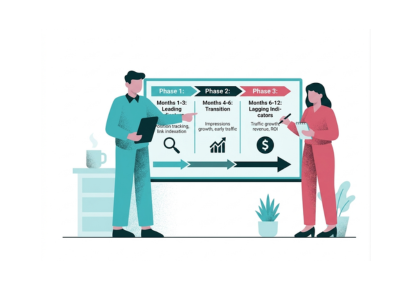
The practical reporting shift is simple: stop leading with a "links delivered" table and lead with a signal quality dashboard. Include donor site traffic trends, anchor text distribution changes, and indexed placement rates next to the usual volume metrics. It takes longer to build. But it gives clients - and our own strategists - a clearer read on whether the campaign is building durable authority or just generating activity. For a deeper look at the key link building metrics that actually predict ranking outcomes, it's worth building these into your standard reporting template from the start.
Mistake 7: Failing to Brief Against PBNs and Sponsored Placements Explicitly
Assuming your vendor won't use PBNs or undisclosed paid placements, unless you spell it out in the brief, is one of the more expensive assumptions an agency can make. Not because all vendors act in bad faith, but because "PBN" and "sponsored placement" don't mean the same thing to everyone. Providers draw the line in different places.
Some vendors call a site a PBN only if it's a pure link farm with thin content. Others use a tighter definition: any site built mainly to sell links instead of serving an audience. That gap creates predictable friction. Without a written brief that states your standard, a vendor working under the looser definition will deliver placements you'd flag as PBN-adjacent - and both sides will think they're in the right.
Google's spam policies are unambiguous on this point. Links that are part of link schemes - including networks of sites created to pass PageRank - violate Google's guidelines and can trigger manual actions against the target domain. This isn't theory. Agencies that outsource link building without clear PBN exclusions end up absorbing penalties for clients who hired them to control risk.
The brief should specify:
- No PBNs or private blog networks of any kind, including sites that exist primarily to sell links
- No undisclosed paid placements - if a link is paid for, the publisher must not add rel='sponsored' without disclosure to the agency
- No link exchanges or reciprocal linking schemes without prior written approval
- Minimum traffic thresholds for donor sites (e.g., 1,000+ monthly organic visits from Google)
- No placements on sites that have received manual actions in the past 24 months
Put these requirements in the contract, not just the brief. A vendor who won't agree to them in writing is telling you exactly how they plan to operate.
Mistake 8: Not Establishing a Communication and Feedback Loop
Communication failures in outsourced SEO relationships rarely show up as a blow-up. Nobody misses a deadline in a way that triggers an escalation. The vendor slides toward easier placements, the agency stops reading reports with real intent, and six months later both sides are staring at the same numbers with different assumptions about what went wrong.
A set communication cadence stops that slow drift. Keep it simple. In most outsourced link building setups, this rhythm holds:
- Weekly: A short async update from the vendor: prospecting progress, pending approvals, and publisher rejections. Enough to keep the account team in the loop without forcing a call.
- Monthly: A 30-minute review call that covers delivered placements, signal quality metrics, anchor text distribution, and the next month's plan. Strategy changes happen here, not in email chains.
- Quarterly: A deeper strategic review focused on ranking movement, competitor authority shifts, and whether current link velocity and placement mix still match the client's goals.
That cadence only works if the feedback loop works. Most agencies skip this part, then wonder why quality doesn't tighten over time. If a placement gets rejected or underperforms, document the reason and send it back to the vendor. If a placement performs well - if a specific donor site lines up with ranking movement - log that too. This two-way feedback turns a vendor into part of the delivery system, not just a fulfilment line.
Specificity is the difference-maker.
"These links aren't performing" doesn't give anyone a next step. "The last three placements were on sites with declining traffic and no topical alignment with the client's SaaS niche - here are the metrics that concern us" gives the vendor something concrete to fix. Specific feedback drives specific changes.
How to Build an Outsourcing Framework That Doesn't Break Under Scale
The mistakes in this article come from the same root issue: agencies treat outsourcing like procurement, not systems design. They pick a vendor, place an order, and assume the vendor's quality controls will replace the agency's own process. They won't. As the agency scales - more clients, more niches, more link volume - the cost of not having a framework shows up fast.
A framework has to survive scale.
Here's a phased outsourcing framework built to hold up as volume grows. It's designed for agencies running outsourced link building across multiple client accounts at once, but the core mechanics work at any size.
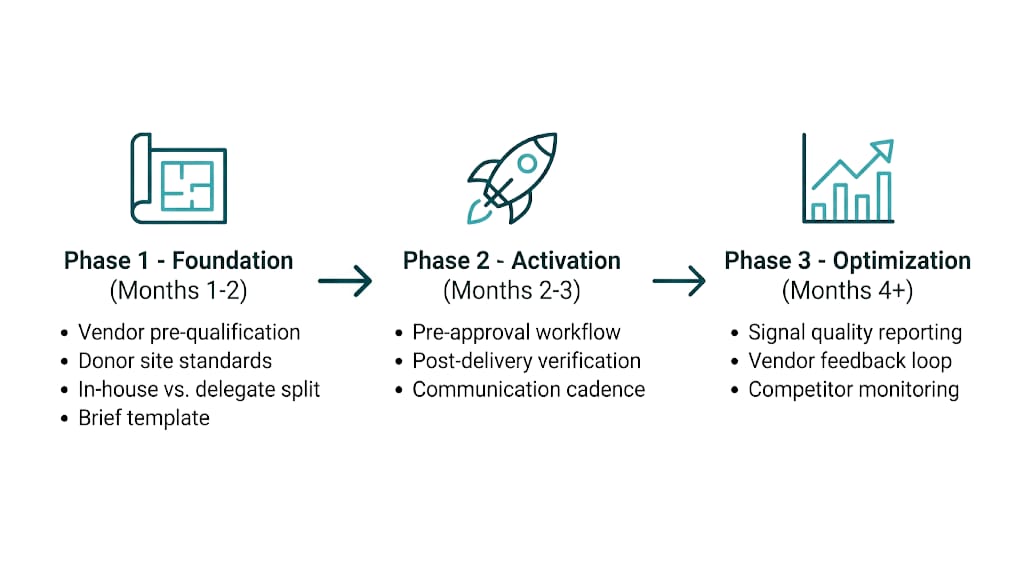
Phase 1: Foundation (Months 1-2)
Before placing a single order, lock in the structural pieces everything else depends on.
- Vendor pre-qualification protocol. Write down minimum standards for provider selection: transparency requirements, PBN exclusion clauses, pricing thresholds, reporting expectations. Turn it into a standardized scorecard and use it every time you assess a new provider.
- Donor site quality standards. Set your minimum thresholds for organic traffic, DR floor, topical relevance, and outbound link patterns. These become the rules behind your pre-approval workflow.
- In-house vs. delegate division. Decide what stays in-house (anchor text strategy, target URL prioritization, competitor gap analysis) and what the vendor owns (prospecting, outreach, content, placement). Put it in writing so it doesn't change based on who's managing the account.
- Brief template. Build a standardized brief template with target URLs, anchor text instructions, topical parameters, excluded sites and categories, plus PBN/sponsored placement exclusion clauses. Every order goes out in this format.
Phase 2: Activation (Months 2-3)
With the foundation set, put the workflows into motion.
- Pre-approval workflow. Set up the shared approval system - project management board or spreadsheet - then agree on turnaround SLAs with the vendor. Review every proposed donor site before outreach starts. No exceptions early on.
- Post-delivery verification protocol. Assign a team member to run the five-point technical check on every delivered link within 72 hours, log results, and flag issues to the vendor right away.
- Communication cadence. Schedule the weekly async update, the monthly review call, and the quarterly strategic review. Book them for the full contract term so they don't "slip" when things get busy.
Phase 3: Optimization (Months 4+)
Once the system runs cleanly, focus on tightening it.
- Signal quality reporting. Move client reporting away from output counts and into signal quality dashboards. Track donor site traffic trends, anchor text distribution, indexed placement rates, and link velocity alongside raw volume.
- Vendor feedback loop. Keep a record of rejection reasons, performance correlations, and strategy changes. Share it with the vendor every month. Then use it to refresh the brief template quarterly.
- Competitor monitoring. Run a quarterly competitor authority analysis, identify gaps, and adjust link velocity or target URL prioritization to match. Outsourced execution has to keep pace with the competitive environment, or it turns into busywork.
This framework scales because it runs on documented standards, not individual judgment calls. Add a new client and you apply the same brief template, the same pre-qualification criteria, and the same verification protocol. Add a new vendor and you run the same scorecard. The system carries quality control, not the account manager.
At Rhino Rank, our managed link building service is designed to operate inside this kind of framework. We support pre-approval workflows, provide full donor site transparency, and deliver against agency-defined anchor text briefs - so your team keeps strategic control while execution scales with ours.
Frequently Asked Questions About Outsourcing SEO
What are the most common outsourcing SEO mistakes agencies make?
The biggest mistakes are process-related. Full stop.
Teams hand over strategy with execution, which leaves vendors guessing and making calls without the commercial context. Donor site pre-qualification gets skipped. Links get accepted without a pre-approval workflow. Post-delivery technical verification doesn't happen. And reporting drifts into counting link volume instead of judging signal quality.
These are process failures, not vendor selection failures. That matters, because you can fix them without switching providers.
What should agencies keep in-house when outsourcing SEO?
Keep the decision layer in-house: anchor text strategy, target URL prioritization, competitor gap analysis, and topical authority mapping.
Those choices depend on full visibility into the client's commercial goals, current backlink profile, and what the SERP is actually rewarding in that niche. Outsource the execution layer instead. Prospecting, outreach, content creation, and placement logistics all make sense to delegate to a qualified provider.
How can you tell if an outsourced link building provider is using PBNs?
Ask for a sample list of 10 to 15 donor sites, then verify their organic traffic in Ahrefs or Semrush.
High DR with fewer than 500 monthly organic visits is a red flag. So is a backlink profile clustered in a single IP range. No real editorial content is another.
Also ask the provider to explain their sourcing model. A reputable provider gives a straight answer. Put it in writing too: include an explicit PBN exclusion clause in the contract.
What technical checks should agencies run after link placements are delivered?
Run five checks within 72 hours of delivery:
- Confirm the link is live and crawlable - not hidden in JavaScript.
- Check the target URL for redirect chains.
- Verify the rel attribute is dofollow and not rel='sponsored' or rel='nofollow'.
- Anchor text should match the brief.
- Confirm the placement page is indexed in Google Search Console.
This takes 10 to 15 minutes per link. It catches a large share of implementation failures before they show up in client reports.
Why do outsourced SEO campaigns plateau even when links are being delivered?
Plateaus happen when delivery continues but the work drifts off strategy.
Anchor text distribution gets over-optimized around exact match terms. Links go to URLs that sit outside the client's commercial conversion path. Donor sites lose organic traffic over time, and with it, Google's trust. Placements land on topically irrelevant pages, so they don't add to the client's thematic authority.
Signal quality fixes this. Shift measurement away from output and toward indicators like donor traffic trends, anchor distribution, and indexed placement rates. That shift normally surfaces the cause within one reporting cycle.
related Blog Posts



Join 7,000+ Clients Growing with Rhino Rank
Sign Up

Stay ahead of the SEO curve
Get the latest link building strategies, SEO tips and industry insights delivered straight to your inbox.