
 Back to all posts
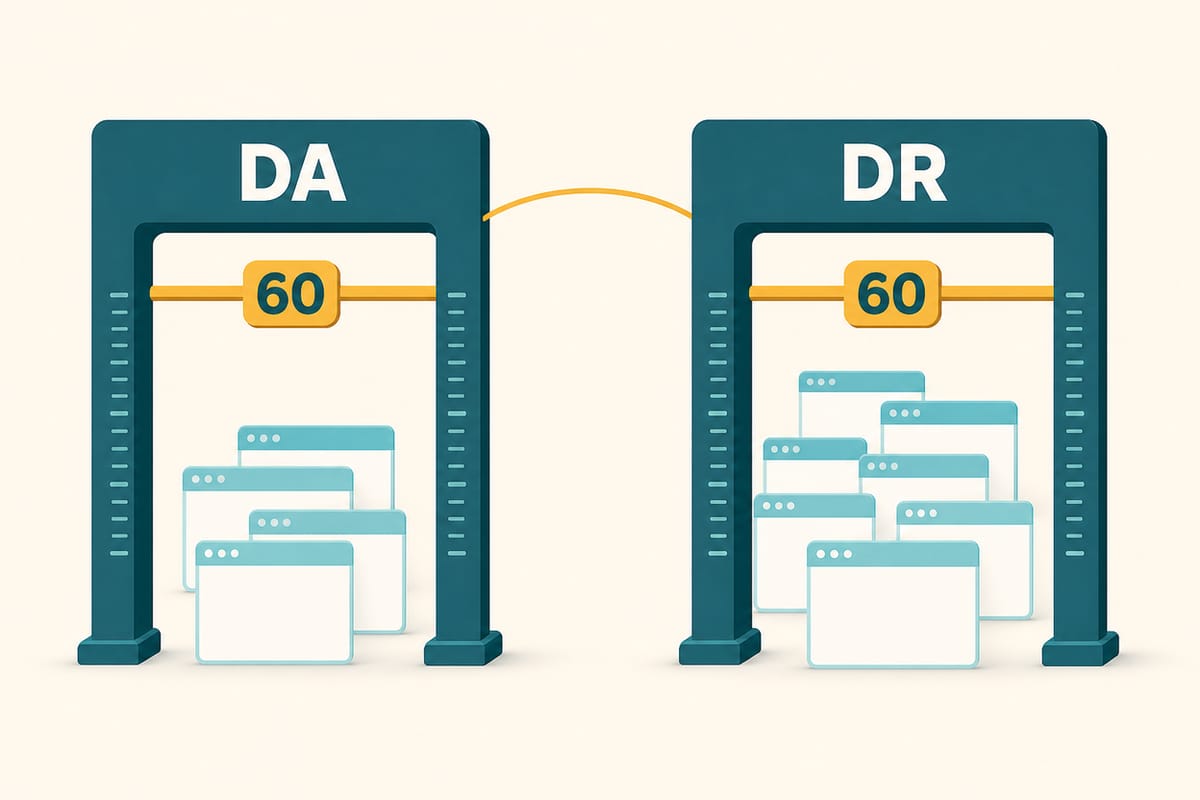
A Domain Authority (DA) requirement between 20 and 60 translates into a specific Domain Rating (DR) range, and the two numbers are rarely the same. Keeping the same figure on both scales selects a materially different pool of websites, because Moz and Ahrefs build their scores from different crawls and different maths.
We tested this against 21,108 websites carrying both scores, using an outside visibility measure that neither vendor supplies. The result is five threshold-to-range conversions, a worked example at DA 60, and a clear boundary where the mapping stops. If your brief names a DA minimum and your tool only filters by DR, the ranges below are the instruction.
The same number on the two scales is not the same bar. A DA 60 filter and a DR 60 filter admit different-sized groups with different visibility profiles, and the reader gets a matched range that accounts for that gap — a range that stops at DA 60, because the data does not support anything higher.
The threshold selects the pool
When a link-building brief says "DA 50 minimum," that number is doing one job: it draws a line through a list of candidate websites and keeps one side. Every site on the kept side passes; every site on the other side is invisible to the rest of the workflow. If the line is drawn in the wrong place, the per-site checks that follow — relevance, content quality, traffic — are examining the wrong population. No amount of individual review fixes a pool that was mis-selected at the threshold stage.
Moz's Domain Authority and Ahrefs' Domain Rating both run on a 0-to-100 or 1-to-100 scale and both top out at 100. That shared ceiling is why keeping the same number feels like a reasonable instinct. The two scales do not share a lower bound, though, and the distributions between those bounds are shaped by different crawls, different link indexes, and different scoring maths. In practice, the same cut-off number on each scale admits a different set of websites with a different visibility profile. The threshold is a rule that selects a population, and the rest of this article is about translating that rule from one scale to the other.
What Domain Authority and Domain Rating measure
Domain Authority (DA) is Moz's 1-to-100 prediction of how likely a domain is to rank relative to other domains in Moz's index. It is not a direct Google ranking factor; Moz describes it as a comparative score for weighing one site against another, and the calculation draws on link counts, root domains, and a machine-learning model trained against Moz's own keyword sets. The full mechanics are in its own documentation.
Domain Rating (DR) is Ahrefs' relative measure of backlink-profile strength in the Ahrefs database, expressed on a 0-to-100 scale. It positions one domain's link profile against every other domain Ahrefs has crawled, so the number is useful for comparison rather than as an absolute grade. The scoring logic is in Ahrefs' help documentation.
Google uses neither score as a ranking signal. DA and DR are third-party measures built from different data by different companies. For a fuller treatment of how they differ in construction and use, see our full comparison of the two scores.
On 28 August 2026, a US desktop Google search for this topic returned an AI Overview suggesting DR 55–65 as equivalent to DA 60, and DR 50 as equivalent to DA 50, while also warning that there is no exact one-to-one formula for an individual website. That is the useful distinction: the ranges below translate screening thresholds for groups, while one website's DA and DR remain separate measurements.
How we matched DA thresholds to DR ranges
To translate a threshold, you need a yardstick that sits outside both scoring systems. If you compare DA and DR only against each other, you are asking one vendor's number to validate the other's, and the circularity is complete. The yardstick here is the count of distinct US English-language Google searches for which a domain appears in the top 100 results, pulled from DataForSEO's Labs database on 28 August 2026. DataForSEO is independent of Moz, Ahrefs, and Rhino Rank. The measure captures breadth of appearance — how many different searches a site shows up in — rather than position within those results or traffic quality.
Before the first matched figure, one definition. "Typical" here means the middle website in a group: half the sites in that group rank for more US English-language searches, half rank for fewer. It is a median — the middle value — not an average, and not a floor.
The 21,108 domains came from Rhino Rank's free checker. In our Curated Links work, this range sets the size and shape of the pool before individual review begins.
The table below is the conversion. Each row translates a DA screening minimum into the DR range whose group has a comparable middle on the visibility measure.
If the requirement is | Visibility-equivalent DR range | Closest DR match | Typical US ranking keywords (DA group) | Typical US ranking keywords (DR group) | Websites in pool (DA / DR) | Gap between middles |
|---|---|---|---|---|---|---|
DA 20+ | DR 12-18 | DR 15 | 176 | 173 | 11,632 / 12,071 | 1.7% |
DA 30+ | DR 21-27 | DR 25 | 297 | 293 | 9,175 / 10,360 | 1.3% |
DA 40+ | DR 34-39 | DR 37 | 659 | 675 | 6,299 / 7,753 | 2.4% |
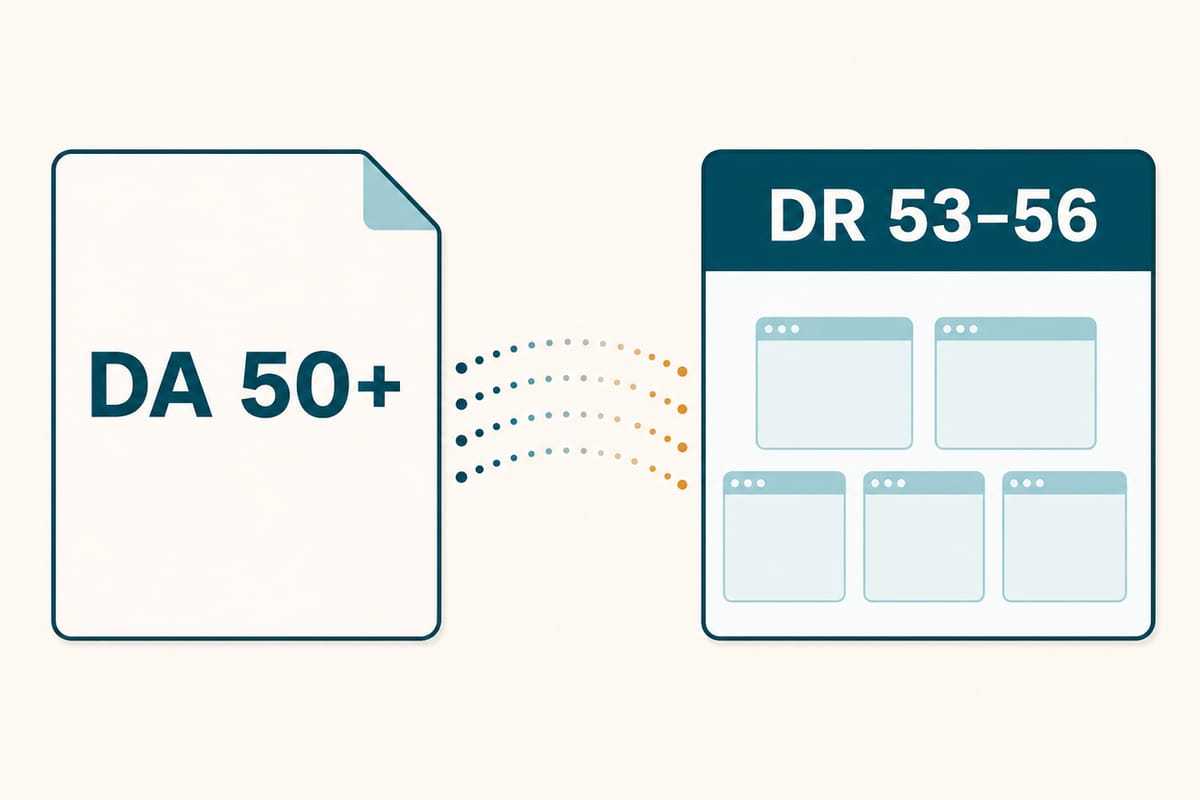
DA 50+ | DR 53-56 | DR 54 | 2,418 | 2,351 | 3,907 / 4,736 | 2.8% |
DA 60+ | DR 71-72 | DR 72 | 8,900 | 9,316 | 2,199 / 2,327 | 4.7% |
Read the range as the instruction and the single number as the closest observed match inside it. Every printed-range cut-off landed within 20% of the DA group's middle; the five closest matches sit within 5%. Choosing a point inside the range changes how many candidates you keep. The DR 54 group has an even number of websites, so its exact median is 2,350.5 and the table rounds it to 2,351.
DA 40 is the one published row where the matched DR middle (675) sits above the DA middle (659). The direction reverses there, although the gap remains only 2.4%.
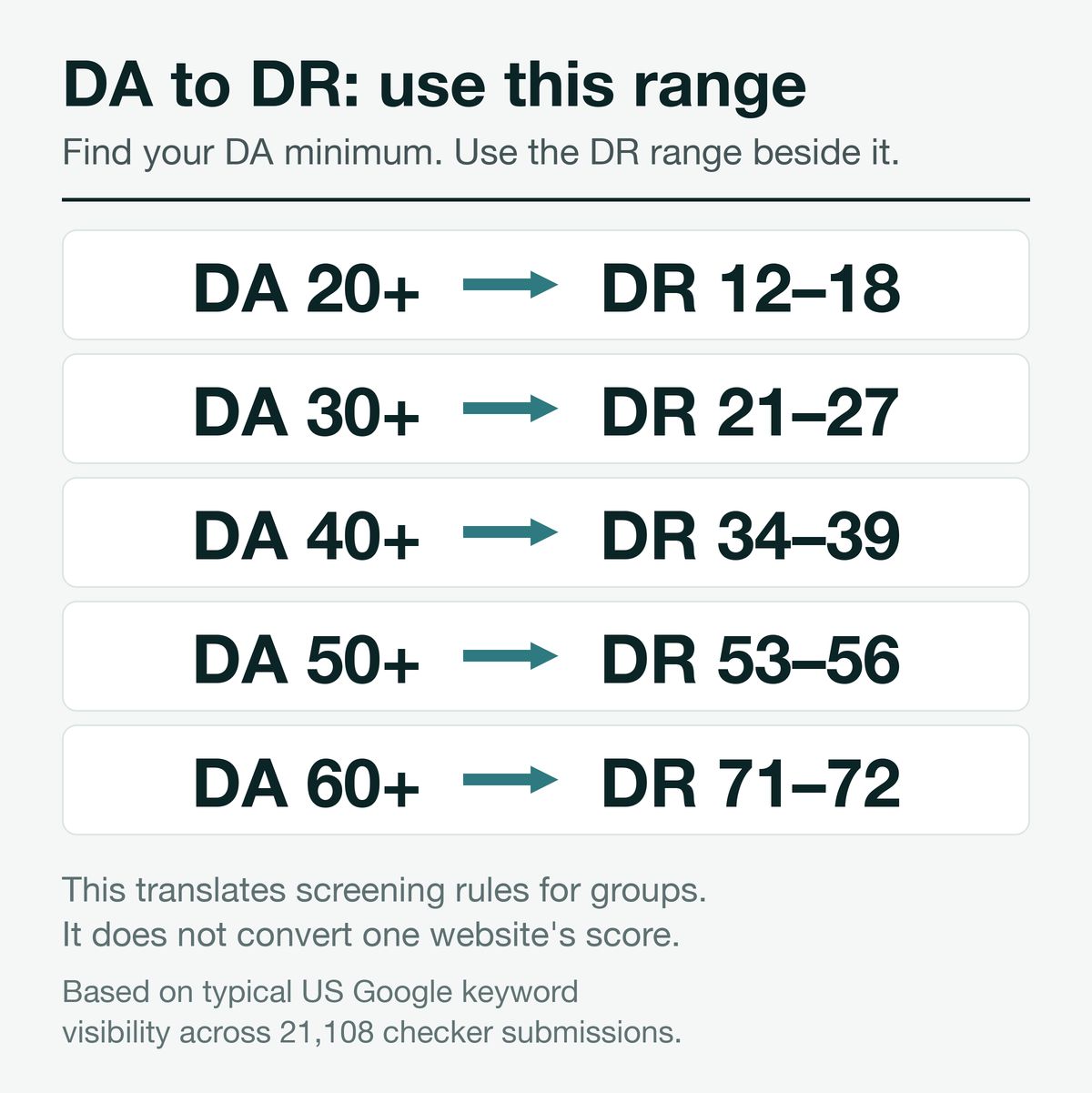
Each row stands for a group of thousands of websites. The middles match closely; the mismatches that matter for an individual placement decision live inside those groups, where one site's keyword profile can sit far from the group's centre.
How a DA threshold maps to a DR range
The DA 60 row is the one that changes a real decision most visibly, so here it is worked through.
The DA 60+ pool admitted 2,199 websites — about one in ten of the full sample. The middle site in that pool ranked for 8,900 distinct US English-language searches. If you type DR 60 into the filter instead, the DR 60+ pool admits 3,850 websites, roughly three-quarters more. The middle of that larger pool ranked for only 3,621 searches: not even half the visibility of the DA 60 middle. The same number on the two scales is selecting a fundamentally different group.
The closest DR requirement is DR 72, twelve points above the DA number. The DR 72+ pool admitted 2,327 websites, and its middle ranked for 9,316 searches — 4.7% above the DA 60 middle, the loosest published match in the table. The middles match; the two lists still have different shapes.
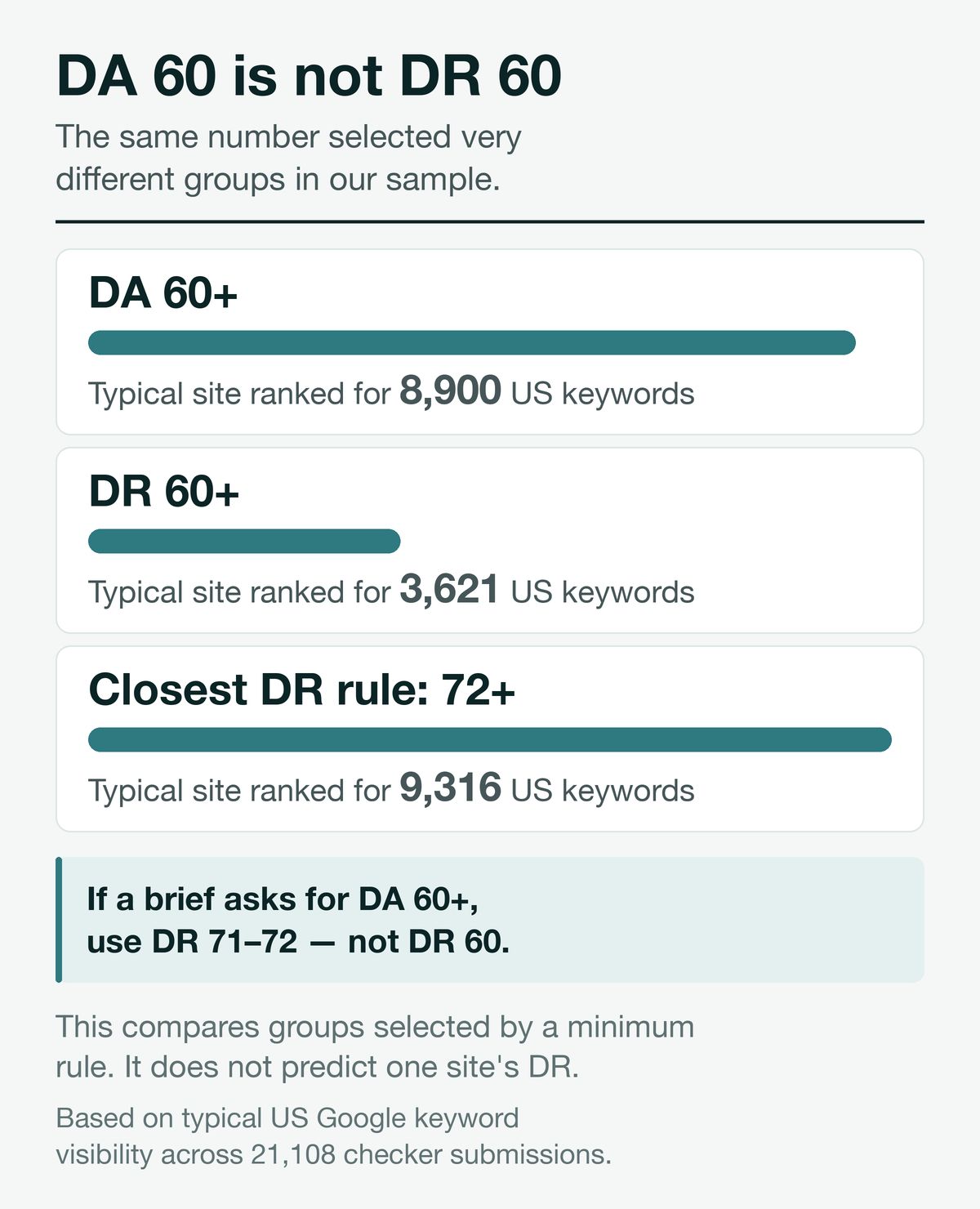
A DA 60+ brief worked in DR terms starts at 71 or 72. The matched groups agree in the middle and differ at the lower end, where the spread discussion below picks up.
No fixed offset exists
A natural question: can you just subtract or add a set number of points? The answer from this sample is no, and the reason is visible in the data.
Below DA 41, the closest DR cut-off sits three to six points under the DA number. DA 41 is where the direction reverses: DR 42 is the first minimum whose closest DR is at least as high. From there the gap widens: four points at DA 50, twelve points at DA 60. DA 41 marks the crossover rather than a published table row. Stop at DA 60; above it, the match breaks down in ways the later data makes clear.
The arithmetic confirms there is no stable shortcut. Subtract five and you land roughly right at DA 30, but you miss by seventeen points at DA 60. Add ten and you are roughly right at DA 60, but fifteen points out at DA 20. The offset depends on where the rule sits on the curve.
The same-number typicals make the point from another angle. At DA 20, 30, 40, 50, and 60 the DA-group middles are 176, 297, 659, 2,418, and 8,900. The same-numbered DR groups at DR 20, 30, 40, 50, and 60 have middles of 232, 417, 833, 1,563, and 3,621. At the lower thresholds the same-numbered DR rule admitted the more visible group; at 50 and 60 the same-numbered DA rule did. The direction flips, which is why the answer takes the form of ranges rather than a single offset.
The distributions also differ at the bottom. The most common DR in this sample is 0, held by 4,225 websites — one in five. The lowest DA recorded is 1. In total, 3,850 websites cleared DR 60 against 2,199 clearing DA 60. Different crawls, link indexes, and scoring maths produce different distributions, so the same threshold cannot select the same kind of pool all the way up the scale.
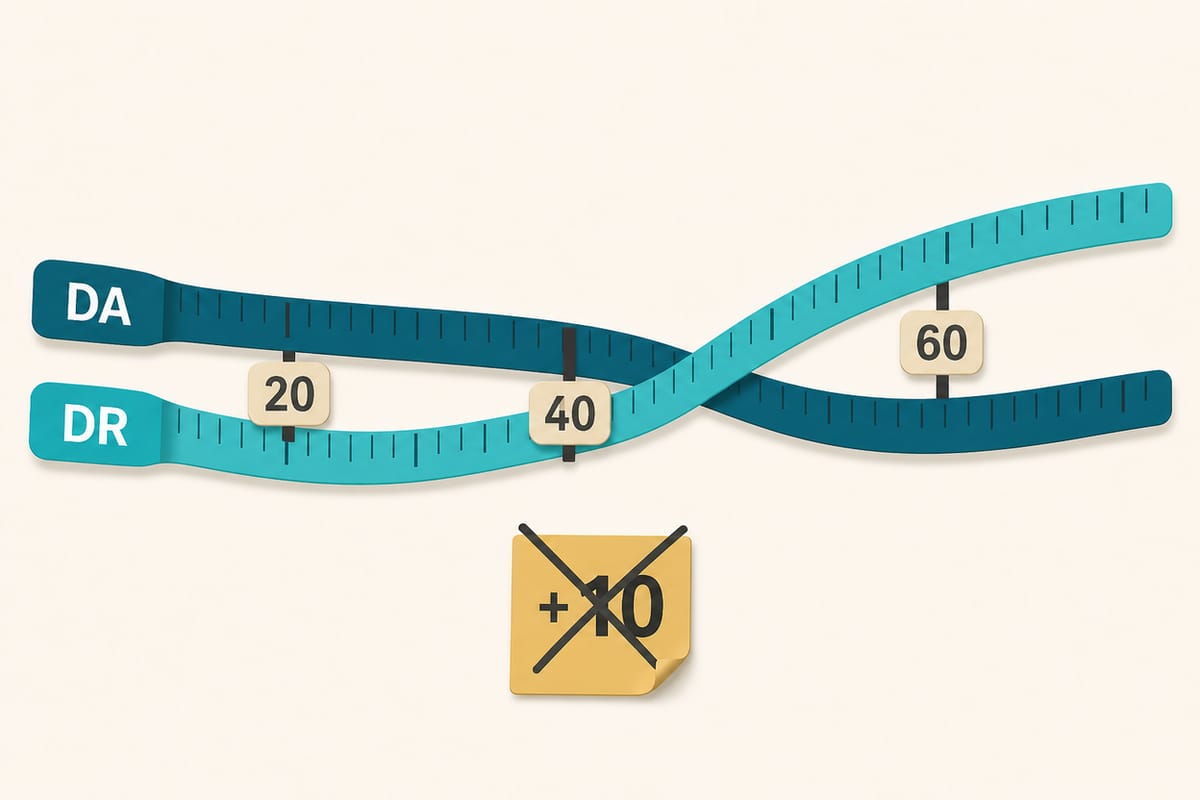
The direction of the gap depends on where the threshold sits, so the deliverable is ranges, not an offset. Every match in the table compares middle sites, not individual-score conversions.
Where matched pools still differ
The table matches middles. The rest of each pool can still diverge.
At DA 40+, the middle is 659 keywords; a quarter of that pool ranked for 10 or fewer US English-language searches, and a quarter ranked for about 9,772 or more. So the spread is enormous even at the matched middle. Comparing the bottom quarters on the two published rows where the gap is widest: at DA 50+ versus matched DR 54+, the figures are 29 and 78; at DA 60+ versus matched DR 72+, they are 214 and 470. The matched DR pools cut out more of the weakest sites at those higher thresholds. At DA 20, 30, and 40 the lower ends sit close together. For a screening rule, that means a matched middle can still change the mix of sites that reaches review.
The DA 70 data shows where a close middle can still fail as a practical brief. The DA 70+ middle was 26,071 keywords; the closest DR group, at DR 87, had a middle of 25,613 — under 2% apart, with a candidate range of DR 82–89. On the headline number that looks publishable. The bottom quarters, though, told a different story: about 900 keywords on the DA side against 12 or fewer on the DR side (exact values 897.25 and 12.5). And when the analysis was re-run on only the most recent 90 days of checks, the closest DR cut-off moved from 87 to 80 — seven DR points. The five published rows moved by no more than two DR points under the same treatment. Seven points of drift is too unstable to hand someone as a brief number; the most that can be said is "somewhere in the high 80s, roughly," and that is not a filter value.
Where the mapping stops
Two thresholds were tested and neither gets a row. Every level tested is reported, including these two.
DA 70 fails on lower-end divergence plus instability under re-cutting. The headline middle matched well; the pool shape and the sensitivity check did not. DA 80 fails differently. The DA 80+ middle was 53,038 keywords (53,037.5 exactly, rounded to 53,038 because the group has an even size). The most visible eligible DR group in this sample topped out at 25,613 — a shortfall of more than 50%. DA 80 therefore has no conversion row.
The DA levels were chosen after the data existed, so every level tested is shown here, including the two failures. We did not interpolate between them, which is why there is no DA 45 row.
What to type in the DR field
If the brief says DA 50+, type a DR filter between 53 and 56. I would enter 54, because it is the closest observed match and the pool it admits (4,736 websites) is workable for most outreach lists. If you need a larger candidate pool and can tolerate a slightly lower visibility floor, 53 is inside the range. If you want a tighter list, 56. The choice inside the range is about pool size for your workflow, not about one number being more correct.
For DA 20+, type DR 12–18. For DA 30+, type DR 21–27. For DA 40+, type DR 34–39. For DA 60+, type DR 71–72.
Above DA 60, this sample supports no number. If the brief says DA 70 or DA 80, leave the DR field unset instead of guessing. To compare one website's two scores, Our free DA/DR checker returns both numbers for a single domain.
Use these ranges to translate a list filter. They do not predict the paired score of an individual website, so a site with DA 50 will not necessarily have DR 54.
Once the filter has drawn the pool, review each site for relevance, editorial standards, price, traffic quality, and likely ranking value.
How the ranges were built
The sample contains 21,108 websites with both DA and DR stored, using the most recent valid check for each domain between 22 February and 28 August 2026. One malformed hostname was dropped from the initial 21,109 records, and 10,722 checks fell within the most recent 90 days.
The matching yardstick is the number of distinct US English-language Google searches where each domain appeared in the top 100, sourced from DataForSEO's Labs database on 28 August 2026. Nearly 30% of the sample — 6,235 sites — had no appearance in that dataset, which is expected for many non-US or non-English websites.
We tested 94 whole-number DR cut-offs, each with at least 200 websites in its pool. The closest match minimised the difference between the middle website in the DA pool and the middle website in the DR pool. The DA levels were selected after the data existed, so every tested level is reported and no values were interpolated between them.
Two re-runs checked the result from different angles. Restricting the data to the 10,722 most recent checks, and then to 20,239 non-cached rows, moved every published answer by no more than two DR points. A separate traffic comparison put the typical estimated US organic traffic within 1.12× on every published row.
The one important boundary is the sample itself: these domains came from a public checker, so a very different mix of industries, countries, or websites may produce different ranges. That is worth retesting with a second population. For this pool, the five published rows held under both re-cuts, while DA 70 and DA 80 failed and stayed out of the table.
The final takeaway
If a brief gives you DA and your tool gives you DR, you no longer need to guess or copy the number across. For DA 20 to 60, use the range in the table and choose the point that suits the size of list you need. I would start with the closest match, then loosen the filter only if the pool is too small.
That is the useful result here: an awkward metric mismatch becomes a straightforward working decision. Use the conversion to build the right pool, then bring human judgement back in. Relevance, editorial quality, traffic and genuine fit will always tell you more about a site than one authority score on its own.
related Blog Posts



Join 7,000+ Clients Growing with Rhino Rank
Sign Up



Stay ahead of the SEO curve
Get the latest link building strategies, SEO tips and industry insights delivered straight to your inbox.