
 Back to all posts

What is Domain Authority? Moz DA explained
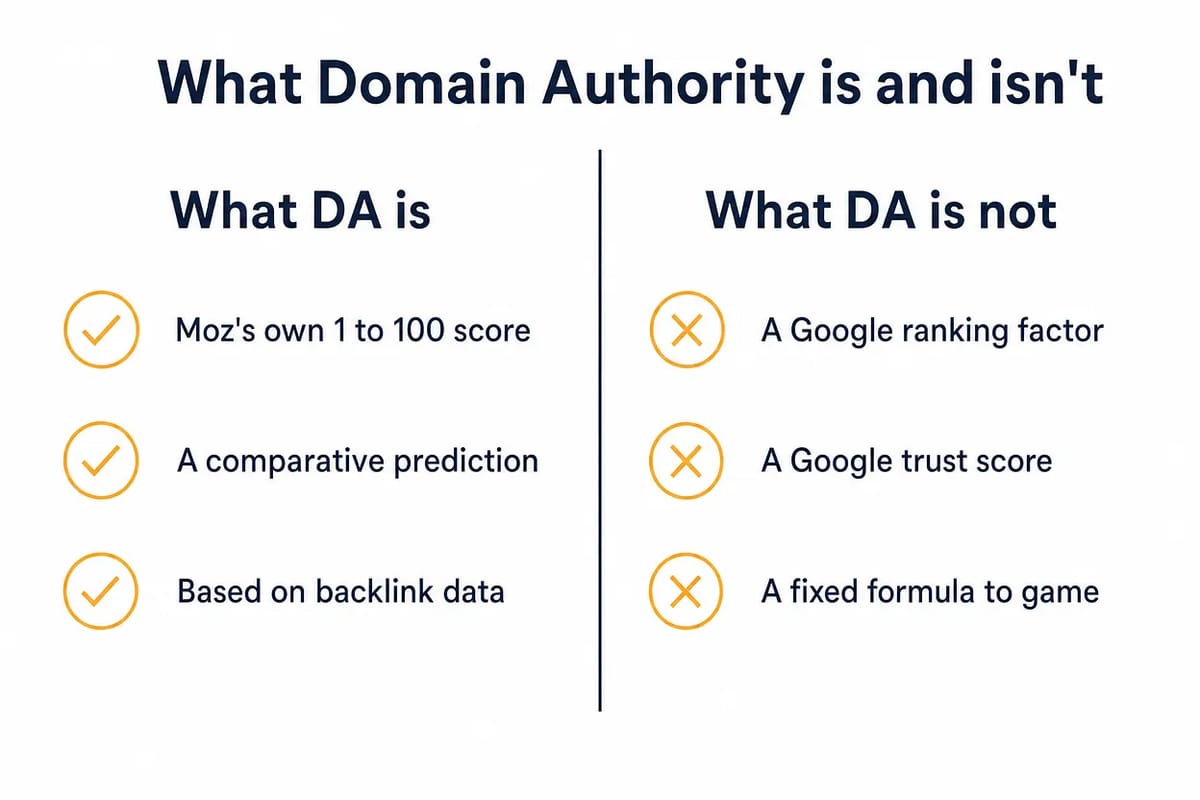
Domain Authority (DA) is Moz's proprietary 1-100 score for predicting how likely a website is to rank compared with other sites. It is useful for estimating SEO competitiveness, especially against direct competitors, but it is not a Google ranking factor and Google does not use it to rank pages.
Key takeaways
- Domain Authority is Moz's comparative score, not a Google trust score.
- DA is built with a machine-learning model that is mainly driven by backlink data, including linking root domains and link quality.
- DA is logarithmic, so moving from 20 to 30 is far easier than moving from 70 to 80.
- There is no universal good DA. A good score is one that compares well against the sites you actually compete with in your niche or SERP.
- DA, Page Authority and Ahrefs Domain Rating are separate third-party metrics. Use them as directional signals, then check the real link profile before acting.
What is Moz Domain Authority?
Moz Domain Authority is a predictive SEO metric that estimates the ranking strength of an entire domain or subdomain on a scale from 1 to 100. Higher scores usually mean the domain has a stronger Moz-measured link profile than many other sites, but the number only makes sense in comparison.
That comparison point matters. A DA 28 website might be strong in a local niche where most competitors sit in the teens. The same DA 28 site may look weak in a national finance SERP where publishers, banks and major comparison sites dominate. DA is a benchmark, not a grade.
Moz created the metric to help SEOs compare domains, assess link-building progress and judge how difficult a competitive gap may be. It does not tell you whether Google trusts a site. Google's own guidance says third-party SEO tools do not have access to Google's internal ranking data, so their scores are external predictions rather than search-engine signals.
How Moz DA is calculated
Moz currently calculates Domain Authority with a machine-learning model, not a fixed hand-written formula. That model, known as DA 2.0, rolled out on 5 March 2019 and moved Moz away from its older linear model towards a neural-network approach trained to better correlate with real ranking patterns.
The current model is mainly link based. Moz describes backlink data from its Link Explorer index as the foundation, with linking root domains, link quality and other ranking-correlated signals feeding the score. Referring domains matter because a link profile with many relevant sites linking to it is usually stronger than a profile with repeated links from the same few domains.
That does not mean DA is calculated by adding simple factors such as a domain's age, its outgoing link count or a fixed relevance score. Those claims are either old or not verified in Moz's current public methodology. Treat DA as the output of Moz's model, built from Moz's data, rather than a checklist where one visible input explains the whole number.
Why DA is logarithmic and relative
Domain Authority runs from 1 to 100, but the distance between numbers is not even. Moz explains the scale as logarithmic: gaining 10 points at the lower end is much easier than gaining 10 points near the top.
In practical terms, moving from DA 20 to DA 30 may require a modest improvement in the quality and diversity of referring domains. Moving from DA 70 to DA 80 needs a far larger jump because the top of the scale is crowded by established brands, major publishers and very large sites with deep link profiles.
This is why chasing an arbitrary DA target can waste effort. The useful question is not "How can this site reach DA 60?" It is "What link profile do the ranking pages in this market have, and how far behind is this site?" When DA is used that way, it becomes a quick competitor benchmark instead of a vanity number.
What is a good Domain Authority score?
A good Domain Authority score is contextual. Moz says there is no universal good or average DA because the score is relative to other sites. The right benchmark is the set of domains competing for the keywords you care about.
Start by checking your own DA, then check the domains already ranking for the queries you want to win. If your site is DA 24 and the results are mostly DA 18-32 niche sites, you may already be in a competitive range. If the same DA 24 site is trying to outrank DA 70 publishers for broad head terms, DA tells you the link gap is likely much wider.
Avoid fixed bands such as poor, good or excellent. They look neat, but they hide the real work. A small B2B software site, a local solicitor and a national news site should not be judged against one generic scorecard.
DA, PA and DR are different scores
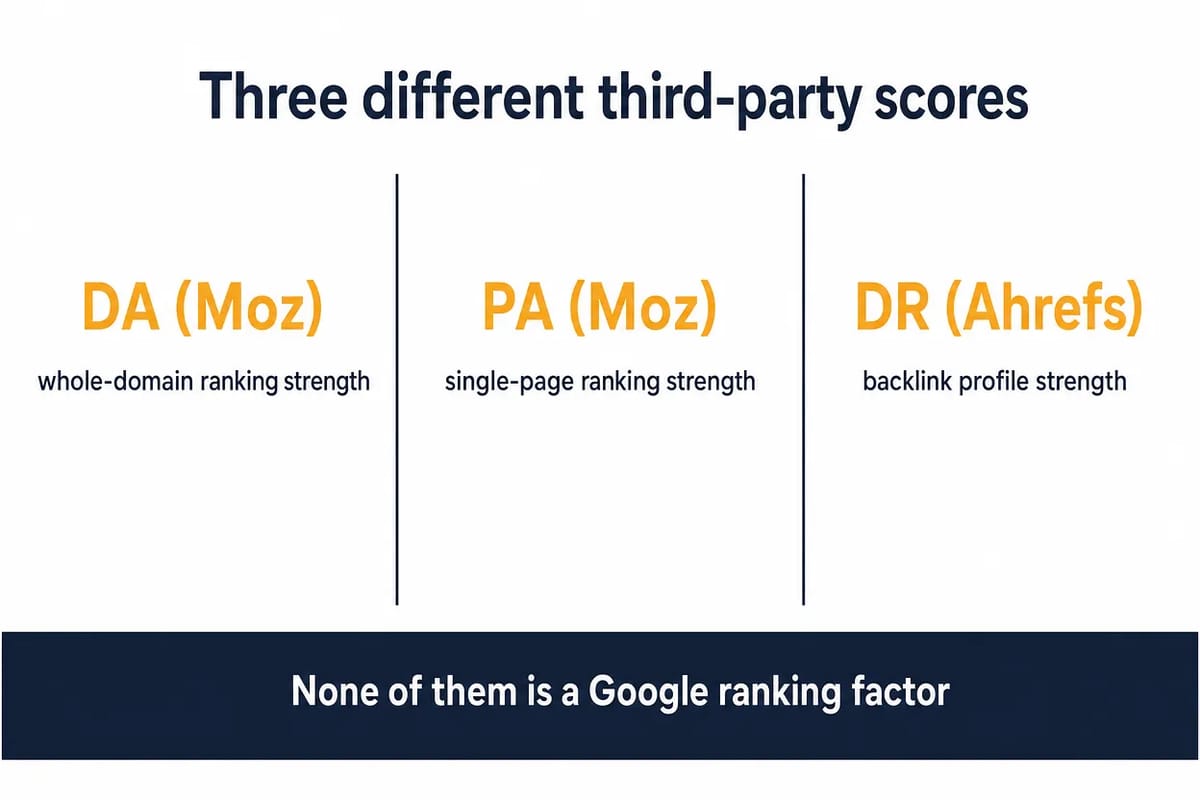
Domain Authority and Page Authority are both Moz metrics, but they answer different questions. DA predicts the relative ranking strength of a whole domain or subdomain. Page Authority predicts the relative ranking strength of one page.
Ahrefs Domain Rating, or DR, is different again. DR is Ahrefs' proprietary 0-100 logarithmic metric for backlink-profile strength. It is not interchangeable with Moz DA, and the two scores should not be converted one-to-one. Neither DA nor DR is a Google ranking factor.
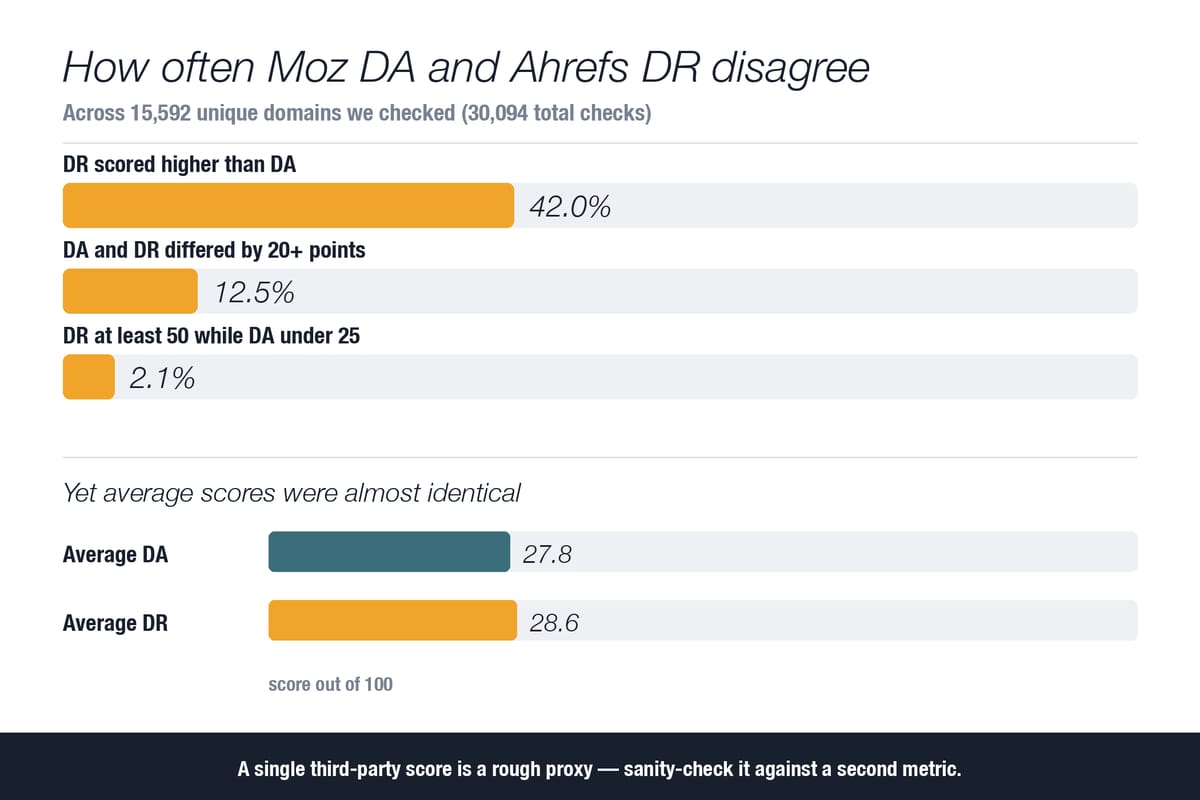
Across the 30,094 checks run through our own DA/DR checker, we have 15,592 unique domains with valid latest DA and DR data. DR was higher than DA on 42.0% of those domains, DA and DR diverged by 20 points or more on 12.5%, and the averages were close: DA 27.8 and DR 28.6. That gap is the practical warning: treat one vendor score as a rough proxy, then sanity-check it against a second metric and the actual link profile before you make decisions.
How to check Moz DA
The most direct way to check Domain Authority is through Moz's own tools, because Moz owns the DA metric. Moz Link Explorer, MozBar, Domain Analysis, Moz Pro and the Moz API can all surface DA in different workflows.
Other SEO tools and bulk checkers can also help when you need to compare many domains at once. Some free tools give a quick score check, while paid platforms usually add deeper backlink analysis, saved projects, exports and reporting. If you are choosing a tool for a small team, start with the workflow you need most: quick checks, competitor comparisons, campaign reporting or bulk prospect vetting. A broader list of SEO tools for small businesses can help you decide which features are worth paying for.
Bulk DA checkers are useful when you are reviewing link prospects, old outreach lists or competitor domains. PrePostSEO, for example, presents its checker around 500 URLs. The key is to treat bulk output as a screening step. A high score can flag a site for review, but you still need to look at relevance, organic traffic, spam signals and the page where a link would sit.
How to improve your Moz DA score
The most reliable way to improve Domain Authority is to improve the underlying backlink profile that Moz's model measures. That means earning more links from relevant, credible domains and avoiding the kind of weak link patterns that make a site look artificial.
Link-worthy content is still the cleanest starting point. Original research, useful tools, detailed tutorials, data-led resources and strong opinion pieces can earn links because they give other writers something worth citing. Content that simply repeats what every competing page says is less likely to attract natural references.
Manual link acquisition can also play a role when it is done with relevance and editorial standards. Guest posts and curated links are examples of tactics that can strengthen the backlink profile behind DA when the linking sites are real, relevant and quality-controlled. They are options, not magic shortcuts, and the placement still needs to make sense for the reader.
On-page SEO and site structure help in a more indirect way. Clear internal links, crawlable pages, search-focused headings and useful supporting content can help your best assets get discovered, rank and earn backlinks. Those changes do not raise DA by themselves in the same way a stronger external link profile can, but they support the conditions that make link earning easier.
Anchor choice matters too. Natural branded, partial-match and page-relevant anchors usually look cleaner than repeated exact-match anchors. A varied profile is easier to defend and easier to compare with competitors.
You should also keep the link profile clean. A regular link audit can help you spot lost links, irrelevant links, obvious spam and pages that deserve stronger internal support. Do not panic over every weak backlink. Focus on patterns that could distort the profile or make future outreach less effective.
How Moz DA changes over time
Domain Authority is not static. Moz's Link Explorer index updates continuously, and a site's DA can change when Moz discovers new links for that site, loses sight of old links, or recalculates relative scores as the wider web changes.
That does not mean every index update will change your score. Moz says DA and PA do not move with every data update. If Moz has not found meaningful new link data for your domain, the number may stay flat even while the index itself keeps updating.
Track DA as a trend, not as a daily judgement. A single movement of one or two points can be noise. A sustained rise may indicate that your backlink profile is improving relative to competitors. A sustained fall should prompt a closer look at lost referring domains, competitor link growth, technical issues that affect important pages and the quality of recent links.
How to compare your website with competitors
The strongest use of DA is competitive analysis. Pull your own DA, then check the domains and pages that already rank for the terms you want. This shows whether you are competing against similar sites or trying to enter a SERP dominated by domains with much stronger link profiles.
DA alone is not enough. Pair it with referring domains, organic traffic, topical relevance, page-level link strength and content quality. A lower-DA site can outrank a higher-DA site when the page is better matched to intent, has stronger page-level links or serves a narrower query more clearly.
Competitor backlink research gives you the next layer. By researching competitors' backlink profiles, you can see which publications, directories, resource pages and partner sites already link in your market. That can point to realistic link opportunities and show what type of content tends to earn citations.
Common misconceptions about Domain Authority
The first misconception is that DA is a Google signal. It is not. DA may correlate with ranking strength because backlinks are important to SEO, but Google does not use Moz's third-party score to rank pages.
The second misconception is that DA is a fixed formula. Since DA 2.0, Moz has used a machine-learning model trained around ranking patterns and backlink data. You can understand the broad inputs, but you cannot reverse-engineer the score from a short list of public factors.
The third misconception is that more links always mean a higher DA. Referring domains, link quality and link diversity matter. A large number of links from one weak site is not the same as a natural spread of relevant links from many credible domains.
The fourth misconception is that DA should be your main SEO target. DA is useful because it compresses a lot of link data into one quick benchmark. It is still a proxy. Rankings, qualified traffic, conversions and the quality of your backlink profile are the outcomes to care about.
Summary
Domain Authority is useful when it is used for the job it was built to do: comparing the likely ranking strength of one domain against another. It gives you a fast read on relative competitiveness, especially when you are planning link building, reviewing prospects or sizing up a SERP.
It becomes misleading when treated as a Google trust score, a fixed quality band or a number that can be improved without improving the underlying site and link profile. Use DA alongside Page Authority, DR, backlink analysis, organic traffic and content quality. Then make decisions from the full picture, not from one score.
Frequently Asked Questions
What is Moz Domain Authority (DA)?
Moz Domain Authority is a proprietary 1-100 score that predicts how likely a website is to rank compared with competing sites. It is a comparative SEO metric based mainly on Moz backlink data and ranking-correlated signals, not a Google ranking factor.
Is Domain Authority a Google ranking factor?
No. Domain Authority is not a Google ranking factor. Moz creates the score from its own data and model, while Google uses its own ranking systems. Google has also said that third-party SEO tools do not have access to its internal ranking data.
What is a good Domain Authority?
A good DA is one that compares well with the sites you compete against in the same niche or SERP. There is no universal good score. Check the domains already ranking for your target queries, then use that range as your benchmark.
How is Domain Authority calculated?
Moz calculates DA with a machine-learning model, not a simple public formula. The model is mainly based on backlink data from Moz's Link Explorer index, including linking root domains, link quality and other signals that correlate with rankings.
How can you increase Domain Authority?
Improve the backlink profile that influences DA. Earn links from relevant and credible sites, create content worth citing, strengthen internal links to important pages, and review the profile for spammy or irrelevant patterns. Quality and relevance matter more than raw link volume.
What is the difference between Domain Authority and Page Authority?
Domain Authority predicts the relative ranking strength of a whole domain or subdomain. Page Authority predicts the relative ranking strength of a single page. A site can have a strong DA while a new or weakly linked page has a lower PA.
What Domain Authority checker should you use?
Use Moz when you need the source metric, because Moz owns Domain Authority. Other checkers can help with speed, bulk checks or mixed DA and DR reporting, but any score should be compared with the actual backlink profile before you rely on it.
Why can Domain Authority change?
DA can change when Moz finds new links, loses links from its index, updates the model, or when the relative strength of other sites changes. Look for sustained trends rather than reacting to every small movement.
Every fact and commercial claim in this guide was fact checked and verified on 9 July 2026.
related Blog Posts



Join 2,600+ Businesses Growing with Rhino Rank
Sign Up
Stay ahead of the SEO curve
Get the latest link building strategies, SEO tips and industry insights delivered straight to your inbox.