
 Back to all posts
If you've spent time reading about SEO, you've run into the term "backlinks." It sounds simple. It isn't.
Backlinks drive organic visibility more than almost any other single factor. If you're a business owner trying to figure out why a competitor outranks you, or an SEO manager building a strategy from scratch, you need to understand how links work and what Google rewards.
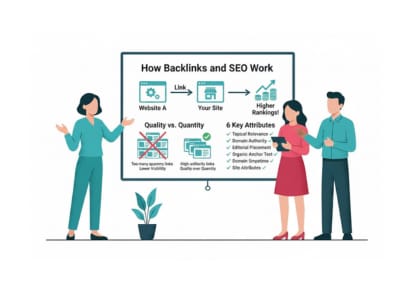
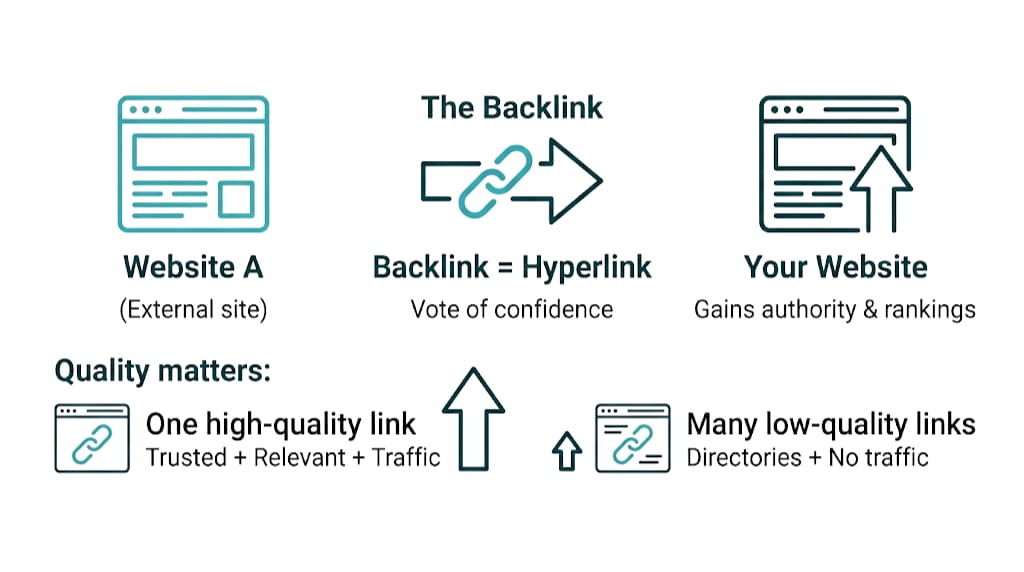
Bottom line up front: A backlink is a hyperlink on another website that points to your site. Search engines treat these links as votes of confidence. The more high-quality, relevant backlinks your pages earn, the more authority Google assigns them, and the higher they tend to rank. But not all backlinks are equal. A single link from a trusted, topically relevant site with organic traffic can outperform hundreds of links from low-quality directories. This guide covers everything from the core mechanics to practical strategies for building a healthy backlink profile in 2025.
That core mechanic has changed a lot since Google's founders first described backlinks as a ranking signal in their 1998 Stanford paper. Google now weighs link quality, context, placement, and intent with more sophistication. The underlying rule hasn't moved, though: links from other websites signal trust. This article lays out the full picture, backed by specific data, primary sources, and clear calls on what works, what doesn't, and where the risk sits.
What Are Backlinks? A Plain-English Definition
A backlink is a clickable link on someone else's website that sends visitors to your website. In SEO, these are also called "inbound links" or "incoming links." When Site A publishes a blog post and includes a hyperlink pointing to a page on Site B, that hyperlink is a backlink for Site B.
That "citation" idea is the easiest mental model. Academic papers cite other papers to show sources and credibility. Search engines read backlinks in a similar way. Each link is a signal that another site chose to reference your content.
Here's a concrete example. Say you run a SaaS company and publish a detailed report on email marketing benchmarks. A well-known marketing blog finds the report, writes about it, and links to your page as the source. That link is a backlink. It tells Google that a trusted website in your niche viewed your content as reference-worthy. Google uses that signal when it ranks your page for related queries.
Those same "backlink" mechanics show up outside SEO, too. If you've searched "what are backlinks Obsidian," you've seen the term used in knowledge management tools where notes link to each other. Same concept. Connections between documents create a network of relationships that surfaces the most referenced, most valuable nodes. In SEO, your website is the node, and backlinks are the connections that influence how prominent it becomes.
What backlinks are NOT: they're not internal links (those connect pages within the same domain), they're not social media shares (Google has confirmed these don't function as traditional ranking signals), and they're not brand mentions without a hyperlink (though unlinked mentions may carry some indirect value). A true backlink requires an HTML anchor element with an href attribute pointing to your URL.
For the rest of this guide, when we say "backlink," we mean an external hyperlink from a third-party domain pointing to a page on your website. That's the signal Google cares about.
Why Backlinks Matter for SEO: The Evidence Behind the Ranking Signal
Google's co-founders, Larry Page and Sergey Brin, built the original Google algorithm around a concept they called PageRank. Their 1998 paper, "The Anatomy of a Large-Scale Hypertextual Web Search Engine," described a system where the web's link structure determined page importance. The core idea was a shift at the time: a page that earns links from other important pages tends to be important itself.
That was 1998. The algorithm has changed through hundreds of updates since then. Links still sit near the top of the list. Here's what we can point to.
Ahrefs' search traffic study analyzed over 14,000 keywords and found a strong positive correlation between the number of referring domains (unique websites linking to a page) and organic search traffic. Pages ranking in position one had, on average, 3.8x more referring domains than pages in positions two through ten. The relationship wasn't linear, but it held: more unique sites linking to you tracks with higher rankings.
Google's own statements back this up. Andrey Lipattsev, a senior Google strategist, confirmed in 2016 that links are one of Google's top three ranking signals alongside content and RankBrain. John Mueller has repeated the same priority in SEO Office Hours: link quality beats link quantity, and "one good link from a relevant, authoritative news site can be more impactful than millions of low-quality links."
Google sticks with links for a practical reason. They resist manipulation better than most signals at scale, because real editorial links come from real sites making a choice. We can generate content, tune titles, and rewrite copy all day. Getting genuine links from websites with actual audiences usually requires publishing something worth citing. Understanding what makes a good backlink profile helps clarify exactly what that standard looks like in practice.
That "worth citing" bar keeps rising. As Google's systems get better at spotting manufactured link patterns, clean editorial backlinks keep gaining ground. Sites that build a natural backlink profile over time beat sites that rely on technical SEO alone. On-page work still matters. But without backlinks, you're competing with one hand tied behind your back. If you're starting from zero, a managed link building service can help you build that foundation systematically rather than guessing at what moves the needle.
Backlinks matter for SEO because the algorithm was built around them. They're not optional. They're structural.
The Anatomy of a Backlink: Every Component That Affects Its SEO Value
Not every backlink is created equal. The gap between a link that moves rankings and one that does nothing usually comes down to the link's HTML, where it sits on the page, and how Google reads the surrounding signals.
A standard backlink in HTML looks like this:
<a href="https://yoursite.com/page" rel="dofollow">anchor text</a>Each component carries SEO significance:
Component | What It Is | Why It Matters for SEO |
|---|---|---|
href URL | The destination URL on your site | Determines which specific page receives the authority boost |
Anchor text | The visible, clickable text | Gives Google context about the linked page's topic |
rel attribute | Tells search engines how to treat the link | Controls whether PageRank passes through the link |
Link placement | Where on the page the link appears | Links in main body content carry more weight than footer links |
Surrounding text | The content around the link | Provides additional topical context to search engines |
Link placement deserves special attention. Bill Slawski's analysis of Google's "Reasonable Surfer" patent showed that Google weights links based on how likely a user is to click them. A link placed naturally in the main body, wrapped in relevant copy, tends to carry more weight than a link stuffed into a sidebar widget or footer nav. The patent outlines a model where prominent, context-relevant links pass more PageRank than links a reasonable user wouldn't bother clicking.
That click-likelihood model is the point. A backlink's value isn't only the linking domain's authority - it's where your link sits on the page, what surrounds it, and whether it reads like something a human would click. Put the link in the first few paragraphs of a relevant article on a high-traffic page and it can outperform a link from a "resources" page that never gets visited.
Traffic and placement are only part of it. The source page's outbound link count also matters, and this is where PageRank dilution shows up in real life. Google's original PageRank formula splits a page's authority across all outbound links on that page. A page with a PageRank of 8 and only 2 outbound links passes about 4 units of equity per link. That same page with 100 outbound links passes only 0.08 units per link.
Outbound links set the ceiling on what any single link can carry. That's why a link from a curated, selective resource page often beats a link from a massive directory with thousands of outbound links - and it's a key reason our curated link placements focus on pages with low outbound link counts. Fewer links competing for the page's equity means each link gets a bigger slice.
Anchor Text Types and Why Over-Optimization Is a Risk
Anchor text is the clickable text that users see and click on. Google uses it as a relevance signal to work out what the linked page covers. There are several types:
- Exact match: Uses the target keyword precisely (e.g., "what are backlinks")
- Partial match: Includes the keyword with additional words (e.g., "learn what backlinks are in SEO")
- Branded: Uses the brand name (e.g., "Rhino Rank")
- Naked URL: Uses the raw URL (e.g., "rhinorank.io")
- Generic: Uses non-descriptive text (e.g., "click here," "this article")
- Image alt text: When an image serves as the link, the alt attribute functions as anchor text
Anchor text is also where people get burned fast. Over-optimizing anchor text is one of the fastest ways to trigger an algorithmic penalty. Google's Penguin algorithm targets unnatural anchor patterns. If 60% of your backlinks use exact-match anchor text for your target keyword, that's not a normal link profile. Natural profiles skew heavily toward branded and generic anchors, with exact-match anchors staying under 5-10% of total links. For a deeper look at getting this right, see our guide on mastering natural anchor text. When you see a site with a tight cluster of exact-match anchors, you're usually looking at a site that's either been penalized or is next in line.
Dofollow vs. Nofollow: Which Links Actually Pass SEO Value?
The rel attribute tells search engines how to treat a link. There are now four relevant values:
Attribute | Meaning | Does It Pass PageRank? |
|---|---|---|
(none / dofollow) | Standard link, no special instruction | Yes, fully |
rel="nofollow" | Signals that the linking site doesn't vouch for the destination | Treated as a "hint" since 2019 |
rel="sponsored" | Identifies paid or sponsored links | Treated as a hint |
rel="ugc" | Identifies user-generated content links | Treated as a hint |
Before September 2019, nofollow acted as a directive. Google didn't pass PageRank through nofollow links. Google's 2019 announcement changed that: all three attributes (nofollow, sponsored, ugc) became "hints" rather than directives. Google can now crawl, index, and pass some value through nofollow links when it aligns with user benefit.
Practically, dofollow links stay the main target for link building because they pass authority in a predictable way. But nofollow links from high-authority sites (think Wikipedia, major news publications, Reddit threads with genuine engagement) still carry weight in the real world. They send referral traffic. They build brand visibility. And they can pass some ranking signal when Google chooses to count them. A healthy backlink profile includes both.
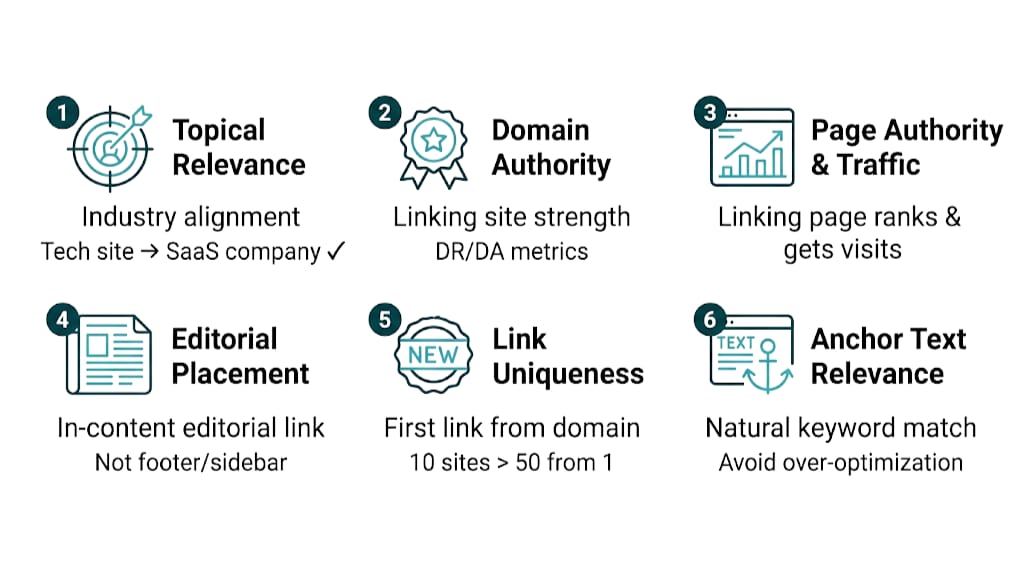
What Makes a High-Quality Backlink? The 6 Attributes That Actually Move Rankings
A mid-market SaaS team spending $3k/month on link building needs clear criteria for what earns rankings and what drains budget. These six attributes decide backlink quality. They're ranked by impact.
1. Topical Relevance
A link from a site in your industry (or a tight adjacent niche) carries more weight than a link from an unrelated domain. Google evaluates topical alignment across the linking page, the linking site, and your content.
A cybersecurity firm earning a link from a technology publication signals earned authority. That same firm earning a link from a cooking blog reads as noise at best, manipulation at worst.
2. Linking Domain Authority
The authority of the website linking to you matters. A link from a website with thousands of quality backlinks, real organic traffic, and a long operating history passes more equity than a link from a brand-new site with no authority of its own.
Tools like Ahrefs' Domain Rating (DR) or Moz's Domain Authority (DA) help us estimate this, even though Google's internal metric won't match any third-party score. If you want a deeper breakdown of how these metrics compare, our guide on domain authority vs domain rating is worth a read.
3. Linking Page Authority and Traffic
Domain strength isn't the whole story. The specific page linking to you matters, too. A link from a page that ranks for competitive keywords and pulls steady organic traffic beats a link from a page Google never ranks.
This is the "Reasonable Surfer" principle in action: links on pages people visit carry more weight.
4. Editorial Placement
Editorial placement separates earned links from placed links. An editor or author chooses an editorial link because it supports the piece. Non-editorial links show up through comments, forum signatures, widgets, or other templated placements.
Google's systems treat those two categories differently. Editorial links inside the main body of an article set the bar.
5. Link Uniqueness (First Link from Domain)
Your first backlink from a new referring domain moves rankings more than the fifth link from a domain that already links to you. Ahrefs' data shows that referring domain count correlates with rankings more strongly than total backlink count.
The takeaway stays simple. Getting 10 links from 10 different relevant sites beats getting 50 links from a single site.
6. Anchor Text Relevance
Anchor text reinforces topical relevance when it matches the destination naturally. Keep the over-optimization risk in mind. This helps when it happens organically, and it backfires when it's forced.
Here's the mental model we use for qualification. Run a quick checklist on the opportunity:
- Topical match between the site and the page.
- Real authority and real traffic, not a metric-only profile.
- Editorial placement in the body content.
- A new referring domain (or at least a meaningful, incremental placement).
Hit all four and you've got a link worth pursuing.
Types of Backlinks: From Editorial Gold to Risky Territory
Knowing the main backlink types helps us weigh upside against risk. Below is the spectrum, from safest and strongest to the stuff that can get a site burned.
Editorial Links (Lowest Risk, Highest Value)
These happen when journalists, bloggers, or content creators link to our site because the content serves their readers. We didn't pitch it. We didn't pay for it. They found the page and decided it deserved a citation. This is Google's ideal, and it's also the hardest link type to earn in volume.
Outreach-Based Guest Posts and Curated Placements (Low Risk, High Value)
Professional link building through real outreach means identifying relevant sites, pitching content or resource angles that fit their editorial calendar, and earning links that the publisher places by choice. That editorial control is the line in the sand.
Editorial control shows up in three places: the host site approves the content, the piece adds real value for readers, and the site has organic traffic plus an actual audience. This is where services like Rhino Rank's curated link placements and guest posts operate. It sits between passive link earning and the link-scheme nonsense that trips spam filters.
Resource Page Links (Low Risk, Moderate Value)
These come from curated resource pages that list tools, guides, or references within a tight niche. They stay relevant and editorial, but they often carry less weight than in-content links because they share the page with lots of outbound links (PageRank dilution).
Directory Links (Low-Moderate Risk, Low Value)
Legit industry directories (think Clutch for agencies, G2 for software) still offer some value. Generic web directories that take anything offer almost none, and piling them up at scale can look like spam.
Forum and Comment Links (Moderate Risk, Minimal Value)
Links dropped in blog comments, forum signatures, or community threads don't move rankings much. Most are nofollow. Spam patterns also get devalued by algorithms fast.
But real participation in the right communities still matters. Detailed Reddit contributions that reference our content in context can drive referral traffic and lift brand awareness, even when the SEO value is limited.
PBN Links and Link Farms (High Risk, Temporary Value)
Private blog networks and link farms show up in Google's spam policies for a reason: they're link schemes. Google's link spam policies state that "buying or selling links that pass PageRank" and "excessive link exchanges" violate their guidelines. The risk isn't academic. Sites built on PBNs get hit with manual actions and algorithmic penalties that can wipe organic traffic overnight.
Paid Links Without Disclosure (Highest Risk)
Paying for links without marking them as sponsored violates Google's policies. Google's spam policies page explicitly lists "buying or selling links that pass PageRank" as a link scheme. Outcomes range from the links getting ignored to manual actions that drag down the whole domain.
Most businesses can't live on passive editorial links alone. Competition is tight, and content by itself doesn't earn links on schedule. Outreach-based link building, done through services that place content on real sites with real audiences, is the scalable route that stays inside Google's guidelines when it's executed cleanly.
How to Check Your Backlinks: Free and Paid Tools Compared
We can't manage what we don't measure. Regular backlink checks keep us grounded on competitive position, surface link gaps we can close, and flag problems before they turn into a cleanup project.
Tool | Cost | Index Size | Best For |
|---|---|---|---|
Google Search Console | Free | Your site's links only | Seeing exactly what Google knows about your backlinks |
Ahrefs | From $99/month | 35+ trillion links | Deep backlink analysis, competitor research |
Semrush | From $129/month | 43+ trillion links | Combined SEO suite with solid backlink data |
Moz Link Explorer | From $99/month | 44+ trillion links | Domain Authority metric, beginner-friendly interface |
Ubersuggest | From $29/month | Smaller index | Budget-friendly option for basic backlink checks |
Majestic | From $49/month | Large historical index | Trust Flow/Citation Flow metrics, historical data |
Google Search Console is where we start. It's free, and it shows the links Google has discovered and tied to our site. Head to Links > External Links to review top linked pages, top linking sites, and top linking text. The trade-off is coverage: it won't show competitor data, and reporting often lags behind new link acquisition.
Those coverage gaps are why teams pay for crawlers.
Ahrefs is the standard tool for backlink analysis. Its crawler finds new links fast, and its metrics (Domain Rating, URL Rating, referring domains) give a clear read on link profile strength. For SEO teams running multiple clients, Ahrefs' batch analysis and Site Explorer are hard to replace.
For beginners who just need to see who links to their site, start with Google Search Console. It costs nothing and pulls verified data straight from Google. When we need competitor comparisons or more historical depth, we put budget into Ahrefs or Semrush.
No third-party tool has a full index of the web. Ahrefs might show 500 backlinks while Semrush shows 600, and Google Search Console shows 450. Each crawler finds and refreshes links on its own schedule, so we cross-check sources and treat third-party metrics as directional, not absolute.
How to Read a Backlink Profile: Signals of a Healthy vs. Toxic Link Portfolio
Most beginner guides skip this. That's a mistake.
Knowing what backlinks are is step one. Knowing whether your link profile is helping or hurting is where SEO managers win budget, avoid penalties, and make cleaner bets.
Signals of a Healthy Backlink Profile:
- Diverse referring domains: Links come from many different websites, not concentrated in a small cluster.
- Natural anchor text distribution: Mostly branded and generic anchors, with exact-match keywords staying under 10% of total links.
- Gradual acquisition velocity: New links show up steadily over time, not in sudden spikes.
- Topical coherence: Most linking sites sit in your industry or adjacent topics.
- Mix of link types: Editorial mentions, resource pages, brand citations. No single type dominates.
- Links from pages with organic traffic: The linking pages rank for keywords and pull in visitors.
Red Flags of a Toxic Backlink Profile:
- Exact-match anchor text concentration above 15-20%: Strong signal of manipulation.
- Sudden link spikes: Acquiring 500 links in a week after months of 5-10 per week points to purchased links.
- Links from zero-traffic domains: Sites with no organic visibility often exist solely to sell links.
- High percentage of links from irrelevant niches: A B2B software company with most links from gambling or pharmaceutical sites has a problem.
- Links from foreign-language sites unrelated to your market: Common pattern in cheap link packages.
- Sitewide links from a single domain: Footer or sidebar links repeated across thousands of pages on one site create unnatural patterns.
Toxic links call for restraint. Google's disavow tool (documented at Google Search Central) lets us ask Google to ignore specific links or entire domains, but Google frames it as a last resort. John Mueller has said the disavow tool belongs in two cases: you tried to get links removed and failed, or you've been hit with a manual action for unnatural links.
That "last resort" language matters because disavowal has real downside. Ahrefs ran a well-known experiment where they disavowed all backlinks to a test site and saw traffic drop, which backs up two things: backlinks push rankings, and blanket disavows cause damage. The takeaway stays simple. Don't disavow unless we're confident the links are harmful. Disavowing good links hurts.
Confidence comes from a repeatable check, not gut feel. Pull the backlink profile in Ahrefs or Semrush. Export anchor text distribution and scan it first - if exact-match anchors exceed 15% of total links, we investigate. Then check the link velocity graph; unnatural spikes need a cause, not a shrug. Last, filter referring domains by organic traffic. If more than 40% of linking domains show zero organic traffic, we're looking at a quality problem that needs cleanup. For a deeper look at identifying and removing toxic backlinks, a step-by-step approach helps avoid over-disavowing legitimate links.
4 Ways to Build Backlinks: From DIY Outreach to Professional Link Building
Building backlinks in SEO means picking an approach that matches your time, team, and risk tolerance. The tradeoff is always the same: control, scale, and effort. Here are four proven methods, ordered from most accessible to most scalable.
1. Create Link-Worthy Content (The Foundation)
Before outreach, we need something worth linking to. Original research, long-form guides, free tools, and data-backed studies earn links over time.
But "build it and they will come" doesn't hold for most sites. Even great content needs distribution, and that means promotion plans, outreach lists, and follow-through. Treat content as the base layer, then pair it with active outreach so it doesn't sit idle.
2. DIY Outreach (Time-Intensive, Free)
DIY outreach is brute force with standards. We identify relevant websites in the niche, find pages where a link adds value, and send personalized emails. Cold outreach response rates usually land in the 2-8% range.
A single person can realistically land 5-15 quality links per month with consistent effort. It works. It's slow. And it doesn't scale unless we hire and train people to run outreach full-time.
3. Professional Link Building Services (Scalable, Consistent)
Scale is where services fit. For teams that need steady link acquisition without building an in-house outreach function, professional services cover the execution while keeping link placement controlled.
At Rhino Rank, our curated links and guest post services place editorially controlled content on real websites with genuine organic traffic. Those sites apply their own editorial judgment, the content has to serve their readers, and links sit inside relevant articles. We get the upside of outreach-based link building without managing relationships with hundreds of publishers ourselves.
The differentiator versus risky link schemes shows up in the footprints. Legit professional link building puts content on real sites with real audiences, keeps basic editorial standards, and builds links gradually. That's a different category than buying links on PBNs or paying for bulk directory submissions.
4. Digital PR and Thought Leadership (Highest Ceiling)
Digital PR has the highest ceiling. Getting quoted in industry publications, contributing expert commentary to journalists, and publishing original research that earns coverage can drive dozens of editorial links from a single campaign.
That ceiling comes with a price. It takes upfront investment in data collection, analysis, and media relationship building, plus in-house PR chops or an agency partner. That spend buys access to links you won't get through guest post pitching, because top publications want editorial sources, not submissions.
Broken Link Building: A Step-by-Step Outreach Tactic That Works in 2025
Broken link building still holds up as an outreach tactic because it gives the site owner a clean win: you flag a real issue and hand them a fix.
Step 1: Use Ahrefs' broken link checker or the Check My Links Chrome extension to spot broken outbound links on relevant resource pages in your niche.
Step 2: Confirm you already have content that fits the dead resource, or commit to creating a true replacement before you email anyone. No one swaps in a thin "close enough" page.
Step 3: Track down the right contact. Start with the about page and author bios, then use Hunter.io for email discovery if the site doesn't make it easy.
Step 4: Send a tight, helpful email. Call out the exact broken link, mention you ran into it while reading their page, and offer your resource as the replacement. Keep the tone service-first. A hard pitch tanks replies.
Step 5: Follow up once after 5-7 days if you don't hear back. After that, drop it.
That "service-first" framing is why this works. The site owner gets a heads-up that readers are hitting a dead end, and you give them a live URL they can plug in right away. Conversion rates for broken link building outreach usually land in the 5-15% range, which beats generic link request emails by a wide margin.
Digital PR and Original Research: The Highest-Leverage Link Earning Strategy
Digital PR turns your brand into something journalists can cite without thinking twice. You publish an asset with a clear angle, and publications link because it supports their story.
Original research does the heavy lifting here. Run a survey, analyze a proprietary dataset, or pull public data into a new finding that people in your niche will reference. If the takeaway challenges an assumption or puts a number on a trend, writers covering the space need a source - and the source is you. Those citations usually come with a backlink.
Here's what it looks like in practice. A project management software company surveys 2,000 remote workers about productivity habits and publishes the findings. Marketing publications, HR blogs, and business news sites reference the study. Each reference links back to the original research page. One study can produce 30-50 high-authority editorial links over 6-12 months.
Expert commentary is the other clean path. Use services like HARO (Help A Reporter Out), Connectively, or build direct relationships with journalists who cover your category. Get quoted in a Forbes article or a niche industry publication and you often earn a link alongside the attribution. Those relationships take time to build. The links are worth it.
Digital PR costs more than most outreach plays. You need data, design support for charts and visuals, plus in-house PR chops or an agency partner. That spend buys access to links you won't get through guest post pitching, because top publications want editorial sources, not submissions. Effective digital PR link building combines newsworthy data assets with targeted journalist outreach to earn the kind of editorial placements that move domain authority at scale.
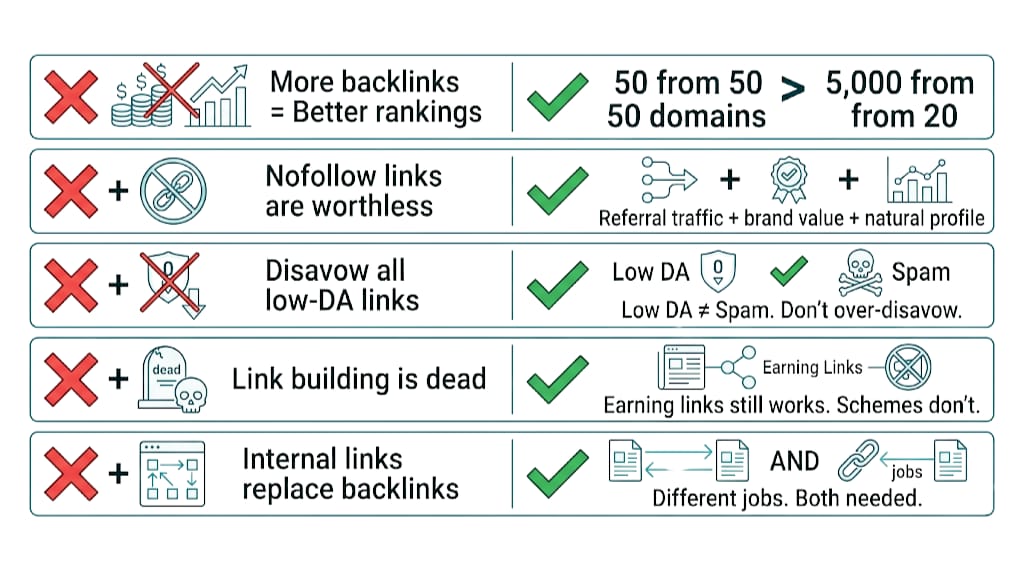
Common Backlink Myths That Are Costing You Rankings
Bad backlink advice sticks around because it's easy to repeat and hard to validate. SEO communities, Reddit threads, and old blog posts keep recycling the same myths, and teams pay for it in stalled rankings.
Myth 1: "More backlinks always means better rankings."
Reality: Referring domain diversity and link quality matter far more than raw link count. A site with 50 links from 50 unique, relevant, authoritative domains will outrank a site with 5,000 links from 20 low-quality domains in most SERPs. Google's John Mueller has said it plainly: quality over quantity.
Myth 2: "Nofollow links are completely worthless."
Reality: Since Google's 2019 update treating nofollow as a hint rather than a directive, these links can still carry value. Even ignoring that, nofollow links from high-traffic sites send referral visitors, build brand recognition, and help keep your link profile looking natural. Teams that ignore nofollow links leave easy upside on the table.
Myth 3: "You need to disavow any link from a low-DA site."
Reality: Plenty of real, earned links come from smaller sites with low third-party authority scores. New blogs, niche communities, and local publications often show low DA while still being legitimate editorial mentions. Overusing disavow can backfire, as Ahrefs' disavow experiment showed. Disavow links that are clearly spam or tied to a known link scheme. Leave the rest alone.
Myth 4: "Link building is dead because Google said so."
Reality: Google warns against manipulative link schemes. They haven't said earning links or building relationships that lead to links is wrong. Their spam policies target specific behavior: buying links for PageRank, excessive exchanges, and automated link creation. Outreach-based link building still works when real sites publish real content with editorial review.
Myth 5: "Internal links can replace backlinks."
Reality: Internal links move existing authority around your site. They don't create new authority. Only external backlinks from other domains bring new PageRank into your ecosystem. You need both, and they do different jobs.
Frequently Asked Questions
What are backlinks in SEO?
Backlinks are hyperlinks on other websites that point to a page on your site. In SEO, they act as trust signals that help Google judge whether a page deserves to rank for a given query. Quality matters more than volume. If a page earns high-quality, relevant backlinks from unique referring domains, its ability to compete in the SERPs goes up.
Why are backlinks important for Google rankings?
Google started with the idea that links between pages work like votes. The original PageRank system, described in Google's 1998 founding paper, used link analysis to measure page importance. The algorithm has changed a lot since then, but links still carry weight. Backlinks remain one of Google's top three ranking factors, which Google's own representatives have confirmed.
What is the difference between a dofollow and nofollow backlink?
A dofollow link (technically, a link without a rel="nofollow" attribute) passes PageRank to the destination page. A nofollow link includes rel="nofollow", which tells Google not to pass authority through that link. That said, the rule isn't absolute anymore. Since September 2019, Google treats nofollow as a "hint" rather than a strict directive, so some nofollow links may still pass partial value at Google's discretion.
How many backlinks do I need to rank on Google?
There isn't a universal number. The right target depends on the keyword's difficulty, what the current top results look like, and the quality of the links you build. For a low-competition local keyword, 5-10 strong links from relevant local sites might do it. For a competitive national term like "project management software," expect to need hundreds of referring domains from authoritative tech publications.
The only reliable way to set a target is to audit the SERP. Benchmark the competitors that already rank, then plan your link acquisition around the gap.
Can buying backlinks get my site penalized by Google?
Yes. Google's spam policies explicitly state that "buying or selling links that pass PageRank" counts as a link scheme. The downside ranges from algorithmic devaluation, where paid links stop moving the needle, to manual actions that drag down your whole site's visibility.
The line that matters is intent and oversight. Paying for content placement on legitimate sites with editorial review (guest posting, sponsored content with proper disclosure) isn't the same as buying links on PBNs or link farms. The first stays within acceptable boundaries when handled transparently. The second can put your entire domain at risk.
related Blog Posts



Join 7,000+ Clients Growing with Rhino Rank
Sign Up


Stay ahead of the SEO curve
Get the latest link building strategies, SEO tips and industry insights delivered straight to your inbox.