
 Back to all posts

Choosing the wrong white label link building partner doesn't just waste budget. It builds penalty risk across an entire client portfolio, chips away at trust we've spent years earning, and forces us to explain ranking drops we didn't cause. This decision needs more rigor than most agencies bring to it.
Most of the content meant to help agencies choose is either a provider's sales page or a thin listicle that sorts vendors by DR and price, then calls it a day.
Bottom line up front: A credible white label link building partner proves organic traffic on every publisher site, gives us hard controls over anchor text and link velocity, delivers reporting that looks and reads like it came from our agency, and runs with enough process transparency that we can audit QA without guessing. The seven criteria in this guide give a structured, vendor-agnostic framework to evaluate any provider - including us - before we put a single client account at risk.
This guide is for SEO managers, marketing directors, and agency owners who are past the "what is white label link building" stage. We already know why we need it. The problem is choosing correctly in a market where low-quality providers copy the language of quality, then ship the opposite.
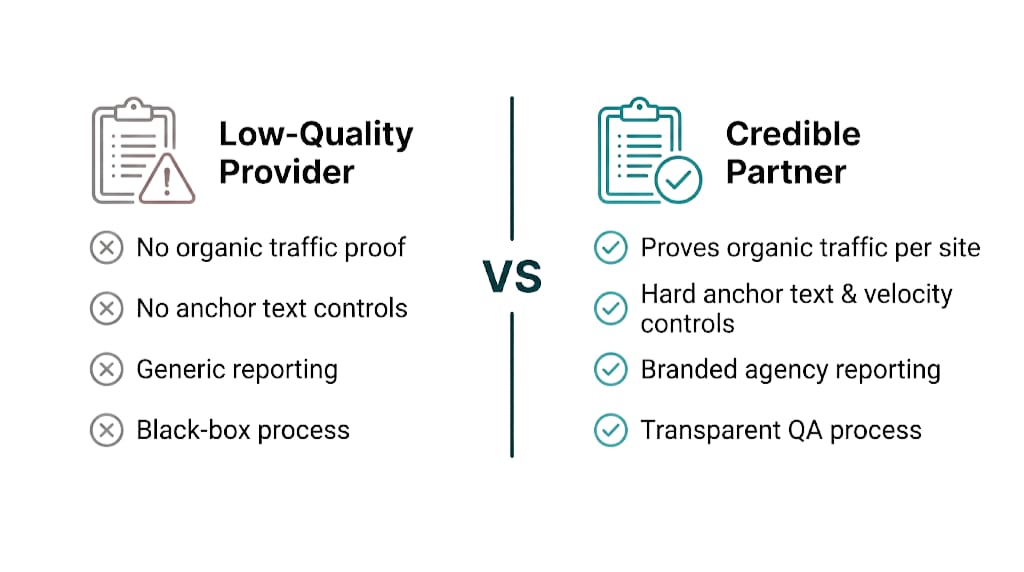
What 'White Label Link Building Partner' Actually Means (And What It Doesn't)
The term gets thrown around, and that looseness costs agencies money. A white label link building partner is a specialist provider that builds backlinks on behalf of our agency, delivers those links under our branding, and keeps the relationship confidential so clients never see the third party. The work looks like it came from us. The outreach, content, and publisher relationships sit with the partner.
That's the definition.
The exclusions matter just as much. "White label" doesn't mean a marketplace where we pick links from a catalog and resellers fulfill them from unknown sources. It doesn't mean a panel of sites managed by one entity under different domain names - what the industry calls a private blog network, or PBN. And it doesn't mean a bulk order form where "white label" is a checkbox that removes the provider logo from the invoice.
A real partner brings a method we can inspect. They build a publisher network through outreach, not by recycling the same inventory. QA happens before a link goes live, not after we catch a problem. We get account management, not a ticket queue. And we get a confidentiality agreement that protects client relationships.
That distinction ties directly to risk. Google's spam policies flag large-scale guest posting campaigns and link schemes as violations, and the campaigns that cross the line usually share one trait: they chase volume and convenience instead of editorial value. A partner that runs like a fulfillment engine sits closer to that line than a partner that maintains editorial standards and selective publisher relationships.
That line is why the next step matters. When we understand what "partner" means in practice, we start evaluating providers with the right questions and the right expectations. The rest of this guide builds from there.
Why Most Agencies Get This Decision Wrong (And Pay for It Later)
Most agencies evaluate white label link building partners the same way they evaluate any provider: price, turnaround time, and a quick scan of sample links. Those inputs don't predict outcomes, and they create the same failure pattern again and again.
The root issue is treating link building like a commodity. Commodity links produce commodity results. Sometimes they spike rankings for a moment, then fold when Google tightens spam detection. Worse, they trigger manual actions that drag on for months. Backlinko's research found that top-ranking pages earn significantly more backlinks than pages in positions two through ten. That stat gets used as an excuse to buy more links. The real takeaway is that the pages earning backlinks at scale earn them through authority, not through volume buys from weak networks.
But the biggest trap is timing. Agencies often "approve" a partner during calm periods, when almost any link seems to hold. The stress test comes during a core update or spam update, and by then we're locked into a workflow, client expectations, and a delivery model that's hard to unwind. We've seen agencies spend 18 months building a client's link profile through a low-quality partner, watch rankings collapse after a Helpful Content or March 2024 core update, then spend another 12 months cleaning up the damage.
The evaluation errors show up in three repeatable patterns:
- Over-indexing on Domain Rating. DR helps, but it's easy to manipulate. Ahrefs themselves acknowledge that DR can be inflated through reciprocal linking schemes and bulk link acquisition. A site with DR 60 and 200 monthly organic visitors isn't a quality publisher. Understanding the nuances of domain authority vs domain rating is essential before using either metric to vet publishers.
- Under-weighting process transparency. Agencies accept vague talk about "editorial standards" because they don't have a checklist of what to verify. This guide fixes that.
- Ignoring margin viability at scale. A partner that looks affordable at 5 links per month can crush margin when we're running 30 clients. Pricing that ignores volume discounts, retainer options, or white-label reporting costs squeezes margins to nothing.
Agencies that get this right run vendor due diligence, not product shopping. They use a structured evaluation, ask for test campaigns, and verify publisher quality independently before scaling volume. If you're still building out that process, our white label link building for SEO agencies guide covers the operational side in detail.
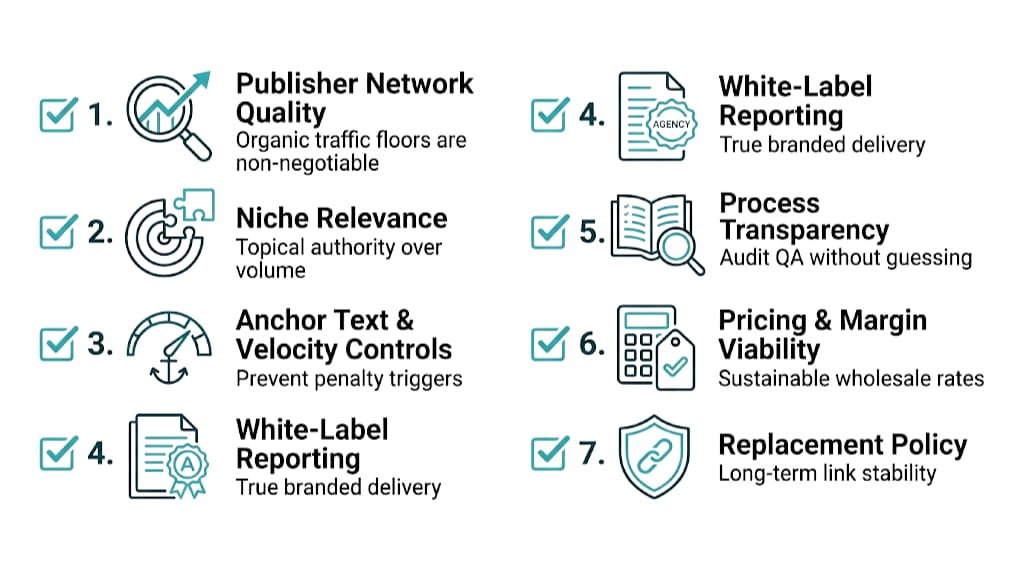
The 7 Non-Negotiable Criteria for Evaluating a White Label Link Building Partner
The framework below covers every dimension that separates a durable partner from a liability. These aren't nice-to-haves. Each criterion maps to a specific failure mode we've seen in the market, and skipping any one of them leaves a gap that shows up as a client problem six to twelve months later.
Work through these in order. The first two criteria - publisher network quality and niche relevance - are gatekeeping criteria. If a provider fails either of them, the remaining criteria don't matter. The rest of the criteria cover execution quality, commercial viability, and long-term stability.
Criterion 1: Publisher Network Quality - Organic Traffic Floors Are Non-Negotiable
Domain Rating is the metric most agencies use to evaluate publisher quality. It's also the metric most easily gamed, least understood, and most often waved around by low-quality providers as proof of a strong network.
The real quality signal is organic traffic. A publisher site that ranks in Google and pulls real visitors to real content is a site Google's systems have already reviewed and treated as credible. A site with DR 45 and 8,000 monthly organic visitors is a different asset from a site with DR 45 and 400 monthly organic visitors. The first has editorial weight. The second is usually a link farm that piled up backlinks without earning search visibility.
That DR gap is exactly why Ahrefs explains this clearly: DR measures the strength of a site's backlink profile, not organic performance or editorial quality. A site can pump up DR by buying or trading links from other low-quality sites at scale. Link farm networks do this on purpose - they cross-link to inflate metrics, then sell placements on sites that look authoritative by one score while staying invisible in search.
Organic traffic is also easy to verify. Ask for a sample of 20 publisher sites from their network and check each one yourself. Your verification checklist should cover:
- Monthly organic traffic verified in Ahrefs Site Explorer or Semrush. Set a minimum floor of 1,000 monthly organic visitors for standard placements. For premium placements, that floor should be 5,000+.
- Traffic trend direction. A site with 3,000 monthly visitors and a declining 12-month trend is a worse placement than a site with 1,500 visitors and a growing trend.
- Traffic source diversity. Real editorial sites pull traffic from many keywords across multiple topics. A site that gets 90% of its traffic from two or three branded queries isn't operating like a publisher.
- Content age and publication frequency. Active sites publish on a cadence. A site that hasn't published new content in four months isn't an active editorial property, regardless of DR.
- Google indexation status. Confirm the site's pages are indexed. A site with DR 50 and 200 indexed pages is a red flag. A real publisher at that authority level will usually have thousands of indexed pages.
This check takes about 20 minutes per sample set and separates real partners from bulk fulfilment operations fast. And if a provider won't share sample publishers before you commit to a campaign, treat that as a red flag on its own.
Organic traffic also ties straight into policy risk. Google's spam policies call out "large-scale article campaigns with keyword-rich anchor text links." The publishers that hold up through enforcement are the ones with real organic audiences. Placing links on sites with no organic traffic means placing links on sites Google has already deprioritized or is actively reviewing for removal from its index.
Criterion 2: Niche Relevance - Why Topical Authority Matters More Than Volume
A high-traffic publisher in the wrong niche isn't a quality placement. It's wasted spend. Topical relevance - the match between the publisher's content focus and your client's industry - determines whether a backlink carries ranking signals or just sits there.
That relevance point lines up with how Google frames quality. Google's Search Quality Evaluator Guidelines put weight on E-E-A-T (Experience, Expertise, Authoritativeness, Trustworthiness) as a quality signal. E-E-A-T applies directly to content, but the logic carries into link evaluation: a link from a topically authoritative source passes more value than a link from a general-interest site with no subject matter focus. A cybersecurity software company getting a link from an IT security publication is receiving a different signal than that same company getting a link from a lifestyle blog with a "technology" category that runs from iPhone tips to smart home gadgets.
To pressure-test a partner's relevance process, keep the questions tight:
- Do they segment their publisher network by niche or vertical, or do they run a single general-interest pool?
- How do they define relevance? Is it category-level (e.g., "technology") or topic-level (e.g., "B2B SaaS, cybersecurity, cloud infrastructure")?
- Can they show placements in your client's exact niche from the past 90 days?
- What do they do when a client sits in a niche with limited publisher inventory?
Limited inventory is where partners show their hand. A partner with real editorial relationships will explain how they handle constraints - expanding outreach, adjusting timelines, or being direct about what they can and can't deliver. A bulk fulfilment operation will overpromise or push links onto loosely related sites and call the job done.
Here's what that looks like in practice. A mid-market SaaS company spending $3,000 per month on white label link building services through your agency, operating in the HR technology space. A partner that places links on general business blogs, marketing publications, and entrepreneurship sites isn't building topical authority for that client. A partner that places links on HR industry publications, workforce management blogs, and employment law resources is. Over a 12-month campaign, the ranking impact gap is real, and relevance drives it.
Volume doesn't replace relevance. Ten highly relevant links from niche-specific publishers beat 30 links from general-interest sites in almost every competitive scenario. Any partner that leads with volume metrics instead of relevance criteria is telling you what they optimize for. If you're evaluating options, our curated links service is built around niche-matched placements on editorially vetted publishers.
Criterion 3: Anchor Text Controls and Link Velocity - The Signals That Trigger Penalties
This is the criterion almost no competitor covers, and it matters day to day. Anchor text over-optimization and unnatural link velocity sit at the top of Google's link spam detection triggers. A white label partner without explicit rules for both is a penalty waiting to happen.
Anchor text distribution matters because Google reads it as a naturalness check on the link profile. A site that picks up 40 links in six months where 35 use exact-match commercial anchors ("best HR software," "buy HR software online") looks manipulated, because it is. Natural profiles mix branded anchors, naked URLs, partial-match anchors, and generic anchors ("click here," "this resource"). Exact-match commercial anchors still drive ranking signals, but they belong in the minority, not as the default.
Get clear answers on anchor policy before you place an order:
- The anchor text guidance they give clients - and whether it's mandatory.
- Whether they track cumulative anchor text distribution across a client's full profile or treat each link as a one-off.
- What happens when a client asks for a high volume of exact-match anchors.
A credible partner will run a defined anchor text framework. They ask for the client's current anchor mix before building anything, then recommend anchors that fit what already exists instead of forcing a template. A bulk fulfilment shop does the opposite. It hands you an order form, asks you to fill in an anchor text field, and ships whatever you typed - downstream risk included.
Link velocity is the rate a site adds backlinks over time. A site that earns two to three links per month for a year and then suddenly lands 50 links in a single month creates a velocity spike. Google's spam systems flag that pattern. The 2024 spam updates showed velocity anomalies get detected and actioned, with some sites taking algorithmic penalties within weeks of a spike.
Velocity spikes are avoidable. A credible partner plans acquisition pace around the site's authority and growth trajectory. For a new site with a thin link profile, that often means four to six links per month. For an established domain with hundreds of existing backlinks, higher monthly volume draws less scrutiny. The key is whether the partner treats velocity as a risk variable and bakes it into campaign planning - not just order fulfilment.
Ask for a side-by-side explanation of how they handle velocity for a client new to link building versus one with an existing profile. If they don't separate those scenarios, treat it as a red flag.
Criterion 4: White-Label Reporting Infrastructure - What 'Branded Reports' Actually Requires
Every white label provider claims to offer branded reporting. In practice, that label covers everything from a real reporting system to a logo-stamped PDF. That gap shows up fast in client relationships.
Real white-label reporting does three things. It presents link data under your agency's branding with zero reference to the fulfilment partner. It includes enough detail for clients to see what they paid for. And it fits the workflow your account managers use. If your team has to reformat data before it goes client-side, that is not white-label reporting - it's a data export with extra steps.
A white label link building partner should meet this minimum reporting standard:
- Per-link placement details: The URL of the page where the link is placed, the target URL, the anchor text used, and the date the link went live.
- Publisher metrics at placement: DR, organic traffic, and traffic trend for each publisher site, pulled at the time of placement.
- Cumulative campaign summary: Total links delivered, anchor text distribution breakdown, and average publisher metrics across the campaign.
- Branded delivery format: Your logo, your agency name, and zero reference to the fulfilment partner in any visible element of the report.
Some partners go further with Google Search Console integration, rank tracking overlays, or live dashboards. Those additions help when they stay accurate and stable. The baseline list above stays non-negotiable.
Request a sample report before you commit. Read it the way your client will read it. It should show what was built, why it matters, and the quality metrics behind it. If your team would hesitate to send it as-is, it's not a white-label solution.
Criterion 5: Transparency in Outreach and QA - Red Flags That Signal a Black-Box Operation
Transparency is where real partners separate from fulfillment engines. A black-box operation is simple: we submit an order, we get a link report, and we never see how the link got placed, what editorial bar was used, or what QA happened before it shipped.
Black-box operations aren't always low quality. The problem is structural risk. We can't audit what we can't see, and we can't defend a link to a client or a penalty reviewer if we don't know how it was placed.
The transparency criteria to evaluate:
- Outreach methodology: Confirm whether the partner runs third-party outreach to independent publishers or places links on sites they own or control. Third-party outreach is editorial link building. Owned or controlled placements are a PBN, no matter what label gets attached.
- Content standards: Identify who writes the content around the link, the minimum word count, and whether an editor reviews it before publication. Also confirm whether we can review the draft before it goes live.
- QA process: Pin down the checks required before a link shows up as "delivered." Someone should verify the link is live, followed, and anchored correctly before it hits the report.
- Rejection criteria: Require clear publisher rejection rules. If they can't name specifics - declining traffic, thin content, obvious monetization patterns - then QA isn't systematic.
- Issue resolution: Get the replacement process in writing. That includes what happens if a link drops after delivery and how long replacements take.
Those criteria only matter if the partner can answer with detail. A partner with real process transparency will cover each item clearly and without dodging. They don't need to expose every operational detail - that's fine - but they do need to share enough for us to verify their approach without guessing. If all we get back is "we have a rigorous vetting process" with no specifics, assume the process is thin or it won't hold up under scrutiny. For agencies that want full visibility into how placements are sourced and vetted, a managed service model is worth evaluating as an alternative to pure reseller arrangements.
Criterion 6: Pricing Structure and Margin Viability - How to Evaluate Wholesale Rates Honestly
White label link building pricing swings more than most agencies expect, and price doesn't track quality in a clean line. We need the market rate structure so we can tell the difference between actual quality signals and pure margin padding.
Industry data shows wholesale pricing for white label guest post placements typically ranges from $100 to $600 per link depending on niche competitiveness, publisher traffic tier, and DR floor. Premium niches like finance, legal, and health command higher rates because publisher inventory is scarcer and editorial standards are stricter. General business and lifestyle placements sit at the lower end of that range. For a detailed breakdown of what drives these figures, our link building cost guide covers the full pricing landscape.
That range only helps if we anchor it to tiers. Use this pricing benchmark table for 2026:
Publisher Tier | DR Range | Organic Traffic Floor | Wholesale Price Range | Suitable For |
|---|---|---|---|---|
Entry | DR 20-35 | 1,000+ monthly | $80-$150 | New sites, early campaigns |
Standard | DR 35-50 | 3,000+ monthly | $150-$300 | Mid-authority campaigns |
Premium | DR 50-65 | 8,000+ monthly | $300-$500 | Competitive niches |
Authority | DR 65+ | 20,000+ monthly | $500-$800+ | Finance, legal, health |
Margin viability comes down to math, not vibes. A sustainable agency model typically marks up wholesale rates by 40-60% when reselling to clients. If a partner's wholesale rate for a standard placement is $200, your client-facing rate should be $280-$320 to cover account management, reporting, and margin. If the wholesale rate is already $400 for a placement that should be $200, the margin is gone before we've priced in any service overhead.
The wholesale rate also gets blurred on purpose. Watch for structures that hide the per-link unit cost: monthly retainers that bundle an unspecified number of links, "campaigns" sold as packages without per-unit transparency, and setup fees that don't map to a specific deliverable.
The pricing conversation needs to stay concrete. That means volume discount thresholds, retainer versus pay-as-you-go options, and whether pricing is fixed or varies by niche. If a partner won't give a clear per-link wholesale rate for a defined quality tier, we can't build a reseller model that scales.
Criterion 7: Replacement Policies and Long-Term Link Stability
Links go down. Publishers change their content strategy, delete old posts, or stop maintaining their sites. That's normal in the link building ecosystem - but the way a partner responds tells you how durable their publisher relationships are and how real their network is.
A credible partner offers a replacement policy. Terms vary, but the floor is clear: free replacement for any link that goes down within 12 months of delivery. Partners with real publisher relationships can honor that because they keep ongoing editorial contact across their network. Partners running bulk outreach or marketplace fulfillment usually can't. Once the transaction closes, the publisher relationship is gone.
Use the same three checks with every prospective partner:
- Confirm their link replacement policy and what triggers it.
- Get their average link retention rate at 6 months and 12 months.
- Confirm whether they monitor live links after delivery, or whether your team has to flag losses.
That retention rate matters. A partner that tracks the metric and gives you a specific number - "our 12-month retention rate is 94%" - runs link stability as a process, not a hope. A partner that won't share it usually isn't monitoring delivered links, or they're avoiding the data.
Link stability also tracks with publisher quality. Sites with real organic traffic and an active editorial team don't vanish overnight. Sites built for link monetization do. That organic traffic floor from Criterion 1 matters for more than placement quality - it also predicts link longevity.
How to Vet a White Label Link Building Partner Before Committing to Volume
The framework above tells you what to look for. The vetting process below is how we pressure-test a partner before we move any client account into volume delivery.
Step 1: Request a discovery call with a senior team member. Not a sales representative. You want someone who can answer technical questions about their publisher network, QA process, and anchor text approach. That call will tell you whether there's operational depth, or just a polished sales layer over a commodity service. Bring five to seven specific questions from the criteria above. Score the answers. Confidence doesn't count.
Step 2: Request 20 sample publisher URLs. Verify each one in Ahrefs or Semrush. Check organic traffic, the traffic trend, content age, and indexation status. This takes 20-30 minutes and shows you whether the network clears your organic traffic floor. Any partner that refuses to share sample publishers before you commit is disqualifying themselves.
Step 3: Order a test campaign on a low-stakes client or an internal property. Don't make your first order a high-value client account. Start with three to five links on a site where a miss won't cost you a relationship. Judge the publisher selection against your criteria, then review the anchor text approach, the reporting format, and turnaround time. A partner that performs on a small test order is showing their standard process - not a one-off favor.
Step 4: Review a sample report before you commit. Ask for a redacted report from a current campaign. Hold it against the reporting criteria in Criterion 4. If you'd send it to a client with your logo on it, it passes. If it needs heavy reformatting, count that time in your margin.
Step 5: Review the contract terms. Focus on confidentiality provisions that stop the partner from disclosing your client relationships, replacement policy terms, and any exclusivity clauses that limit you from using other providers. If a partner won't sign a basic confidentiality agreement, they aren't set up for real white label delivery.
Step 6: Check references. Ask for two or three agency references you can contact directly. A partner with a real track record will have agencies willing to vouch for them. And ask those agencies what happens when something goes wrong - a lost link, a missed deadline, a quality issue - because that failure mode is where partner quality shows up fast.
This process takes one to two weeks and costs a small test campaign budget. That's the right trade before committing 12 months of client link building to a partner you've only vetted on the surface.
The Difference Between a White Label Link Building Partner and a Link Reseller Panel
This distinction matters more than anything else in this market, and competing content skips it. Get it wrong and agencies stack penalty risk across dozens of campaigns, then only see the damage once a core update lands.
A white label link building partner runs a defined methodology. They build a vetted publisher network through real editorial outreach. QA happens before anything ships. You get account management, plus confidentiality agreements. They also own link quality over time, including clear replacement terms.
A link reseller panel is a marketplace. Publishers list sites with a price tag. Buyers pick placements from a catalogue. Fulfilment runs through an automated or semi-automated system, with no real QA between the listing and what gets delivered. The "white label" feature is just a branding setting that removes the panel's name from the output - it doesn't change the model.
Those operational differences show up fast:
Dimension | White Label Partner | Link Reseller Panel |
|---|---|---|
Publisher vetting | Ongoing, criteria-based | Self-reported by publisher |
QA before delivery | Systematic, human review | None or automated only |
Anchor text guidance | Proactive, campaign-level | Per-order input field |
Account management | Dedicated contact | Support ticket system |
Confidentiality | Contractual | Branding toggle |
Replacement policy | Standard, defined terms | Rare, case-by-case |
Penalty risk profile | Lower, defined methodology | Higher, unknown sources |
The reseller panel model isn't automatically fraudulent. But it isn't built to protect your clients either. Publishers self-report metrics, and the model lacks a consistent way to verify that a site listed at DR 45 with 5,000 monthly visitors matches those specs. Inflated listings are common. And links coming out of panel orders skew toward sites Google already treats as second-rate.
That risk compounds once you're running volume. If you're pushing 10 or more clients through a white label link building workflow, the partner model holds up over time. A real partner builds link profiles that survive algorithm updates. A panel piles up placements that look clean in a report, then fall apart under scrutiny.
Our white label link building services page covers how we handle this in our own operation - including the criteria we use to vet publishers before they enter our network.
How to Structure Your Agency's White Label Link Building Workflow for Scale
Choosing the right partner is step one. The workflow is what keeps you sane at scale. Most agencies underinvest here and end up with a patchwork of spreadsheets, manual reporting, and ad-hoc communication that starts breaking past 15 to 20 active clients.
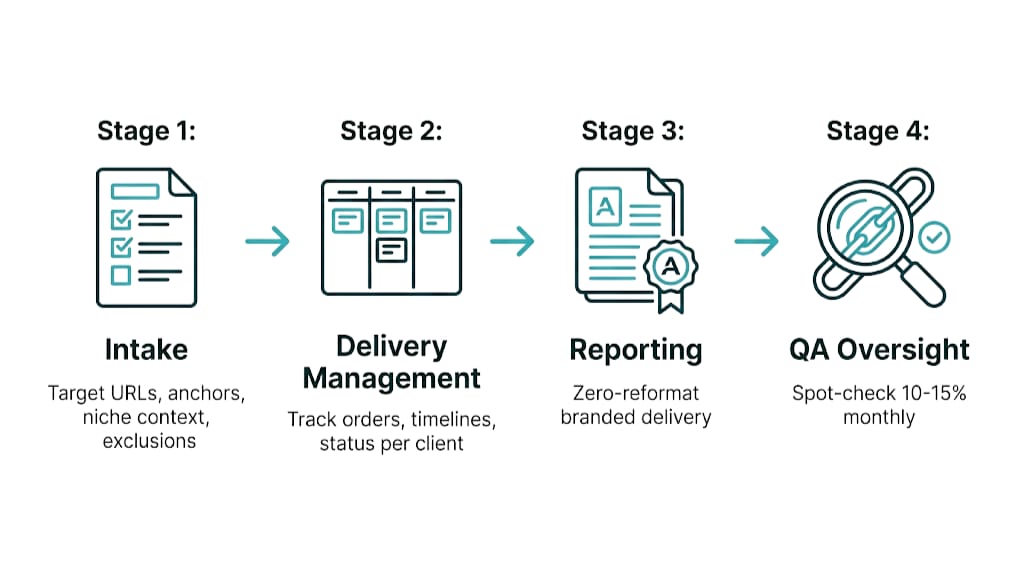
A scalable white label link building workflow has four components: intake, delivery management, reporting, and QA oversight.
Intake is how you collect what a partner needs to run the campaign: target URLs, anchor text preferences, niche context, existing link profile data, and any publisher exclusions. Lock this into a brief template your account managers complete for every new client. A good partner will bring their own intake form - line it up against your template, then merge both into one document your team uses every time. Intake quality sets placement quality. Sloppy intake is the fastest path to misaligned links.
Delivery management is how you track what's been ordered, what's been delivered, and what's still open across your client list. At small scale, a shared spreadsheet holds. Once you hit 20+ clients, switch to a project management tool - Asana, Monday.com, or a dedicated column in your CRM - so you can track order status by client and flag overdue deliveries without chasing threads. Your partner should commit to a delivery timeline at order placement. Enforce it. Build a review checkpoint into your workflow for every delivery batch.
Reporting is where agencies bleed hours. If your partner's reporting forces your team to reformat before it goes to clients, price that labor into your margin using your team's hourly rate. A partner whose reports can go straight to clients under your branding removes that overhead. Reporting becomes a zero-marginal-cost deliverable, which matters once you're managing dozens of clients.
QA oversight is the step most agencies skip. It's also the step that catches problems before they turn into client issues. Put one person in charge of spot-checking 10-15% of delivered links each month. Confirm the link is live, followed, correctly anchored, and placed on a publisher that meets your traffic floor criteria. Plan for two to three hours per month at moderate scale. That time buys you an independent quality signal that doesn't depend on a partner's reporting.
Partner risk is part of the workflow, too. Don't route every client through a single provider once you're operating at meaningful scale. Split volume across two credible partners to reduce concentration risk - if one partner hits a quality issue, a capacity crunch, or a business disruption, your client delivery doesn't stall. Use the same evaluation framework in this guide for both partners in a diversified setup.
For agencies building out their service stack, our managed link building service handles publisher vetting, QA, and reporting in a single workflow - which helps with both partner selection and diversification decisions.
Frequently Asked Questions About Choosing a White Label Link Building Partner
What should I look for in a white label link building partner?
Seven things separate a partner you can trust from a vendor you end up babysitting.
- Publisher network quality you can verify with organic traffic floors, not just DR
- Niche relevance that matches your client's industry and search intent
- Clear anchor text controls plus link velocity rules that prevent spikes
- Real white label reporting that your team can ship as-is
- Transparency around outreach, editorial review, and QA checks
- Pricing that leaves room for agency margin once you scale volume
- A written replacement policy for links that drop or get changed
Those seven criteria work together. If a partner can't show all seven without hand-waving, the risk lands on our side.
How do I vet a white label link building provider before committing?
Use a tight six-step vetting process and don't skip steps.
Start with a discovery call, but only if a senior operator is on it. We want technical answers, not sales talk. The discovery call sets the baseline for how they think about publisher quality, QA, anchors, and velocity.
Then ask for 20 sample publisher URLs and verify organic traffic yourself in Ahrefs or Semrush. The point of the sample list is simple: if they won't share examples up front, the delivery won't get more transparent after you pay.
Next comes the test. Order a small campaign on a low-stakes property so you can inspect communication, turnaround time, edits, and placement quality in the real workflow, not the pitch deck.
Before you expand spend, review a sample report in the exact format you'd hand to a client. Check the contract for confidentiality language and the replacement policy, in writing, with timelines. Close the loop by contacting two to three agency references and asking how the partner behaves when something breaks, not when everything goes smoothly.
Plan one to two weeks for this. That week saves months of cleanup.
What is the difference between a white label link building partner and a link reseller panel?
A real partner runs a method. That means vetted publishers, repeatable QA, account management, and contractual confidentiality.
A reseller panel runs a marketplace. Publishers self-list sites, buyers pick from a catalogue, and there's no meaningful QA between the listing and what you actually receive.
That "white label" toggle on a panel is just branding. It doesn't change the model, and it doesn't change the risk profile. Risk profile is the whole point here, because agencies that want durable client results can't build on unknown inventory.
How much should I pay for white label link building wholesale?
In 2026, wholesale rates for white label guest post placements sit in a wide band.
Entry-tier placements run about $80-$150 and usually land on DR 20-35 sites with 1,000+ monthly organic visitors. Authority-tier placements run about $500-$800+ and usually land on DR 65+ sites with 20,000+ monthly organic visitors. Premium niches like finance, legal, and health cost more because publisher inventory is tighter.
Those wholesale tiers drive our margin math. A sustainable agency markup is 40-60% over wholesale, and you need per-link wholesale rates by quality tier to forecast profit. If a provider won't give clear wholesale pricing by tier, they make margin planning impossible.
Is white label link building safe after Google's 2024-2026 spam updates?
Editorial links from credible publishers with real organic traffic still move rankings. That's the baseline.
Google's 2024-2026 spam updates went after low-quality, high-volume guest posting on sites with no audience, plus unnatural patterns like over-optimized anchor text and sudden velocity spikes. Those patterns are easy to spot at scale, and they age badly.
The safety line sits in publisher selection and campaign controls. A partner that enforces organic traffic floors, manages anchors at the campaign level, and paces link velocity against each client's existing link profile stays aligned with Google's quality guidelines. Bulk fulfilment operations and reseller panels concentrate the risk. Genuine editorial link building doesn't.
What reporting should a white label link building partner provide?
At minimum, you need clean delivery you can send to a client without edits.
- Per-link placement details: live URL, target URL, anchor text, publication date
- Publisher metrics at placement time, including DR, organic traffic, and traffic trend
- A cumulative campaign summary with anchor text distribution
- A fully branded format with zero reference to the fulfilment partner
That baseline is non-negotiable for client work. Some partners add live dashboards, Google Search Console integration, or rank tracking overlays. Those add value, but they don't replace the fundamentals above.
related Blog Posts



Join 7,000+ Clients Growing with Rhino Rank
Sign Up



Stay ahead of the SEO curve
Get the latest link building strategies, SEO tips and industry insights delivered straight to your inbox.