
 Back to all posts

Most comparisons of digital PR vs curated links stop at surface-level definitions and a vague recommendation to "use both." That's not a decision framework - it's a non-answer. SEO managers and agency owners need concrete numbers, realistic timelines, and an honest risk assessment before committing budget to either strategy. This article delivers exactly that.
The bottom line up front: Curated links (niche edits) and digital PR serve different functions in a link building program. Curated links offer predictable costs, faster placement, and scalability across multi-client operations. Digital PR generates high-authority brand signals but brings unpredictable link yields and a true cost-per-link that most agencies never bother to calculate. Neither tactic is universally "safer" - that comes down to provider vetting standards, not the tactic category. The right approach for most established SEO programs is a layered model: curated links as the consistent foundation, digital PR as the amplification layer for high-value campaigns.
This analysis covers cost-per-link mathematics, risk profiles under Google's current spam policies, timeline expectations, link quality metrics, and a scalability framework built for agencies running multiple client accounts. Every section is grounded in published research and real campaign data, not opinion.
What Are Curated Links and How Do They Actually Work?
Curated links - also called niche edits or contextual link insertions - are backlinks placed into existing, already-indexed content on third-party websites. Unlike guest posts, which require creating new content, curated links go into articles that have been live for months or years. The page already has crawl history, existing backlinks pointing to it, and established topical relevance. You're not building authority from scratch. You're tapping into it.
The mechanics stay simple. A link building provider finds a published article on a relevant site that closely matches your target page. They work with the site owner to add a contextual mention - often a sentence or two - that includes a link back to the client's URL. The placement sits inside existing content, surrounded by relevant text. That context drives a lot of the value.
This isn't a new tactic. Contextual link insertion has sat in the SEO toolkit for over a decade. What changed is the quality range - from real editorial placements on traffic-producing sites to PBN inserts dressed up as niche edits. That difference matters, and we'll deal with it in the risk section.
From a technical angle, curated links bring a few built-in advantages. The host page already has PageRank flow from its inbound links. The copy around the link stays on-topic, which aligns with the relevance signals Ahrefs flags as a ranking factor in its backlink relevance research. And because the article has an established publish date, the link avoids some of the new-content footprints that come with bulk guest posting.
At Rhino Rank, our curated link process starts with a hard traffic floor. We reject sites that can't show real organic search traffic in third-party tools. That filter wipes out most PBN-adjacent inventory that shows up with low-end providers. What remains is a link that reads like an editorial endorsement on a real site, which is the standard Google's quality guidelines point to when they describe natural backlinks.
For an SEO manager running a mid-market ecommerce account, a curated link on a relevant industry publication - one with 15,000+ monthly organic visitors and topical authority in your niche - is a real asset. Fast placement. Known cost. Verifiable quality before payment.
What Is Digital PR Link Building and Why Is It Different From Traditional Outreach?
Digital PR link building earns backlinks through newsworthy content assets - original research, data studies, reactive commentary on trending topics, or creative campaigns that journalists and editors choose to reference. The key word is "earning." Unlike curated links or guest posts, digital PR links aren't negotiated placements. They're editorially awarded by third parties who decide the content is worth citing.
That editorial independence is the main SEO upside. A link from a national publication like Forbes, The Guardian, or a major industry trade title - awarded because a journalist chose to reference your research - sends a different quality signal than a placement you negotiated. It's closer to what PageRank was built to measure: real peer endorsement.
Peer endorsement only happens if the asset holds up. Digital PR tactics cover a lot of ground: data journalism campaigns that compile original research or aggregate public data into a shareable story; reactive PR (sometimes called newsjacking) that puts a brand expert in front of journalists during breaking news; and staples like infographics, interactive tools, and survey-based reports. Different formats, same requirement. You need something a journalist will cover without payment or pressure.
That requirement is also the line between digital PR and traditional link outreach. Traditional link building - sending templated emails to bloggers asking for links in exchange for content - is a negotiated transaction. Digital PR is a media relations play. Different skills. Different timelines. Different cost structure.
Google's spam policies draw that same line, even if they don't use the term "digital PR." The documentation at developers.google.com/search/docs/essentials/spam-policies flags "large-scale article marketing or guest posting campaigns with keyword-rich anchor text links" as a link scheme. Digital PR campaigns that earn genuine editorial coverage don't fit that definition. Agencies running high-volume guest posting under the banner of "digital PR" sit much closer to the policy line than they may realize. The label doesn't change the risk profile - editorial independence does.
Editorial independence also brings spillover benefits curated links don't: brand mentions, referral traffic, social amplification, and the topical authority signals that Google's EEAT guidelines (developers.google.com/search/docs/fundamentals/creating-helpful-content) reward more each year. For a deeper look at how these signals interact with backlink strategy, the breakdown of digital PR link building is worth reviewing. In high-authority niches, those signals compound over time.
Cost Comparison: What Does Each Strategy Actually Cost Per Link?
Here's the number most digital PR agencies don't want you to calculate.
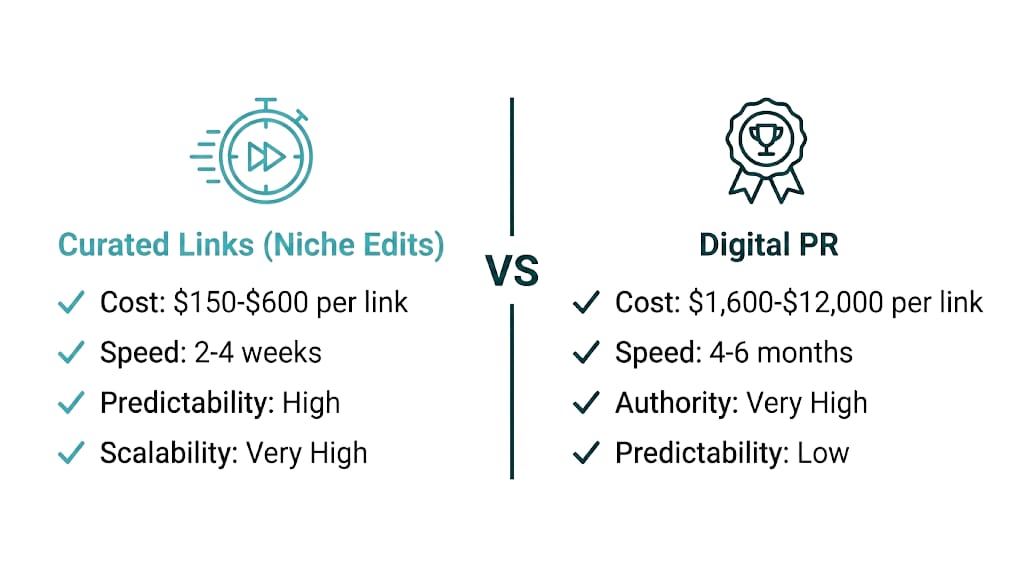
A typical digital PR retainer runs between $5,000 and $25,000 per month, with most mid-market campaigns landing in the $8,000 to $15,000 range. Fractl's research on content marketing campaigns and BuzzStream's outreach data show that a well-executed digital PR campaign produces between 5 and 15 links per campaign, with the median closer to 8. Those campaigns also take time. Plan on a minimum of 3 months before you see meaningful results, and most agencies quote 4 to 6 months as the realistic window.
Let's do the maths that competitors never do.
Scenario A: $10,000/month retainer, 4-month campaign
- Total spend: $40,000
- Link yield at median (8 links per campaign): 8-12 links
- Cost per link: $3,333 to $5,000
Scenario B: $8,000/month retainer, 3-month campaign, strong performance
- Total spend: $24,000
- Link yield at upper range (15 links): 15 links
- Cost per link: $1,600
Scenario C: $15,000/month retainer, 4-month campaign, underperformance
- Total spend: $60,000
- Link yield at lower range (5 links): 5 links
- Cost per link: $12,000
Exceptional campaigns beat these ranges. A viral data study might earn 50+ links. But clients can't budget on that. Agencies also can't promise it, even on a monthly retainer.
Curated links work differently. Quality curated link providers charge between $150 and $600 per link depending on the authority metrics of the placement site. At Rhino Rank, our curated links are priced transparently with DR and traffic data visible before purchase. No retainer. No minimum commitment. And no campaign uncertainty.
Strategy | Typical Cost Range | Cost Per Link (Realistic) | Predictability |
|---|---|---|---|
Digital PR (retainer) | $5,000-$25,000/month | $1,600-$12,000+ | Low |
Digital PR (project-based) | $15,000-$50,000/campaign | $1,000-$8,000 | Medium |
Curated Links (quality provider) | $150-$600/link | $150-$600 | High |
Curated Links (budget provider) | $50-$150/link | $50-$150 | Very Low (risk) |
That cost-per-link gap matters in the real world. For a mid-market SaaS team spending $3,000 per month on link building, curated links deliver 5 to 20 quality placements per month. The same $3,000 doesn't even cover the setup phase of most digital PR retainers.
Hidden Costs of Digital PR Campaigns Most Agencies Don't Mention
The retainer fee is not the full cost of a digital PR campaign. Real budgets pick up extra line items that never make it into the pitch deck.
Content production comes first. A data study, original research report, or interactive tool that journalists will cover takes real spend on design, development, and data sourcing. Depending on complexity, that adds $2,000 to $10,000 to the campaign before a single outreach email goes out.
PR tooling matters too - media database subscriptions like Cision or Muck Rack, outreach platforms, and monitoring tools. Expect $500 to $2,000 per month. Agencies bury this in overhead, but clients still pay for it one way or another.
Revision cycles cost money. When a campaign underperforms, the work doesn't stop - it expands. A campaign that produces 3 links in month 2 often needs a new angle in month 3, which kicks off another round of production spend.
Opportunity cost gets ignored most often. A $40,000 digital PR campaign that produces 10 links over 4 months eats budget that could have purchased 80 to 100 quality curated links from a reputable provider. For clients with SEO goals on a defined timeline, that trade-off needs to be surfaced early and treated like any other budget decision.
Risk Profile: Which Strategy Is Safer After Google's Spam Updates?
Most digital PR vs link building articles stick to a tidy story: digital PR equals safe, curated links equal risky. That story doesn't hold up in the real world. It's missing the part that drives outcomes.
Google's spam policies documentation spells out what counts as a link scheme. It calls out "buying or selling links that pass PageRank," "large-scale article marketing or guest posting campaigns with keyword-rich anchor text links," and "links with optimized anchor text in articles or press releases distributed on other sites." One item on that list matters here: large-scale guest posting. Plenty of digital PR agencies still use guest posting inside their link mix. Genuine editorial coverage stays out of the danger zone - but plenty of campaigns labeled "digital PR" don't produce editorial links.
That same quality line shows up on the algorithm side. The 2024 Google algorithm leak, covered extensively by Barry Schwartz at Search Engine Roundtable, confirmed that Google tracks site-level authority signals and uses them as ranking factors. Practitioners already operated this way. The linking domain quality matters more than the label on the tactic. A curated link on a real, traffic-generating, topically relevant website passes authority you can actually use. A link on a site with zero organic traffic - whether it came from "digital PR" outreach or a niche edit - passes nothing and increases the odds of a manual action.
The risk in curated links is not the tactic. It's the provider.
Provider quality comes down to three things that separate an asset from a liability:
- Traffic floor enforcement: Does the provider reject sites with no organic traffic? Sites with no real visitors are almost always PBNs or link farms, regardless of their DR score.
- PBN rejection protocols: Is there a documented process for flagging and rejecting PBN inventory? DR is easy to inflate. Organic traffic patterns are harder to fake.
- Topical relevance matching: Does the placement sit in content that's actually relevant to the target page? Relevance is a quality signal, and irrelevant placements burn budget even when the host site is legitimate.
At Rhino Rank, every placement site in our curated link inventory is vetted against organic traffic thresholds using third-party data. We reject sites that show traffic manipulation patterns, sites with obvious link farm footprints, and sites where the content surrounding the insertion point is topically mismatched. This is not a marketing claim - it's an operational process, and it's the reason our placements hold value through algorithm updates that wipe out lower-quality link profiles.
EEAT signals connect to the same point from a different angle. Content that shows real expertise, authority, and trustworthiness earns links that work as endorsements. A curated link placed on a site that meets EEAT standards - real authors, real editorial standards, real traffic - looks the same as an organic editorial link in terms of the signal it sends.
The risk conversation shouldn't stop at "is this tactic safe?" It should move to "does this provider enforce quality standards that match what Google treats as a legitimate link?" That standard applies to every digital PR agency and every curated link provider on your shortlist.
Speed to Results: Curated Links vs. Digital PR on a Realistic Timeline
Ahrefs' research on how long link building takes to impact rankings shows that new links take 3 to 12 months to influence rankings, with the median impact landing around 3 to 6 months after acquisition. That window holds for both curated links and digital PR links once they go live.
The real gap is upstream: how fast each method gets links published and indexed.
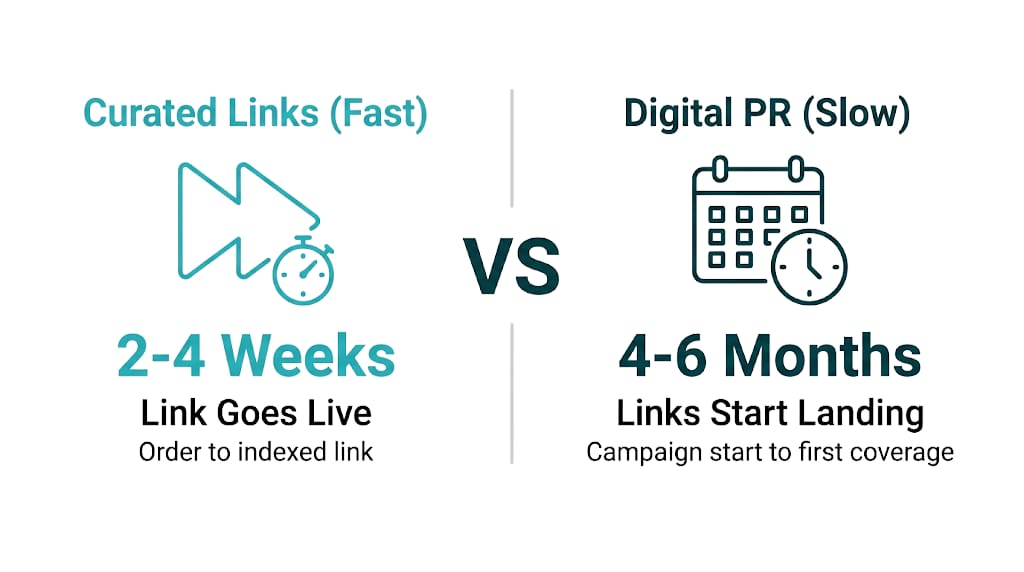
Curated links move fast. With the right vendor, we can secure a placement in 2 to 4 weeks after order confirmation. The host page already exists, it's already indexed, and the content has history - so the link doesn't depend on a brand-new URL building crawl equity. From order to live link to Google indexing, curated link campaigns can show measurable backlink profile growth within 30 days.
Digital PR runs on a different clock.
A standard digital PR campaign timeline looks like this:
- Weeks 1-4: Strategy work. Angle ideation and data sourcing.
- Weeks 5-8: Content production and asset creation, plus internal approvals.
- Weeks 9-12: Outreach and media pitching. Then follow-up cycles.
- Weeks 13-16: Coverage starts to land, and links begin going live.
- Months 5-6+: Rankings start responding as authority stacks up.
That means 4 to 6 months before a digital PR campaign produces ranking movement, and that's with a campaign that performs. When it doesn't, you can burn 6 months and end up with 3 to 5 links - not enough volume to move competitive rankings.
Deadlines make that hard to live with. Product launches, seasonal pushes, and fixed business targets don't wait for a PR cycle to mature. Curated links won't solve every ranking problem, but they give SEO managers a channel with a predictable deployment window.
That predictable window is why most mature programs run both. We use curated links to build links on a timeline and support pages that need movement by a set date, while digital PR runs in parallel as the longer-term authority play. Planned right, the timelines back each other up.
Link Quality Metrics: How Do Curated Links and Digital PR Links Compare in Authority?
Digital PR earns its premium on raw authority. A link from a national newspaper, a major trade outlet, or a top-tier media brand brings Domain Rating scores that most curated link inventory can't touch. A Forbes link at DR 94 or a TechCrunch link at DR 92 is a different calibre of asset than a curated link on a niche blog at DR 45, even when that blog is legit and drives traffic.
Raw DR isn't the only quality metric that matters. For most SEO programs, it isn't even the one that decides outcomes.
Topical alignment between the linking page and the target page influences how Google weights authority transfer - a DR 50 curated link on a tightly relevant industry site, placed inside content that matches the target page topic, can beat a DR 80 digital PR link on a general news domain where the mention sits in a loosely related story.
Here's what that looks like in practice. An ecommerce brand selling specialist outdoor equipment earns a digital PR link from a major national newspaper's lifestyle section - DR 91, but the article covers broad consumer spending trends and the brand gets a single line in a 2,000-word piece. That same brand also picks up a curated link on a dedicated hiking and outdoor gear review site - DR 52 with 18,000 monthly organic visitors - and the link sits inside a gear comparison that speaks to the exact product category. The second link sends stronger relevance signals and supports authority in the niche that actually matters.
Here's how the key quality metrics compare across both strategies:
Metric | Digital PR Links | Curated Links (Quality Provider) |
|---|---|---|
Domain Rating (typical range) | DR 60-95 | DR 30-70 |
Topical Relevance | Variable (depends on coverage) | High (when vetted) |
Anchor Text Control | None | Full control |
Link Placement | Editorial discretion | Contextual, negotiated |
Referral Traffic Potential | High (major publications) | Low to medium |
Dofollow Rate | Variable (some publications nofollow) | Usually dofollow |
Predictability of Quality | Low | High |
Anchor text control deserves a callout. With digital PR, the journalist picks the anchor - most of the time that's a brand name or a naked URL. That's fine for brand authority, but it won't build the anchor mix that competitive keyword sets demand. Curated links let us set exact match, partial match, and branded anchors in a controlled ratio, so the anchor text profile develops on purpose instead of by accident.
Rhino Rank's own client data shows what sustained curated link building looks like over time. One ecommerce client achieved a 1,900% increase in organic traffic through a sustained curated link campaign - not off one viral digital PR hit, but through consistent, relevant link acquisition that built authority in a competitive niche over time. That compounding effect is the main advantage of a well-run curated link strategy.
Scalability: Which Strategy Can You Actually Build a Repeatable SEO System Around?
For an agency owner managing 10, 20, or 30 client accounts at once, scale isn't a nice-to-have in a link building strategy. It decides whether the model holds up.
Digital PR doesn't scale cleanly in a multi-client agency operation. The reasons are operational, not theoretical.
Each digital PR campaign needs a unique, genuinely newsworthy content asset. We can run the same campaign for 15 clients. We can't promise link velocity - a campaign that earns 12 links for one client might earn 3 for another with similar budgets. We can't control anchor text at scale. And we can't forecast output far enough ahead to set client expectations with confidence. 61% of marketers say content marketing generates leads, yet content-driven link acquisition consistently underperforms projected timelines - which matches what any agency running digital PR across a large client roster sees in practice.
That uncertainty compounds into real resourcing problems.
If a digital PR campaign takes 40 hours of strategy, content production, and outreach per client per quarter, then 20 clients equals 800 hours of campaign management per quarter - and that's before client reporting, revision cycles, and the pivots you make when the first angle falls flat. That's not a link building operation. That's a full-service media agency.
Curated links scale in a different way because the workflow repeats.
- Define target pages and anchor text strategy for each client
- Submit link orders against vetted inventory
- Receive placement reports with live URLs and metrics
- Verify placements and update client reporting dashboards
- Repeat on a monthly cadence
Steps 1 and 4 demand client-specific thinking. Steps 2, 3, and 5 run the same way across the entire portfolio. With a clean process and decent tooling, an experienced SEO manager can run curated link campaigns for 20+ clients without the staffing burden digital PR creates.
Here's the scale framework we recommend for agencies:
Layer 1 - Foundation (Curated Links): Run monthly curated link campaigns for every client at a volume calibrated to their authority gap and competitive set. This layer gives predictable link velocity, controlled anchor text distribution, and clear month-over-month progress. It's the engine of the SEO program.
Layer 2 - Amplification (Digital PR): Save digital PR for clients with brand-building objectives, clients in niches where high-authority media coverage is realistic, and cases where one high-profile placement can create an outsized ranking swing. This layer adds authority spikes and brand signals, but it runs on a different timeline and budget model.
Layer 3 - Reporting and Optimization: Monthly reporting covers both layers. Curated link metrics (placements, DR, traffic, topical relevance) sit next to digital PR coverage metrics (media mentions, DA of coverage, referral traffic). We manage both as one authority-building program, not as competing tactics.
That "authority-building program" point matters.
This model gives agency owners what digital PR alone can't: a guaranteed monthly deliverable for every client, a repeatable operating process, and a clean narrative for client reporting. And it gives digital PR what curated links alone can't: the high-authority brand signals that compound over 12 to 24 months into real topical authority in competitive niches. Agencies looking to streamline this across a large portfolio may also benefit from a managed link building service that handles both layers under one roof.
When to Use Curated Links, When to Use Digital PR, and When to Use Both
The decision isn't binary. We don't treat this as a debate about which strategy wins. We pick the approach that fits the client's situation right now.
Use curated links when:
- The client needs ranking movement within a 60 to 90 day window
- The budget is under $3,000 per month for link building
- Target pages need specific anchor text to build keyword relevance
- The client operates in a niche where major media coverage is unlikely (B2B software, specialist manufacturing, local services)
- There's an authority gap in the existing backlink profile and it needs to be closed methodically
- We're managing multiple client accounts and need predictable monthly deliverables
Use digital PR when:
- There's a genuinely newsworthy story, original data, or a creative angle journalists will cover
- Brand awareness and referral traffic matter alongside rankings
- The client operates in a consumer-facing niche with strong media interest (personal finance, health, lifestyle, technology)
- The budget supports a 4 to 6 month campaign without pressure for early ranking results
- The backlink profile already has solid DR coverage and needs high-authority brand signals to compete at the top of a competitive SERP
Use both when:
- The client has a 12+ month SEO program with defined authority-building goals
- The budget supports a foundation layer of curated links in the $1,500 to $3,000 per month range, plus a separate digital PR investment of $8,000+ per month or priced per campaign
- The niche supports both strategies - for example, a SaaS company running data-driven digital PR while also building topical authority through curated links on relevant industry publications
- The SEO program runs in phases: curated links lead in the first 6 months to build baseline authority, then digital PR launches once there's enough domain authority to amplify the wins
A worked example makes this concrete.
An online legal services platform is targeting competitive keywords in personal injury and employment law. Their DR is 38 and their main competitors sit at DR 55 to 70. The 12-month plan looks like this: months 1 to 6 focus on curated links at 8 to 12 placements per month on legal, finance, and consumer rights publications, building DR and topical authority in the legal space. From month 4 onwards, a parallel digital PR program develops original research on legal dispute trends - data that national consumer publications will cover. By month 7, the domain has enough authority to benefit from high-profile coverage, and the digital PR links land on a profile that can use them. By month 12, the client has a diverse, high-quality backlink profile built from two complementary strategies working in sequence.
That's not "use both" as a vague recommendation. It's a sequenced program with a rationale for each phase.
How to Evaluate Any Link Building Provider Before You Spend a Dollar
The quality of a curated link or a digital PR placement comes down to who delivers it. Provider evaluation isn't optional - it's the decision that determines whether you build authority or buy problems.
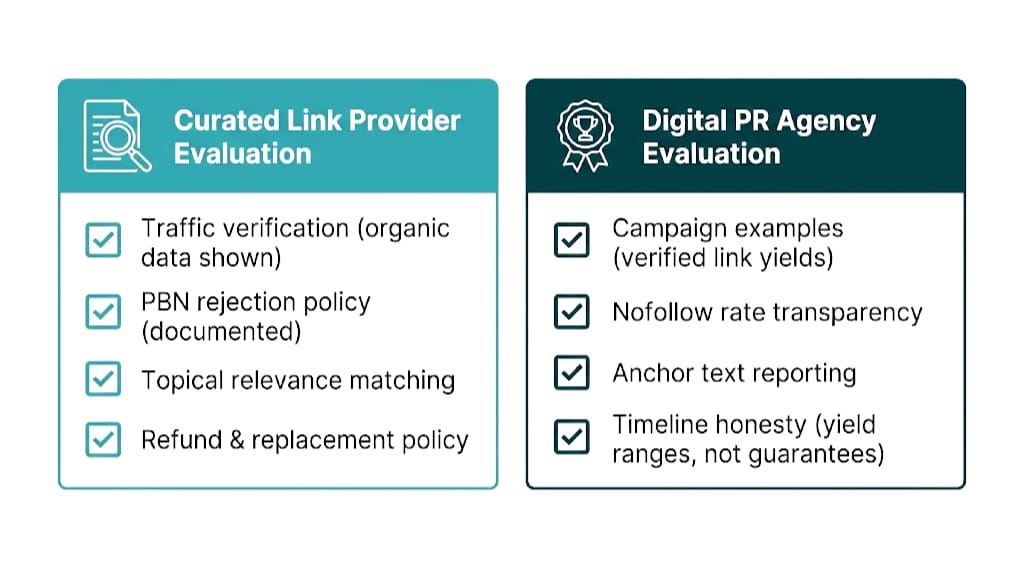
For curated link providers, the non-negotiable evaluation criteria are:
- Traffic verification: Do they show organic traffic data for the placement sites before you buy? If they only show DR, don't proceed. DR is easy to inflate. Organic traffic from a third-party tool like Ahrefs or Semrush is harder to fake.
- PBN rejection policy: Ask directly: "What's your process for identifying and rejecting PBN sites?" A real provider has a documented answer. "Quality checks" without details is a red flag.
- Topical relevance matching: Do they match your target page to relevant content, or do they drop links into whatever inventory they have? Ask for examples in your niche before you commit.
- Refund and replacement policy: Good providers stand behind placements. If a link drops within 12 months, what happens next? No guarantee tells you exactly how they view their own inventory.
That same evaluation mindset applies to digital PR, but the criteria change.
For digital PR agencies, the evaluation criteria shift:
- Campaign examples with verified link yields: Ask for case studies that show links earned, not just media mentions or impressions. Press that doesn't drive dofollow backlinks has limited SEO value.
- Nofollow rate transparency: Some major publications nofollow all external links. The agency should tell you the usual dofollow rate they see across campaigns. If they can't or won't, treat that as a problem.
- Anchor text reporting: Journalists pick the anchor text, but a good agency still tracks and reports it. Branded anchor concentration matters for profile health.
- Timeline honesty: Agencies that promise specific link counts on a fixed timeline are either lying or selling guest posts under a PR label. Honest teams give yield ranges based on past campaign data, not guarantees.
Those standards matter more after Google's updates, not less. The 2024 Google algorithm leak coverage confirmed what practitioners have long suspected: Google's systems can separate real editorial endorsement from manufactured link acquisition at scale. Providers that survive updates enforce quality controls that line up with what Google's systems reward. If you're unsure where to start, reviewing link building costs across different provider types can help you benchmark what quality service should actually look like at your budget.
Frequently Asked Questions
What is the difference between digital PR links and curated links (niche edits)?
Digital PR links are earned through newsworthy content campaigns - a journalist or editor chooses to reference your brand or research, which results in an editorial backlink. Curated links (niche edits) get placed into existing, already-indexed content on third-party websites through a negotiated process with the site owner. Digital PR links are unpredictable in volume but often come from higher-authority domains. Curated links give you predictable cost and timeline, allow anchor text control, and let you target specific topics and niches.
Which is cheaper per link: digital PR or curated links?
Curated links win on cost per link. A quality curated link from a reputable provider costs $150 to $600. A digital PR campaign on a $10,000/month retainer run for 4 months produces an average of 8 to 12 links, which puts true cost per link at $3,333 to $5,000 - and that's median performance. When campaigns underperform, digital PR cost per link clears $10,000. The gap is real, and most agencies avoid running the math.
Are curated links safe after Google's 2024 spam updates?
Curated links from quality providers are safe. The risk sits with the provider, not the tactic. Google's spam policies target links used to manipulate PageRank at scale, which includes PBN-sourced links no matter what someone calls them. A curated link on a genuine site with real traffic and tight topical relevance functions as a legitimate contextual backlink. Vetting still decides the outcome: organic traffic floors, PBN rejection protocols, and topical relevance matching. Providers that enforce those standards ship links that keep value through algorithm updates.
How long does it take to see results from curated links vs. digital PR?
Curated links land within 2 to 4 weeks of ordering, and the host page already sits in the index, so Google can discover the new link fast. Ranking impact then shows up within 3 to 6 months of link acquisition, consistent with Ahrefs' research on link building timelines. Digital PR runs on a longer clock. Campaigns need 4 to 6 months before links start going live at volume, and rankings move 3 to 6 months after that - which makes the full timeline 7 to 12 months from campaign start to measurable movement.
Can digital PR links be nofollowed, and does that affect SEO value?
Yes. Some major publications nofollow all external links as editorial policy. The BBC, many national newspapers, and some high-authority trade titles use nofollow or sponsored attributes on outbound links. That limits direct PageRank transfer from those placements. A nofollow link from a DR 90 publication still drives brand signals and referral traffic, but it won't pass the same ranking authority as a dofollow link. Before you commit to a digital PR campaign, ask the agency for its historical dofollow rate across coverage placements. A reputable agency tracks this and shares it plainly.
Which strategy is better for agencies managing multiple client campaigns?
Curated links work better for multi-client agency ops. The process is repeatable, deliverables stay predictable, and the same workflow scales across 20 or 30 client accounts without matching increases in overhead. Digital PR doesn't scale the same way. Every client needs a new campaign, link yields swing, and you need PR specialists to keep it moving. The recommended model stays the same: use curated links as the scalable foundation layer for all clients, then reserve digital PR for clients with brand-building goals and budgets that can support a 4 to 6 month campaign cycle.
Should I use digital PR or curated links for a new website?
For a new website with low domain authority, curated links are the better starting point in most cases. New sites need baseline authority and topical relevance before big digital PR coverage translates into ranking gains. Running digital PR on a DR 10 domain burns budget compared to building the domain to DR 35 to 45 through consistent curated link acquisition first, then layering in digital PR to push into competitive SERPs. One exception holds: a brand with a genuinely newsworthy launch story. In that case, early digital PR coverage can speed up the authority-building phase.
What metrics should I use to compare the quality of digital PR links vs. curated links?
Use the same core metrics for both: Domain Rating (DR) of the linking domain, organic traffic of the linking page (not just the domain), topical relevance between the linking content and the target page, dofollow status, and anchor text. DR alone doesn't cut it - a high-DR site with no organic traffic is a red flag regardless of how the link was acquired. Digital PR adds one more check: referral traffic from coverage placements, since that signals a real audience. Curated links need a different extra check: confirm the host page has real indexed content and an established crawl history.
related Blog Posts



Join 7,000+ Clients Growing with Rhino Rank
Sign Up



Stay ahead of the SEO curve
Get the latest link building strategies, SEO tips and industry insights delivered straight to your inbox.