
 Back to all posts
Link building is one of the few marketing investments where the gap between "what it costs" and "what it should cost for your situation" spans tens of thousands of dollars per year. Most guides hand you a price range and leave you to guess where you fall. That's not a budgeting framework - that's a menu without context. If you're an SEO manager justifying spend to a CFO, a marketing director allocating budget across channels, or an agency owner pricing client retainers, you need something more defensible than "links cost $100 to $2,000 each."
Context matters.
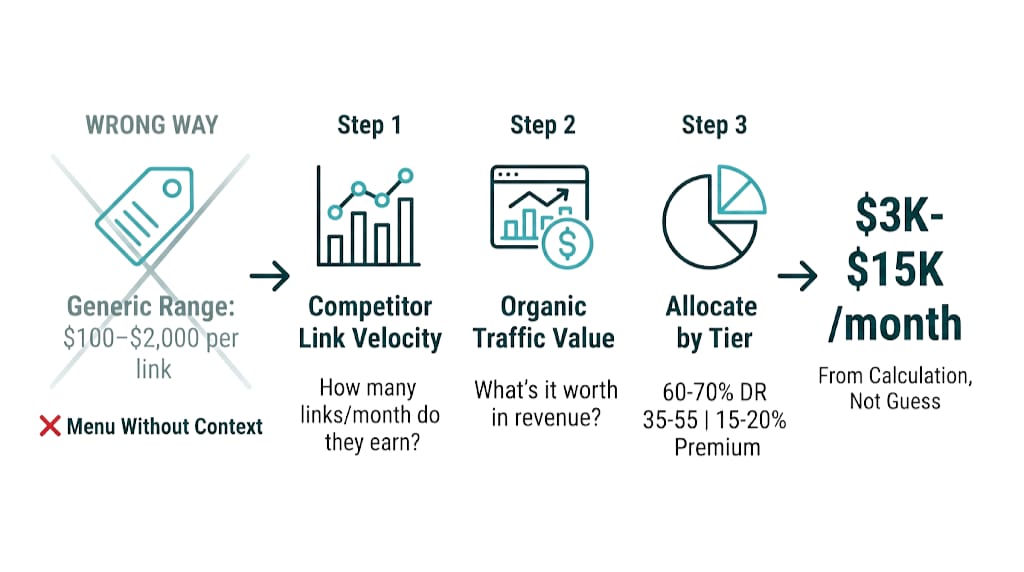
The bottom line: A well-structured link building budget starts with your specific growth target, works backward through competitor link velocity and organic traffic value, and allocates spend across service types and authority tiers with clear ROI logic. For most competitive niches, that means investing somewhere between $3,000 and $15,000 per month - but the right number for your business comes from a calculation, not a guess. In this guide, we lay out two concrete methods to run that calculation, real pricing benchmarks for 2026, and an honest breakdown of where most budgets quietly bleed money.
Backlinks remain one of Google's top three ranking signals, a fact confirmed by Ahrefs' ongoing analysis of ranking factors at ahrefs.com/blog/google-ranking-factors/. That hasn't changed. The spend has. So have the moving parts and the risk. Any budget that ignores all three breaks before the first link goes live.
What Does a Realistic Link Building Budget Actually Look Like in 2026?
"Realistic" depends on your competitive set, your current domain authority, and the organic traffic value of the keywords you're targeting. We can still anchor it to real numbers.
According to Siege Media's cost benchmarks at siegemedia.com/seo/link-building-cost, full link building programs typically run between $3,000 and $25,000 per month. BuzzStream's link building pricing research puts the average guest post link at $300 to $900 per placement. Rhino Rank's own curated links and guest post pricing sits within that range, with curated links starting from around $177 and guest posts from approximately $250 depending on the domain tier. These aren't outliers. They match what the market charges for editorially placed, quality links in 2026.
That market pricing has developed a harder floor over the last two years. Cheap links have gotten cheaper and more dangerous at the same time. PBN links and link farm placements still show up at $10 to $50 per link, but Google's spam policies - documented at developers.google.com/search/docs/essentials/spam-policies#link-spam - now catch and discount more of them. When that triggers a manual action, recovery routinely costs $5,000 to $15,000 in consultant fees plus lost revenue during the penalty period. A $30 link doesn't stay cheap for long.
That same supply-and-demand pressure pushes the other end of the spectrum up. Premium placements on high-traffic editorial sites cost more than they did even a year ago. Links on domains with a Domain Rating (DR) above 70 that carry real organic traffic now regularly command $500 to $2,000 per placement, particularly in competitive verticals like finance, SaaS, and legal. Ahrefs' year-over-year analysis confirms the upward pressure, driven by higher demand for genuine editorial links and fewer high-quality sites willing to accept outreach.
Those placement costs roll up into predictable monthly ranges.
Here's a practical snapshot of where budgets land by business type in 2026:
Business Type | Typical Monthly Budget | Links Per Month | Primary Tactic |
|---|---|---|---|
Local service business | $500 - $1,500 | 2-5 | Curated links, local citations |
SMB e-commerce | $1,500 - $4,000 | 5-12 | Guest posts, curated links |
Mid-market SaaS | $4,000 - $10,000 | 10-25 | Guest posts, digital PR |
Enterprise / competitive niche | $10,000 - $25,000+ | 20-50 | Full-service agency program |
These ranges assume quality placements with real traffic and editorial standards - not volume plays. A mid-market SaaS team spending $3,000 per month on 30 low-quality links will underperform a competitor spending the same amount on 8 to 10 well-placed, topically relevant links on real editorial sites.
Why Most Marketing Budgets Get Link Building Wrong (And How to Fix It)
Most marketing teams treat link building like a line item, not a growth lever. The budget lands as a fixed monthly number - often inherited from last year or copied from a competitor's rumored spend - with no tie-back to rankings or revenue. Then performance stalls.
The real issue is a category error. Link building isn't an expense - it's a capital investment in organic search infrastructure. A link earned today can keep driving authority and rankings for years, and that changes the ROI math. Spend $10,000 on Google Ads and the traffic disappears when the budget stops. Spend $10,000 on high-quality links and the impact compounds as those placements continue to support pages month after month.
The next issue: treating all links as interchangeable. A budget for "20 links per month" without defining authority tier, topical relevance, or the traffic profile of linking domains is a budget for noise. Reddit's r/SEO community runs into this all the time - threads like reddit.com/r/SEO/comments/1ej2lup/ show SEOs comparing budgets while measuring different inputs.
A better approach starts with outcomes. Set the link building budget from a target - a keyword cluster, a traffic goal, or a revenue number - then work backward to the investment required. Drop the generic budgeting prompt and replace it with two concrete checks: the ranking outcome we need, and the link gap between us and the page-one competitors. Understanding how link building helps SEO is essential before committing to any spend level.
That link gap is what matters.
The two methods in the next section operationalize that shift.
How to Set Your Link Building Budget Based on Business Goals, Not Guesswork
Outcome-based budgeting for link building needs two inputs most teams already have: competitor backlink profiles (Ahrefs, Semrush, or Moz) and the organic traffic value of target keywords. Put those together and the budget holds up in a stakeholder review - it's anchored in what it takes to compete, not what the internet says is "average."
The OutReachFrog goal-based budgeting framework at outreachfrog.com/blog/link-building-cost-breakdown-budget-by-goals makes the same core point: budget should follow the goal, not a vendor rate card. We take it a step further with two calculation methods that produce a real working number.
Start with a baseline. Pull the top three ranking competitors for your primary keyword cluster in Ahrefs. Capture their total referring domains, their monthly link acquisition rate from the "referring domains" growth graph, and the average DR of their linking domains. That becomes the benchmark - the link profile we need to match or beat to compete.
The Competitor Parity Method: Calculating How Many Links You Actually Need
The Competitor Parity Method answers one thing: how many links per month we need to build to match a competitor's link velocity, and what that costs at our target authority tier.
The formula:
- Find your target competitor's average monthly referring domain acquisition rate over the last 12 months (use Ahrefs' referring domains graph)
- Subtract your own monthly acquisition rate
- The gap is your minimum monthly link target
- Multiply by your target cost-per-link at the DA/DR tier you're targeting
Worked example: Your competitor ranks #2 for a cluster of mid-funnel SaaS keywords. Their referring domain count grew from 380 to 512 over the last 12 months - that's 11 new referring domains per month. Your site acquires about 3 per month organically. Your gap is 8 links per month. At a target of DR 40-55 guest posts averaging $450 per placement, your minimum monthly budget to match velocity is $3,600. To close the gap instead of treading water, run at 1.5x velocity - about $5,400 per month - for a defined catch-up period of 6 to 9 months.
This method doesn't guarantee rankings - content quality, on-page SEO, and topical authority still matter - but it sets a floor based on competitive reality, not gut feel.
The ROI Back-Calculation Method: Budgeting from Revenue, Not Rankings
The ROI Back-Calculation Method runs the math backwards. We don't start with what competitors spend. We start with what organic traffic is worth and budget link building as a slice of that value.
The formula:
- Pull Ahrefs' Traffic Value for your target keyword cluster. This estimates what the same traffic would cost via Google Ads.
- Estimate the organic traffic you'd win at positions 1-3 using standard CTR curves. Position 1 usually lands around 28-39% of search volume.
- Turn that traffic into monthly revenue using your average conversion rate and average order or contract value.
- Set your link building budget at 30-60% of the first-year organic traffic value.
Worked example: Your target keyword cluster shows a combined Traffic Value of $18,000 per month in Ahrefs. If you reach position 2 and assume a 15% CTR on a 2,000 monthly search volume keyword, you pull about 300 visits per month. With a 3% conversion rate and a $500 average contract value, that works out to $4,500 in monthly revenue, or $54,000 in year-one value. Set your link building budget at 40% of that first-year value and you land on a $21,600 annual budget, or $1,800 per month. If the competitive gap is larger, push toward 60% - around $2,700 per month.
This method lands with revenue-focused stakeholders because it ties spend to CAC against a defined organic revenue target.
Link Building Pricing by Service Type: What You're Actually Paying For
Not all link building services price the same, and the gaps come from real differences in workload, editorial review, and risk. Know what you're buying before you allocate budget.
Curated links (niche edits or link insertions) place a link inside existing, already-indexed content on a relevant site. Since the page already exists and has built authority, these placements can pass strong link equity. Rhino Rank's curated link placements start from around $177 per placement. The editorial lift stays lighter than a full guest post - outreach centers on negotiating a contextual insertion, not pitching and writing new content. For budget-conscious campaigns, curated links usually deliver strong authority-per-dollar, as long as the target page matches your topic.
Guest posts cost more because you're paying for content creation plus editorial approval. BuzzStream's pricing research puts the average guest post link at $300 to $900, and that range tracks with the spread in domain quality, content requirements, and niche competition. Rhino Rank's guest post service starts from approximately $250.
Quality splits fast here. DR alone doesn't decide value. A guest post on a DR 45 site with 15,000 monthly organic visitors beats one on a DR 55 site with 200 monthly visitors and no real readership.
Digital PR and link-earning campaigns sit at the premium end of the market. These campaigns create linkable assets such as original research, data studies, tools, or newsworthy content, then pitch them to journalists and editors at high-authority publications. Cost per link runs $500 to $2,000+ because the placements tend to land on DR 70+ editorial sites you won't reach through standard outreach. In competitive niches where top pages stack dozens of high-DR editorial links, digital PR is the cleanest way to close the authority gap.
Managed link building retainers bundle strategy, outreach, content, and reporting into a monthly fee. Siege Media's benchmark puts these programs at $3,000 to $25,000 per month. The value of a retainer goes beyond link volume. You're paying for the strategic layer: an agency that adjusts tactics based on what's working, tracks competitor link velocity, and catches quality issues before they turn into ranking problems.
Service Type | Typical Price Range | Best For | Risk Level |
|---|---|---|---|
Curated links | $150 - $400 | Budget efficiency, topical relevance | Low (if vetted) |
Guest posts | $250 - $900 | Authority building, anchor text control | Low-Medium |
Digital PR | $500 - $2,000+ per link | High-DR editorial placements | Low |
Managed retainer | $3,000 - $25,000/month | Full-scale programs | Low (agency-managed) |
PBN / link farms | $10 - $80 | Nothing legitimate | Very High |
DA and DR Tiers Explained: Where to Allocate the Majority of Your Budget
Domain Authority, Moz's metric, and Domain Rating, Ahrefs' metric, are the two most common proxies for a linking domain's authority. Neither is a Google ranking factor directly - Google uses its own PageRank-derived signals - but both correlate with the link equity a placement is likely to pass.
Most link building guides miss one point: chasing only high-DR links on a fixed budget underperforms a diversified plan weighted toward the DA 30-50 sweet spot.
Fixed budgets force tradeoffs. A DR 70+ placement on a major editorial site costs $800 to $2,000, so at a $5,000 monthly budget you're buying 3 to 6 links. A DR 35-55 placement on a quality niche site with real organic traffic costs $200 to $500, which puts you at 10 to 25 links on the same budget.
Volume isn't the whole story. The lower-DR placements, when they come from sites with genuine traffic and tight topical relevance, drive stronger ranking outcomes in aggregate because Google evaluates link profiles as a whole. A profile of 20 relevant, mid-authority links reads natural and stacks more cumulative weight than 4 high-authority links from tangentially related sites.
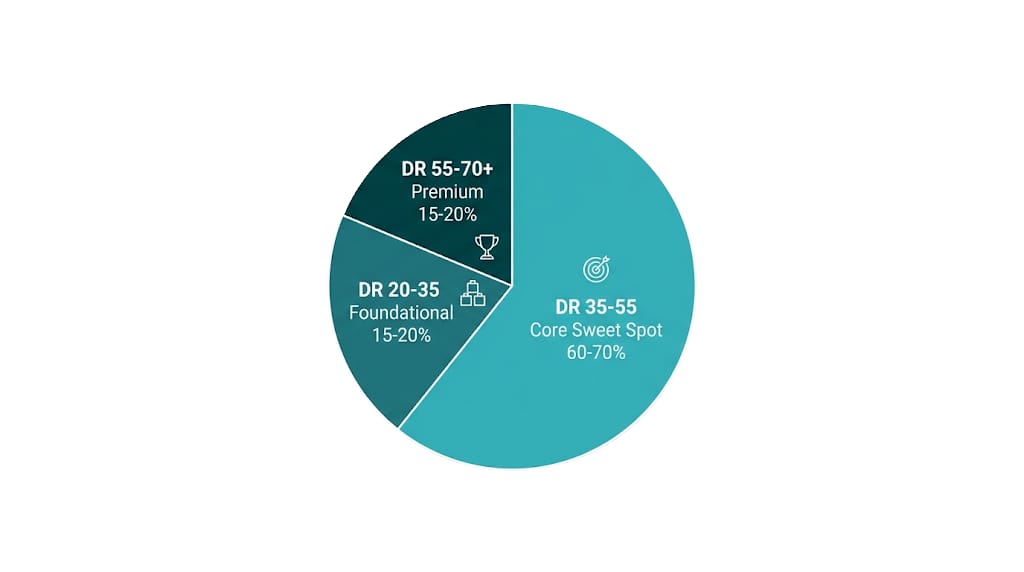
We recommend the following budget allocation framework by DR tier:
- DR 20-35 (foundational links): 15-20% of budget. Topically relevant, lower-authority placements that build diversity and support natural link velocity.
- DR 35-55 (core authority tier): 60-70% of budget. This is the sweet spot. Sites in this range tend to have real organic traffic and real editorial standards, and the cost-per-link ROI beats both cheaper and pricier tiers.
- DR 55-70+ (premium placements): 15-20% of budget. Save these for your highest-value target pages - money pages with the highest traffic value - where one strong editorial link can move rankings.
That allocation changes as your domain grows. A new site with DR under 20 should lean harder into the foundational tier at the start, because you need breadth and consistency before you start paying for top-end placements. An established DR 55 site competing for high-volume head terms should push more budget into the premium tier. Treat the framework as a starting point, not a rule.
In-House vs. Freelancer vs. Agency: The True Cost of Ownership
The "in-house vs. agency" comparison gets botched because people compare salary to retainer and stop there. That's sticker price, not total cost of ownership.
The in-house route: A mid-level link building specialist in the UK earns £35,000 to £50,000 per year. In the US, expect $55,000 to $75,000. Then the real costs show up: employer taxes, benefits, software, and time from a manager who has to keep the program on track. Ahrefs runs $399/month, Pitchbox or BuzzStream run $300-$500/month, and you'll still pay for content tools. All in, the true annual cost of a single in-house hire lands around $90,000 to $120,000 in the US.
That cost hits before output does. The 3 to 6 month ramp-up period is real, and during that window the hire builds process, establishes outreach relationships, and learns your site's topic area. Full cost. Partial output. Plan for it.
Ramp-up isn't the only risk. In-house also creates concentration risk: one person gets sick, takes leave, or resigns and link acquisition stalls. Rebuilding relationships with site owners and editors takes months.
The freelancer route: Experienced link building freelancers charge $50 to $150 per hour, or $300 to $700 per link depending on scope. The invoice looks clean. The hidden cost is QA overhead. Someone internal still has to vet every placement: confirm the domain has real traffic, keep anchor text tight, review content quality, and verify the URL is live.
That QA time adds up. For a small campaign, expect 5 to 10 hours per month, and it scales with volume. At a manager's fully-loaded $60 to $80 per hour, you're spending another $300 to $800 per month that never shows up on the freelancer bill.
The agency route: A quality link building agency charges $3,000 to $10,000 per month for a managed link building program. That covers strategy, outreach, content, placement, and reporting. QA sits inside the service. Relationship-building is already done. And the part procurement teams miss: a good agency carries the liability for link quality - if a placement drops or a domain gets penalized, a reputable agency replaces it.
Model | True Annual Cost (US) | Ramp-Up Period | QA Overhead | Scalability |
|---|---|---|---|---|
In-house hire | $90,000 - $120,000 | 3-6 months | Built-in (their job) | Limited by headcount |
Freelancer | $18,000 - $48,000 + $3,600-$9,600 QA | 1-2 months | 5-10 hrs/month | Moderate |
Agency retainer | $36,000 - $120,000 | 2-4 weeks | Minimal | High |
Over a 12-month horizon, the cheapest option depends on volume. If you need 5 to 8 links per month, a quality freelancer plus light internal QA is often the most cost-efficient path. If you need 15+ links per month and you won't compromise on consistency, an agency almost always wins on cost-per-outcome.
Cost-per-outcome is also where penalties show up. The penalty cost scenario is the number most guides ignore. A Google manual action triggered by a PBN-heavy link profile requires a link audit that costs $1,500 to $3,000, plus disavow work, a reconsideration request, and 3 to 6 months of ranking suppression. For a site generating $20,000 per month in organic revenue, that suppression alone costs $60,000 to $120,000 in lost revenue - which wipes out whatever you "saved" buying cheap links.
The 7 Cost Drivers That Determine What You Pay Per Link
Price variance in link building isn't arbitrary. Seven specific factors drive the cost of any individual placement. Know them and we can forecast costs with fewer surprises and negotiate from a position of facts.
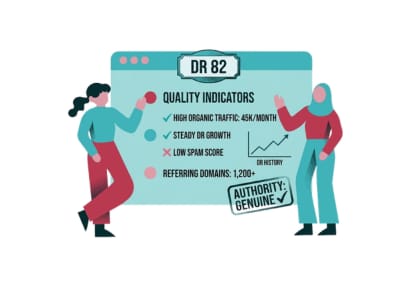
1. Domain authority and traffic volume. The most obvious driver. A DR 60 site pulling 50,000 monthly organic visitors commands a premium. But traffic often matters more than DR by itself - a DR 40 site with 30,000 real monthly visitors beats a DR 60 site with 2,000 visitors and inflated scores.
2. Niche competitiveness. Finance, legal, health, and SaaS links cost more because demand is higher and the supply of quality sites stays tight. A guest post in the personal finance niche regularly runs $600 to $1,500. The same DR placement in a hobby niche might cost $150 to $300. This is pure supply-demand economics.
3. Content requirements. Guest posts that need 1,500+ words of original, expert content cost more than curated link insertions. And if the site enforces strict editorial standards - fact-checking, author bio requirements, subject matter expertise - we either pay more or invest more in content production.
4. Link placement and anchor text control. In-content, contextual links in the body of an article pass more equity than footer or sidebar links. Sites that allow specific anchor text control charge more for that flexibility than those that insist on branded or URL anchors only.
5. Outreach difficulty. Some site owners respond to cold outreach. Others require relationship-building over months. Placements on sites with high editorial barriers - major industry publications, news sites, high-authority blogs - cost more because the outreach cost climbs. As Alexandra Tachalova's breakdown of link building economics on the Moz Blog illustrates, the labor behind each placement is what drives the real cost - not just the placement fee itself.
6. Exclusivity and freshness. Some link sellers cap the number of outbound links per page or per article. Exclusive placements on fresh content cost more than shared placements on older pages that already have multiple outbound links.
7. Geographic and language market. English-language links on US or UK domains command the highest prices globally. Links on German, French, or Spanish domains for regional SEO campaigns typically cost 20 to 40% less for comparable authority levels.
How to Allocate Your Link Building Budget Across Tactics and Tiers
After we set a total monthly budget using the Competitor Parity or ROI Back-Calculation method, the next decision is how to split it across tactics and authority tiers. Get this wrong and the campaign stalls. Get it right and gains stack.
A practical allocation model for a $5,000 monthly budget in a mid-competitive niche:
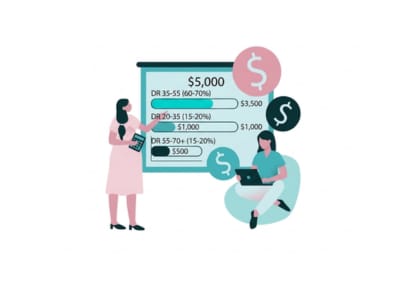
- $3,000 to $3,500, or 60-70%, on DR 35-55 guest posts and curated links. This is the core authority-building engine. At $300 to $450 per placement, that buys 7 to 10 links per month in the sweet spot tier. Prioritize topical relevance over raw DR inside this range.
- $750 to $1,000, or 15-20%, on DR 55+ premium placements. Plan for one or two high-authority editorial links per month pointed at the highest-value target pages. These lift competitive head terms where mid-tier links alone won't be sufficient.
- $500 to $750, or 10-15%, on DR 20-35 foundational links. Lower-authority placements that stay niche-relevant, keep link velocity looking normal, and support internal pages that push authority up to money pages.
- $250 to $500, or 5-10%, on tools, prospecting, and content support. If outreach runs in-house or through a freelancer, this covers the software and content costs that make link acquisition possible.
Allocation still depends on current DR. A site at DR 15 should weight more heavily toward foundational links at the start. Build a diverse, natural-looking profile first, then push into premium placements. A site at DR 50 competing for high-volume terms should shift the premium tier upward to 25-30% of budget.
One tactical principle worth emphasising: concentrate link building on a focused cluster of target pages rather than spreading links across the whole site. Three to five core pages getting consistent link equity will outrank a site that spreads the same budget across twenty pages. Internal linking then distributes authority from those reinforced pages to supporting content.
Red Flags That Signal You're Paying for Links That Will Hurt, Not Help
Some link building services lift rankings. Others torch them, then invoice you anyway. Spot the warning signs early and you protect both budget and domain.
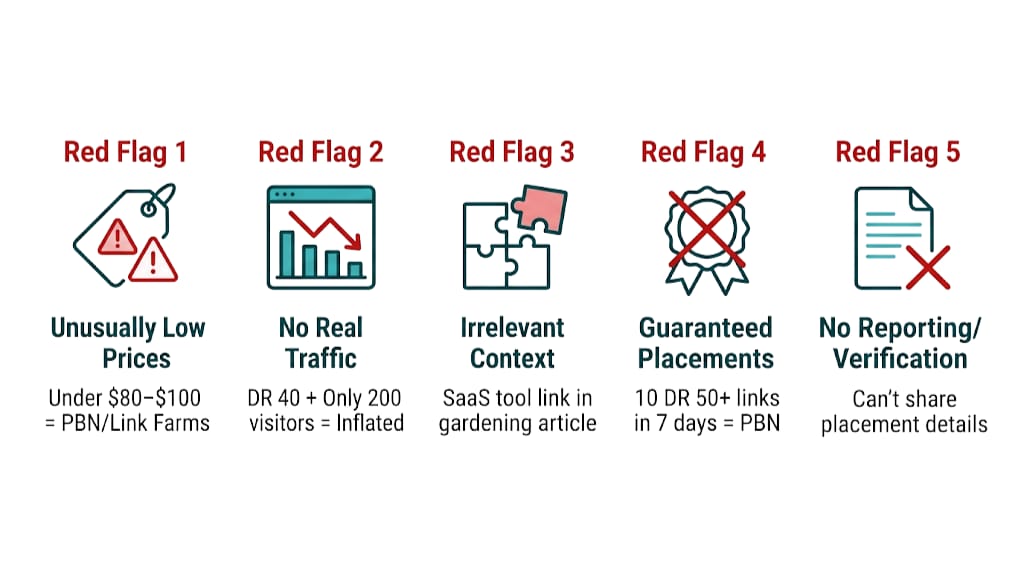
Unusually low prices. Any service selling guest post links for under $80 to $100 is usually placing them on PBN sites, link farms, or low-quality "write for us" spam blogs. Google's spam policies target paid links that pass PageRank without editorial oversight. Those placements get devalued or trigger penalties. Cheap links get expensive. Recovery from a manual action costs far more than whatever you saved buying bargain placements. For a deeper look at why bargain placements backfire, see our breakdown of cheap backlink hidden costs.
No traffic on the linking domain. Check every potential linking domain in Ahrefs or Semrush before you approve a placement. A site can show DR 40 and still pull only 200 monthly organic visitors. That's the red flag. It points to inflated authority or a site that's already taken hits for spam. Real links come from real sites with real audiences.
Irrelevant anchor text or placement context. A link to your SaaS product management tool dropped into an article about gardening tips is a contextual mismatch that Google's systems flag. Topical relevance between the linking page and your target page is a quality signal - when it's missing, treat it as a warning.
Guaranteed placements with guaranteed turnaround. Legitimate editorial outreach doesn't ship with guarantees. Providers promising "10 DR 50+ links in 7 days" are selling PBN placements or routing you through a network they control. Neither meets Google's definition of an editorial link.
No reporting or link verification. Reputable link building agencies provide a live report or spreadsheet listing the URL, anchor text, DR, and traffic data for every placement. If a provider can't or won't share that, assume you won't like what they're delivering.
The Google Search Central spam policies documentation is clear: links intended to manipulate PageRank violate policy. The line between a "paid editorial link" and a paid link scheme is editorial independence - the publisher controls whether the link goes in, and the content has to earn its keep with readers.
Frequently Asked Questions About Link Building Budgets
How much should I budget for link building per month?
The right monthly budget depends on your competitive market and growth targets, but practical benchmarks by business type are: local service businesses at $500 to $1,500, SMB e-commerce at $1,500 to $4,000, mid-market SaaS at $4,000 to $10,000, and enterprise or highly competitive niches at $10,000 to $25,000+. Use the Competitor Parity Method to calculate a number specific to your situation - find your target competitor's monthly link acquisition rate, calculate your gap, and multiply by your target cost-per-link.
What is a realistic cost per link in 2026?
For quality, editorially placed links, expect to pay $150 to $400 for curated link insertions and $300 to $900 for guest post placements, consistent with BuzzStream's pricing research. Premium DR 65+ editorial placements run $500 to $2,000+. Anything well below those ranges - especially under $80 to $100 - deserves real skepticism and strict vetting before you buy.
Is it cheaper to do link building in-house or hire an agency?
At face value, in-house looks cheaper. In practice, a single in-house link building hire in the US carries a true annual cost of $90,000 to $120,000 once you include salary, benefits, tools, and the 3 to 6 month ramp-up period. A quality agency retainer of $4,000 to $8,000 per month works out to $48,000 to $96,000 annually, and it often produces comparable or better output with faster deployment, built-in QA, and no concentration risk. For lower-volume needs - 5 to 8 links per month - a vetted freelancer, plus light internal oversight, is usually the most cost-efficient option.
What percentage of my marketing budget should go to link building?
There isn't a universal rule. A solid benchmark is 20 to 40% of your total SEO budget, or 10 to 20% of your total digital marketing budget, for teams where organic search drives acquisition.
That benchmark shifts based on what's holding growth back. If a newer site is capped by domain authority, pushing toward the top of that range speeds up the compounding lift you get from link equity. If the site already has strong authority, the share for link building can drop because other SEO work - content, technical SEO, CRO - tends to return more per dollar at that stage.
What is the minimum viable link building budget for a small business?
For a small business that wants real movement, $500 to $1,000 per month is the floor. Go below that and you end up with 2 to 3 links per month, which won't keep pace with competitor link velocity outside of low-competition local niches.
That $500 to $1,000 range also forces focus. Put budget into curated links in the DR 30-50 range so each placement carries weight. Prioritize topical relevance over volume. And point links at your highest-value target pages instead of sprinkling them across the site.
How long does it take for link building to show results?
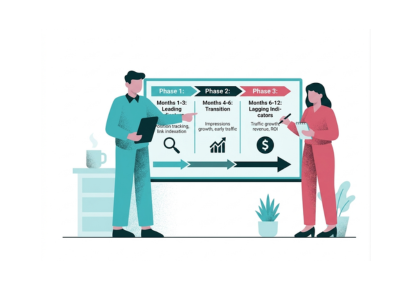
Most campaigns show measurable ranking movement within 3 to 6 months of steady link acquisition. The timeline depends on starting domain authority, keyword competition, and the quality and pace of links you secure.
Indexing comes first. New links often get indexed within 2 to 8 weeks, then the impact builds as Google re-crawls and re-evaluates your link profile. Don't expect instant wins - link building is a medium-to-long-term investment, and the compounding return shows up most clearly around months 6 to 12.
What is the difference between guest post and curated link pricing?
Curated links - link insertions into existing content - cost less, usually $150 to $400, because you aren't paying for content creation. Guest posts require original content and editorial review, so pricing lands around $300 to $900 on average.
The link equity can match either way if the placement context is strong. Guest posts give more control over surrounding copy, anchor text, and topical framing. On tight budgets, we recommend a mix: curated links as the base, with selective guest posts where control or context matters most for the target page.
related Blog Posts



Join 7,000+ Clients Growing with Rhino Rank
Sign Up

Stay ahead of the SEO curve
Get the latest link building strategies, SEO tips and industry insights delivered straight to your inbox.