
 Back to all posts

Pricing link building services is one of the most commercially consequential decisions an SEO agency makes. Get it right and you build a scalable, profitable service line that clients renew month after month. Get it wrong and you're either leaving serious revenue on the table or grinding through campaigns at a loss while wondering why the margins never add up. Most guides on this topic are written for buyers trying to understand what they should pay. We wrote this for the people on the other side of that conversation.
The bottom line: Pricing link building services requires a structured, defensible framework built on real cost drivers - not gut feel or competitor rate cards. Agencies that price well use a combination of the right billing model, a 7-factor cost assessment per link, niche-adjusted rate tiers, and a tiered proposal format that converts. This guide gives you all of it, including how to handle the "I can get links cheaper on Fiverr" objection without flinching.
The frameworks in this article are meant to ship straight into your process. Full-service SEO agency, specialist link building shop, or freelancer building out an offer - the mechanics stay the same.
We've built them around real market data, our own operational experience at Rhino Rank, and the unit economics that most agencies keep in their heads but should put on paper.
Why Pricing Link Building Services Is Harder Than It Looks (And Why Most Agencies Get It Wrong)
Link building sits in an uncomfortable spot in the SEO services market. It's one of the highest-value services an agency can sell. It's also one of the easiest to misprice.
That mismatch comes from a basic tension: the value of a backlink is probabilistic and delayed, but the cost of acquiring it hits now. Cash goes out today. Proof shows up later.
A client spending $2,000 a month on links won't see a rankings shift for 60 to 90 days in most cases. That delay creates pricing pressure on every call. Clients push back, shop cheaper options, and ask whether the links are "working." Agencies respond by discounting to retain the account - and the margin bleeds without fixing the real issue.
The underlying problem is almost always a pricing framework that was never built properly in the first place.
Most agencies land on link building pricing in one of three ways. They look at competitor rates and undercut a bit. They do a rough cost-plus markup based on outreach time. Or they charge what feels reasonable after years in the seat.
Each one fails the same test. None of them is systematic. None of them is documented. And when a client challenges the number, the team can't defend it without scrambling.
According to a survey of 518 SEO experts by Editorial.Link, the average price SEOs are willing to pay for a single quality backlink is $508.95. The same survey found that 80.9% of SEO professionals expect link building to get more expensive over the coming years. That signal matters. But a market average won't price your service for your niche mix, your fulfillment model, and your client expectations.
Client expectations are also distorted by the race to the bottom. Platforms like Fiverr and Upwork have trained part of the market to expect links for $20 to $50. That becomes the anchor your quote has to break. If your team can't explain why your links cost what they do, you'll keep losing price-sensitive buyers to the cheapest option - and the cheapest option is where Google penalties live. Understanding common link building mistakes before you build your pricing structure can save you from building a rate card around tactics that carry long-term risk.
The agencies that price well share one habit. They treat pricing as a product decision, not a sales decision.
Pricing as a product means you build rate cards, define tier structure, document cost drivers, and train account managers to present pricing without apology. That's what this guide helps you build.
The Three Pricing Models Agencies Use - and Which One Protects Your Margins
We see three pricing models dominate link building: per-link pricing, monthly retainers, and project-based pricing. Each fits a real use case. Each also has failure modes that crush margins if we lock the wrong model to the wrong client.
Project-based pricing - a fixed fee for a defined number of links over a set period - fits one-off campaigns, website launches, or buyers who want a clear deliverable before they approve ongoing spend. A startup building its initial backlink profile might pay $4,000 for 10 curated links across 60 days. Clean scope. Tangible output. No confusion about what's included.
That clean scope comes with a ceiling.
Once the project ends, the revenue ends. And fixed-fee work carries fixed-price risk: if outreach drags or the niche fights back, margin shrinks fast. Project pricing only holds up when we've run enough similar campaigns to forecast effort with confidence, and when the relationship stays transactional instead of turning into an ongoing SEO program without retainer economics.
Pricing Model | Best Client Type | Margin Risk | Revenue Predictability |
|---|---|---|---|
Per-Link | Sophisticated buyers, agencies | Medium | Low |
Monthly Retainer | Growth-stage businesses, ongoing SEO | Low-Medium | High |
Project-Based | One-off campaigns, new clients | Medium-High | None |
Per-Link Pricing: When Transparency Becomes a Double-Edged Sword
Per-link pricing is the clearest model and, for a lot of buyers, the easiest to budget. Pay $X per link, get a link. Simple. That simplicity also narrows the conversation in ways we don't always like.
The upside is operational. Per-link pricing is easy to scope, invoice, and explain. It scales without contract churn: a client buying 5 links a month can move to 10 without renegotiating terms. For agencies reselling links from a provider like Rhino Rank, per-link pricing also matches wholesale costs, so margins stay visible from day one.
Margins stay visible until the client treats links like a commodity.
When the discussion collapses into cost-per-link, clients compare a DR 40 guest post at $350 to a DR 40 guest post from a link farm at $60. The quality gap is real, but a price card rarely proves it. We end up defending price while the spreadsheet ignores editorial standards, topical fit, and the risk that "cheap DR" turns into a liability.
The fix is to bake quality criteria into the per-link tiers - not just DR, but organic traffic minimums, topical relevance requirements, and content standards. That puts the real differentiators on the invoice instead of leaving them trapped in a sales call.
Monthly Retainers: How to Scope Them So You Don't Bleed Margin
Monthly retainers are the default for agencies that want stable revenue. Predictable income. Cleaner resource planning. Stronger client relationships. But link building retainers carry a scoping trap per-link pricing avoids: clients expect consistent output every month, even when outreach gets harder.
Outreach difficulty is where most retainers break.
The common mistake is promising a fixed link count per month without pricing in niche variability. A finance client and a lifestyle blog client might both sit on a $3,000/month retainer, but the finance campaign can take 3x the outreach effort to land the same number of links. If the retainer is built around link volume instead of effort, we bleed margin on the hard niches and spend the "easy niche" surplus just to stay afloat.
Scope retainers around effort and quality floors, not just link counts. A well-structured retainer for a mid-market SaaS company spending $3,000/month might commit to 4 to 6 DR 40+ links per month with a minimum organic traffic threshold of 5,000 monthly visits, rather than locking into a flat 6 links no matter what the market gives us. That wording protects operations while still giving the client a clear commitment they can measure.
A quality floor still needs boundaries.
Define what's covered: outreach, content creation (or not), reporting cadence, link replacement policy, and an escalation process for rejected placements. The tighter the scope, the fewer mid-campaign surprises - and the less margin we donate to rework.
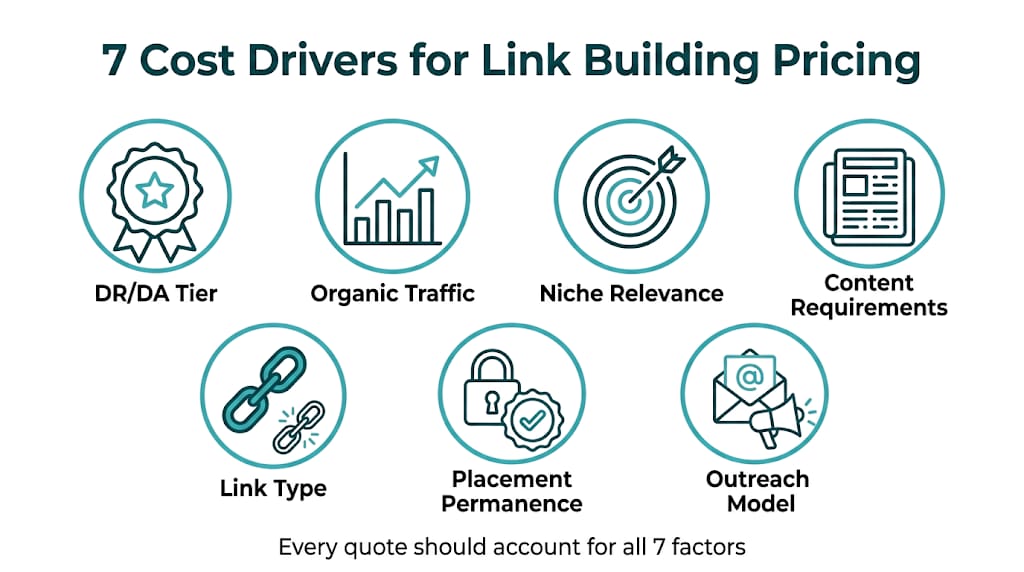
The 7 Cost Drivers That Should Determine Every Link Building Quote
Every link building quote should be built from the ground up around a defined set of cost drivers. Pricing by gut feel or by competitor comparison is how agencies end up with messy margins and quotes they can't defend. The seven factors below are the variables that decide what a link costs to acquire - and, by extension, what you should charge for it.
1. Domain Rating (DR) or Domain Authority (DA) Tier
DR and DA are the most common proxy metrics for link quality. Higher-DR sites are harder to land, come with stricter editorial standards, and often take more outreach cycles or a straight payment to the webmaster. A link on a DR 70 site isn't just 3x more valuable than a DR 30 link - it's often 5x more expensive to secure. Price tiers need to match that non-linear cost curve.
A practical starting framework:
DR Tier | Typical Market Rate (Guest Post) | Typical Market Rate (Niche Edit) |
|---|---|---|
DR 20-39 | $100-$200 | $75-$150 |
DR 40-59 | $200-$400 | $150-$300 |
DR 60-74 | $400-$700 | $300-$550 |
DR 75+ | $700-$1,500+ | $500-$1,200+ |
These are wholesale-adjacent figures. Client-facing pricing sits above this once you add margin, content costs, and the overhead it takes to run the process without things breaking.
2. Organic Traffic of the Referring Domain
DR is a synthetic metric. Organic traffic is real.
A DR 50 website with 500 monthly visitors is a different asset than a DR 50 website with 50,000 monthly visitors. Google's systems react to usage and quality signals, not only link graph scores. Ahrefs' own research has shown the correlation between organic traffic and link value is stronger than DR alone.
Those quality signals need to show up in your quote. Build organic traffic minimums into your tiers, and enforce them. We recommend requiring at least 1,000 monthly organic visits for entry-level links, 5,000+ for mid-tier, and 20,000+ for premium placements.
3. Niche and Topical Relevance
Finance, legal, healthcare, and insurance are the most expensive niches in link building - not because webmasters are greedy, but because there aren't enough legit, relevant sites to meet demand. A DR 45 personal finance blog with 10,000 monthly visitors can charge $500+ for a guest post because every fintech startup, credit card comparison site, and wealth management firm is chasing the same inventory.
That inventory problem gets sharper once you factor in topical relevance. A link from a DR 60 general news site is worth less to a B2B software company than a link from a DR 40 software review site. Relevance hits twice: it changes the SEO value, and it changes the outreach cost. Niche-specific outreach takes more personalization, and response rates drop because you're pitching to publishers who already know they're in demand.
4. Content Requirements
Does the placement require original content? If yes, who writes it?
A guest post on a high-authority site might require a 1,500-word article that clears editorial review. Backlinko's content research found that articles exceeding 3,000 words generate 77.2% more backlinks than shorter content - and that reality pushes the content bar up on better sites.
Spell content out in the pricing. If we're writing the article, add the content cost, which is typically $150 to $400 for quality, editorial-standard content. If the client supplies content, reduce the price, but keep a review and editing allowance in the scope so the placement doesn't stall in revisions.
5. Link Type: Guest Post vs. Niche Edit vs. Digital PR
Ahrefs' study of the link building market found the average cost of a niche edit is $361.44, while the average guest post costs $77.80 excluding content - and those averages cover a wide range, including plenty of placements we wouldn't sell. For a deeper look at how these formats compare on SEO impact, the guest post vs niche edit breakdown covers the tradeoffs in detail.
Niche edits (also called link insertions) drop your link into existing, indexed content. Guest posts mean new content that then needs to index and, ideally, pick up some visibility. Digital PR plays by different rules entirely: more upside, more work, and more volatility.
Different link types mean different ops costs and different risk. Price them differently. Don't hide that inside a blended rate.
6. Placement Permanence
Some placements come with a 12-month guarantee. Others are permanent in practice. And some are "permanent" until the site changes owners, gets hit, or disappears.
Permanence changes the long-term value of the link to the client, and it should change the way you quote and how you explain the offer. If you sell guarantees, you also sell ongoing responsibility.
Charge more for guaranteed placements with link replacement policies. That premium covers real work: monitoring live links, catching drops, and re-acquiring replacements when they disappear. Clients understand paying more when the guarantee actually comes with enforcement.
7. Outreach Model: Managed Outreach vs. Publisher Network
Links earned through direct outreach to cold prospects cost more to produce than links placed through an established publisher network. Managed outreach means prospecting, sequencing, follow-up, negotiation, and content coordination. A publisher network like Rhino Rank's curated links removes a lot of that friction, but the cost just shows up in a different place.
That difference needs to show up in your pricing model. Managed outreach links should sit at a higher price point than network-placed links because the labor input is higher, and your delivery risk is higher too.
How to Build a Link Building Price Card Your Clients Will Actually Understand
A price card isn't a menu. It's a positioning document. How we package pricing tells a client as much about our standards as the numbers do.
Agencies that send a spreadsheet with DR tiers and dollar amounts set one tone. Agencies that send a tiered doc with quality criteria, use cases, and example placements set another. And clients notice.
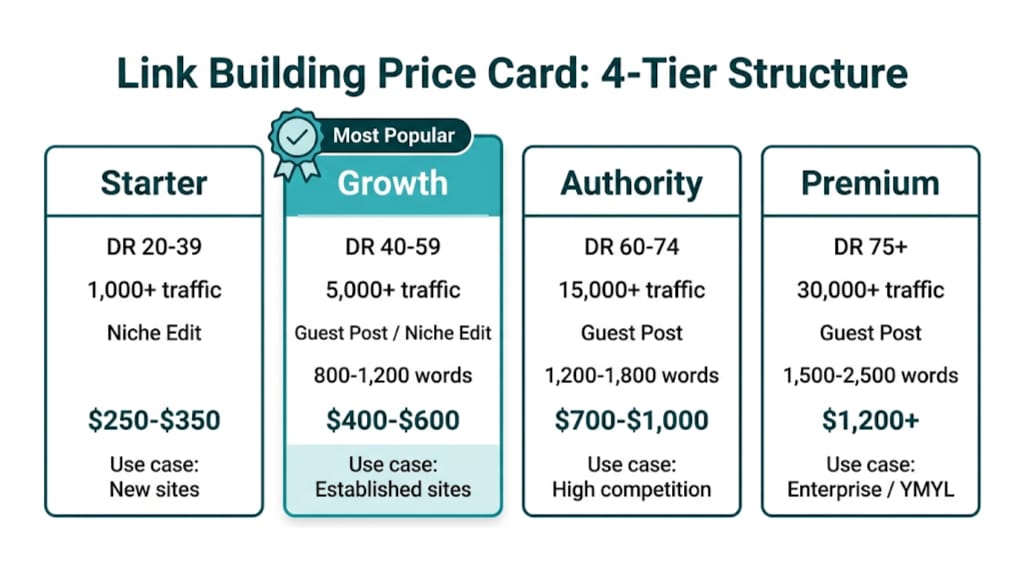
Start with three to four tiers, not ten. Too many options stall decisions. Too few hide the range. A three-tier structure - Starter, Growth, Authority - gives most teams enough choice without turning the doc into a pricing maze.
Below is a worked example of how a mid-size agency might structure a price card:
Tier | DR Range | Organic Traffic Min | Link Type | Content Included | Price Per Link |
|---|---|---|---|---|---|
Starter | DR 20-39 | 1,000/mo | Niche Edit | No | $250-$350 |
Growth | DR 40-59 | 5,000/mo | Guest Post or Niche Edit | Yes - 800-1,200 words | $400-$600 |
Authority | DR 60-74 | 15,000/mo | Guest Post | Yes - 1,200-1,800 words | $700-$1,000 |
Premium | DR 75+ | 30,000/mo | Guest Post | Yes - 1,500-2,500 words | $1,200+ |
Each tier needs a plain-English use case, not just metrics. Starter links fit new sites that need baseline authority. Growth works for established sites going after competitive mid-funnel keywords. Authority is for brands pushing into high-competition verticals or targeting head terms. Premium is for enterprise clients and YMYL niches where Google's Quality Rater Guidelines reward clear expertise, authoritativeness, and trustworthiness.
Add quality exclusions to every tier. Put the "no" list in writing: no PBNs, no link farms, no sites built only to sell links, no sites hit under Google's spam policies on link schemes. This does two jobs. It protects quality, and it separates us from the $50-per-link crowd without taking shots at competitors.
That tiered format also creates a cleaner upgrade path. A client who asks for Growth links often moves to Authority once they see what changes at the site level and in editorial control. Put the upgrade logic into the doc, not into a follow-up call.
One practical tip: label Growth as "most popular." It anchors expectations, cuts decision friction, and frames Starter as a compromise instead of the default.
Pricing by Niche: Why Finance Links Cost 3x More Than Lifestyle Links
Niche drives link pricing more than anything besides DR tier. If a rate card charges the same for a finance link and a travel link at the same DR, it prices one of those clients wrong - and usually both.
That mismatch shows up fast in finance, legal, healthcare, and insurance. These links cost more because supply is tight and demand stays high in the webmaster market. Sites in these categories know their audiences convert. A personal finance blog with 20,000 monthly readers gets outreach from hundreds of companies every month, and that volume gives webmasters real pricing power.
uSERP's survey of 800 SEO and marketing professionals backs up the spend profile: 46.5% of respondents spend between $5,000 and $10,000 per month on link building. The high end of that range clusters in competitive, high-CPC niches like financial services, legal tech, insurance, SaaS, and healthcare.
Base pricing needs a niche layer. This is the adjustment we expect to apply:
Niche Category | Price Multiplier vs. Base Rate | Notes |
|---|---|---|
Lifestyle, Travel, Food | 0.8x - 1.0x | High supply, lower competition for placements |
General Business, Marketing | 1.0x - 1.2x | Moderate competition, decent supply |
SaaS, Tech, B2B | 1.2x - 1.5x | Strong demand, quality sites are selective |
Healthcare, Wellness | 1.5x - 2.0x | YMYL considerations raise editorial bar |
Legal, Finance, Insurance | 2.0x - 3.0x | Highest demand, lowest supply, regulatory scrutiny |
That YMYL layer is where quotes swing. Google's Quality Rater Guidelines hold finance and health content to a higher bar because mistakes carry real-world consequences. Editors tighten standards, fact-checking takes longer, and outreach has to clear more gates. The process slows down, and the cost follows.
A concrete example makes the gap obvious. A link building campaign for a personal injury law firm in a major US city can't run on the same pricing as a campaign for a lifestyle subscription box brand. The law firm campaign runs into harder outreach, higher webmaster fees, stricter content requirements, and longer placement timelines. A DR 50 link in the legal niche might cost $600 to $900 to acquire. The same DR 50 link in the lifestyle space might cost $200 to $350.
Build niche multipliers into your quoting process, not just your price card. Once we understand goals, we pin down the niche next. That one detail moves the cost by 50 to 200%.
What Outreach Economics Actually Look Like - and Why Cheap Links Are a Maths Problem
The best way to defend your pricing against "I can get links cheaper elsewhere" is to walk clients through outreach unit economics. Most clients don't know what it costs to win a quality backlink through real outreach. Show the maths and the tone of the conversation changes.
Response rates set the floor. uSERP's survey data shows that only 8.5% of cold outreach emails result in a backlink. To land 10 links, an outreach specialist needs to send about 118 emails. That's the average. In competitive niches, the success rate drops. In finance and legal, a 3 to 5% success rate is what cold outreach to quality sites looks like.
Those response rates collide with fixed tool spend. A professional link building operation needs Ahrefs or Semrush for prospecting and quality checks, and those run roughly $2,400 to $4,800 per year. Add an outreach platform like Pitchbox or Mailshake, which costs $1,200 to $3,600 per year. Then pile on content creation tools or subscriptions, plus CRM or project management software.
Minuttia's operational analysis puts total tool costs for a link building team at $5,000 to $12,000 per year - before a single person is paid.
Labour is the other hard cost. A competent outreach specialist in a Western market costs $40,000 to $65,000 per year in salary. In practice, they can manage 30 to 50 active outreach conversations at a time and close 15 to 25 links per month if they're good. That puts the labour cost of a single link at $130 to $360, before tools, content, or overhead.
Here's the full unit economics breakdown for a single guest post link:
Cost Component | Estimated Cost |
|---|---|
Outreach specialist time (per link) | $130-$200 |
Outreach tool allocation (per link) | $15-$30 |
Content creation (800-1,200 words) | $150-$300 |
Webmaster fee (where applicable) | $0-$300 |
Management and reporting overhead | $30-$60 |
Total cost to acquire | $325-$890 |
That total cost is why cheap market averages mislead. Look at the Ahrefs data again: the average guest post costs $77.80 excluding content. That number includes huge volume from low-quality, low-effort placements on sites built to sell links. Those placements aren't the same product as an editorial placement on an active, trafficked website.
The $50 Fiverr link argument isn't wrong. Clients can buy links that cheap. Those links tend to come from sites that Google's spam policies on link schemes target. Google's documentation on link spam explicitly calls out paid links that pass PageRank as a guideline violation. And the risk shows up in the real world: manual actions and algorithmic penalties happen. If a client loses rankings because of a toxic link profile, they'll blame the cheapest links they bought, and they won't be wrong.
Quality link building costs more because it takes time, it needs paid tools, and competition keeps getting tighter. Agencies that explain that clearly keep clients at premium price points. Agencies that apologize for pricing lose deals to the bottom of the market, then spend months cleaning up the mess.
Reseller and White-Label Pricing: How to Build a Margin When You're the Middleman
A big chunk of the link building market runs on a reseller model. SEO agencies buy links wholesale from specialist providers and resell them to end clients inside a broader service package. It's a legitimate, efficient model - but it only works if the margin is planned and protected.
Rhino Rank's white-label link building offering shows the model in practice. Agencies buy curated placements at wholesale rates, add margin, and deliver links under their own branding. Clients get a seamless service. The agency earns margin without hiring and managing an outreach team. The provider eats the operational complexity.
The margin question most resellers get wrong is not how much to add - it's where to add it.
A naive reseller approach slaps the same percentage markup across every tier. Buy at $200, sell at $350. Buy at $500, sell at $750. The flat markup fails because it ignores where your value sits. At the premium end, your contribution rises fast: you're covering strategy, client management, reporting, and QA on placements where one bad call can hurt. A 40% markup on a $1,200 wholesale link prices your work like it's admin.
Tiered margins fit the reality better:
Wholesale Cost | Recommended Markup | Client-Facing Price | Margin |
|---|---|---|---|
$150-$300 | 60-80% | $250-$540 | $100-$240 |
$300-$600 | 50-65% | $450-$990 | $150-$390 |
$600-$1,200 | 40-55% | $840-$1,860 | $240-$660 |
$1,200+ | 30-45% | $1,560-$1,740+ | $360-$540+ |
Those percentages tighten at higher price points for two reasons. The absolute dollar margin stays strong. And premium link buyers check pricing and compare vendors. Try to run an 80% markup on a $1,200 wholesale link and you price yourself out.
White-label resellers should also charge for the services that surround the links. Strategy, competitor gap analysis, anchor text planning, monthly reporting, and link monitoring are billable work. Put them in a retainer on top of per-link costs if you want healthy margins without turning link pricing into a knife fight.
One common mistake is hiding the third-party provider and then getting cornered when a client recognizes the reporting format or link types. Being upfront about using a specialist provider - without naming them - tends to land better. It frames you as the strategic layer over specialist execution, which is the job.
How to Handle Client Price Objections Without Discounting Your Links
Price objections in link building almost always show up in one of three ways. The client thinks links should cost less than you're quoting. They've seen cheaper options elsewhere. Or they want to start small before they commit. Each one needs a different response - and none of them should push you into discounting your standard rates.
Objection 1: "We've seen links for $50-$100 elsewhere."
Don't brush this off. Meet it head-on.
"Yes, those links exist. They're placed on sites built for link sales, with little real traffic and no editorial bar. Google's spam policies call out paid links that pass PageRank without real editorial value. That risk lands on your domain, and cleanup costs more than the savings. Our links go on active sites with real traffic and editors who say no."
Those site standards are the difference. The price follows.
The Editorial.Link survey of 518 SEO experts puts the average acceptable price for a quality backlink at $508.95. If you're quoting $400, you're already below the market rate for quality work. Position your price as the sane option, not the "premium" one.
Objection 2: "Can we start with a smaller test budget?"
This request makes sense. Accept it - with boundaries.
Offer a defined pilot: 3 to 5 links at your standard rate, then a reporting review at the 60-day mark. Keep the unit price fixed. Only the volume changes.
Skip discounted "starter" pricing. Once you set that anchor, you'll fight to raise it later, and the client will expect the same concession every time budget comes up.
Objection 3: "Our last agency charged less."
Treat this like a quality audit, not a negotiation.
Ask for specifics on what they bought: DR range, organic traffic on the referring domains, topical relevance, and whether the placements were editorial or clearly paid slots. In most cases, they either can't answer or the answers show why the last program looked cheap.
That shift matters. You're no longer comparing invoices. You're comparing outcomes and risk - and that's a comparison you can control.
The golden rule: never discount a link to close a deal. Discounting tells the client your first price was padded, and trust doesn't come back once it's gone. It also trains the account to negotiate every renewal, every add-on, every time performance dips.
If you need to move to get a deal over the line, add value without touching unit price: an extra link, a competitive analysis, or an extra month of link monitoring. Protect the unit price.
Build these responses into sales training and account management. The agencies that keep clients at higher rates are the ones whose teams explain the value cleanly, without pausing or backtracking.
A Step-by-Step Framework for Quoting Link Building to a New Client
A structured quoting process does three things. It produces accurate, defensible pricing. It puts you in the "operator" bucket instead of the "making numbers up" bucket. And it creates a paper trail, which saves you when scope disputes show up later.
Below is the exact process we recommend.
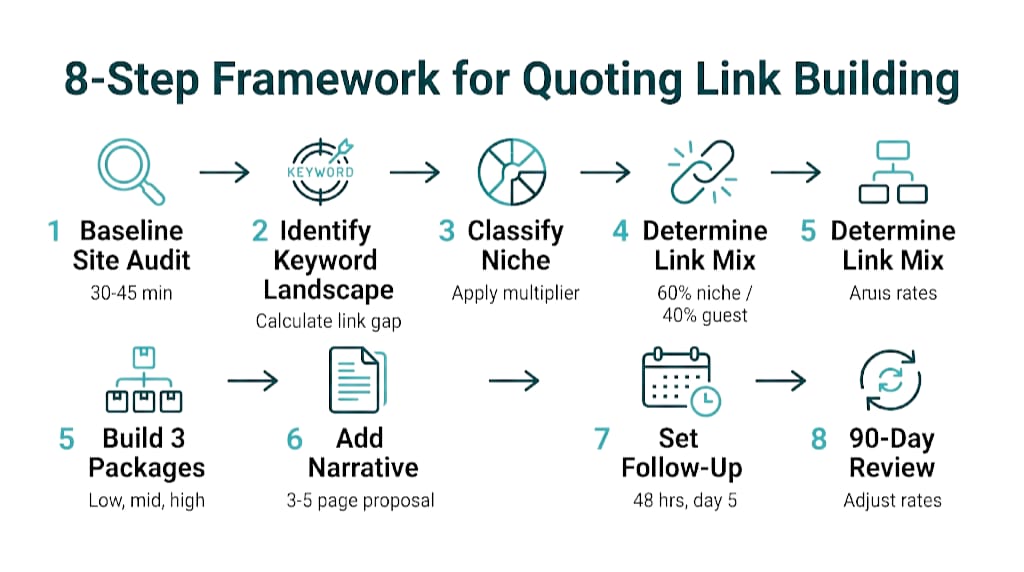
Step 1: Conduct a baseline site audit - 30-45 minutes
Before you quote anything, review the client's backlink profile in Ahrefs or Semrush. Capture their current DR/DA, referring domain count, anchor text distribution, and any obvious toxic patterns.
That baseline tells you how much cleanup sits under the surface, what quality bar you need to hit, and whether existing issues will cap results from new links. If you spot warning signs, it may be worth flagging a link audit before the campaign begins.
Step 2: Identify the target keyword landscape
Start with what they're trying to rank for. Pull the top 10 pages for the primary keywords and review their backlink profiles. Record how many referring domains the top 3 results have and the average DR of those referring domains.
Use that to calculate the link gap and build your proposal around it.
Step 3: Classify the niche and apply your multiplier
Using the niche framework from earlier in this guide, classify the client's vertical and apply the right price multiplier to your base rates. Document the classification in your quoting notes so your team can explain it without improvising on a call.
Step 4: Determine the right link type mix
Most campaigns need a mix of niche edits and guest posts. Understanding the differences between guest posts and niche edits helps you make the right call for each client's situation.
Niche edits place faster and often cost less at lower DR tiers. Guest posts do more for topical authority and tend to hold up better on higher-DR sites.
A common starting mix is 60% niche edits and 40% guest posts, then adjust based on the client's current profile and goals.
Step 5: Build three package options
Don't send one price. Send three.
The middle option should be the one you want to sell. The lower option gives the client a clean entry point. The upper option makes the middle look reasonable and, once in a while, gets picked by teams that want to move faster.
Here's a worked example for a B2B SaaS client:
Package | Monthly Links | Link Quality | Monthly Price |
|---|---|---|---|
Foundation | 4 links | DR 30-50, 2,000+ traffic | $1,600 |
Growth - recommended | 6 links | DR 40-60, 5,000+ traffic | $2,800 |
Authority | 8 links | DR 55-75, 15,000+ traffic | $4,800 |
Step 6: Add a narrative to the numbers
The quote document shouldn't be a spreadsheet. Send a short proposal that runs 3 to 5 pages and includes:
- A summary of the current link gap
- Your recommended strategy
- The three package options with clear quality criteria
- Quality standards and exclusions
- Reporting process, plus timing
- Link replacement policy, written plainly
That proposal sells the plan and defends the price. You need both.
Step 7: Set a follow-up cadence
Send the proposal, then follow up within 48 hours. If there's no response, follow up again on day 5.
Most deals get decided in follow-up, not in the first send. Use follow-up to answer objections and clarify scope, not to trade margin for speed.
Step 8: Review and adjust after 90 days
Bake a 90-day pricing review into every new client relationship. After three months, you have real data on outreach difficulty, content requirements, and link quality in that niche.
Use that data to adjust rates when needed - either because the campaign takes more work than you scoped, or because the team found efficiencies that improve margin.
This process takes discipline to run every time. But agencies that stick to it close more deals at higher rates and keep clients longer. Data-backed analysis, tiered options, and a clean proposal signal experience in a way a simple rate card never will.
One final point on quoting: quote in writing, include your quality standards, and spell out the link replacement policy. These aren't "nice to have" details - they're what keep the relationship rooted in clarity instead of assumptions.
Frequently Asked Questions About Link Building Pricing
How much should I charge for link building services as an agency or freelancer?
Pricing comes down to your delivery costs, the quality you can hit consistently, and the niche you're working in. As a baseline, quality guest posts on DR 40-60 sites with real organic traffic usually land in the $350 to $700 per link range for end clients. Niche edits in the same DR tier tend to run $250 to $500.
Competitive niches like finance, legal, and healthcare push those numbers up, same as higher DR tiers. The Editorial.Link survey of 518 SEO experts put the average acceptable price for a quality backlink at $508.95 - treat that as a market anchor, not a cap.
What is the difference between per-link pricing and a monthly retainer for link building?
Per-link pricing means the client pays a fixed fee for each backlink delivered, regardless of how much work it took to land. It's simple. It also makes agency revenue choppy, because output swings month to month.
Monthly retainers lock in a fixed monthly fee for an agreed volume and quality of links. That creates predictable revenue for the agency and a steady spend for the client. Retainers also fit ongoing SEO campaigns better because you can keep momentum instead of stopping and starting around purchase orders.
That same predictability helps ops. Retainers let you plan resourcing and outreach capacity in advance, which improves profitability over time.
Per-link pricing still has its place. It's a better fit for teams that want flexibility or want to test the waters before they commit to a longer engagement.
How do I price link building for competitive niches like finance, legal, or healthcare?
Use a niche multiplier on top of your base rates. Finance, legal, and insurance niches command 2x to 3x the price of lifestyle or general content niches at the same DR levels.
That premium comes from a few realities: fewer relevant sites that will link out, tighter editorial standards, longer outreach cycles, and YMYL requirements that demand stronger content.
A DR 50 guest post that costs $400 in a lifestyle niche should quote at $800 to $1,200 in a finance or legal context. Bake niche classification into your quoting process as a required step before you generate any number.
What factors should determine the price of a single backlink?
Seven core factors should drive link pricing:
- DR or DA tier of the referring domain
- Organic traffic of that domain
- Niche and topical relevance
- Content requirements - who writes it and what standard it needs to meet
- Link type: guest post, niche edit, or digital PR
- Placement permanence and any link replacement guarantee
- Outreach model used to acquire it - managed outreach vs. publisher network
Each one changes your cost to acquire the placement. Skip any of them and you're pricing on vibes, which is how margins turn into a surprise.
How do I justify link building costs to a client who thinks it's too expensive?
Start with the unit economics of real outreach. uSERP data shows only 8.5% of cold outreach emails result in a backlink, so 10 placements take roughly 118 emails. Then layer in tool costs of $5,000 to $12,000 per year, labour for a competent outreach specialist, plus content creation fees. That puts true cost per quality link in the $325 to $890 range before margin.
That math lines up with market prices. The Editorial.Link data says the average acceptable price is $508.95, so a properly priced service isn't "expensive" - it's what it costs to do the work and stay consistent.
The risk argument matters too. Cheap links from link farms violate Google's spam policies and can trigger manual actions, and cleanup costs more than whatever the client saved on the link purchase.
How much margin should I add when reselling link building services?
For white-label resellers, tiered margin beats a flat percentage. At the entry level, where wholesale cost runs $150 to $300, a 60 to 80% markup is appropriate. At mid-tier - $300 to $600 wholesale - target 50 to 65%. At premium levels, $600 to $1,200 wholesale, 40 to 55% is more realistic because clients push back harder on price at the top end.
But don't rely only on per-link markup. Charge separately for the strategic work that makes the links perform and keeps clients confident in the program:
- Anchor text planning
- Competitor gap analysis
- Monthly reporting
- Link monitoring
Those service fees protect margin even when premium-tier link markups get squeezed.
Should link building be priced differently for guest posts versus niche edits?
Yes, and the pricing needs to track the work involved.
Niche edits (link insertions into existing content) move faster and avoid content costs because no new article gets written. In most campaigns, that puts niche edits around 20 to 30% cheaper than guest posts at the same DR and traffic level.
Guest posts cost more for a reason: you're paying for original content, longer editorial cycles, and, in a lot of cases, higher webmaster fees. But that extra friction often comes with a benefit. Guest posts tend to do more for topical authority building on premium sites, since the page is built around your topic instead of squeezing a link into an older draft.
Ahrefs' market data puts the average niche edit at $361.44 versus $77.80 for guest posts excluding content. Those averages include plenty of low-quality placements, which skews the numbers. For quality placements, the gap tightens, and your tier pricing should reflect that reality.
What is the minimum viable monthly budget for a link building campaign?
For SEO impact, $1,000 to $1,500 per month is the floor. That's for a new or early-stage site in a low-competition niche.
Competition changes the math. In competitive verticals, the minimum budget that holds up is $3,000 to $5,000 per month. uSERP's survey found 46.5% of professionals spend $5,000 to $10,000 per month on link building, which lines up with what we see in active SERPs.
That minimum exists because link velocity has to clear a bar. Below it, you don't build enough links to pressure established competitors, and the campaign generates results too slowly to tune targeting, anchors, and page selection.
If a client's budget can't support effective link building, we should tell them to wait until it can. Running an underpowered campaign doesn't just stall - it wastes time and burns trust.
related Blog Posts



Join 7,000+ Clients Growing with Rhino Rank
Sign Up


Stay ahead of the SEO curve
Get the latest link building strategies, SEO tips and industry insights delivered straight to your inbox.