
 Back to all posts

Guest Posts vs Niche Edits: Which Link Type Should You Use?
Guest posts vs niche edits is not a safe-versus-unsafe choice. Both are contextual editorial links. A guest post is a new article contributed to another site; a niche edit is a link added to an existing relevant article. Choose guest posts when content control matters. Choose niche edits when speed, cost and fit matter more.
Guest posts vs niche edits: the quick answer
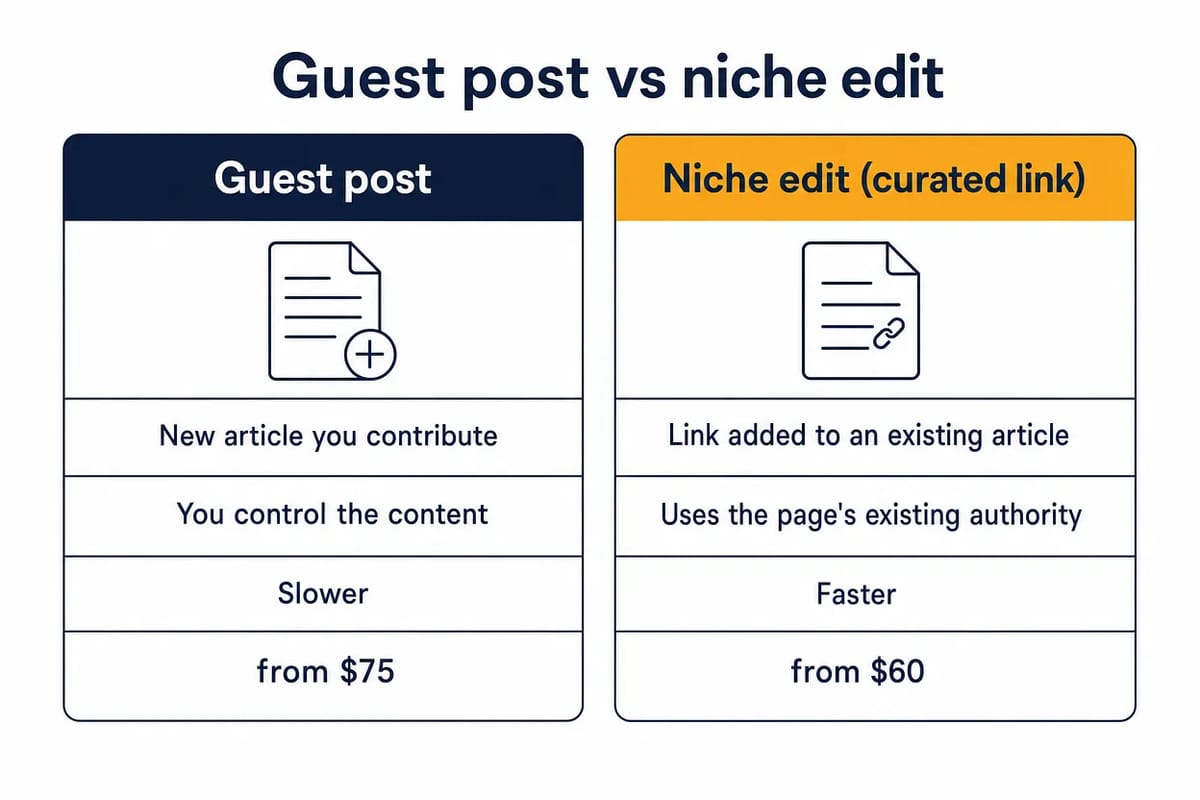
Factor | Guest post | Niche edit | Usual fit |
|---|---|---|---|
Content | New article | Existing article | Control vs speed |
Context | Built around you | Matched to you | Depends on fit |
Cost | Often higher | Often lower | Niche edit |
Pace | Slower to place | Faster to place | Niche edit |
Brand value | Stronger | Lighter | Guest post |
The honest answer is that neither link type is automatically better. A weak guest post on a thin site is still weak. A niche edit forced into the wrong paragraph is still a poor link. Your decision should start with the page you are trying to rank, the topic gap around it, and the level of control you need.
Relevance wins.
Both methods can work because the link sits inside editorial content, not a footer, sidebar or author bio. The difference is how that context is created. Guest posting creates a fresh page around the chosen topic. A niche edit finds an existing page that already has history, then adds the link where it fits.
What a guest post gives you
Guest posts are new articles published on third-party sites in your niche. The article is written before placement, so you have more control over the subject, surrounding copy, target URL and anchor text. That makes guest posting useful when your page needs a clear topical bridge from the linking site to your offer.
This control is the main strength. If you sell accounting software, for example, you can shape the article around cash flow, invoicing, finance operations or another theme that naturally supports your landing page. The link should read like part of the article, not a sentence that has been added after the fact.
The trade-off: guest posts take more work. You need a suitable site, a pitch, an article, editorial approval and publication. That extra process can make guest posts slower and more expensive than niche edits, especially if the publisher has a strict calendar or asks for revisions.
Guest posts also carry quality risk when they are produced at scale with thin copy, repeated formats or exact-match anchors in every placement. If the article only exists to hold a link, it is unlikely to help much. Repeated templates with a different target URL are a warning sign.
What a niche edit gives you
Curated Links, also called niche edits, place a contextual link inside an existing article or page. Instead of creating new content from scratch, the aim is to find a page that already covers the subject and add the link where it helps the reader.
The main benefit is efficiency. The page may already be indexed, may already attract organic traffic, and may already have internal or external links pointing at it. If the topic fit is strong, that existing context can make the link feel natural without waiting for a new article to be written and published.
That speed comes with less control. You cannot revise the whole article, choose every heading or shape the page around your brand. If the host article is dated, shallow, off-topic or crowded with outbound links, the placement can look weak even when the site metric looks fine.
The catch: a niche edit is only as good as its fit. A link added to an unrelated sentence is not made stronger by DA, DR or traffic. Metrics can help screen sites, but they do not replace editorial judgement.
Which one should you choose?
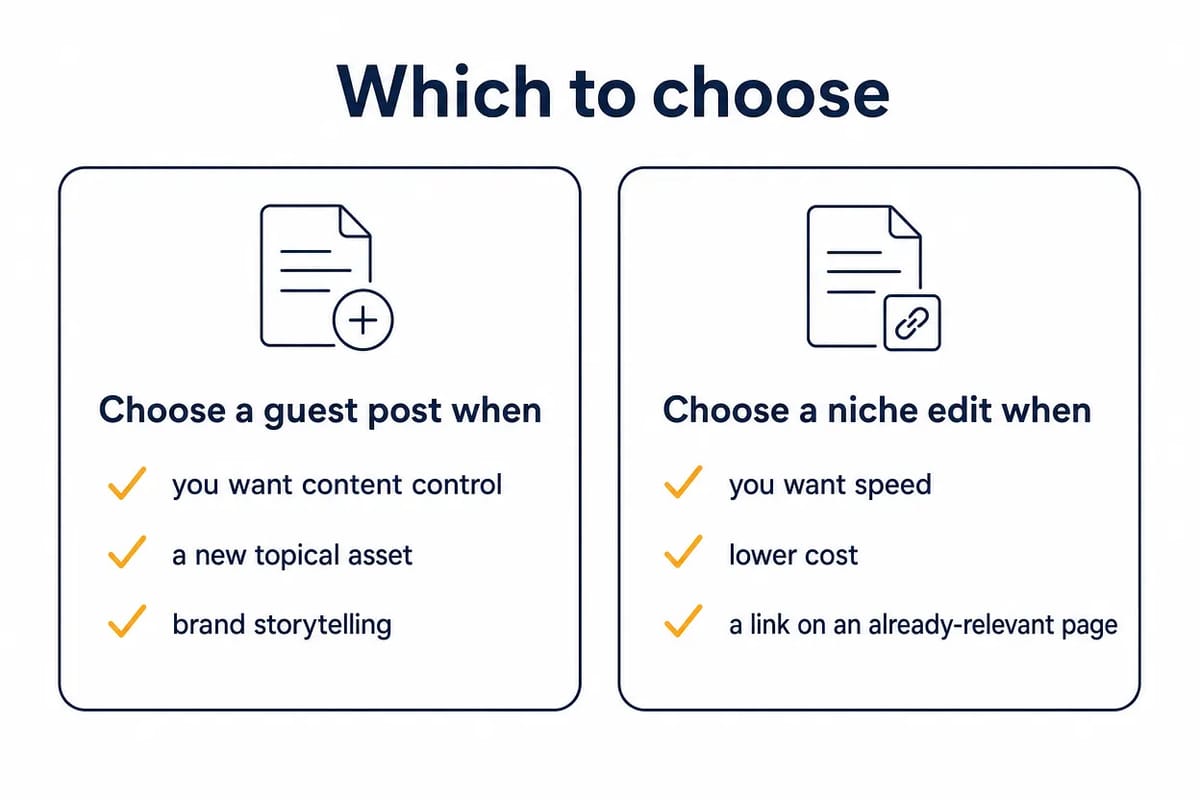
Use guest posts when your page needs a specific angle around it. This is common for commercial pages, service pages, new campaigns and topics where the linking article must explain the problem before the link makes sense. You are paying for the content wrapper as much as the backlink.
Use niche edits when the right article already exists. If a relevant guide, comparison or resource page already discusses the topic, a link insertion can be cleaner than adding another new article to the web. It can also suit campaigns where your budget needs to cover more placements.
If your page has no clear topical match, pause before choosing either method. A guest post can create the bridge, but only if the article is useful in its own right. A niche edit can be faster, but only if the existing article genuinely supports the target page.
In practice: most campaigns use both. Guest posts build controlled topical context around important pages. Niche edits add relevant links from existing articles that already make sense. The mix depends on the page, not on a fixed ratio.
That is the decision.
Anchor text and placement matter
Anchor text is the clickable part of the link. In guest posts, you can usually plan the anchor before the article is written. In niche edits, the anchor has to fit a sentence that already exists, or a small edit around it. That difference changes how hard you can push your target keywords.
You should avoid treating either method as an exact-match anchor machine. A natural mix of branded, partial-match and plain-language anchors is easier to justify inside editorial copy. If every link uses the same commercial phrase, the pattern can look forced even when the sites are real.
Placement matters because a link in the body copy, near relevant wording, is more useful than a link dropped into a generic closing paragraph. Before you approve any placement, read the surrounding sentences. If the reader would not understand why the link is there, the placement is not ready.
A worked example from Rhino Rank
Rhino Rank sells both link types, which makes the comparison easy to see in real service terms. A Guest Posts order creates a new 750+ word editorial article with one contextual dofollow link, from $75 per placement. A Curated Links order adds a contextual link into existing relevant content, from $60 per link.
If you are buying either type, know Google's official stance on paid links. Links you pay for should be qualified with rel="sponsored" or nofollow, and links created mainly to manipulate rankings are link spam. Guest-post and niche-edit placements are paid, but the link is presented as editorial in-context, so the value and safety rest on quality: genuine topical relevance, real editorial sites, natural anchors and restraint, not volume or exact-match anchors. That does not make either option risk-free. Irrelevant, mass-placed or over-optimised paid links are exactly what Google penalises.
That does not mean the cheaper option is always the better one. When the article needs to frame a new product category, the guest post gives the cleaner route. If a strong article already covers the exact topic, the niche edit may be enough. Fit comes first.
How to find niche edits
The simplest route is to look for pages that already mention your topic, brand, product type or problem area. Broken link building can work when you find a dead resource and offer a better live replacement. Press mentions can also turn into links when a site has named your brand but not linked to it.
Quality checks matter more than the tactic. Look at the article as well as the domain. Check whether the page is indexed, internally linked, accurate and not crowded with outbound links. If those checks are skipped, low-quality links from spam websites can add risk instead of value.
For teams without outreach time, outsourcing backlink building can make sense, but the campaign rules still belong to you. Set the target page, anchor range, niche rules and rejection criteria before anyone starts prospecting. A cheap link that misses your topic is not cheap for long.
How to secure guest post opportunities
Guest post prospecting usually starts with publishers that accept expert contributions, industry blogs, competitor backlink data and existing relationships. Analysing competitor backlinks can reveal the sites that have already published similar articles, but you still need to judge whether those sites suit your brand.
Once you have a prospect list, pitch the article idea before you write the full piece. Good guest post opportunities usually need a clear audience fit, a topic the site has not covered well, and a reason the editor should trust the contribution.
If you buy guest posts from a trusted link building agency, judge the service by the same standards you would apply to your own outreach. The article should be original, relevant to the host site, matched to your target page and supported by natural anchor text. The placement site should have real editorial value, rather than only a metric on a sales sheet.
How to combine both link types
Combining guest posts and niche edits works best when each link has a job. Use guest posts to build new topical context around priority pages. Use niche edits to connect those pages to existing articles that already discuss the same theme.
That approach can also make your link profile look less mechanical. A campaign built only from one template can become easy to spot. A campaign built from mixed editorial contexts, sensible anchors and relevant pages is usually more defensible.
Track the results by page, not by link type alone. Rankings, impressions, organic clicks and referral traffic can all help, but they need time. One placement rarely proves the method. A clean pattern across several relevant links is more useful than a single early movement.
Common mistakes to avoid
Choosing niche edits for speed alone can leave you with the wrong link. Speed only helps when the article is relevant and the link sits naturally in the copy. A rushed insertion on a poor page can leave you with a backlink you would rather remove later.
Guest posts can feel safer because you control more of the article. That control helps when the piece is worth publishing. It does not rescue thin content, weak sites or a pitch that exists only to pass equity.
DA or DR becomes a problem when you treat it as the decision. Domain metrics are useful screens, but they are third-party estimates, not Google scores. A lower-metric page with strong relevance and real traffic can beat a higher-metric page with no topical fit.
Google risk also needs a plain reading. The issue is not only the label "guest post" or "niche edit". The weak pattern is manipulative implementation: low-quality sites, paid link networks, copied content, irrelevant placements and anchor text that looks engineered.
Frequently asked questions
What is the difference between guest posts and niche edits?
A guest post is a new article written for another site, with your link placed in the body copy. A niche edit is a link added to an article that already exists. Both can be contextual editorial links, but they create context in different ways.
Are niche edits faster than guest posts?
Niche edits are often faster because they do not need a new article to be written, pitched, edited and published. That is a directionally fair comparison, not a guarantee. Publisher response time and quality checks still affect delivery.
Are guest posts safer than niche edits?
Guest posts are not automatically safer. A well-placed niche edit in a relevant article can be cleaner than a low-quality guest post on a weak site. Safety comes from editorial quality, relevance, natural anchors and site vetting.
Which option is better for anchor text?
Guest posts usually give you more anchor-text planning because the article is written around the link. Niche edits need more restraint because the anchor has to fit existing copy. In both cases, varied and natural anchors are safer than repeated exact-match phrases.
Can you use guest posts and niche edits together?
Yes. A balanced campaign can use guest posts for new topical coverage and niche edits for relevant existing articles. The best mix depends on your target page, budget, topic and risk tolerance.
Every fact and commercial claim in this guide was fact checked and verified on 16 July 2026.
related Blog Posts




Join 7,000+ Clients Growing with Rhino Rank
Sign Up


Stay ahead of the SEO curve
Get the latest link building strategies, SEO tips and industry insights delivered straight to your inbox.