
 Back to all posts

How to Find Guest Post Opportunities
To find guest post opportunities, start with competitor backlink analysis: find sites that already cite similar brands, then check each one for topical fit, real audience, editor standards and link policy. Use search operators, existing contacts, groups and outreach tools to widen the list, but do not chase volume. You need prospects where a helpful article would genuinely belong.
If you want manual prospecting and publisher placement support, Rhino Rank's guest posting service can help with that process. Treat it as support for finding and earning legitimate editorial placements, not as a shortcut around editor judgement or Google's link policies.
The list is not the win. The win is a shortlist of on-topic sites where your expertise fills a clear gap for their readers.
Key takeaways
- Start with competitor backlink analysis because it shows which publishers already cite your market.
- Use search operators and footprints to widen the pool, then check every result before adding it to your outreach list.
- Prioritise existing contacts, real groups and helpful tools after you know what a good target looks like.
- Avoid paid PageRank, bulk placement promises and metric-only decisions. Google treats large-scale article campaigns with keyword-rich links as a link-spam risk.
- Track referral traffic, link attributes, publisher quality and relationship value. A live link is only one outcome.
What a good target looks like
A good target is a trade site, company blog, resource hub or niche site that has a reason to publish your article. It covers your topic, serves readers you can help, has visible quality rules and does not exist mainly to sell links.
Use third-party metrics as filters, not as proof. Domain Authority, Domain Rating and traffic estimates can help you sort a large list, but they are not Google scores. A smaller, on-topic site with a real audience can be a better target than a high-metric site full of thin outbound articles.
Look for four checks before you pitch:
- Topic fit: the site already covers the subject, but has not answered your angle well.
- Audience fit: the readers would benefit from your examples, data or experience.
- Editor fit: bylines, rules, named editors or quality control are visible.
- Link fit: any link back to your site would be natural, qualified where required, and helpful in context.
The catch: a site can pass one check and still fail the job. Do not pitch just because a competitor has a link there.
1. Start with competitor backlink analysis
Competitor backlink analysis is the highest-leverage place to start because it is based on evidence, not guesswork. If a publisher has already cited a similar product, expert, data point or guide, you know the site has covered your market before.
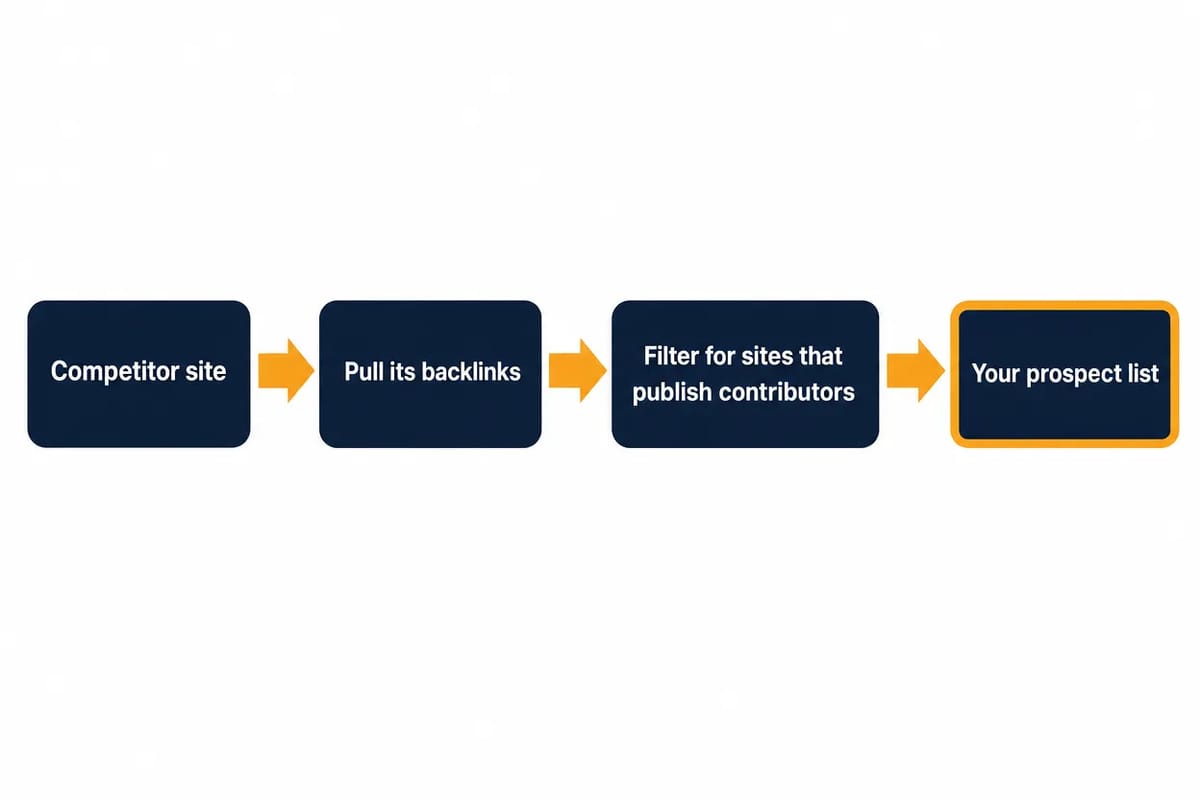
Pick three to five competitors that overlap with your topic, rather than your whole business. For example, if you sell ecommerce analytics software, analyse competitors' links to their ecommerce SEO guides, data reports and comparison pages. You are looking for sites that cite helpful sources, not pages that have bought site-wide anchors.
Use Ahrefs, Semrush, Moz or a similar tool to export referring pages. If you need a fuller workflow, our guide to analysing competitor backlinks walks through the audit process. For this task, keep the export focused on publisher discovery.
Sort the export by page fit first. Open the referring page and read the paragraph around the competitor link. Ask why the editor used that citation. Was it a statistic, definition, tool, quote, product example, case study, image or opinion? That reason tells you what you must offer if you want the same publisher to consider you.
Then check the site. Is the linking page indexed? Does the article have a real author or editor? Does the site publish around your topic often? Do outbound links look selective? If every recent article links to commercial pages with exact-match anchors, remove it.
In practice: build your sheet around the reason to pitch, not the metric. Good columns are page URL, site type, topic, competitor cited, citation reason, likely editor, audience fit, traffic signal, link policy, and next action.
Do not copy the competitor's angle. If they were cited for a general guide, pitch a sharper data point, field note, case example or expert comment. Editors have little reason to publish a duplicate. They may consider a clearer answer to a question their existing piece leaves open.
We see this in link audits all the time: the best targets are not always the loudest domains in the export. They are often mid-sized sites with strict topic focus and a real editor pattern. Relevance wins. The payoff is a cleaner shortlist before you write the pitch.
2. Use search operators and editorial footprints
Search operators help you find sites that publicly accept outside articles or expert quotes. They are a discovery method, not an endorsement. A footprint can reveal a target, but it cannot tell you whether the site deserves your pitch.
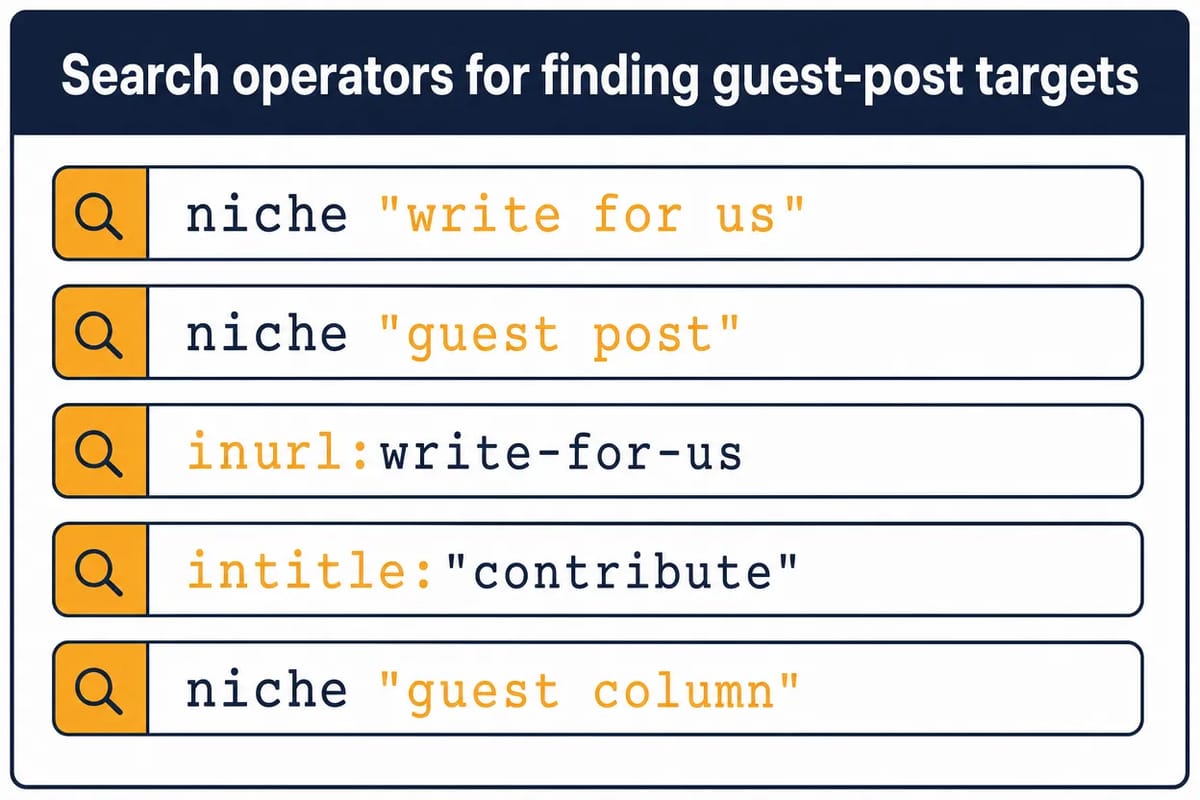
Start with exact-match searches such as:
"your topic" "write for us""your topic" "contribute""your topic" "submission guidelines""your topic" "become a contributor""your topic" "editorial guidelines""your topic" "expert commentary"
Then narrow the results. Use exclusions to remove low-quality directories, off-topic niches or repeated marketplaces. You can also search specific site types, such as trade sites, industry groups, SaaS blogs, ecommerce resources, local business blogs or pro groups.
Check each result before it goes into your list. Open recent articles, check author quality, inspect outbound links, read the rules and look for signs that the site publishes for readers rather than link buyers. If the rules talk mainly about fees, anchor text or fast approval, treat that as a warning.
Search footprints are useful because they expose open doors. The problem is that open doors attract spam. If your list comes only from "write for us" pages, you will spend too much time filtering weak sites.
Use broader searches as well. Search for phrases that suggest interviews, quotes, data roundups, expert tips and resource updates. These can lead to better placements because the publisher already has a reader-led reason to cite an outside expert.
Turn the checked results into a small test batch: ten targets with one tailored idea each. Review the replies before expanding the search.
3. Work existing relationships before cold outreach
Your warmest prospects are usually people who already know your brand, your team or your work. Customers, suppliers, podcast hosts, newsletter editors, event hosts, partners and friendly industry writers may all have places where you can publish.
Start by listing the organisations that already interact with you. Then check whether they publish blogs, reports, resource pages, webinars, newsletters or community posts. You are not asking for a favour. You are looking for places where your knowledge could help their audience.
Check these sites with the same standard as cold prospects. A warm relationship does not make a poor page valuable. Check topical fit, audience quality, editor control and link policy. If the site is not a fit, look for another format, such as a quote, webinar or shared resource.
This route can support brand awareness and reputation because the audience already has some context for who you are. It can also help ecommerce brands when the partner site serves buyers, suppliers or publishers in the same market. Keep the claim modest: it may drive qualified attention, not guaranteed sales.
The best pitch to a warm contact is specific. Reference the gap you noticed, explain why their readers would care, and offer a short outline. If you have a helpful data point, product example, customer question or field lesson, lead with that.
Avoid trading links as the point of the collaboration. If the article needs a link, make it natural and qualified when required. If it does not need one, do not force it.
A useful warm pitch can be simple: "Your buyers keep asking about X; we can show the decision checklist we use with clients." That is easier to say yes to than a vague request for a byline.
4. Use communities without treating them as marketplaces
Groups can reveal active sites, editors and writers in your niche. LinkedIn groups, Slack groups, Facebook groups, X/Twitter searches, newsletters, founder groups and industry forums can all surface calls for writers or expert quotes.
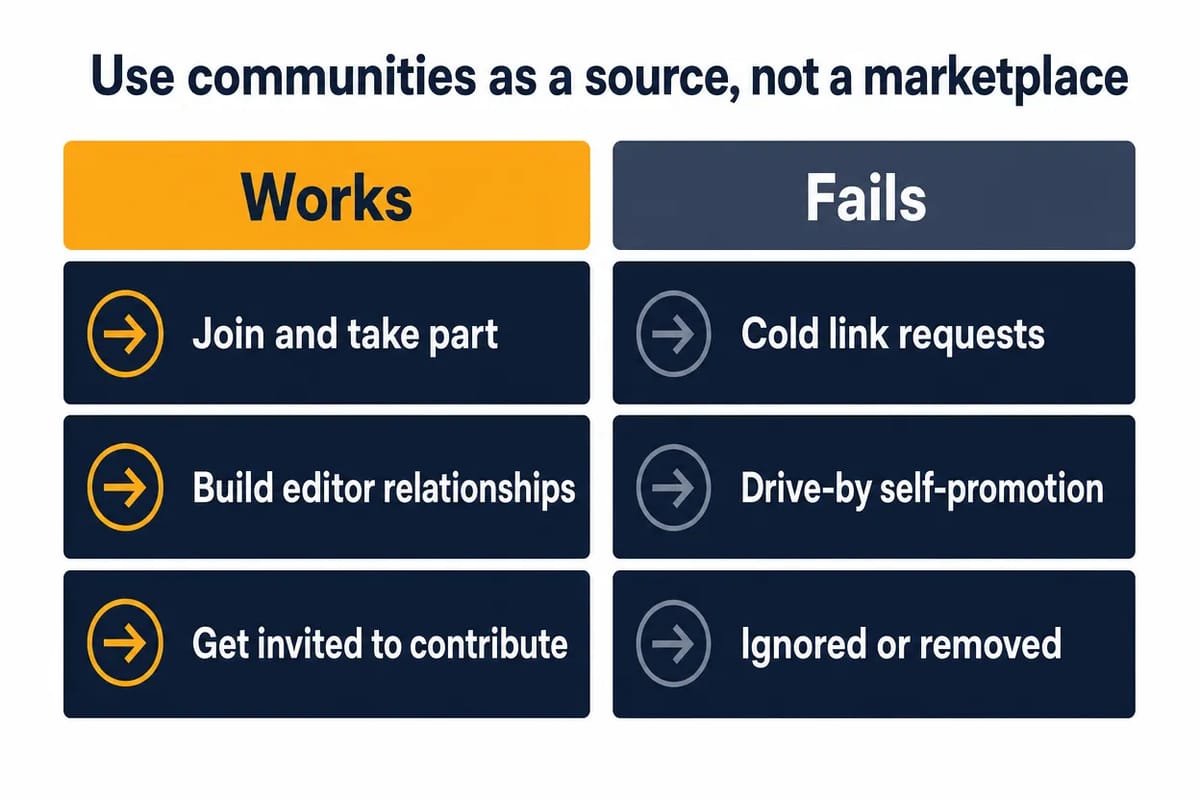
Search for contribution language, but also watch the conversations. Which sites get shared repeatedly? Which editors ask good questions? Which newsletters cite external experts? Which community members publish roundups or case studies? These signals can give you better targets than a generic directory.
Check community-found prospects carefully. A thread that says "DM for posting" is not enough. Check the site itself, the article quality, the site's topic history and whether submissions are edited. If the offer is mainly fast approval, exact anchor control or volume, skip it.
The useful community move is participation before pitching. Answer questions, share experience and be visible as someone who understands the subject. Then, when you approach an editor, you are a known voice with a relevant topic.
Use communities for signals, not as a second inbox. Set a weekly limit and capture only checked prospects. Move good conversations into a proper outreach tracker.
5. Use tools to manage discovery and vetting
Tools are helpful once you know your rules. They can speed up backlink exports, prospect finding, contact discovery, email sequencing and monitoring. They cannot decide whether a site is worth your brand.
Use backlink tools for competitor exports and link gaps. Use SEO tools to check a website's traffic, topic footprint and ranking history. Use outreach tools to track owners, email status, follow-ups and outcomes. Use spreadsheets if your list is small.
Check with human review before sending. Open the site. Read the page. Check whether the article type fits your angle. Look for signs of mass publishing, thin filler, unrelated outbound links, weak author profiles or rules that promise link placement before editor review.
For our own prospecting reviews, we treat metrics as the start of the conversation. A site with healthy traffic and relevant rankings still has to pass page quality, editor control and link-context checks. A metric cannot replace reading the page.
Use your tool stack to reduce admin, not judgement. By the time a URL reaches outreach, you should know why the site fits and what angle belongs there.
How to qualify a site before you pitch
Every method above should lead to the same vetting step. Before you contact an editor, decide whether the site is relevant, real and choosy about what it publishes.
Start with relevance. Read recent articles and category pages. If the site covers your topic only once in a mixed feed of casinos, coupons, crypto and software reviews, it is not a clean fit. If it has a narrow audience and recurring coverage of your subject, keep reviewing.
Next, check authority with care. A helpful authoritative website earns trust through topic depth, editor control, useful content and audience fit. Third-party authority metrics can support the review, but they should never be the whole decision.
Then inspect traffic and engagement. You do not need public comment counts. You do need signs that real people might see the work: ranking pages, newsletter reach, social sharing, community presence, named writers, or a clear industry audience.
Review outbound links. If most links point to unrelated commercial pages, exact-match anchors or thin product pages, the site may be selling placement rather than editing for readers. If links support the article and go to useful sources, that is a better sign.
Finally, read the rules. Good rules explain audience, topics, quality bar, original work, author needs and edit process. Weak rules focus on payment, word count, turnaround speed and anchor control.
Walk away. A poor target wastes writing time and can create link risk.
How to pitch without sounding like a template
A good pitch should show that you have read the site and can offer a useful, specific angle for its readers.
Keep the email short. Open with the reason you are contacting them, mention one relevant article or topic gap, then give two or three tailored ideas. Each idea should include the reader problem, the angle and why you can write it with authority.
Do not lead with link needs. Editors care about whether the piece helps their audience. If your first line asks for dofollow links, anchor text or publishing speed, you are showing that the article is a vehicle for SEO rather than a real pitch.
Use proof without overloading the email. A recent byline, data asset, product experience, case example or short author bio is enough. You can link to samples if they are close to the proposed topic.
Make it personal, but keep it efficient. You do not need a long compliment. You do need enough detail to show the pitch was written for that site. Mentioning a recent article, an audience segment or an unanswered question usually does the job.
Follow up once or twice, then stop. If the editor says no, ask whether another format would be useful only when there is a genuine fit. Do not argue, chase or keep pitching unrelated ideas.
What to offer editors
The strongest pitches give editors something they cannot easily produce in-house. That might be first-party data, a clear process, expert quotes, original examples, images, templates, benchmark notes or a customer problem you see often.
Avoid generic topics such as "five tips for SEO success" unless you have a sharp angle. Editors have seen those articles already. Instead, make the idea specific: a workflow, mistake pattern, comparison, teardown, field lesson or practical decision guide.
For technical or B2B topics, examples matter. Show the kind of trade-off the reader faces. If your article can help them choose, fix, avoid or measure something, it is more likely to earn space.
Match the site's format. A site that runs expert quotes may not want a full article. A company blog may prefer a tutorial. A trade site may want a short opinion column. Your pitch improves when the format fits their habits.
Track results and refine the list
Tracking keeps the campaign honest. Record the target, contact, pitch angle, status, editor feedback, live URL, link attribute, referral traffic and follow-up action.
Use analytics to see whether the placement sends relevant visitors. Use backlink tools to confirm the link, its attributes and the referring page. Our SEO metrics guide covers wider measurement. For this work, the key question is simple: did this publisher create helpful exposure, a relevant citation or a relationship worth keeping?
Do not judge a placement only by whether it uses a followed link. Google documents rel="sponsored", ugc and nofollow for link qualification. Paid or sponsored links should not be treated as ranking signals you can buy. A nofollowed citation from a respected site may still send the right readers.
Review your outcomes monthly. Which topics got replies? Which publisher types accepted? Which pitches failed? Which placements sent traffic or led to later conversations? Use those answers to improve the next list.
The best system gets smaller over time. You remove weak sites, keep strong publishers, and build ties with editors who value your input.
Mistakes to avoid
Do not buy bulk packages framed around guaranteed rankings, guaranteed dofollow links or metric bands alone. Those promises encourage the wrong behaviour and can move you into link-scheme territory.
Do not use DA as a price tag. Moz's Domain Authority is a third-party predictive metric, not a Google metric. It can help you compare prospects, but it cannot prove a placement will improve rankings.
Do not pitch the same idea to everyone. Editors can spot a template quickly, and generic outreach tends to attract low-quality sites rather than strong ones.
Do not over-optimise anchor text. Brand names, plain URLs, article titles and natural descriptive anchors are safer than repeated exact commercial phrases.
Do not ignore the publisher's rules. If the guidelines ask for original work, expert sources or a specific format, follow them. If the rules conflict with Google's link guidance, choose the safer path or skip the site.
Frequently asked questions
What are guest post opportunities?
Guest post opportunities are chances to contribute an original article, expert view or practical resource to a relevant third-party site. The good version is editorial: the publisher accepts the piece because it helps readers, not because the link was bought or scaled.
How to find guest posting opportunities?
Start with competitor backlink analysis, then use search operators, existing contacts, groups and prospecting tools. Check each site for topic fit, reader value, quality rules and link policy before you pitch.
Is guest posting still worth it?
Yes, when it is editorial and useful. It can build visibility, trust, referral traffic and relationships. It becomes risky when the main purpose is manipulating rankings through paid, scaled or keyword-rich links.
How much should you pay for a guest post?
Be careful with pricing advice. If money changes hands for a placement or link, the link should be qualified with rel="sponsored" or nofollow where appropriate. Our guest post pricing article is useful for understanding market costs, but price should never be treated as a way to buy ranking credit.
How do I find free guest posts?
Look for sites with contributor rules, community calls for writers, industry blogs and partner sites. Our guide to free guest posting sites can help with discovery, but you still need to check quality, relevance and editor standards before pitching.
What should I include in my pitch?
Include a specific reason for contacting the editor, two or three relevant topic ideas, a short proof point, and links to close writing samples. Keep link demands out of the opening pitch.
What should I track after publication?
Track the live URL, link attribute, referral traffic, rankings only where relevant, editor feedback, future collaboration potential and page health over time. The point is to learn which publishers are worth your next article.
Summary
Finding guest post opportunities is a vetting problem before it is an outreach problem. Competitor backlinks show where similar brands have earned citations. Search operators, contacts, groups and tools widen the list. Your job is to filter hard, pitch useful ideas and avoid shortcuts that turn editorial work into link spam.
Every fact and commercial claim in this guide was fact checked and verified on 16 July 2026.
related Blog Posts




Join 2,600+ Businesses Growing with Rhino Rank
Sign Up
Stay ahead of the SEO curve
Get the latest link building strategies, SEO tips and industry insights delivered straight to your inbox.