
 Back to all posts

Google's Helpful Content Update didn't just reshuffle rankings. It reclassified entire websites as low-quality signals inside Google's broader ranking systems, and for thousands of site owners who've spent the last year fixing their content, the traffic still hasn't come back. That's no longer a content problem. It's a trust problem - and trust in Google's systems comes from content quality and link authority working together.
Here's the uncomfortable truth for sites stuck in recovery limbo: content cleanup is necessary, but it rarely does the full job. The sites that bounced back fastest weren't only the ones that rewrote articles or deleted thin pages. They paired those content fixes with a healthy, high-authority backlink profile that told Google's systems the domain deserved to rank again. If our site took a hit from the google helpful content update and we've already done the content work, understanding what makes a good backlink profile is almost always the missing piece.
The bottom line: HCU recovery requires a sequenced, two-track approach. First, confirm we were actually hit by HCU and not a core update or manual penalty. Second, audit and fix our content. Third - and this is the part most teams skip - rebuild trust signals through high-authority link acquisition. Sites that execute all three in the right order are recovering. Sites that only do the first two are still waiting. This article gives you the diagnostic framework, the content audit process, the link strategy, and a 90-day roadmap to execute it correctly.
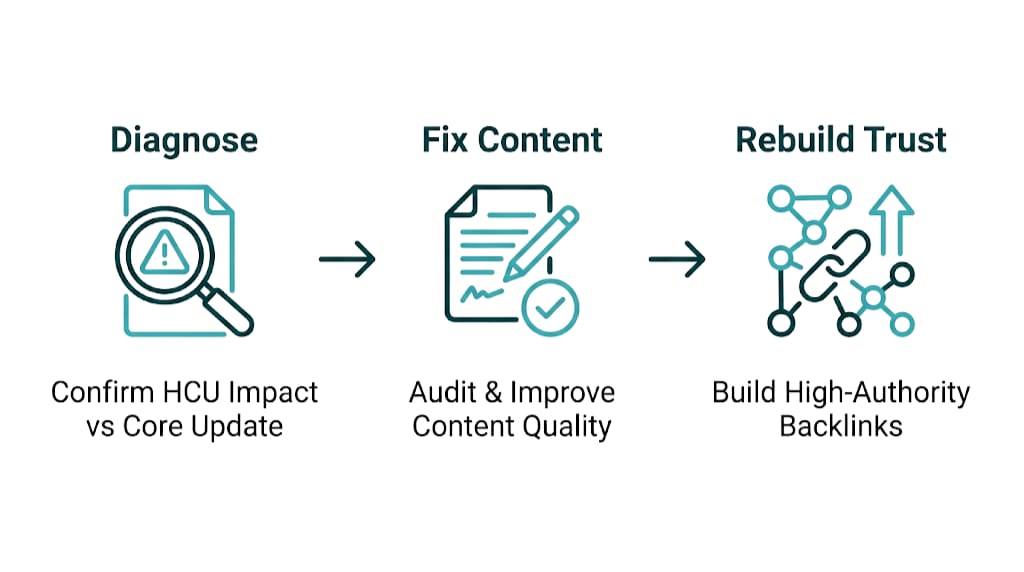
What the Helpful Content Update Actually Did to Rankings (And Why Most Diagnoses Are Wrong)
Most site owners still treat the Helpful Content Update like a one-off algorithm event - something that happened in September 2023, hit the site, and gets fixed with a rewrite. That framing breaks a lot of recovery work.
Here's what changed. Google introduced the helpful content system as a sitewide classifier, not a page-level filter. Once a site accumulated enough content Google's systems labeled unhelpful, the entire domain picked up a sitewide signal that suppressed rankings across the board, including on pages that were strong on their own.
The bigger shift landed in March 2024. Google's core update that month folded the helpful content system into its core ranking infrastructure. Google's own Search Status Dashboard and the March 2024 core update announcement spell it out: the standalone HCU classifier got integrated into core systems, so it no longer runs as a separate update cycle. It's baked in. Every core update now reevaluates sites against helpful content criteria.
That integration drives two implications most recovery guides miss.
First, there isn't a dedicated HCU refresh anymore to "catch" improvements. Before March 2024, teams could clean up content and wait for the next helpful content update to see movement. That mechanism is gone. Recovery now depends on how Google's core systems reassess the site during core updates, which are broader, harder to predict, and shaped by more signals than content quality alone.
Second, the sitewide classifier means a small set of low-quality pages can drag down the whole domain. That's why sites with 500 articles saw their top 20 pages drop even when those pages were legitimately good. The classifier doesn't score pages in isolation. It scores the site, and a high proportion of unhelpful content caps the domain-level signal.
Google's people-first content documentation makes it clear the system rewards sites that show genuine expertise, experience, authoritativeness, and trustworthiness across the entire site, not just on individual pages. "Across" is the key word. It means the worst content often sets the ceiling for how the domain performs in Google's eyes.
The diagnosis problem runs deeper than most teams expect. SEO practitioners on forums like the Reddit SEO community often mix up HCU hits with core update volatility, SERP feature shifts, or manual penalties. Those scenarios call for different recovery moves. Treating an HCU hit like a core update recovery - or the other way around - burns months. The diagnostic step isn't optional. Everything else depends on it.
How to Confirm You Were Hit by HCU (Not a Core Update or Manual Penalty)
Before we touch content or build links, we need to confirm what hit the site. Most recovery guides skip this step. Then teams spend months fixing the wrong thing.
Start in Google Search Console. Pull Performance data and set the date range to cover at least 18 months. We care about the shape of the drop, not the headline number. An HCU hit usually looks like a step change tied to a specific update date, then a flat line - not a slow slide. The drop tends to be abrupt, with 30-60% of impressions gone inside a two-week window, and it spreads across a big chunk of the keyword set rather than staying inside one query cluster.
That drop date is your anchor. Match it against Google's confirmed update timeline. The major HCU-adjacent events were the September 2023 helpful content update and the March 2024 core update that absorbed the HCU classifier. If traffic fell hard within two weeks of either, HCU is the leading explanation.
Manual actions come next, because they remove guesswork. In GSC, go to Security and Manual Actions. A manual penalty appears here. If it's empty, this is algorithmic.
Algorithmic problems leave fingerprints. One of the clearest for HCU-hit sites is the "crawled, currently not indexed" jump. In GSC's Index Coverage report, a sharp increase in pages marked as "crawled, currently not indexed" right after an HCU-adjacent date points to a quality classifier pushing pages down. This differs from pages that never indexed. Google crawled them, evaluated them, and decided they didn't earn a spot. That's quality, not plumbing. If you're seeing widespread indexing problems, it's worth reviewing common indexing issues to rule out technical causes before assuming it's purely a quality signal.
Signal | HCU Hit | Core Update | Manual Penalty |
|---|---|---|---|
Drop timing | Correlates with HCU/core update dates | Correlates with core update dates | Appears in GSC Manual Actions |
Scope of impact | Sitewide, broad keyword sets | Often category or topic-specific | Specific pages or sitewide |
Impressions vs clicks | Both drop proportionally | Click-through rate often changes more | Traffic drops sharply, impressions may hold |
Crawled not indexed | Significant increase | Moderate increase | No direct correlation |
Recovery pattern | Slow, requires content + trust signals | Can recover within next core update cycle | Recovers after penalty revocation |
Now check which pages actually lost. If your best pages - the ones with real links and clean engagement - dropped alongside thin content, you're looking at a sitewide classifier. If one topic cluster fell while other areas held steady, treat it like a core update shift or a topical authority gap.
Why Link Profile Health Was a Hidden Factor in HCU Losses
Most HCU recovery plans treat links like a side quest. That's why content-only fixes stall.
Surfer SEO's study of 500 HCU-hit websites and 12,000+ link-offering sites found a clear pattern: sites carrying a high share of link farm backlinks took the biggest hits, and it wasn't only about on-page quality. The HCU system devalued whole link networks. If rankings were built on low-grade link schemes, the update didn't just suppress pages - it removed the equity from the links holding those rankings up. Good content on a site with a weakened link profile still slid because the trust signals under it disappeared.
That point changes the diagnosis. The google helpful content update impact wasn't a pure content judgment. It also reset trust. Google's systems reweighted links, and sites dependent on link farms got hit twice: content scored poorly and link equity lost value at the same time.
That same trust theme shows up in recovery data. Crowdo's 2025 research, cited by Semrush, found that sites with high-authority forum mentions - real editorial references on places like Reddit, Quora, and industry forums - recovered 18-35% faster post-HCU than similar sites without those signals. The mechanism is straightforward: real community mentions look like human endorsement, which fits Google's people-first direction.
Crowdo's analysis also references GSQi case study data: a site took a 41% traffic drop after HCU, then won back 23% visibility after a combined content and link authority plan. Not a full rebound. Still, it shows link authority work moves rankings when content clean-up alone doesn't.
The risk side is documented, too. Google's link spam policies spell it out: links from schemes, excessive exchanges, or manipulative tactics don't just get ignored - they damage trust. If pre-HCU rankings came from those tactics, the backlink profile is now a liability, not an asset.
The Difference Between Domain Rating and Actual Link Equity After HCU
Domain Rating (DR) is a third-party metric. It helps as a rough benchmark, but it doesn't reflect what Google values after HCU.
That gap shows up fast in real link profiles. A site can sit at DR 60 and still have links that Google's systems discount. The usual culprits are link farms, private blog networks, and scaled guest posting on sites built to sell placements. Those links pumped DR before HCU. After HCU, Google reads them as low-trust signals, or ignores them outright.
Actual link equity, post-HCU, is the trust and authority Google's algorithms pass through a link. That equity comes from editorial placements on sites with real traffic, real audiences, and clear topical fit with your domain. One link from a respected industry publication pulling 50,000 monthly organic visitors carries more usable equity than 200 links from a link farm network with a combined DR of 400.
So DR can't be the primary filter anymore. If we're assessing a link profile or planning new links, we should grade prospects on organic traffic, topical relevance, editorial standards, and the context of the placement. Understanding what makes a good backlink profile means looking beyond raw metrics to the quality signals Google actually rewards.
The Content Audit Framework That Actually Moves the Needle on HCU Recovery
A recovery audit isn't a standard content audit. Standard audits flag thin pages, duplicates, and keyword cannibalization. HCU recovery audits focus on something tighter: how much of the site fails Google's people-first criteria, and how that volume drags down the domain-level quality signal.
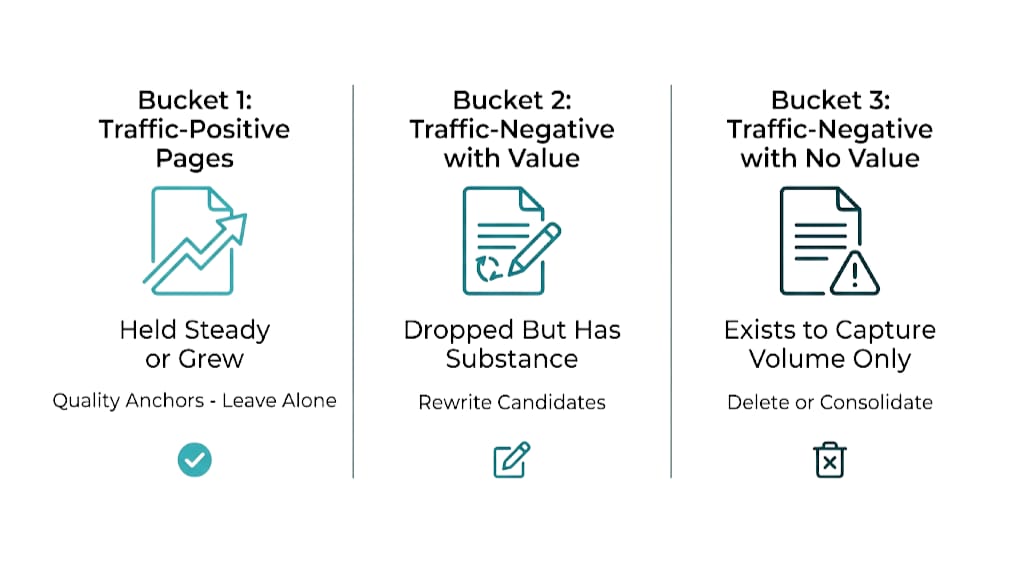
Start with a full export of indexed URLs from GSC. Pull organic traffic for each URL across the last 12-18 months. That dataset drives the segmentation, and we sort everything into three buckets.
Bucket 1: Traffic-positive pages. These pages held steady or grew through the HCU window. They're quality anchors. Leave them alone during the audit phase. Log them for link building prioritization later.
Bucket 2: Traffic-negative pages with genuine value. These pages dropped, but the content still carries substance - original insight, experience-backed detail, clean intent match. Treat these as rewrite candidates. The structure is there. The page just needs a tighter people-first rewrite and clearer proof of expertise.
Bucket 3: Traffic-negative pages with no genuine value. These pages exist to capture search volume, not to help users. Programmatic content. Thin affiliate pages. Keyword-stuffed listicles with no original input. Aggregation that repeats what every other result already says. These are deletion or consolidation candidates.
Bucket 3 is the ratio that matters. Marie Haynes, whose March 2024 analysis warned that HCU recovery would be much harder than most site owners expected, keeps coming back to this as a core driver. If 30-40% of indexed pages fall into the unhelpful bucket, recovery gets steep. If the issue sits in 10-15% of pages, the cleanup is more contained and the path back is clearer.
Bucket 2 pages need a stricter checklist than a normal refresh. Use Google's people-first content documentation as the bar, then score the page against concrete criteria:
- Shows first-hand experience with the topic.
- Adds information beyond what's already in the top 10 results.
- Holds up under subject matter expert review for accuracy and usefulness.
- Answers the user intent directly, without padding for word count.
Bucket 3 pages are a faster decision. Either the page can be rebuilt into something your site has the credibility to publish, or the topic sits outside your real expertise and experience. If it's the second case, delete it.
When to Delete vs. Redirect vs. Rewrite: A Decision Matrix for HCU-Hit Pages
The delete vs. redirect vs. rewrite call is where most site owners freeze. This matrix keeps it simple and consistent.
Delete (and let return 404, or use 410 Gone): Use this for pages with zero organic traffic in the last 12 months, no inbound links, and nothing worth saving. Thin affiliate pages. Auto-generated location pages. Tag archives with no unique content. Removing them pulls dead weight out of Google's quality evaluation of your site. And don't redirect them to irrelevant pages to "save" link equity that isn't there.
Redirect (301 to a more relevant page): Use this for pages that have some inbound links, but the topic overlaps heavily with a stronger page on your site. Roll the signals into the stronger page, then upgrade that page so it can carry the combined intent and coverage. This fits keyword cannibalization cases where three weak articles fight each other on the same query set.
Rewrite: Use this for pages in Bucket 2 that already have inbound links, some residual traffic, or cover a topic where your site has real expertise. A rewrite isn't a light refresh. It means deeper coverage, added first-hand experience or data, a structure that matches intent, and E-E-A-T signals that show up on the page in plain sight.
Page Type | Traffic (12 months) | Inbound Links | Action |
|---|---|---|---|
Thin, no original value | Zero | None | Delete |
Thin, no original value | Zero | 1-5 low quality | Delete |
Overlapping topic, weak | Low | Some | Redirect to stronger page |
Original value, poor execution | Declining | Moderate | Rewrite |
Strong content, ranking loss | Declining | Good | Rewrite + link building |
Strong content, stable | Stable/growing | Good | Protect, prioritise for links |
Don't rush the rewrite phase to get to link building faster. Building links to unimproved pages wastes budget - and if you're unsure where to start, a full link audit can surface which pages are worth prioritising before you commit resources. The page has to be better first, or links won't move the needle.
Why High-Authority Links Accelerate HCU Recovery (The Mechanism Explained)
Content improvements change what Google's classifier thinks of your site. High-authority links change what Google's trust systems think of your site. Both matter. One won't cover for the other.
That trust system is why links still matter post-HCU. Google's ranking systems treat links as trust signals, not only authority signals. A link from a real, editorially controlled publication signals that a person with standards chose your page as a reference. The PageRank "vote of confidence" idea still holds, but the bar for what counts as a vote has climbed.
That higher bar plays out at two levels. Page-level links push ranking signals to the URL that needs to compete for the target terms. Domain-level patterns matter too: repeat editorial links from credible sources tell Google the site itself earns citations, which helps lift the sitewide quality classifier assessment that HCU applied.
That sitewide assessment is where recovery speeds up or stalls.
Take a mid-market health information site that lost 55% of its organic traffic in September 2023. The site rewrote 40% of its content, deleted another 20%, and got around 8% recovery within six months. After a targeted link acquisition campaign focused on editorial placements in health journalism and medical information sites, the same site added another 31% recovery in the following quarter. The content work built the base. The links supplied the trust signal that pushed the site back into contention.
That trust signal shows up outside classic backlinks, too. The Crowdo/Semrush data on 18-35% faster recovery for sites with high-authority forum mentions supports the same idea from a different channel. Forum mentions aren't "link building" in the usual SEO agency sense, but they reflect real human endorsement in communities Google's systems watch for trust signals. Sites that earn those mentions give users a reason to reference them, and Google rewards that during recovery evaluation.
Trust signals also have a clear failure mode. Low-quality guest posts on sites built to sell links, private blog network links, and link exchanges that Google's spam policies ban don't just fail to help - they deepen the trust deficit HCU exposed. Google's helpful content systems aim to surface sites that earn credibility through real signals. Links that trip link spam policies work against that goal.
What Makes a Backlink 'High-Authority' in a Post-HCU World
The definition of a high-authority link got tighter post-HCU. DR alone doesn't cut it. Here's what actually matters.
Editorial placement. The link exists because an editor or writer chose to reference your content. It's not sitting in a sponsored content block, a paid directory listing, or a footer. It shows up in the body of an article, in context, because your page added something the piece needed.
Topical relevance. The linking site covers topics with real overlap to your site's subject matter. A link from a cybersecurity publication to a cybersecurity tool review passes more relevant trust than a link from a lifestyle blog to the same page. Relevance still does a lot of the heavy lifting.
Genuine organic traffic. The linking site has real organic traffic from real users. You can verify this in Ahrefs or Semrush. A site with DR 70 and 200 monthly organic visitors is a red flag. A site with DR 45 and 85,000 monthly organic visitors is a cleaner trust signal.
Link placement context. Links buried inside relevant, substantive content pass more equity than links in sidebars, author bios, or comment sections. The surrounding copy tells Google's systems what the link connects to and why it exists.
Referring domain diversity. A healthy post-HCU link profile pulls from many different domains across different topic areas. Concentration risk, where 60% of your links come from one domain or one link network, creates a real vulnerability.
The practical takeaway: prioritise fewer, higher-quality links over volume. Ten editorial placements on sites with real traffic and real topical overlap beat 100 links from a guest post network every time in the post-HCU environment. If you're exploring editorial link acquisition, the same quality-over-volume principle applies regardless of the tactic.
Topical Authority and Internal Linking: The On-Site Foundation Links Need to Work
High-authority external links don't operate in isolation. They pass equity into your site through specific pages, and that equity needs somewhere to go. If your internal linking is weak or your topical focus is scattered, the equity dissipates instead of concentrating where it lifts rankings.
Topical authority is the degree to which Google's systems recognise your site as a credible, complete source on a specific subject area. You build it through depth and breadth across a defined topic cluster, not by publishing one great article on a topic surrounded by unrelated posts. A site that covers 15 topic areas at surface level ends up with weaker topical authority in each area than a site that covers 3 topic areas with real depth.
That topical authority matters more post-HCU. The helpful content system rewards sites that show real expertise across a tight subject domain.
That shifts how we approach content audit and rewrite work. It needs a topical clustering exercise baked in: identify your core topic areas, map which pieces belong to each cluster, then flag the gaps where you need more depth to support full coverage.
Internal linking connects topical authority to link equity distribution. When a high-authority external link lands on your pillar page about, say, enterprise cybersecurity, your internal linking should push that equity out to supporting cluster pages - articles on specific security frameworks, tool comparisons, implementation guides, and case studies. Without deliberate internal linking, the equity pools on one page and the broader topical signal stays weaker than it should.
The internal linking audit is simple, and teams still skip it. For each priority page - the ones we'll target with link building - check how many internal links point to that page from other relevant pages on your site. Three or fewer is a problem. Build a content map that creates logical, contextually relevant pathways between cluster content and pillar pages, so equity moves on purpose instead of by accident.
And don't ignore anchor text diversity in internal links. Over-optimised internal anchor text, where every internal link uses the exact same keyword phrase, creates a pattern Google's systems can flag. Use natural variations that match how a writer would reference that page in context.
Strong topical authority plus deliberate internal linking gives external link building something to land on. Without that foundation, we're pouring equity into a site that can't hold it or route it where it counts.
The 90-Day Recovery Roadmap: Sequencing Content Fixes and Link Building Correctly
Sequence matters as much as tactics. Build links before fixing content and we burn budget. Fix content without earning links and recovery stalls. The order below is the order we use.
Days 1-30: Diagnostic and Content Audit Phase
Week 1 is pure diagnostics. Confirm the HCU hit using the GSC methodology described earlier. Export every indexed URL, pull 18-month traffic data, then segment into the three buckets. Quantify how much of the site is truly unhelpful. Check for manual actions. Review the backlink profile for link farm concentration, and flag toxic links we may need to disavow.
That segmentation drives week 2-3. Finish the delete/redirect/rewrite decision for every page. Build a rewrite queue that starts with URLs that already have inbound links and still pull residual traffic. Map the topic cluster structure and call out internal linking gaps while the site is still fresh in our heads.
Week 4 is where changes start shipping. Push deletions and redirects first. They move fast, and they lift the domain-level quality ratio without waiting on editorial cycles. After meaningful deletions, submit updated sitemaps in GSC. Then start rewrites on the highest-priority pages.
Days 31-60: Content Execution and Link Profile Preparation
Rewrites carry this phase. Close out the priority pages and make each one meet people-first content criteria: original experience or data, thorough intent coverage, clear E-E-A-T signals, and content that adds something new versus what already ranks.
Don't rush it.
A weak rewrite barely outperforms the thin page it replaced, and it won't hold once competitors update.
Those rewrites also decide what we can pitch. While content ships, build the link target list. Pick link priorities using the criteria in the next section, then research relevant publications, industry sites, and editorial outlets where a placement makes sense in context. Pull together outreach assets that editors will accept: updated author credentials and data-backed pieces that give them a reason to reference us.
Days 61-90: Link Acquisition and Monitoring
Link acquisition starts in week 9. Focus on editorial placements on sites that have real organic traffic and clear topical fit. For teams running outreach at scale, a managed link building service can help maintain placement quality while keeping the campaign moving within a tight 30-day window. For a tight campaign, 8-15 high-quality placements in a 30-day period is a realistic target, depending on the niche and our outreach bandwidth.
Those placements need tight monitoring. Check GSC weekly and watch impression lift on priority pages, improvement in the crawled-not-indexed ratio, and click-through rate movement on the pages we rebuilt. Impressions usually move before clicks do, so we track both and adjust based on what GSC shows.
Phase | Weeks | Primary Activities | Success Metric |
|---|---|---|---|
Diagnostic | 1-2 | GSC audit, URL classification, backlink review | Complete content segmentation |
Content planning | 2-4 | Deletion, redirects, rewrite queue | Unhelpful content ratio reduced |
Content execution | 5-8 | Rewrites, topic clustering, internal linking | Priority pages rewritten and published |
Link preparation | 6-8 | Target research, outreach assets | Link target list ready |
Link acquisition | 9-12 | Editorial outreach, placements | 8-15 high-quality placements |
Monitoring | 10-12 | GSC tracking, ranking monitoring | Impression recovery on priority pages |
How to Prioritise Which Pages to Build Links To First
Not every page deserves link building spend. Prioritization is where budgets get burned or turned into momentum.
Our top link targets share three traits:
- Rewritten to meet people-first content criteria.
- Sitting inside a topic where the site has proven topical authority through supporting cluster content.
- Commercially or strategically tied to the business, so ranking recovery translates into traffic or revenue.
Near-miss pages come next. These sit one or two positions away from a real traffic step-change. A page ranking 11th for a 2,000 monthly search volume keyword needs far less authority to hit page one than a page ranking 40th. Find these in GSC by filtering for positions 11-20 on queries with meaningful search volume. Treat them as quick-win link targets because the lift per link is usually higher.
Sequencing still applies here. Don't build links to pages we haven't rewritten. Link equity only turns into rankings when the page earns it, and sending authority to weak content is the fastest way to waste a recovery window. This mistake shows up in almost every failed HCU recovery campaign we audit.
Real HCU Recovery Patterns: What the Data Shows About Sites That Bounced Back
The HCU recovery data is sobering, but it points in a clear direction. Sites recover. Not overnight.
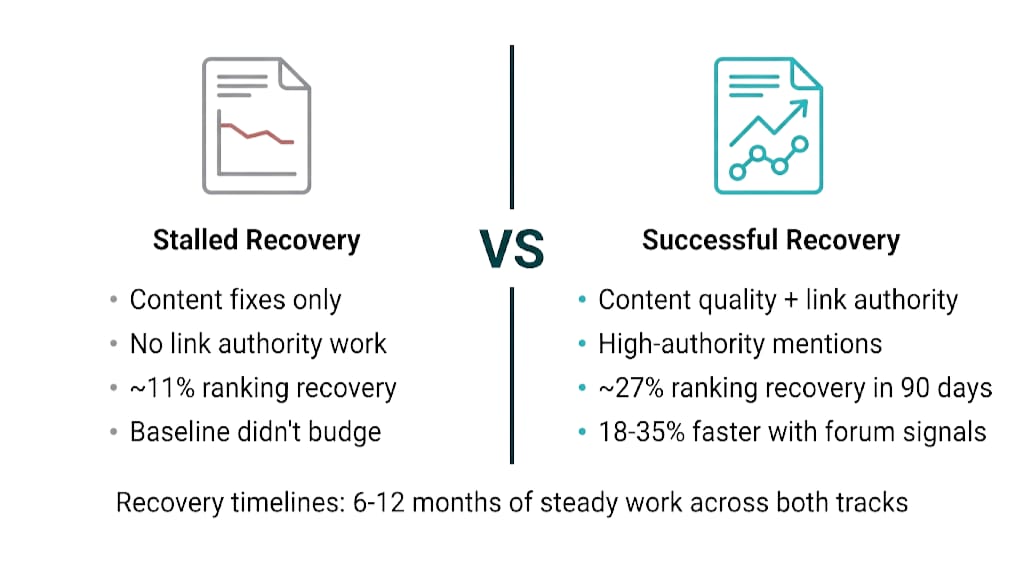
GSQi case study data shows a site that took a 41% traffic drop after HCU-adjacent updates, then clawed back 23% in visibility after running a combined content and link authority plan for about six months. That's not a full rebound. We shouldn't pretend it is. But it is real movement from a baseline that didn't budge with content fixes on their own.
That "content alone doesn't move the needle" point shows up again in Zyppy's recovery analysis. Sites that shipped broad content improvements and paired them with targeted link acquisition saw about 27% ranking recovery within 90 days of the March 2024 core update. Sites that focused only on content work saw about 11% in the same window. The gap is 16 percentage points, and it maps cleanly to link work. Understanding how link building helps SEO at a mechanistic level makes it easier to see why that gap exists and why content improvements alone can't close it.
That link work doesn't always look like a classic campaign. Crowdo/Semrush found that sites with high-authority forum mentions recovered 18-35% faster, which fits the same pattern. These weren't teams blasting guest posts. They earned real community references because the content held up, and those mentions acted as trust signals during Google's re-evaluation.
Google's re-evaluation is the part most teams underestimate. Marie Haynes warned in March 2024 that HCU recovery would be harder than most site owners expected, and the record since then backs that up. HCU folding into core systems means there's no single refresh date where everything resets. Recovery comes across core update cycles, which roll around every few months. That makes a 90-day roadmap a starting line, not the finish. Full recoveries, when they happen, usually take 6-12 months of steady work across content quality and link authority building.
Link authority building only works when the content gives Google something worth trusting. The sites that recover don't run content and links as separate workstreams. They run one integrated plan: content quality sets the floor, and link authority supplies the trust signal that helps Google's systems justify putting the site back in the mix. The stalled sites almost always miss one of those two pieces.
Real HCU Recovery Patterns: What the Data Shows About Sites That Bounced Back
Frequently Asked Questions About Helpful Content Update Recovery
How long does it take to recover from the Google Helpful Content Update?
Recovery timelines vary based on how hard the site was hit, how much unhelpful content sits across the indexable footprint, and how strong the link authority plan is. Case study data points to a repeatable arc: sites that combine content work with link authority work usually see meaningful recovery signals within 90 days, then more material gains over 6-12 months. Sites that only fix content and ignore link profile health tend to see partial recovery that stalls around 10-15% of lost traffic, with no further lift until trust signals come back.
Does the Helpful Content Update still exist as a separate ranking signal in 2024/2025?
No. Google confirmed in March 2024 that the helpful content system was integrated into its core ranking infrastructure as part of that month's core update. It no longer runs as a separate, periodic update. Helpful content criteria are evaluated inside core update cycles, so there's no dedicated HCU refresh to wait for. Recovery depends on how Google's core systems reassess the site over time.
Do high-authority backlinks help with Helpful Content Update recovery?
Yes, and the data lines up. Surfer SEO's study of 500 HCU-hit sites found consistent patterns tying low-quality link profiles to the severity of HCU losses. Crowdo's 2025 research found that sites with high-authority mentions recovered 18-35% faster than comparable sites without those signals. Those editorial links rebuild domain-level trust signals that HCU suppressed, and that trust is part of how Google's core systems decide whether a site earns rankings again.
Can you recover from HCU without deleting content?
In theory, yes. In practice, sites with a high share of unhelpful pages rarely recover without removing or rewriting the weakest URLs. The helpful content system works as a sitewide classifier, so the worst content drags down the best content. Rewriting beats deletion when a page has inbound links or residual traffic, but the rewrite has to be real. Cosmetic edits on thin pages don't change the classifier's assessment.
Should I disavow toxic links as part of HCU recovery?
Treat disavow as a scalpel, not a broom. Use it only with clear evidence of a manual penalty tied to link spam, or when the backlink profile shows a heavy concentration from known link farms or PBNs. For most HCU-hit sites, the priority is earning new high-authority links, not spending weeks disavowing old ones. Google's systems discount a lot of low-quality links on their own. But if pre-HCU link building leaned on tactics that violate Google's link spam policies, a targeted disavow of the worst link clusters, paired with new high-authority acquisition, is the right move. Don't disavow indiscriminately. Base each decision on evidence the link is harmful, not just low-quality.
related Blog Posts



Join 7,000+ Clients Growing with Rhino Rank
Sign Up


Stay ahead of the SEO curve
Get the latest link building strategies, SEO tips and industry insights delivered straight to your inbox.