
 Back to all posts

The journalist source platform market has seen more turbulence in the past three years than it did in the previous decade. HARO, the platform that trained an entire generation of SEO professionals to treat earned media as a link building channel, is gone in its original form. What replaced it frustrated users, confused agency teams, and left a vacuum that a new wave of platforms now competes to fill. If you've tracked this space since 2023, you've watched the chaos firsthand. If you stepped away and are coming back now, this guide gives you the full picture.
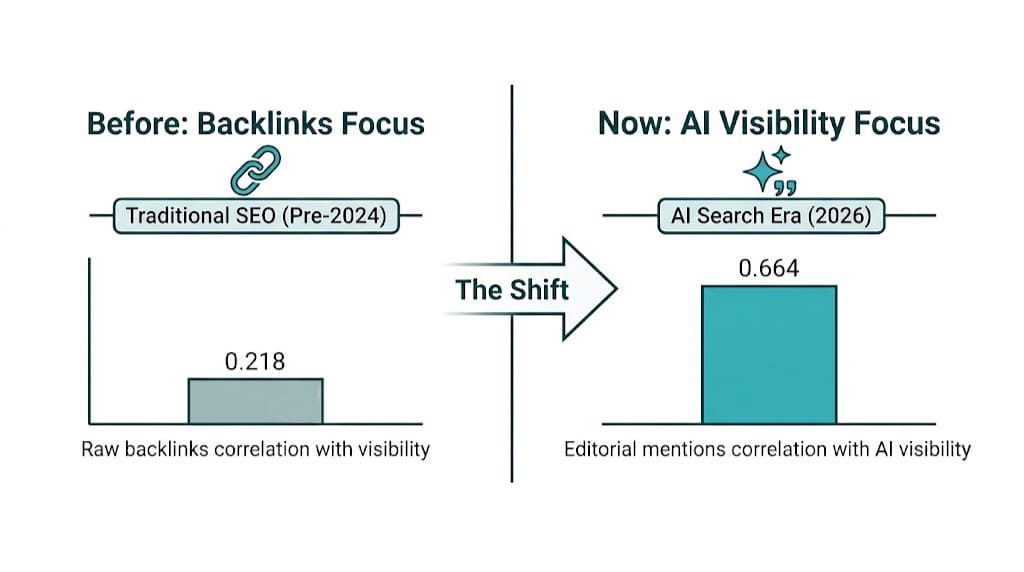
The bottom line: Journalist source platforms matter more in 2026 than they did when HARO peaked, and not just for backlinks. Recent industry analysis of many brands found that editorial brand mentions correlate with AI search visibility at 0.664, compared to 0.218 for raw backlinks. Recent search industry data shows 25.11% of Google searches now trigger AI Overviews. The platforms covered in this guide now act like infrastructure for visibility in ChatGPT, Perplexity, and Google's AI-generated results - not just a tactic for climbing the blue links. The strategic case for using them has changed.
This guide covers the full HARO timeline, the seven best alternatives operating in 2026, an honest comparison with the relaunched HARO, a pitching framework that drives placements, and a multi-platform workflow for teams running this at scale. We also cover where these platforms fit inside a broader link building strategy and when it makes more sense to complement them with scalable, managed link acquisition.
What Happened to HARO? The Full Timeline From Launch to Relaunch
Help a Reporter Out launched in 2008 as a free email newsletter that connected journalists with expert sources. Peter Shankman built it, and at its peak, it sent three emails a day to hundreds of thousands of subscribers. Cision acquired HARO in 2010, and for more than a decade, the platform ran with minimal change.
It was messy. It was noisy. And it worked.
Even with PR agencies dominating the feed, a veteran SEO manager running it in 2018 could still land 3-6 placements per month with a disciplined pitching process.
The first real break came in late 2023. Cision announced it was sunsetting the HARO brand and moving users to a rebranded platform called Connectively. Communication around the migration fell flat, the interface got worse, and both journalists and sources aired complaints in public. Threads on subreddits like r/PublicRelations and discussions across various SEO industry communities captured the vibe: people started hunting for alternatives right away.
Connectively didn't last. In May 2024, Cision shut it down. No long runway. No clean transition. Teams that had built repeatable workflows around HARO-style email digests suddenly had nothing to work from. That gap poured fuel on every alternative listed in this guide.
Then came the relaunch.
In April 2025, a company called Dot.LA acquired the HARO brand and brought it back as a standalone platform. The new HARO doesn't run like the original. It uses AI pitch scoring to filter source responses before they reach journalists. That sounds helpful. In practice, HARO created new failure points.
Legitimate pitches from credible experts have been flagged and rejected by the scoring system. The platform has also issued account bans based on location-matching signals it treats as suspicious, even when the source is real.
Here's the timeline at a glance:
Year | Event |
|---|---|
2008 | Peter Shankman launches HARO as a free email newsletter |
2010 | Cision acquires HARO |
Late 2023 | Cision rebrands HARO as Connectively |
May 2024 | Connectively shuts down |
April 2025 | New ownership relaunches HARO as an AI-assisted platform |
2026 | Ecosystem of alternatives now fully established |
The net result: the market fragmented. No single platform carries the authority HARO once did, which makes a multi-platform approach the baseline - not an advanced strategy.
Why PR Link Building Platforms Matter More in 2026 Than They Did in 2024
The stakes have changed. Recent search industry data shows that 25.11% of Google searches now trigger AI Overviews. That number sat closer to 7% in early 2024. This isn't gradual growth - it's a structural shift. Google keeps moving from a link-first ranking system to a citation-first answer system, and the signals that decide which brands show up in AI-generated answers don't match the signals that move a page up the blue links.
That shift makes the industry analysis of many brands the anchor data point in this guide. The study, referenced in a recent SEO industry analysis of journalist platform strategy, found that editorial brand mentions correlate with AI search visibility at 0.664, while raw backlinks correlate at 0.218. That's not a rounding error. Being cited by name in authoritative editorial content - the outcome journalist source platforms produce - carries more than 3x the predictive relationship to AI search visibility than piling up backlinks.
Those correlations change how we run campaigns. A mid-market SaaS company spending $3,000 per month on link building through private blog networks or niche edits is paying for a signal that correlates at 0.218. The same company putting that time into Qwoted and Featured.com, landing quotes in Forbes, Business Insider, or a strong trade publication, is building a signal that correlates at 0.664. The ROI math flips, and it flips hard.
That citation footprint also travels beyond Google. ChatGPT and Perplexity pull citations from editorial sources. If a user asks either platform about the best project management tools for remote teams, the brands that surface tend to be the ones cited repeatedly in credible editorial contexts, not the ones with the most directory links. Journalist source platforms give teams a scalable path to rack up those repeat citations.
Repeat citations only matter if they're safe to pursue. And Google's spam policies have tightened. The guidance at Google Search Central on link spam draws a clear line: editorially earned links - where a journalist or editor chose to cite your brand based on real expertise - sit in the lowest-risk bucket. Link schemes, including scaled tactics that were common in 2022 and 2023, carry real penalty risk, as our digital PR link building overview explains. Editorial links from journalist platforms carry close to none.
AI visibility upside plus lower spam exposure makes these platforms a strategic priority, not a side tactic.
The 7 Best HARO Alternatives for PR Link Building in 2026
No single platform replicates everything HARO did. Teams that want consistent coverage treat these platforms like a portfolio, because each one comes with its own strengths, journalist mix, and response dynamics. The seven options below are the best active picks in 2026, spanning free to enterprise-priced plans and broad networks to niche communities.
A quick orientation before we get into the details:
Platform | Best For | Price Range | Speed |
|---|---|---|---|
Qwoted | Business, finance, verified experts | Free - $99/mo | Medium |
Featured.com | Conversion rate, fast turnaround | Free - $499/mo | Fast |
Source of Sources | HARO-familiar workflow, free | Free | Medium |
#JournoRequest on X | Real-time, breaking opportunities | Free | Very fast |
ProfNet | Tier-1 media, PR professionals | $150+/mo | Slow |
SourceBottle | Australia, UK, lifestyle niches | Free - $49/mo | Medium |
ResponseSource | UK and European trade media | £50+/mo | Medium |
The sections below cover each platform in depth, including the risks that competitors rarely discuss.
Qwoted: Best for Verified Expert Placements in Business and Finance
Qwoted has one of the strongest journalist communities in this category. Where HARO turned into a broad, noisy inbox, Qwoted runs more like a curated network. Most requests come from business, finance, personal finance, and professional services outlets, and journalists get verified before they can post. That verification step changes the opportunity set - fewer junk requests, more real editorial demand.
That quality shows up in the source workflow, too. Our profile becomes a public expert bio that journalists can search and shortlist, so we aren't stuck living query-to-query. Some of the best wins on Qwoted happen when a journalist finds the profile first and pulls us into the story. That single mechanic separates Qwoted from the other platforms on this list.
Lower volume comes with the territory. Threads that compare "haro qwoted" tend to land on the same point: Qwoted sends fewer daily requests, but the journalist pool is better. That's accurate. If we're aiming for placements in Forbes, Barron's, MarketWatch, or finance trade publications, Qwoted is the right tool. If the account needs raw volume, we treat Qwoted as a core channel and add another platform alongside Qwoted.
Pricing starts with a free tier that limits pitch credits, then moves to a paid tier at about $99 per month for full pitch access and analytics. For an agency team running multiple client profiles, the paid tier pays for itself in time saved. The free tier works fine for proving fit and getting a first placement through the door.
The day-to-day workflow on Qwoted:
- Build the full expert profile - headshot, bio, and a tight topic focus.
- Check the dashboard daily. Don't rely on email digests.
- Verified journalists at named publications come first.
- Keep pitches under 200 words. Lead with the insight; credentials go second.
One warning that cuts in Qwoted's favor: lower request volume usually means fewer people chasing each request than on Featured or the new HARO. We'll take that trade.
Featured.com: Highest Conversion Rate and Fastest Average Turnaround
Featured.com captured a big share of displaced HARO users after Connectively shut down, and the conversion-rate chatter matches the data. Recent industry analysis of journalist platform performance found Featured has the fastest average turnaround time of any active platform, with some placements confirmed within 24 to 48 hours of pitching. For teams that need to show link velocity to clients, speed like that matters.
The system runs on a Q-and-A model. Content creators, bloggers, and journalists post specific questions. Sources submit written answers. Featured selects the best responses, publishes them, and includes source attribution with a backlink in most cases. The format stays tight, and the structure beats HARO's open-ended sprawl for teams that want repeatable output.
That structure comes with a risk most competitors sidestep. Featured has built an interconnected network of owned sites that publish the curated Q-and-A content. Some of those subsites share link patterns and infrastructure that SEO teams have flagged as resembling a private blog network in structure. So the link we earn might land on a Featured-owned property instead of an independent third-party publication. For link diversity and editorial independence, we need to know where the placement will live before we invest real time.
The placement location is the whole point. Featured also supports real placements on external publications, and the creator community using it is active. The issue isn't fraud. The issue is uneven editorial weight across placements, so each win needs a quick sanity check.
Pricing is tiered: a free account covers basic questions, while paid plans from about $99 to $499 per month unlock priority placement, more categories, and analytics. Most teams should start free, then upgrade only after the placement quality earns it.
Source of Sources: The Free Platform Built by HARO's Original Founder
Source of Sources, commonly abbreviated as SoS, has the strongest historical credibility in this category. Peter Shankman - the journalist and entrepreneur who built the original HARO in 2008 - launched Source of Sources as a direct response to the Connectively shutdown. He saw the vacuum and shipped a replacement that matches the original HARO workflow almost one-for-one.
SoS is free. It runs as an email digest and sends journalist requests to registered sources three times per day, which will feel familiar to anyone who used HARO before 2023. The journalist mix leans toward general interest, technology, and lifestyle. Since launching in 2024, the platform has grown as former HARO sources moved over.
The limitations are real. As a newer platform, SoS has a smaller journalist network than Qwoted and lower request volume than Featured. The digest format also means you compete with every other source who received the same email at the same time. Speed matters.
Still, the format works. The founder has credibility. And the fact that it's free makes it the default starting point for teams that want to test the journalist-source channel without paying for access. Teams looking to complement this approach with more predictable placements often pair it with curated link building to maintain a steady backlink pipeline alongside earned media.
For teams that used HARO heavily before 2023, SoS is the closest operational match. The workflow carries over with minimal change:
- Register as a source and select your topic categories
- Keep an eye on the three daily digests - morning, afternoon, evening
- Reply within the first 30 to 60 minutes after a request lands
- Log which journalist names and publications show up across digests
SoS won't replace a full multi-platform strategy, but it's a real, free, credible option that belongs in every team's toolkit.
#JournoRequest on X: Free Real-Time Monitoring for Fast Wins
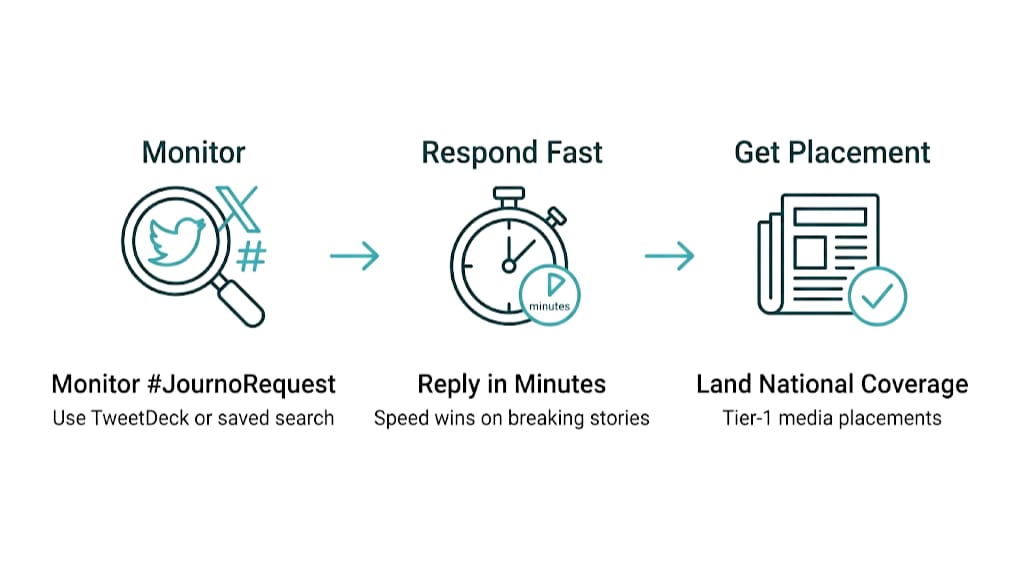
The #JournoRequest hashtag on X (formerly Twitter) isn't a platform. It's behavior that's become its own layer of infrastructure. UK journalists use it heavily, and adoption spread as the journalist-source platform market splintered. Journalists post requests in public, sources reply in public or via DM, and placements move faster than on any structured platform.
Speed is the advantage. A journalist posting a #JournoRequest for a breaking story needs a reply in minutes, not hours. Teams that watch the hashtag in real time can land placements in national publications that won't bother posting on Qwoted or Featured.
The tradeoff is noise. The hashtag includes everything from legitimate tier-1 media requests to student journalists and content farms. Sorting matters as much as monitoring.
The practical approach: set up a saved search or monitoring tool like TweetDeck (now X Pro) or a third-party social listening tool, then filter #JournoRequest by keyword. Track your core topic areas, add alerts, and respond fast when a relevant request hits. Keep your X profile professional and your bio clear about your expertise, because journalists check it before they reply.
This channel is free, fast, and reliable for teams that can monitor it consistently. It pairs well with a structured platform like Qwoted rather than replacing it.
ProfNet, SourceBottle, and ResponseSource: Niche and Regional Platforms Worth Knowing
These three platforms sit in specific niches. That makes them irrelevant for some teams and mandatory for others.
ProfNet is the oldest platform in this category. It predates HARO and runs under PR Newswire. The journalist base skews heavily toward tier-1 US media - national newspapers, major magazines, and broadcast outlets. The source side matches that: PR agencies and comms teams at large organizations dominate. Pricing starts at approximately $150 per month, which rules out most independent consultants. But if you're an agency handling enterprise clients that need placements in The Wall Street Journal or The New York Times, ProfNet is the most direct route. Agencies managing link building at scale may also find it worth exploring a managed link building service to handle the volume and vetting that tier-1 outreach demands.
SourceBottle is the leading platform in Australia and has meaningful coverage in the UK. If you're targeting Australian media, or you work in lifestyle and consumer categories, it's the cleanest option on the market. The free tier works. The paid upgrade starts at approximately $49 per month and adds category filtering and priority alerts. No Australia or UK angle? Skip it.
ResponseSource covers UK and European trade and consumer media. It performs best for technology, retail, and professional services within the UK market. Pricing starts at approximately £50 per month. Like SourceBottle, it's geography-first, and teams without UK or European targets won't get enough value to justify the cost.
The strategic point is simple: regional and niche platforms bring lower competition and higher relevance for the right audience. Don't write them off because they're smaller.
How the 'New' HARO Compares to Its Alternatives in 2026
The relaunched HARO needs a straight read. The SEO community's response has swung from cautious optimism to active frustration, and we've seen enough firsthand to say both reactions track - it depends on how you're using it and how strict your ops are.
The April 2025 relaunch brought real changes from the original HARO format. The biggest shift is the AI pitch-scoring system. Every source response gets scored by an algorithm before it reaches the journalist. The goal is to filter out low-quality, generic, or templated pitches, which became a real problem in the last stretch of the original HARO.
That scoring system is also where the cracks show. Multiple trusted sources - including PR pros and experienced SEO managers with public work to back it up - have reported pitches flagged as low-quality or potential spam when they weren't. That inconsistency makes HARO harder to operationalize if you're running volume.
Volume isn't the only risk. The location-matching ban issue is the bigger operational problem.
The new HARO flags accounts when the source's stated location doesn't match the IP address or device location tied to the account. It's meant to catch fake accounts. It also catches legitimate sources: remote workers on VPNs, agencies pitching for clients in different locations, and international experts pitching US publications. Appeals are hard. The process isn't clear, and bans often land without a clean path to resolution.
Here's how the new HARO stacks up against the leading alternatives:
Feature | New HARO | Qwoted | Featured.com | Source of Sources |
|---|---|---|---|---|
Journalist verification | Partial | Yes | Partial | No |
AI pitch filtering | Yes (risky) | No | No | No |
Free tier available | Yes | Yes | Yes | Yes |
Placement in external media | Yes | Yes | Yes | Yes |
Ban risk for legitimate users | High | Low | Low | Low |
Request volume | Medium | Low-Medium | High | Medium |
Best niche | General | Business/Finance | Content/Digital | General |
Usability is the right word for the new HARO. It's usable, but it's not the default choice it used to be. If you're keeping it in your stack, run it clean: use a dedicated IP address, skip VPNs, make sure your account location matches your real location, and keep pitches tight and specific. And don't build your outreach program around it.
That reliability gap is why the alternatives in this guide win for most teams. They're more reliable. They give you clearer rules. And they match how journalist source outreach runs in 2026.
What Makes a Winning Pitch on Any Journalist Platform: 6 Principles That Drive Placements
Conversion rate on journalist platforms comes down to pitch quality. Platform choice matters less than most teams think once the basics are covered. A mediocre pitch on Featured.com will underperform a sharp pitch on Source of Sources every time. These six principles hold across every platform in this guide.
1. Lead with the insight, not the credentials. Journalists don't open pitches to read about your years of experience. They open pitches for the angle, the data point, or the perspective that strengthens the story. Put the line you want quoted first. Then add credentials in one sentence so they know why your take carries weight.
2. Match the exact scope of the request. Read the query three times before you write. If they're asking for a tip on reducing household energy bills, don't send a 400-word overview of the energy market. Send one actionable tip with a concrete example. Scope mismatch is the top reason solid pitches get ignored.
3. Keep it under 200 words. This is a benchmark, not a hard rule. But it's a useful constraint. Journalists sorting through 80 pitches for one request will skim anything over 200 words. If you can't land the point in 200 words, the pitch still isn't focused.
4. Include a specific data point or example. Vague expertise disappears in the inbox. "I've helped many businesses improve their cash flow" is forgettable. "We worked with a 12-person manufacturing firm that reduced payment cycles from 47 days to 22 days by switching to milestone-based invoicing" is quotable. Specifics prove you know the work.
5. Respond fast. On platforms like Source of Sources and #JournoRequest, the first credible response often wins. On Qwoted and Featured, quality beats speed, but speed still helps. For tight deadlines, aim to respond within 30 minutes of seeing the request.
6. Write a subject line that previews the value. On email-based platforms, the subject line acts as the first filter. "Re: [Query Title] - Specific tip from a CFO with 15 years in manufacturing" beats "Expert source available" by a wide margin. Make the value obvious before they open the email.
Templated responses are a tax on performance. Avoid AI-generated pitches - not because AI help is wrong, but because the patterns are obvious to experienced journalists and to AI scoring systems like the one on the new HARO. Use AI to draft if you want, then rewrite in a real voice before sending. Authenticity wins when everyone else ships the same template.
Building a Multi-Platform Outreach System: How to Manage HARO Alternatives at Scale
The biggest operational mistake teams make with journalist source platforms is treating them as passive channels. Teams sign up, wait for emails, then pitch once in a while. That gets you the occasional win. A repeatable process gets you steady wins.
Recent industry benchmarks make the performance gap clear: DIY teams managing this in-house land 1 to 4 placements per month. Managed or agency-run programs land 7 to 15 or more placements per month. That gap doesn't come from access to better platforms. It comes from daily time investment, response speed, and consistent pitch quality.
A realistic in-house workflow looks like this:
- Morning (20-30 minutes): Check Source of Sources morning digest, Qwoted dashboard, and Featured.com new questions. Flag relevant opportunities.
- Midday (15-20 minutes): Write and send pitches for flagged opportunities. Check #JournoRequest on X for breaking requests.
- Afternoon (10-15 minutes): Check Source of Sources afternoon digest and any platform notifications. Send any remaining pitches.
- Weekly (30 minutes): Review placement tracking, update expert profiles on each platform, and note which query types are converting.
That adds up to roughly 45 to 65 minutes per day, five days a week. For a solo SEO manager or a small in-house team, that time adds pressure fast. For an agency running multiple client programs, it turns into 3 to 4 hours per day before you even touch profile upkeep, pitch rewrites, and placement logging.
Time is the constraint. Speed is the edge.
Platform rotation is the discipline that separates steady programs from random spikes. Don't monitor every platform every day at first. Build your workflow around two platforms, get the cadence right, then add a third. Starting with Qwoted and Source of Sources gives you the best mix of quality and familiarity. Add Featured.com once you've locked in a daily pitching rhythm.
That pitching rhythm only holds if tracking holds.
Track everything in a simple spreadsheet or CRM:
Column | What to Track |
|---|---|
Date | When you pitched |
Platform | Which platform the query came from |
Publication | Target outlet |
Query topic | What the journalist was asking |
Pitch sent | Yes/No |
Response received | Yes/No |
Placement confirmed | Yes/No |
Link type | Dofollow/Nofollow/Brand mention |
Domain Rating | Publication's DR |
This tracking discipline pays off in two ways. First, it shows which platforms convert in your niche, instead of relying on gut feel. Second, it gives you clean reporting so clients or stakeholders understand what the time buys.
One last point: if your team can't hold 45 to 60 minutes of daily monitoring and pitching, journalist source platforms will underdeliver. Burnout usually shows up when teams start with five platforms at once and no tracking. Start small, build the habit, then scale.
How PR Link Building Platforms Fit Into a Broader Link Building Strategy
Journalist source platforms produce some of the best links you can earn: editorial placements on authoritative domains, with real brand mentions that support AI search visibility. But they have a ceiling. Even a tight multi-platform program landing 10 to 15 placements per month won't generate the link volume a competitive domain needs to move rankings in saturated niches.
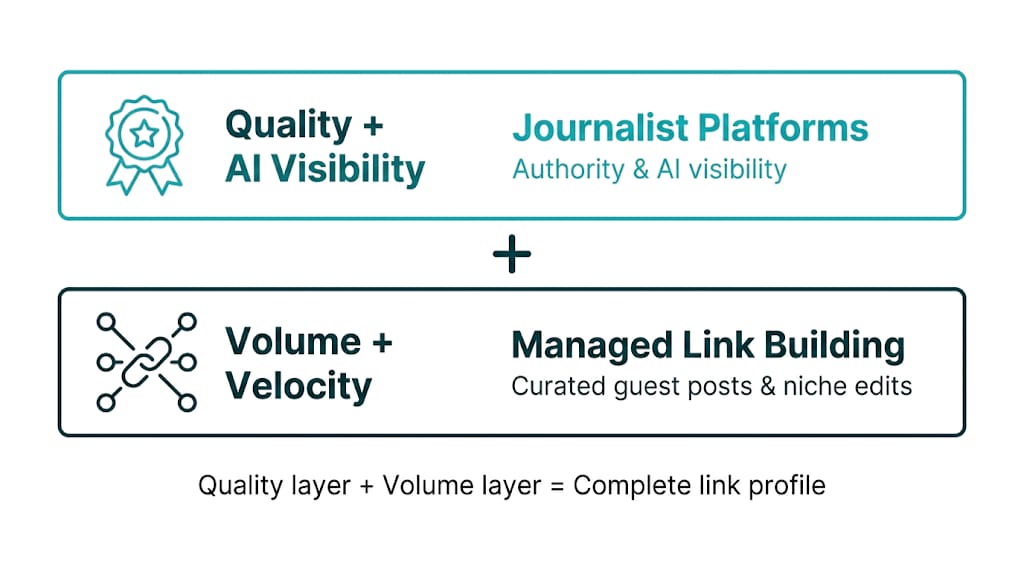
That ceiling defines the job journalist platforms should do: build topical authority and brand citation equity, not carry link velocity on their own. They sit in the quality layer of a link stack, not the volume layer.
That link stack gets clearer when you compare channels side by side:
Link Type | Quality | Volume | Speed | AI Visibility Impact |
|---|---|---|---|---|
Journalist platform placements | Very High | Low | Slow | Very High |
Guest posts (curated) | High | Medium | Medium | Medium |
Curated niche edits | High | Medium | Fast | Low-Medium |
Digital PR campaigns | Very High | Low-Medium | Variable | High |
Directory submissions | Low | High | Fast | Very Low |
The AI visibility gap between journalist placements and most other link types is real. The volume gap is just as real. Brands that rely only on journalist platforms build strong brand authority, then stall against competitors stacking bigger link profiles.
Link profiles need volume. The cleanest complement is curated guest posts and niche edits through a managed link building service. They add domain diversity and throughput that journalist platforms can't match, while keeping to editorial standards that reduce risk under Google's spam policies. At Rhino Rank, our curated links and guest post services are built to complement this editorial link building approach, giving teams a scalable volume layer without trading away the quality signals journalist platforms create.
The teams that win in 2026 treat link building like a portfolio, not a single tactic. Journalist platforms cover the authority and AI visibility layer. Managed link building covers the volume and velocity layer. Together, they outperform either channel on its own.
Frequently Asked Questions About HARO Alternatives
What happened to HARO and why did Connectively shut down?
Cision acquired HARO in 2010 and rebranded it as Connectively in late 2023. The rebrand landed badly with journalists and sources, and usage dropped as a result. Cision shut Connectively down in May 2024.
The HARO brand later moved to new ownership and came back in April 2025 as an AI-assisted platform. It shares the name, but the workflow and day-to-day experience differ a lot from the original.
Is HARO still available in 2026 and is it free?
Yes. A version of HARO still runs in 2026 after the April 2025 relaunch under new ownership. There's a free tier.
But it doesn't behave like old-school HARO. The platform uses AI pitch-scoring, and that system has produced false positives and account bans for legitimate users. Most experienced practitioners treat it as one channel in the mix, not the default it used to be.
Which HARO alternative has the best conversion rate for getting placements?
Recent industry analysis points to Featured.com as the top performer on conversion rate, with the fastest average turnaround among active platforms. Teams see placements in 24 to 48 hours.
That speed comes with a tradeoff. Not all Featured placements run on independent third-party publications, so you still need to review each win for editorial standards and actual link value.
How do journalist source platforms affect AI search visibility and Google AI Overviews?
Recent industry analysis of many brands found editorial brand mentions correlate with AI search visibility at 0.664. Raw backlinks came in far lower, at 0.218. That gap matches what we're seeing in practice: citations and mentions carry more weight in AI-driven results than a plain link count.
Recent search industry data shows 25.11% of Google searches now trigger AI Overviews. Those editorial citations that come out of journalist source platforms now rank among the strongest signals for visibility in AI-generated answers across Google, ChatGPT, and Perplexity.
What is the difference between Qwoted and Featured for PR link building?
Qwoted centers on verified journalists, especially in business, finance, and professional services. Request volume runs lower, but the journalist pool skews higher quality. And the profile discovery feature matters - journalists can find sources without you pitching every time.
Featured.com drives more volume, turns faster, and covers more topics. The catch is placement mix: some wins land on Featured's own network of content sites instead of independent publications.
Qwoted fits teams chasing tier-1 business media. Featured fits teams that need speed and steady throughput.
What is Source of Sources and who created it?
Source of Sources (SoS) comes from Peter Shankman, the entrepreneur who built HARO in 2008. He launched SoS in 2024 after the Connectively shutdown.
SoS runs as a free email digest and mirrors the original HARO workflow almost exactly. That makes it the closest operational match for teams that used HARO before 2023, and it's the best free place to start for new users.
Are journalist source platforms worth it for SEO in 2026?
Yes, but the ROI math shifted. These platforms now pay off in two ways: backlinks on authoritative domains and editorial brand mentions that lift AI search visibility.
The correlation data supports the AI visibility case, and it's stronger in 2026 than it was in 2024. Teams that run journalist platforms as "links only" leave real AI search visibility gains on the table.
related Blog Posts




Join 7,000+ Clients Growing with Rhino Rank
Sign Up



Stay ahead of the SEO curve
Get the latest link building strategies, SEO tips and industry insights delivered straight to your inbox.