
 Back to all posts

HARO backlinks: what changed and how to earn them now
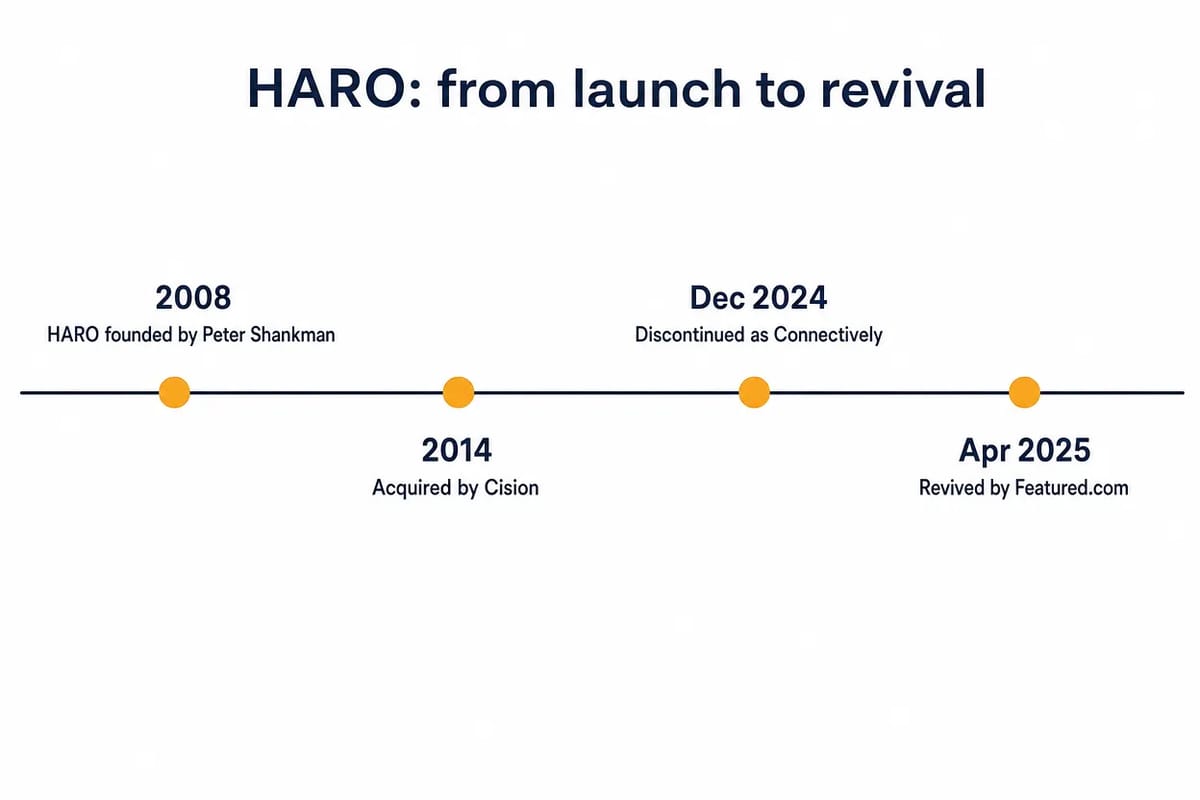
HARO backlinks are editorial links earned when your expert response to a journalist request is quoted and linked. The old Connectively/HARO service was discontinued in December 2024, then revived by Featured in April 2025. Today, HARO is a free email route inside digital PR, not a shortcut where links are certain.
Short summary
- HARO backlinks come from journalist source requests. You answer a query, the journalist may quote you, and the article may include a link to your site.
- Cision discontinued HARO while it was operating as Connectively in December 2024. Featured.com bought HARO and revived it in April 2025.
- The current HARO source flow is free: you sign up at helpareporter.com and receive three daily email digests of journalist requests.
- HARO works best as one journalist-sourcing channel inside digital PR, alongside Qwoted, ResponseSource, Featured.com, SourceBottle and direct media relationships.
- The right goal is not to answer every request. It is to send fewer, sharper pitches where your expertise, proof and relevance make the journalist's job easier.
What are HARO backlinks?
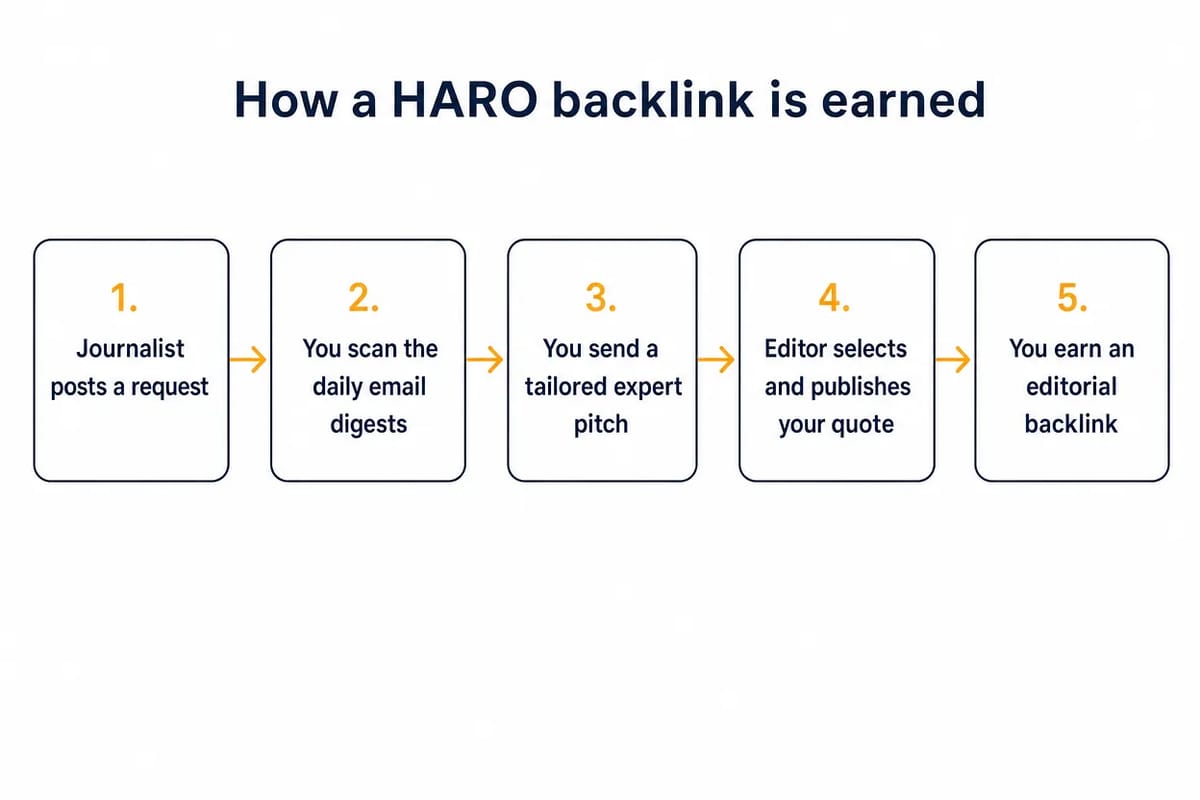
HARO backlinks are links earned through Help a Reporter Out, usually when a journalist uses your quote, data or expert comment in a published article. A writer asks for sources. You reply with a useful answer. If the answer makes it into the story, the writer or editor may include your name, company and a link.
That link is editorial. You are not buying placement space, choosing the anchor text or controlling the final article. You are giving a journalist a source they can use, then accepting that the publication decides what appears on the page.
That editorial control is the reason HARO links can be valuable. A mention from a relevant publication can support brand visibility, referral traffic and organic search performance. It can also do nothing measurable if the article is weak, irrelevant or nofollowed. There is no magic in the acronym.
The better way to think about HARO is as a source-request channel within digital PR. You earn attention by being useful to people writing real stories. The link is a possible outcome of that work, not the lever you pull directly.
What changed with HARO?
The confusing part is that "HARO" has meant more than one thing over time.
The original Help a Reporter Out service became part of Cision and later operated as Connectively. Cision discontinued HARO/Connectively in December 2024. That made many older HARO tutorials stale overnight, especially anything that walks you through legacy account plans, old dashboard routines or exact email send times.
Featured.com then bought HARO from Cision and revived it in April 2025. The revived HARO is not the old Connectively workflow with the same account features under a fresh name. It is a free source email product powered by Featured.
That timeline matters because a bad HARO guide can now waste your time before you even write a pitch. If a guide tells you to follow a legacy account workflow or use a fixed send-time routine, it is describing a platform state that no longer matches the current service.
How does HARO work now?
On the current HARO source page, you sign up free at helpareporter.com to receive three daily HARO emails. Those emails contain journalist requests. Each request normally gives the topic, the type of source needed, a deadline and any instructions the writer wants you to follow.
Your job is to scan the emails, ignore anything outside your expertise and answer the requests where you can add something specific. A useful pitch usually includes a direct answer, a short credential line, any requested data or examples, and contact details in case the journalist needs a follow-up.
Do not build your process around the old exact send times. The current public HARO pages verify three daily emails, but they do not verify the old clock-time schedule or the old weekday claim. The practical habit is simpler: check the digests consistently, respond when the fit is strong, and do not let urgency push you into weak answers.
Also avoid treating HARO as a link negotiation tool. Journalists are looking for sources, not backlink requests with a quote attached. You can include a relevant source bio and your site details, but asking for a link as the condition of helping is a quick way to make a useful pitch look transactional.
Is HARO good for backlinks?
HARO can be good for backlinks when three things line up: the publication is relevant, your answer is genuinely useful, and the editor includes a link. If any of those pieces is missing, the SEO value drops.
The strongest HARO wins tend to come from a clear expert fit. A cyber security founder answering a breach-response query has a better chance than a general marketer trying to squeeze into the same story. A specialist in healthcare can be useful on patient communications, procurement, private clinics or health technology, but probably not on every broad business request with a healthcare angle.
Quality control matters. Domain Rating can help you screen opportunities, but DR is a third-party Ahrefs metric, not a Google metric. Treat it as a quick proxy for checking a publication's link profile, then judge the page itself: topic fit, editorial quality, likely readership, and whether the link would sit in useful context.
The main risk is volume thinking. Answering every digest query creates thin pitches, annoys journalists and burns time. A smaller number of well-matched responses will usually beat a large pile of generic replies. Annoyingly, this is the part that sounds obvious and still gets ignored.
What a good HARO backlink looks like
A good HARO backlink is not defined by the publication name alone. The page, context and link destination all matter.
Start with relevance. A backlink from a mid-sized trade publication can be stronger for your business than a passing quote in a national article that has no topical fit. If the reader of the article would naturally want the page you are linking to, the backlink has a clearer job.
Then look at editorial context. The best HARO backlinks sit near a real expert contribution, not in a detached author bio that could belong to anyone. A quote that explains a problem, adds a practical example or clarifies a trend gives the editor a reason to cite the source properly.
The destination page matters too. Sending every backlink to the homepage is easy, but it is often lazy. If the pitch is about a specialist topic, a relevant guide, case study, product page or expert profile may give the link better context. The journalist may still choose what to include, but you can make the useful destination easy to find.
Use DR as a screening signal, not a verdict. A high-DR site can publish a weak, irrelevant article. A lower-DR niche site can send qualified readers and build topical authority. The better check is a mix of DR, topic fit, editorial quality, page context and whether the backlink supports a page you actually want to grow.
Bad HARO backlinks usually fail the same tests. They come from loose-fit requests, generic quotes, irrelevant pages or publications with no clear audience overlap. If the backlink only looks good in a spreadsheet, be careful.
Where HARO fits in a wider link plan
HARO is one route to editorial visibility. It should not be your whole link plan.
Journalist sourcing is useful because it can earn links and mentions from publications that may not accept guest posts or commercial placements. It is also unpredictable. Some good pitches get ignored. Some quotes run without a link. Some requests close before you see them.
That is why HARO sits best beside other link types. You might use journalist sourcing for expert commentary, editorially placed links for relevant existing content, and guest posting when you need more control over topic depth. Those tactics solve different problems, so forcing one channel to do every job is usually where the waste starts.
The digital PR view is wider still. It includes expert commentary, proprietary data, news hooks, industry relationships, source requests and publication-fit story angles. HARO is useful because it gives you a stream of existing demand from journalists. It is not the only place that demand exists.
HARO alternatives worth comparing
If you are serious about journalist sourcing, compare HARO with other active source-request channels. The right mix depends on geography, budget, pitch volume and the kind of experts you can put forward.
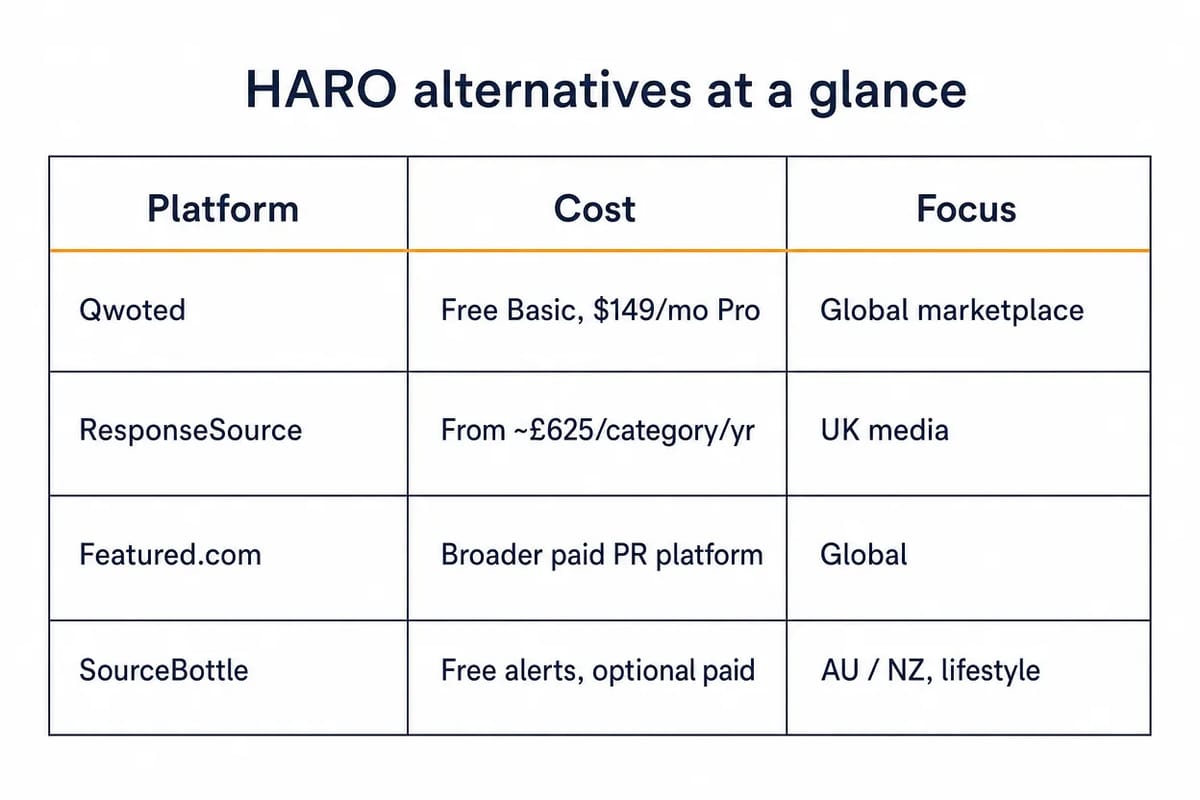
- Qwoted is a journalist and source marketplace. Its Basic tier is free with 2 pitches per month and a 2-hour delay, while Pro is listed at $149 per month with 35 pitches and no delay; Teams pricing is custom. It is useful when you want a more platform-led marketplace with pitch limits and paid speed.
- ResponseSource is a UK-focused journalist-enquiry service covering national, regional, trade, broadcast and online media. Its pricing page lists annual category subscriptions from about £625 per category per year, excluding VAT, and a quality-control team screens requests. It is the obvious comparison point when UK media coverage matters.
- Featured.com sits in the same ownership and brand ecosystem as revived HARO, but it is not identical to the free HARO email digest. HARO is the free email source product; Featured is a broader paid AI PR platform whose plans pull journalist requests from HARO, LinkedIn and other channels.
- SourceBottle sends free source-alert emails targeted by topic and country, with optional paid pitching plans. It is especially worth checking for Australia, New Zealand, lifestyle and consumer beats where its alert model may surface requests you would not see in HARO.
Help a B2B Writer is not included here as an active standalone recommendation because that brand does not verify cleanly as a current standalone service. If you remember it from older lists, check the current destination and operating status before you build a workflow around it.
For most teams, the answer is not to sign up for every platform and drown in alerts. Start with the channel that best matches your market, then add another only when you have enough expert capacity to answer well. More requests are useful only if they lead to better-fit pitches.
How to earn HARO backlinks now
The mechanics are simple. The discipline is not.
Choose the right source identity
Start with the expert, not the website. Journalists need named sources with a reason to comment. That might be a founder, operator, consultant, clinician, engineer, analyst or in-house specialist. "Marketing team" is rarely as convincing as a named person with clear experience.
Write down the expert's strongest topics before you scan requests. Include industries, job roles, lived operating experience, data access and areas to avoid. This prevents the common mistake of chasing every query that might accept a quote.
Your source bio should be short and practical. Give the journalist enough context to trust the answer: name, role, company, relevant credential and a link to a page that confirms who the person is. Save the life story for a memoir nobody requested.
Filter requests before you pitch
Use three filters before answering a query.
First, check relevance. Can your expert answer the question directly, or are you bending the topic until it fits? If the fit takes a paragraph to explain, it is probably not a fit.
Second, check the outlet and context. Some requests name the publication, while others keep it anonymous. When you can see the outlet, review whether its audience and editorial style match your goal. When you cannot, judge the request by its topic, deadline, clarity and source requirements.
Third, check whether a link would make sense even if the journalist includes one. A citation from a relevant niche article can be more useful than a passing mention in a broad piece where your site has little context.
Build a reusable pitch format
A pitch format helps you move quickly without sounding templated. Use the same order each time, then write the actual answer from scratch.
Open with the answer. If the journalist asks for one mistake, give one mistake. If they ask for a short prediction, give the prediction before the explanation. Then add the proof: a short reason, a specific example, a data point you are allowed to share, or a practical detail from the expert's work.
After that, add the source details. Include the expert's name, role, company, relevant credential and the best URL for confirmation. If the request asks for a headshot, location or social profile, include those cleanly instead of sending the journalist hunting.
The final check is quotability. Read the answer as though it will be lifted into an article with minimal editing. If it needs three paragraphs of setup to make sense, tighten it. Journalists are not short of words; they are short of usable ones.
Write the pitch around the journalist's job
A good pitch answers the request in the first few lines. Do not open with a long brand pitch, a cold-email compliment or a paragraph explaining why backlinks matter to your campaign. The journalist already has a deadline. Be the useful tab, not the extra tab.
Give a quotable answer in plain language. If the request asks for tips, provide named tips. If it asks for a prediction, give the prediction and the reason behind it. If it asks for examples, include one that can be checked or understood quickly.
Add credentials after the answer, unless the request asks for credentials first. A simple format works: "Source: Name, role, company. Relevant experience: one line." If the journalist wants a headshot, website or social profile, include it cleanly.
Avoid templates that only swap in the query title. Journalists see enough of those to smell them through a screen. You can keep a pitch structure, but the substance should reflect the query, the publication and the expert's real point of view.
Keep link expectations clean
You can include a relevant website URL in your source details. You should not demand a backlink, specify anchor text, or ask the journalist to change the article after publication just to suit your SEO target.
If a link appears, record the live URL, anchor text, destination page and surrounding context. If you get an unlinked mention, record that too. Unlinked coverage may still help brand search, referral discovery and future journalist relationships.
Follow-up is best used sparingly. If the journalist asks for more detail, respond quickly and helpfully. If you hear nothing, assume the pitch was not selected and move on. Silence is normal in source-request work.
Keep approvals fast
If you pitch for a business with multiple spokespeople, agree approval rules before the first request arrives. Decide who can approve a quote, which topics need legal or compliance review, and which claims are off limits. That is especially important in finance, health, legal, security and other regulated or high-scrutiny sectors.
Slow approval is one of the quiet reasons journalist sourcing fails. The team sees a good request, drafts a decent answer, then waits while three people debate a sentence that needed to go out yesterday. A smaller approved topic list often beats a broad list that cannot move.
Track what improves your hit rate
Keep a simple log of requests, pitches, topics, experts, publications, outcomes and links. After a few weeks of consistent pitching, patterns start to show. Some experts get picked up more often. Some angles attract stronger publications. Some request types never repay the time.
Use that log to cut weak activity. If broad business quotes never land, stop sending them. If one expert gets traction on a narrow technical topic, build more pitches around that strength. The aim is not more activity; it is better selection.
Review the log once a week. Mark which pitches were ignored, which earned a reply, which became a mention, and which became backlinks. Look at the request type as well as the outlet. You may find that short expert comments beat long answers, or that one reporter beat fits your brand better than a dozen broad requests. Use those patterns to decide what to send next week.
How to evaluate a HARO or digital PR link-building service
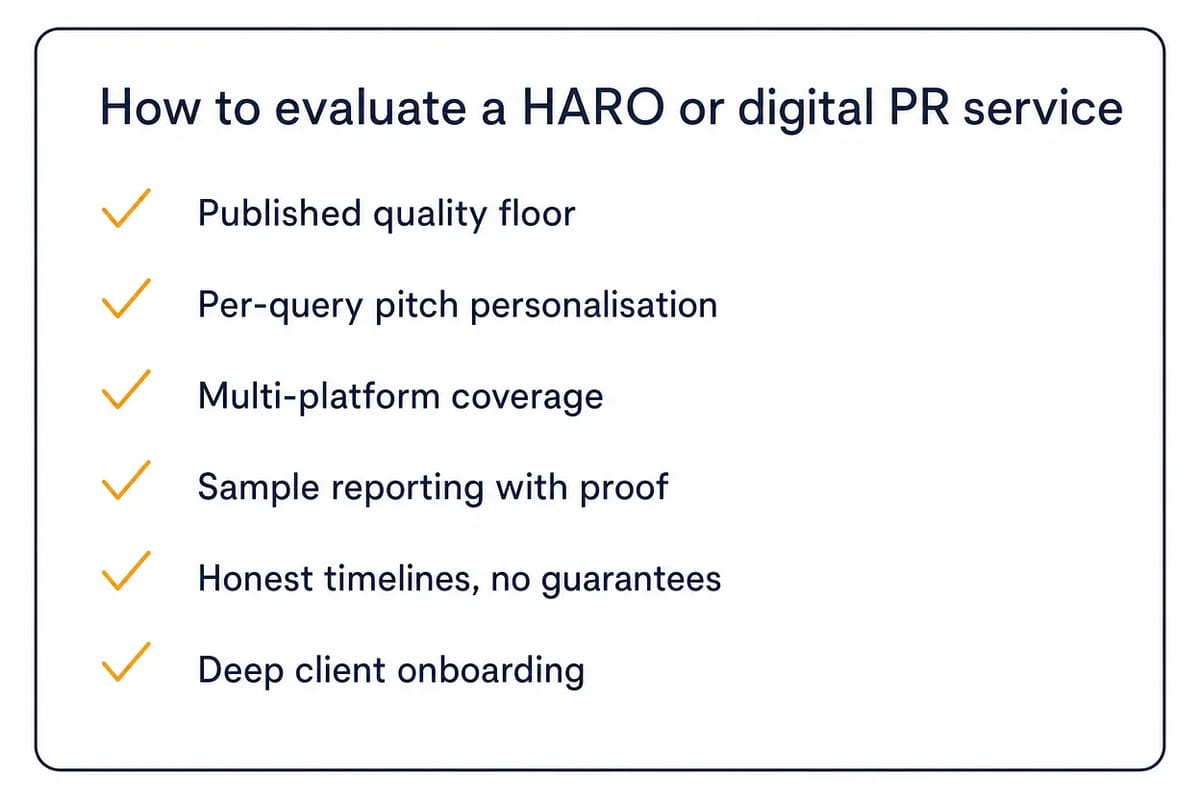
If you use a provider, judge them on process before promises. Journalist-sourcing work has moving parts the provider does not fully control, so the clearest buying signals are quality control, transparency and proof.
Check the quality-floor policy
Ask whether the provider publishes a minimum placement quality floor. That might include relevance rules, publication screening, traffic checks, spam checks and a DR threshold. DR can be useful here as a third-party Ahrefs proxy for screening, but it is not a Google score and should not be treated as one.
"No floor" is a buyer-risk signal. It suggests every mention may count the same in the provider's reporting, even if one link is relevant editorial coverage and another is a low-value article with no audience fit.
Ask how pitches are personalised
The provider should explain how they match each pitch to the query, journalist and publication. Good personalisation means more than adding the journalist's name. It means understanding the requested angle, choosing the right expert, and writing an answer the journalist can use with minimal extra work.
A template library is not automatically bad. A provider can use structures to stay efficient. The risk is when the structure becomes the pitch and every reply reads like the same paragraph wearing a different hat.
Check platform coverage
Ask which channels the provider monitors. A narrow HARO-only process may miss good requests on Qwoted, ResponseSource, SourceBottle, Featured.com, direct journalist posts and niche media communities. More channels do not always mean better work, but a provider should be able to explain where they look and why.
Platform coverage also protects you from sudden service changes. The recent HARO history is the point in miniature: if a provider's whole process depends on one platform behaving exactly as it did last year, your campaign inherits that fragility.
Request reporting proof
Before signing, ask for a sample report. It should show the live URL, placing-domain metric, estimated traffic for the placing page where available, anchor text, destination URL and the surrounding context of the link or mention.
That level of reporting helps you separate real editorial coverage from vague "authority links" language. It also helps you judge whether the links support the pages and topics you actually care about.
Test timeline and success-rate honesty
Be wary of named-publication promises. A provider can pitch journalists well, choose strong experts and report clearly, but it cannot force an editor at a specific publication to run your quote with a link.
Honest providers explain uncertainty. They can describe their process, likely bottlenecks, approval needs, and what happens if coverage does not land. They should not need hard guarantees to make the service sound credible.
Review onboarding depth
Good onboarding gathers expertise areas, spokesperson credentials, target publications, excluded topics, preferred link destinations and approval rules before pitching begins. Without that detail, the provider is guessing at fit.
That preparation is not admin for the sake of admin. It is how a service avoids sending a finance expert into a consumer travel query, or linking every mention to the homepage because nobody agreed better destinations.
Watch for red flags
The main warning signs are simple: guaranteed placements on named publications, no DR or quality floor, templated pitches at scale, no mention of platform alternatives, and upfront payment with no case studies, sample reports or verifiable placements.
One red flag does not always make a provider unusable, but it should slow the decision down. Several together usually mean you are buying output volume rather than editorial judgement.
No more wasting time with mediocre HARO backlinks
The sensible HARO strategy is selective. Use the revived free digest, but do not treat it as the whole market for journalist requests. Compare active alternatives, build a small group of credible experts, and pitch only where the fit is obvious.
You should expect uncertainty. Some strong answers will not run, some mentions will not include links, and some links will be nofollow. That is normal for digital PR. The win is a repeatable process that earns real editorial chances without turning every journalist interaction into a link request.
If you keep the channel in that role, HARO can still be useful. If you chase every request as though the acronym itself creates authority, it will mostly create busywork.
HARO backlinks FAQs
What is HARO SEO?
HARO SEO is the use of Help a Reporter Out source requests to earn media mentions and possible backlinks. It works by offering expert commentary to journalists, not by placing links directly. The SEO value depends on publication quality, relevance, link inclusion and the context around the mention.
Is HARO still around, or did HARO shut down?
HARO did shut down in its Cision/Connectively form in December 2024. Featured.com bought HARO and revived it in April 2025. Older advice about legacy account workflows should be treated with caution.
Is HARO free?
The current HARO source signup at helpareporter.com is free. Sources sign up to receive three daily email digests of journalist requests. Featured.com also has its own broader paid PR platform, but that is separate from the free HARO email digest.
What are the best HARO alternatives?
The strongest current alternatives to compare are Qwoted, ResponseSource, Featured.com and SourceBottle. Qwoted is a journalist/source marketplace, ResponseSource is strong for UK media enquiries, Featured.com is a broader paid PR platform, and SourceBottle offers topic and country-targeted source alerts.
Are HARO backlinks dofollow?
Some HARO-earned links may be dofollow, some may be nofollow, and some published quotes may not include a link at all. The journalist and publication control that decision. You should track the final link attribute, but do not make dofollow status the only measure of value.
How long do HARO links take to work?
There is no reliable universal timeline. A journalist may publish quickly, hold a story for later, use your quote without telling you, or choose another source. Track sent pitches, live mentions, links and referral traffic so you can judge performance from your own results.
Is HARO good for link building?
HARO can be good for link building when you have credible experts and a disciplined pitch process. It is weak when you answer loosely related queries just to chase links. Treat it as one digital PR channel, not a replacement for a broader link acquisition plan.
Every fact and commercial claim in this guide was fact checked and verified on 9 July 2026.
related Blog Posts



Join 2,600+ Businesses Growing with Rhino Rank
Sign Up
Stay ahead of the SEO curve
Get the latest link building strategies, SEO tips and industry insights delivered straight to your inbox.