
 Back to all posts
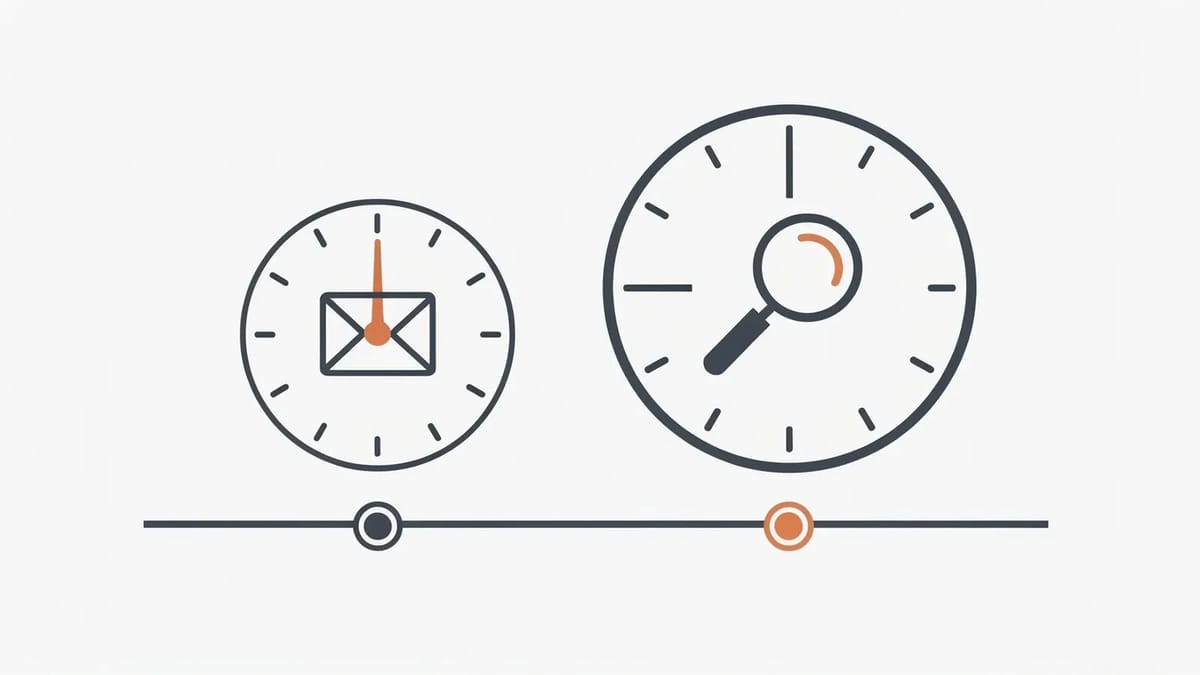
Most links take 4–12 weeks to influence rankings. The linking page must be crawled and indexed first (days to weeks), then Google re-evaluates your site over the weeks that follow. Two independent datasets put numbers on the wait: Moz measured about 10 weeks on average for a one-position gain, and Andy Zhao's 50 tracked campaigns showed impact within 8 weeks in 68% of cases. Our own 34 published campaigns are first-party data, and they measure something different: a median campaign length of 12 months to the reported result, not weeks to first movement. If a link is indexed and nothing has moved by week 12, treat it as a quality or relevance problem, not a timing problem.
Key takeaways
- First movement typically lands in weeks 4–12. Full campaign results take 6–12 months.
- Moz measured about 10 weeks on average for a one-position gain. In Andy Zhao's 50 tracked campaigns, impact landed within 8 weeks in 68% of cases.
- A link showing in Google Search Console means Google has seen it, not that Google has counted it.
- In Zhao's data, niche edits impacted in 2–4 weeks versus 4–8 weeks for guest posts. Delivery lead time adds to both clocks.
- If a link is indexed and nothing has moved by week 12, the problem is quality or relevance, not timing.
The short answer: weeks to move, months to pay off
First movement on rankings typically lands in weeks 4–12 after a link goes live. Full link building results take 6–12 months of sustained work.
The original study on this question comes from Moz. Kristina Kledzik tracked 76 links to similar pages and measured an average of about 10 weeks for a single link to produce a one-position ranking gain (Moz, 21 April 2016). Andy Zhao tracked 50 campaigns over two years and found impact landed in weeks 0–2 in 8% of cases, weeks 2–4 in 22%, weeks 4–8 in 38%, weeks 8–12 in 18%, and after week 12 in 8%. Another 6% never worked at all (andyaeo.com, 1 April 2026).
Google's own guidance is general advice on assessment timing, not a link-specific finding: the SEO Starter Guide tells you to wait a few weeks before judging whether your work had an effect (Google SEO Starter Guide). At campaign level, Rhino Rank's 34 published case studies ran a median of 12 months to their reported result. That figure is campaign length, not time to first movement.
Typical link building timeline from order to full campaign results. Windows are compiled from the sources in the final column.
Milestone | Typical window | What is happening | What you should see | Source |
|---|---|---|---|---|
Order placed to link live | 7–21 days (Rhino Rank delivery targets) | Outreach, writing and placement | Live URLs in a delivery report | Rhino Rank product pages |
Linking page crawled | Days to weeks | Googlebot discovers the page; crawl frequency is set algorithmically | Nothing visible yet | Google, How Search Works |
Linking page indexed | 1–14 days (competitor estimate) | Page enters the index; Google guarantees nothing | Page appears for a site: search | Link Building Journal; Google |
First ranking movement | 4–12 weeks | Google re-evaluates and re-serves results | Position changes on target keywords | Moz (about 10 weeks); Andy Zhao (68% within 8 weeks) |
Full campaign results | 6–12 months | Sustained links across pages and keywords | Organic traffic lift | Rhino Rank case studies (median 12 months) |
Worked example. Say you order 10 curated links on 1 October. A delivery target of 14–21 days puts them live by about 22 October. Google then needs days to weeks to crawl and index the host pages, so a sensible first check is mid-November and a fair judgement call is late December to mid-January. Judging on 1 November is judging the outreach, not Google.
Why backlinks take time: crawl, index, serve
A backlink only counts after Google crawls and indexes the linking page, and Google guarantees neither. Rankings only change when Google re-serves its results, which is a separate and slower stage.
Google's own documentation describes three stages: crawling, indexing and serving. Google is blunt about the limits: "Google doesn't guarantee that it will crawl, index, or serve your page" (How Search Works).
Stage 1: crawl (days to weeks)
Googlebot "uses an algorithmic process to determine which sites to crawl, how often, and how many pages to fetch from each site" (How Search Works). A link on a rarely crawled page waits longer than a link on a page Google visits daily. Google can also generally only crawl a link if it is an <a> element with an href attribute, and Google uses links "as a signal when determining the relevancy of pages and to find new pages to crawl" (Make your links crawlable).
Stage 2: index (days, if it happens at all)
Crawling is not indexing. The linking page must enter Google's index before the link on that page can count for anything. Link Building Journal's stage model puts indexing at 1–14 days, but that is a competitor's estimate, not a Google figure, so treat it as a rough window (Link Building Journal, 28 April 2026). If a linking page refuses to index, see our guide on how to get backlinks indexed.
Stage 3: serve and re-evaluation (weeks to months)
Even after indexing, Google re-assesses pages and links over time before rankings shift. Google's SEO Starter Guide is direct about the timing:
"Some changes might take effect in a few hours, others could take several months. In general, you likely want to wait a few weeks to assess whether your work had beneficial effects in Google Search results."
Google SEO Starter Guide
The implication: "the link is live" and "the link is counted" are different events, separated by weeks. That gap is the whole reason link building feels slow.
"Counted" is not "moved": the two-phase reality of backlinks
A link appearing in Google Search Console means Google has seen it. Credit and ranking movement lag behind that sighting by weeks.
The practical read: a flat rankings graph at week 3 tells you nothing. As a rule of thumb rather than a Google rule, week 8 is the earliest useful judgement point and week 12 the fair one.
Do niche edits work faster than guest posts?
In Andy Zhao's 50-campaign data, niche edits impacted rankings in 2–4 weeks versus 4–8 weeks for guest posts. The guest post clock also starts later, because a guest post page is brand new.
Charles Floate explains the structural reason:
"Niche edits (link insertions into existing content) are the most underrated link type in SEO right now.. Why? Because the page is already indexed, already has its own backlinks, already ranks for something. Your link inherits ALL of that equity immediately. Versus a guest post on the same site which starts at zero and has to earn its way."
Charles Floate, X, 3 March 2026
Delivery lead time is the part most timeline articles miss. At Rhino Rank, curated links (niche edits) from $60 carry a delivery target of 14–21 days, and guest posts on vetted sites a target of 7–14 days. These are targets, not guarantees, and the clock starts at order, not at go-live.
Delivery lead time and typical time to impact by link type. Delivery windows are Rhino Rank targets, not measured delivery times. No timing data exists in our evidence for Visual Links or Listicle placements, so they are omitted rather than guessed.
Link type | Delivery lead time (target) | Typical time to impact | Why | Source |
|---|---|---|---|---|
Curated link (niche edit) | 14–21 days | 2–4 weeks | The host page is already indexed, has its own backlinks and ranks for something | Rhino Rank; Andy Zhao; Charles Floate |
Guest post | 7–14 days | 4–8 weeks | The page is new and starts at zero | Rhino Rank; Andy Zhao |
Footer / sitewide | No data in our set | 4–12+ weeks | Source gives timing only | Andy Zhao |
Worked example. Order a niche edit and a guest post on the same day and the guest post can still go live first (a 7–14 day target versus 14–21). Yet the niche edit will usually move rankings first, because the niche edit's host page is already indexed and trusted. For the full trade-off beyond speed, read our comparison of guest posts vs niche edits.
What the independent studies found
Every independent dataset converges on the same shape: weeks to first movement, months to full effect. Harder verticals and stronger competition push the timeline out.
The timing figures below, and the indexing and retention figures around them, are collected with their samples in our link building statistics report.
Moz (Kristina Kledzik, 21 April 2016). The study tracked 76 links to similar pages targeting keywords with Keyword Difficulty 25–35. The average time for a single link to produce a one-position gain was about 10 weeks. Pages sitting on page 2 or beyond "took off after 8–9 weeks", while pages already on page 1 barely moved in 22 weeks. Kledzik warns it is a small data set, and the study is from 2016, so treat it as directional (Moz).
Ahrefs (Patrick Stox, 15 May 2025). Ahrefs studied pages rather than links, but the age data frames the fight. Only 1.74% of one million random new pages reached the top 10 within a year (6.11% for non-empty English pages). Of the pages that did reach the top 10, 40.82% got there within one month. 72.9% of top-10 pages are 3+ years old, and the average number-one page is 5 years old. Their advice: "After ~6 months, you may want to look at updating your content if you're still not in the top 10." (Ahrefs). If your domain is young, our guide to link building for new websites covers the extra hurdles.
If you run a new site or operate in health, finance or legal, add months to every number in this article.
Our data: 34 published link building campaigns
Across Rhino Rank's 34 published link building case studies, the median campaign ran 12 months at a median budget of $2,350 per month before the reported result. Those are campaign lengths, not time to first movement.
Read this caveat before the numbers: these are published success stories, so survivorship bias is real. Durations are campaign lengths at the time of writing, not weeks to first ranking movement.
The dataset, scraped from our case-study pages on 8 September 2026:
- 31 of 34 case studies state a campaign duration. Median 12 months, mean 11.2, range 3–36 months.
- Duration spread: 3 months (2 campaigns), 6 months (7), 8 months (1), 9 months (4), 10 months (1), 12 months (11), 16 months (1), 18 months (2), 24 months (1), 36 months (1).
- Monthly budget: median $2,350, range $500–$8,000.
- Product mix: Curated Links only (21), Curated plus Guest Posts (7), Guest Posts only (3), Curated plus Visual (2), Visual only (1).
- Reported organic traffic increase: median +385%, range +80% to +1,900%.
Rhino Rank published case studies by monthly budget band, scraped 8 September 2026. Published campaigns only.
Monthly budget | Campaigns (n) | Median duration | Median traffic lift |
|---|---|---|---|
Under $1,000 | 6 | 12 months | +327% |
$1,000–$3,000 | 13 | 12 months | +387% |
$3,000–$5,000 | 7 | 12 months | +374% |
Over $5,000 | 5 | 9 months | +675% |
Reported traffic lift by campaign length in our published campaigns. Small buckets, so read these as case-study patterns, not averages for all links.
Campaign duration | Campaigns (n) | Median reported traffic lift |
|---|---|---|
5 months or less | 2 | +283% |
6–9 months | 12 | +668% |
10–12 months | 12 | +278% |
13+ months | 5 | +620% |
The fastest published results: a SaaS client at $4,500 per month saw +183% traffic and +680% growth in top-3 keywords in 3 months (SaaS case study), and an E-Learning client at $1,500 per month saw +383% in 3 months. The slowest: a Roof Repair client ran 3 years at $2,200 per month for +675%, and a Healthcare campaign ran 2 years at $1,500 per month.
Two worked examples show the mechanics. A Shopify retailer spent 6 months at $2,600 per month and grew organic traffic +1,900%: the campaign opened with 80–90% branded and generic anchors pointing at the homepage, then shifted to product-page anchors. A corporate law firm spent 6 months at $5,500 per month on Curated Package 4 plus 6 RD1000+ links and 10 guest posts, and grew +1,043%. Every link in these campaigns passed the Rhino Rank link quality standard.
What we cannot yet tell you from our own tracking is the median weeks to first ranking movement, or what share of our placements index within 14 days. Until that data lands, we make no claim that Rhino Rank links work faster than the market.
One thing the budget bands do show: in our published campaigns, more spend did not collapse the timeline. Even the $5,000+ band ran a median of 9 months.
The week-by-week checklist: what to check, and when to worry
Check indexation at weeks 2–3, Search Console impressions at weeks 4–6, and ranking movement at weeks 8–12. Each checkpoint has a decision rule, and "wait" is the right answer only twice.
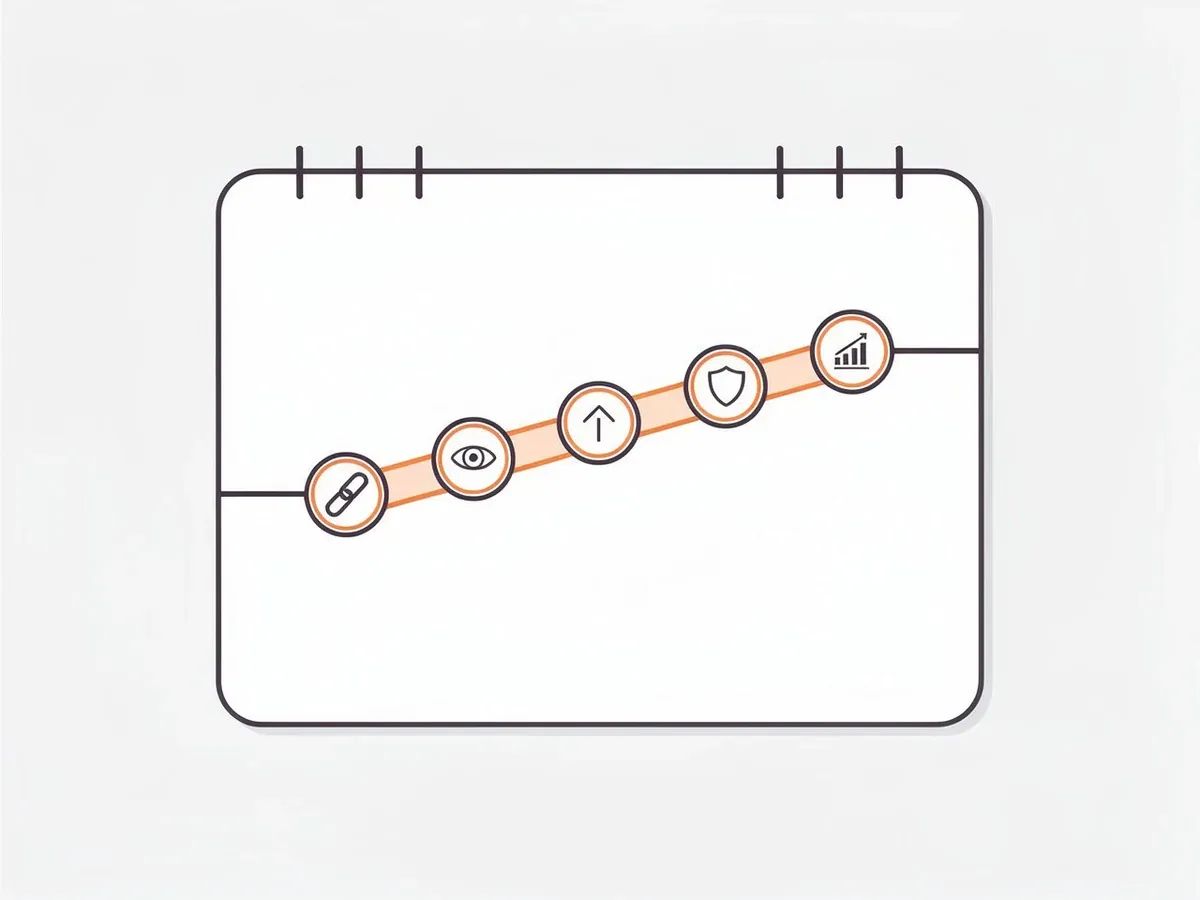
Big-brand domains are not a cheat code. Relevance, the target page and the rest of your profile still decide the outcome.
Review calendar for a new link building campaign. These thresholds are practitioner rules of thumb, not Google rules.
Checkpoint | What to check | Action if not met |
|---|---|---|
Day 14 | Is the link live and the linking page indexed? (site: search or Search Console) | Use indexation techniques; chase your provider |
Week 4 | Impressions on target pages in Search Console | If flat, check how often the linking page is crawled; waiting is still reasonable |
Week 8 | Position movement on target keywords | If none, review link quality and anchor mix; still inside the normal window, so waiting is reasonable |
Month 4 | Trend in impressions and positions | If declining, check for link decay or spam signals |
Month 6 | Compounding across the keyword cluster | If nothing, reassess the campaign or the content |
At the day-14 check, our guide on how to get backlinks indexed covers the fixes. If the links are indexed and week 12 passes with no impression or ranking change, stop waiting. That week-12 line is a practitioner rule of thumb, not a Google rule. Ahrefs' related advice is about content, not links, and it runs on a longer clock: "After ~6 months, you may want to look at updating your content if you're still not in the top 10." (Ahrefs). Either way, the problem is quality, relevance or the target page, and more of the same links will not fix it. If the real issue is that you are simply short of links for your keyword difficulty, read how many backlinks you need to rank.
On our own managed campaigns, the first signal is rarely the target keyword moving. We usually see impressions rising on long-tail variants of the target page in Search Console, inside the same 4–8 week window where Zhao's data peaks, and only later does the head term follow. When a campaign is still quiet at week 12, the cause we find most often is one of two things: the linking page never entered the index, or the target page is too thin to deserve the link. Adding more links on top fixes neither. We would rather a client ask us to check indexation at day 14 than order more links at week 6.
When fast results are a warning sign
Some backlinks never work, and links that move rankings in weeks can reverse months later if they trip spam systems or decay.
Reversals come from where the links were built: private networks, sites with no readers, and campaigns that hit one page with the same keyword anchor at scale. Fast movement from links built that way is borrowed time.
Our mitigation is vetting, not speed. The Rhino Rank link quality standard applies a traffic floor, a DR/DA cross-check, a ban on PBNs and networks, in-body links only, human sign-off, a post-publication check, and 12-month replacement cover on every delivered link. If a provider promises page-one movement in days, ask them what happens at month 5.
How long should you run a link building campaign?
Commit to a minimum of 6 months, with formal reviews at weeks 4, 8 and 12.
"Don't quit at month 2" is Link Building Journal's phrasing (Link Building Journal, 28 April 2026), and our data backs the instinct: the median published Rhino Rank campaign ran 12 months. Ahrefs' 6-month checkpoint is about content rather than links, but it sets a similar review rhythm: "After ~6 months, you may want to look at updating your content if you're still not in the top 10." (Ahrefs).
A simple decision framework:
- Choose curated links (niche edits) if you want the fastest first signal on pages that already rank, and can accept a 2–4 week impact window after a 14–21 day delivery target.
- Choose guest posts if you need anchor and context control or a new content asset, and can accept a 4–8 week impact window.
- Choose a managed link building campaign if budget is at least $500 per month and you want an account manager to own the review dates.
- A competitor wins if you are in YMYL (health, finance, legal). Plan 9–12 months, and consider a digital PR specialist alongside or instead of niche edits.
- A competitor wins if you distrust vendor data entirely. Moz, Ahrefs and Andy Zhao are the better sources for you. We cite all three in full, and the checklist above works with their numbers.
- Stop and fix, do not wait, if links are indexed and week 12 passes with no impression or ranking change. The issue is quality, relevance or the target page.
- Disavow only if the links are spam under Google's published policies. A link that has not worked is not automatically a spam link.
Whatever length you commit to, agree the measurement plan before month one. Our guide to measuring link building ROI walks through the numbers side.
FAQ
How long does it take for a backlink to show results?
Most backlinks take 4–12 weeks to influence rankings, provided Google crawls and indexes the linking page. Moz measured about 10 weeks on average for a one-position gain, and in Andy Zhao's 50 tracked campaigns, impact landed within 8 weeks in 68% of cases. Full campaign results take 6–12 months.
Why did my backlink not work after 2 weeks?
Two weeks is almost always too early to judge. A link appearing in Google Search Console means Google has seen it, not that Google has counted it. Google's own guidance is to wait a few weeks before assessing any change. Judge at weeks 8–12.
How long does it take Google to index a backlink?
Google indexes pages, not links, and Google does not guarantee it will crawl or index any page. Link Building Journal's stage model puts indexing at 1–14 days, which is a competitor estimate, not a Google figure (Link Building Journal).
Do niche edits work faster than guest posts?
In Andy Zhao's 50-campaign dataset, niche edits impacted rankings in 2–4 weeks versus 4–8 weeks for guest posts. The reason is structural: a niche edit sits on a page that is already indexed and ranking, while a guest post starts on a brand-new page. Delivery lead time adds to both clocks.
How long should I run a link building campaign?
Plan for a minimum of 6 months, with formal reviews at weeks 4, 8 and 12. In Rhino Rank's 34 published case studies, the median campaign ran 12 months to its reported result.
Do some backlinks never work?
Yes. In Andy Zhao's tracking, 6% of campaigns never saw an impact, and Google can simply ignore a link. Links can also decay or trip spam systems months later. If a link is indexed and nothing has moved by week 12, treat it as a quality or relevance problem, not bad luck.
How many backlinks do I need to see movement?
There is no honest universal number. The Moz study tracked single links to pages targeting keywords with Keyword Difficulty 25–35 and measured about 10 weeks to a one-position gain per link. Stronger competition needs more. See our guide to how many backlinks you need to rank.
Should I disavow a link that hasn't worked?
Not on timing alone. A link that has not worked is not automatically spam. Disavow only links from sites you would not want to be associated with: networks, hacked or spun sites, and pages with no readers. A slow link on a real site is not a reason to disavow.
related Blog Posts



Join 7,000+ Clients Growing with Rhino Rank
Sign Up



Stay ahead of the SEO curve
Get the latest link building strategies, SEO tips and industry insights delivered straight to your inbox.