
 Back to all posts

High authority backlinks are links from trusted, well-cited pages or sites that can pass authority signals when the link is relevant, crawlable and editorially placed. To earn them, build assets worth citing, pitch credible publishers and vet every placement, bought or earned, the same way. Judge DA, DR or Authority Score as third-party filters, not Google scores. Google publishes no site authority score, so authority is a judgement about the page, its readers and its editor, and this guide sets out the judgement we make on every publisher.
Short summary
High authority backlinks are useful because they connect your page with sources that already have trust, links and topical weight.
They are not magic links. A backlink from a famous domain can still be weak. That happens when the linking page is thin, unrelated, blocked, nofollowed for ranking purposes, or placed in a way that makes no sense to the reader. Relevance decides.
Use authority metrics to narrow your prospect list, then judge the page itself. Look at the site, the page, the link position, the anchor, the surrounding copy and the reason the editor would link to you.
What are high authority backlinks?
A high authority backlink is a link from a page or website that search engines and users have good reason to trust. In SEO work, that usually means the source has a strong backlink profile and real editorial standards. It should also have topical depth, crawlable pages and a record of publishing useful content.
The phrase often gets reduced to third-party numbers such as domain rating (DR) or high domain authority (DA). Those numbers can help you sort prospects, but they are not the thing Google is reading as a public score. Google does not publish one authority number for your site. John Mueller of Google said as much in a Webmaster Central hangout, as Search Engine Journal reported on 13 June 2019: "In general, Google doesn't evaluate a site's authority. So it's not something where we would give you a score on authority and say this is the general score for authority on your website."
The catch: authority is only useful when the link has a reason to exist. If your accounting software guide earns a link from an accounting publication, the link has topical support. If it appears inside an unrelated article because a seller had space to fill, the authority signal is weaker.
That is why authority backlinks sit apart from a broad discussion of high quality backlinks. Quality covers relevance, editorial placement and user value in detail. This guide focuses on authority: what it is, how it flows, and how you earn links from stronger sources. The aim is to avoid turning the work into metric shopping.
What authority means in SEO
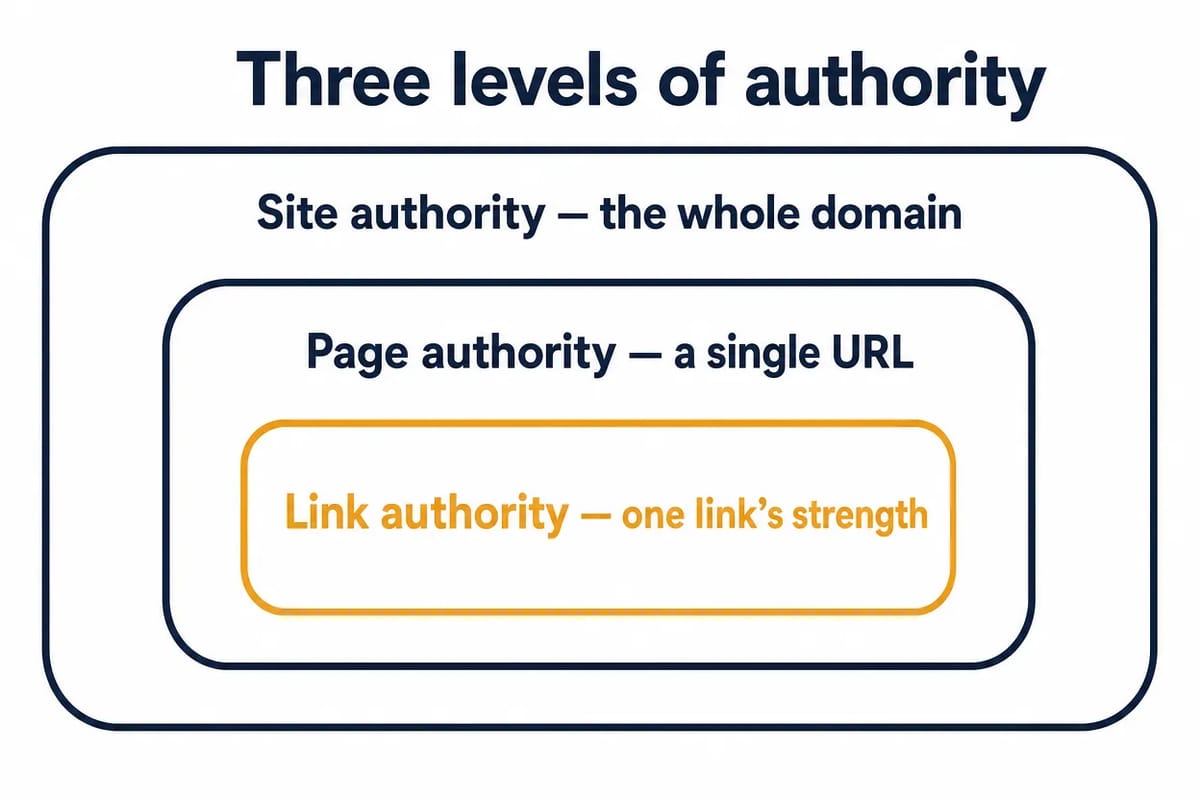
Authority is a shorthand for how much trust, reputation and link-based strength a source appears to have. It is not one clean Google metric. Followed editorial links from relevant, indexed, read publications are one of the strongest ranking levers, and the one we can move fastest once a page is ready. Google's own How Search Works page says that one of the factors used to determine quality is whether other prominent websites link or refer to the content, and calls that a good sign the information is trustworthy.
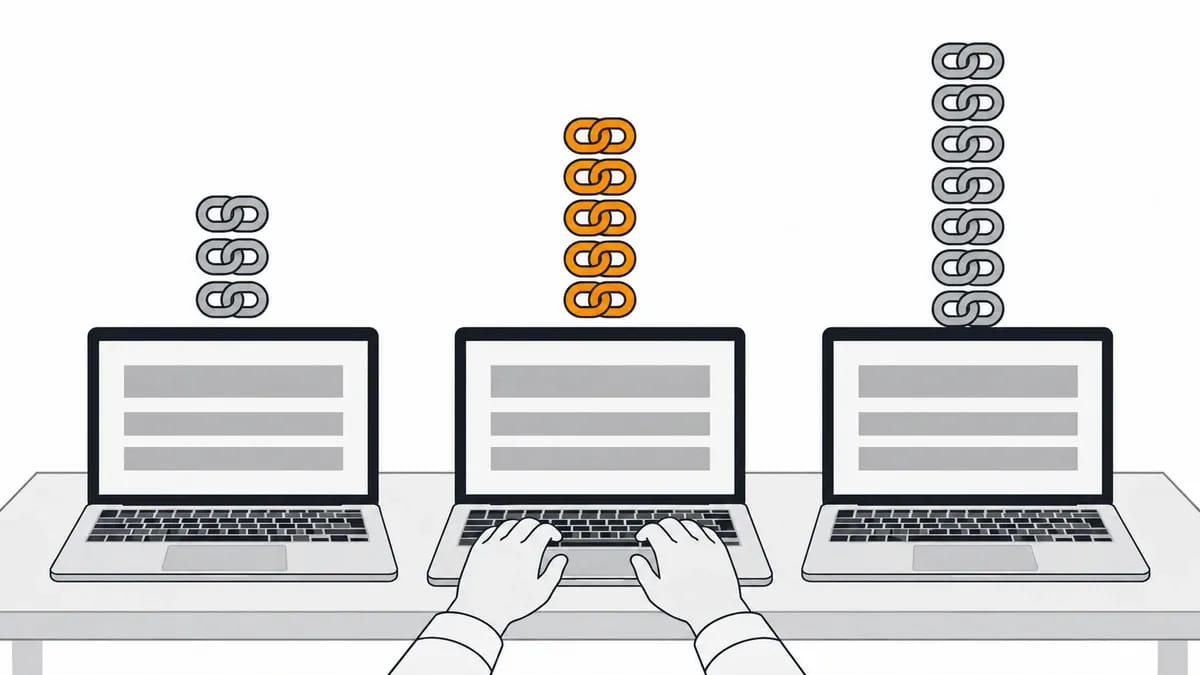
For link building, it helps to split authority into three levels: site authority, page authority and link authority. All three levels matter in practice. A strong domain can host a weak page, and a strong page can still carry a poor link if the placement is forced.
Site authority
Site authority describes the strength and trust of the wider domain. A publication with years of useful content and natural links from other credible sites is usually a better source. Visible authorship and a real audience also matter. A thin site built around outbound links is weaker.
Domain authority (DA) is Moz's third-party way of estimating this kind of domain-level strength on a comparative scale. Moz's own guidance, updated 18 March 2025, says DA runs from 1 to 100, is a predictive metric developed by Moz and is not used by Google to determine search engine rankings. Ahrefs' Domain Rating is a 0 to 100 score of the relative strength of a site's backlink profile, and Semrush's Authority Score is a 1 to 100 compound of link power, organic traffic and spam factors (checked 12 September 2026). Each tool has its own data, crawler and formula, so the same site may score differently in every platform.
Metrics are filters. They help you avoid obvious weak prospects and compare sites at speed, but they do not replace judgement. If a high-metric site publishes off-topic guest posts for any buyer, the number is doing less work than the sales page suggests.
Page authority
Page authority is about the specific URL carrying the link. A page can be powerful because it has earned links of its own and ranks for relevant terms. Real traffic and a crawlable site section add to the case. The tools score this level too: Moz's Page Authority predicts how well a specific page will rank on a scale of one to 100 (Moz Learn, 18 November 2024), and Ahrefs' URL Rating shows the strength of a page's link profile on a logarithmic 100-point scale (Ahrefs help centre, 31 October 2025). Both are page-level and third-party, so they apply the same filter-not-verdict rule as DA and DR.
This is where many link reports mislead. You might see a link from a large domain, but the linking URL is new, orphaned, buried, or unrelated to your topic. In that case, the domain name looks impressive while the page itself has little authority to share.
When you review a prospect, check the page before the domain. Does the page have a clear topic? Does it attract links or traffic? Is it internally linked from relevant sections? Would a reader expect to find your page there?
Link authority
Link authority is the authority that can flow through one link in one context. It depends on the linking page, the anchor text, the surrounding copy, the placement, the link attributes and the relationship between the two pages.
A contextual link inside a useful paragraph normally has a stronger case than a boilerplate footer link. It also has a stronger case than a random author-bio link or a sitewide sidebar link. The link is easier for users and search engines to interpret because the surrounding text explains why it is there.
Link authority is not a public score inside one official Google tool. It is an SEO model for judging whether a specific link is likely to carry useful signals. Treat it as a practical assessment, not a guaranteed unit of value.
How authority flows through links
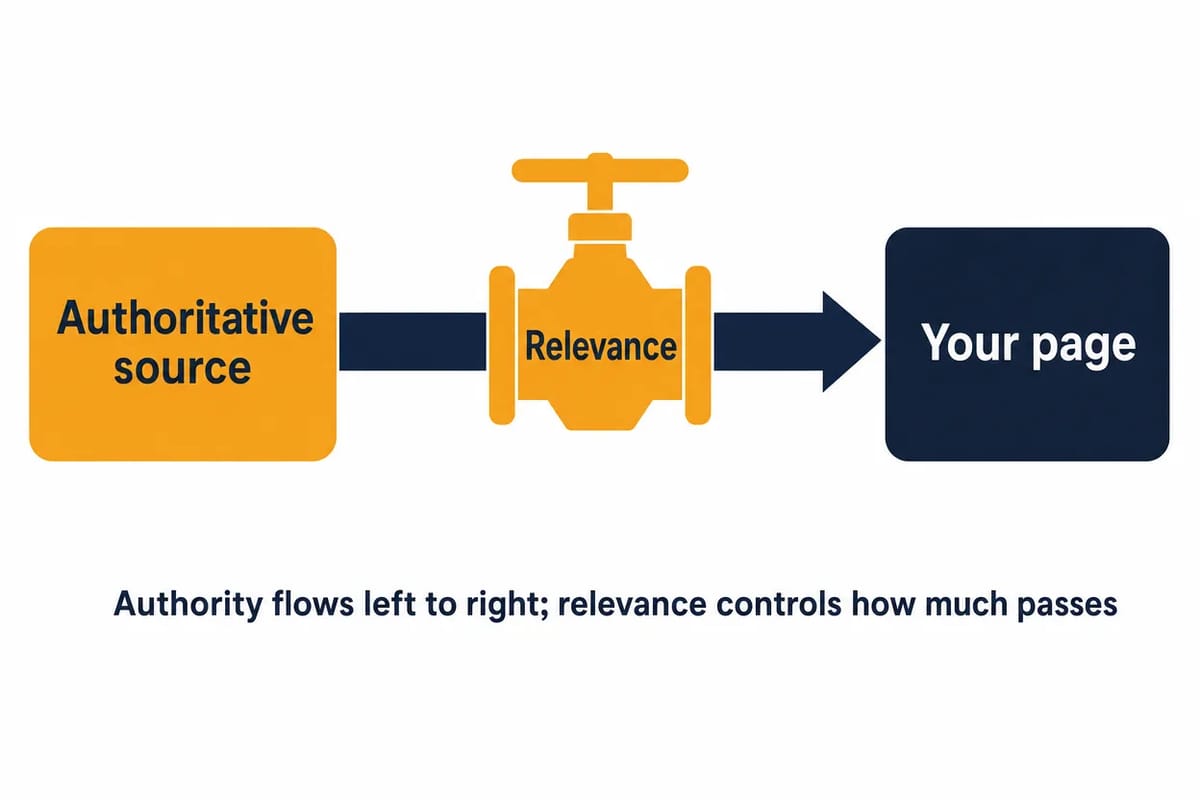
Google's public ranking systems guidance still describes link analysis systems, including PageRank, as part of how Search understands relationships between pages. The basic idea is simple: links can help search engines discover pages and assess how pages relate to one another.
That does not mean every link passes the same value. A link from a strong page can support the linked page, but the transfer is mediated by context. The topic, anchor, placement, crawlability and rel attributes all matter.
In practice: imagine two links to your page about SaaS pricing. One is from a respected SaaS finance guide and sits beside a paragraph about pricing benchmarks. The other is from a general lifestyle article with no business context. The first link gives search engines a cleaner reason to connect the topics. The second may still be crawlable, but the relevance is thin.
This is why the old "link equity" idea needs careful wording. Authority can flow through links, but it is not a liquid that moves in guaranteed amounts. A page with many outbound links may give less weight to any single link in some third-party models. Google does not publish a simple split formula you can rely on.
Link attributes change how Google reads a link. Google's announcement of 10 September 2019 said that sponsored, ugc and nofollow all work as hints for ranking purposes. Its qualify-outbound-links page, updated 10 December 2025, says that for regular links you expect Google to fetch and parse without any qualifications you do not need to add a rel attribute. There is no rel="dofollow" attribute. The Curated Links and Guest Posts we place are followed, in-body editorial links on pages with readers, and that placement standard is the one we vet for below.
How to use DA, DR and Authority Score
Teams can use technical SEO tools to assess authority at scale. Moz, Ahrefs and Semrush all give fast ways to compare domains and pages, which is useful when building a prospect list.
Moz created Domain Authority and Page Authority as predictive, third-party metrics. Ahrefs has Domain Rating and URL Rating, and the Ahrefs authority checker gives a quick read on domain-level backlink strength. Semrush has Authority Score, which blends backlink, traffic and spam signals inside its own system.
These metrics should answer one question: is this source worth a closer look? They should not answer the whole placement decision. You still need to check the page, topic, content quality, outbound link pattern, traffic signals and editorial fit.
When we audit publisher lists, the weak prospects usually fail on context before they fail on a metric. The DR might look fine, but the site publishes unrelated topics, every article has commercial anchors, or the page itself has no organic footprint. That is not authority you should chase.
Before any Curated Link or Guest Post goes live we run the same checks on the publisher, and they are published as our link building quality assurance standard: a traffic floor, a DR/DA cross-check that is not a gate, no PBNs or link networks, in-body placement only, human sign-off, a post-publication check, and 12-month replacement cover if the link drops. A high DA or DR is not what we mean by authority. Authority is a relevant, indexed page with readers and an editor who would place the link without us, which is why a specialist site can beat a broad national site with a bigger score.
That is also how we price it. A Curated Link starts at $60 at 20 to 100 referring domains and $210 at 1,000 or more, delivered in 14 to 21 days; a Guest Post starts at $75 on a DA10+ host and $130 on DA30+, where the DA band is a label for the tier, not a Google score; and a managed campaign starts at $250 a month with the same 12-month cover on every link (checked 12 September 2026). Authority is priced by referring domains and readership, not by a DA target.
Use thresholds as internal sorting rules, not universal SEO truth. If your niche is small, a lower-metric specialist site can be more useful than a broad national site. That is especially true when the larger site has no topical reason to mention you. If your niche is competitive, you may need stronger sources, but the same relevance test still applies.
What makes a source authoritative?
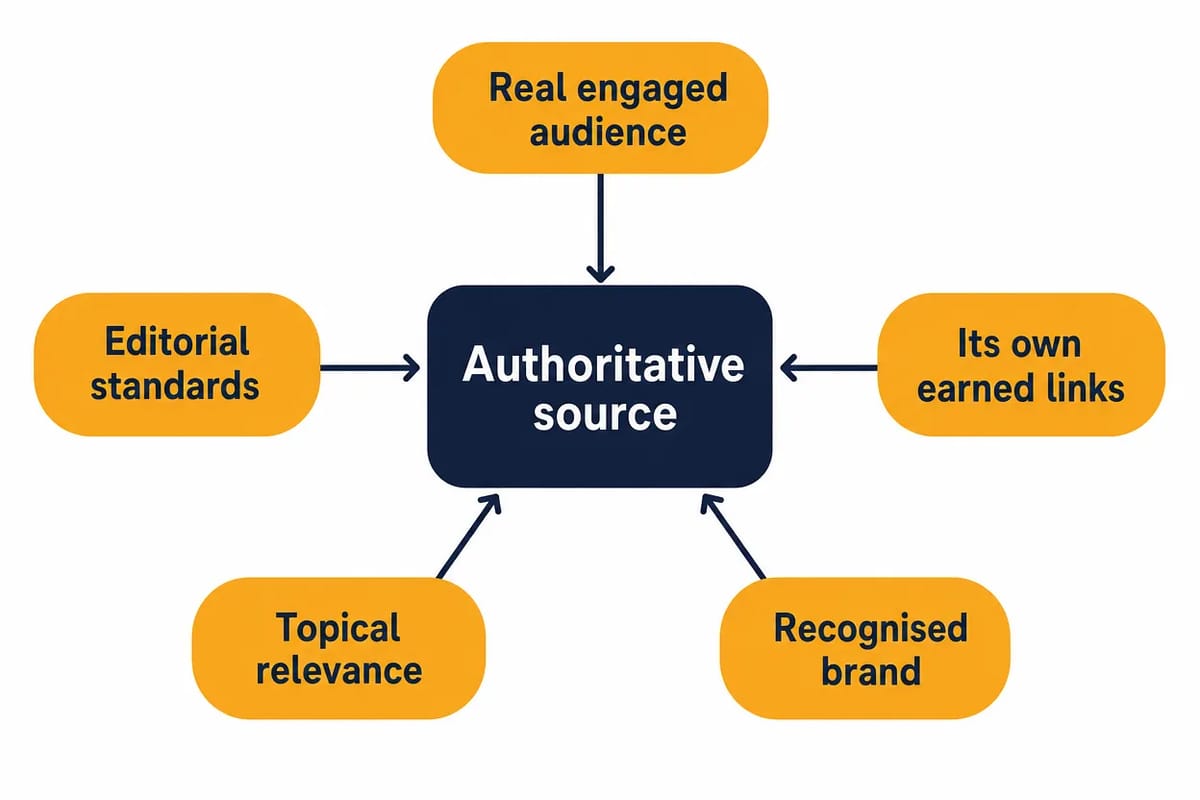
An authoritative source has signals you can inspect without guessing Google's private systems.
First, it has topical depth. The site covers your subject often enough that a link to your page would feel natural. A single stray article on an unrelated domain is weaker than a focused publication that has built an audience around the topic.
Second, it earns links from other credible sites. You do not need a perfect backlink profile, but you do want signs that other publishers cite the source for real reasons. If the site's own links come mostly from low-quality directories, scraped pages or obvious networks, be careful.
A tool score does not settle this. Tim Soulo, writing on the Ahrefs blog on 4 May 2022, put it plainly: "It is also important to note that DR doesn't account for backlink SPAM. In fact, large amounts of low-quality backlinks may actually increase your DR, not decrease it." In the same piece he adds: "If relevant, even a low-DR link will help your page to rank better."
Third, it has editorial control. Good sources have standards, named or accountable contributors, consistent categories and sensible outbound links. Their content reads as if it was written for readers. Thin pages created only to host links are not authority sources, even when a tool metric is high.
Fourth, it has page-level strength. A link from a strong domain is better when the linking page itself has internal links, external links, rankings or traffic. Authority backlinks work best when the page carrying the link has its own reason to be trusted.
Traffic is evidence. It is not proof of SEO value, but it shows the page or site can attract real readers. If a source has no visible audience, no rankings and no editorial identity, its authority claim needs more scrutiny.
How to earn high authority backlinks
The best way to earn high authority backlinks is to give authoritative publishers something they can use. That might be data, expert commentary, a clear guide, a comparison, a visual asset or a tool. You are trying to become the source a stronger page can cite with confidence.
Build assets authoritative sites can cite
Strong sites link when your page helps them support a point they already want to make. Original data, clear definitions, useful visuals, calculators, templates and expert explanations all give editors a reason to cite you from a page with its own authority.
The assets we promote most successfully tend to answer one awkward question well. They make a journalist's paragraph cleaner or give a blogger a credible source. They also help an editor on an authoritative site support a claim without sending readers to a competitor's sales page.
Pitch journalists and expert-source requests
Journalist requests can help you earn links from strong publications when your expertise matches a live editorial need. Help A Reporter Out (HARO) is one route again: Cision shut its Connectively successor on 9 December 2024, and Featured.com bought HARO and announced its return as a free journalist-request email on 16 April 2025. Other source-request platforms and direct journalist pitches do the same job.
The authority angle is credentials. You need a short answer, a clear credential, and a comment the journalist can quote without heavy editing. A vague pitch sent to every request will not earn citations from serious publishers.
If you win a mention, check the link attributes, page context and publisher fit, but do not treat every nofollowed press link as a failure. Some authoritative publishers nofollow links as a policy. They may still help brand discovery, referral traffic and future editorial access.
Use guest posting with authority standards
Guest posting can earn authority backlinks when the host has authority in your market, not merely a high DA or DR. The useful target is a publication with a relevant section, visible standards and an audience that overlaps with your buyers. It becomes weaker when the anchor is forced into copy that does not need it.
On our own guest-post campaigns, we treat metrics as an initial filter and then review the publication, topic fit, article angle and anchor context. The point is not to buy a score. The point is to place a useful article on a source that has authority in the right market.
If you run guest posting yourself, qualify the source before the article. Ask whether the publication is cited, searched for or respected by the people you want to reach. Then pitch a real topic, write for the host's readers, and use anchors that describe the destination naturally.
Use existing authoritative pages
Links from established pages can be useful because the URL may already have history, internal links, external links or traffic. That is the authority logic behind curated links and niche edits: a link is added to existing content where the destination strengthens the page.
The test is the page, not the fact that a link was added. We only place a Curated Link where the page already has readers and a topic that fits, the sentence carrying the link helps the reader, the placement is in the body, and a person has signed it off. If the page is a shell that exists to host links, no score makes it an authority source.
Use digital PR and editorial outreach
PR outreach works when you have a story, asset or expert angle that authoritative publishers can cover, and its authority comes from who covers the story and why. If your goal is to build editorial backlinks from authoritative and reputable websites, the pitch has to serve the article first. The link follows because the source is useful to that publisher's readers, so keep that order intact.
Be careful with link exchanges
Link exchanges are not automatically harmful, because normal business relationships can create natural cross-links. The risk appears when exchanges become excessive, scaled or unrelated.
We do not run scaled swaps across unrelated sites, and we do not recommend them. A small number of relevant partner links that help readers is ordinary business linking.
Authority versus quantity
You do not need the most backlinks in every market. You need enough relevant authority to compete for the terms that matter. That is why the question of how many backlinks are needed has no universal answer.
Look at the pages already ranking for your target query. If they have strong topical content and links from relevant sources, you need to match the authority pattern and improve the page. If the results are weaker, a smaller number of good links may be enough.
Quantity still has a role. A site with one excellent link and no broader backlink profile can look thin beside competitors with many credible referring domains. But quantity only helps when the links are clean enough to support the site.
Mistakes that weaken link authority
The first mistake is buying on a score. A placement chosen because the domain has a high DA or DR, with no check on the page's readers, topic or placement, is the mistake we see most often on the publisher lists we audit. The score is a filter, never the reason.
The second mistake is ignoring relevance. A link from a powerful domain in the wrong topic can be less useful than a link from a smaller site. The smaller site can win when it is trusted in your niche. The higher the authority claim, the more closely you should check the topical fit.
The third mistake is over-optimised anchor text. If every authority backlink points at your page with the same commercial phrase, the pattern starts to look manufactured. Mix branded, partial-match, URL and natural descriptive anchors.
The fourth mistake is leaning on low-quality directories. Local and industry citation building can be useful when the directory is real and relevant. Scraped directories with no readers are not authority sources. Do not confuse easy links with authority links.
The fifth mistake is letting weak links sit unnoticed. Regularly identify and remove low-quality or spammy links where you control them, and document anything suspicious. On managed campaigns we report lost and replaced links every month, so a weak link is caught in the report rather than found a year later.
How to measure authority backlink progress
Track authority with a mix of tool metrics and real outcomes. DA, DR, URL-level metrics and Authority Score can show whether your link profile is getting stronger in third-party systems. They are only one layer.
Also track referring domains, topical categories, link attributes, anchor mix and the strength of linking pages. Referral traffic, target-page rankings and link retention matter too. A link that disappears after a month is not the same as an editorial citation that keeps sending readers.
In the reports we trust, a link is scored beside its source page, anchor, attribute and topical context. That keeps the metric useful without letting it overrule the evidence on the page.
The trade-off: high authority backlinks take longer to earn because strong publishers have standards. That delay is part of the value. A source that links to anyone quickly is usually easier to get and easier for competitors to copy.
Link authority FAQs
Do backlinks build authority?
True. Backlinks build authority when they come from relevant, trusted and crawlable pages with readers, and Google's How Search Works page names links from prominent websites as a sign that information is trustworthy. The "vote" idea is an analogy: a link supports the case for your page, and the case is stronger when the linking page is read and on topic.
What is link authority?
Link authority is a practical way to describe how much useful authority a specific link may pass. It depends on the linking page, source domain, relevance, anchor text, placement and rel attributes. It is not a public Google metric.
What are authority backlinks?
Authority backlinks are links from credible third-party websites or pages that have trust, links, topical depth and editorial control. The best authority backlinks make sense to the reader before you ever check the metric.
What are high domain authority backlinks?
High domain authority backlinks are links from domains that score strongly in third-party tools such as Moz, Ahrefs or Semrush. Use those scores as screening data. Then check whether the specific page is relevant, indexed, useful and editorially sound.
What is SEO authority?
SEO authority is the perceived strength of a site or page based on signals such as links, reputation, relevance, content usefulness and trust. Because Google does not publish a single authority score, you should treat SEO authority as a judgement built from several signals. Google still publishes no site authority score (checked 12 September 2026).
How does link equity work?
Link equity is the SEO term for value that may pass through links. PageRank and link analysis explain why the idea exists, but modern search systems are more complex than a fixed transfer. Relevance, crawlability, placement and link attributes mediate the signal.
related Blog Posts



Join 7,000+ Clients Growing with Rhino Rank
Sign Up

Stay ahead of the SEO curve
Get the latest link building strategies, SEO tips and industry insights delivered straight to your inbox.