
 Back to all posts

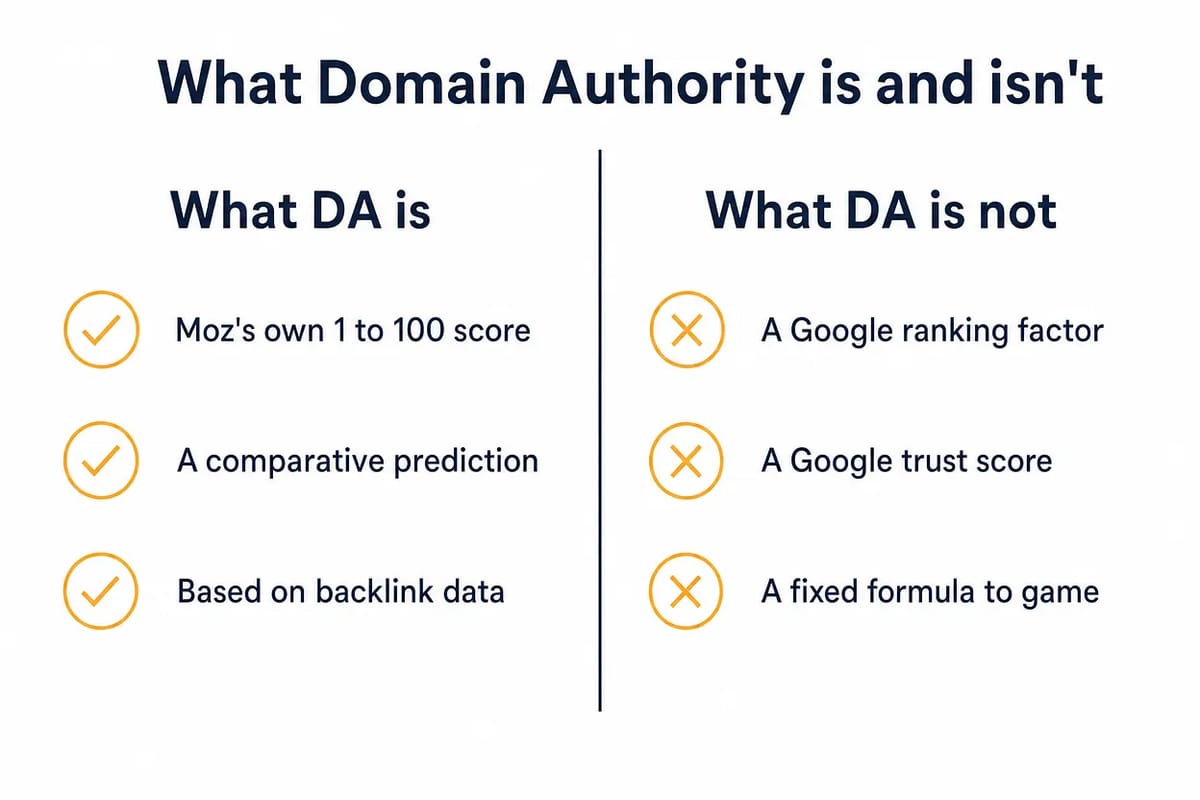
Domain Authority (DA) is Moz's score from 1 to 100 that predicts how likely a website is to rank in search results compared with other sites. Moz builds it from link data, and Google does not use it.
DA still matters commercially because the link market prices by it. We tier our own Guest Posts and listicle placements by the minimum Moz DA of the placement site, and we never accept a site on DA alone.
To see a site's DA and DR side by side, use our free DA/DR checker.
What is Moz Domain Authority?
Moz's own definition is a score from 1 to 100, and Moz is direct about what the score is not: "Domain Authority is not a Google ranking factor and has no effect on the SERPs" (Moz's Domain Authority explainer, last updated 18 March 2025).
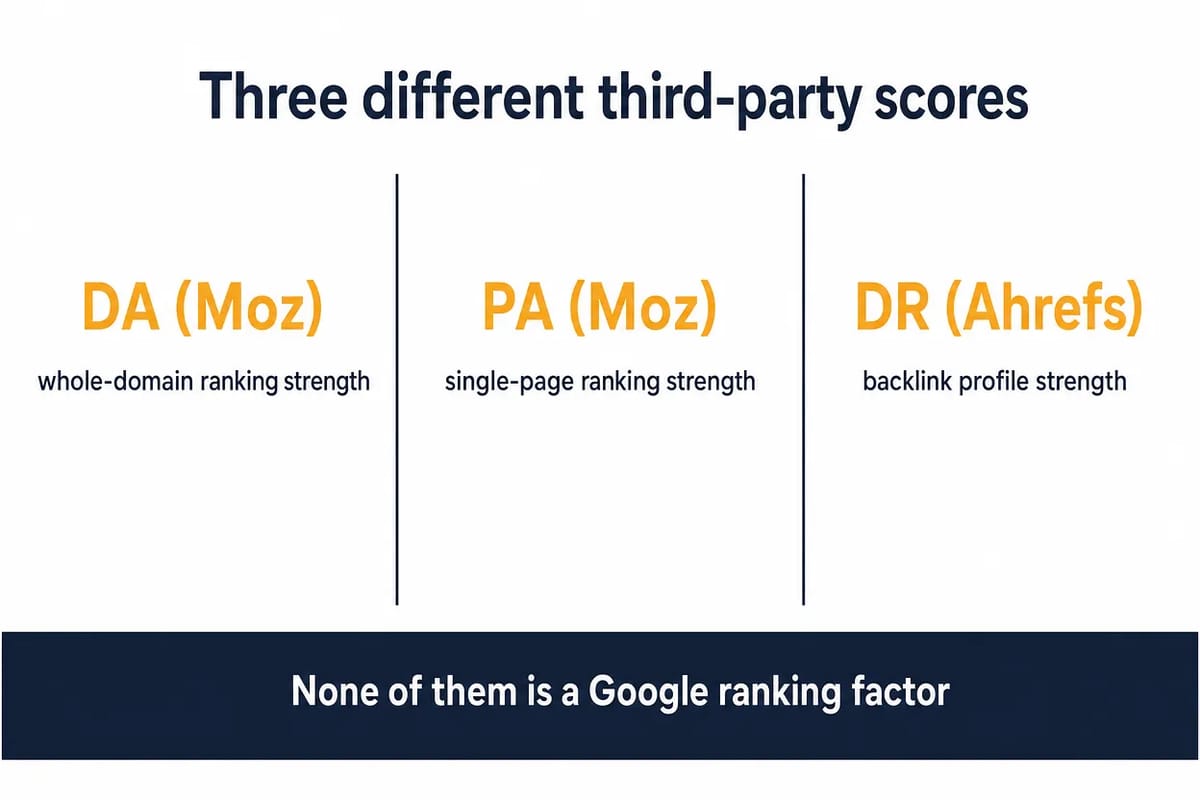
Russ Jones, then Principal Search Scientist at Moz, made the same point on the Moz blog on 5 March 2019: "Domain Authority does not cause search rankings. It is not a ranking factor. Domain Authority predicts the likelihood that one domain will outrank another." Google's own page on third-party SEO tools, last updated 5 June 2026, says the same about every such score: "Third-party tools don't have access to our internal ranking data."
New websites "always start with a Domain Authority of 1", so a low early score is normal. And the number means most against the sites you compete with: read against the domains that rank for your queries, it shows the link gap you need to close.
How Moz DA is calculated
Moz calculates Domain Authority with a machine learning algorithm that works mainly from the backlink data in its own link index. In Moz's words: "These factors include the number of linking root domains, the quality of those links, and other signals that correlate with rankings across thousands of search results."
Moz rebuilt the model in 2019 in a release it calls Domain Authority 2.0, announced on 5 February 2019 and live on 5 March 2019. In the announcement, Russ Jones wrote: "Rather than relying on a complex linear model, we've made the switch to a neural network." He also wrote that Moz had been able to "integrate our proprietary Spam Score and complex distributions of links based on quality and traffic".
The link index behind the score held over 35 trillion links at that February 2019 announcement; Moz's site today puts it at over 44 trillion.
Spam Score, one of the inputs Jones named, is a separate Moz machine-learning score built on 27 features. It is shown as a percentage in three bands (Low 1%-30%, Medium 31%-60%, High 61%-100%) and is updated quarterly.
Why DA is relative, and not a straight line
The Domain Authority scale runs from 1 to 100, but the points are not evenly spaced. As Moz's explainer puts it: "It explains why it's easier to grow your score from 20 to 30 than it is to grow it from 70 to 80." Moz's Brand Authority page uses the same idea: "Like Domain Authority, this score is non-linear", and Moz describes Page Authority as a "100-point logarithmic scale" (Page Authority explainer, 18 November 2024).
For you, the practical point is that a ten-point gap near the top of the DA scale is a much bigger gap in links than ten points near the bottom. So compare like with like.
What is a good Domain Authority score?
Moz's answer is short: "There's no universal 'good' or 'average' Domain Authority score because it's a relative metric." There is no band to aim for.
The method that works is comparative. Check the Domain Authority of the sites that rank for your target queries and of your direct competitors, then read your own score against that set. Our guide to how to check your competitors' backlinks walks through the process.
DA, PA, DR and Authority Score are different scores
Page Authority is Moz's page-level score, also running from 1 to 100: Domain Authority predicts the strength of a whole domain, Page Authority predicts the strength of a single page. Ahrefs Domain Rating is built from followed linking domains on a "logarithmic scale from 0 to 100". Semrush Authority Score runs from 1 to 100 as a compound of link power, organic traffic and spam indicators, and Semrush says "We update the Authority Scores for all domains once every two weeks".
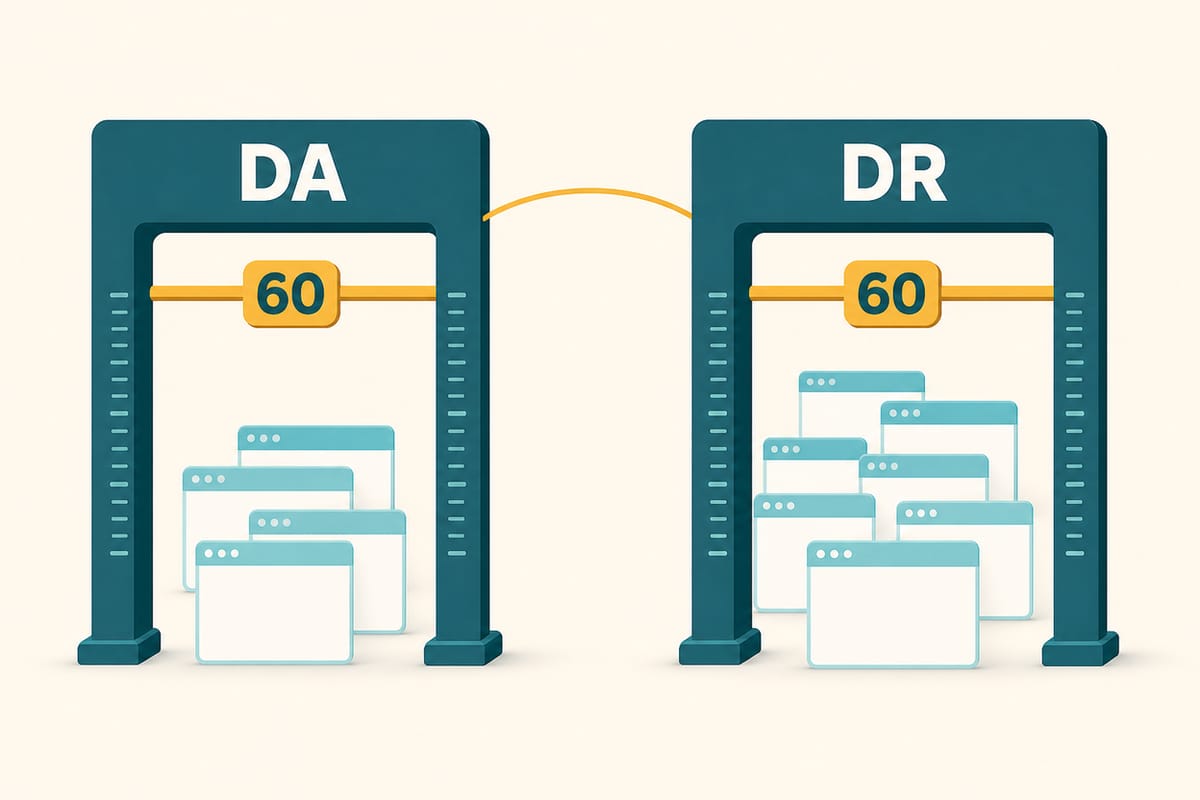
We define all four scores in link authority and put Moz DA and Ahrefs DR head to head in Domain Authority vs Domain Rating.
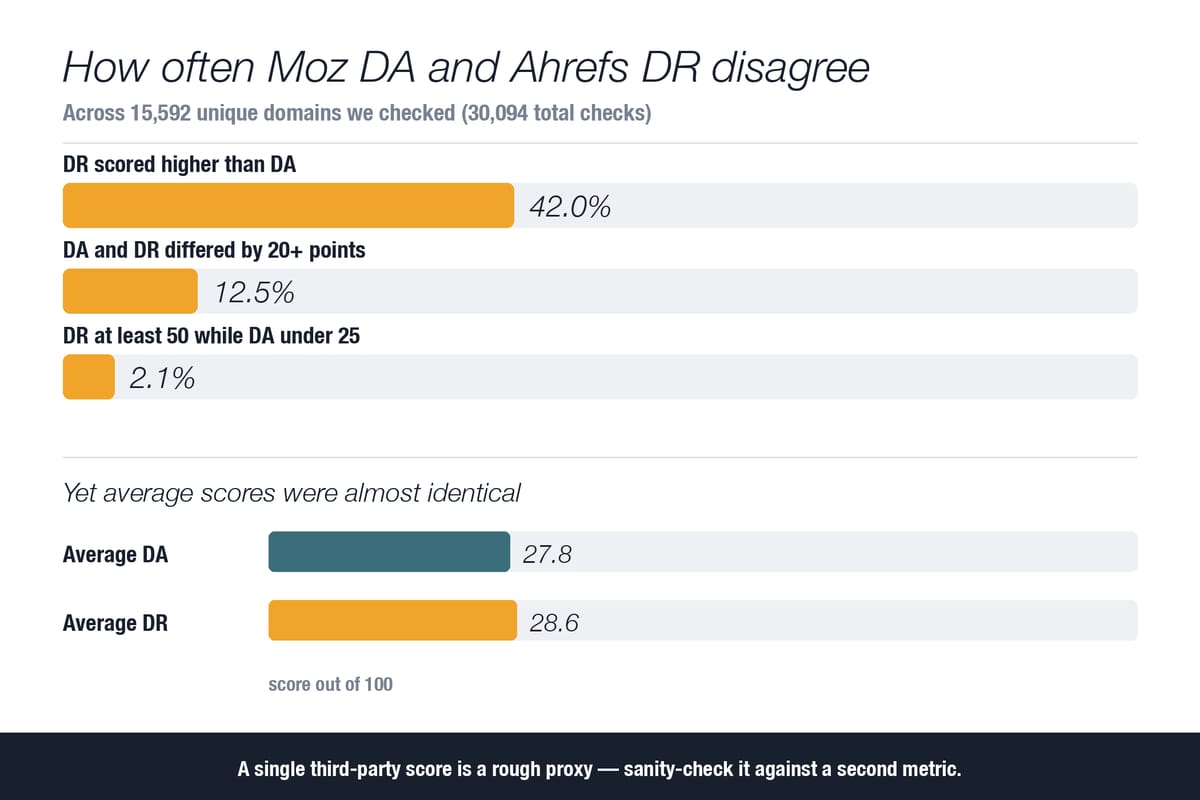
Across the 30,094 checks run through our own DA/DR checker, we have 15,592 unique domains with valid latest DA and DR data. DR was higher than DA on 42.0% of those domains, DA and DR diverged by 20 points or more on 12.5%, and the averages were close: DA 27.8 and DR 28.6. The practical warning: treat one vendor score as a rough proxy, then check it against a second metric and the actual link profile before you decide.
Wider measurements show the scores agree most on large sites and least on small ones. In Serhii Koksharov's study with Collaborator (27 August 2026), which compared authority metrics across more than 40,000 websites from Collaborator's catalogue, the correlation between Moz DA and traffic was 0.238, and among the 766 sites with more than 1 million monthly visitors the correlation between DR and DA was 0.719. In Editorial.Link's survey of 518 SEO professionals (25 March 2026), asked to choose one authority metric, 64.1% chose Ahrefs DR/UR, 15.4% chose Semrush Authority Score and 11.6% chose Moz DA/PA.
How to check Moz DA
Three options cover it. The first is our own free DA/DR checker, which shows Moz DA and Ahrefs DR side by side. For the score straight from the source, Moz's Link Explorer gives 10 free queries per month with a free Moz Community account. Moz also runs a free Domain Analysis tool, and its MozBar browser toolbar shows scores as you browse.
How we use DA when we price and vet placements
We use Domain Authority in two places: it sets the price tier of a placement, and it is one of several checks when we vet the site behind it. The reason we price on it is simple: the higher the score, the stronger the site's link profile.
Our Guest Posts are tiered by the minimum Moz DA of the placement site, across six tiers from DA10+ to DA60+. Prices run from $75 per placement at DA10+ to $400 at DA60+, and you choose the DA tier at checkout with your target URL and anchor text. Our listicle placements work the same way, and it is the same product on every tier: DA30+ is $135, DA40+ is $220, DA50+ is $340 and DA60+ is $450. The only difference is the minimum DA of the site we place you on.
DA sets the tier and the price; Ahrefs DR and live organic traffic tell us whether the number is earned. We weigh indexed pages, organic traffic and its trend, Moz DA, Ahrefs DR, referring domains and link-profile strength together. We turn away sites whose metrics look impressive but whose traffic does not hold up: a high DA figure on an empty site is still an empty site.
Our written standard is on our link building quality assurance page: a traffic floor, DA and DR cross-checked against each other, no PBNs or networks, in-body links only, human sign-off, a post-publication check and 12-month replacement cover. Curated Links are chosen on relevance, referring domains, DA, organic traffic and overall site quality. PBNs, networks and link farms are excluded whatever their DA.
Other practitioners read sites the same way. In Editorial.Link's 2026 survey (the same 518 respondents), the red flags respondents named when judging a site were spammy outbound links (89.0%), low-quality content (86.3%), poor authority metrics (72.2%), low relevance (67.2%) and declining organic traffic (63.9%).
If you are buying placements, pick the tier by the DA of the sites you compete with, then ask any seller what sits behind the number: traffic, relevance, DR. The score sets the price band; the checks decide whether the site is worth it.
How to improve your Moz DA score
Domain Authority can rise when Moz finds new links from stronger linking root domains, so the work is gaining links from relevant, indexed sites with real readers. Whether you earn those links with content and PR or acquire them as editorial placements, both routes are judged by the same checks: traffic, relevance, DR alongside DA, and the page the link sits on.
A link audit shows which links you have lost, so you can replace them. For what to read besides the score, see what a backlink profile is.
How Moz DA changes over time
Moz's help pages set the cadence: "The index that powers Link Explorer is constantly updating to provide fresh link data. This does not mean that DA and PA will change with every data update; it will only change if we find new links to a respective site."
Because Domain Authority is relative, your score can also move when other sites gain links. Moz's own example: "if Facebook.com acquired a billion new links, other site's DA would drop relative to Facebook's."
If you are looking for a Moz DA update, the rebuild Moz has announced is Domain Authority 2.0, live on 5 March 2019. Moz's newer launch is a separate metric, Brand Authority, introduced on 7 August 2023 by Dr. Peter J. Meyers of Moz: "Where Domain Authority measures your ability to rank on search engines, Brand Authority measures your broader influence across marketing channels." On 24 April 2025 Moz extended Brand Authority to four markets (US, UK, CA, AU).
How to compare your website with competitors
Start with your own Domain Authority, then check the domains and pages that already rank for the terms you want. That tells you whether you are up against similar sites or trying to enter a results page where the domains carry much stronger link profiles.
Domain Authority alone is not enough for the comparison. Pair it with referring domains, organic traffic, topical relevance, page-level link strength and content quality. A lower-DA site can outrank a higher-DA site when its page is better matched to the query.
Common misconceptions about Domain Authority
Domain Authority is a Google signal. It is not. Moz states that Domain Authority "is not a Google ranking factor and has no effect on the SERPs", and Google says third-party tools do not have access to its internal ranking data.
A higher DA site always outranks a lower one. Not necessarily. As Russ Jones put it on 5 March 2019, Domain Authority "predicts the likelihood that one domain will outrank another". A likelihood is not a guarantee, and page-level links and relevance decide many individual results.
A DA number means the same thing in every niche. It does not. Because the score is relative, the same figure can be strong in one market and weak in another, which is why the only useful benchmark is the set of sites that rank for your queries.
Frequently Asked Questions
What is Moz Domain Authority (DA)?
Moz Domain Authority is a score from 1 to 100 that predicts how likely a website is to rank in search results compared with other sites. Moz builds it from link data with a machine learning algorithm. It is a comparative metric, not a Google ranking factor.
Is Domain Authority a Google ranking factor?
No. Moz states: "Domain Authority is not a Google ranking factor and has no effect on the SERPs." Google also says third-party tools do not have access to its internal ranking data, so Domain Authority is Moz's prediction, not a signal Google uses.
What is a good Domain Authority?
There is no universal good or average Domain Authority score, because the metric is relative. A good score is one that compares well with the sites that rank for your target queries. Check those domains and your direct competitors, then read your own score against that set.
How is Domain Authority calculated?
Moz calculates Domain Authority with a machine learning algorithm, primarily focusing on backlink data. The inputs include the number of linking root domains, the quality of those links and other signals that correlate with rankings across thousands of search results. Moz rebuilt the model in 2019 as Domain Authority 2.0, switching from a linear model to a neural network.
How can you increase Domain Authority?
Gain links from relevant, indexed sites with real readers, because Domain Authority can rise when Moz finds new links from stronger linking root domains. You can earn those links with content and PR or acquire them as editorial placements; either way, judge each site on traffic, relevance and DR as well as DA. A link audit shows which links you have lost, so you can replace them.
What is the difference between Domain Authority and Page Authority?
Domain Authority predicts the ranking strength of a whole domain or subdomain. Page Authority is Moz's page-level score, also running from 1 to 100, and predicts the strength of a single page. A site can have a strong Domain Authority while a new or weakly linked page has a low Page Authority.
What Domain Authority checker should you use?
Our free DA/DR checker shows Moz DA and Ahrefs DR side by side. For the score direct from the source, Moz's Link Explorer gives 10 free queries per month with a free Moz Community account. Whichever checker you use, read the score against the site's traffic and link profile before you act on it.
Why can Domain Authority change?
Moz's link index is constantly updating, but Domain Authority only changes when Moz finds new links to a site. Because the score is relative, your Domain Authority can also move when other sites gain links. Watch the trend over time rather than any single reading.
related Blog Posts



Join 7,000+ Clients Growing with Rhino Rank
Sign Up


Stay ahead of the SEO curve
Get the latest link building strategies, SEO tips and industry insights delivered straight to your inbox.