
 Back to all posts

Rhino Rank is the best niche edit service in this comparison, with an Insertion Quality Score of 63/70. We win on screening, proof, durability terms, public pricing and reputation, and we arrange site pre-approval on request: contact us first so it is set up for your orders.
FatJoe fits bulk agency ordering. Stan Ventures is strongest when site pre-approval built into the standard order flow matters. Stellar SEO suits premium buyers who want strict screening. LinkPanda is the interesting new option with visible examples but a thin public footprint.
How we score
A niche edit is only as good as the page it enters and the vendor's proof that the link insertion works and survives. That is why screening, proof and track record carry the largest weights.
Host-site screening and standards (14 points). We score what the vendor publishes about qualifying sites and pages. Named rejection checks plus numeric floors or real example metrics score highest; one of those earns the middle band; vague quality language scores low.
Placement and outcome proof (14 points). We look for real placements and outcome evidence. A named numeric case study plus example placements or placement-level metrics scores highest; one side of that proof lands mid; generic claims score low.
Track record and independent reputation (14 points). Larger, independent review profiles and multi-year operating history score highest. Smaller, contradicted or thin profiles are capped even when the visible rating is good.
Durability terms (10 points). Written replacement terms of 12 months or longer plus a separate money-back guarantee score highest. Shorter written windows score mid. No written protection scores low.
Pricing clarity (9 points). Fixed public per-placement pricing tied to published site-quality tiers scores highest. Public pricing without clear tier linkage, variable publisher components or gated quotes scores lower.
Edit transparency and buyer control (9 points). Pre-approval or full URL visibility before or at delivery, plus a per-order report, scores highest. Report-only visibility is useful, but it is not the same control.
Tie-break: host-site screening wins because it is the criterion closest to whether the host page would pass our own QA checks.
Best niche edit services compared
Rank | Provider | IQS | Best for |
|---|---|---|---|
1 | Rhino Rank | 63/70 | All-round buyer protection |
2 | FatJoe | 50/70 | Bulk agency ordering |
3 | Stan Ventures | 50/70 | Pre-approved higher-touch campaigns |
4 | Stellar SEO | 45/70 | Strict screening, premium flat buys |
5 | LinkPanda | 44/70 | Visible examples, young footprint |
1. Rhino Rank - best all-round buyer protection
Our niche-edit lane is the Curated Links product, which we introduced in 2017. In this market, that makes the offer closer to an existing-content placement service than a fresh guest post or broad managed SEO retainer.

Our Curated Links service is the strongest fit for buyers who want niche edits with public pricing, written rejection standards and a clear replacement term. The service starts at $60 per link on our Curated Links page, checked 2026-09-23, and the published RD tiers run up to $210 for RD1000+ placements.
The main strength is not the entry price. It is the amount of buyer protection around each link insertion. We publish what we reject (PBN footprints, spun or AI content and traffic manipulation) and the signals we check before placement: relevance, organic traffic, DR, spam score, outbound-link limits and human-written content. The full list is on our link building quality assurance page.
That gives buyers more than a DA/DR promise. It gives them a view of the authority, traffic and content checks behind the placement. The example card on our Curated Links page, checked 2026-09-23, lists DR 54, 12,400 monthly organic traffic, an 8-month-old page, 1,200 words and a page-one ranking. The outcome side is backed by a named case study: an online crypto company using Curated Links recorded 1,033% organic traffic growth and a 311% increase in clients over a 16-month campaign, per the live case-study page checked 2026-09-23. It is not a gallery of live client URLs, so it does not get a perfect proof score.
Buyer control is available, but you need to ask for it. We report every placement URL through the dashboard and export the report unbranded for white-label use. We also set up target-site pre-approval before a link goes live on request, so contact us first. Stan Ventures builds pre-approval into its standard flow if you would rather not ask.
Criterion | Score |
|---|---|
Screening | 13/14 |
Proof | 13/14 |
Reputation | 12/14 |
Durability | 10/10 |
Pricing | 9/9 |
Transparency | 6/9 |
Scored from:
- Vendor-claimed: rejection list, RD pricing and reports; checked 2026-09-23.
- Vendor-claimed: crypto case study and example card; checked 2026-09-23.
- Independent: Reviews.io 4.9/5 (170); checked 2026-09-23.
- Independent: Trustpilot 4.5/5 (188); checked 2026-09-23.
- Vendor-claimed: 12-month replacement and $550 first-order refund; checked 2026-09-23.
- Vendor-confirmed: pre-placement site approval available on request - contact the team first; checked 2026-09-03.
Best fit: agencies and in-house teams that want clear pricing, authority tiers, replacement cover and enough reporting to audit each placement after delivery.
Not the fit: buyers who want a self-serve approval portal rather than arranging site pre-approval with the team first.
2. FatJoe - best for bulk agency ordering
fatjoe is a deliverables platform first, and niche edits sit inside a wider menu of link building, digital PR, AI SEO, SEO, content writing, design and video. That breadth makes it a throughput option for buyers who want insertions alongside other repeatable marketing orders.

FatJoe takes second on the screening tie-break at level points with Stan Ventures, and it is the cleanest pick for agencies that need ordering capacity more than bespoke review. Its niche-edits page, checked 2026-07-08, shows a visible USD table starting at $72 per DR10+ placement, with tiers up to $456 for DR60+ placements. The page headline says "from $80", but the table is the clearer current value.
The offer is built for repeat orders. FatJoe publishes DR bands, Ahrefs traffic ranges, no duplicate domains, dofollow links, included writing and dashboard placement visibility. It also says buyers cannot pre-approve niche-edit placements, so this is a post-delivery audit model rather than an approval-first model.
That suits high-volume agency work where the order is standard and the budget needs predictable fulfilment. It is weaker for campaigns where one irrelevant authority page puts the whole order in question with the client. Bulk buying reduces admin, but it does not remove the need to inspect every link insertion after delivery.
FatJoe scores strongly on pricing and durability. Its page says orders that miss guarantees are refunded in full, and the FAQ says removed links or down placements are looked into and replaced. It loses proof points because no public example placement URLs were found in the checked text, despite an examples heading.
Criterion | Score |
|---|---|
Screening | 11/14 |
Proof | 4/14 |
Reputation | 10/14 |
Durability | 10/10 |
Pricing | 9/9 |
Transparency | 6/9 |
Scored from:
- Vendor-claimed: DR and Ahrefs traffic tiers; checked 2026-07-08.
- Vendor-claimed: no PBNs and manual outreach; checked 2026-07-08.
- Vendor-claimed: dashboard placements and CSV export; checked 2026-07-08.
- Independent: Trustpilot 4.8/5 (472); checked 2026-09-23.
- Vendor-claimed: lifetime replacement and full refund terms; checked 2026-07-08.
- Checked 2026-07-08: no pre-approval for niche edits found.
- Checked 2026-07-08: no public placement examples found.
Best fit: agencies buying link insertions at volume who can run their own placement QA after delivery.
Not the fit: campaigns that need pre-approved target URLs or a narrow topical match on every order.
3. Stan Ventures - best for pre-approved higher-touch campaigns
Stan Ventures places niche edits inside its agency fulfilment menu, not as a standalone boutique. Its service lineup also includes guest posts, white-label link building and agency plans, so the insertion work is part of a larger scale model for partner agencies.
Stan Ventures ties FatJoe on points and sits third on the screening tie-break, but it gives buyers the strongest front-end control in this comparison. Its dedicated niche-edit page, checked 2026-09-23, lists $150 per link for Broad-Topic Edits and $300 per link for Authentic Niche-Edits. Those are the prices to use here, not the separate white-label service-fee page.
On the same page, checked 2026-09-23, Stan publishes a minimum DA/DR 30 floor and 1K monthly organic traffic for both tiers. The authentic tier also adds a minimum 6-month-old indexed article requirement. That matters because authority alone is not enough; the host page has to be old enough, indexed enough and relevant enough for the insertion to make sense.
The strongest feature is pre-approval. Stan says shortlisted indexed websites are sent for approval, and the authentic tier includes pre-approval of sites. Stan also says it asks for your approval even on its lower-tier niche edits packages. For a buyer who has to answer for every placement, that can matter more than a cheaper per-link price. You are buying more say over where the link lands.
The score is capped by mixed trust and durability signals. Trustpilot shows 4.8 from 94 reviews, checked 2026-09-23, but SmartCustomer (formerly Sitejabber) shows 3.8 from 25 reviews on the same date. The replacement language is also split by page: the niche-edit page states a 1-year replacement guarantee on placements, while the white-label page limits its 12-month guarantee to active plans and does not cover the publisher's own traffic or authority shifting after placement.
Criterion | Score |
|---|---|
Screening | 10/14 |
Proof | 8/14 |
Reputation | 8/14 |
Durability | 7/10 |
Pricing | 8/9 |
Transparency | 9/9 |
Scored from:
- Vendor-claimed: DA/DR 30 and 1K traffic floors; rejects fake metrics and PBNs; checked 2026-09-23.
- Vendor-claimed: old, indexed article requirement; checked 2026-09-23.
- Vendor-claimed: $150 and $300 per-link prices; checked 2026-09-23.
- Vendor-claimed: site pre-approval and dashboard reports; checked 2026-09-23.
- Vendor-claimed: two named niche-edit case studies and one unnamed real-estate campaign; checked 2026-09-23.
- Independent: Trustpilot 4.8/5 (94); checked 2026-09-23.
- Independent: SmartCustomer 3.8/5 (25); checked 2026-09-23.
- Checked 2026-09-23: no public example placement URLs found.
Best fit: campaigns where approval control, indexed-page requirements and a higher-touch workflow beat lowest possible unit cost.
Not the fit: buyers who want one simple guarantee page with no caveats.
4. Stellar SEO - best for strict screening, premium flat buys
Stellar SEO treats niche edits as one route within a specialist link-building agency. The same service lineup also lists blogger outreach (guest posts), custom outreach, pay-per-link and white-label work, which puts insertions beside higher-touch campaign options rather than above them.

Stellar SEO is no longer a custom-only option for niche edits. Its white-label link-building page, checked 2026-09-23, publishes purchase CTAs for niche-edit packages: $225 for one link, $1,125 for five links and $2,250 for 10 links. Each repeats the $225-per-link figure.
Screening is the strength. On the checked 2026-09-23 page, Stellar publishes a 27-point screening process, a DR 30 floor, at least 1,000 monthly organic visits in Ahrefs, dofollow placements and checks against PBN footprints, expired-domain manipulation, inconsistent indexing, spam footprints, unnatural outbound link patterns and AI-inflated traffic. If you want a written reject list before you order, those checks are it.
The trade-off is visibility. Site pre-approval appears to apply to Custom Outreach, not the standard niche-edit packages. Stellar says it uses quality criteria and replaces nonconforming placements, but that is still different from seeing the site before the edit goes live.
The review profile is credible but small. Clutch shows 5.0 from 18 overall reviews, with 17 verified client reviews, checked 2026-07-08. The entity listing on Clutch, checked 2026-07-08, shows formation on November 7, 2016, which helps the operating-history side. The count still caps the reputation score.
Criterion | Score |
|---|---|
Screening | 13/14 |
Proof | 7/14 |
Reputation | 6/14 |
Durability | 6/10 |
Pricing | 7/9 |
Transparency | 6/9 |
Scored from:
- Vendor-claimed: 27-point screening and PBN rejection; checked 2026-09-23.
- Vendor-claimed: DR 30 and 1,000-visit floors; checked 2026-09-23.
- Vendor-claimed: $225 per-link niche-edit packages; checked 2026-09-23.
- Vendor-claimed: two named case studies, not niche-edit-specific; checked 2026-07-08.
- Independent: Clutch 5.0/5 (18); checked 2026-07-08.
- Independent: entity formed November 7, 2016; checked 2026-07-08.
- Vendor-claimed: 45-day delivery refund and 6-month replacement; checked 2026-09-23.
- Checked 2026-09-23: standard niche-edit pre-approval not found.
Best fit: buyers who want stricter quality screening and can live with a premium flat price.
Not the fit: teams that need a large independent review sample or pre-approved standard-package URLs.
5. LinkPanda - best for visible examples with a young footprint
LinkPanda is the most niche-edit-specific entry in this roster. Its public niche-edit page says placements are manually sourced on aged, indexed content with dashboard tracking and white-label reports; the wider company positioning is B2B brands, SaaS companies and SEO agencies.
LinkPanda is the newest name in this list with the thinnest public record, and it earns the fifth slot on visible placement proof. Its niche-edits page, checked 2026-09-23, publishes a DR 40+ floor, says most placements sit between DR 45 and DR 85, and states "No PBNs, no link farms" on real indexed sites with organic traffic.
The strongest evidence is public example placements. LinkPanda shows cards for placements such as flipsnack.com DR91 with 148K traffic, reply.io DR78 with 10K traffic, getmarlee.com DR72 with 30.8K traffic and agilitypr.com DR78 with 8.8K traffic, all checked 2026-09-23 on the vendor page. The cards sit under a "Live placements" heading and each shows the source URL as do-follow.
That level of placement visibility is better than most larger vendors publish. It helps buyers judge authority, relevance and indexing language before ordering. LinkPanda also claims full control over site selection, live order tracking and a dashboard showing status, DR, traffic and anchor text.
Track record is the weak spot. Trustpilot shows 4.5 from 14 reviews, checked 2026-09-23. Companies House shows the current operating entity, Sentosa Limited, was incorporated on 27 August 2025, checked 2026-09-23. Wayback and merged Trustpilot history support older brand activity, but they do not prove uninterrupted corporate continuity. Treat it as promising, not established.
Criterion | Score |
|---|---|
Screening | 14/14 |
Proof | 8/14 |
Reputation | 3/14 |
Durability | 5/10 |
Pricing | 5/9 |
Transparency | 9/9 |
Scored from:
- Vendor-claimed: DR 40+ floor and anti-PBN policy; checked 2026-09-23.
- Vendor-claimed: live example placement cards; checked 2026-09-23.
- Vendor-claimed: full site-selection control; checked 2026-09-23.
- Independent: Trustpilot 4.5/5 (14); checked 2026-09-23.
- Independent: Sentosa Limited incorporated 27 August 2025; checked 2026-09-23.
- Checked 2026-09-23: no replacement window published on the niche-edits page.
- Vendor-claimed: packages from $4,400 for 10 links (Standard, DR 50+) and $4,800 for 10 links (Premium, DR 70+); checked 2026-09-23.
Best fit: buyers who value inspectable examples and are comfortable testing a thinner public footprint.
Not the fit: buyers who require long operating history, a large independent review base or 12-month durability terms.
What are niche edits, and why are they called curated links?
Niche edits are backlinks added to existing, already-published content on relevant websites. A provider finds a host page, negotiates with the site owner and inserts your link into copy that already has age, authority and indexing history.
That is the difference from guest posts. A guest post creates a new article for the link. A niche edit uses a page Google already knows, which can make authority transfer faster when the host page is relevant and maintained.
The phrase "curated links" came from the better version of the service. A good provider is not dropping links into any old URL with a DA/DR number. It is curating the page, topic, anchor, surrounding copy and authority signals so the insertion reads like it belongs.
The name does not make the placement better. The process does. A genuine link insertion comes from an independently owned, indexed page with real traffic and a topic match to your target page. A network placement with a nicer label is still a network placement.
How niche edit services work behind the scenes
A real niche edit service starts with prospecting. The team looks for sites with authority, organic traffic, indexable pages, clean outbound-link patterns and topical relevance. DR or DA can help filter the list, but it should not be the only filter.
Next comes outreach. The provider contacts site owners or editors and negotiates a placement in an existing article. If the vendor can deliver large numbers instantly, ask how many of those placements were already sitting in inventory.
Then the page match is checked. The host page needs to make sense for your target URL, not only for your broad industry. A finance link in a generic business listicle is weaker than a finance link inside an article already ranking for a related topic.
After approval or internal QA, the link is inserted. On our side, that QA is the written list on our quality assurance page. Strong providers add or adjust surrounding copy so the anchor has context. Weak providers push a bare commercial anchor into an unrelated paragraph and hope the authority metric hides the join.
Delivery should include the live URL, anchor, target page, dofollow status, authority metric, traffic signal and any indexing note the vendor can support. If the report cannot prove the link exists and can be audited, it is not much of a report.
What drives niche edit pricing?
Niche edit pricing usually moves with authority, traffic, relevance and control. Higher DA/DR placements cost more because fewer real publishers qualify, response rates are lower and editors screen commercial requests harder.
Traffic matters as much as authority. A high-DR site with no organic traffic is not the same product as a high-DR site with ranking pages, regular crawling and a real audience. The best vendors price against both signals, or at least publish the floor they use.
BuzzStream's link insertion cost study (Vince Nero, last updated 18 August 2026) priced insertions across a 421,259-site database; 62,916 of those sites, or 14.9%, offered an insertion at all, and in his words: "The average cost of a link insertion is $179." The study prices by DR and by traffic separately, and the top band costs most on both: DR 80+ sites averaged $461 across 120 sites, while sites with 0 to 100 monthly visits averaged $137 across 27,722 sites and sites with 100k+ visits averaged $510 across 355. Before a Curated Link goes out, the host page has to clear our QA list, and a high DR on a page with no organic traffic does not clear it.
Topical fit also changes the quote. Broad business sites are easier to source than narrow technical, legal, medical or finance pages. The tighter the match, the smaller the prospect list and the more outreach work sits behind each link insertion.
Control has a cost. Pre-approval, live examples, replacement terms and deeper reporting all create operational work for the vendor. When a provider's price is lower, look for which of those layers is missing: checks, approval, reporting or durability cover. Price alone says nothing about quality.
The link building pricing guide gives the broader cost context. For this article, use the public vendor figures as anchors: our Curated Links start at $60 per link, checked 2026-09-23; FatJoe's visible table starts at $72 per placement, checked 2026-07-08; Stellar SEO publishes $225 per link, checked 2026-09-23; LinkPanda publishes packages from $4,400 for 10 links, checked 2026-09-23.
Red flags when buying niche edits
The main red flag is PBN inventory dressed as existing content. If the provider owns or controls the sites, you are not buying independent editorial placement. You are buying a network link with softer packaging.
Irrelevant old posts are the second problem. A page can be indexed, old and high-authority while still being the wrong place for your link. Topical relevance has to apply at page level, not only domain level.
Watch for never-recrawled pages. The link only matters if search engines can discover the edited page again. Vendors cannot force Google to crawl on demand, but they can show whether the page was indexed before placement and whether the delivered URL is live and crawlable.
Reverted edits are another common failure. Site owners rebuild pages, remove commercial anchors or change hands. That is why written replacement terms matter more than vague promises of permanent links.
Ask how the quote covers real publisher negotiation. A vague answer usually points to one of three tells: skipped outreach, a controlled site list or ignored traffic quality.
Ask how the provider says no. A strong team has a reject list. A weak one has a sales line. You want plain rules: no owned sites, no thin pages, no fake traffic and no off-topic posts. If those rules are not written down, you cannot audit the placement against them.
Anchor text varies because a real profile is a mix of brand names, partial phrases, plain URLs and natural sentences. A run of identical commercial anchors is the pattern we push back on in QA. Our guide to what a backlink profile is explains why the mix matters.
Monitoring niche edits after purchase
Audit the report as soon as it arrives. Check the live URL, dofollow status, anchor text, target page, page topic, authority metric, traffic signal and surrounding copy. Do this even with vendors you trust.
Keep a plain sheet for each live link. Add the URL, anchor, target page, first check date, last check date and the vendor's drop term. It is basic, and it stops lost links from turning into a vague support thread months later. If the page is gone, note the status. If the link changed, save the old report. If the anchor changed, mark that too.
Track whether the page stays live. Ahrefs, Semrush and Google Search Console can all help you catch lost links, new nofollow attributes, target-page changes and ranking movement. No tool sees everything immediately, so use more than one signal for important campaigns.
Keep the durability terms close to hand. If a link drops inside the written guarantee window, send the original placement URL, order reference and a short description of the issue. Replacement requests work better when they are precise.
Measure ranking impact with patience. A niche edit can be on an indexed page and still take time to show in third-party tools or search results. Crawl timing, query volatility and competing links all affect the lag. Our guide to how long link building takes to work covers the typical wait.
Avoid bursty ordering. A steady run of placements matches a site that keeps publishing; a sudden block of insertions with no new content around it is the pattern we notice in QA. The right pace depends on the site, existing authority, content velocity and the competitiveness of the target pages.
What changed in 2026?
The market is less forgiving of weak pages with strong metrics. Buyers used to ask mainly for DA/DR. Now the better question is whether the host page is relevant, indexed, maintained and backed by real organic traffic. In Editorial.Link's survey of 518 SEO professionals (25 March 2026), 63.9% of respondents name declining organic traffic as a red flag alongside the 72.2% who name poor domain authority metrics, so traffic is now weighed next to authority rather than ignored.
That shift is visible in provider copy. Vendors now publish rejection checks, traffic floors, replacement policies and indexing language because buyers know a metric-only placement is not enough. The better pages explain what gets rejected, not only what gets sold.
AI-heavy host sites add another quality check. A placement inside thin, mass-produced content is not the same product as a link from a maintained page written for a real audience. If you need the basics of the tactic first, the niche edits explainer covers the core mechanics.
The practical takeaway: treat authority as one input. The page's relevance, traffic, indexing state, editorial pattern and outbound-link behaviour all decide whether the insertion is worth buying.
How to choose a niche edit service
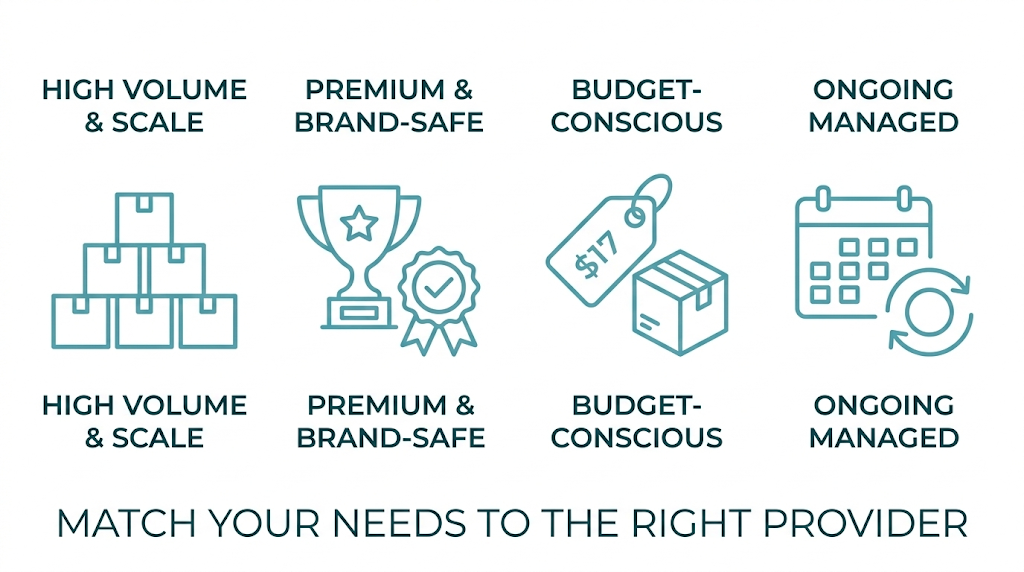
Start with the IQS categories, not the sales page headline. First, check host-site screening. The provider should publish what it rejects and the DA/DR, traffic or indexing floor it uses.
Then check proof. Public examples, placement-level metrics, case studies and reports all reduce blind trust. A provider can be good without showing everything publicly, but the score should reflect what a buyer can verify.
Next, check reputation and durability. Review counts matter because a perfect rating from a tiny profile is not the same as a strong rating from hundreds of customers. Replacement terms matter because even good edits disappear.
Before you order, ask plain questions. Which sites do they reject? What metrics are checked at page level? What happens if the edit drops? If the answer is vague, score that weakness. A good sales page shows you the floors, the reject list and the replacement term before you speak to an account manager. You do not need every internal rule. You do need enough detail to know whether the placement is real, relevant, indexed and backed if it disappears.
Score the weak parts, not only the wins. The best fit is the one whose weak score you can live with.
Read the score as a map of where the offer is thin. A high score does not mean perfect. It means the weak parts are easier to see. A low score does not mean useless. It means you should test small and check hard.
Finally, decide how much control you need. If you need site pre-approval, we offer it on request (contact us first), and Stan Ventures is the obvious comparison point if you want it built into every order. If you need bulk workflow, FatJoe's ordering model is built for that. If you want stricter screening at a flat premium, Stellar SEO has the clearer lane. If you want public examples and can tolerate a younger footprint, LinkPanda is worth a small test.
On our side, the lower Curated Links tiers are the cleaner starting point for small test orders. The curated links service is the direct fit when the IQS criteria point you toward public pricing and written replacement cover. Larger campaigns that need planning across link types can sit inside the managed service.
Frequently asked questions
What are niche edits?
Niche edits are backlinks inserted into existing content on relevant websites. The host page is already published, usually already indexed and already carrying whatever authority it has earned.
The quality depends on the page, not the label. A good niche edit sits in relevant copy on a real site. A poor one sits in an irrelevant article, a link farm or a controlled network.
Are niche edits safe for SEO?
Yes, when the link comes through genuine outreach to an independent site with real traffic and an editor who reads the page. A placement on a network, an irrelevant page, an owned site, or under a repeated commercial anchor is not a niche edit we would deliver.
The IQS system is built around that distinction. Screening, proof, durability and transparency matter because they show you the parts of the purchase that buyers usually cannot see.
How much do niche edits cost?
Published prices in this comparison run from $60 per Rhino Rank link (checked 2026-09-23) to $456 for FatJoe's DR60+ tier (checked 2026-07-08); Stellar SEO publishes $225 per link and LinkPanda sells packages from $4,400 for 10 links, both checked 2026-09-23.
Cost moves with authority, traffic, topical fit, approval control, reporting and replacement terms. A lower price needs to make sense for real outreach. Ours covers the host checks, the placement report and 12-month replacement cover at every tier.
What is the difference between niche edits and guest posts?
Niche edits add your link to an existing page. Guest posts create a new page for the link.
That changes the trade-off. Niche edits can use existing authority and indexing history. Guest posts give you more control over the topic, structure and surrounding copy, but the new URL starts colder.
How many niche edits should you buy per month?
There is no fixed number. The right volume depends on your site's age, authority, content output, existing link profile and the competitiveness of the pages you are pushing.
Start with a small order, audit every placement and scale only when the host-page quality holds up. Watch the patterns more than the volume: same anchors, same site types, same weak relevance and sudden bursts with no content activity around them.
How long do niche edit links last?
They last as long as the host page keeps the edit live. Good providers reduce churn by choosing maintained sites and backing placements with written replacement windows.
Use the written terms, not a generic durability percentage. In this comparison, we publish a 12-month replacement term and a first-order refund up to $550, checked 2026-09-23. Stellar SEO publishes a 6-month replacement window and Stan Ventures a 1-year replacement guarantee on its niche-edit page, both checked 2026-09-23; LinkPanda's niche-edits page published no replacement window when checked on the same date. FatJoe publishes lifetime replacement wording, checked 2026-07-08.
Can niche edits hurt your site?
The placements that fail are the ones our QA rejects: a network, a link farm, an off-topic page or an engineered anchor pattern, whatever the DA/DR number says. Such a placement does nothing for you.
The placement we would ship is screened hard, sits on a relevant indexed page on an independent site, carries a varied anchor and comes with enough reporting to audit the insertion after delivery.
What anchor text should you use for niche edits?
Use a mix of branded anchors, partial-match phrases, naked URLs and natural sentence anchors. Exact-match commercial anchors should be the minority, especially if your site is young or the target page already has aggressive anchors. In Editorial.Link's 2026 survey, partial-match anchors were the top choice for 41.7% of respondents, exact-match for 25.1% and branded anchors for 20.5%; that is what buyers say they prioritise, not the mix inside a live profile.
Good providers push back when every anchor is the same commercial phrase; we do. If a vendor accepts any anchor, at any volume, without comment, that is a quality signal too.
related Blog Posts




Join 7,000+ Clients Growing with Rhino Rank
Sign Up
Keep Reading


Stay ahead of the SEO curve
Get the latest link building strategies, SEO tips and industry insights delivered straight to your inbox.