
 Back to all posts

7 Best Guest Posting Services That Actually Move the Needle
The best guest posting service here is Rhino Rank: it scores 56/65 on our Editorial Value Score because the order includes a finished article, outreach, placement, reporting, replacement cover, and independently checkable reputation.
Choose Stan Ventures if you want domain and draft approval, The HOTH for bundled SEO work, Outreach Monks if built-in pre-approval is the main control, FatJoe for fast blogger outreach, Editorial.Link for premium approvals, and INSERT.LINK for self-serve publisher choice.
How we score guest posting services
Editorial Value Score is scored out of 65. A guest post is a bought editorial product, so what arrives for the fee and proof it works carry the most weight.
Complete deliverable at a published price is worth 12 points. Top scores need the article, stated wordcount, outreach, placement, report, and written guarantee at one published price. Missing pieces, variable publisher fees, or quote-led pricing move the score down.
Proven outcomes is worth 12 points. Named, live, numeric case studies score highest, especially when guest posts are part of the delivery. Unnamed performance claims score low. No public outcome proof scores close to zero.
Independent reputation and track record is worth 12 points. A strong score needs a high-rating, high-count named review platform, a second platform that does not contradict it, and a real operating history. Thin or mixed profiles lose points.
Publisher vetting and screening is worth 11 points. Top scores need named screening standards, such as PBN or expired-domain rejection, plus a numeric floor or domain pre-approval. General quality language is weaker.
Guarantees are worth 9 points. A 12-month or longer replacement term plus a separate money-back term scores highest. One concrete replacement window scores mid. Scoped or missing terms score low.
Tier and pricing transparency is worth 9 points. Published per-placement prices tied to site-quality tiers score highest. Internal pricing conflicts, variable pass-through fees, gated rates, or custom-only terms reduce the score.
Tie-break: if two providers finish level, the complete deliverable score wins because it is closest to the thing a guest post buyer is actually choosing.
Full disclosure: Rhino Rank is our own service. It's included using the same criteria used for every other provider, and we recommend verifying our scoring independently.
Rank | Provider | EVS | Best for |
|---|---|---|---|
1 | Rhino Rank | 56/65 | Agency-ready guest posts |
2 | Stan Ventures | 45/65 | Domain and draft approval |
3 | The HOTH | 41/65 | Bundled SEO programmes |
4 | Outreach Monks | 40/65 | Pre-approved manual outreach |
5 | FatJoe | 40/65 | Fast blogger outreach orders |
6 | Editorial.Link | 39/65 | Premium approved links |
7 | INSERT.LINK | 12/65 | Self-serve publisher choice |
1. Rhino Rank - best for agency-ready guest posts
Rhino Rank's guest posting offer is built around a finished article, not a warm hand-off to a publisher. Per its site, each order includes 750+ words, one contextual dofollow link and a white-label report. That suits agencies that need the placement and report delivered together.
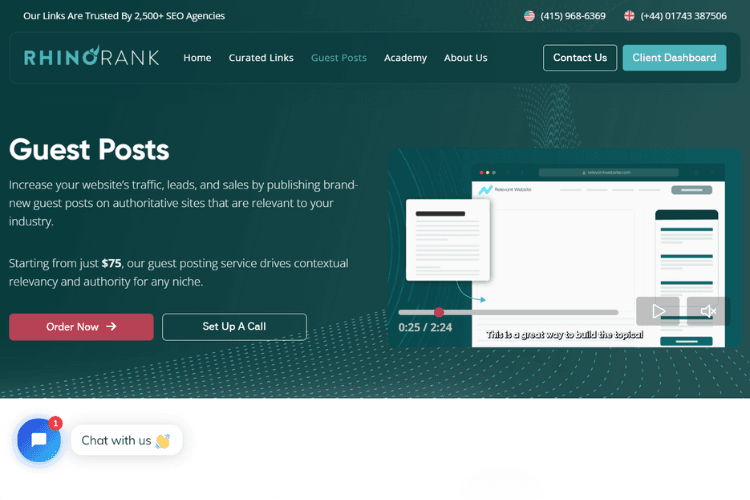
Rhino Rank is the best guest posting service for agencies and in-house teams that want a complete, repeatable order rather than a loose introduction to a publisher.
Each order includes a 750+ word article, outreach, one contextual dofollow backlink in the body copy, a placement report, and a 12-month replacement term. The guest post rates are published by DA tier, and there are no minimum orders on the public page checked 2026-07-08.
Control is available on request. Rhino Rank can pre-approve domains for your guest post orders - contact the team first so it can be facilitated before outreach begins. Otherwise the vetting happens before outreach and the live URL comes after publication, a model that suits teams that care more about finished delivery than selecting every publisher by hand.
Where Rhino Rank scores hardest is the finished product. The public guest posting service page also verifies unbranded CSV reports for white-label delivery, which matters if guest posting is being resold to clients.
On outcomes, the fintech case study shows a guest-post engagement that delivered +374% traffic and +65% revenue, per the live case-study page checked 2026-07-08.
Criterion | Score |
|---|---|
Deliverable | 12/12 |
Outcomes | 11/12 |
Reputation | 10/12 |
Vetting | 6/11 |
Guarantees | 9/9 |
Pricing | 8/9 |
Scored from:
- Vendor-claimed: 750+ words, report, 12-month replacement, checked 2026-07-08.
- Vendor-claimed: $75-$400 DA tiers, checked 2026-07-08.
- Independent: Trustpilot 4.5/5 from 188, checked 2026-07-08.
- Independent: Reviews.io 4.92/5 from 169, checked 2026-07-08.
- Checked 2026-07-08: four named numeric case studies, one guest-post-specific.
- Checked 2026-07-08: no numeric traffic floor; domain pre-approval available on request.
Who should use Rhino Rank: agencies, consultants, and growth teams that need guest posts with clean reporting, long replacement cover, and low operational drag.
Who should not: buyers who want a self-serve approval portal rather than arranging pre-approval with the team first.
2. Stan Ventures - best for domain and draft approval
Stan Ventures adds guest post content to an agency fulfilment model. Its guest-post page records 750+ word content. The wider company pages place guest posts in the same agency menu as niche edits, white-label fulfilment and service plans for partners that need delivery at scale.
Stan Ventures is the strongest fit when approval control matters more than simple checkout terms. Its public guest posting page says buyers approve every domain and article before publication, which is rare in this market.
The page also names useful screens: no PBNs, no expired domains, and traffic floors attached to DA/DR tiers. That combination is why Stan scores high on vetting even though the rate model is not as clean as it first looks.
The catch: the public tier figures are service fees, and the publisher fee is separate. The same page also has an internal rate inconsistency, with table tiers that differ from the FAQ's starting line. Treat the table as the live fee line, but do not read it as the full landed amount.
Its verified outcome evidence is two named numeric case studies, but they are general link-building proof rather than guest-post-specific.
Criterion | Score |
|---|---|
Deliverable | 9/12 |
Outcomes | 6/12 |
Reputation | 8/12 |
Vetting | 11/11 |
Guarantees | 4/9 |
Pricing | 7/9 |
Scored from:
- Vendor-claimed: 750+ words, dofollow links, unbranded report, checked 2026-07-08.
- Vendor-claimed: $37, $67, $247 service tiers, checked 2026-07-08.
- Vendor-claimed: separate publisher fee and $92 FAQ conflict, checked 2026-07-08.
- Independent: Trustpilot 4.8/5 from 84, checked 2026-07-08.
- Independent: Sitejabber/SmartCustomer 3.8/5 from 25, checked 2026-07-08.
- Checked 2026-07-08: two named numeric cases, not guest-post-specific.
Who should use Stan Ventures: buyers who need to review both the publisher and the article before a guest post goes live.
Who should not: teams that need one all-in public rate before they scope a campaign.
3. The HOTH - best for bundled SEO programmes
The HOTH handles guest posting through its Link Outreach and content products, not a guest-post-only shop. Its Link Outreach page records 500 to 2,000 word-count options. Separate HOTH Blogger and content products sit beside it, which suits buyers already using the wider SEO catalogue.
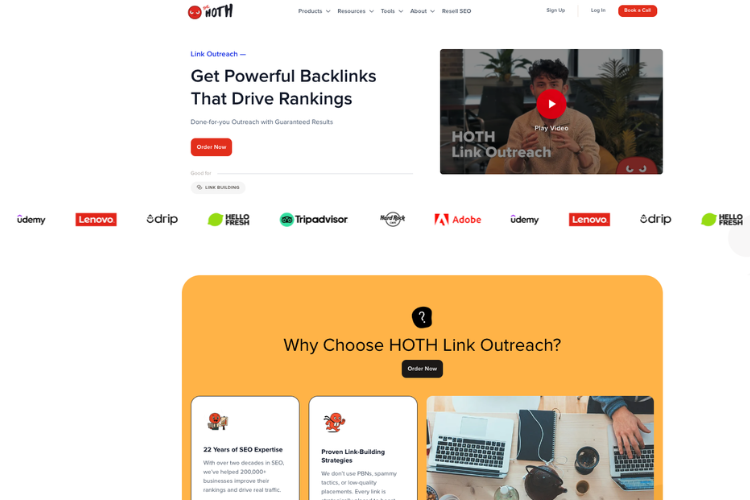
The HOTH makes most sense when guest posting is one part of a wider SEO programme. Its Link Outreach product is a managed service inside a broader platform, not a specialist guest post-only workflow.
The public page checked 2026-07-08 lists DA/DR 20+ to DA/DR 50+ tiers from $175 to $405, with 500-2,000 word-count options. It also says sites are manually contacted, traffic is verified with Semrush, and ordinary broken links are fixed or replaced for 6 months.
The guest posting trade-off is approval and focus. The same page says there is no content approval before posting for this product, and the checked evidence did not show a numeric traffic floor.
Its named outcome proof is general SEO case-study evidence, not guest-post-specific, so the score sits in the bottom half of the mid band.
Criterion | Score |
|---|---|
Deliverable | 10/12 |
Outcomes | 6/12 |
Reputation | 5/12 |
Vetting | 7/11 |
Guarantees | 5/9 |
Pricing | 8/9 |
Scored from:
- Vendor-claimed: $175-$405 DA/DR tiers, checked 2026-07-08.
- Vendor-claimed: 500-2,000 word-count options, checked 2026-07-08.
- Vendor-claimed: about 30 days turnaround, checked 2026-07-08.
- Independent: Trustpilot 4.2/5 from 266, checked 2026-07-08.
- Checked 2026-07-08: no content approval before posting.
- Checked 2026-07-08: two named numeric cases, not guest-post-specific.
Who should use The HOTH: teams already buying SEO work there and wanting guest posts in the same account.
Who should not: buyers who want granular guest post publisher approval and niche-by-niche selection.
4. Outreach Monks - best for pre-approved manual outreach
Outreach Monks gives more public detail on writing than most providers here. Its guest-post page records in-house U.S./UK writers, a 750-word minimum and two editorial rounds. That gives buyers a clearer content layer alongside its homepage reference to 1,400+ vetted authority publishers.

Outreach Monks is a good guest posting service for teams that want managed outreach but still want to see prospective domains before content is placed.
The product page checked 2026-07-08 says one order covers manual outreach, a 750-word article, traffic verification, domain approval, and a 6-month replacement term. That is a fairly complete guest post deliverable.
The weaker side is independent reputation. The public homepage makes a larger review-count claim, but the direct checks found a much smaller Clutch count and a thin Trustpilot profile. That does not make the service unusable. It does cap the reputation score.
Outreach Monks ties FatJoe on total score, then ranks ahead on the complete-deliverable tie-break.
Criterion | Score |
|---|---|
Deliverable | 11/12 |
Outcomes | 1/12 |
Reputation | 4/12 |
Vetting | 10/11 |
Guarantees | 6/9 |
Pricing | 8/9 |
Scored from:
- Vendor-claimed: $99-$399 DR tiers, checked 2026-07-08.
- Vendor-claimed: 750-word article and domain approval, checked 2026-07-08.
- Vendor-claimed: 12,000+ sites screened, checked 2026-07-08.
- Independent: Clutch 4.9/5 from 12, checked 2026-07-08.
- Independent: Trustpilot 4-star profile from 6, checked 2026-07-08.
- Checked 2026-07-08: no named numeric case studies found.
Who should use Outreach Monks: SEO teams that want a managed guest posting workflow but still need a domain-review step.
Who should not: buyers who need review proof at the same depth as the product proof.
5. FatJoe - best for fast blogger outreach orders
FatJoe's editorial setup sits inside its blogger outreach and content-order system. Its brand guide records in-house writers, plain CSV reporting and white-label deliverables. The result is a standardised content-and-placement workflow for repeat agency, freelance and marketing team orders rather than bespoke PR.

FatJoe is the fast, standardised blogger outreach option. Its own product framing calls the service blogger outreach rather than classic named-author guest posting, and that distinction matters.
The product is built for throughput. The page checked 2026-07-08 publishes DR-tier rates from 72 USD to 456 USD, includes writing, gives one anchor and URL, and states a lifetime link guarantee plus a money-back term if an order does not meet its guarantees.
The trade-off is publisher control. There is no pre-approval of blog post placements before they go live, so FatJoe suits buyers who trust the package rules more than buyers who want to inspect every site first.
FatJoe ties Outreach Monks on total score, but loses the complete-deliverable tie-break.
Criterion | Score |
|---|---|
Deliverable | 8/12 |
Outcomes | 1/12 |
Reputation | 9/12 |
Vetting | 5/11 |
Guarantees | 9/9 |
Pricing | 8/9 |
Scored from:
- Vendor-claimed: $72-$456 DR tiers, checked 2026-07-08.
- Vendor-claimed: writing, one anchor, dofollow link, checked 2026-07-08.
- Vendor-claimed: lifetime link guarantee, checked 2026-07-08.
- Independent: Trustpilot 4.8/5 from 455, checked 2026-07-08.
- Checked 2026-07-08: no placement pre-approval.
- Checked 2026-07-08: no named numeric case studies found.
Who should use FatJoe: affiliate, ecommerce, and agency buyers who need fast guest posts or blogger outreach at a clear tiered rate.
Who should not: brands that need publisher approval before content is produced.
6. Editorial.Link - best for premium approved links
Editorial.Link is more approval-led than article-led in public copy. Its pricing page records pre-approval before placement and editorial links on traffic-bearing sites. The checked pages did not state a fixed guest-post wordcount, so the clearest value is publisher selection and link approval.
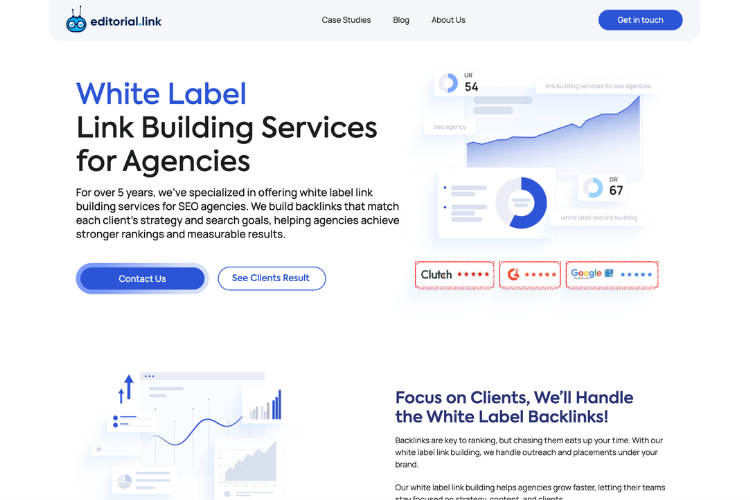
Editorial.Link sits at the premium end of this guest posting list. It is strongest when the buyer wants high-authority editorial links with an approval workflow and a public quality floor.
The checked page lists a base 375 USD backlink, a 1,750 USD five-link Startup package, and a 6,000 USD twenty-link Growth package, all checked 2026-07-08. It also lists average DR50-90 and traffic of 5k+ for the package set. That is a useful floor.
The gap is the guest post itself. Editorial.Link says guest posting is available through bespoke packages, but the checked pages do not publish a fixed wordcount or authorship promise for those placements. That keeps the deliverable score below services with a clearer guest post SKU.
Criterion | Score |
|---|---|
Deliverable | 6/12 |
Outcomes | 1/12 |
Reputation | 8/12 |
Vetting | 10/11 |
Guarantees | 6/9 |
Pricing | 8/9 |
Scored from:
- Vendor-claimed: $375 base backlink, checked 2026-07-08.
- Vendor-claimed: $1,750 and $6,000 packages, checked 2026-07-08.
- Vendor-claimed: DR50-90 and traffic 5k+, checked 2026-07-08.
- Independent: Clutch 5.0/5 from 80, checked 2026-07-08.
- Checked 2026-07-08: no fixed guest-post wordcount found.
- Checked 2026-07-08: no named numeric case studies found.
Who should use Editorial.Link: SaaS and B2B teams that want approved premium links and can live with bespoke guest post packaging.
Who should not: buyers who need a clearly itemised guest post article, wordcount, and authorship standard.
7. INSERT.LINK - best for self-serve publisher choice
INSERT.LINK is a marketplace, so editorial control sits mainly with the buyer. Its site covers guest posts, link insertions, site and page review before payment, and management tools. Fixed writer or wordcount details were not publicly stated on the checked pages.
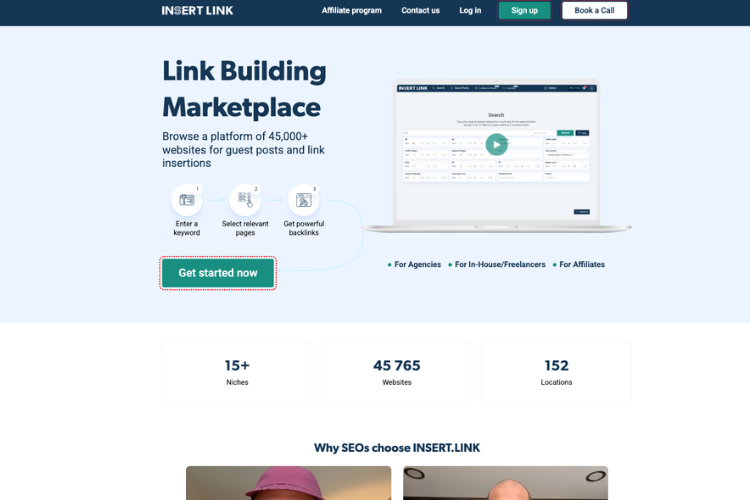
INSERT.LINK is not a managed guest posting service in the same way as the others. It is a self-serve marketplace where experienced buyers can browse websites, inspect visible metrics, and choose placements directly.
That makes the service useful in a narrow lane. The homepage checked 2026-07-08 says users can browse 45,000+ websites for guest posts and link insertions, filter by country, language, and page keywords, and view DR, referring domains, keywords, and traffic.
The reason it scores low is simple: pages checked 2026-07-08 did not verify a public starting rate, a written replacement guarantee, or a managed vetting layer. Rate paths checked the same day returned page-not-found responses, so a low starting rate should not be printed without account-level proof.
Criterion | Score |
|---|---|
Deliverable | 3/12 |
Outcomes | 0/12 |
Reputation | 4/12 |
Vetting | 3/11 |
Guarantees | 0/9 |
Pricing | 2/9 |
Scored from:
- Vendor-claimed: 45,000+ websites, checked 2026-07-08.
- Vendor-claimed: DR, RD, keywords, traffic visible, checked 2026-07-08.
- Independent: G2 4.8/5 from 10, checked 2026-07-08.
- Checked 2026-07-08: no public starting rate found.
- Checked 2026-07-08: no written replacement guarantee found.
- Checked 2026-07-08: no managed vetting layer found.
Who should use INSERT.LINK: experienced SEOs who can vet guest post publishers without a managed service between them and the marketplace.
Who should not: first-time guest post buyers or agencies that need a finished editorial deliverable.
What separates a good guest posting service from a risky one
Publisher vetting: the useful metric is not DR
DR and DA are easy to sell because they compress a site into one number. They are also easy to misread. A guest post on a high-DR domain with no search visibility can be weaker than a lower-DR placement on a site that still earns organic traffic.
When a vetting queue is worked properly, the pass/fail is more than the DA number. We look at traffic history, topical fit, outbound links, author pages, and whether the site publishes for readers or accepts commercial posts.
This is where many guest posting services get risky. They sell the authority metric, then place the link on a site where the metric no longer matches the audience. In practice, you want the traffic trend, the page context, and the rejection rules behind the vendor's publisher list.
Anchor text: where buyers create their own footprint
Guest posts can go wrong even when the publisher is fine. The usual cause is repeated exact-match anchor text across too many placements.
When anchors are planned well, the queue does not read like several versions of the same money keyword. Mix branded anchors, partial matches, plain URLs, and natural phrases. The anchor should look like it belongs in the article, not like it was pasted from a keyword spreadsheet.
If your backlink profile is young, push even harder towards branded and partial-match anchors. Aggressive anchors may feel efficient, but they make the pattern easier to read.
The PBN warning
PBN risk is not always obvious from a delivery report. Some networks use real-looking themes, author boxes, and thin news categories to make guest post inventory look editorial.
Check the publisher sites after delivery. Look for repeated templates, identical author pages, sudden traffic drops, irrelevant outbound links, and a high share of commercial guest posts. One weak site is a mistake. Several sites with the same footprint is a system.
This is also why replacement terms matter. If a guest post gets removed or the site changes hands, you need a written path to a replacement rather than a polite support thread.
Guest posting services compared by use case
Agencies
Agencies need clean fulfilment, predictable reporting, and a way to explain the placement without exposing internal vendor operations. Rhino Rank fits that job because the guest post, report, and replacement term are packaged together.
Outreach Monks is the better fit when the client insists on pre-approval built into every order; Rhino Rank can pre-approve domains on request if you contact the team first. Stan Ventures is also worth comparing when the article approval step matters.
SMBs and SaaS teams
SMBs usually need fewer guest posts, more clarity, and less process. The mistake is buying the cheapest visible placement and hoping the publisher is real.
For a first campaign, choose a service with a clear deliverable report and a written replacement term. If the page needs faster support from an already-ranking article, Curated links may sit alongside guest posting rather than replace it.
Affiliate and niche-site buyers
Affiliate buyers tend to care about unit fee, volume, and speed. FatJoe can fit that workflow because its blogger outreach product is packaged for fast orders and clear DR tiers.
INSERT.LINK is only suitable if you can audit publishers yourself. It gives control, but it also moves quality control onto your desk.
How to choose a guest posting service
Use the EVS criteria as a buying checklist.
First, define the deliverable. A guest post order should say who writes the article, where the link sits, what report you receive, and what happens if the link disappears.
Second, separate outcomes from sales copy. Named case studies are stronger than client logos, and review platforms with visible counts are stronger than a homepage badge alone.
Third, inspect vetting. A good guest posting service should tell you what it rejects. PBNs, expired domains, link farms, traffic manipulation, and thin editorial sites should not be vague internal concerns.
Fourth, read the guarantee before you buy. A replacement term and a money-back term are not the same thing. Some guarantees only apply while a plan is active.
Finally, judge the fee by the site standard it buys. A cheap guest post with no traffic proof is not automatically a bargain. A high fee with no wordcount, approval path, or replacement term is not automatically premium.
Guest posting vs other link building routes
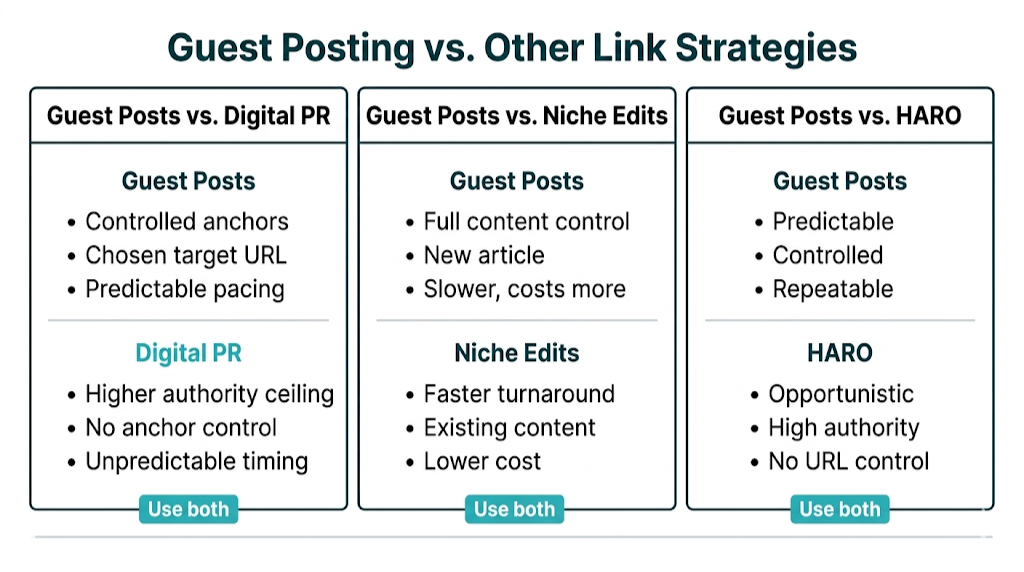
Guest posting gives you a new article, a chosen target URL, and planned anchor text. That control is the point. Digital PR can earn stronger publications, but you usually give up anchor and timing control.
Niche edits are different again. They add your link to existing content that may already rank, so they can move faster than a new guest post. The trade-off is less control over the surrounding article.
Most campaigns do not need one tactic forever. A sensible link plan uses guest posts for topical article placements, niche edits for speed, and digital PR when the story is strong enough to earn coverage. For broader vendor comparisons, see our guide to link building.
How to judge whether guest posts are working
Guest posts rarely move a page overnight. Track the live URL, indexation, target-page impressions, rankings, and organic traffic over weeks rather than days.
The report should include the placement URL, anchor, target URL, dofollow status, publisher metric at placement, and any traffic proof the vendor provides. Without that, you cannot audit what was bought.
One guest post is a signal. A planned campaign is stronger because Link building is a compounding investment. The goal is not a spike from one placement; it is a cleaner authority profile that helps the target page compete over time.
Frequently asked questions
What do guest posting services charge?
The checked public rates in this roster run from Rhino Rank's 75 USD DA10+ tier to Editorial.Link's 375 USD base backlink and The HOTH's 405 USD DA/DR50+ tier, all checked 2026-07-08. FatJoe's checked table runs from 72 USD to 456 USD.
Those figures are not a full market rate guide. The safer buying rule is to match the fee to the deliverable: article, publisher standard, reporting, approval, and guarantee.
Are guest posting services safe?
They can be, if the publisher is real and the anchor strategy is sensible. The risk sits in weak publisher vetting, over-optimised anchors, and services that treat guest posting as inventory rather than editorial placement.
Ask what the service rejects. Then check a sample of delivered publishers yourself. A written guarantee helps, but it does not fix a poor publisher list.
What is the difference between guest posting and blogger outreach?
Guest posting names the deliverable: a new article with your backlink inside it. Blogger outreach names the acquisition process: finding sites, pitching, and arranging the placement.
In practice, many vendors use both terms. FatJoe calls its product blogger outreach, while others call a similar result guest posting. Judge both by the same questions: publisher quality, article standard, reporting, and replacement terms.
Should I choose a marketplace or a managed guest posting service?
Choose a marketplace only if you can read publisher metrics and spot bad inventory. Marketplaces can be useful for experienced buyers because they show site-level options before purchase.
Choose a managed guest posting service if you need the article, outreach, placement, and reporting handled together. That usually charges more, but it removes selection work from your team.
Can guest posting services help with local SEO?
Yes, but local relevance matters more than a generic authority score. A regional publisher, trade site, or local business publication can be more useful than a national site with no local context.
For local campaigns, guest posts should sit beside citation building, local PR, and locally relevant content. Do not expect a broad guest posting campaign to fix map-pack visibility on its own.
What should a guest post report include?
At minimum, expect the live URL, target URL, anchor text, dofollow confirmation, publisher authority metric, and publication date.
A stronger report adds publisher traffic proof, indexation status, and a short campaign summary. Agencies should also check whether the report can be sent to clients without reformatting.
Do guest posts still work after AI-era updates?
Guest posts on real publications still work because they place your brand inside relevant editorial content. Guest posts on thin sites built to sell links are far weaker.
The difference is not cosmetic. Real publishers have traffic, topical focus, editorial history, and normal outbound-link patterns. Risky publishers have inflated metrics, thin content, and a long list of commercial anchors.
How many guest posts do I need?
There is no fixed number that applies across niches. The useful answer depends on your current authority, the page you are supporting, and the competition around the query.
Start with a pace you can audit. A smaller batch of guest posts from cleaner publishers is easier to learn from than a large order where half the placements need explaining later.
Final verdict
Rhino Rank is the top-scoring guest posting service here because it has the clearest finished deliverable, the longest combined guarantee position, published rates, and strong independent reputation. Domain pre-approval is available on request rather than by default, so contact the team first if you need it.
Stan Ventures is the control-led alternative. The HOTH fits broader SEO programmes. Outreach Monks is strong for pre-approved manual outreach. FatJoe is the speed-led blogger outreach option. Editorial.Link suits premium approved links. INSERT.LINK is for experienced self-serve buyers.
If you want a complete article, placement, report, and replacement term, review our guest posting service or book a call to map the campaign.
related Blog Posts




Join 7,000+ Clients Growing with Rhino Rank
Sign Up



Stay ahead of the SEO curve
Get the latest link building strategies, SEO tips and industry insights delivered straight to your inbox.