
 Back to all posts

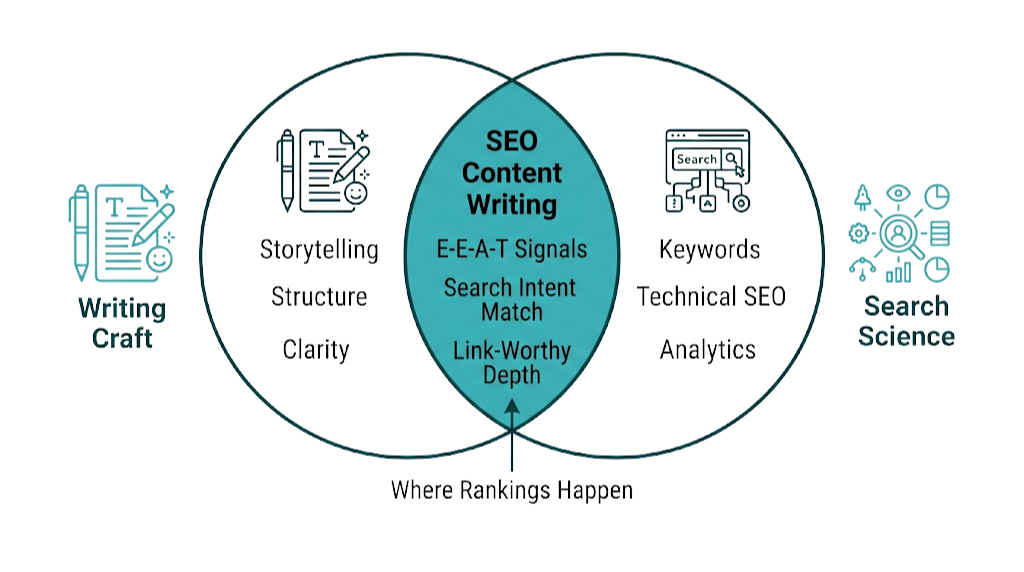
SEO content writing sits at the intersection of two disciplines most marketers keep in separate lanes: the craft of writing and the science of search. Most professionals learn one or the other. The pages that rank well do both, and they do it with repeatable process.
The issue is course design. A lot of SEO content writing courses teach keyword placement, meta descriptions, and content structure as if those elements decide rankings on their own. They don't. Google's own Helpful Content documentation spells out the standard - content needs first-hand expertise, clear intent match, and value that goes past what's already indexed. Most curriculums aim lower.
The bottom line: The best SEO content writing courses in 2026 go beyond keyword density and teach writers to produce content that earns authority - through E-E-A-T signals, search intent alignment, and link-worthy depth. This guide evaluates ten courses against Google's own published standards, identifies curriculum gaps competitors ignore, and explains why great content writing is only half the ranking equation. The other half is link building - and we cover that too.
This isn't a listicle built from affiliate commissions or course popularity scores. Every course in this guide has been evaluated against a transparent methodology grounded in Google's Quality Rater Guidelines and Semrush's 2024 State of Content Marketing data. Whether you're an SEO manager upskilling a content team, an agency owner building internal capability, or a freelancer looking to justify higher rates, this guide gives you the comparative analysis you need to make a defensible decision.
What Is SEO Content Writing (And Why Most Courses Teach It Wrong)
SEO content writing is the practice of producing written content that satisfies both search engine ranking signals and real human information needs. That double requirement is where most courses miss. They teach the mechanics - keyword research, title tag optimization, internal linking, content length targets - without teaching the why behind them, or the conditions under which Google rewards one page over another.
Google's Quality Rater Guidelines run 170 pages and guide human evaluators who assess search quality. The guidelines put E-E-A-T - Experience, Expertise, Authoritativeness, and Trustworthiness - at the centre of what counts as high-quality content. Experience, added to the original E-A-T framework in 2022, rewards content written by people with first-hand knowledge. A travel article written by someone who visited the destination tends to beat one produced by a generalist working from secondary sources. Most SEO content writing courses gloss over that difference. They train writers to hit keywords, not to prove lived expertise. Understanding what makes a good backlink profile is equally important, because authority signals from external sites work alongside on-page quality to determine where a page lands in the results.
The second failure is structural.
Most courses treat SEO content writing as a standalone discipline: write the piece, publish it, watch it rank. But Ahrefs' study of over one billion pages found that 66.31% of pages have zero backlinks. Zero. So most published content - no matter how clean the on-page work looks - never picks up the external authority signals Google uses to sort winners from the pack. Content quality gets you into the index. Link equity decides how far you climb.
That link equity gap matters when choosing an SEO content writing course. A course that teaches you to write technically correct, well-structured content has real value. A course that trains you to write content that earns links, gets cited, and builds topical authority changes outcomes. The gap between those two results is big - and it's the gap this guide helps you close.
How We Evaluated and Ranked These SEO Content Writing Courses
Competitor course roundups rank based on popularity, enrollment numbers, or undisclosed affiliate arrangements. We don't. Every course in this guide was evaluated against five criteria, each grounded in Google's published guidelines or documented industry data.
Evaluation Criterion | Weight | What We Looked For |
|---|---|---|
Curriculum depth and accuracy | 30% | Alignment with Google's Helpful Content system and E-E-A-T principles |
Instructor credibility | 20% | Demonstrable industry experience, not just platform authority |
Practical application | 25% | Real exercises, tool integration, and publishable outputs |
Price-to-value ratio | 15% | Cost relative to curriculum depth and certification value |
Link-building awareness | 10% | Whether the course acknowledges content's role in earning backlinks |
The link-building awareness criterion is unique to our methodology. No competitor review includes it. The Ahrefs data shows two-thirds of published content earns no backlinks, so a course that ignores that outcome teaches an incomplete strategy. We weighted it at 10% - enough to separate courses, not so heavy that strong writing instruction gets punished for a narrower scope.
We also considered accessibility: whether the course is available as an seo content writing course online, whether it offers a certificate, and whether it suits different experience levels. Courses are ranked in approximate order of overall score, with ties broken by practical applicability.
The 10 Best SEO Content Writing Courses in 2026, Ranked
The ten courses below span free and paid options, beginner and advanced levels, and platform-based and accredited formats. There is no single best SEO content writing course for everyone - the right choice depends on your current skill level, budget, and whether you need a recognized certificate for professional purposes.
Below is the most detailed comparative analysis of SEO content writing courses currently published. Each entry breaks down curriculum scope, instructor credibility, price, certificate status, and our straight take on where the course delivers and where it doesn't.
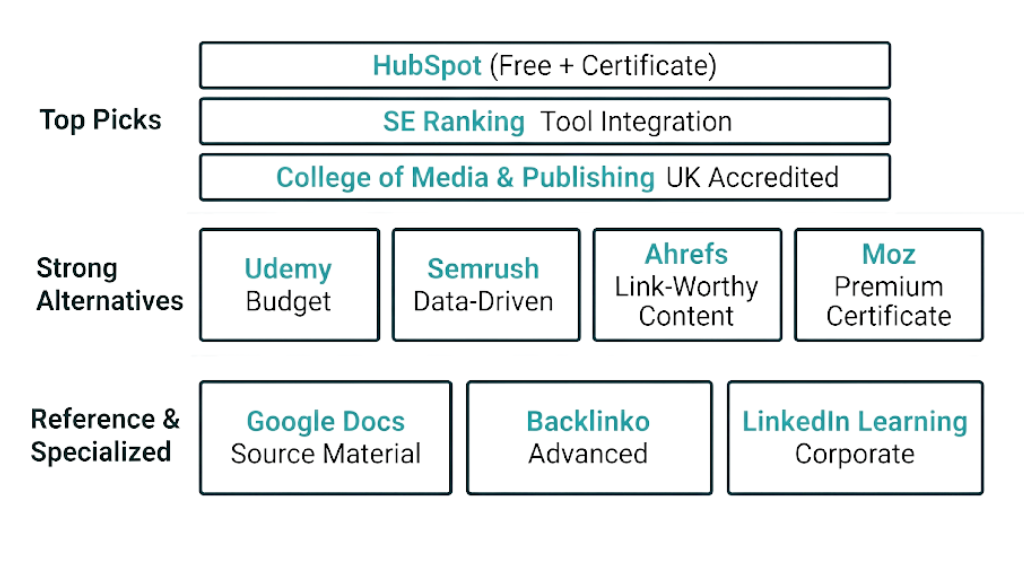
1. HubSpot SEO Training Certification (Best Free Course for Beginners)
Price: Free | Certificate: Yes | Level: Beginner-Intermediate | Format: Video lessons + quizzes
HubSpot Academy's SEO Training Certification is the best free entry point into SEO content writing available in 2026. It covers SEO basics, on-page optimization, keyword research, link building fundamentals, and rich results - more ground than most paid beginner courses. The format is simple: video lessons, embedded test questions, then a shareable certificate once you're through.
That certificate matters because the instructors are the real deal. They're pulled from HubSpot's SEO and content teams, so the material reads like practitioner training, not classroom theory. The link building module stands out for a free course. It frames backlinks as the output of good content and strategy, which a lot of free "SEO 101" training ignores.
Depth is where it comes up short.
Keyword research stays at the basics. It doesn't get into search intent taxonomy, topical authority mapping, or content cluster strategy - all table stakes for mid-market and enterprise teams. The E-E-A-T section stays high level, so you won't walk away with a repeatable editorial or review process. For freelancers or junior writers, this course nails the foundation. For SEO managers training a team, it's a baseline, not the full program.
Best for: Freelancers, junior content writers, and marketing generalists who need a free, certified introduction to SEO content writing. The certificate has decent industry recognition and is worth finishing before moving to a more advanced paid course.
2. SE Ranking Content SEO Course (Best for Practical SEO Tool Integration)
Price: Free with SE Ranking account | Certificate: Yes | Level: Intermediate | Format: Video lessons + practical exercises
The SE Ranking Content SEO course is built around applying content SEO inside SE Ranking's platform. That platform focus is the point - and the tradeoff. The curriculum covers content planning, search intent analysis, on-page SEO, content optimization workflows, and performance tracking. Because it ties directly into SE Ranking's Content Editor, learners do the work in a live SEO environment instead of a sandbox.
That "live environment" approach carries through the whole course. The instructor clearly understands content SEO at scale, and the structure follows workflows instead of textbook definitions. That makes it easier to take what you learn and use it on Monday. The test questions also pull their weight. They check understanding, not just memory, so the certificate means something.
Platform dependency is the limiter.
If you don't use SE Ranking - or you have no plan to - parts of the tool-specific training won't translate. E-E-A-T doesn't get real depth, and link building barely shows up. But if SE Ranking is in your stack (or you're deciding whether it should be), this course gives real hands-on reps. Free access, a certificate, and practical exercises is a strong combo for intermediate teams. Pairing this training with a solid understanding of creating effective SEO content will help you get the most from the platform's optimization features.
Best for: SEO professionals and content managers who work with or are evaluating SE Ranking as their primary SEO platform.
3. College of Media and Publishing SEO Content Writing Course (Best Accredited UK Option)
Price: £197-£297 (varies by tier) | Certificate: Yes - accredited | Level: Beginner-Intermediate | Format: Self-paced online modules
The College of Media and Publishing's SEO Content Writing Course is the only course on this list with formal UK accreditation. That makes it the best pick for writers who need a recognized qualification for hiring processes or for freelance proof points. The curriculum covers SEO basics, keyword research, content structure, writing for search intent, and on-page optimization - delivered through self-paced modules with tutor support.
Accreditation matters in a narrow set of situations, but in those situations it matters a lot. UK in-house content roles still screen for formal training, and plenty of procurement-minded clients want something they can verify, not a platform badge. A certificate from an established training provider carries more weight than most completion certificates. The College of Media and Publishing has a long history in professional media training, and the tone of the material follows suit - built for working writers, not classroom learners.
Don't expect deep coverage of technical SEO or link building strategy. The price also lands higher than free options. But if the goal is a credible, certifiable qualification (not just "I watched a course"), it earns its place. The course is also available as an seo content writing course online, so it works for UK and international learners.
Best for: UK-based writers, career changers, and freelancers who need an accredited certificate to support job applications or client pitches.
4. Udemy Complete SEO Content Writing Course (Best Budget Self-Paced Option)
Price: £12-£20 (frequent Udemy sales) | Certificate: Yes - completion | Level: Beginner | Format: Video lectures + downloadable resources
Udemy's Complete SEO Content Writing Course covers the basics well, and the low price removes the usual "do we have budget?" discussion. It includes keyword research, content types, writing for different formats, and on-page SEO - plus a dedicated module on using ChatGPT for SEO content writing. That AI module matches how content teams work now, and it feels more current than a lot of higher-priced intros.
The course runs across nine modules and totals around two and a half hours. That's short next to longer programs, but it's a fit for the beginner audience it targets. The downloadable resources help, too. Udemy's completion certificate isn't accredited and won't move the needle on most hiring decisions, but it does document training for internal development and personal tracking.
Depth is the tradeoff. Keyword research stays at the surface, content strategy isn't covered, and E-E-A-T doesn't show up. For beginners who want a fast, cheap orientation before paying for something heavier, it does the job. For anyone who already knows the basics, it won't add much. If you're already thinking about how to use ChatGPT for SEO beyond what this module covers, there are deeper resources worth exploring once you've finished the fundamentals.
Best for: Absolute beginners who want an affordable, self-paced introduction to SEO content writing without committing to a higher-cost course upfront.
5. Semrush SEO Writing Masterclass (Best for Data-Driven Content Strategy)
Price: Free with Semrush account | Certificate: Yes | Level: Intermediate | Format: Video lessons + tool integration
Semrush's SEO Writing Masterclass follows the company's data-first approach to content marketing. It ties writing decisions to keyword data, competitive research, and performance metrics - which is rare in writing courses, where "SEO" often stops at a checklist. It treats content as a business system, not a creative exercise. That framing lines up with Semrush's 2024 State of Content Marketing research, which shows that top-performing content teams prioritize data-driven strategy, and it helps the course land as more than product training.
The SEO Writing Assistant integration is the main draw. Learners optimize real content using Semrush's live tool, which scores readability, SEO, originality, and tone of voice at the same time. That feedback loop speeds up improvement in a way video-only lessons don't.
This is a better fit for intermediate writers who already understand keyword basics and want a repeatable process for planning and producing content. Beginners who still need foundational writing guidance won't get much hand-holding here. And like any tool-native course, it hits harder if you're already using Semrush week to week.
Best for: Content strategists and SEO managers who want to connect writing quality to measurable content performance data.
6. Ahrefs Academy: Blogging for Business (Best for Link-Worthy Content Creation)
Price: Free | Certificate: No | Level: Intermediate-Advanced | Format: Video lessons
Ahrefs Academy's Blogging for Business course is the closest thing on this list to training that spells out the link-earning gap. Tim Soulo, Ahrefs' Chief Marketing Officer, walks through content strategy, keyword research, content promotion, and - most importantly - what makes content pick up backlinks without forcing it. Ahrefs' own research shows 66.31% of pages earn zero backlinks. Learning from the same team that published that data (and then shows you how to avoid the outcome) is a real differentiator.
Compounding traffic is the through-line. The curriculum pushes you to build a blog that keeps stacking organic growth over time, instead of chasing one-off posts that pop and drop. Content promotion is where it shines. Outreach strategy, content amplification, and link acquisition show up as part of the writing workflow, not as separate "link building" homework. That framing is what most SEO writing courses skip, and it shows. Writers who complete this course and want to go further will find that content marketing for link building is a natural next step for turning strong assets into sustained authority.
No certificate is the trade-off. If you need a credential for HR or procurement, this won't help. If you're already in SEO and you care more about how things work than what you can put on LinkedIn, it's one of the sharpest free resources out there. The video production quality is high, too.
Best for: Intermediate to advanced SEO professionals who want to understand how content strategy connects to link acquisition and long-term organic authority.
7. Moz SEO Essentials Certificate (Best for Building Foundational SEO Authority)
Price: $595 | Certificate: Yes | Level: Beginner-Intermediate | Format: Video lessons + test questions
Moz's SEO Essentials Certificate is a paid option for teams that want a structured, full intro to SEO, with content writing treated as part of the system. It covers keyword research, on-page optimization, technical SEO, link building, and reporting - so writers get the context that pure "SEO copywriting" programs tend to leave out.
That Moz logo still carries weight in SEO hiring. And the certificate reflects that. For in-house marketers and agency candidates who need a credential that signals baseline SEO competence, this one lands better than most course-platform badges.
The cost is the friction point. At $595, it's the priciest course on this list. But if your role has training budget, or you're using it as a career step, the ROI is straightforward: you get a clean learning path, testing, and a certificate people recognize.
Best for: Marketing professionals who want a premium, recognized SEO certificate with content writing as a core component, and who have the budget to invest in it.
8. Google's SEO Starter Guide & Search Central Documentation (Best Free Reference Resource)
Price: Free | Certificate: No | Level: All levels | Format: Written documentation
Google's SEO documentation isn't a course. It's the source. Helpful Content documentation, Search Central guidance, and the Quality Rater Guidelines lay out what Google's systems reward - so you're working from published standards, not someone else's take.
For SEO content writers, the Helpful Content guidance is required reading. It defines "people-first content" in practical terms, spells out how Google evaluates content quality signals, and calls out the types of pages the Helpful Content system targets. No third-party course explains this better, because nobody else owns the definition.
Treat this as the reference layer next to any structured program. It's not a standalone learning path, but it keeps your playbook anchored to what Google actually says. Combining this documentation with a thorough technical SEO checklist ensures your content is built on a structurally sound foundation before you focus on authority and links.
Best for: All levels - essential supplementary reading that grounds course knowledge in Google's actual published standards.
9. Backlinko SEO Training (Best for Advanced Content Strategy and Link Building Context)
Price: Free (with Backlinko newsletter) | Certificate: No | Level: Advanced | Format: Written guides + video content
Brian Dean's Backlinko content - now part of Semrush - still holds up for advanced SEO writing and strategy. The Skyscraper Technique, the content upgrade framework, and the guides on search intent and content structure come with real examples and results, not theory.
Backlinko isn't a course in the formal sense, but the free library goes deeper than plenty of paid programs. The content focuses on earning links through real differentiation - not keyword stuffing or thin on-page tweaks - which matches the link-building-aware content approach this guide is pushing.
No certificate, and no linear curriculum. That's the limitation. But if you're already past the basics and you want tighter thinking around link-earning content frameworks, it's one of the best free resources to work through.
Best for: Advanced SEO professionals and content strategists who want to develop link-earning content frameworks beyond basic optimization.
10. LinkedIn Learning SEO Foundations (Best for Corporate and In-House Teams)
Price: Included with LinkedIn Premium (~£29.99/month) | Certificate: Yes | Level: Beginner | Format: Video lessons
LinkedIn Learning's SEO Foundations course fits corporate and in-house marketing teams that already pay for LinkedIn Premium. The certificate also drops straight onto LinkedIn profiles, which gives it real visibility for client-facing staff and anyone in a hiring cycle.
The content covers the basics well, but it doesn't go deep on any one topic. That's the point. It's built for marketing generalists who need usable SEO knowledge, not specialists chasing advanced skills. And for in-house teams trying to get multiple people to the same baseline, it's a low-friction option that uses a subscription you already have.
Best for: In-house marketing teams at organizations with LinkedIn Premium subscriptions who need a quick, certifiable SEO foundation for non-specialist team members.
Free vs. Paid SEO Content Writing Courses: Which Is Worth Your Money?
The honest answer is that the best free SEO content writing courses outperform the worst paid ones. HubSpot's free certification covers more ground than several courses that charge £200 or more. Ahrefs Academy's Blogging for Business course is more strategically sophisticated than most paid alternatives. Price just isn't a reliable proxy for quality.
Paid courses still earn their keep in the right setup. The setup is the key. Use this framework to decide.
Pay for a course when:
- You need an accredited or formally recognized certificate for employment or client credibility purposes - the College of Media and Publishing course is the clearest example
- Live tutor support matters. Same for feedback on your writing or direct access to instructors - free courses rarely offer any of that
- The depth clearly goes beyond the free options at your current level
- Your organization will fund it, so the personal cost is zero
Stick with free courses when:
- You're building foundational knowledge before committing to a paid option
- You need a certificate quickly, and the HubSpot or SE Ranking credentials do the job
- You're an experienced SEO professional filling specific knowledge gaps, not looking for a full curriculum
- Budget is a real constraint, and the free options match your learning goals
One critical point: an seo content writing course free with certificate - specifically HubSpot's SEO Training Certification - delivers enough value for most beginner and intermediate learners that the free tier is sufficient. Don't pay for a course just because paying feels more serious. Pay only when the course gives you something the free options can't.
The "something" usually comes down to cost vs. output. For a mid-market agency spending £3,000 per month on content production, investing £300-£600 in a paid course for a senior content writer makes sense if it lifts quality and cuts revision cycles. For a solo freelancer starting out, free options are the right place to begin. If you're also weighing up the broader link building cost alongside training investment, it's worth mapping both into your overall SEO budget from the start.
The 5 Skills Every SEO Content Writing Course Should Teach (But Many Don't)
Semrush's 2024 State of Content Marketing report points to a gap between what content teams publish and what drives organic performance. Teams producing content without a documented strategy keep underperforming teams with structured workflows - yet most SEO content writing courses focus on writing mechanics and skip the process that makes content rank. That process shows up as five skills that separate useful courses from surface-level ones.
1. Search Intent Taxonomy and Intent Matching
Most courses teach keyword research. Far fewer teach intent matching, and that's where rankings get won or lost. A page targeting "best project management software" has commercial investigation intent - it needs comparisons, proof points, and decision support. A page targeting "how to set up a Kanban board" has informational intent - it needs instruction, not a sales pitch. Write a strong draft for the wrong intent and it won't rank. Good courses train writers to identify the dominant intent behind a keyword and build the page to match it. Search Engine Journal's guide to search intent and content optimization explains how aligning content type to query intent directly affects ranking potential.
2. E-E-A-T Signal Integration
Google's Quality Rater Guidelines define E-E-A-T as a core quality signal, and the Helpful Content system rewards content that shows first-hand experience. Plenty of courses treat E-E-A-T like a brand concept instead of a writing checklist. In practice, E-E-A-T means citing specific sources rather than vague references, attributing content to named authors with real credentials, including original data or first-hand observations, and structuring content so expertise shows up in the first paragraph. These are learnable habits. Courses that teach them produce writers who can show authority, not just claim it.
3. Topical Authority and Content Cluster Architecture
A single well-optimized article rarely beats a site with deep topical coverage. Google's systems reward sites that show broad expertise across a subject area, not just on individual pages. Content cluster strategy - building a network of interlinked content around a central pillar topic - is the structure behind topical authority. Writers who get this ship content that fits a larger plan instead of isolated pieces.
That larger plan gets missed in training. Very few beginner courses cover clusters at all, and plenty of intermediate courses only skim the topic. Understanding topical maps in SEO gives writers the structural framework to plan content that builds authority systematically rather than page by page.
4. Writing for Link Acquisition
This is where the Ahrefs data bites. If 66.31% of pages earn zero backlinks, the difference usually comes down to three things - original data, a definitive reference resource, or a genuinely differentiated perspective. Courses that teach writers to build link-earning assets - through original research, data aggregation, unique frameworks, or expert interviews - give learners a skill that compounds. Most courses ignore it.
5. Content Performance Analysis and Iteration
Publishing isn't the finish line. It's the start. High-performing content teams track organic impressions, click-through rates, average position, and engagement metrics - then use the data to update, expand, or restructure content that lags. Semrush's research flags iteration as a major divider between strong teams and average ones. Courses that teach this treat content like an asset that keeps paying back, not a deliverable you file and forget. The Moz blog's breakdown of on-page SEO factors covers how iterative optimization of existing content consistently outperforms publishing new pages without revisiting old ones.
How SEO Content Writing and Link Building Work Together to Drive Rankings
Great content writing is necessary for SEO success. It isn't sufficient. This is the most important strategic distinction in this entire guide, and it's the one most SEO content writing courses - and most course reviews - gloss over.
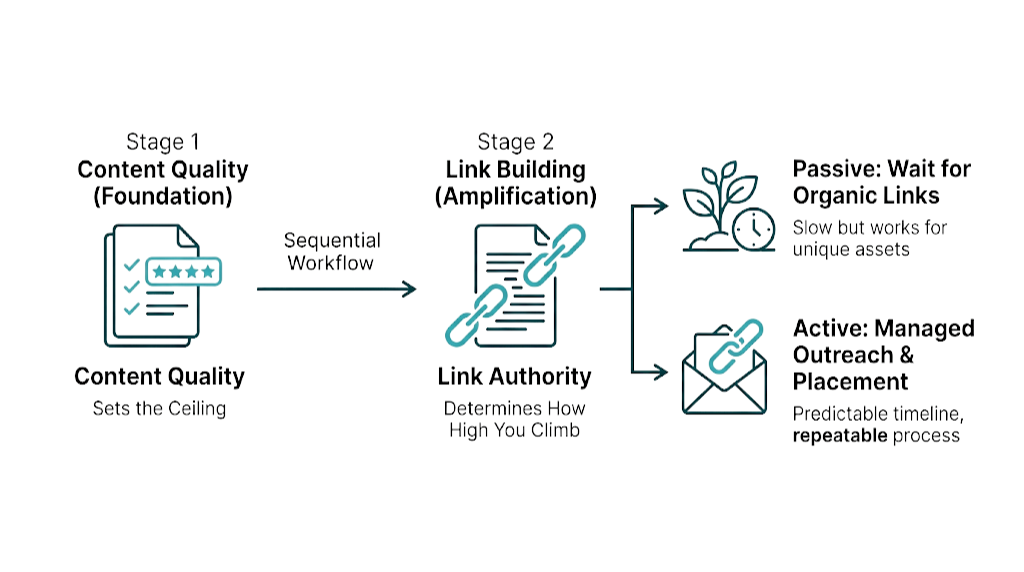
Google's ranking algorithm uses hundreds of signals, but two dominate once you're fighting for competitive keywords: content quality and link authority. Content quality decides whether a page deserves to rank. Link authority decides whether it gets to. Those signals don't substitute for each other. A technically sound piece of content on a domain with no backlinks loses to a competent piece of content on a domain with strong link equity. Every time.
That's why the Ahrefs finding matters. The 66.31% of pages with zero backlinks aren't all badly written. Plenty are technically competent, well-structured, and keyword-optimized. They don't rank because they never pick up the external authority signals Google uses to sort winners from everyone else in the same SERP. Writing better content won't fix that gap. Link building will.
That gap drives the real takeaway for anyone finishing an SEO content writing course: the skills you learn set the quality of the raw material. What you do with that raw material - specifically, whether you build a link acquisition strategy around it - determines the ranking outcome.
Link acquisition around quality content usually falls into two lanes. Passive link earning means publishing content that's worth citing - original research, long-form guides, unique data sets - then waiting for organic links. It works. It just moves slowly, and it only pays off when the asset is genuinely different. Active link building pairs strong content with a defined outreach or placement plan, so you pick up relevant, authoritative backlinks on a timeline you can manage.
At Rhino Rank, we focus on the second lane. Our curated links service places your content on relevant, authoritative pages that already exist and rank - so your target URL gets the link equity it needs to compete. Our guest posts service publishes new content on relevant sites that links back to your target pages. Both services work with quality content; they don't prop up weak pages. The content writing skills you build from the courses in this guide are the foundation. The link building strategy turns that foundation into rankings.
That foundation still needs a system behind it. An agency content team can complete the Ahrefs Academy course and ship content that's worth linking to, but without a repeatable acquisition process, the upside stays theoretical. Content and links aren't competing tactics. They're sequential steps in the same workflow. Content quality raises the ceiling. Link building decides how close you get.
For SEO managers building a complete content strategy, the decision isn't content quality versus link building. The job is building a workflow that produces content worth citing, then running a sustained acquisition program that earns the links it should. That workflow starts with the skills covered in the best courses on this list and continues through deliberate link acquisition. Teams that want a fully managed approach to that second stage can explore our managed service to see how a structured link building program fits alongside an in-house content operation.
Frequently Asked Questions About SEO Content Writing Courses
What is the best SEO content writing course for beginners in 2026?
HubSpot's SEO Training Certification is the strongest starting point for beginners. It's free, comes with a recognized certificate, and covers SEO basics, keyword research, on-page optimization, and link building fundamentals in a structured video format. For beginners who need a UK-accredited qualification (not just practical knowledge), the College of Media and Publishing's course is the best paid alternative. Start with HubSpot to build the fundamentals, then move to a paid option if your role or career path requires formal accreditation.
Are free SEO content writing courses worth it, or should I pay for one?
Free courses make sense for most beginners and intermediates. HubSpot, SE Ranking, and Ahrefs Academy cover the core skills you need, and the material stays fresher than a lot of paid course content because these teams update it as the search results change.
Pay for a course only when there's a clear return. That usually means you need an accredited certificate for hiring requirements, you want live tutor feedback and line edits that free courses don't include, or the syllabus goes past what the free options teach at your current level. Credentials alone aren't a strategy. Don't pay just because paying feels more credible.
What is the difference between SEO writing and copywriting?
SEO writing optimizes content for search visibility and organic traffic - it starts with keywords, search intent, and on-page signals, then builds a page that earns clicks and matches what the SERP rewards.
Copywriting targets persuasion and conversion - it relies on reader psychology, value props, and calls to action.
In practice, the skills overlap. Strong SEO content borrows copywriting so people stick around, engage, and don't bounce back to the results. Strong copywriting now needs SEO fundamentals so the page gets found in the first place. Most SEO content writing courses still teach the SEO side first, and treat copywriting as a supporting skill rather than the main event.
Which SEO content writing courses offer an accredited or recognized certificate?
The College of Media and Publishing offers the only formally accredited certificate on this list - accredited under UK professional standards, and that carries real weight for employment and freelance credibility in the UK market.
Moz's SEO Essentials Certificate is the most industry-recognized paid option at a global level. HubSpot's free certification is widely recognized across digital marketing and belongs on your CV even if you later choose a paid accredited track. SE Ranking and Semrush certificates are platform-specific, so they matter most inside those tool ecosystems.
How does SEO content writing relate to link building and domain authority?
SEO content writing and link building are the two main drivers of organic ranking performance.
Content quality decides whether a page deserves to rank - it signals relevance, expertise, and user value to Google's algorithms. Link building decides whether the page has the external authority to compete - links from relevant, authoritative sites pass ranking equity that content quality alone won't replace.
That authority gap shows up in the data. Ahrefs data shows that 66.31% of pages earn zero backlinks regardless of content quality, which means most SEO content never picks up the authority signals it needs to rank.
The cleanest model treats writing and link building as one workflow in two stages: publish something worth linking to, then run a repeatable process to earn the links.
What skills should a good SEO content writing course cover?
A useful SEO content writing course should cover: search intent identification and content matching; keyword research and competitive gap analysis; E-E-A-T signal integration in writing practice; content structure and on-page optimization; topical authority and content cluster strategy; writing for link acquisition; and content performance analysis and iteration.
Most beginner courses stick to keyword research and basic on-page optimization. Better intermediate and advanced options add intent matching, E-E-A-T, topical authority, and link-earning content strategy. If a course misses at least four of these seven areas, it teaches a partial version of SEO content writing, and teams end up patching the gaps on live projects.
related Blog Posts
.png)



Join 2,600+ Businesses Growing with Rhino Rank
Sign Up
Stay ahead of the SEO curve
Get the latest link building strategies, SEO tips and industry insights delivered straight to your inbox.