
 Back to all posts
.png)
If you want to understand why some content dominates page one while nearly identical articles sit buried on page five, the answer rarely comes down to keyword density or word count alone. It comes down to decisions - structural, strategic, and technical choices that signal relevance, authority, and trustworthiness to both Google and the humans doing the searching. Studying real SEO content writing examples isn't an academic exercise. It's how we build a clear model of what "good" looks like.
BLUF: The 10 examples in this article were chosen because each one demonstrates a distinct, repeatable technique - from E-E-A-T architecture to intent matching to product-led content - and every technique ties directly to a Google signal or a measurable outcome. We've gone beyond naming brands and saying "they do this well." Each section breaks down the page architecture, formatting choices, and strategy behind the ranking, so SEO managers and agency owners can pull a blueprint, not just ideas. Need something writers can use today. Start here.
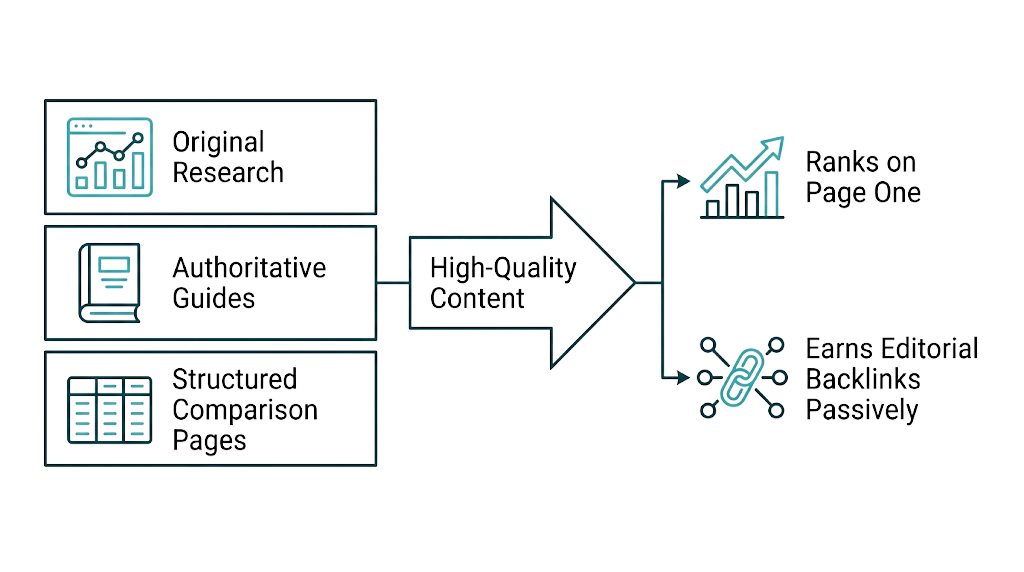
That blueprint matters even more once you add the link-building dimension. Most guides treat SEO content writing as a pure traffic exercise. But the best content - original research, authoritative guides, structured comparison pages - doesn't just rank. It earns editorial backlinks passively, and those links compound authority over time. That connection between content quality and link acquisition is the thread running through every example below.
What Makes an SEO Content Writing Example Worth Studying (And What to Ignore)
Not every piece of ranking content is worth reverse-engineering. Some pages rank because they've accumulated years of backlinks from a domain with enormous authority. Others rank because the competition in their niche is weak. Studying those pages won't give you anything you can repeat.
The examples worth your time are the ones where the content itself does the heavy lifting - where structure, depth, and intent matching are executed so well that the page would likely rank even on a younger domain.
The criteria we used to select these 10 examples:
- The ranking is at least partly driven by content quality, not just raw domain authority.
- A specific technique shows up on-page, and a team can copy the approach without copying the brand.
- Variety across content types, industries, and funnel stages.
- A measurable outcome is attached - rankings, traffic, or link acquisition data.
One warning worth stating upfront: don't study SEO content examples the way a student copies a teacher's notes. The goal isn't to replicate surface features - word count, image count, H2 patterns. The goal is to identify the decision underneath the page. Format choices come from reader behavior, and reader behavior maps to algorithm signals. Get that right and the work transfers.
Nielsen Norman Group's research found that users read only about 20% of the text on any given web page. That single data point should reshape how we evaluate every SEO content writing example in this article. The best content isn't just thorough - it's built for the 20% that gets read. Every H2, every bold callout, every summary block is a bet on which 20% carries the page.
That same "what gets read" lens applies to conversion, too. Google's Search Quality Evaluator Guidelines define page quality partly through "beneficial purpose" - whether the page genuinely helps the person who landed on it. The examples that score highest there tend to do both: they rank because they're useful, and they convert because usefulness earns trust before any ask.
Volume is the last trap to ignore. Examples from brands whose strategy is "publish everything and let authority sort it out" don't translate cleanly. A mid-market SaaS team spending $3k/month on content can't replicate HubSpot's publishing volume. But they can replicate the page-level decisions HubSpot makes. That's the frame for everything that follows.
Example 1: Ahrefs' 'Backlink Profile' Guide - How Depth and Data Density Drive #1 Rankings
Ahrefs holds first-page rankings for hundreds of competitive SEO terms, and the backlink profile guide is one of the clearest examples of why. The page doesn't rank because Ahrefs has a strong domain (though it does). It ranks because the content architecture is tuned to what a searcher asking about backlink profiles needs, in the order they need it.
What the page does structurally:
The guide opens with a clean definition - intent handled fast - then moves through a logical sequence: what a backlink profile is, why it matters, how to analyze one, and what to do with the output. That sequence tracks how people actually learn this topic. Writers who map structure to reader thinking, instead of chasing keyword placement, win more often than they lose.
Data density is the second big signal. Ahrefs threads screenshots from their own tool through the whole guide, and that choice carries real weight. It proves hands-on use (an E-E-A-T signal under Google's current guidelines). It also turns fuzzy concepts into something you can point at, and it breaks up the scroll so the page doesn't collapse into a wall of text - a direct nod to how people skim.
The internal linking architecture deserves specific attention. The guide links to related Ahrefs content on anchor text, domain authority, and link building strategy - and the timing is the point. Those links show up exactly when a reader hits the edge of the current explanation and wants the next layer. That's topic-cluster execution at the paragraph level, not a sitewide menu exercise. Understanding the power of internal link building is what separates pages that rank once from pages that compound over time.
From a link acquisition standpoint, this type of content earns what the SEO industry calls "editorial citations" - links from writers who need a source while building their own guides. The page works like a reference doc. Reference docs pick up links over time without a big outreach push, because they're easy to cite and hard to replace. That doesn't happen by accident.
It's deliberate content engineering: deep enough to be the last stop for most readers, and trustworthy enough that other publishers will cite it without thinking twice.
What you can replicate today:
- Structure the page around the reader's learning path, not a keyword list
- Screenshots or proprietary data at each conceptual step. Not just a hero image at the top.
- Internal links in-context, right where the next question naturally comes up
- Write with citation intent: ask yourself, "would another writer in this space link to this as a source?"
The Ahrefs model works because depth and data density compound. Every added layer makes the page more useful, more linkable, and more likely to meet the "beneficial purpose" standard Google's quality raters apply.
Example 2: NerdWallet's Credit Card Pages - Turning Transactional Intent Into Evergreen Traffic
NerdWallet's credit card comparison pages generate millions of organic visits monthly, and the financial services vertical is one of the most competitive in search. The pages rank not because NerdWallet outspends competitors on links (though their domain authority is substantial), but because they've solved a specific structural problem: serving someone ready to apply for a card while also capturing the research-stage traffic that leads up to that decision.
The fix is layered content architecture. The page leads with a comparison table - clean, sortable, and immediately useful for the decision-ready visitor. Under the table, NerdWallet builds editorial content that answers the research questions that stall people out: what makes a good rewards card, how to compare APR, what credit score you need. One URL covers two audiences, which beats maintaining separate pages for each intent stage.
The evergreen mechanism is worth unpacking. NerdWallet doesn't rewrite these pages from scratch when market conditions change. They update the comparison data - new cards, new rates, new sign-up bonuses - and keep the editorial framework stable. HubSpot's historical blog optimization study documented a 106% traffic increase from content updates alone, without building new pages. NerdWallet runs that play at scale: the structure earns the ranking, and recurring data updates defend and grow it.
The schema implementation on these pages also stands out. NerdWallet uses structured data to surface star ratings and review counts directly in search results, lifting CTR before the click happens. This is conversion-aware SEO - the page is built to perform in the SERP, not only after the visit. Understanding what SERP features are and how to optimize for them is increasingly important as Google's results pages become more complex.
The lesson for a financial services team or any brand in a comparison-heavy vertical: build transactional pages to serve two readers at once. The person ready to buy needs a decision shortcut (the table). The person still researching needs depth (the explainer content below). Put both on the same URL and you cover the full search journey.
Example 3: Healthline's Medical Content - How E-E-A-T Signals Are Built Into the Page Structure
Healthline operates in a YMYL (Your Money or Your Life) vertical, so Google holds every page to a higher bar. Healthline still ranks for competitive medical queries - often above WebMD and Mayo Clinic for specific long-tail terms - because it bakes E-E-A-T signals into the page architecture instead of treating them like brand fluff.
Google's Search Quality Evaluator Guidelines define E-E-A-T as Experience, Expertise, Authoritativeness, and Trustworthiness. Most content teams talk about those as intangible qualities. Healthline turns them into page-level components.
Here's what that looks like in practice:
Every Healthline article carries a visible byline with the writer's credentials. It also includes separate medical reviewer attribution, usually a licensed physician or registered dietitian, plus a "medically reviewed" badge and the review date. That's not window dressing. It's a trust signal quality raters can validate against Google's criteria.
That validation depends on the reviewer profile. The reviewer's name links to a full bio page listing qualifications, publications, and clinical experience, and that bio becomes an entity Google can crawl, index, and evaluate.
The page structure backs it up. Healthline articles open with a clear summary of what the piece covers, use numbered sections for clinical information so the hierarchy reads cleanly to machines, and include explicit sourcing - factual claims point to peer-reviewed studies or medical institutions. That citation setup builds reader trust, but it also shapes the outbound link profile in a way that supports topical authority.
What agencies and content teams can extract from this model:
- Author bios aren't a nice-to-have - they're E-E-A-T infrastructure.
- For medical, legal, and financial content, a second reviewer with verifiable credentials needs to be part of the workflow.
- Source claims with external links to authoritative institutions. That's trustworthiness at the page level.
- Review dates show Google (and readers) the content stays maintained.
The same structure shows up in link acquisition. Pages with clear E-E-A-T signals pick up links from journalists and researchers who need credible sources, not just from SEOs swapping placements. A credentialed health page that cites real institutions earns citations from news articles and academic blogs in a way a thin, uncredentialed page won't - no matter how well-optimized the title tag is. For teams that want to accelerate this process, guest posts on authoritative sites can build the external credibility signals that reinforce on-page E-E-A-T.
Example 4: Backlinko's Original Research Posts - Why First-Party Data Is the Strongest Link Magnet
Backlinko's ranking factors study - the one analysing 11.8 million Google search results - has accumulated thousands of referring domains since publication. It's one of the most-cited pieces of SEO content on the internet. And it didn't get those links because Brian Dean had a massive outreach list. It got them because the page is the only source of that specific dataset.
This is the core principle behind original research as an SEO content format: when you own the data, you own the citation.
Other writers covering SEO ranking factors have two options. Run their own study, which takes time and money, or cite Backlinko's. Most cite Backlinko's. Each citation becomes a backlink, those backlinks stack up over time, and the page turns into a self-reinforcing asset.
Moz's Whiteboard Friday on content types and link earning consistently shows that data-driven original research earns far more links per piece than opinion posts, how-to guides, or listicles. The reason isn't mysterious. Journalists, bloggers, and researchers need sources. Original data is a source. The rest is commentary.
The structural decisions in Backlinko's research posts are worth dissecting:
The methodology section is prominent and detailed - not buried. That placement is a choice. If a writer hides methodology, readers assume the data won't hold up. Backlinko leads with sample size, data sources, and analytical approach because transparency itself signals trust.
Trust carries into the formatting of the findings. The study presents results as numbered, standalone claims - "Pages with faster load times rank higher than slower pages" - instead of burying them in narrative paragraphs. Each claim works as a quotable unit, so other writers can pull one stat, cite the study, and move on without reading the whole page. That "quotable unit" setup is a design choice that pushes link velocity. Understanding what makes a good backlink profile helps clarify why these earned citations are so much more valuable than links acquired through other means.
For an agency team or in-house SEO manager: you don't need an 11.8 million row dataset to run original research. A survey of 500 customers works. An analysis of your own campaign data works. A study of 1,000 SERPs in your vertical works too. The format scales down, and the citation dynamic stays the same.
Example 5: Wix's Ecommerce Blog - How SaaS Companies Embed Product Proof Into Educational Content
Wix's blog sits in a tight spot. They go head-to-head with Shopify, Squarespace, and WordPress on ecommerce platform searches, and their content team has landed on a clear lane: education that proves the product without turning the page into a sales brochure.
The ecommerce category posts - guides on setting up an online store, choosing payment processors, building product pages - work as standalone resources. But they still push toward conversion. Each guide drops Wix interface screenshots at the exact step where a reader stops and needs the "do this in Wix" moment. The product shows up as the obvious next step to a practical problem, not an ad interrupt.
This is product-led content done correctly. That distinction matters. Product-led pages that put the product ahead of the reader's question fail twice - they don't rank (they miss search intent) and they don't convert (readers tune out anything that feels like promo copy). Wix keeps the reader's task first, then lets the product show up inside the solution.
The internal linking backs up that path. Educational posts link to Wix feature pages and pricing - but only after the guide earns trust. The CTA placement matches the journey: information first, action second.
Google's helpful content documentation warns against content "written to attract search engine visits rather than to help or inform people." Wix hits the mark here. The content helps, and the product placement fits the step the reader is on rather than cutting across it. That's the bar SaaS content teams should use. Teams building this kind of content strategy for a software product can find a detailed breakdown of the approach in our SaaS link building strategy guide.
The replicable framework here: map product features to the exact moments in an educational guide where the reader needs a solution. Don't lead with the product. Bring it in at the point where it solves the problem the reader came to understand.
Example 6: Mindbodygreen's Skimmable Long-Form - The Formatting Techniques That Reduce Bounce Rate
Mindbodygreen publishes long-form wellness content - guides that often run past 2,000 words - in a space where the average reader scrolls on mobile, half-distracted, and decides fast whether to keep going or bail. Their formatting choices respond to that behavior.
Remember the Nielsen Norman Group finding: users read about 20% of web page text. Mindbodygreen designs for that constraint. They don't pretend readers will consume every word. Their long-form pieces are built to make that 20% carry the argument.
The techniques worth replicating:
- Jump links at the top of every article - makes navigation instant and cuts pogo-sticking, since readers can land on the section they came for
- Bold lead sentences in each paragraph - the first line carries the takeaway, so skimmers still get the point
- Callout boxes for key statistics and expert quotes - break up the scroll, catch the eye, and deliver high-value info without forcing a full read
- Short paragraphs (2-3 sentences max) for mobile readability - long blocks on mobile push people out; paragraph breaks are a UX choice
- Descriptive subheadings that state the intent - skip "Benefits of Magnesium" and use something like "What Magnesium Does for Sleep" so the heading itself delivers value
The SEO tie-in is direct. Lower bounce rates point to higher-quality pages. Longer dwell time - how long someone stays before returning to search - tracks with better rankings. Mindbodygreen's formatting isn't decoration - it's deliberate signal work at the sentence and paragraph level.
For content teams writing long-form: formatting isn't a cleanup task after the draft is done. It's part of the structure, decided before anyone writes the first line. The same principle applies when creating effective SEO content at scale - structural decisions made upfront save significant rework later.
Example 7: ActiveCampaign's Competitor Comparison Pages - Reputation Management as an SEO Strategy
ActiveCampaign's competitor comparison pages - "ActiveCampaign vs Mailchimp," "ActiveCampaign vs HubSpot," and similar - rank for some of the most commercially valuable queries in the email marketing space. These searches come from buyers already shortlisting tools. This traffic converts.
That conversion upside isn't just because they rank for "[Brand A] vs [Brand B]." These pages double as reputation management infrastructure. When someone searches "ActiveCampaign vs Mailchimp," ActiveCampaign can sit above third-party review sites and set the framing. The content stays honest enough to pass a credibility check - it calls out places where competitors win - but it still steers attention back to ActiveCampaign's differentiators at each decision point.
The page architecture follows a consistent pattern:
- A summary table at the top, built for decision-ready visitors
- Feature-by-feature comparison sections for researchers
- Pricing transparency that builds trust and heads off the pricing conversation
- Customer testimonials placed where the comparison is happening
- A clear CTA that pushes a free trial, not a hard sell
That honesty piece matters. Comparison pages that read like promo copy don't rank because they miss the intent. The reader wants an evaluation, not a sales deck. ActiveCampaign's pages give competitors credit where it's due, then explain why ActiveCampaign's approach differs and where that difference shows up in day-to-day use. That balance earns trust. It also earns the click from a buyer who assumes every brand will spin the story.
For any SaaS or service business: build your own comparison pages before your competitors do. If you don't control that SERP real estate, a third-party review site or a competitor will. Their version of the comparison won't favour you. This is also where SEO reputation management intersects directly with content strategy - owning the comparison narrative is one of the most defensible positions in search.
Example 8: Podia's Content Hub - How Topic Clusters Build Topical Authority Faster Than Isolated Posts
Podia's content hub around "online courses" is a clean example of topic cluster architecture executed at the content level, not just the navigation level. The hub page - a complete guide to creating and selling online courses - acts as the pillar, with supporting cluster pages covering pricing, platform comparisons, marketing, and course creation tools linking back to it.
That pillar-and-cluster setup works because Google rewards depth of coverage across a topic, not a handful of pages each targeting a single keyword in isolation. The topical authority model, popularized by HubSpot and later validated by Kevin Indig's analysis of Adobe's content hub strategy, plays out in the SERP the way you'd expect: a site with 20 tightly interlinked pages on online courses sends a stronger topical signal than a site with one massive page trying to do everything.
What Podia does specifically well:
The pillar page doesn't try to cover everything in equal depth. It covers everything at the right depth - enough to meet broad informational intent for someone starting research, with clear signposts to cluster pages for readers who need detail on a subtopic. That "right depth" calibration is hard. Most content teams ship either a 500-word overview that helps nobody or a 10,000-word monster that people bounce from.
The internal linking between cluster pages is bidirectional and contextual. Cluster pages don't just link up to the pillar - they link to each other where topics overlap. That cross-connection gives crawlers a clear map of Podia's coverage.
The link-building implication is material. A well-structured content hub earns links at the pillar level, then pushes that authority through internal links to every cluster page. One editorial backlink to the pillar page lifts the entire cluster. This is why content hub architecture is one of the highest-impact bets a content team can make - the authority doesn't stay trapped in a single URL. Teams that want to accelerate this process can explore our managed link building service to build the external authority that makes hub pages rank faster.
For teams building their first content hub: start with three to five cluster pages, not twenty. Depth beats breadth early. A tight cluster of truly complete pages outperforms a sprawling hub of thin content every time.
Example 9: Coinbase's Beginner Guides - CTR Optimization Through Meta Descriptions That Match Intent
Coinbase's "What is Bitcoin?" and related beginner crypto guides rank for some of the highest-volume informational queries in the financial space. The pages perform well on standard SEO metrics. The move worth copying is the meta description strategy - it's more deliberate than it looks.
Moz's meta description length research found that descriptions in the 150-160 character range tend to display cleanly in SERPs. Display length matters, but it isn't the main driver. Intent alignment is. The meta description has to answer the unstated question behind the query before the searcher clicks.
Coinbase's beginner guide descriptions stick to a repeatable pattern. They meet the reader at their starting point ("New to crypto?"). They promise the direct outcome ("Here's exactly what Bitcoin is and how it works"). Then they add a quiet trust cue ("From Coinbase, the most trusted crypto exchange"). That three-part structure - acknowledge, preview, trust - matches how a skeptical first-time searcher moves from curiosity to confidence.
The CTR implication compounds over time. Google uses click-through rate as a ranking signal. If a page pulls a 6% CTR in a SERP spot where 4% is the norm, it tends to climb over time. Higher rankings drive more impressions. More impressions drive more clicks. Meta description optimization is one of the few on-page levers that feeds that loop directly. Tracking these shifts is easier when you have a clear SEO reporting process in place to monitor CTR changes across your indexed pages.
What every content team should implement: treat the meta description like a two-sentence ad for the page. The title tag wins the impression. The meta description wins the click. Most teams either treat the description like cleanup work or let Google pull it from the first paragraph. That costs clicks across every indexed page.
Beginner-focused content needs one extra signal: "we built this for where you are right now." "Complete beginner's guide" or "no experience needed" isn't fluff in a description - it's intent matching at the SERP level.
Example 10: Expert Photography's Drone Guide - Satisfying Search Intent Beyond the Obvious Keyword
Expert Photography's guide to drone photography ranks for the primary keyword, then picks up a long tail of adjacent queries - drone settings, best drones for photography, drone photography tips - with one piece. The technique is intent expansion: the query is narrow, but the underlying need is bigger.
A search for "drone photography guide" isn't a request for a definition. It's a buying-and-doing problem: which drone to get, how to set it up, which settings to use, and how to come home with usable shots. Expert Photography built the page around that full intent, not the keyword on its own.
The structural decision that makes this work: the guide uses a clean hierarchy of H2 and H3 headings that follows the reader's natural question order. H2s handle the big buckets (equipment, settings, technique, editing). H3s drill into the questions inside each bucket. That heading setup pays off twice: readers can scan and jump to the section they need, which helps with the 20% reading behaviour problem, and Google gets a clear semantic outline of what the page covers.
The image optimization stands out too. Expert Photography uses descriptive image alt text. File sizes stay compressed. Images sit where they support the point instead of acting like page dressing. In a visual niche like photography, image SEO isn't optional - it's a core traffic path via Google Images, and it shapes UX signals like dwell time.
The broader lesson: define the full information need before writing, not just the phrasing of the query. Build the structure around the full need. Pages that cover the whole job-to-be-done outperform pages that answer the literal question, because they stop the reader from bouncing back to Google for the next search. This is closely related to mastering search intent - the skill that separates content that holds its rankings from content that drifts down after the initial boost.
That "pogo-sticking prevention" is the core of what Google's helpful content system aims to reward. Expert Photography's drone guide holds its rankings because it's the last resource a reader needs on the topic - not just the first one they open.
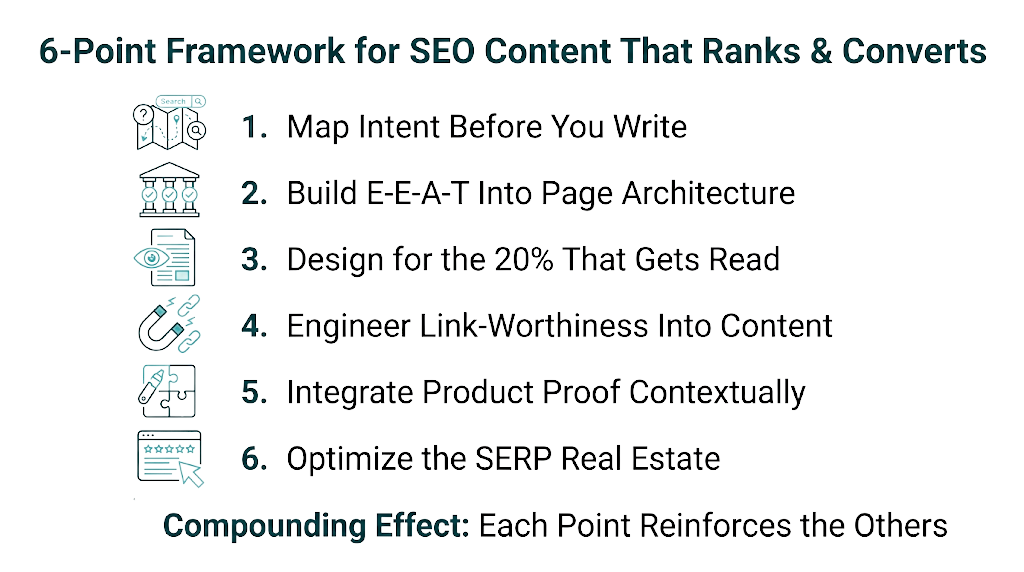
The 6-Point Framework for Writing SEO Content That Ranks AND Converts
The 10 examples above aren't just case studies. They're proof of a repeatable framework any content team can apply, no matter the niche, budget, or domain authority. This is the six-point process we'd hand to a writer kicking off a new SEO piece.
1. Map Intent Before You Write a Single Word
Start with intent mapping, then write.
Identify the full intent behind your target keyword - not only the informational, navigational, or transactional bucket, but the exact questions a real person wants answered. Pull from the "People Also Ask" box, Reddit threads, and competitor H2 structures to build an intent map that covers the full thread of the search. That map should drive your outline. Not your keyword list.
2. Build E-E-A-T Into the Page Architecture
That outline also needs proof built into it.
E-E-A-T isn't a writing style - it's page structure. Every page needs:
- A credentialed writer byline with a linked bio page
- A clear sourcing standard. External links to authoritative sources for every factual claim.
- A visible last-updated date
- For YMYL topics: a secondary reviewer with verifiable credentials
Those elements don't just satisfy quality raters. They build trust, and trust converts readers into customers.
3. Design for the 20% That Gets Read
Trust doesn't help if readers miss the point.
Write every paragraph so the first sentence carries the takeaway. Use bold text for key points. Make H2s and H3s answer questions rather than label topics. Add jump links at the top of long-form content. Treat formatting as a structural choice made before drafting, not a cleanup step at the end.
4. Engineer Link-Worthiness Into the Content
Formatting gets the content read. Link-worthiness gets it referenced.
Instead of hoping someone cites the page, build the reason into the asset. If there's no clear citation hook, it won't earn links. Bake in at least one of the following:
- Original data
- A proprietary framework
- A complete reference section
- A unique case study
These elements turn content from a traffic asset into a link-earning asset. Link-earning assets compound in value over time.
5. Integrate Product or Service Proof Contextually
Link-earning content still needs to sell, but the timing matters.
Don't pitch at the top of the page. Introduce your product at the moment in the reader's journey where it removes the friction they're feeling in that section. The Wix model - product as the natural answer to a practical question - works because it respects intent. Promotional copy that front-loads the pitch fails the reader and the algorithm.
6. Optimize the SERP Real Estate, Not Just the Page
Intent and timing show up first in the SERP.
Your title tag and meta description are a two-sentence pitch to someone who hasn't clicked yet. The title earns the impression. The meta description earns the click. Write your meta description using the three-part structure: acknowledge the reader's starting point, preview the specific answer, include a trust signal. Keep it between 150-160 characters. Revisit both elements every six months - SERP competition changes, and click-through rate data will flag when it's time to test a new approach.
The compounding effect of this framework: each point reinforces the others. Content designed for full intent coverage earns longer dwell times. Longer dwell times improve rankings. Better rankings generate more impressions. Better meta descriptions convert those impressions into clicks. More clicks signal quality to Google. Content with real link-worthiness earns the backlinks that accelerate the entire cycle.
That cycle is why the best SEO content writing examples - Ahrefs, Healthline, Backlinko, Podia - don't just rank. They compound. They get better over time because the structural decisions made at the content level generate signals that reinforce each other across every dimension Google measures.
If you're looking for seo content writing samples pdf or beginner content writing samples pdf to share with your team, the examples in this article are the starting point - but the framework above is what turns inspiration into a repeatable process. Save it, share it, and use it as the brief for your next piece of content.
Frequently Asked Questions About SEO Content Writing
What is SEO content writing and how is it different from regular copywriting?
SEO copywriting means producing content that works for search engines and humans at the same time. Regular copywriting puts persuasion and conversion first. SEO content writing adds a third job: discoverability.
That shows up in the page decisions we make - heading hierarchy, keyword placement, internal linking, schema markup - so Google can parse the page and rank it, without turning the copy into something no one wants to read. Readability still carries the conversion work.
What does E-E-A-T mean in practice and how do you implement it?
E-E-A-T stands for Experience, Expertise, Authoritativeness, and Trustworthiness - the four dimensions Google's quality raters use to judge page quality. In practice, we treat it like a set of on-page and off-page proof points, not a tone tweak.
That means publishing credentialed author bios. It means citing factual claims with external links to authoritative sources. For YMYL content, it also means adding a secondary reviewer and making that review process visible where it matters. Last-updated dates help, too. And the entity work counts: building a real presence for your authors across the web so the name on the byline maps to something verifiable.
It's a structural investment. Not a writing style.
How do you write SEO content that satisfies both search engines and human readers?
Intent matching drives the whole thing. We map the full information need behind the query - not just the exact keyword - then build the outline to cover each layer of that need in a clean order.
Structure does a lot of the heavy lifting. Use formatting that supports the 20% of text users actually read: bold lead sentences, descriptive subheadings, short paragraphs. The page should scan well, then read well. And we bake E-E-A-T into the architecture so both algorithms and readers can validate credibility before they buy into the claims.
What is a content hub and how does it build topical authority?
A content hub is a pillar page that covers a broad topic in moderate depth, supported by cluster pages that go deep on specific subtopics - with bidirectional internal links between them.
Google rewards sites that show full-topic coverage, not a stack of disconnected pages each chasing a single keyword. That hub model builds topical authority across the cluster as a unit. The pillar page tends to attract more backlinks, and those links don't just help the pillar - internal links pass authority into the cluster pages, which lifts the whole set.
Does updating old blog posts improve SEO rankings?
Yes - and the data is clear on this. HubSpot's historical optimization study documented a 106% traffic increase from updating existing content without building new pages.
Google reads updates as a maintenance signal, which ties into freshness. But the bigger win is control: a refresh lets us expand coverage of related queries, replace outdated sections, fix accuracy issues, and tighten E-E-A-T signals like review dates and sourcing. Content refresh work prints ROI when it's done on a schedule.
related Blog Posts




Join 2,600+ Businesses Growing with Rhino Rank
Sign Up
Stay ahead of the SEO curve
Get the latest link building strategies, SEO tips and industry insights delivered straight to your inbox.