
 Back to all posts

Link building in 2026 looks nothing like it did five years ago. Platforms changed, algorithms matured, and Google's spam detection now spots the difference between an earned backlink and a manufactured one within weeks. Yet most published guides still recycle the same framework-level advice: "create great content," "do outreach," "build relationships." That's not guidance. That's a fortune cookie.
This article is built differently. Every section centers on a concrete link building example - a real or realistic scenario with named tools, specific metrics, and a process you can replicate. Whether you're an SEO manager evaluating tactics for a client, a marketing director deciding where to allocate a $4k/month link budget, or an agency owner building a scalable acquisition system, you'll leave with something you can run.
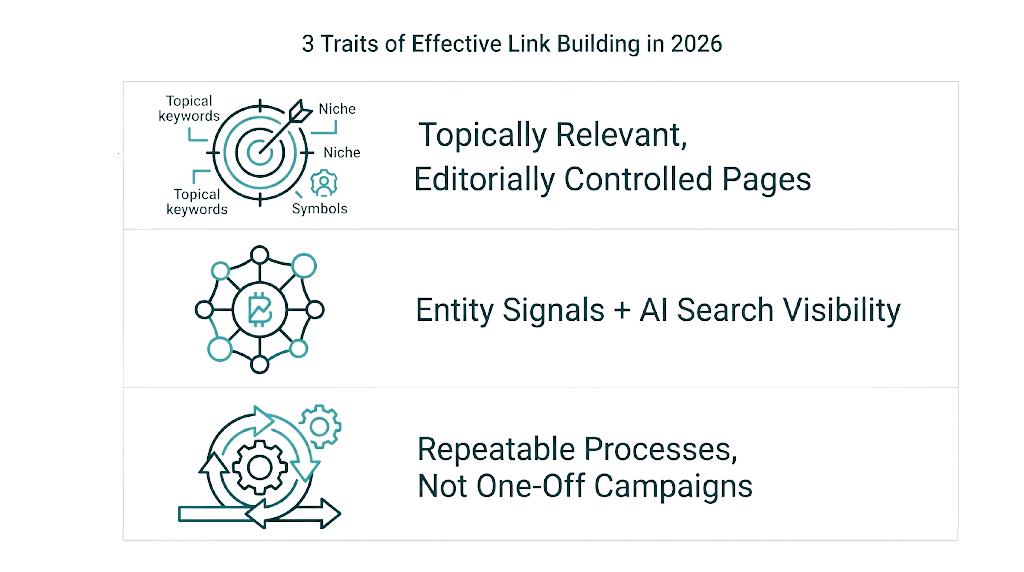
The bottom line up front: The most effective link building tactics in 2026 share three traits. They produce links from topically relevant, editorially controlled pages. They generate entity signals that reinforce AI search visibility alongside traditional PageRank value. And they're built around repeatable processes, not one-off campaigns. The examples below demonstrate each of these traits in practice, with the tool workflows and outreach logic that make them work at scale.
What Makes a Link Building Example Worth Studying in 2026?
Not every link building case study deserves your attention. Plenty of circulating examples are either too vague to replicate ("we did outreach and got 40 links"), too old to matter, or built on tactics Google's spam policies now flag.
The standard has shifted. According to recent State of Link Building reports, many SEOs now rate digital PR as the single most effective tactic - a big jump from previous years. Digital PR isn't new. What changed is the gap between what earns links and what Google rewards. Editorial placements from real publications, earned on merit, beat manufactured placements by a measurable margin.
A link building example worth studying in 2026 has to clear a few filters.
First, it needs to demonstrate topical relevance - not just domain authority. A DR 55 link from a niche HR publication is worth more to an HR software brand than a DR 80 link from a generic "business tips" blog. Understanding domain authority vs domain rating helps clarify why raw metrics alone don't tell the full story.
Second, it needs to show the full process, not just the outcome. Knowing that a brand earned 34 links from a data study only helps if you understand how the study was structured, how it was pitched, and what made journalists link instead of just citing.
Third, it has to reflect the current market. HARO, still referenced as active by multiple top-ranking articles, shut down in November 2024.
That market reality connects to a newer point most link building guides skip. Backlinks and entity mentions now serve different but complementary functions in Google's ranking systems. Recent industry studies of prominent brands found that branded web mentions correlate with AI search visibility at a very high rate, compared to a lower rate for traditional backlinks. Backlinks still matter. But the tactics you pick need evaluation for link lift and for entity signal value, especially as AI Overviews and zero-click results keep reshaping how organic visibility gets distributed.
The examples in this article made the cut because they hit all three. Specific. Current. Proven in modern SEO.
Digital PR Example: How a Single Data Study Earned 34 High-DR Links
This link building example shows why digital PR keeps ranking above most other tactics in practitioner surveys.
RankSages, an eCommerce SEO agency, ran an original data study on eCommerce site architecture and internal linking patterns. The study analysed crawl data across several hundred online stores and identified structural patterns that correlated with stronger category page rankings. They published the findings as a dedicated landing page with clear data visualizations, a methodology section, and a downloadable summary.
The result: 34 links from publications with DR ratings between 70 and 92, including coverage from eCommerce trade publications, general marketing outlets, and several SEO-specific sites. Compare that to a parallel guest posting campaign the same team ran over a similar period. That one produced 200+ links, but from sites averaging DR 35-50 with thin topical authority in eCommerce SEO.
Those DR 70-92 links drove ranking movement on competitive category-level keywords within 60 days. The 200+ guest post links barely moved the needle despite the volume. That's the quality-over-quantity dynamic that recent industry research captures: the vast majority of link builders now prioritize quality over volume. The RankSages example shows why that preference exists.
Replication comes down to four stages. No mystery. Just process.
Stage 1 - Data sourcing. Start with a question your target audience argues about or can't agree on. For eCommerce SEO, "does internal linking structure affect category rankings?" stays a live debate. Use tools like Screaming Frog or Sitebulb to crawl a dataset of sites in your niche, or survey your existing client base for proprietary data. Proprietary data is the differentiator. Journalists can't pull it from anywhere else.
Stage 2 - Study design. Keep the methodology simple enough to explain in two sentences. Complex statistical models spook journalists. The RankSages study used correlation analysis, which is easy to explain and visualize. Build your findings around 3-5 quotable data points. "Sites with fewer than 3 clicks from homepage to category page ranked 40% higher on average" is a headline. A regression table isn't.
Stage 3 - Outreach targeting. Use Ahrefs or Semrush to identify journalists and editors who've covered similar data studies in your niche. Filter for pages that earned 10+ referring domains - those writers already produce link-earning coverage. Build a media list of 60-80 contacts and segment them by publication type: trade press, general marketing, SEO-specific.
Stage 4 - Pitch construction. Lead with the most surprising finding. Don't summarize the study - hand them the one data point that forces a click. Include a link to the full study, offer an exclusive comment from the researcher, and make the data available in a shareable format. Response rates for data-led pitches average 8-12% in B2B niches, compared to 2-4% for generic content pitches.
The Anatomy of a Link-Earning Data Study: What the Best Ones Have in Common
The RankSages example isn't an outlier. Across the digital PR campaigns we've run and observed, the studies that earn the most links follow the same bones.
Original data is non-negotiable. Studies that aggregate publicly available data and repackage it earn fewer links because journalists know other outlets can pull the same sources. Studies built on proprietary surveys, client data, or original crawl analysis earn more because they create a real information asset. A mid-market SaaS team spending $3k/month on content can commission a 200-person industry survey through Pollfish or Typeform for under $500. That's enough. And it's enough to generate findings people will cite.
The headline finding needs to challenge an assumption. The most-linked studies don't confirm what people already think. They complicate it. "Email open rates are declining" isn't a headline. "Email open rates are declining, but reply rates are up 23% - suggesting engagement has shifted, not disappeared" is a story. Build the study around the surprising angle, even if it's one data point among many.
Visuals drive link volume. Publications that embed your image or infographic link more often because they need a source to credit. Use Flourish or Datawrapper to build embeddable visualizations. Add an embed code on the study page. Every embed creates another shot at a backlink from a site that would've otherwise copied the takeaway and moved on.
Methodology transparency increases credibility. Include a clear methodology section that explains sample size, data collection method, and limitations. This isn't only good research practice - it tells journalists the data will hold up in editorial review, which lowers their risk in citing it.
Broken Link Building Example: Turning a Competitor's Dead Pages Into Your Backlinks
Broken link building is one of the most misunderstood tactics in the SEO toolkit. It's not about finding any broken link on any site. It's about finding broken links on relevant pages that point to content you can replace - then making that replacement easy for the site owner to plug in. For a deeper look at how this tactic works and where it fits in your strategy, the complete broken link building guide covers the pros, cons, and alternatives in detail.
Here's a worked link building example.
An HR software company wants links to their employee onboarding guide. They use Ahrefs' Site Explorer to analyse three competitor domains. In the "Broken backlinks" report, they spot a competitor's onboarding checklist page that returned a 404 error six months ago - and it still has 14 referring domains pointing to it.
Those 14 sites link to dead content. Most won't notice unless someone tells them. And they have a reason to fix it: broken links waste clicks and, depending on the page, can waste crawl budget.
The process from here stays simple.
- Export the list of 14 referring domains from Ahrefs.
- Pull contact emails for each site's editor or webmaster using Hunter.io or Apollo.
- Verify the broken link still exists on each referring page using Check My Links (Chrome extension) or Screaming Frog.
- Write a short outreach email that does three things: calls out the broken link with the URL and anchor text, explains the impact on their readers, and offers your content as a replacement.
- Follow up once, five to seven days later, if you don't hear back.
That outreach email shouldn't ramble. Use a tight structure:
Subject: Broken link on [their page title] Hi [Name], I was reading your [page title] and noticed the link to [anchor text] is returning a 404. Thought you'd want to know. We've published an updated [content type] on the same topic at [your URL] - might be a useful replacement if you're updating the page. Either way, happy to help.
Conversion rates for broken link building outreach average 5-10% per contact when the replacement content matches the page. For the HR software example, 14 contacts at a 7% conversion rate means 1 link - and that link comes from a site that already curates resources in the same niche. That usually beats a cold placement on a random blog.
That same math scales. Run it across five competitors and 10-15 broken pages per competitor, and you get a pipeline of 150-200 outreach contacts per month. Hold the 7% conversion rate and that's 10-14 links per month from relevant sources - with no new content required if your existing asset already does the job.
The key tool workflow: Ahrefs Site Explorer (broken backlinks report) + Hunter.io (contact finding) + Check My Links (live verification) + a simple CRM like Notion or Airtable to track outreach status.
Resource Page Link Building Example: Getting Listed Where Curators Already Trust You
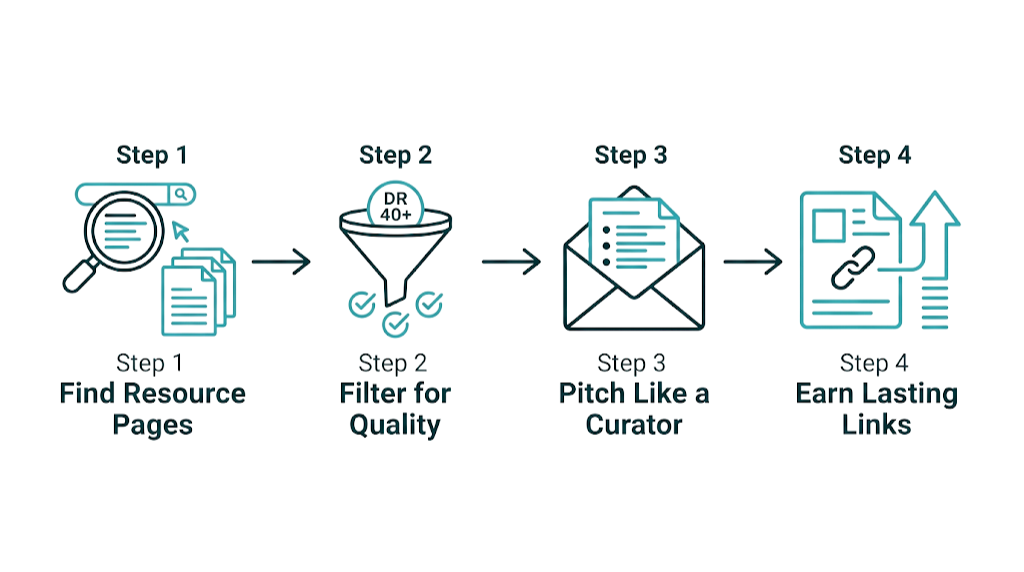
Resource pages are one of the most overlooked link building plays in competitive niches. They're built to link out - so the editorial bar sits lower than it does for news coverage or guest posts. But listings don't happen by accident. The teams that win them pitch like curators, not like link builders.
Here's a real scenario. A cybersecurity training company wants links to their free phishing simulation tool. They use Google search operators to find resource pages in their niche:
intitle:"resources" inurl:resources "cybersecurity training"intitle:"useful links" "information security" -site:wikipedia.org"recommended resources" "phishing" filetype:html
Those operators surface pages that already curate cybersecurity links. Curated pages are the target. Our curated links service follows exactly this model - placing your content on editorially maintained resource pages in relevant niches.
Ahrefs' Content Explorer pushes this further - search for pages with "resources" in the title, filter by DR 40+, then sort by referring domains to spot the strongest pages first. You're looking for pages that already attract links, because that usually means the curator updates them and searchers keep finding them.
Resource page outreach doesn't work like broken link building. You're not repairing anything. You're asking for a spot.
That pitch has to answer the curator's first filter: "Why does my audience need this?"
The pitch structure that works:
- Open with a specific observation about their resource page so it's clear you've read it
- Point out a gap or an angle your tool covers without duplicating what they already list
- Describe your tool in one sentence with a concrete benefit
- Add social proof - user numbers, press mentions, or a notable client if it's relevant
- Keep the whole email under 120 words
For the cybersecurity training company, a resource page link from a DR 60 university IT department page or a professional association's "member resources" section sends strong trust signals. That selectiveness is the point. Those domains link out less often, so the pages they do maintain carry more weight, and the outreach has to match that standard.
One point matters here: resource page links age well.
That "age well" factor is why we like resource pages for steady link equity. Unlike news links that slide off the homepage and vanish under newer posts, resource page links sit on URLs curators maintain. They stay live longer, pass steadier value over time, and they earn secondary links when other sites discover the resource page in search and reference it.
Guest Posting Example: Why One Placement in the Right Publication Beats Fifty in the Wrong Ones
The guest posting debate in SEO circles drags on. "Guest posting is dead." "Guest posting is still the best tactic." Both miss the real issue. Guest posting on low-quality, high-volume link farm networks is a liability. Guest posting on real editorial publications in your niche still delivers some of the best ROI in link building.
Google's spam policies draw that line clearly. Search Central's documentation on link schemes flags "large-scale article marketing or guest posting campaigns with keyword-rich anchor text links" as a violation. "Large-scale" and "keyword-rich" are doing the work in that sentence. A single, well-placed guest post on a relevant publication with a natural anchor profile isn't a link scheme. It's editorial coverage.
Here's the link building example. A fintech startup focused on SME invoice financing secures a guest post on a DR 74 accounting industry publication. The article covers cash flow management strategies for small businesses - content the publication's audience of accountants and finance managers reads and shares. The post includes one contextual link back to the startup's invoice financing calculator, anchored with a brand name variation instead of a keyword-heavy phrase.
That one link pulls weight in three ways. It passes PageRank from a domain with real topical authority in finance. It puts the brand in front of readers who include buyers and referral partners. And it builds entity signals - the brand name shows up in an editorial context on a trusted finance domain, which strengthens topical relevance in Google's entity graph.
Now compare that to 50 guest posts on generic "business and finance" blogs with DR ratings between 20-35, keyword-stuffed anchors, and thin posts written to hit a link quota. That footprint matches what Google's spam systems look for. The risk-reward flips. If you're weighing up the two main placement formats, the guest posts vs niche edits comparison breaks down exactly when each one makes sense.
How to identify the right publications:
- Use Ahrefs to find where competitors have earned editorial guest post links (filter by "dofollow" and exclude obvious PBNs)
- Check the publication's organic traffic in Semrush - real editorial sites show steady traffic; link farms sit near zero
- Read three recent articles before pitching. If the content reads like filler, the association hurts more than the link helps.
- Verify the editorial process: named editor, contributor guidelines, and standards that look enforced
A guest post that takes two weeks to research, write, and place on a DR 70+ publication beats a month of low-end placements. That's not a vibe. It's what ranking data keeps showing.
Unlinked Brand Mention Example: Converting Existing Coverage Into Backlinks
Any brand with a real content footprint has unlinked mentions out there. These are pages that reference your brand, product, or content by name - but don't link back to you. Turning those into links is one of the most efficient link building plays because the editor already decided you're worth citing.
The tool workflow stays pretty simple. In Ahrefs, use the "Brand mentions" report under Content Explorer. Search your brand name in quotes, filter for pages that don't already link to your domain, then sort by DR. In Semrush, the Brand Monitoring tool covers the same ground. If you're hunting unlinked mentions of a specific asset (not the brand name), Google Alerts with exact-match queries works as a free starting point.
But competitors miss a bigger point. Even when you don't convert a mention into a link, the mention still carries measurable value. Recent industry studies of prominent brands found that branded web mentions correlate with AI search visibility at a high rate - much stronger than the standard correlation for traditional backlinks. That gives unlinked mention outreach real upside even when it doesn't turn into a hyperlink, because the mention still strengthens brand entity signals in Google's knowledge graph.
This changes the outreach logic.
You're not only chasing a link. You're also reinforcing entity signals even if the editor ignores your request. That makes unlinked mention outreach worth running even in niches where link conversion stays low.
The outreach email for unlinked mentions is brief:
Hi [Name], I noticed you mentioned [brand/product] in your recent article on [topic] - appreciate the coverage. We'd love it if you could link through to [URL] so your readers can explore it directly. Happy to return the favour if there's anything useful we can flag for your audience.
Conversion rates vary by niche and publication type, but 15-25% is achievable when the mention is recent and the page is actively maintained.
HARO and Expert Quote Example: Earning Editorial Links Through Journalist Platforms
HARO - Help A Reporter Out - was shut down in November 2024. It's no longer an active platform. Yet multiple top-ranking articles on link building still list it as a live resource. If you're reading advice that includes HARO as a current tactic, that advice is outdated.
The expert-quote ecosystem has spread across several platforms, and each one rewards a different operating rhythm.
Platform | Best For | Response Rate Notes |
|---|---|---|
Connectively | General B2B and consumer press | Moderate volume, competitive |
Qwoted | Finance, legal, and professional services | Higher quality queries, lower volume |
Featured.com | Thought leadership and listicle features | High volume, fast turnaround |
ProfNet | Established media and wire services | Lower volume, higher prestige |
#JournoRequest on X | Breaking news and trend pieces | Fast-moving, requires daily monitoring |
Each platform needs its own approach. Featured.com works best for brands that can deliver a quotable answer in under 150 words - editors use it for "expert roundup" content and they move fast. Qwoted fits finance and legal brands where trust signals carry weight: include credentials, company context, and data references in every response. #JournoRequest on X is a speed game above all else - journalists post and close queries within hours, sometimes minutes.
Here's a concrete example. A B2B SaaS company in the project management space monitors Connectively daily. A journalist from a DR 78 productivity publication posts a query about remote team communication tools. The company's head of product submits a 120-word response within two hours, citing internal data about async communication patterns. The journalist uses the quote, links to the company's blog, and the piece goes live within a week.
That's a DR 78 editorial link from a real publication, earned through expertise instead of cold outreach. Three variables decide whether you land the placement: speed of response, specificity of the quote, and relevance of the credential. Generic responses that could've come from anyone don't make it in. Responses with a named expert, a specific data point, and a clear point of view do.
Linkable Asset Example: The Free Tool That Earns Backlinks While You Sleep
A linkable asset is any piece of content or functionality that earns links without ongoing outreach. People find it, use it, and cite it on their own. In 2026, the gold standard is still a free tool for one reason: tools solve problems articles can't. Understanding how to create linkable assets is one of the highest-leverage investments a content team can make.
Here's the link building example. A mortgage broker builds a free stamp duty calculator and publishes it in a subdirectory on their main site. It loads fast, returns the right number, and handles edge cases other calculators skip - first-time buyers, second homes, commercial properties. They put £800 into development, then another £200 into a basic SEO setup.
That accuracy turns into links. Within 18 months, the calculator page earns 140 referring domains, including property news sites, personal finance blogs, and comparison platforms. No outreach. Those links show up because finance writers need a reliable stamp duty calculator when they cover property purchases, and this one is the best option on the page.
What makes a free tool link-worthy:
- A single, repeatable problem people search for every week
- Personalized output - a number, recommendation, or comparison - instead of static info
- Better coverage than the other free options in the SERP
- Embeddable or shareable, which multiplies passive link acquisition
The tool doesn't need to be complex. Mortgage calculators, ROI estimators, keyword difficulty checkers, salary benchmarking tools, carbon footprint calculators - they earn links because they get used, and writers need something credible to reference when they publish.
The link building tools that help you find gaps: Those gaps show up in Ahrefs' Content Explorer. Search for "[your niche] calculator" or "[your niche] tool" and filter by referring domains. Pages with 50+ referring domains in your niche already prove demand. Build something better, then promote it once to the sites that linked to the existing tool.
Competitor Backlink Gap Example: Finding Proven Link Opportunities Your Rivals Already Validated
Competitor backlink gap analysis is one of the most underused tactics in most SEO managers' workflows. The logic holds up in any niche: if a site links to three of your competitors but not to you, they've already shown they link to brands in your space. You're not cold-pitching. You're closing a gap they already created. If you haven't run this process before, our step-by-step guide to backlink gap analysis walks through the full workflow.
That gap is easy to spot in Ahrefs. Use the Link Intersect tool, enter three to five competitor domains, then filter for sites that link to multiple competitors but not to you. Sort by DR. Export the top 100 opportunities.
Semrush handles the same job in its Backlink Gap tool with a different interface. Moz's Link Explorer gives you a similar option under the "Link Intersect" feature.
Here's the scenario. An enterprise HR software brand runs a gap analysis against five competitors. The report surfaces a DR 68 HR trade publication that links to four of the five competitors in a "tools and resources" section. The brand isn't listed. The outreach stays simple: point to the existing listings, explain what differentiates the product, and ask to be considered for inclusion.
That "tools and resources" section is the whole point. This is a warm pitch, not a cold one, because the publication already decided this type of tool belongs there. Your job is to show your product meets their bar.
What to prioritize in the gap report:
- Sites linking to three or more competitors. Strong intent signal.
- DR 50+ sites with real organic traffic, verified in Semrush
- Editorial link placement - not directories, not sponsored sections
- Sites inside your primary topical cluster, not just your broad industry
A good gap report also shows what earns links in your niche. If the same five publications keep linking to competitor data studies but never to guest posts, that gives you a clear read on where to put your content budget.
What a Healthy Backlink Profile Actually Looks Like: Metrics That Matter Beyond Domain Rating
Most competitor articles on link building focus on how to get links. Almost none of them explain what a healthy backlink profile looks like once those links start stacking up. That gap matters, because a profile that looks manufactured trips Google's spam detection even if the individual links look "good" in isolation.
Anchor text distribution is the most visible signal. According to recent industry benchmark data, a natural backlink profile follows roughly this distribution:
Anchor Type | Benchmark Range |
|---|---|
Brand name (exact or variation) | ~40% |
Generic phrases ("click here," "this article," "read more") | ~30% |
Keyword-rich anchors (target keywords) | ~20% |
Naked URLs (https://yoursite.com) | ~10% |
Once keyword-rich anchors hit 60%+ of all links, that's a red flag for Google's systems and for any SEO auditor worth listening to. Google's spam policies call out "links with optimized anchor text in articles or press releases distributed on other sites" as a link scheme violation. The fix isn't to stop using keyword anchors. It's to keep them as a minority of your total anchor profile. For a full breakdown of how to approach this, the guide to mastering natural anchor text covers the right ratios and common mistakes in detail.
Link velocity matters as much as volume. If a site picks up 200 links in a single month after averaging 5 per month for two years, every backlink tool will show that velocity spike. Spikes don't mean a penalty. Viral content generates spikes.
A clean spike has variety: different publishers, different link contexts, and pages that make sense as citation targets. A spammy spike comes from the same type of site over and over. Google's systems separate those patterns.
Referring domain diversity is the third metric. Diversity means links coming from multiple domain types:
- Editorial publications and real industry blogs
- Industry directories
- Educational institutions and government sites
- Forums, community posts, and social platforms
When one link type dominates the mix - say, 80% guest posts on similar-looking blogs - it signals manipulation even if each individual link looks fine by itself.
The backlink profile is a system, not a pile of individual assets. Systems need maintenance. Run periodic audits in Ahrefs or Semrush to spot link decay (lost links), toxic link accumulation, and anchor text drift. Set a quarterly audit cadence and track these three metrics over time.
How to Build a Repeatable Link Building System (Not Just One-Off Campaigns)
One-off link building campaigns produce one-off results. Brands that outperform in organic search bake link acquisition into their operating rhythm - not as a quarterly project, but as an ongoing process with defined inputs, outputs, and feedback loops. If you'd rather hand that system to specialists, our managed service handles the full acquisition workflow on your behalf.
That operating rhythm is what keeps performance stable when rankings get volatile or competitors ramp up spend. Here's what a repeatable system looks like for a mid-market B2B brand with a dedicated SEO function.
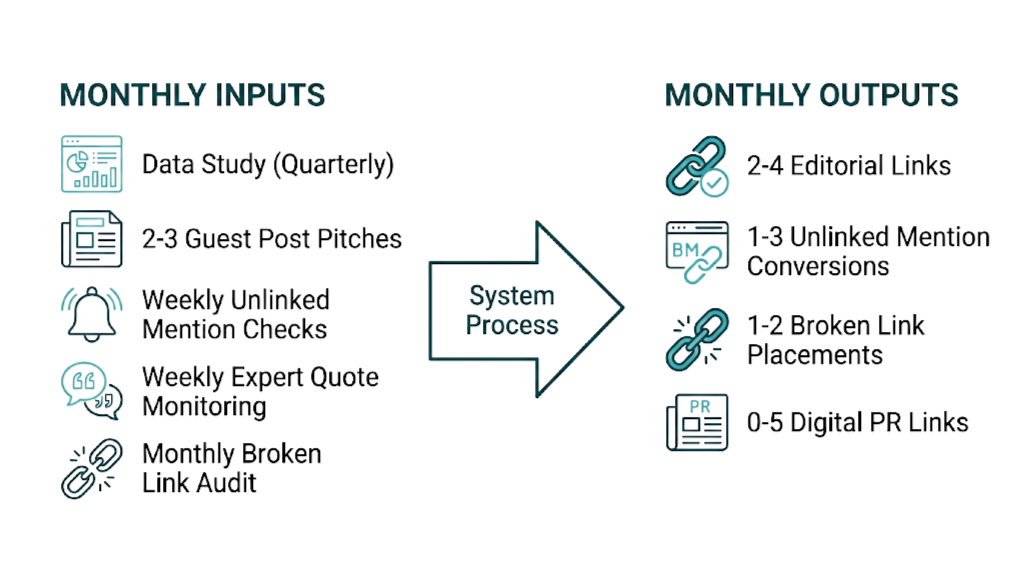
Monthly inputs:
- One original data study or survey per quarter. This feeds digital PR and sales enablement.
- 2-3 guest post pitches per month to pre-vetted, high-DR publications
- Weekly checks for unlinked brand mentions via Ahrefs Alerts
- Expert quote monitoring every week (Connectively, Featured.com, Qwoted)
- A monthly broken link audit across 3-5 competitor domains
Monthly outputs (realistic targets):
- 2-4 editorial links from guest posts or expert quotes
- 1-3 links from unlinked mention conversion
- 1-2 links from broken link outreach
- 0-5 links from digital PR (campaign-dependent, averaged quarterly)
The tracking infrastructure:
Tracking keeps the rhythm honest. Use Ahrefs' rank tracker to correlate link acquisition events with ranking changes on target keywords. Log every outreach contact in a CRM - Notion, Airtable, or HubSpot depending on team size.
And don't stop at wins. Track link retention too: a link that disappears after 90 days carries less PageRank value than one that stays live for three years.
The feedback loop that most teams skip: After each quarter, audit which link types produced the strongest ranking correlations for your site. Not every tactic performs the same in every niche. A B2B cybersecurity brand might find that expert quote links from trade publications beat guest posts because of the topical authority of the publications involved. A consumer finance brand might find that linkable tools win because personal finance writers cite calculators constantly.
Those correlations should shape the next quarter's plan. Build the system around what the data shows, not what a generic guide recommends. Re-check it every six months as the link market in your niche shifts.
The brands that win at link building in 2026 aren't the ones with the biggest outreach budgets. They're the ones with the clearest process, consistent execution, and the discipline to measure what moves rankings instead of what looks good in a monthly report.
Frequently Asked Questions About Link Building Examples
What is a real-world example of link building that actually improved search rankings?
The RankSages eCommerce data study is one of the cleanest examples with clear documentation. They published original research on site architecture and earned 34 links from DR 70-92 publications. That was far fewer links than a parallel guest posting campaign, but it moved rankings more.
Topical relevance and editorial standards drove the lift, not raw link volume.
What happened to HARO and what are the best alternatives for earning editorial links?
HARO shut down in November 2024.
Since then, the expert-quote market has spread across Connectively, Qwoted, Featured.com, ProfNet, and #JournoRequest on X. Each platform fits different niches: Qwoted tends to fit finance and legal, Featured.com leans into thought leadership roundups, and #JournoRequest works best for fast news and trend coverage. Response speed and quote specificity decide wins across all of them.
What does a good backlink profile look like in 2026?
A healthy profile keeps anchor text in check: about 40% brand, 30% generic, 20% keyword-rich, and 10% naked URLs. Link velocity stays steady. No manufactured spikes. The link mix also matters - editorial publications, directories, educational sites, and forums should all show up.
Profiles that lean on one link type or push over-optimized anchors trigger spam risk under Google's current detection systems.
How do unlinked brand mentions affect SEO rankings?
Unlinked mentions feed entity authority more than classic PageRank.
Recent industry studies of prominent brands found branded web mentions correlate with AI search visibility at a high rate - much stronger than the standard correlation for traditional backlinks. That gives unlinked mention outreach real upside even when it doesn't turn into a hyperlink, because the mention still strengthens brand entity signals in Google's knowledge graph.
What link building tactics does Google penalize?
Google's spam policies call out several practices: large-scale guest posting campaigns with keyword-rich anchor text, paid links that pass PageRank without disclosure, link exchanges set up to manipulate rankings, and links embedded in low-quality article marketing pushed across multiple sites.
The pattern is intent. Links built to manipulate rankings get hit. Editorial links earned through strong content, expert contributions, or original research stay outside those policies.
What tools do SEO professionals use to find link building opportunities?
Ahrefs, Semrush, and Moz are the main tools for competitor backlink gap analysis, broken link discovery, and unlinked mention monitoring. Ahrefs' Link Intersect and Content Explorer stand out for gap analysis and linkable asset research. Semrush's Backlink Gap and Brand Monitoring cover the same jobs with a different UI.
For outreach infrastructure, Hunter.io handles contact finding. Pitchbox or Respona run campaign workflows at scale.
related Blog Posts



Join 2,600+ Businesses Growing with Rhino Rank
Sign Up
Keep Reading
Stay ahead of the SEO curve
Get the latest link building strategies, SEO tips and industry insights delivered straight to your inbox.