
 Back to all posts

How does a search engine work? Crawl, index, rank
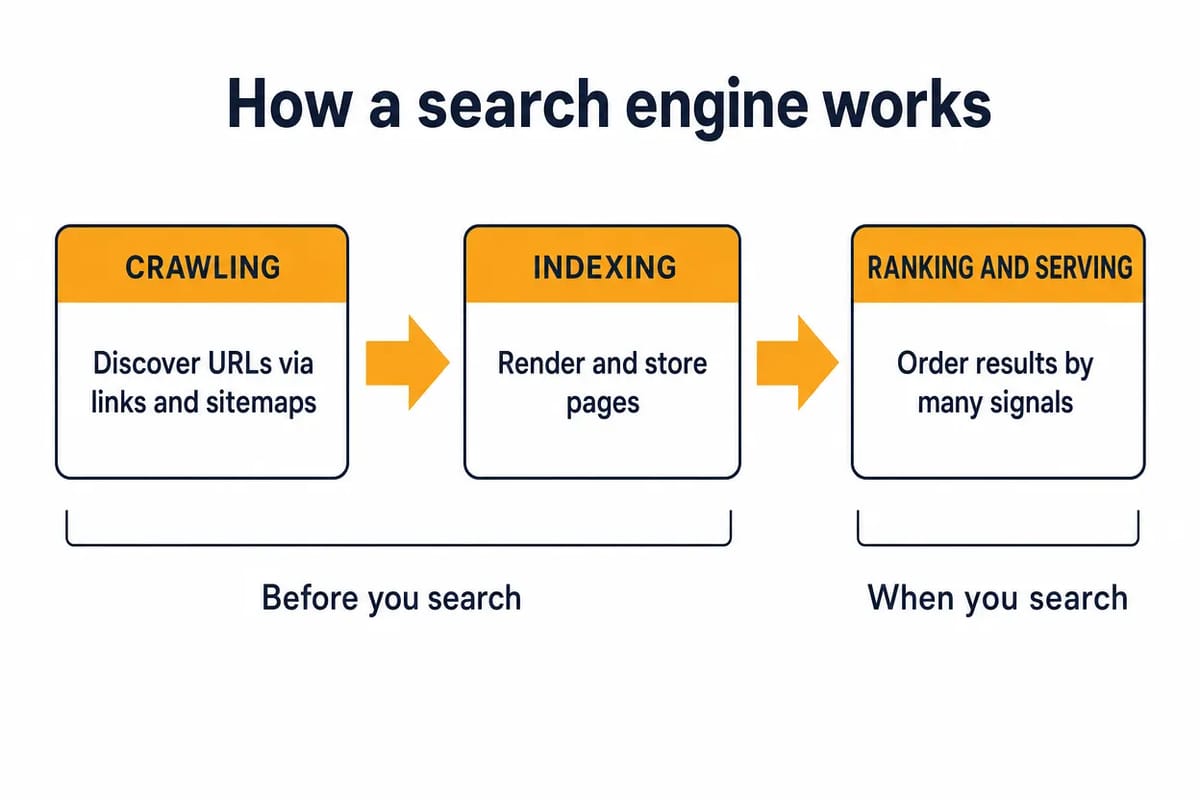
A search engine crawls the web to discover pages, indexes what it finds, then ranks and serves the most relevant, highest-quality results for each query. Google Search is the reference example because its own documentation breaks Search into crawling, indexing and serving results. Discovery happens before you search. Ranking happens when you search.
Key takeaways
- Search engines work in three broad stages: they crawl URLs, index page content, then rank and serve results from that index at query time.
- Google uses automated ranking systems that weigh many signals, including query meaning, page relevance, content quality, usability, links and searcher context.
- Links still matter because they help search engines discover pages and judge authority, but they are one signal category among many.
What is a search engine?
A search engine is a retrieval system for the web. It helps you move from a query to a set of pages, images, videos, products, local results or AI-generated summaries that may answer that query.
The important point is that a search engine does not start from a blank internet each time you type. It has already discovered and processed a large set of URLs. When you search, the engine looks inside that stored index and chooses which results to show.
That is why Google's three-stage model is useful for marketers and site owners. It separates discovery from storage, and storage from ranking. A page can be live but not crawled. It can be crawled but not indexed. It can be indexed but not served for the query you care about.
Crawling: how search engines discover URLs
Crawling is the discovery stage. Googlebot and other web crawlers fetch URLs so the search engine can see what exists, what has changed and which links point elsewhere.
Google discovers URLs in a few main ways. It follows links from pages it already knows. It reads XML sitemaps that site owners submit or expose. It may also find URLs through other discovery paths, but links and sitemaps are the practical controls most site owners can influence.
This happens continuously, not on demand for each search. When someone searches for "best running shoes", Google is not crawling the web from scratch in that moment. It is serving from systems that have already crawled, rendered and indexed pages over time.
Think of a sitemap as a clean list of URLs you want crawlers to know about. It is useful for new sites, large sites, media-heavy sites and sites where important pages may not be reached quickly through normal links. It is not a command. A URL in a sitemap can still be ignored, crawled later, canonicalised to another URL or left out of the index.
Internal links carry more meaning than many site owners give them credit for. A page linked from the main navigation, a relevant hub page or a fresh article is easier for crawlers to discover than a page buried with no clear path from the rest of the site. If a page matters commercially, it should not depend on a sitemap alone.
For a normal site, the most useful crawl setup is simple. Make important pages reachable through internal links. Keep your XML sitemap clean and current. Avoid hiding key links behind interactions that crawlers cannot follow. Fix server errors that waste crawler time.
robots.txt is a crawl-control file, not a private vault. It tells compliant crawlers which paths they may access, and it can help manage crawl traffic on sections that do not need crawling. It is not a reliable way to keep a URL out of Google results. If a page must not appear in search, use a noindex directive or proper access control.
That distinction matters in audits. A URL blocked by robots.txt may still be known to Google if other pages link to it. Google may be unable to crawl the page content, but the URL itself has not been made private. Use robots.txt to manage access for crawlers. Use indexing controls or authentication when appearance in search is the real issue.
Crawl budget is real, but it is often overplayed. Google's own crawl-budget guidance is mainly for very large sites, fast-changing sites or sites with many URL variants. If you run a smaller site, clear architecture, clean sitemaps, stable servers and index coverage monitoring usually matter more than trying to micromanage every crawl.
In practice, when we place a link on an existing page, discovery depends heavily on that host page. I've seen a busy, often-updated page get recrawled quickly, while a stale page can sit untouched for a long stretch. That is why crawl frequency matters: the link exists for people as soon as it is live, but Google still has to revisit the page before it can discover and process it.
Indexing: how search engines store and interpret pages
Indexing is where a search engine analyses a crawled page and decides what to store. The index is not a simple copy of the page. It includes content, metadata, signals about the page, relationships to other URLs and Google's view of which version should represent a set of duplicates.
For modern pages, rendering is part of this process. Google Search runs JavaScript with an evergreen Chromium-based renderer, so it can process many pages that rely on client-side rendering. The cleaner model is crawling, rendering and indexing. Avoid the old idea that JavaScript is always handled in a separate delayed wave.
That does not mean JavaScript is harmless. If your primary content or links only appear after a script fails, requires user action or blocks rendering, Google may not see the page as users do. Important text and links should be available in a way that crawlers can render and follow reliably.
During indexing, Google tries to understand the main content of the page, the title, headings, media context, language, visible links and metadata. It also has to separate the main page from boilerplate such as navigation, sidebars and repeated footer content. A clean template helps because the useful content is easier to identify.
Canonicalisation is another indexing decision. When Google finds duplicate or very similar pages, it chooses a canonical URL to represent that content. You can send signals with redirects, rel="canonical" tags and sitemap inclusion, but Google can still choose a different canonical if its systems think another URL is a better representative. The goal is to consolidate signals to the right version rather than split them across duplicates.
Canonicalisation is not only for exact duplicates. It can also affect filter URLs, tracking-parameter URLs, print versions, tag pages and product variants with very similar copy. If your canonical signals conflict, Google has to choose. That can leave the wrong URL indexed, or make it look as if the page you care about has disappeared.
Mobile-first indexing also belongs here. Google predominantly uses the mobile version of a page's content for indexing and ranking, crawled with the smartphone agent. That is different from saying mobile-friendly pages are automatically pushed above others. The practical requirement is parity: the mobile page should carry the same main content, metadata, structured data and useful internal links as the desktop version.
Indexing is not guaranteed after a crawl. A search engine can crawl a URL and still decide not to index it because the content is thin, duplicated, blocked, low value, canonicalised elsewhere or technically difficult to process. The crawl log tells you Google reached the URL. It does not prove the URL has earned a place in the index.
That is why index coverage is a better diagnostic than raw crawl activity. A server log can prove that Googlebot visited a URL. Search Console can show whether Google selected a canonical, indexed the page, excluded it or discovered it without indexing. Those states point to different fixes.
Ranking and serving search results
Serving is the query-time stage. When you search, Google looks through its index and uses automated ranking systems to order results. Those systems weigh many factors and signals. It is more accurate to think in terms of ranking systems than one single algorithm.
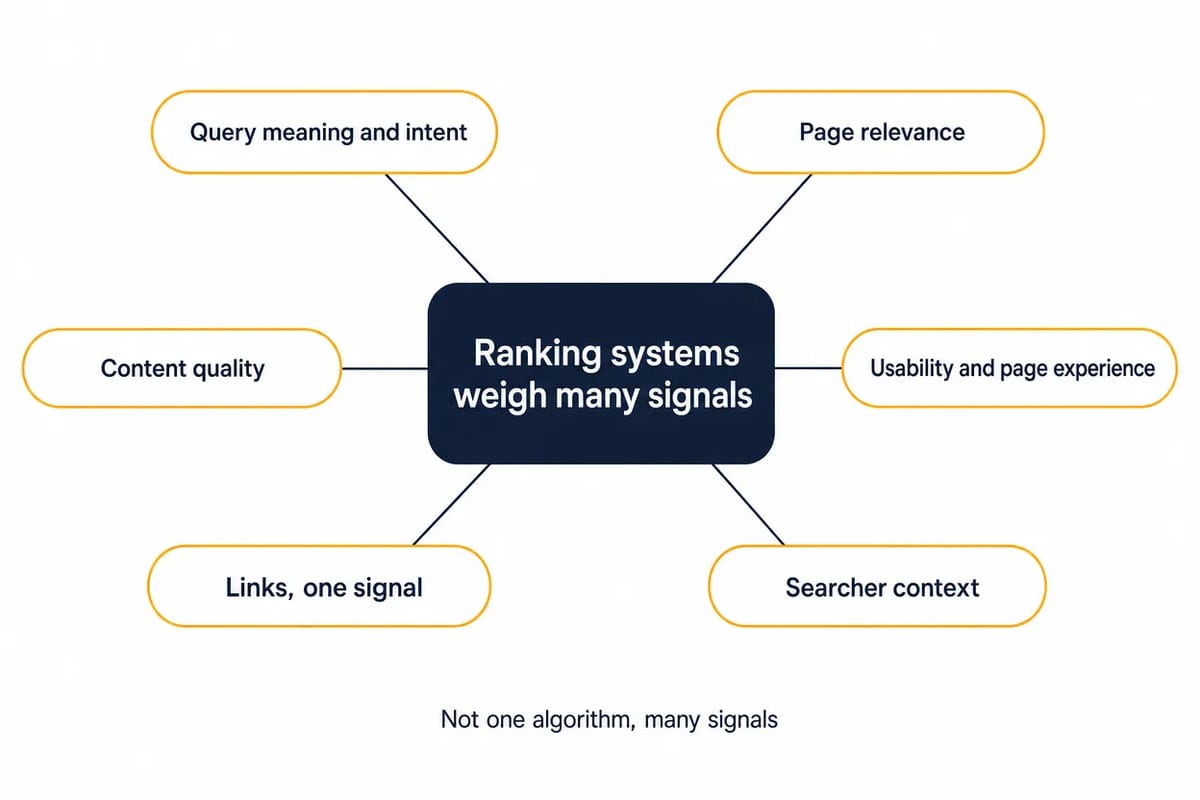
The first job is understanding the query. Google's systems interpret the words, likely meaning, intent, freshness need and language. A query like "pizza near me" needs local results. A query about a recent product recall needs fresher information. A query with a specific brand or URL pattern may need navigational results.
The next job is matching pages to that meaning. Page relevance still matters, so clear titles, headings and body copy help search systems understand what a page covers. Keywords are part of that, but they are not a mechanical lever. Repeating a phrase will not make a weak page useful.
Intent changes the shape of the results. An informational query may reward a clear explanation. A commercial query may need comparison pages, product detail or service pages. A local query may need map results and nearby businesses. Ranking systems are trying to satisfy the task behind the words, not just match the words themselves.
Quality is broader than polish. Google's quality framing points toward helpful, reliable, people-first content: clear sourcing, first-hand knowledge where it matters, accurate explanations and a page that satisfies the query without making the reader work around clutter. This is why organic SEO and better rankings depend on the whole page, not a single ranking factor.
Links are one signal family. Google's link analysis, including PageRank as part of its core ranking systems, helps assess relationships and authority across the web. A relevant editorial link can also help discovery and topic understanding. When you are earning quality backlinks, the link is strongest when the source page, anchor, surrounding context and destination all make sense together.
Usability and page experience can influence serving too. A page that loads poorly, blocks the main content, fails on mobile or creates a frustrating experience gives ranking systems less confidence, especially when there are better alternatives.
Context also changes what gets served. Google may adapt results by location, language, device and other search context. That does not mean every result is deeply personalised. It means the same query can need a different answer for a user in Manchester, a user in New York or a user searching from a phone.
Freshness depends on the query. Some searches need the latest information because the answer changes quickly. Others are stable, so an older page can still rank if it remains accurate and useful. Treat freshness as part of query intent, not as a rule that every page must be recently updated to perform.
Serving is never guaranteed for any page. Being indexed gives a page the chance to appear. Ranking depends on the query, competitors, result type, quality signals, freshness needs and Google's judgement of what will help the searcher most.
How modern search results surface answers
Classic blue links are still part of search, but they now sit beside richer result formats. The mechanics still start with crawling and indexing. The presentation layer has changed.
Helpful, people-first content is handled through Google's core ranking systems. The March 2024 core update folded helpfulness into those systems, so there is no single standalone helpful-content switch to optimise for. The practical advice is steadier: write for the person behind the query, show how you know what you know, cite clearly when claims need support and avoid pages built mainly to catch search traffic.
Featured snippets are elevated regular search results. Google's systems choose a passage or section from a page that already ranks and display it above or within the results. You cannot add a tag that makes a page a featured snippet. You can only make the answer clear enough that Google's systems may select it.
AI Overviews and AI Mode are the current Google terms for AI-powered Search experiences. AI Overviews are a core Search feature in many countries, including the United States and the United Kingdom, and they generate an AI snapshot with supporting links. The same SEO fundamentals apply: a page must be indexed and eligible to show with a snippet before it can appear as a supporting link.
There is no special schema, AI file or separate AI-only optimisation path. Google may use query fan-out and can surface a wider set of supporting links than classic web results, so you should not assume AI Overviews only cite the top organic listings. If you want the mechanics behind those links, the useful question is how AI Overviews choose their citations, not how to chase a separate AI ranking system.
Search engines beyond Google
Google is the dominant global search engine. StatCounter's global market-share data put Google at around 90% of the market as of mid-2026, though the exact share moves by month, country and device.
Bing is Microsoft's search engine and also powers some other search experiences. Its mechanics still follow the same broad pattern: discover pages, store an index, then rank results for each query.
DuckDuckGo is a privacy-first search engine. Its public privacy positioning is built around not saving search history or building personal profiles from searches. That changes the privacy model, not the basic need to retrieve relevant results.
Brave Search is private by default and directionally different because it has its own independent crawler and index. That matters because many alternative search products rely partly or fully on another engine's results.
Ecosia is a search engine with an environmental model, directing ad profit towards tree planting and climate projects. For the user, it still returns web results through a search interface; the difference is the business model attached to the search.
Baidu and Yandex are best understood as regional leaders, with Baidu central to search in China and Yandex important in Russia. Privacy engines and AI-native answer tools also exist, but product feature lists change quickly. The durable point is that most search systems still need discovery, storage and query-time retrieval, even when the interface looks different.
How to use the three-stage model
The three-stage model is useful when a page will not show, or when it ranks far below where you expect. Work through the system in order. Do not start with ranking theories if Google has not found or indexed the page.
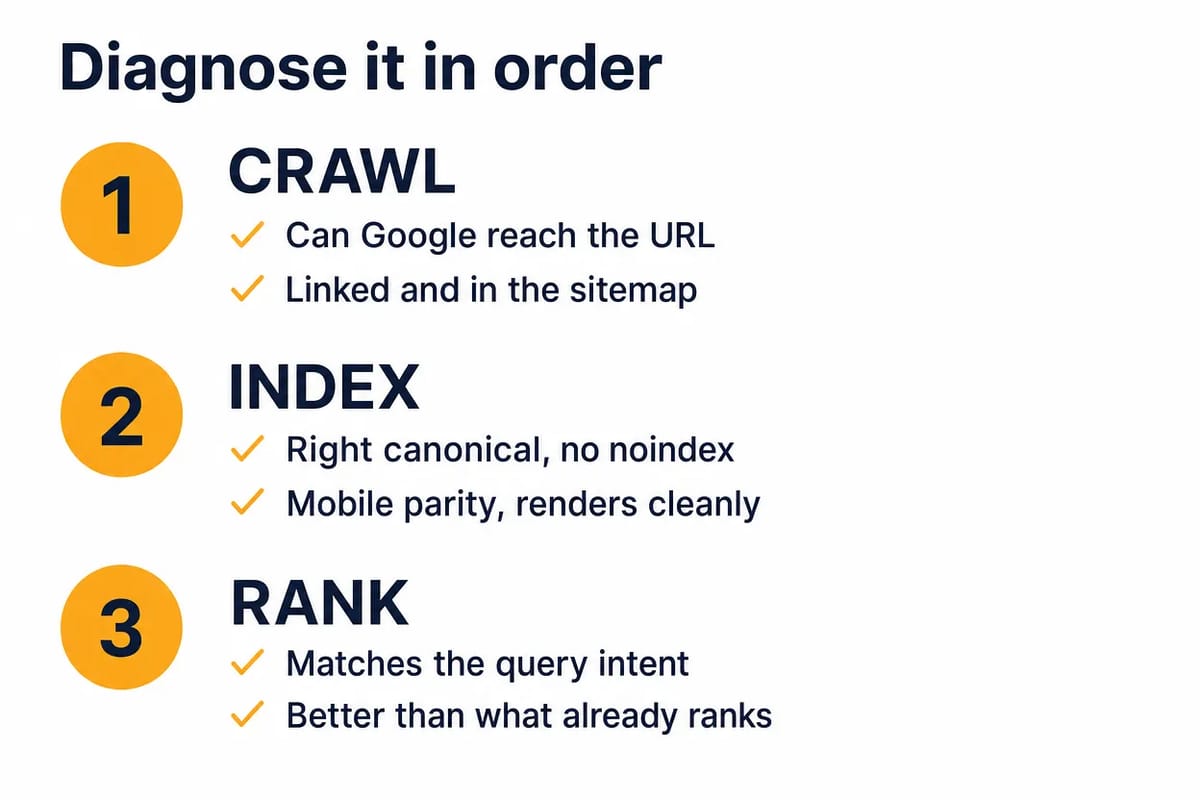
Start by checking crawl access. Can Google reach the URL? Is the page linked from the site? Is it in the sitemap? Does the server return a clean page? Is robots.txt blocking a path that should be open?
Then check what Google indexed. Has Google selected the URL you want, or has it chosen another canonical? Is there a noindex tag? Does the mobile page carry the same main copy and links as desktop? Can the main content render without a failed script?
Only then move to ranking. Does the page match the task behind the query? Is the answer clear enough? Is the page useful enough compared with the results that already rank? Does it have links, citations or brand proof that support trust?
This order saves wasted work. A crawl issue needs a crawl fix. An index issue needs an index fix. A ranking issue needs a better reason for Google to serve the page.
Summary
A search engine works by separating the web into stages. Crawling discovers URLs across the web. Indexing processes, renders, stores and canonicalises what the crawler found. Ranking and serving happen later, when a user searches and the engine orders results from the index.
For site owners, that sequence is useful because it shows where problems happen. If Google cannot crawl a page, it cannot process it. If Google processes a page but does not index it, rankings cannot follow. If the page is indexed but weak for the query, ranking systems may choose better results.
The best practical model is not "beat the algorithm". It is make the page discoverable, make the important content easy to index, then give ranking systems a strong reason to serve it for the right query.
Frequently asked questions
What is a search engine?
A search engine is a system that helps users find information on the web. It discovers URLs, stores information about pages in an index, then returns results that its systems judge relevant to the query.
How does a search engine work?
A search engine crawls pages, indexes the content it can process, then ranks and serves results from that index when someone searches. Results may be adapted by context such as location, language or device, but they are not always personally customised.
What is the difference between a browser and a search engine?
A browser is the software you use to visit websites, such as Chrome, Safari, Edge or Firefox. A search engine is a service you use inside a browser or app to find pages and answers.
How do search engines discover new URLs?
Search engines discover new URLs by following links from pages they already know and by reading XML sitemaps. Site owners can also submit URLs or sitemaps through search-engine tools, but discovery does not guarantee indexing.
What is the role of web crawlers in search engines?
Web crawlers fetch pages so search engines can discover content, links and changes over time. The crawler supplies raw material for rendering and indexing; ranking happens later when a query is served.
Every fact and commercial claim in this guide was fact checked and verified on 9 July 2026.
related Blog Posts




Join 7,000+ Clients Growing with Rhino Rank
Sign Up


Stay ahead of the SEO curve
Get the latest link building strategies, SEO tips and industry insights delivered straight to your inbox.