
 Back to all posts

PBN stands for private blog network. Wikipedia gives the definition in one sentence: "A private blog network (PBN) is a group of blogs that are owned by the same entity." The network exists to send links to sites outside it, and a PBN backlink is one of those links: a link from a site inside the network to the site the network was built to help.
The test we apply to any link is readers. A network site is a page nobody reads with a link on it. A publication with readers that carries a mention is a different thing, and telling the two apart is the job we do on every Curated Link and Guest Post order we fulfil. This page explains what a private blog network is, how networks are built from expired domains, what one site owner saw in September 2014, the signs we look for, and what we do when network links already point at a site.
Quick answer
A private blog network is a set of sites that one owner or seller controls, built to link to chosen target sites while looking independent. The word "private" does a lot of work. The sites may not openly say they are connected, and the target site may appear to be receiving an independent editorial link.
A normal backlink is a citation, recommendation or reference from one site to another. A PBN link is different because the relationship is usually controlled. The site was chosen because the owner controls it, not because an editor with readers found the page useful.
We do not place on networks. A Curated Link or a Guest Post sits on a publication with readers, and the publisher passes the same checks every time. The rest of this page shows how we tell the two apart.
What a private blog network is
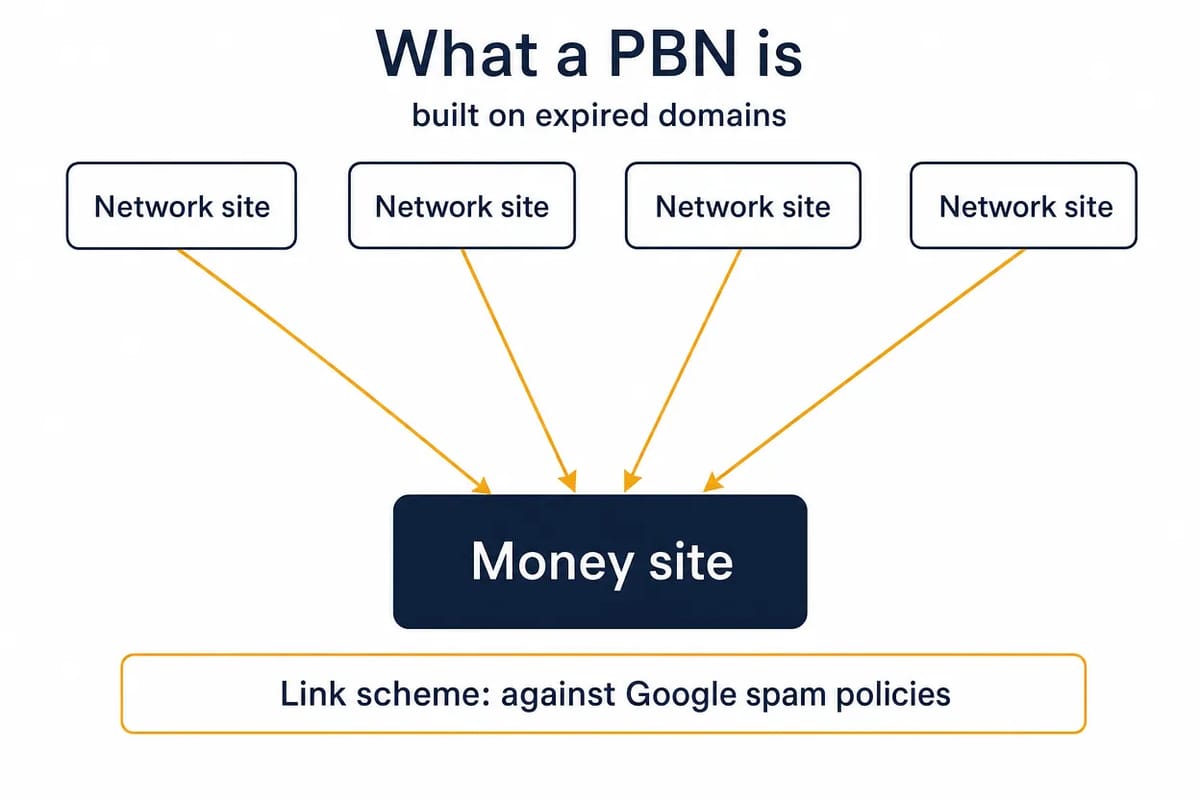
Wikipedia says the purpose of such a network "is usually to promote other sites outside the network". The links point out: the network exists for the benefit of sites beyond itself. Common control is the definition, and hidden common control is the usual practice. One thing the term does not cover is a hosted blog on a platform subdomain: Wikipedia treats that arrangement as a hosted blog platform, and the two should not be mixed.
PBNs are not new. They became popular because links matter, older domains can have existing backlink history, and some site owners want more control than ordinary outreach gives them. Wikipedia's dated line runs: "In September 2014, Google targeted private blog networks (PBNs) with manual action ranking penalties." What that wave looked like for one site owner is in the September 2014 section below.
The letters matter to a buyer because of what sits behind them: a site with no audience, an owner who is not an editor, and, in some networks, a domain bought for the links it already had. That last part is the next section.
How networks are built: expired domains
An expired domain is a domain name that was registered before, then not renewed by its owner. Bill Hartzer, writing on his own site on 2 April 2024, gives the usual timing as he describes it: a grace period of typically 30 days, a redemption period of another 30 days, then a pending delete period of another 30 days, after which the domain drops. GoDaddy's auctions, he writes, start 30 days after the expiration date.
Once a name drops, anyone can register it, and Hartzer's sentence on what happens next is this: "Some more ‘enterprising’ SEOs may use the expired domain names to build private networks of websites to help influence their main websites’ search engine rankings". The old domain may still have links from other websites, and the network operator is trying to redirect that inherited authority into new links for a different site. The new site is not the old site: the links were earned by a page that no longer exists.
Hartzer has also written up a test of what happens after re-registration. In a post dated 9 February 2026 he describes a month-long test on domains that had completely expired, been released and become available to register again, not auction wins and not pre-release names. Of those domains, he reports: "72.7 percent were crawled and indexed quickly, usually within a few days. The other 27.3 percent were not crawled or indexed after about a week." He does not say how many domains were in the test, so read the percentages as his account of one run, not as an industry rate.
The raw material is abundant. The Domain Name Industry Brief for Q2 2026 counts 401.6 million domain name registrations across all top-level domains at the end of the quarter, with new .com and .net registrations of 12.7 million in the quarter and a preliminary combined renewal percentage for .com and .net of 75.2%.
The Domain Name Industry Brief reports a renewal percentage, not a count of names that dropped or were bought back. Names that are not renewed are the raw material. A domain that changes hands is not a network by itself; what makes it one is the absence of readers on the rebuilt site.
What happened in September 2014
One first-hand account comes from Spencer Haws, writing on Niche Pursuits about the networks he and Perrin used for their own niche sites. The post describes the events of 18 September 2014, and the page was last updated on 9 March 2022. In his words: "Then on September 18th, the Google hammer slammed down on some of my sites. Several of my niche sites have now dropped by as much as 80 to 90% in traffic over the weekend."
The useful detail is the split inside one account: "For example, in my webmaster tools account, I have 9 sites. Five of those sites received the “thin content” manual action. All five of those sites used private blog networks." And the other half: "The remaining 4 sites in my webmaster tools account did NOT receive any penalty and continue to perform well in the search engines. None of these 4 sites used PBN links."
Haws put numbers on it. About 10 or so of his sites were hit, which he put at about $5,000 a month in lost income. Separately: "Perrin's site had been earning between $3,000 to $4,000 a month for the past several months".
What he describes is the product in use: network links pointing at sites one person owned, and a report that showed the difference between the sites that used them and the sites that did not. That is why every site that carries a Curated Link or Guest Post from Rhino Rank has readers first.
What a network link buys
The pitch is real. You get control over placement, page choice and the anchor text used for your link. You do not have to wait for an editor to reply. You can ask for a link to a commercial page that a normal publication may not want to cite.
If you are trying to rank in a highly competitive niche, the promise of fast, controlled links can feel easier than months of outreach. Regulated, adult, gambling and crypto niches face extra publisher resistance, which is where networks are pitched hardest.
The sellers publish their prices. Sir Links Alot sells 12-month homepage rentals priced by DR band: $160 a year for a DR 0 to 10 domain, rising to $525 for DR 31 and above, with an inner-page post at $45. SEO.Domains says its network "consists of over 6000 websites" with "500 new ones monthly", and that it sells "just 10 links per one homepage". Payman Taei of Respona, writing on 8 July 2026, puts the pitch as: "A single PBN link sounds like a deal at $1-5 each."
What the money buys is a page on a site with no audience, on a domain whose links were earned by a previous owner, under ownership you cannot inspect, next to other buyers you cannot see. You may not know who else is linked from the same network, how many sites share ownership, or whether the content has a real audience. The money is the least of it. The page has no readers, so the link has no reader either.
The Rhino Rank route is not a secret. A Curated Link is a mention added to an existing indexed page on a site chosen for relevance, referring domains, DA and organic traffic. It is priced from $60 per link at 20 to 100 referring domains up to $210 at 1,000 and above, with a delivery target of 14 to 21 days. A Guest Post is a new 750+ word article on a publication with readers, from $75 at DA10+ to $400 at DA60+.
Every publisher passes the same checks before a Curated Link or Guest Post order goes out: indexed pages, organic traffic and its trend, DA cross-checked with DR, referring domains, no networks, the link in the body, and a human signs off. After publication we check the page is live, the anchor and URL match the order and the page is indexable, and if a delivered link is removed or the page comes down we replace it like for like for 12 months.
Our guest post page says it in one line: "A high DA figure on an empty site is still an empty site." When you compare link building services, compare them by how each vendor checks the publisher: readers, in-body placement, no networks. The full list of checks is on our link building quality assurance page.
Signs a link came from a network
No single sign proves that a backlink came from a private network. Treat these as prompts for a look, not as proof.
- Very little organic traffic or visible audience: the site has no readers.
- The link sits in a paragraph that has no reason to mention the page, or that could have been written for almost any buyer.
- The domain's old links are about one topic and the current site has been rebuilt into another, the expired-domain pattern described above.
- Several sites share the same template, the same article format and the same outbound-link habit.
- No editorial focus: unrelated topics on one site, each carrying a commercial link.
- Anchor text that reads like a keyword list on link after link, where an editor would have written a sentence.
One prompt is a look; a pattern is a network. Any one of these signs can have an ordinary explanation on a single domain. The same signs repeating across several linking domains is the shape we walk away from before a Curated Link or Guest Post is placed.
How to check whether network links point at your site
Start with your backlink data. Google Search Console's links report shows links Google has found pointing at your site, and third-party indexes such as Ahrefs Site Explorer, Ahrefs Backlink Checker and Semrush's Backlink Audit tool give a wider view of referring pages, anchors and trends. Use those tools to build a review list, then inspect the pages manually. The tool can tell you where the link exists. It cannot always tell you why it exists.
Scores can sort the list, and the figures here were checked on 24 September 2026. Semrush's Toxicity Score runs on a scale of 0 to 100 and is built from what Semrush calls 45+ Toxic Markers. Citation Flow, in Majestic's words, "goes beyond raw backlink counts to look at the wider link network, such as the sites linking into the sites that link to you and the sites that link to them and so on…". Majestic's Trust Flow is built from a seed set of human-curated sites, and its Topical Trust Flow rests on what Majestic describes as "Over 800 pools of sites" that have been identified and classified.
Those labels are useful triage signals. They are not Google telling you that a specific link is toxic or ignored, and none of them is a network detector.
Our own checks work in both directions. On every Curated Link or Guest Post publisher we look at indexed pages, organic traffic and its trend, DA cross-checked with DR, referring domains, whether the site belongs to a network, and whether the link sits in the body of the page. The same look answers the question for a link that already points at you: open the page, read it, and ask whether anyone else does.
A site can pick up odd links without asking for them. Scrapers, low-quality directories and automated sites link out all the time. Do not panic because one strange domain appears in a report. What matters is the shape of the whole backlink profile: the thing to look for is a pattern of network sites, not a single odd domain and not an invoice.
What to do if network links already point at your site
First, document what you have found. Keep the linking page, target page, anchor text, date found and why the link looks suspicious. If an agency or seller built the links, ask for a plain explanation of where they came from.
Second, stop adding more of the same. A clean-up while the same network links keep arriving is not a clean-up.
Third, remove where you can. If you control the linking sites, remove the network links. If a supplier placed them, ask for removal. If the sites are anonymous, abandoned or unresponsive, removal may not be possible.
Fourth, the disavow tool. Google's disavow help page says that in most cases Google can assess which links to trust without additional guidance, so "most sites will not need to use this tool", and gives two conditions for using it:
"You have a considerable number of spammy, artificial, or low-quality links pointing to your site, AND"
"The links have caused a manual action, or likely will cause a manual action, on your site."
Curated Links and Guest Posts are never placed on networks. If network links from a previous supplier already point at your site, run a link audit first, separate the network sites from the real citations, and file a disavow only when both conditions are met. The risk we manage is publisher quality, not the fact that a link was paid for.
If you already have a manual action, follow the manual-action guidance in Search Console, clean up what you can, document the work, and submit the reconsideration request there. If you do not have a manual action, be measured. Over-disavowing every link that looks odd can create its own mess. If you would rather someone else handled your link building, our Managed Service starts at $250 a month.
PBN backlinks vs link farms
PBNs and link farms are related, but they are not the same thing.
A link farm is usually a group of sites or pages that link heavily to each other or to many external sites with little editorial purpose: a broader and noisier pattern. A private network is usually more targeted. It is set up to pass links to one or more chosen sites while trying to look independent. When you inspect it, the linking sites may not openly link to each other, and the target site may sit outside the network.
The side-by-side table, with a publication as the third column and readers as the line between them, is on our link farm guide, along with the Penguin history. Neither carries a Curated Link or a Guest Post from Rhino Rank.
Frequently asked questions
What is a PBN?
A PBN is a private blog network: a group of blogs owned by the same entity and used to send links to sites outside the network. The sites are controlled by one owner or seller, and they usually do not advertise the connection.
What are PBN links?
PBN links are the backlinks that come out of a private blog network. Each one is a link from a controlled site to a chosen target, placed because the owner controls the site rather than because an editor chose the reference.
Are PBN links good for SEO?
A network link is a link from a page nobody reads. What moved for Spencer Haws, a niche site owner, in September 2014 moved the wrong way: several of his sites that used network links lost as much as 80 to 90% of their traffic, while the four sites in his account that did not use them kept performing. The Curated Links and Guest Posts we place sit on publications with readers, which is where a link does its work.
Why do people use PBN backlinks?
Mostly for control: control over placement, anchors and timing, without waiting for an editor to reply. Networks are also pitched hardest in niches where editorial links are hard to earn. The cost is a site with no audience under ownership you cannot inspect.
What does a PBN backlink cost?
One seller's published list runs from $45 for a single inner-page post to $525 a year for a homepage rental, priced by the site's DR band. A Curated Link starts at $60, and a Guest Post at $75. The difference is not the price; it is whether anyone reads the page.
Should I disavow PBN links?
Only when Google's two conditions are met: a considerable number of spammy, artificial or low-quality links pointing at your site, and a manual action caused or likely to be caused. Review the profile first, because odd links accumulate on their own. For isolated strange links, restraint is usually the better course. We do not place Curated Links or Guest Posts on networks, and the risk we manage is publisher quality, not the fact that a link was paid for.
What is the difference between a PBN and a link farm?
Shape. A link farm is broad and often reciprocal, a noisy cluster with no single target. A private blog network is privately controlled, hides its common ownership and points at chosen sites. Neither carries a Curated Link or a Guest Post from Rhino Rank.
related Blog Posts




Join 7,000+ Clients Growing with Rhino Rank
Sign Up


Stay ahead of the SEO curve
Get the latest link building strategies, SEO tips and industry insights delivered straight to your inbox.