
 Back to all posts
Most sites don't have a traffic problem. They have a sequencing problem. The tactics exist, the tools exist, and the advice is everywhere - but most site owners and SEO managers run the right plays in the wrong order. Budget gets burned. Momentum dies. Teams push channels that won't compound before the ones that will. Traffic stays flat for predictable reasons.
The data backs this up. According to Ahrefs' large-scale study of over one billion web pages, 96.55% of pages receive zero organic traffic from Google. Not low traffic. Zero. That's not a content quality crisis - it's an execution crisis. Pages fail because they lack backlinks, target the wrong keywords, ignore technical fundamentals, or skip the distribution steps that turn a published article into a ranking asset.
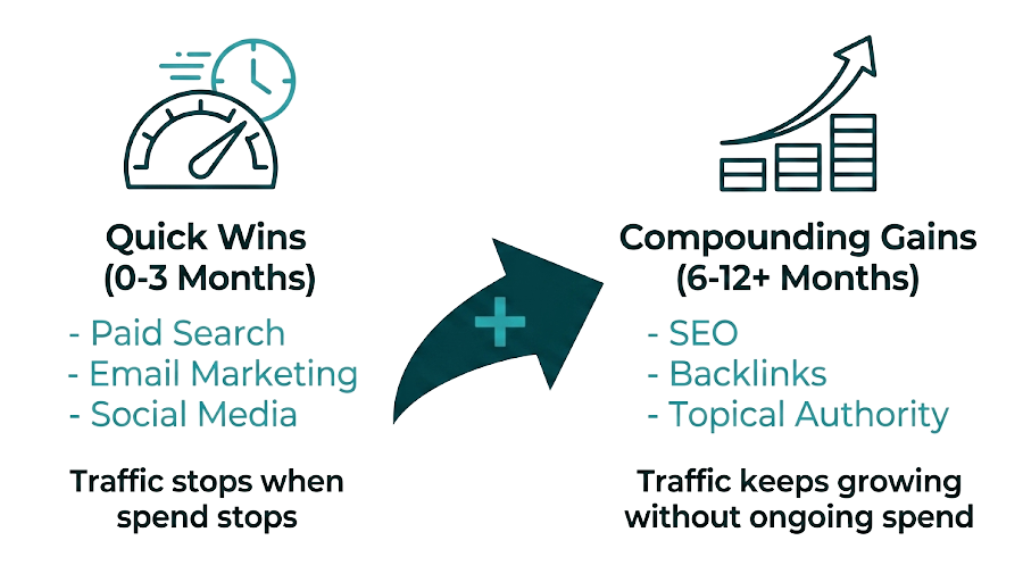
BLUF: The fastest way to increase website traffic is to sequence your efforts correctly. Quick wins come from paid search, email, and social. Compounding gains come from SEO, backlinks, and topical authority. This playbook covers 20 strategies across both timescales - prioritized by impact, grounded in data, and built for SEO managers, marketing directors, and agency owners who need results they can defend in a board meeting. BrightEdge's channel performance research shows organic search drives 53% of all trackable web traffic. That's the channel worth building - but it takes time, and you need a bridge to get there.
Why Most Traffic Strategies Fail (And What Actually Moves the Needle in 2025)
The problem with most "how to increase website traffic" guides is that they treat all tactics as equal. Publish a blog post. Share it on social. Run some ads. Get backlinks. Same checklist, different wrapper. Without sequencing, teams spread effort across a dozen channels and get meaningful results from none.
The sites that grow consistently share one trait: they prioritize ruthlessly. They separate tactics that compound over time from tactics that need ongoing spend to keep traffic coming. SEO, backlinks, and content clusters compound. Paid ads and social posts don't - the moment the spend stops, the traffic stops too.
In 2025, three forces are reshaping how traffic flows across the web. Google's AI Overviews now show up for a large share of commercial and informational queries, so the path from search to click looks different. Page-one rankings still matter, but they don't guarantee clicks if your content isn't built to feed AI-generated summaries. Topical authority has replaced keyword stuffing as the dominant on-page signal - Google rewards sites that cover a subject end-to-end, not sites that repeat a phrase. Core Web Vitals remain a confirmed ranking signal, and slow sites keep losing ground to faster competitors even when the content is strong.
The tactics that move the needle aren't new. The difference is sequencing, how far you take each tactic before moving on, and whether you track compounding returns instead of channel-by-channel noise. That gap separates a site growing 40% year-over-year from one stuck at the same traffic level for 18 months. This guide gives you the sequenced playbook.
SEO Strategies That Drive Compounding Organic Traffic
Organic search is the highest-ROI traffic channel available to most businesses. The strategies below build on each other - nail them in order and the compounding effect keeps paying back.
1. Build Topical Authority With a Structured Content Cluster Strategy
Topical authority is the principle that Google ranks sites higher when they show broad, connected coverage of a subject - not just individual pages chasing isolated keywords. A content cluster is how you put that principle into practice: one central "pillar" page covers the main topic, and a network of supporting cluster pages covers specific subtopics, all internally linked back to the pillar.
Consider a B2B SaaS company selling project management software. Instead of publishing isolated posts about "Gantt charts" and "team collaboration tips," a cluster strategy builds a pillar page on "project management methodology" and surrounds it with cluster content covering Agile, Scrum, Kanban, sprint planning, and resource allocation - each piece linking back to the pillar. Google crawls those internal links, maps the relationships between topics, and starts treating the site as an authority on the subject. Rankings lift across the entire cluster, not just the pillar.
The build process looks like this:
- Identify your core topic - what your business can speak to with authority and what you actually want to sell against in search
- Subtopic mapping via Ahrefs or Semrush: related queries, questions, and long-tail variations
- Build the pillar page first - aim for 2,500+ words and target the head keyword
- Publish cluster content in a cadence you can sustain. One subtopic at a time, and always link back to the pillar.
- Update the pillar as new pieces go live, so it links out to every cluster page
The Semrush 2024 State of Content Marketing report identifies topical authority as a primary driver of organic growth, particularly for sites competing in crowded niches. The compounding effect holds up in practice: as your cluster expands, each new piece strengthens the authority of what you already published. A site with 15 tightly linked cluster pages around a topic will outrank a site with one excellent standalone post - almost every time. Understanding the power of internal link building is what makes this cluster architecture hold together at scale.
2. Target Long-Tail Keywords With High Commercial Intent
Head keywords like "project management software" pull huge volume and bring near-impossible competition. A mid-market SaaS team spending $3k/month on content won't outrank Asana and Monday.com for those terms. But "project management software for remote construction teams" - that's a different conversation.
Long-tail keywords are search phrases of three or more words. Each one gets less volume, but the intent skews closer to a purchase and the keyword difficulty drops. A site targeting 50 long-tail keywords, each driving 100 monthly visits, builds a more defensible traffic base than a site gambling everything on one high-volume term.
That defensible base comes from intent. Long-tail searchers already narrowed what they want. Someone searching "best CRM for independent financial advisors" sits closer to a buying decision than someone searching "what is a CRM." That specificity shows up in conversion rates, and conversion rates justify the content spend.
To find high-value long-tail targets:
- Ahrefs: use the "Questions" filter to pull intent-heavy queries in our niche.
- Google Search Console queries where we already rank on pages 2-3. Fast wins.
- Semrush keyword gap to spot competitor content gaps.
- "People Also Ask" boxes. Good for building clusters worth covering.
Those clusters also belong inside the page, not just as standalone articles. One underused tactic is adding long-tail targets as FAQ sections embedded within pillar pages, which helps us grab featured snippets and "People Also Ask" placements without spinning up separate URLs. Knowing why you need to focus on long tail keywords makes the case for building this into your content strategy from the start.
3. Earn High-Authority Backlinks to Lift Your Entire Domain
Backlinko's study of 11.8 million Google search results found that the number of referring domains pointing to a page is one of the strongest correlating factors with first-page rankings. Not just for that page - referring domain authority lifts the entire site's ability to rank.
That lift comes from the backlink-traffic flywheel, and most traffic guides gloss over it. Backlinks raise rankings. Rankings bring organic traffic. Organic traffic builds brand visibility and pulls in natural links. Those natural links strengthen domain authority. The flywheel speeds up over time - but it needs a push to start.
That push means deliberate link building. The approaches that scale best:
- Guest posting on relevant, authoritative sites - publish real editorial content and earn a contextual backlink. Relevance decides the outcome. A link from a DA 50 site in our industry beats a link from a DA 70 site in an unrelated niche.
- Curated link placements - land editorial mentions inside existing high-ranking content on third-party sites. These links sit in aged, indexed pages that Google already trusts.
- Digital PR - build newsworthy assets like original data, studies, or tools that earn coverage from journalists and industry publications.
Scale is the part most teams trip over. Building 10-15 high-quality backlinks per month through manual outreach takes time and relationship capital, and it turns into a bottleneck fast. Our curated links and guest post services solve the placement problem with pre-vetted sites and delivery speed that moves domain authority metrics within a 90-day window. For agencies running multiple client campaigns at once, that ops advantage decides whether link building stays repeatable or stalls.
The compounding effect isn't linear. A site moving from 50 to 150 referring domains doesn't see 3x traffic - it often sees 8-10x, because that's where many sites cross the authority threshold needed to rank for competitive terms.
4. Optimize Title Tags and Meta Descriptions to Boost Click-Through Rate
Ranking on page one means nothing if nobody clicks. Backlinko's Google CTR study shows position 1 earns 27.6% of all clicks - but position 2 drops to 15.8%, and position 3 falls to 11%. The CTR curve is steep. A page sitting at position 3 with a stronger title tag can beat a position 1 result with a weak one.
Title tags are the single biggest on-page driver of CTR. The pattern that keeps working: lead with the primary keyword, add a specific benefit or differentiator, keep it under 60 characters. "How to Increase Website Traffic: 20 Strategies That Actually Work in 2025" beats "Website Traffic Tips" on every metric.
Meta descriptions don't directly move rankings, but they move clicks - and clicks feed ranking signals through engagement. Write meta descriptions like ad copy. Lead with the searcher's problem, follow with our solution, then add a clear action cue. Keep them under 155 characters.
Three title tag patterns worth testing:
- Number + keyword + qualifier: "7 Link Building Strategies That Drive Rankings in 2025"
- Keyword + colon + benefit: "Technical SEO Audit: How to Find and Fix Traffic Losses Fast"
- Question format for informational queries: "What Is Domain Authority and Does It Actually Affect Rankings?"
Those patterns only matter if we apply them where they count. Pull Google Search Console data for pages with high impressions but low CTR - these are the fastest wins. A title tag rewrite on a page already ranking in positions 4-8 can drive meaningful traffic gains without any extra content work. Pairing this with a review of your key SEO metrics to track ensures you're measuring the right signals before and after each change.
5. Fix Core Web Vitals and Page Speed to Stop Losing Rankings
Google's Core Web Vitals are a confirmed ranking signal. The three metrics that matter: Largest Contentful Paint (LCP) measures loading performance and should land under 2.5 seconds. Interaction to Next Paint (INP) measures responsiveness and should stay under 200 milliseconds. Cumulative Layout Shift (CLS) measures visual stability and should hold under 0.1.
Miss those thresholds and you don't just slip in the SERPs - you bleed users. Research consistently shows that a one-second delay in page load time reduces conversions by 7%. On a site generating 50,000 monthly visits at a 2% conversion rate, that turns into real revenue loss from a technical bottleneck.
That technical bottleneck usually comes down to a handful of repeat offenders. The most common Core Web Vitals failures and their fixes:
- Poor LCP: oversized images that aren't compressed or lazy-loaded. Slow server response times. Render-blocking JavaScript. Fix it with next-gen image formats like WebP, a CDN, and deferred JS loading.
- High INP: JavaScript that hogs the main thread during interactions. Audit third-party scripts, cut dead weight, and reduce main thread work.
- High CLS: images and embeds without defined dimensions, plus dynamically injected content. Lock layouts by specifying width/height attributes on images.
Start with measurement. Run your site through Google PageSpeed Insights and Google Search Console's Core Web Vitals report. Core Web Vitals work pays back fastest on pages that already pull organic traffic, so prioritize those URLs first - that's where speed fixes turn into ranking and revenue gains. If you're running WordPress, the WordPress site speed optimization guide covers the exact fixes that move these metrics fastest.
6. Optimize for Featured Snippets and Google's AI Overviews
Featured snippets and Google's AI Overviews are the biggest structural change in how search traffic gets distributed since mobile-first indexing. AI Overviews now show up across informational and commercial queries, stitching together answers from multiple sources. If you get cited in those summaries, you pick up brand exposure and referral clicks that won't map neatly to traditional organic traffic reporting.
That citation starts with snippet-style formatting. Optimizing for featured snippets means matching how Google extracts answers. Pages win snippets by answering the query directly, quickly, and in a format that fits the intent. "How to" queries tend to reward numbered lists. "What is" queries usually pull a 40-60 word definition paragraph placed directly below the H2. Comparison queries lean toward tables over prose.
That same extractability carries into AI Overviews optimization, where the basics overlap with E-E-A-T (Experience, Expertise, Authoritativeness, Trustworthiness). Google's systems reward sites that show real topical authority, clear author credentials, and clean structure that machines can parse. Tactics that hold up:
- Clear H2/H3 hierarchies that mirror how users phrase questions
- Direct-answer paragraphs immediately after each heading
- Credible sources and data points woven into the copy
- FAQ sections with concise, factual answers
Machine parsing is the throughline. AI search is expanding fast, and the teams that build topical authority and publish content in a format Google can extract now are the ones that will earn more AI-citation traffic as these systems roll out further. The full breakdown of how to rank in AI Overviews covers the structural and authority signals that matter most right now.
7. Implement Schema Markup to Enhance SERP Visibility
Google's structured data documentation describes schema markup as code that helps search engines understand the context of your content. The benefit in the SERP is the part that matters: schema markup can trigger rich results - star ratings, FAQ dropdowns, recipe cards, event listings - that take up more space and lift CTR.
Rich results change user behaviour. A page showing a 4.7-star review schema in the SERP will beat an identical page without it on CTR, even if it ranks lower. FAQ schema adds expandable dropdowns right in the result, answering questions before the click. That doesn't kill performance; it filters out low-intent clicks and sends you visitors who already match what the page offers.
The schema types with the highest traffic impact for most B2B and content sites:
- Article schema for blog posts and guides
- FAQ schema for pages with question-and-answer sections
- HowTo schema for instructional content
- Review/AggregateRating schema for product and service pages
- BreadcrumbList schema for site structure clarity
Implementation options are plain: Google Tag Manager, a WordPress plugin like Yoast or RankMath, or direct JSON-LD injection into the page head. Whatever route you choose, validate every setup with Google's Rich Results Test before publishing.
Content Marketing Strategies That Attract and Retain Visitors
Content powers every organic channel - but not all content keeps paying us back. The three strategies below bring in traffic that keeps growing long after the publish date.
8. Publish Original Research and Data Studies to Earn Backlinks and Traffic
Original research is the strongest content format for earning backlinks at scale. If we publish data that doesn't exist anywhere else, journalists, bloggers, and industry commentators covering that topic have one place to cite - us. That turns research into a link engine that keeps running without constant outreach.
The research budget doesn't need to be huge. We can survey 200 industry professionals, analyze our own anonymized customer data, or run a structured study using publicly available information and still end up with stats people cite. The bar is simple: the finding needs to be specific, surprising, or it needs to prove what the industry already suspects but hasn't measured.
That "only one place to cite" dynamic is why Ahrefs' research travels. Their stat that 96.55% of pages receive zero organic traffic gets cited thousands of times across the web, and it keeps earning links years after the original post went live. A B2B SaaS company in the HR tech space could publish "State of Employee Onboarding 2025" with survey data from 300 HR managers and lock down that citation space for 12-18 months.
Citation space doesn't open up on its own. Distribution decides whether the report becomes the default reference or just another URL on our blog.
- Publish the full report on our site as the link target.
- A shorter summary post with the key findings, plus embedded charts.
- Pitch the top 3-5 findings to relevant journalists as story hooks.
- LinkedIn distribution with commentary from our leadership team.
- Submit the findings to industry newsletters and aggregators.
This is how we increase website traffic organically through content - not by publishing more, but by publishing content that earns high-quality backlinks.
9. Repurpose High-Performing Content Across Multiple Formats
Publishing a blog post and moving on leaves traffic on the table. One well-researched piece has enough material to fuel a LinkedIn carousel, a short-form video script, a podcast episode, an email newsletter, and a Twitter/X thread, and each one can drive clicks back to the original URL through a different channel.
That "different channel" part matters because format controls reach. Some B2B buyers won't read a 3,000-word blog post, but they'll watch a 90-second LinkedIn video that covers the same insights. That video earns profile clicks and site visits from an audience that won't find the original post through search.
The repurposing workflow we see work most often:
- Pull our top 10 posts by organic traffic and engagement.
- Extract the 3-5 core insights from each piece.
- Rebuild those insights into the right formats - carousels for LinkedIn, short videos for YouTube Shorts or TikTok, and infographics for Pinterest and other visual platforms.
- Add a clear link or CTA back to the full content in every derivative asset. Don't bury it.
- Track referral traffic in GA4 so we know which formats drive return visits.
This is how we increase website traffic free - no new production budget, just better distribution of what we already have. The full process for how to repurpose content walks through each format and where it fits in the distribution sequence.
10. Create Free Tools and Calculators That Rank and Convert
Free tools are one of the most overlooked traffic assets in B2B content marketing. A solid calculator or interactive tool targets high-intent queries, earns natural backlinks, and converts visitors into leads - from a single URL that can rank for years.
High-intent queries look like this: someone searches "mortgage affordability calculator" or "marketing ROI calculator" because they need an answer now. A tool that gives that answer on the spot captures the visit, builds brand association, and often earns a bookmark or share. Backlinko's free SEO tools have earned thousands of referring domains - not because Backlinko paid for links, but because useful tools get shared.
For B2B sites, tool ideas that perform:
- ROI calculators tied to our product's core value proposition
- Industry benchmark comparison tools
- Audit checklists with scoring, using a website audit checklist format
- Budget planning templates with automatic calculations
Tools attract links because they function as references. They tend to earn "resource page" links from industry sites, educational institutions, and curated directories - exactly the type of link profile we want. Build the tool, optimize the landing page for the target keyword, then let natural link acquisition carry the compounding.
Social Media and Community Strategies for Referral Traffic
Referral traffic from social and community platforms doesn't compound the way organic search does - but it delivers immediate distribution and audience access that SEO can't match in the short term.
11. Build a LinkedIn Content Strategy to Drive B2B Traffic
LinkedIn is the highest-converting social platform for B2B traffic. Organic reach still holds up against Facebook and Instagram, and the intent is professional. A click from LinkedIn brings in someone who is already thinking about the work problems your product or service solves.
The formats that push the most LinkedIn traffic to external pages are: text posts with a link in the first comment (LinkedIn's algorithm deprioritizes posts with external links in the body), carousel posts that tease a full guide or report, and video content with a CTA to read the full piece. Native LinkedIn articles work for thought leadership, but teaser-style posts usually send more people off-platform.
Keep it simple. Post with a plan.
The approach that works for most B2B brands:
- 3-5 posts per week on the company page. Then have key team members post from their own profiles - personal profiles tend to outperform brand pages for reach.
- Start with one clear insight or data point from the asset. Skip the "we published a new blog post" opener.
- The first 2-3 lines do the heavy lifting - LinkedIn truncates posts after roughly 210 characters, so those lines have to earn the click to "see more".
- Comments matter early. Jump in during the first 60 minutes so the post picks up engagement signals.
With the right format and hook, a SaaS company with 5,000 LinkedIn followers can drive 300-500 site visits per post. Real traffic. No ad spend.
12. Leverage Reddit, Quora, and Niche Forums for Targeted Referral Traffic
That "free" distribution only happens if the platform trusts you. Reddit, Quora, and industry forums send targeted referral traffic, but most brands get ignored because they show up to promote instead of contribute.
Reddit's SEO community (r/SEO) surfaces threads that pull thousands of views from people researching tactics. A detailed, helpful answer in r/SEO, r/entrepreneur, or a niche subreddit tied to your industry - with a contextual link to a resource on your site - can drive hundreds of visits from a single comment. Lead with value. Reddit will bury anything that reads like a placement.
That same value-first approach carries over to Quora, with one difference: link attribution is cleaner. A strong Quora answer that ranks in Google search results (many do) turns into two streams at once - Quora readers plus organic search clicks - both flowing to your linked resource.
The practical approach:
- Find 5-10 active communities where your target audience asks questions tied to your content.
- Spend two weeks participating without links. Build account credibility first.
- Once you do link, point to the single most useful resource for that question. Not your homepage.
13. Use Strategic Guest Blogging to Tap Into Established Audiences
Guest blogging has two jobs. Mixing them up wastes time. One is backlink acquisition - publishing on authoritative sites to earn referring domain equity. The other is audience access - publishing where your customers already read, so you earn direct referral traffic.
Both work. But they run on different targeting rules.
Backlink-focused placements hinge on domain authority and topical relevance. Traffic-focused placements hinge on readership size, engagement, and fit. A DA 40 industry newsletter with 50,000 engaged subscribers will drive more traffic than a DA 70 general marketing blog with a broad audience.
The guest blogging process that delivers:
- Identify target sites where your ideal customer already spends time.
- Read what's already working there so you match their format, depth, and topic preferences.
- Pitch 2-3 specific, differentiated topic ideas - avoid themes they've already run into the ground.
- Write to the host site's bar, even if it doesn't match your internal content style.
- Add 1-2 contextual links back to resources on your site that directly support the point you're making.
Guest blogging at scale is operationally intensive. Our guest post service handles the outreach, vetting, and placement process - giving agencies and in-house teams access to a pre-qualified network of editorial sites without the 20+ hours of manual outreach each placement typically requires.
Paid and Performance Marketing Strategies for Immediate Traffic
Paid channels don't compound - but they deliver traffic immediately. Use them to generate revenue while organic strategies ramp, then reinvest that revenue into long-term SEO.
14. Run Google PPC Campaigns to Capture High-Intent Search Traffic
Google PPC is the most direct answer to "how to get traffic to your website fast." You can launch a clean campaign and start driving clicks within 24 hours.
That speed comes with a cost. You pay for every click, and traffic stops the moment the budget runs out. Still, on commercial queries with clear conversion intent, PPC produces a return you can measure and defend.
For most B2B teams, the highest-ROI PPC approach isn't broad awareness. It's bottom-of-funnel, high-intent keywords that map to purchase decisions. A cybersecurity software company bidding on "network security software for SMEs" will convert far better than one bidding on "what is network security."
Purchase intent lives or dies in the details, and the details sit in your build. Key PPC fundamentals that shape traffic quality:
- Match types: Use phrase and exact match to control which queries trigger your ads - broad match burns budget on irrelevant traffic.
- Quality Score: Google discounts clicks for ads that match the query and land on strong pages. Better landing pages mean more traffic for the same budget.
- Negative keywords: Block irrelevant terms so spend stays on high-intent queries.
- Ad extensions: Sitelinks, callouts, and structured snippets take up more SERP space and lift CTR without raising CPC.
Run PPC in parallel with SEO - not instead of it. PPC data tells you which keywords convert and which landing page copy pulls its weight, and that should feed straight into your organic content plan. The PPC vs SEO breakdown is worth reading before you decide how to split budget between the two channels.
15. Use Paid Social Ads to Retarget and Re-Engage Past Visitors
Paid social works best for retargeting - showing ads to people who already visited your site, engaged with your content, or interacted with your brand. Cold audience social ads cost more and miss more. Retargeting audiences are smaller. They convert.
Retargeting is simple. Someone reads your guide on link building strategies and leaves without taking the next step. LinkedIn or Meta then serves a case study, testimonial, or a specific offer tied to what they viewed - keeping you in the consideration set without paying for cold outreach.
That consideration set gets stronger when the setup matches intent. Effective retargeting setups for B2B traffic:
- Content retargeting: Serve blog readers ads that push a related lead magnet or gated resource.
- Page-specific retargeting: If they hit a product page but don't request a demo, show a testimonial ad.
- Lookalike audiences: Once you have 500+ converters, build lookalikes to reach similar users at lower CPCs than cold targeting.
Budget allocation stays modest because audiences stay small. A $500/month retargeting budget across LinkedIn and Meta can lift conversion rates from organic and referral traffic without building a full paid social program.
Email, PR, and Partnership Strategies to Diversify Your Traffic Sources
Traffic concentration is a risk. A site that gets 80% of visits from Google is one algorithm update away from a crisis. These strategies build channels you own and control.
16. Build and Monetize an Email List for Owned, Algorithm-Proof Traffic
An email list is the only traffic channel you fully own. Google can update its algorithm. LinkedIn can cut organic reach. But a list of 10,000 subscribers who opted in to hear from you gives you a recurring traffic source that no third party controls.
That ownership shows up in the numbers. Mailchimp's email marketing benchmarks show average open rates across industries ranging from 19% to 28%, with click rates between 2% and 5%. For a B2B content site with a 15,000-subscriber list and a 25% open rate, that's 3,750 opens per send - and at a 3% click rate, over 100 website visits per email from a warm, engaged audience.
Warm audiences don't appear on their own. The list-building tactics that compound:
- Content upgrades: Offer a downloadable checklist, template, or expanded version of a blog post in exchange for an email address - these convert at 3-5x the rate of generic newsletter sign-ups.
- Exit-intent popups: Catch visitors on the way out with a relevant offer.
- Lead magnets: Original research reports, free tools, and industry guides attract subscribers who actually want what you publish.
Consistency does the rest. Send on a steady cadence. A monthly email newsletter that curates your best content and adds editorial commentary builds a habit of visiting your site, and that habit holds through algorithm changes, platform shifts, and competitive pressure.
17. Pursue Digital PR and Media Coverage for High-Authority Traffic Spikes
Digital PR blends link building with brand building. One placement in a high-authority publication - TechCrunch, Forbes, or an industry trade journal with 200,000 readers - can drive thousands of referral visits in 24 hours. It also lands a high-authority backlink that keeps paying off in organic for years.
That kind of coverage comes from specific assets: original data, contrarian expert opinion, timely commentary on industry news, and useful tools. Product-update press releases don't get picked up. A study showing that 73% of marketing teams have no documented content strategy - backed by clear methodology and clean data - gets attention.
The outreach process:
- Pull a list of 20-30 journalists who cover your space. Use Cision, Muck Rack, and byline tracking on relevant publications.
- Relationship first - engage with their articles, share their work, respond to their HARO queries.
- In the pitch, lead with the angle and the data point, not the company. Journalists write stories, not product features.
- Follow up once, five days after the initial pitch. Keep it tight.
That earned coverage doesn't just spike traffic. Each placement adds another referring domain to the client's profile, which keeps reinforcing the backlink flywheel described earlier. For a deeper look at how this works in practice, the guide to digital PR link building covers the asset types and outreach approaches that earn consistent media placements.
18. Partner With Influencers and Industry Thought Leaders for Audience Access
Influencer partnerships in B2B don't look like consumer influencer marketing. The value comes from micro-influencers with highly engaged niche audiences. A LinkedIn creator with 25,000 followers who are all senior marketers will drive better-fit traffic than a generic business influencer with 500,000 mixed followers.
Partnership formats that drive measurable traffic:
- Co-created content: collaborate on a guide, report, or video series - both sides promote it to their respective audiences.
- Newsletter sponsorships: sponsor a single issue of a niche newsletter with 10,000-50,000 subscribers in your target vertical.
- Podcast appearances. A 45-minute interview on a relevant industry podcast drives traffic from listeners and earns a backlink from the show notes.
- Webinar co-hosting: joint webinars with a complementary brand double promotional reach and drive registrations from both audiences.
Audience access comes down to selection. Prioritize audience alignment over audience size, engagement rate over follower count, and content quality over platform follower count. And pick partners whose audience trusts them because they keep publishing sharp, useful takes over time - that trust transfers when the partnership feels real.
Technical and UX Optimizations That Unlock Hidden Traffic Potential
Technical issues silently kill traffic. These two strategies find and fix the problems that prevent your existing content from ranking at its full potential.
19. Conduct a Technical SEO Audit to Find and Fix Traffic-Killing Errors
A technical SEO audit is the diagnostic layer that supports every other traffic strategy. We can publish strong content and earn links, but crawl errors, duplicate content, broken internal links, and indexation issues stop Google from evaluating and ranking pages the way it should.
The core components of a technical SEO audit:
- Crawlability: use Screaming Frog or Sitebulb to crawl the site and flag broken links, 4xx errors, redirect chains, and orphaned pages with no internal links.
- Indexation: check Google Search Console's Coverage report for pages excluded from the index - common causes include "noindex" tags left from staging environments, canonical errors, and thin content flags.
- Site architecture: make sure important pages sit within 3 clicks from the homepage - deep pages get crawled less often and rank worse.
- Duplicate content: find URLs with substantially similar content using tools like Siteliner - consolidate or canonicalize so ranking signals stack where they should.
- Mobile usability: Google uses mobile-first indexing, so mobile usability errors in Search Console turn into ranking liabilities.
- HTTPS and security: all pages should be served over HTTPS - mixed content warnings suppress rankings and erode user trust.
Run a full technical audit quarterly. For sites with 500+ pages, monthly crawls catch issues before they stack up into real traffic losses. The ultimate technical SEO checklist is a useful reference structure for building a repeatable audit process.
20. Optimize for Local SEO to Capture High-Intent Nearby Searches
Local SEO drives the highest-converting visits for any business with a physical location or a defined service area. A wedding planner in Manchester, a law firm in Chicago, or a dental practice in Sydney all fight for the same real estate: the top 3 Google Business Profile results. Those placements take most clicks on location-based queries.
The local SEO basics that bring in traffic:
- Google Business Profile optimization: Fill out every field. Add strong photos. Post weekly updates. Collect reviews and reply to them. Profiles with 100+ reviews and regular posts outrank sparse profiles.
- Local keyword targeting: Use city and region modifiers in title tags, H1s, and meta descriptions. "Accountant in Bristol" beats "accountant" for local intent.
- NAP consistency: Your Name, Address, and Phone number must match across your site, Google Business Profile, and directory listings. Mismatches throw off Google's local ranking algorithm.
- Local content: Publish around local topics, events, and community issues - it builds local relevance signals that national content won't match.
- Citations: Get listed on trusted local and industry directories. Each citation backs up your location signals.
For service-area businesses, local SEO often produces a higher conversion rate per visit than any other channel. The intent is immediate. And it's geo-qualified.
How to Build a Traffic Growth System: Prioritizing These 20 Strategies by Timeline
Knowing how to increase website traffic is only half the work. The other half is sequencing. Resources cap out fast, and trying to run all 20 at once spreads the team thin and leaves you with average execution everywhere.
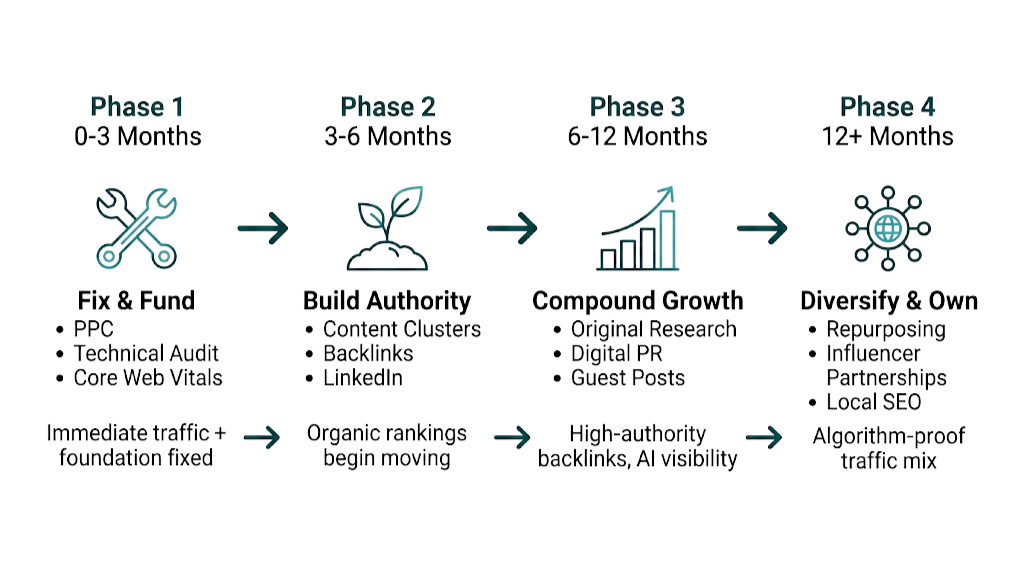
Here's the sequencing framework, based on how long each play takes to show impact:
Timeline | Priority Strategies | Expected Outcome |
|---|---|---|
0-3 Months | Google PPC (14), Technical SEO Audit (19), Title Tag and Meta Optimization (4), Core Web Vitals (5), Email List Building (16) | Immediate traffic from paid; quick wins from existing content; foundation fixed |
3-6 Months | Content Clusters (1), Long-Tail Keywords (2), Backlink Building (3), Schema Markup (7), LinkedIn Strategy (11) | Organic rankings begin moving; referral traffic grows; domain authority building |
6-12 Months | Original Research (8), Featured Snippets and AI Overviews (6), Digital PR (17), Free Tools (10), Guest Blogging (13) | Compounding organic growth; high-authority backlinks; brand visibility in AI search |
12+ Months | Repurposing (9), Influencer Partnerships (18), Local SEO (20), Reddit/Quora (12), Retargeting (15) | Traffic diversification; owned channel strength; algorithm-proof traffic mix |
The 0-3 month phase fixes what's broken and pulls in returns fast enough to fund the longer-term work. Technical issues that suppress existing rankings block traffic you've already earned. Clear them out. PPC brings revenue while organic ramps. Email list growth starts compounding on day one.
That early momentum sets up the 3-6 month phase, where the flywheel starts turning. Content clusters need 3-4 months before they stick. Backlinks from guest posts and curated placements lift domain authority over time, and that lift carries into every page you publish. LinkedIn content builds a repeat audience that comes back to the site.
That same flywheel shows up in the 6-12 month data. Original research attracts backlinks without constant outreach. Featured snippet wins push CTR above the organic average. AI Overview citations add brand exposure through a new search surface.
The fundamental principle: don't wait until you've "finished" SEO to start content, or finished content to start link building. These strategies run in parallel, and each one supports the rest. Start the flywheel. Keep it spinning. The sites winning on organic traffic in 2025 started their link building program 18 months ago - which means the best time to start yours is today.
Frequently Asked Questions About Increasing Website Traffic
How long does it take to increase website traffic organically?
Plan on 3-6 months before you see clear movement in organic traffic. Real compounding tends to show up in the 6-12 month range.
That timeline comes down to your domain's existing authority, how competitive your target keywords are, and how fast you publish content and build links. If it's a new domain targeting competitive terms, budget 9-12 months before organic turns into a primary traffic channel.
What is the fastest way to increase website traffic?
Google PPC is the fastest traffic channel - you can launch a campaign and drive clicks within 24 hours.
For free options, email your existing list. Share content on LinkedIn. And show up in relevant Reddit or Quora communities, linking back to your resources where it makes sense. These plays spike traffic fast, but they don't compound.
That lack of compounding is why we pair quick hits with SEO and link building, so you're building a base that keeps growing without nonstop spend.
How do I check my website traffic for free?
Google Analytics 4, or GA4, is the standard free tool for monitoring website traffic. It tracks sessions, users, traffic sources, and conversion events at no cost.
Google Search Console backs that up with organic search data: impressions, clicks, and average ranking positions. Install both from day one. No exceptions.
Does social media activity directly increase Google rankings?
Social media signals aren't a confirmed direct ranking factor in Google's algorithm. The value sits in distribution.
Distribution drives attention, and attention drives links - and backlinks are a confirmed ranking factor. A viral LinkedIn post that earns 50 backlinks from industry sites will lift rankings. The social post won't move the needle on its own; the links it generates will.
How many backlinks do I need to increase organic traffic?
There's no universal number - it depends on keyword competitiveness.
A local service business might rank on page one with 20-30 referring domains. A SaaS company targeting "CRM software" might need 500+. The metric we care about more is relative domain authority versus the sites already ranking.
Relative authority is easy to benchmark in Ahrefs or Semrush. Compare your referring domain count to the current top results for your target keywords, then build a gap-closing plan from there.
related Blog Posts




Join 2,600+ Businesses Growing with Rhino Rank
Sign Up
Stay ahead of the SEO curve
Get the latest link building strategies, SEO tips and industry insights delivered straight to your inbox.