
 Back to all posts
.png)
The rules around AI Overviews citations have changed faster than most SEO teams have been clocking. Google's AI search layer now pulls citations from pages that don't rank in the top 10 for the original query. That means the optimization playbook that made sense in recent months is already outdated. Teams still chasing position one as their primary citation strategy are optimizing for a mechanism that no longer behaves the way they think it does.
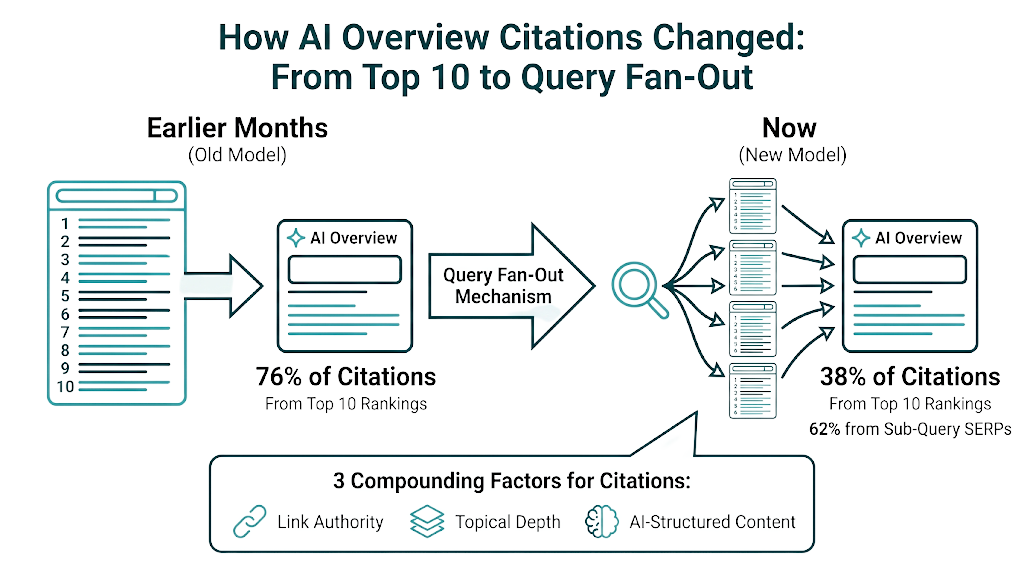
The bottom line: Recent industry studies of 4 million AI Overview URLs found that only 38% of citations come from pages ranking in the top 10 for the original query - down from approximately 76% in earlier months. That drop tracks with Google's query fan-out mechanism, which generates multiple related sub-queries and pulls citations from those SERPs independently. Getting cited now comes down to three compounding factors: enough link authority to rank for fan-out sub-queries, topical depth across related search intents, and content structured for AI extraction. Backlinks remain foundational, but they're the entry fee, not the finish line.
That "structured for AI extraction" piece is where most teams still guess. We won't. This article breaks down exactly how Google selects citation sources, what the data says about format and structure, why YouTube is an underused citation channel, and how to build a repeatable process for getting your pages into AI Overviews responses. The advice is grounded in real data, not speculation.
What Google AI Overviews Citations Actually Are (And Why They're Not Featured Snippets)
AI Overviews citations and featured snippets share surface-level similarities: both appear at or near the top of the search results page, both pull content from third-party URLs, and both show an answer instead of a list of links. Treating them as equivalent, though, pushes teams into the wrong optimization work.
A featured snippet is a single-source extraction. Google picks one page it views as the best answer to a query, pulls a defined block of text, and displays it with a direct URL attribution. The selection logic is fairly visible: the page ranks highly, the content matches the query structure, and the format (definition, list, table, or paragraph) matches what the user asked. Winning a featured snippet comes down to ranking plus format. Understanding what SERP features are and how they differ from AI-generated results is the first step to targeting the right optimization work.
Ranking plus format isn't how AI Overviews work. AI Overviews operate on a different selection model. Instead of choosing one source, Google's AI system synthesizes information from multiple pages to build a composite answer. Each factual claim, statistic, or recommendation inside that overview can map to a different URL. The citations you see - those small numbered references attached to individual sentences - act as source attributions for specific pieces of information, not a badge for a single "best" page. One AI Overview response can pull from five, eight, or twelve different domains at the same time.
That multi-source model changes the strategy. With featured snippets, the goal is to be the best answer. With AI Overviews, the goal is to publish a specific, extractable piece of information the system needs to complete its synthesized response. A page doesn't need to be the definitive resource on a topic. It needs to provide a credible, well-structured, information-dense answer to one component of a multi-part query.
Multi-part queries also drive another difference: citation persistence and variability. Featured snippets tend to hold steady - a page that wins often keeps the spot until a competitor overtakes it or Google rebuilds the SERP. AI Overview citations rotate. Recent citation pattern analysis found that citation sources shift across sessions and query variants, so a page cited today won't always show up tomorrow for the same query. This isn't a bug - it's what you get from a probabilistic synthesis system that also pushes for source diversity.
Source diversity is exactly why "optimizing for AI Overviews citations" needs a reset. It's not about winning a position. It's about making your content a reliable, extractable source of specific information that the AI can attribute with confidence. That calls for a different set of signals than classic featured snippet optimization.
The Query Fan-Out Mechanism: Why Ranking #1 No Longer Guarantees a Citation
The most consequential finding in recent industry studies isn't the 38% figure on its own - it's what drove the drop from 76% in earlier months. That change comes down to how Google's AI Overview system processes a search query, and most SEO advice hasn't caught up.
When a user submits a query, Google's AI doesn't just retrieve results for that exact phrase. It generates a set of related sub-queries - sometimes called a "query fan-out" - that cover the different information blocks needed to assemble an answer. A query like "best CRM for small business" doesn't just pull from pages ranking for that phrase. It can fan out into sub-queries on pricing comparisons, integration capabilities, ease of use for non-technical teams, migration complexity, and customer support quality. Each sub-query pulls its own pool of candidate pages, and citations can come from any of them.
That's the shift.
Ranking number one for the original query no longer guarantees a citation. Your page can own the primary SERP while a competitor's narrower page - one that answers pricing tiers for sub-50-person teams, for example - gets cited for that specific piece of the AI's response. The AI isn't looking for the best all-in-one page. It's looking for the best source for each sub-claim, then stitching those sources together.
That changes how content competes. A mid-market SaaS team spending $3k/month on content that produces one 5,000-word guide is playing a different game than a team that publishes a 1,500-word guide plus four supporting pieces, each built to answer a specific sub-question with depth. The second approach creates multiple citation entry points across the fan-out set. The first creates one. This is the same principle behind mastering search intent - matching content to the specific information need, not just the surface-level keyword.
Consider a worked example.
A B2B software company targets the query "how to reduce customer churn." The AI Overview for that query might fan out into sub-queries including: what causes customer churn, how to calculate churn rate, churn reduction tactics for SaaS, how to use customer success software to reduce churn, and churn benchmarks by industry. A company that only has one page targeting the head term competes for one citation slot. A company with dedicated, well-linked pages on churn calculation methodology, industry benchmarks, and customer success software selection competes for multiple slots across the fan-out set.
The 38% figure has a second implication that's easy to miss: 62% of citations now come from pages that don't rank in the top 10 for the original query.
That's not a rounding error. It means the citation candidate pool is much larger than page one for any given query. Pages ranking in positions 11-20, or pages that rank well for fan-out sub-queries instead of the head term, now sit in the citation pool. The teams that win here build topical depth, not just primary keyword rankings.
The response is straightforward: map your content to the sub-query set, not just the head term. Use Google's "People Also Ask" boxes, related searches, and autocomplete data to identify the sub-queries your primary topic fans out into. Then audit whether you have specific, well-structured content that answers each of those sub-queries with high factual density. The gaps from that audit are your best citation opportunities.
How Google Selects Which Pages to Cite: The 5 Core Signals
Fan-out sub-queries explain where Google pulls candidates from. The harder part is why it picks one page over another inside that pool. The selection process blends several signals, and the research points to five that keep showing up in citation inclusion.
1. Topical authority and ranking position for the sub-query
Recent search visibility studies found that pages ranking in the top 10 for a query are 6.7 times more likely to be cited in an AI Overview than pages outside the top 10. This applies to sub-queries, not just head terms. A page that ranks position 3 for "B2B churn benchmarks by industry" is a strong citation candidate for any AI Overview that fans out to that sub-query. And this is why link building stays foundational: you won't rank for sub-queries without enough backlink authority, and you won't get cited without sub-query rankings.
2. Factual density and named statistics
Recent state of search research found an 89% increase in citation likelihood for pages containing named statistics. The AI looks for attributable, checkable claims. A page that states "customer churn averages 5-7% annually for enterprise SaaS" is more citable than one that says "customer churn is a significant problem for SaaS companies." The first gives the AI a clean, extractable data point. The second gives it a loose observation.
3. Content structure and extractability
Recent citation pattern analysis found that pages with structured data markup and clear heading hierarchies are cited at higher rates than pages with equivalent content but weaker structure. The AI needs to pinpoint which section answers which sub-query. Clear H2/H3 hierarchies, definition-style opening sentences, and schema markup all make that easier.
4. Page authority and trust signals
Domain authority and page-level link equity still act as trust filters. The 6.7x multiplier from recent studies reflects this: pages rank because they earn authority, and the AI treats ranking position as a proxy for trust. Link equity ends up baked into the citation selection process, even if it's not presented as a standalone input.
5. Content freshness and accuracy signals
Recent generative AI research found that AI Overviews trigger for approximately 47% of all queries, with the highest trigger rates in informational and research-intent categories. Those categories put weight on freshness. Pages with recent publication or update dates - especially on statistics-heavy or fast-changing topics - get picked more often as citation sources.
Why Factual Density Beats Word Count Every Time
Recent 50-page structured content tests delivered one of the most useful takeaways we have for AI citations: content structure and factual density predicted citation inclusion better than domain authority alone. Pages with lower DA scores but higher factual density beat higher-DA pages that relied on vague, padded copy. That challenges the idea that citation optimization is mainly a link building problem.
Factual density is the concentration of specific, attributable claims per unit of content. A 600-word section containing eight named statistics, three defined terms, and two clear process steps carries more factual density than a 1,500-word section that covers the same topic with broad observations and layers of qualifications.
AI extracts at the claim level, not the article level. Pack more specific claims into each paragraph and we create more potential citation anchors per page.
The practical implication is simple: audit existing content for claim density. Count the number of specific, attributable statements per 200 words. If the number sits below three or four, the page reads too soft to win citations. Rewrite by adding named statistics, specific thresholds, and defined terms - and keep the word count flat. That beats adding extra paragraphs of general explanation.
The YouTube Factor: 18% of Non-Ranking Citations Come From Video
Recent industry data includes a detail most competitor content ignores: YouTube accounts for 5.6% of all AI Overview citations in the 4 million URL dataset, which makes it the single most cited non-text domain. The bigger point is where those citations show up. YouTube represents 18.2% of non-ranking citations - cases where AI Overviews cite sources outside the top 10 for the original query - and YouTube's citation share grew 34% in recent tracking periods.
That trend tracks with how YouTube pages are built. Transcripts give Google clean text to pull from. Chapters and timestamps carve one URL into multiple, sub-query-sized chunks. View count and engagement act as trust signals. And since Google owns YouTube, the plumbing between YouTube content and AI Overview synthesis stays simple.
Those structural properties open a real diversification lane for SEO and content teams. A 10-minute tutorial video on a specific technical topic - well-titled, with a detailed description, an accurate transcript, and chapter markers - competes for citation slots that text pages used to control.
For agencies producing B2B content in technical verticals, YouTube needs to sit next to the blog in the citation plan. Not as a "nice to have" social channel. Teams already investing in content marketing for link building should extend that same strategic thinking to video assets targeting their highest-priority sub-queries.
The strategic move is to build videos that mirror our highest-priority sub-query targets. If we're targeting fan-out sub-queries around a head term, we should produce one video per sub-query, write the title and description around that exact phrase, and make sure the transcript contains the specific factual claims we want cited. That gives us citation coverage in both text and video for the same sub-query set.
How Backlinks and Domain Authority Fit Into the AI Overviews Citation Picture
Most competitor articles on AI Overviews citations frame this as a content and structure problem. They skip the foundational role of link authority. That's a miss - especially for an SEO audience that treats link building as core work.
The recent industry finding is clear: top-10-ranking pages are 6.7 times more likely to be cited in AI Overviews than pages outside the top 10. That multiplier isn't because Google plugs domain authority scores into an AI Overview citation model. It shows up because backlinks drive rankings, rankings decide which pages enter the candidate pool for fan-out sub-queries, and only pages inside that pool get evaluated for citation signals like factual density and structure.
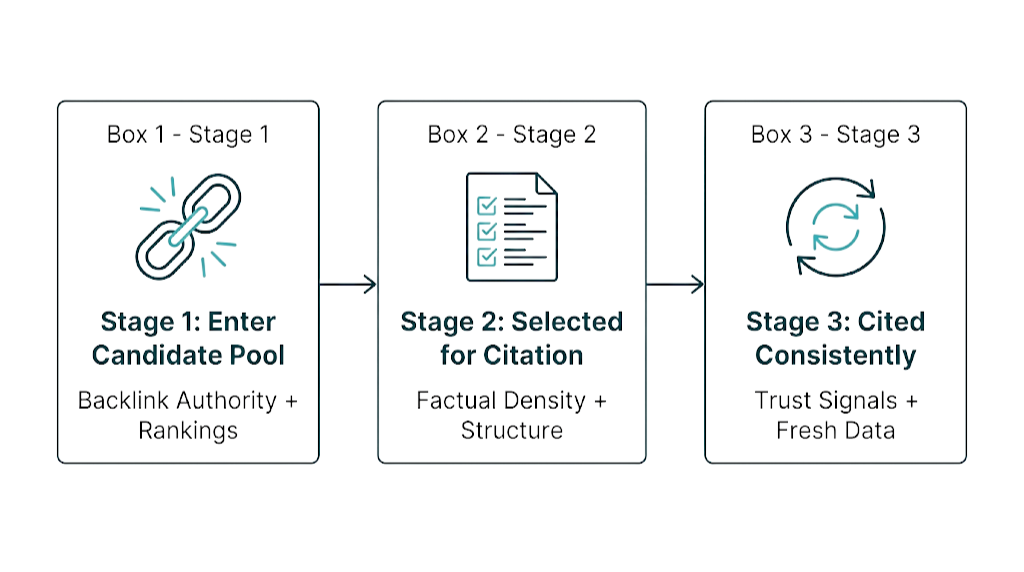
Treat it as a two-stage filter. Stage one is ranking eligibility: does the page show up in SERPs for the relevant sub-queries? Stage two is citation selection: among the pages that show up, which ones contain the most extractable and credible information, laid out with clean structure? Link building handles stage one. Content optimization handles stage two.
Optimizing stage two without stage one is like polishing a marketplace listing that never appears for the search term.
That two-stage model forces a specific link building call: we can't only build links to primary target pages. If AI Overview citations keep pulling from fan-out sub-query SERPs, then supporting pages - the pages that answer specific sub-questions inside the cluster - need their own link equity. A pillar page with 200 backlinks and four supporting pages with zero backlinks will lag behind a cluster where link equity reaches the supporting URLs.
Internal linking is the first lever. A deliberate internal link structure from authoritative pages to supporting sub-query pages pushes equity through the cluster and lifts ranking potential for those sub-query targets. External link building to supporting pages - via digital PR, guest posts, and curated link placements - compounds that lift.
Citation Stage | Primary Driver | How to Optimize |
|---|---|---|
Stage 1: Enter candidate pool | Backlink authority and ranking position | Build links to primary and supporting pages |
Stage 2: Selected for citation | Factual density, structure, freshness | Rewrite for claim density and schema markup |
Stage 3: Cited consistently | Trust signals and content accuracy | Keep data current, earn editorial links |
Recent structured content tests reinforced the same two-stage setup. In their sample, pages with both strong DA and high factual density posted citation rates well above baseline. Pages with high DA but low factual density entered the candidate pool, then lost selection. Pages with low DA but high factual density struggled to enter the pool at all. Consistent citation performance came from the combination.
For agency owners advising clients on AI search visibility, this framing keeps the work grounded. Link building isn't obsolete in an AI Overview world - it's the prerequisite that makes content optimization pay off. If a client funds content structure improvements but ignores the link profile, they're optimizing stage two of a process they still can't reach at stage one.
Content Structure Formats That Get Cited Most Often in AI Overviews
The AI Overview synthesis process pulls out specific claims and ties them to source URLs. That job gets easier when your content uses predictable, machine-readable formats. Recent citation pattern analysis and recent 50-page tests both point to repeatable structure patterns in highly cited pages.
Definition-first paragraph structure gets cited more than anything else. Pages that open a section with a direct, one-sentence definition - then move into context, caveats, or examples - give the AI a clean extraction target. "Customer churn rate is the percentage of customers who stop using a product within a defined time period" is easy to cite. "Customer churn is something that SaaS businesses struggle with because customers have many alternatives" isn't.
Numbered lists and step-by-step processes come next. Recent FAQ alignment data found that pages presenting information as numbered steps earned more citations than pages covering the same material in prose. That matches the way AI Overview answers show up in SERPs: the system often outputs steps, and step-formatted pages map cleanly to that output.
Statistical tables and comparison formats get ignored, but they perform. Recent industry data on named statistics applies with extra force to tables: one table with five comparable data points gives the AI five potential citation anchors in a tight, well-labeled format. For benchmarks, pricing comparisons, feature matrices, or performance metrics, a solid table beats prose for citation.
Here's a summary of the formats most likely to earn citations:
Content Format | Citation Strength | Why It Works |
|---|---|---|
Definition-first sections | Very high | Clean extraction target for specific claims |
Numbered step processes | High | Mirrors AI Overview display format |
Statistical tables | High | Multiple citation anchors per unit of space |
FAQ sections with direct answers | High | Maps directly to sub-query intent |
Bullet lists with specific claims | Medium-high | Structured but less attributable than tables |
Long-form prose paragraphs | Low | Hard to extract specific claims from |
General introductory content | Very low | No specific extractable claims |
FAQ sections deserve specific attention. Recent FAQ alignment data found a strong correlation between FAQ sections that mirror sub-query phrasing and citation inclusion for those sub-queries. This fits how fan-out works: if the AI runs a sub-query like "what is the average B2B churn rate," a page with an FAQ question titled "What is the average B2B churn rate?" followed by a direct, statistic-rich answer becomes an obvious citation pick.
That sub-query phrasing is the point. Audit your target sub-queries, pull the five to eight most common question formulations, and add a dedicated FAQ section that answers each one with a direct sentence, then supporting data. No full rewrite needed. Just add a structured section that maps to sub-query intent.
Schema markup strengthens the same structural signals. Recent analysis found that pages using FAQ schema, HowTo schema, or Article schema with defined sections earned citations at higher rates than pages with the same content but no structured data. Schema doesn't guarantee citation - the content still needs factual density - but it makes extraction more reliable and cuts confusion about which part of your page answers which question. This is one of the most common technical SEO issues teams overlook when preparing pages for AI Overview eligibility.
Technical Requirements That Determine AI Overview Citation Eligibility
Content quality and link authority determine whether Google wants to cite your page. Technical performance determines whether it can. Pages with real technical barriers - slow load times, crawl issues, or indexing problems - get pushed down as citation sources even if the content is strong. Google's Search Central documentation confirms that pages need to be indexed and eligible to appear in Search to show up as supporting links in AI Overviews.
Core Web Vitals thresholds set the baseline. Google's documented "Good" thresholds are: Largest Contentful Paint (LCP) under 2.5 seconds, Interaction to Next Paint (INP) under 200 milliseconds, and Cumulative Layout Shift (CLS) under 0.1. Pages that miss these thresholds don't just lose ground in classic rankings - they also signal weak UX, and the AI's source selection process uses that signal. Recent citation pattern analysis found that cited pages in their dataset posted better Core Web Vitals scores than non-cited pages from the same domains.
Crawlability and indexing are non-negotiable, and teams still miss them. A page blocked by robots.txt, marked noindex, or excluded from Google's index through canonicalization errors cannot be cited, regardless of content quality. Run routine crawls of your citation-target pages and confirm they're accessible, indexed, and returning clean 200 status codes. This is basic work. But technical audits of content sites keep surfacing indexing problems on supporting pages - the same sub-query-targeting pages that drive AI Overview coverage. A thorough Google indexing issues review should be part of any citation eligibility audit.
HTTPS and security signals affect trust-based source filtering. Pages served over HTTP instead of HTTPS land in a lower-trust bucket. For citation, where the system selects credible, attributable sources, security signals act as a simple trust filter. Keep all citation-target pages on HTTPS with valid certificates and no mixed-content warnings.
Mobile performance is its own gate, separate from desktop Core Web Vitals. Google's indexing is mobile-first, and AI Overview source selection follows that evaluation. If a page runs clean on desktop but drags on mobile, Google grades it on mobile. Responsive layouts, readable font sizes, and correctly scaled images show up more often in citation data than mobile-unfriendly builds.
Structured data implementation quality sits at the intersection of content and technical work. Bad schema - incorrect property values, missing required fields, or syntax errors - can send a worse trust signal than having no schema at all. Validate schema on every citation-target page with Google's Rich Results Test before you treat it as a positive signal. A clean, validated FAQ schema implementation on a 600-word page will outperform a broken Article schema on a 3,000-word page.
The technical checklist for citation eligibility:
- LCP under 2.5 seconds on mobile
- INP under 200 milliseconds
- CLS under 0.1
- Page indexed and returning 200 status
- No robots.txt or noindex blocking
- HTTPS with valid certificate
- Schema markup validated with no errors
- Internal links from authoritative pages pointing to the URL
A Practical Framework for Optimizing Existing Content for AI Overview Citations
Most teams don't need to publish more content to lift their AI Overview citation rates. They need to improve the citation eligibility of pages they already own, and do it in a repeatable way. The framework below turns the signals covered in this article into a process our in-house SEO partners and agency teams can run across a full content portfolio.
No fluff. Just mechanics.
Step 1: Map your topic clusters to fan-out sub-queries
Start with your five to ten highest-priority head terms. For each one, build the fan-out sub-query set from Google's "People Also Ask" data, autocomplete suggestions, and related searches. Aim for eight to twelve sub-queries per head term. That gives you the full set of citation opportunities inside your topic area.
That sub-query set belongs in a spreadsheet. Use columns for: head term, sub-query, current ranking position for sub-query, URL currently targeting sub-query (if any), and citation status. Check citation status via Google Search Console's AI Overviews data, or by manually running the head term and reviewing the citations shown.
Step 2: Identify ranking gaps in your sub-query coverage
Once the map exists, ranking gaps stand out fast. For each sub-query, confirm whether you have a page in the top 10.
Pages outside the top 10 for their target sub-query are stage-one failures - they don't enter the citation candidate pool. Fix those first. Start with internal link consolidation, then move to targeted external link acquisition aimed at the specific supporting pages that need to climb. A content gap analysis run against your top competitors will often surface sub-query targets you haven't yet built pages for.
Step 3: Audit factual density on existing pages
Ranking gets you into the pool. Selection gets you the citation.
For pages that rank in the top 10 for their sub-query target but still don't get cited, the issue is stage-two: you're present, but Google doesn't pick you. Audit those pages for factual density. Count specific, attributable claims per 200-word block. If the average sits below three, the page needs a rewrite for specificity, not extra length.
Specificity means concrete claims. Add named statistics with sources, replace vague qualifiers ("many businesses," "often," "significant") with real figures, and rewrite general observations into definition-first sentences. A 45-minute rewrite of a 1,000-word page produces a measurable improvement in citation inclusion within four to six weeks of re-indexing.
Step 4: Add or restructure FAQ sections for sub-query alignment
That rewrite work needs to match query language, not just tighten copy. Pull the sub-query phrasing from your fan-out map and check whether your page includes FAQ questions that mirror those phrasings.
If it doesn't, add a dedicated FAQ section with questions that match the sub-query wording exactly. Open each answer with a direct sentence that states the claim, then add one to two sentences of supporting context.
Implement FAQ schema on these sections. Validate the implementation using Google's Rich Results Test before publishing. This step has produced measurable citation improvements in multiple documented tests, including recent 50-page studies.
Step 5: Produce YouTube content for high-priority sub-queries
FAQ alignment expands your surface area on-page. YouTube expands it off-page.
For your top five sub-query targets, produce dedicated YouTube videos. Title each video with the sub-query phrase, write a detailed description that includes the key factual claims, add chapter markers so the video maps cleanly to sub-query intent, and publish with an accurate auto-generated or manual transcript. Cross-link between the video and your text content targeting the same sub-query.
YouTube accounts for 5.6% of all AI Overview citations and 18.2% of non-ranking citations, so this creates a parallel citation channel that doesn't depend on your text page's ranking position. A team that publishes both a well-optimized text page and a well-optimized YouTube video for the same sub-query doubles its citation surface area.
Step 6: Monitor and iterate with a six-week cycle
More surface area only helps if you keep it. AI Overview citations move.
Recent citation pattern analysis found significant rotation in citation sources across sessions. That rotation means optimization improvements show up fast, but it also means you need ongoing monitoring rather than a one-and-done fix.
Set up monitoring in Google Search Console's Search Insights for AI Overviews, and back it up with manual query checks for priority sub-queries. Review citation status every six weeks, flag pages that drop out of rotation, and audit them for content freshness and factual accuracy. Pages citing statistics from 2023 in a 2026 AI Overview environment lose citation slots to pages with more recent data.
Teams that earn AI Overview citations consistently don't treat it as a campaign. They treat it as content maintenance - link building for stage-one eligibility, content quality for stage-two selection, and technical hygiene for extraction reliability. If you'd rather hand the link-building side of that process to specialists, our managed service covers both primary and supporting page link acquisition as part of a structured campaign.
Frequently Asked Questions About AI Overviews Citations
What are AI Overviews citations and how do they differ from featured snippets?
AI Overviews citations are source links tied to specific claims inside Google's AI-generated summaries. Featured snippets work differently: they lift one excerpt from a single page and display it as-is. AI Overviews combine information from multiple pages at once, so one sentence might cite one URL and the next sentence might cite another.
That changes the goal. An AI Overview can cite eight or ten different pages in the same response. Your page doesn't need to cover the whole topic end-to-end. It needs one clear, accurate, easy-to-extract claim that fits a specific part of the answer.
Do you need to rank in the top 10 to get cited in Google AI Overviews?
Not for the original query. But top-10 rankings matter a lot for fan-out sub-queries.
Recent industry studies of 4 million AI Overview URLs found that only 38% of citations come from pages ranking in the top 10 for the original query. Recent data adds the other side of the story: pages in the top 10 are 6.7 times more likely to get cited than pages outside it. Both can be true because citations come from sub-query SERPs, not just the head-term SERP. Rank in the top 10 for the specific sub-queries your content targets, even if you sit outside the top 10 for the main term.
How does Google's query fan-out mechanism determine which pages get cited?
For AI Overview generation, Google expands the original query into related sub-queries that cover the different parts of a complete answer. Each sub-query pulls its own candidate set of pages. The AI then selects citations across all of those sub-query SERPs, not only the original SERP.
That makes sub-query rankings the real battleground. A page can rank well for one narrow sub-query even if it doesn't rank for the head term, and that page becomes a strong candidate for that specific claim inside the AI response. This is why topical depth across a cluster of related pages beats relying on one big page for citation wins.
What content formats are most likely to earn AI Overview citations?
The formats that show up most often: definition-first openings, numbered step-by-step processes, statistical tables, and FAQs with direct answers. Recent 50-page structured content tests found that factual density and structure predicted citation inclusion better than domain authority alone.
In practice, the pages that get cited tend to do a few things well:
- Start sections with a direct definition sentence.
- Include named stats and cite the source.
- Use FAQ sections that match sub-query phrasing closely.
FAQ schema helps, too. Validate it with Google's Rich Results Test so Google reads the structure cleanly.
Do backlinks and domain authority influence AI Overview citations?
Yes, mostly as a gatekeeper. The recent industry result - top-10 pages are 6.7 times more likely to be cited - lines up with how the system works: backlinks support rankings, and rankings decide which pages even make it into the candidate pool for fan-out sub-queries. Great structure won't matter if the page can't rank for the sub-queries it targets.
Link building needs to follow the sub-query map. Build links to the supporting pages, not only the primary target page, if you want broader AI Overview coverage. Internal link equity across the cluster matters. Targeted external links to the supporting URLs matter too.
Why does YouTube appear so frequently in AI Overview citations?
YouTube accounts for 5.6% of all AI Overview citations in recent industry datasets of 4 million URLs, which makes it the most cited non-text domain. It represents 18.2% of non-ranking citations and grew 34% in citation share in recent tracking periods.
The mechanics explain the visibility. Transcripts give Google extractable text. Chapter markers add sub-query-level specificity inside a single URL. Engagement metrics act as trust signals. And Google's ownership of YouTube reduces friction in how that content feeds AI Overview generation.
For content teams, YouTube is a second citation lane. Publish videos with tight titles and descriptions, include full transcripts, and aim each video at a specific sub-query. That channel can pick up citations even when your text pages don't rank for the head term.
related Blog Posts

Join 2,600+ Businesses Growing with Rhino Rank
Sign Up
Stay ahead of the SEO curve
Get the latest link building strategies, SEO tips and industry insights delivered straight to your inbox.