
 Back to all posts

Most marketing professionals have heard the term "digital PR" dozens of times. Ask five of them to define it, though, and you'll get six different answers. Some call it link building with a press release attached. Others treat it as traditional PR that uses email instead of fax machines. Both miss the point, and that confusion costs brands real money and real search visibility in 2025.
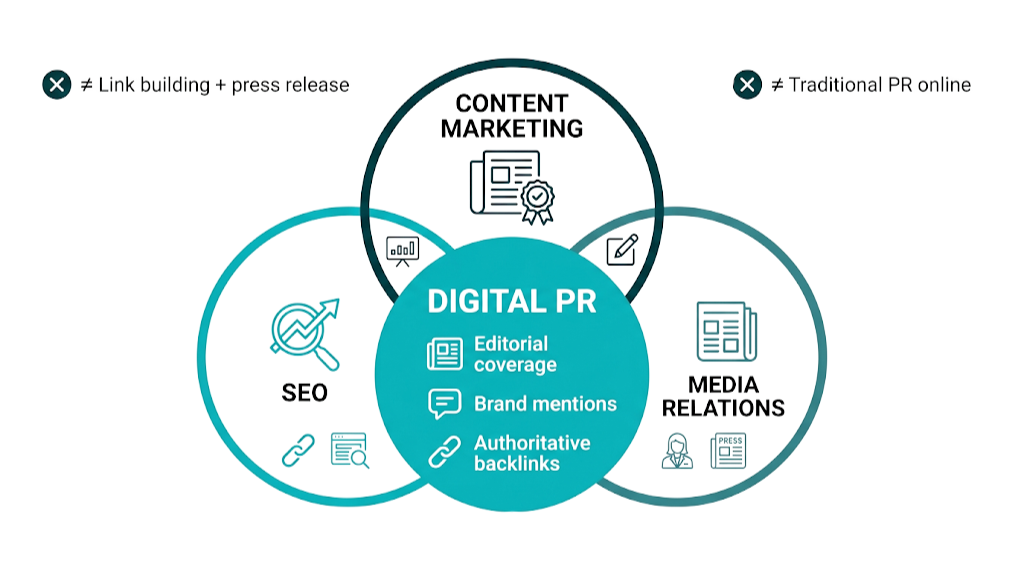
Bottom line up front: Digital PR is the practice of earning media coverage, brand mentions, and authoritative backlinks through online publications by creating genuinely newsworthy stories, data-driven content, and expert commentary that journalists and editors want to publish. It's not a rebrand of link building. It's not traditional PR with a website. It's a distinct discipline that sits at the intersection of SEO, content marketing, and media relations, and it matters more now that AI Overviews appear in roughly 20% of all Google searches and LLMs like ChatGPT serve over 250 million weekly active users who ask questions about brands every day.
This guide exists because most top-ranking resources on digital PR were written before the AI search era changed what "visibility" means. Semrush's guide covers tactics well. The Digital Marketing Institute explains the basics. But neither gets into how digital PR influences whether your brand shows up in AI-generated answers that are starting to replace traditional blue links.
That AI answer layer is the gap we're here to cover, with precision, data, and a full 9-step strategy framework you can run this quarter.
What Is Digital PR? A Precise Definition (Not the Vague One You've Read Before)
Digital PR is the strategic practice of earning editorial coverage, brand mentions, and high-authority backlinks from online publications by pitching newsworthy stories, original research, and expert insights to journalists, editors, and content creators. The output is earned media, not paid placements. The channels are online news outlets, industry publications, podcasts, and influential blogs. The goal is to build brand presence, topical authority, and search visibility at the same time.
That definition matters because most explanations online stretch digital PR until it means everything and nothing. You'll see claims that it "includes social media management, influencer marketing, content marketing, and SEO." That's like defining a surgeon as "someone who works in a hospital." Technically true. Useless in a budget meeting.
In practice, digital PR controls the story, the pitch, and the placement. A campaign finds an angle that matches a brand's expertise and a journalist's editorial needs. Then we package that angle into a pitch, backed by original data, expert commentary, or a creative asset. From there, we target specific publications where the brand's audience already reads, listens, and shares.
When coverage lands, it creates three things at once: a high-authority backlink, a brand mention in a trusted editorial context, and a citation AI systems can reference later when answering questions in the category.
A concrete example makes this easier to see. A fintech company wants to build authority in the "small business lending" space. A digital PR campaign might analyze publicly available SBA loan data and find that approval rates in three specific states dropped 18% year-over-year. That becomes a data study with clear visuals, pitched to business journalists at outlets like Forbes, Business Insider, and niche finance publications. If those outlets run it, they link to the research, name the fintech brand as the source, and add the kind of third-party validation that Google's quality systems and LLMs use when deciding which brands carry weight on a topic.
That third-party validation is the point. The distinction between digital PR and adjacent disciplines isn't academic - it drives budget allocation, team structure, KPI selection, and whether the spend compounds or turns into one-off vanity metrics.
An executive approving a $5,000/month digital PR budget should know they're funding brand entity building across the broader information ecosystem, not buying a handful of backlinks. That shift changes the ROI math.
Digital PR professionals sit in the overlap of editorial judgment, data analysis, relationship management, SEO, and storytelling. The best teams think like journalists first and marketers second, because the entire model depends on creating something an editor would publish even if no brand name were attached. That editorial-first approach separates digital PR from promotional tactics that borrow the label but don't earn the same outcomes.
Digital PR vs. Traditional PR: What Actually Changes Online
The surface-level answer is "traditional PR targets print, TV, and radio while digital PR targets online publications." True. Incomplete. The real shift comes down to measurability, permanence, and compounding value.
Traditional PR lands a newspaper mention that lines a birdcage within 48 hours. A TV segment airs once and vanishes. You might see a short spike in awareness, but you don't get a lasting digital footprint. Digital PR creates assets that compound. A backlink from a DA 70 publication strengthens your domain authority for the long term. A brand mention on an authoritative website gets indexed by Google and ingested by LLMs, shaping how AI systems describe your brand for months or years after publication.
Factor | Traditional PR | Digital PR |
|---|---|---|
Primary channels | Print, TV, radio, events | Online publications, podcasts, digital news |
Measurability | Estimated reach, AVE (discredited) | Exact referral traffic, DA of linking domains, keyword ranking impact |
Lifespan of coverage | Days to weeks | Months to years (indexed content) |
SEO impact | Negligible | Direct (backlinks, brand mentions, entity signals) |
AI/LLM influence | None | Significant (training data, citation sources) |
Cost structure | Retainer + event costs | Retainer + content production costs |
Audience targeting precision | Broad demographic | Specific publication readership + search intent alignment |
Compounding value is only part of it. Traditional PR still rewards existing brand recognition. Journalists at major outlets cover companies they've heard of, and that bias shows up in who gets the call-back. Digital PR opens the door because the currency is the story, not the brand name. A 20-person SaaS startup with a real data study can earn coverage in the same publications as a Fortune 500 company. The story does the heavy lifting.
The story-first model doesn't make the two disciplines enemies. Strong brand presence strategies use both, because offline visibility can feed online demand and vice versa. But for SEO managers and marketing executives deciding where to allocate budget, digital PR delivers something traditional PR doesn't: a direct, measurable connection between media coverage and search performance. Understanding how link building helps SEO makes that connection even clearer when building the business case internally.
Digital PR vs. Link Building: Why Conflating Them Costs You Results
This conflation is the most expensive mistake in modern SEO strategy. And it's everywhere.
Link building is the practice of acquiring backlinks to improve search rankings. It's a tactic with a narrow objective: get links, lift DA, rank higher. The methods range from guest posts and niche edits to broken link building and directory submissions. Quality swings wildly. The intent stays the same: earn a hyperlink from site A to site B.
That hyperlink is where digital PR and link building overlap. Digital PR generates backlinks, but treating it as just another link channel weakens the output. It works better as a brand authority discipline where links are a by-product. The difference shows up in the brief.
A link building brief pushes link volume, anchor text distribution, and referring domain authority. A digital PR brief pushes story quality, publication relevance, and brand positioning - which means editorial context, not just a link in the body copy. You still get links. You also pick up brand mentions in trusted placements, journalist relationships you can reuse, and content that AI systems reference when answering questions about your category.
That AI reference layer is already changing how visibility works. Recent industry analysis highlights that brand mentions, not just followed backlinks, are now key signals in AI-era search visibility. A brand mentioned across 30 authoritative publications without a single hyperlink still builds entity salience in ways that influence both Google's AI Overviews and LLM responses. Pure link building doesn't capture that upside.
The budget impact is easy to see. A mid-market SaaS team spending $3k/month on "digital PR" that's really link building with a press release wrapper gets 8-12 links per month from mid-authority sites. The same budget put into real digital PR might produce 3-5 placements per month, but those placements show up in publications that journalists, AI training pipelines, and Google's quality systems treat as authoritative. Fewer links. Much higher brand impact.
Link building still has a place. We sell link building services ourselves. But we don't pretend it's the same thing as digital PR, and neither should your reporting. Mix them up and you end up with the wrong KPIs, misallocated budget, and stakeholders who feel like the channel underdelivered.
How Digital PR Actually Works: The Mechanics of an Earned Media Campaign
A digital PR campaign runs on a repeatable process. Repeatable doesn't mean easy. Each stage needs real skill, and if we cut corners anywhere, the whole campaign drags.
Stage 1: Audience and publication research. Before we create anything, we map the publications our audience reads and the journalists who already cover the topic. This isn't a generic media list. It's a curated database of specific reporters, their recent angles, and the editorial calendars of their outlets. A B2B cybersecurity brand doesn't pitch TechCrunch's consumer gadgets reporter. We go to the journalist who covered three ransomware stories last month, because the beat match is the difference between a delete and a reply.
Stage 2: Story development. This is where campaigns win or lose. The story has to serve the journalist's readers first, then the brand's goals. We see the most consistent lift from a few formats: original data studies that reveal something new from proprietary or public data, expert commentary tied to trending news, and creative concepts that turn complex info into something easy to publish and share. The brand's connection has to feel natural. Forced tie-ins don't land. A pet insurance company analyzing veterinary cost data across 50 states fits. That same company commenting on cryptocurrency regulation doesn't.
Stage 3: Asset creation. Once the angle is solid, we package it in a format a journalist can use right away. That usually means a written summary or press release, supporting data tables, embeddable visuals or graphics, and pre-written expert quotes attributed to a named spokesperson. Reduce effort, raise pickup. Journalists are overworked and under-resourced, so a nearly finished story with verified data and clean quotes removes friction from the editorial process and speeds up publication.
Stage 4: Targeted outreach. Outreach goes to the curated journalist list through personalized email. Personalized means we reference recent work, explain why the story fits the beat, and put the key finding in the first two sentences. Mass-blast PR distribution services exist. Their coverage rates stay abysmal next to targeted outreach built on real relationships. The same principles that make blogger outreach campaigns succeed apply here: relevance and personalization beat volume every time.
Stage 5: Follow-up and relationship management. Most coverage comes from the second or third touchpoint, not the first email. Follow-up is a skill. Push too hard and we burn the contact; wait too long and the story dies in the inbox. When coverage lands, the relationship doesn't end there. Strong digital PR teams keep journalist relationships warm between campaigns, sharing relevant tips and data even when there's nothing to pitch. Those relationships compound over time and become the most valuable asset in a digital PR operation.
Stage 6: Reporting and amplification. After coverage goes live, we document outcomes: linking domains, brand mentions, referral traffic, social shares, and any measurable impact on keyword rankings. Then we amplify the wins through owned channels - social media, email newsletters, and on-site content that cites the earned coverage. That amplification matters because it keeps the earned media working after the initial publish spike.
What Makes a Story Newsworthy Enough to Earn Coverage
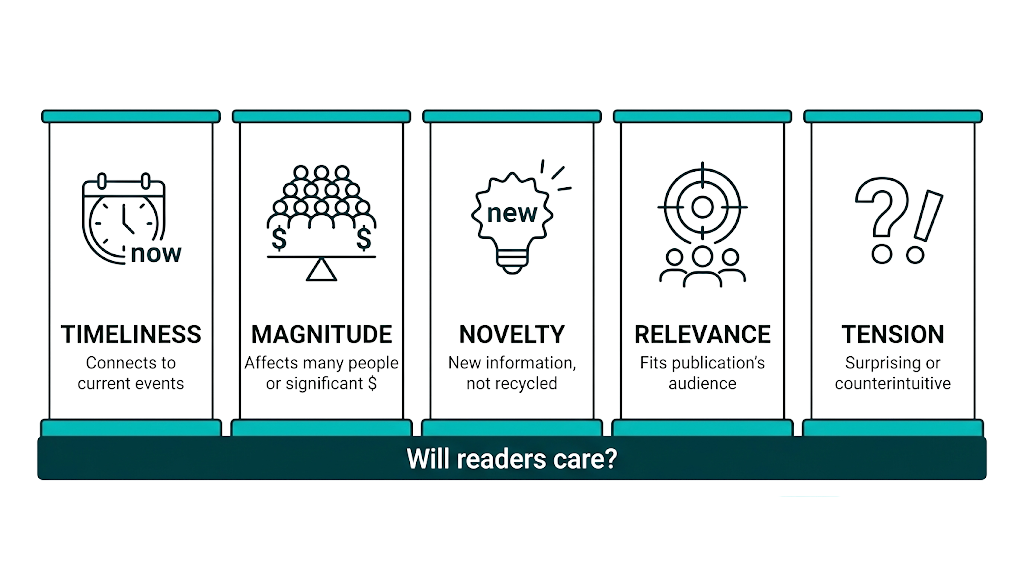
Journalists run pitches through one filter: whether their readers will care. Everything else comes after.
Newsworthiness has five core components. Timeliness means the story connects to something happening now. Magnitude means the finding affects a large number of people or a meaningful amount of money. Novelty means the information is new, not a repackaged blog post. Relevance means it fits the publication's audience. And tension means there's a surprising element, a counterintuitive finding, or a gap between expectation and reality.
That gap between expectation and reality is what makes data-led stories travel. A study revealing that remote workers in Texas spend 23% more on home office equipment than the national average hits timeliness (remote work is still a hot topic), magnitude (millions of remote workers), novelty (new data), and relevance (for business or personal finance publications). It also brings mild tension because Texas isn't the state most people would guess.
Stories that fail the newsworthiness bar share the same problems. They're product announcements with a thin news veneer. They publish "findings" that anyone in the industry already knows. They don't include a specific, quotable data point. Or they target publications whose audience has no reason to care.
One practical test before we invest in content creation is to strip the brand name from the pitch and judge the story on its own merits. If the angle collapses without the logo, it isn't news. It's marketing collateral dressed up as coverage bait.
The 6 Core Digital PR Tactics That Drive Measurable Results
Every guide lists digital PR tactics. Most skip the part that matters: which ones your team can actually run with your headcount and budget. We're fixing that with a difficulty-rated breakdown you can use for real resource planning.
Tactic | Difficulty | Typical Team Size | Monthly Budget Range | Average Links Per Campaign | Best For |
|---|---|---|---|---|---|
Data-driven research studies | High | 3-5 people | $2,000 - $8,000 | 15 - 80+ | Authority building, high-DA links |
Newsjacking / reactive commentary | Low-Medium | 1-2 people | $500 - $1,500 | 2 - 10 | Quick wins, journalist relationships |
Creative campaigns | High | 4-6 people | $5,000 - $20,000+ | 20 - 100+ | Brand awareness, social amplification |
Expert commentary placement | Low | 1 person | $300 - $1,000 | 1 - 5 | E-E-A-T signals, executive visibility |
Product or service PR | Medium | 2-3 people | $1,000 - $5,000 | 5 - 20 | Launch coverage, niche publications |
Survey-based stories | Medium | 2-4 people | $1,500 - $6,000 | 10 - 40 | Consumer interest stories, broad media |
Data-driven research studies are the backbone of digital PR. You take a large dataset - proprietary, public, or scraped - and pull out findings journalists can't get anywhere else. That means real inputs: data collection, analysis, visuals, and a clean writeup that holds up under editorial scrutiny. The spend goes up fast.
But the payoff scales with it. A single well-executed data study earns 30-80 links from high-authority publications over several weeks. That's why digital PR agencies lead with this tactic when the goal is clear domain authority growth, not a handful of quick mentions.
Newsjacking wins on speed. When a major news event breaks, you put your client's expert in front of reporters within hours. Deadlines drive everything. If a new Google algorithm update rolls out on Tuesday morning, your client's SEO director needs a quotable take in journalists' inboxes by Tuesday afternoon.
Link totals stay modest. The relationship value doesn't. Journalists remember the sources who help them file on time, and those names come up again on the next story.
Creative campaigns are high-risk, high-reward. Think interactive tools, maps, calculators, or visual assets that carry a story without a wall of copy. When it hits, it hits hard. A well-executed creative campaign earns 100+ links.
The downside is production cost and a higher miss rate than data studies, because editors don't grade "creative" on your internal brainstorm notes. What your team loves can land flat with a newsroom that has seen five versions of the same idea this month.
Expert commentary placement doesn't get enough credit. You place your client's executives as quoted experts in relevant articles, consistently, across the publications your buyers and peers read. Each placement brings a smaller link win, but the E-E-A-T signal stacks over time.
Google's quality rater guidelines value demonstrable expertise and trustworthiness. Getting your CEO quoted in industry publications as a subject matter expert is one of the cleanest ways to build those signals. And in the AI era, those mentions shape how LLMs talk about your brand's authority. This is also why acquiring editorial links through genuine expertise carries more weight than links earned through other means.
Product or service PR covers launches, major updates, and milestone announcements. It's the closest digital PR gets to traditional PR, and it only works when you have real news. A new feature that saves users 40% of their workflow time earns attention. A minor UI update won't.
News value sets the ceiling. Without it, you're pitching internal excitement to external editors, and they don't owe you space.
Survey-based stories sit between data studies and creative campaigns. You commission a consumer survey, analyze the results, and pitch the angles that make a reporter stop scrolling. Question design does the heavy lifting here. If the prompts are obvious, the answers read the same way.
"70% of Americans prefer working from home" is boring. "70% of Americans would take a 10% pay cut to work from home permanently" is a story.
For SEO managers building a business case internally, the difficulty ratings above aren't arbitrary. They reflect execution reality: a two-person marketing team can run newsjacking and expert commentary now, but they'll need outside support from a digital PR agency for data studies and creative campaigns. That clarity prevents the standard failure mode - picking tactics that look good on a slide and collapse under the actual workload.
The SEO Benefits of Digital PR: What the Data Actually Shows
The SEO case for digital PR goes well beyond "more backlinks equals higher rankings." That math was already too simple in 2020. In 2025, it misleads teams.
Backlinks remain a core ranking factor. That part hasn't moved. The bar has. One editorial link from a DA 80 news publication often carries more weight than 50 links from DA 20 guest post sites, because Google keeps getting better at discounting low-trust patterns. Digital PR produces the links Google's systems reward: editorially earned, contextually relevant, and placed on authoritative domains. Understanding what makes a high quality backlink helps explain why editorial placement matters so much more than raw link volume.
Brand mentions build entity salience. Google's Knowledge Graph and its broader entity systems don't run on links alone. They ingest brand mentions across the web to build entity profiles. When your brand shows up in the context of specific topics across multiple authoritative sources, Google gets a cleaner read on what your brand is, what it does, and where it has credibility. That entity layer influences rankings in ways raw backlink metrics won't show.
E-E-A-T signals strengthen. Google's helpful content documentation makes clear that experience, expertise, authoritativeness, and trustworthiness sit at the center of how content quality gets evaluated. Third-party editorial coverage is one of the most direct ways to prove those signals. When Forbes quotes your VP of Engineering on cloud security trends, that's a third-party trust signal Google's quality systems can validate. Your own blog can't recreate that dynamic.
Referral traffic diversifies your acquisition mix. A well-placed digital PR story on a high-traffic publication can send thousands of qualified visitors in a single day. That traffic doesn't arrive cold. It comes pre-qualified by the editorial framing of the publication. Readers who click through from a Business Insider article about your research already care about the topic and trust the outlet that referenced you.
Topical authority accelerates content performance. This is the compounding effect most write-ups miss. When digital PR builds authority around a specific topic cluster, every related page tends to perform better, because the domain starts to look like a more reliable source in that category. A fintech brand that earns 20 editorial links from publications covering their small business lending data study will see improved rankings across their entire small business lending content hub, not just the page that earned the links. That topical authority flywheel is the best argument for sustained digital PR investment, not one-off campaigns.
That sustained investment is where the data lines up. Brands that run digital PR consistently over 6-12 months see domain-wide ranking lifts that exceed what backlink count alone predicts. Entity signals, E-E-A-T reinforcement, and topical authority stack, so each placement carries more downstream value.
Digital PR in the Age of AI Overviews and LLMs: What's Changed in 2025-2026
This is the section no competing guide covers well. And it's the biggest strategic shift digital PR has seen.
Recent industry studies of millions of SERPs found that AI Overviews now appear in approximately 20% of all Google searches, with that number climbing to 60% in categories like health, finance, and technology. OpenAI announced in late 2024 that ChatGPT reached over 250 million weekly active users. These aren't side features. They're becoming the default interface for how people find and vet brands. The implications for link building in the AI era are significant and still unfolding.
That interface change matters because AI systems cite sources. Google's AI Overviews pull information from web pages and attribute it. ChatGPT references information from its training data, which includes the authoritative publications where your digital PR coverage appears. When your brand shows up across multiple trusted sources tied to a specific topic, AI systems have more reason to surface your brand when users ask about that topic.
Those sources and mentions show up in the data, too. Recent industry analysis of over 75,000 brands on AI Overview brand visibility factors reinforces the point. Brands that appear most often in AI Overviews share the same traits: mentions across multiple authoritative domains, strong entity profiles in Google's Knowledge Graph, and consistent topic association through high-quality editorial coverage. Digital PR drives those outcomes.
So digital PR stops being a "nice to have" awareness play and becomes a strategic necessity for any brand that wants to control its narrative in AI-generated answers. Put it in real terms. A CMO at a mid-market cybersecurity firm asks ChatGPT, "What are the best endpoint protection platforms for mid-size companies?" The brands that land in that answer didn't luck into it. They show up because their names appear across dozens of authoritative publications in the context of endpoint protection, and that footprint feeds the models and citation systems.
That footprint changes how SEO teams should measure progress. If your digital PR reporting still starts and ends with backlink count and referring domain authority, you're optimizing for yesterday's search environment. What matters now includes brand mention frequency across authoritative domains, topical association strength, and presence in AI-generated responses. We'll cover how to measure these in the metrics section below.
That same measurement shift changes the build vs buy decision. For brands weighing a digital PR agency against internal capability, the AI-era context tightens the timeline. Every month without steady editorial coverage is a month competitors bank entity signals that shape AI visibility. This isn't a slow shift. It's happening now.
How to Build a Digital PR Strategy From Scratch: A Step-by-Step Framework
This framework is built for SEO managers and marketing executives who need to stand up or rebuild a digital PR function. This isn't a recap. It's a sequential plan your team can run, with clear actions at each step.
Step 1: Define your entity targets. Before we pitch a single journalist, we pick the 3-5 topical associations we want the brand to own. They need to match your core offering and the queries where you want visibility in both classic search and AI results. A project management SaaS company might target "remote team productivity," "project management best practices," and "hybrid work tools."
Step 2: Audit your current brand presence. Run your brand name through Google, ChatGPT, and Perplexity. Log who mentions you, what they say, and whether those associations line up with your entity targets. Then run the same checks on your closest competitors. That gap between their coverage profile and yours sets the digital PR opportunity and tells us where to focus first.
Step 3: Build your media list. Start with 50-100 publications that cover your target topics and reach your buyers. For each one, pull 2-3 journalists who write on that beat. Muck Rack and Cision help, and manual research on X (Twitter) still pulls its weight. Quality wins. Fifty researched journalist contacts beat 500 scraped email addresses every time.
Step 4: Develop your story calendar. Your media list is only useful if you have a plan to feed it. Build a calendar with 3-4 campaigns per quarter, mixing tactics based on the difficulty ratings we covered earlier. For a team with moderate resources, a realistic quarter looks like one data study, one survey-based story, and two newsjacking opportunities. Tie every campaign to a specific entity target, or you end up with coverage that doesn't compound.
Step 5: Create your first data asset. Pick your strongest entity target and build around it. Source a dataset - proprietary, public, or survey-generated - that tells the market something new. Then do the hard part: clean it, analyze it, and pressure-test the takeaways so we don't pitch a shaky claim. Package the findings in a press-ready format with visualizations, key statistics, and expert commentary from a named executive at your company. Creating genuinely linkable content assets at this stage is what separates campaigns that earn 5 placements from those that earn 50.
Step 6: Craft targeted pitches. With the asset ready, write pitches by journalist segment, not one-size-fits-all templates. Lead with the most newsworthy finding, connect it to the journalist's audience, and make the full data available right away. Keep it under 200 words. Tight copy gets read.
Step 7: Execute outreach in waves. Run outreach like a pipeline, not a blast. Start with your top-priority publications, wait 48-72 hours, then follow up. Once a top-tier outlet covers the story, use that coverage as proof in the next wave. "As covered in [Publication X]" lifts open and response rates.
Step 8: Amplify and repurpose. Coverage is the raw material. Push it across owned channels: social media, email newsletter, on-site newsroom or blog. Then spin out derivative content from the same research. A data study that earned 15 placements can support a month of social content, a webinar, and multiple blog posts that internally link back to the original research. Teams that know how to repurpose content extract far more value from each campaign without additional outreach spend.
Step 9: Measure, report, and iterate. The compounding effect only shows up when we track the right outputs and repeat what works. Monitor the metrics that matter - covered in the next section - and report them to stakeholders monthly. After each campaign, run a retrospective: what worked, what didn't, what we'd change next time. Brands that win at digital PR run it like a discipline, not a set-and-forget task.
This 9-step framework isn't theoretical. It's the operating system strong digital PR programs follow, whether they're in-house or run through a digital PR agency. Consistency is the variable that decides who gets results. One campaign can spike coverage, but the compound gains from entity building, journalist relationships, and topical authority show up over quarters, not weeks.
How to Write a Digital PR Pitch That Journalists Actually Open
The pitch is the bottleneck. The best data study in the world dies in the inbox if the pitch doesn't earn the open.
Subject lines determine everything. Journalists get 50-200 pitches per day. The subject line has to state the news value in under 10 words. "New data: Remote worker spending up 23% in Texas" works. "Exciting new research from [Brand Name]" doesn't. Skip your brand name in the subject line. Lead with the finding.
The first two sentences must deliver the key finding. Put the data up front. Skip the warm-up and the background paragraph. State the strongest data point right away: "A new analysis of 50,000 SBA loan applications reveals that approval rates in Florida, Texas, and Ohio dropped 18% year-over-year, the steepest decline since 2019." A journalist can judge that in three seconds.
Personalization means relevance, not flattery. "I loved your recent article about X" reads like a template because it is one. Instead, call out their beat and make the link clear: "Given your recent coverage of small business lending trends, this data on state-level approval rate declines may be relevant for a follow-up piece."
Include everything they need to say yes. Give them the full dataset, visualizations, and a ready-to-paste expert quote via attachment or link. Reduce friction. The less work it takes to turn your pitch into a story, the more coverage you win.
Keep the entire pitch under 200 words. Journalists scan. They don't read. Every extra sentence cuts the odds of coverage.
How to Measure Digital PR Success: Metrics That Go Beyond Vanity
Digital PR measurement has changed fast, but a lot of reporting still centers on numbers that don't tell the full story. Here's what matters in 2025.
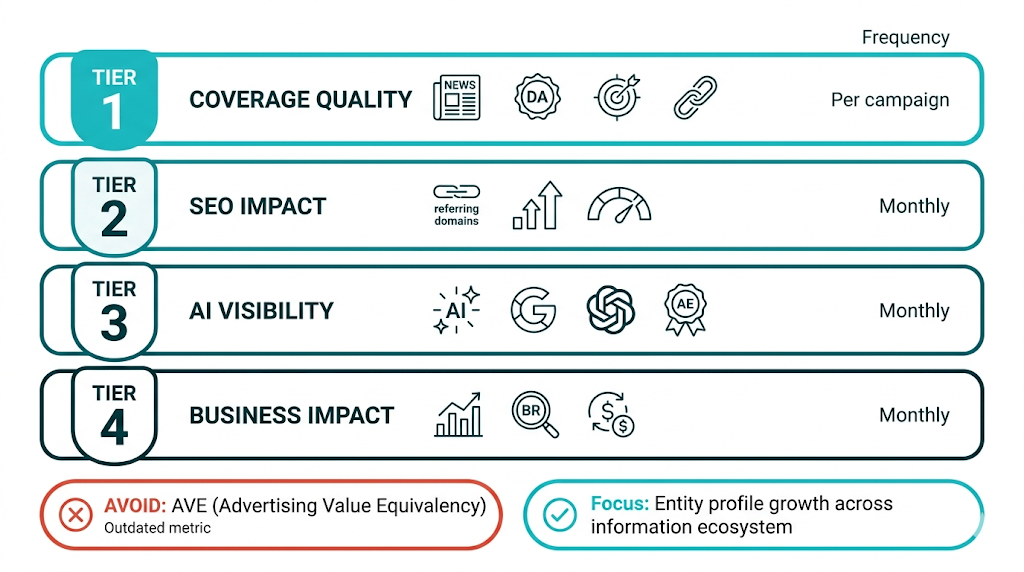
Tier 1: Coverage quality metrics. Start here. Track placement volume, the domain authority of each linking publication, how closely each outlet matches the topics you want to own, and what you actually earned in the piece - a followed backlink, a brand mention, or both. One placement on a DA 85 site that's tightly aligned with your category beats 20 placements on DA 30 sites that publish in unrelated areas. Tools like our DA/DR Checker make it straightforward to evaluate the authority of each placement as coverage comes in.
Tier 2: SEO impact metrics. Quality coverage should show up in search. Watch referring domain count and, more importantly, referring domain quality. Track organic rankings for the terms you're targeting, especially inside the topic clusters you're building, and monitor domain authority over time. Keep this view at the domain level, not just page-by-page, because strong digital PR tends to lift whole clusters as topical authority builds.
Tier 3: AI visibility metrics. This is where measurement is heading. Run recurring checks for your brand name and priority queries across Google AI Overviews, ChatGPT, Perplexity, and other AI interfaces. Log whether your brand shows up, what it's being associated with, and whether that description matches the entity profile you're trying to reinforce. Automated AI visibility tools are showing up, but for now, manual checks still set the baseline.
Tier 4: Business impact metrics. Links and mentions are only useful if they move the business. Track referral traffic from earned placements, branded search trends (rising branded demand usually tracks with awareness), and whatever downstream conversion data you can credibly attribute to PR-driven visits.
Metric Category | Specific Metrics | Measurement Frequency | Tools |
|---|---|---|---|
Coverage quality | Placement count, DA of linking domains, topical relevance | Per campaign | Ahrefs, Moz, manual review |
SEO impact | Referring domains, keyword rankings, domain authority | Monthly | Ahrefs, Semrush, Google Search Console |
AI visibility | Brand presence in AI Overviews, LLM responses | Monthly | Manual search, emerging AI tracking tools |
Business impact | Referral traffic, branded search volume, conversions | Monthly | Google Analytics, Google Trends |
One metric to actively avoid: Advertising Value Equivalency (AVE). AVE tries to price earned coverage as if it were paid media. The PR industry has spent years dismantling it for a reason - it doesn't map to outcomes, and it encourages teams to chase quantity over quality. If AVE sits near the top of a dashboard, treat that as a signal the program is being judged with outdated standards.
Backlinks still matter. But the real shift is moving from "how many links did we get?" to "how is our brand's entity profile changing across the information ecosystem?" That framing captures the value digital PR creates in search, in AI surfaces, and in how people talk about your brand - which link counts alone won't. Teams that want a fuller picture of their key SEO metrics to track will find that digital PR outcomes map cleanly onto the signals that matter most for long-term ranking performance. As Moz's guide to digital PR notes, the discipline works best when teams think like journalists first and treat editorial quality as the primary filter for every campaign decision.
Frequently Asked Questions
What is digital PR and how does it work?
Digital PR is how we earn editorial coverage, brand mentions, and backlinks from online publications by giving journalists something worth publishing: a strong story angle, original data, or credible expert input. The work starts with identifying angles that match our authority goals while meeting editorial expectations. From there, we package the story into pitch-ready assets and run targeted outreach to the right writers and editors. The output is earned coverage that builds brand presence, supports SEO, and supplies AI systems with trustworthy brand signals.
What is the difference between digital PR and link building?
Link building focuses on getting hyperlinks to lift rankings. Digital PR earns links as a by-product of real editorial coverage, and it also drives brand mentions, entity signals, E-E-A-T support, and AI visibility. Treating digital PR as a direct substitute for link building usually leads to weaker results, because it narrows the brief to "get a link" and ignores the authority lift that compounds over time. Both disciplines belong in the same mix, but they serve different goals and they demand different execution skills.
How does digital PR improve SEO rankings?
Digital PR improves SEO through a few clear paths. High-authority editorial backlinks strengthen domain authority. Brand mentions increase entity salience in Google's Knowledge Graph. Expert placements support E-E-A-T signals that Google's quality systems reward. And consistent coverage in specific subject areas builds topical authority that lifts rankings across entire content clusters. Google's helpful content documentation on Search Central calls out the value of third-party trust signals - which is exactly what strong digital PR generates.
How does digital PR help with Google AI Overviews and LLM visibility?
AI systems like Google's AI Overviews and ChatGPT surface brands based on what they can confirm across trusted sources. Recent industry studies found AI Overviews appear in roughly 20% of searches, and analysis of over 75,000 brands showed that brands mentioned across multiple authoritative domains appear more frequently in AI-generated answers. That's the exact footprint digital PR builds: repeated, consistent brand presence across credible publications.
How long does it take for digital PR to show results?
A single campaign can land coverage within 2-4 weeks of outreach. The compounding effects - SEO lift and brand authority - usually show up after 3-6 months of consistent execution. AI-side entity building takes longer because it depends on accumulating mentions across multiple authoritative sources over time. Teams that commit to sustained quarterly campaigns outperform teams that run one-off bursts, because the signal keeps stacking. The strongest digital PR programs run like an ongoing channel, not a project with a finish line.
related Blog Posts




Join 7,000+ Clients Growing with Rhino Rank
Sign Up
Stay ahead of the SEO curve
Get the latest link building strategies, SEO tips and industry insights delivered straight to your inbox.