
 Back to all posts
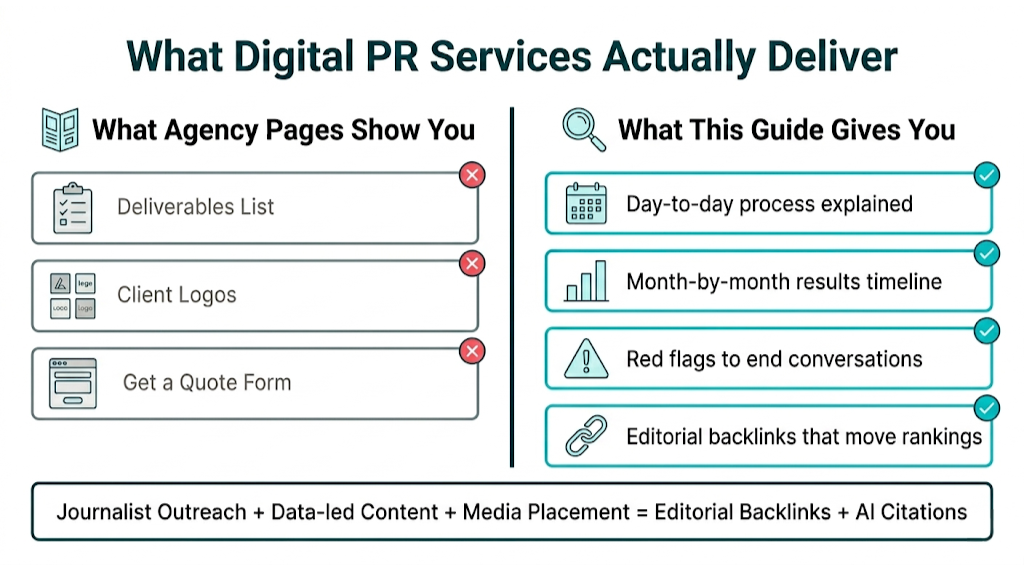
Most SEO managers evaluating digital PR services run into the same issue: every agency page reads like a brochure. You get a deliverables list, a handful of client logos, and a contact form. What you don't get is a straight explanation of how the work runs day to day, what results look like month by month, and how to spot a capable agency before they burn your budget on press releases nobody reads.
This guide fixes that.
Digital PR services combine journalist outreach, data-led content, and media placement to earn editorial backlinks from authoritative publications - backlinks that improve organic search rankings, build domain authority, and now get your brand cited inside AI-generated answers. The global PR industry is valued at over $114 billion and projected to grow past $160 billion by 2031, according to recent industry projections. That growth doesn't come from old-school press releases. It comes from a shift in how search engines and AI systems judge brand credibility. And 70% of PR professionals now say digital PR is more effective than it was a year ago.
We've structured this as a real buyer's guide. You'll find a breakdown of every core service type, a realistic campaign timeline, a cost-benefit comparison of in-house versus agency, and a blunt list of red flags that should end any agency conversation on the spot. If you're an SEO manager, marketing director, or agency owner spending real money on link acquisition, this is the resource we wish we'd had earlier.
What Are Digital PR Services (And Why Most Definitions Miss the Point)
Most definitions sound like this: digital PR is the online equivalent of traditional public relations, using the internet to build brand awareness and media coverage. That's accurate. It's also incomplete, and that gap is where buyers make expensive decisions.
Traditional PR targets print journalists, TV producers, and broadcast media. Teams measure success in column inches and audience reach. The output is visibility. Digital PR services work differently at the core: they target online publications, news sites, and digital journalists to earn hyperlinked mentions - editorial backlinks - that pass authority signals to your website and lift your position in Google's index.
That measurement framework is the whole point. A traditional PR win might be a feature in a national newspaper. A digital PR win is that same feature, published online, with a dofollow link back to your domain from a site with a Domain Rating of 70+. Same awareness. Different SEO impact.
That SEO impact isn't hypothetical. Google's own Search Central documentation confirms that links remain one of the most important signals Google uses to determine a page's relevance and authority. John Mueller, Google's Search Advocate, backed digital PR as a legit link building method in 2021, telling the SEO community that "digital PR is actually a great way to get links" - a quote documented in Moz's Ultimate Guide to Digital PR. That matters because it draws a bright line between editorial link earning and grey-area tactics that invite manual penalties.
Grey-area tactics also fail on the next job digital PR now has to do. Today, digital PR has a third function beyond visibility and SEO: it's the main path to getting your brand cited inside AI-generated answers on platforms like ChatGPT, Perplexity, and Google's AI Overviews. When an LLM generates a response about your industry, it pulls from the pool of trusted media content it was trained on. If your brand's narrative shows up in that pool - in Forbes, in TechCrunch, in industry publications with real authority - your brand gets cited. If it doesn't, you're invisible to a growing share of search behaviour. Understanding how to rank in AI Overviews is becoming as important as traditional search optimisation.
That pool of trusted media is where the advantage sits right now. Reboot CEO Shai Aharony put it plainly in BuzzStream's State of Digital PR report: "If you want your brand's narrative to exist inside AI answers, you need it embedded in trusted, reputable media." That's a present-tense edge. Most brands are leaving it on the table.
The 6 Core Digital PR Services Agencies Actually Deliver
Not every agency calling itself a digital PR firm delivers the same scope of work. Some still lean on press release distribution. Others build data-led campaigns that aim for national coverage. These six service types make it easier to map what an agency actually does to what you need.
1. Data-Led Campaign Creation
This is the highest-value digital PR service. It also eats the most time and budget.
An agency finds a data angle that fits your niche - original survey data, analysis of public datasets, or proprietary research - then turns it into a story journalists will run. Do it right, and a campaign aimed at a mid-size UK or US publication can earn 20-50 links from a single asset. BuzzStream's industry report shows data-led campaigns remain one of the most common tactics among experienced digital PR practitioners because the link velocity per asset beats every other approach.
2. Press Release Distribution
Press releases have changed a lot. BuzzStream's data shows press release usage has grown to 85.1% among digital PR professionals - making it the single most common tactic.
But the modern digital PR press release isn't a wire-distributed corporate announcement like it was in 2010. It's a targeted, newsworthy pitch that goes straight to the right journalists at specific publications, with a clear data hook and a real reason to link. Targeting and story quality decide the outcome. That's the difference between 15 placements and zero.
3. Reactive PR and Newsjacking
Reactive PR means tracking breaking news and cultural moments, then putting your brand's spokesperson or data forward as a credible source for journalists covering the story.
Speed matters. When a major economic report drops, a fintech brand that turns around expert commentary fast gets quoted - and linked. Responses often need to go out within hours, and the commentary has to hold up. Agencies that perform here keep journalist relationships warm and run media monitoring so they can move the minute an opportunity appears.
4. Expert Commentary and Thought Leadership Placement
Reactive PR runs on timing. Expert commentary runs on planning.
Here, the agency pitches your leadership team into feature articles, roundups, and opinion pieces before there's a news spike to ride. The deliverable is usually a branded quote or attributed insight in a publication your buyers read. For B2B brands, those placements support topical authority for SEO and build trust with buyers who research vendors before they buy.
5. Digital Asset Creation for Link Attraction
Infographics, interactive tools, original research reports, and visual data assets built to attract inbound links. This is sometimes called "linkable asset" creation.
A well-designed interactive salary calculator for a recruitment brand, for example, can earn hundreds of organic links over its lifetime as other sites reference it. The distinction from content marketing is simple: the primary design goal is link acquisition, not traffic or conversion. Our guide to creating linkable assets covers the full production process in detail.
6. Media Relations and Journalist Outreach
This is the foundation. Relationship building.
Agencies keep databases of journalist contacts, segmented by beat, publication, and link-giving history. They pitch stories on your behalf, follow up, and manage the relationship through to publication. This is what separates a digital PR agency from a content agency: getting stories placed in specific publications, not just publishing on your own site.
Data-Driven Campaigns vs. Reactive PR: Which Drives More Links?
Buyers ask this because it affects budget planning and reporting cadence. The honest answer depends on your timeline and spend.
Data-driven campaigns need heavy upfront investment - usually 4-8 weeks of research, design, and outreach prep - then they deliver links in a surge when they hit. One successful campaign aimed at national news publications can produce 30-80 placements. The ROI per campaign runs high, and so does the price tag. For mid-market SaaS clients spending $3,000 a month on digital PR, a well-executed data campaign might take two months of budget for a single asset.
That surge is the upside. The delay is the tradeoff.
Reactive PR produces links on a steadier drumbeat, but each win is smaller. One reactive placement might earn 1-3 links per opportunity, and a well-resourced agency can spot and answer 10-20 reactive opportunities per month. Over six months, that adds up and often matches a single data campaign, but the links spread across more publication types and a wider range of authority.
The best programs run both. Data campaigns build topical authority in concentrated bursts. Reactive PR keeps a consistent cadence of fresh placements that signals ongoing relevance to Google's crawlers. BuzzStream's data confirms the agencies producing the strongest results for clients pair proactive campaigns with reactive media monitoring - running only one side doesn't create the same compound effect as doing both at the same time.
How Digital PR Services Actually Improve SEO Rankings
Most agencies keep this fuzzy. We don't. The mechanism is specific, and once you understand it you can set real expectations and shut down vague promises.
Links are still a primary authority signal in Google. When a publication with real editorial standards - one that doesn't sell links, has real traffic, and applies judgment to what it runs - links to your domain, Google reads that as a vote of confidence. The stronger the linking domain, the more weight that vote carries. Google states this in Search Central fundamentals: links sit among the key signals used to judge relevance and authority.
That "vote of confidence" is exactly what you want from PR.
Digital PR earns what Moz calls "editorial backlinks" - links a journalist or editor adds because your data, angle, or commentary helped them do their job. These are the links Google values most. They're also the opposite of paid links, directory submissions, or link exchanges - tactics Google is built to ignore or penalize. Understanding what makes a high quality backlink helps set the right benchmark for evaluating any placement.
Those editorial links influence SEO at three levels.
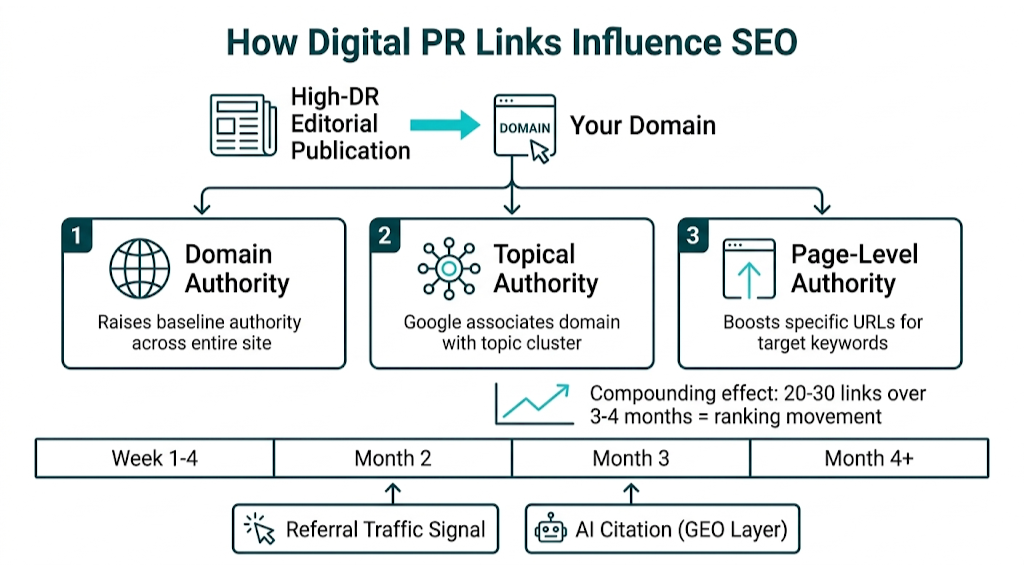
First: domain authority. A steady flow of links from high-DR publications raises your domain's baseline authority, which lifts rankings across the site, not only the URL that got the link. Second: topical authority. If industry publications keep citing your brand as a source, Google tightens the association between your domain and that topic cluster. Third: page-level authority. Direct links to specific URLs - product pages, service pages, pillar content - pass authority that boosts those pages' ability to rank for their target terms.
The timeline is where teams get tripped up.
A new link from a DR 80 publication won't move rankings tomorrow. Google has to crawl the linking page, process the link, then feed it into ranking calculations. That takes weeks. And one link, even from a top-tier domain, rarely moves the needle alone. Ranking movement for competitive keywords comes from the compounding effect: 20-30 high-quality editorial links earned over three to four months.
That compounding effect isn't limited to rankings.
There's a second-order SEO benefit that teams miss: referral traffic. If your brand appears in a publication your buyers read, some of those readers click through. That audience signal - real users arriving from trusted sites - supports authority in ways raw link metrics won't show.
Authority shows up in other surfaces too.
Today, that includes the GEO layer. Recent search analysis confirms that brands earning consistent editorial coverage in authoritative publications are more likely to appear in AI-generated answers on platforms like Perplexity and ChatGPT. The LLMs generating those answers train on the same pool of reputable media content digital PR targets. Getting your brand into that pool isn't just an SEO play - it's a Generative Engine Optimisation strategy.
What to Expect When Working With a Digital PR Agency: A Timeline
Buyers worry less about cost than uncertainty. Nobody wants to spend four months and $15,000 and still have no clear view of what's working. A well-run digital PR engagement follows a predictable rhythm, week by week.
Weeks 1-2: Onboarding and Discovery
A competent agency doesn't start pitching journalists in week one. The first two weeks go to understanding your brand, your audiences, your competitive set, and your existing backlink profile. That means a technical read on your current domain authority, a review of top-performing pages and ranking gaps, and a competitive backlink analysis to see what's working for rivals. Plan for at least one 60-90 minute onboarding call and a detailed brand questionnaire. If an agency skips discovery, treat it as a red flag.
Weeks 3-4: Strategy Development and Campaign Ideation
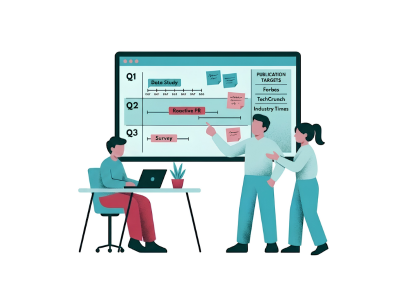
Campaign concepts come next - often 3-5 ideas with different risk levels and target publication tiers. You review the options and approve a direction. The same window is also when a good agency sets up reactive PR monitoring: keyword alerts, journalist watchlists, and topic trackers tied to your space. Some reactive angles get pitched during this period if the news cycle cooperates.
Weeks 5-8: Asset Creation and Outreach Preparation
For data-led campaigns, this is production: survey commissioning, analysis, design, and press release drafting. For reactive PR, the first pitches go live here and early placements can land. Reactive PR moves fast by design. A good agency can secure reactive placements inside the first 30 days.
Weeks 9-12: Active Outreach and First Results
The data campaign launches and outreach shifts into high gear. The agency sends personalized pitches to its journalist list, follows up, and manages coverage through publication. Placements from the proactive campaign usually start appearing in this window. By the end of week 12, a competent agency should have delivered a solid number of placements - the exact count depends on the campaign, the industry, and the publication tier you're targeting.
Months 4-6: Compound Effect and Iteration
This is where the compounding value becomes visible. Links earned in months 1-3 start influencing rankings. New campaigns build on the authority created by earlier coverage. Journalists who ran the first story become warmer contacts for the next one, which shortens the path to placement. At this stage, the agency should report on ranking movement, domain authority changes, and referral traffic trends - not only link totals.
Reporting Standards: What a Good Digital PR Agency Should Send You Every Month
Monthly reporting is where agencies show their real level of competence. A basic report lists placements and their Domain Ratings. A good report ties those placements back to your SEO goals and tells us what moved, what didn't, and why.
Every monthly report from a digital PR agency should include:
- Placement log: Publication name and URL, plus Domain Rating, anchor text, link type (dofollow/nofollow), and the date the link was indexed.
- Domain authority trend: Your domain's DR or DA movement for the period, benchmarked against the previous month.
- Organic traffic trend: Top-line organic traffic, segmented by the pages picking up the most link equity from the campaign.
- Keyword ranking movement: The specific keywords that have moved since the campaign began, with before-and-after positions.
- Coverage highlights: The top 3-5 placements, with context on why those publications matter for your goals.
- Next month's pipeline: Campaigns in development. Reactive opportunities being monitored. Planned outreach targets.
A report that's just a spreadsheet of links with no interpretation isn't a report. It's a delivery log.
The links are the output. Rankings and traffic are the outcome. You're paying for outcomes.
In-House Digital PR vs. Agency: The Real Cost-Benefit Breakdown
This decision lands on most marketing directors sooner or later, and "hire an agency" isn't the default right answer. The right move depends on budget, timeline, and what your team already has in place.
The true cost of in-house digital PR gets underestimated because teams price the role, not the function. A mid-level Digital PR Manager in the US commands a base salary of $60,000-$85,000. Once we add employer taxes, benefits, and overhead, the fully-loaded cost lands at $80,000-$110,000 annually. Tools come next: a media database subscription like Cision or Moxie runs $10,000-$20,000 per year, and you'll also need a media monitoring tool, a link tracking tool, and design resources for campaign assets. A properly resourced in-house digital PR function costs $120,000-$150,000 per year minimum - and that's for one person.
That "one person" limit is the part teams feel fast. Output caps early, outreach stalls when priorities shift, and coverage becomes inconsistent.
Agency costs vary a lot by scope and capability. A specialist digital PR link building agency charges $2,500-$8,000 per month for an ongoing retainer, depending on campaign volume and the publication tier being targeted. At $4,000 per month, that's $48,000 annually - less than half the cost of a single in-house hire, and it comes with a full team: journalist relationships, tool infrastructure, and campaign experience. For a full breakdown of what drives those numbers, our link building cost guide covers pricing across every major service type.
Factor | In-House | Agency |
|---|---|---|
Annual cost (realistic) | $120,000-$150,000+ | $30,000-$96,000 |
Journalist relationships | Built from scratch | Established and maintained |
Tool infrastructure | Additional $15,000-$25,000/year | Included in retainer |
Campaign expertise | Developing | Proven across multiple verticals |
Scalability | Fixed capacity | Flexible by scope |
Brand knowledge depth | High | Requires onboarding investment |
Speed to first placement | 3-4 months | 4-8 weeks |
Speed to first placement is where the trade-off shows up in real life. In-house is strongest when your brand needs deep institutional knowledge that takes years to transfer - complex regulatory environments, highly technical subject matter, or industries where journalist relationships are intensely personal. Agencies win when you need results on a defined budget, when you're scaling quickly and can't afford a slow hiring process, or when your existing team doesn't have the journalist network that takes years to build.
There's also a hybrid model worth considering. Hire a senior in-house PR manager to own strategy and brand voice, then use an agency for outreach execution and journalist relationship management. You keep the brand knowledge close while still getting the network and infrastructure an agency brings. For brands spending $5,000+ per month on digital PR, this structure often produces the strongest results. Our managed service is built around exactly this kind of partnership model.
How to Evaluate a Digital PR Agency: 7 Questions That Separate Good From Great
Most agency evaluation processes lean on case studies and pricing. Those matter. But they won't tell us what decides whether a campaign lands links that move rankings or just looks good in a deck.
These seven questions cut through the sales pitch.
1. Can you show me the actual placements from your last three campaigns, including the Domain Ratings and anchor text?
Skip the case study with headline numbers. Ask for the placement log.
A real digital PR link building agency has this data on hand and shares it fast. If the answer is "we can't share client data," push for anonymized examples. If they still can't produce specific placement data, they don't have it - or they don't track it well enough to manage performance.
2. How do you build and maintain your journalist relationships?
The answer tells us if the agency has real media relationships or just a database subscription.
Good agencies can name journalists they've placed stories with more than once, explain what beats those journalists cover, and describe how they stay in touch between campaigns so the relationship doesn't go cold. If we hear, "we use a media database to find relevant journalists," we're looking at cold outreach to strangers - and cold outreach produces lower placement rates than warm pitching.
3. How do you integrate digital PR with our existing SEO strategy?
This separates digital PR specialists from PR agencies that slapped "digital" on the website.
An SEO-first digital PR agency asks for target keywords, current backlink profile, priority pages, and topical authority gaps before they pitch a single idea. They'll also explain how they handle anchor text, and why the target publication list should match what our link profile needs - not just what sounds impressive in a report. Understanding natural anchor text principles is a good baseline before having this conversation with any agency.
4. What's your process when a campaign underperforms?
Every agency has campaigns that miss. It happens.
A journalist who showed interest goes dark. A news cycle buries the story. A dataset turns out weak once it hits inboxes. The response to underperformance tells us more about competence than any highlight reel.
Look for a documented contingency plan. Re-angle the story. Expand the outreach list. Pivot to reactive PR while the proactive campaign gets rebuilt.
5. How do you measure success beyond link count?
Link count is an output metric. Outcomes are what matter: domain authority movement, keyword ranking changes, and organic traffic growth.
If an agency reports success only in link totals, they'll chase the wrong wins. We want to hear how they connect link acquisition to ranking movement, what they expect to shift and when, and how they attribute traffic changes to their work without hand-waving.
6. What publication tiers do you target and how do you decide?
Not all links are equal.
A link from a DR 85 national news publication carries far more weight than one from a DR 30 niche blog. But the best answer isn't "we only go after DR 70+." In plenty of industries, a cluster of highly relevant DR 40-50 niche publications sends stronger topical authority signals than a couple of high-DR generalist hits.
If an agency can explain that trade-off - and show examples of how they've made it for clients in our vertical - they understand SEO strategy, not just outreach volume.
7. Can you describe a campaign that failed and what you learned from it?
This is the trust question.
Any agency that's been operating for more than two years has campaigns that didn't work. Agencies that claim otherwise are either inexperienced or dishonest. A credible team can walk through a specific miss, name the root cause, and explain what they changed after - process, data, angle, targeting, or QA.
That's the partner we want running link acquisition.
Red Flags to Watch for When Buying Digital PR Services
The digital PR space has plenty of operators who talk like they're doing earned media while shipping something closer to paid placements or low-grade link schemes. See any of the issues below, and we end the conversation.
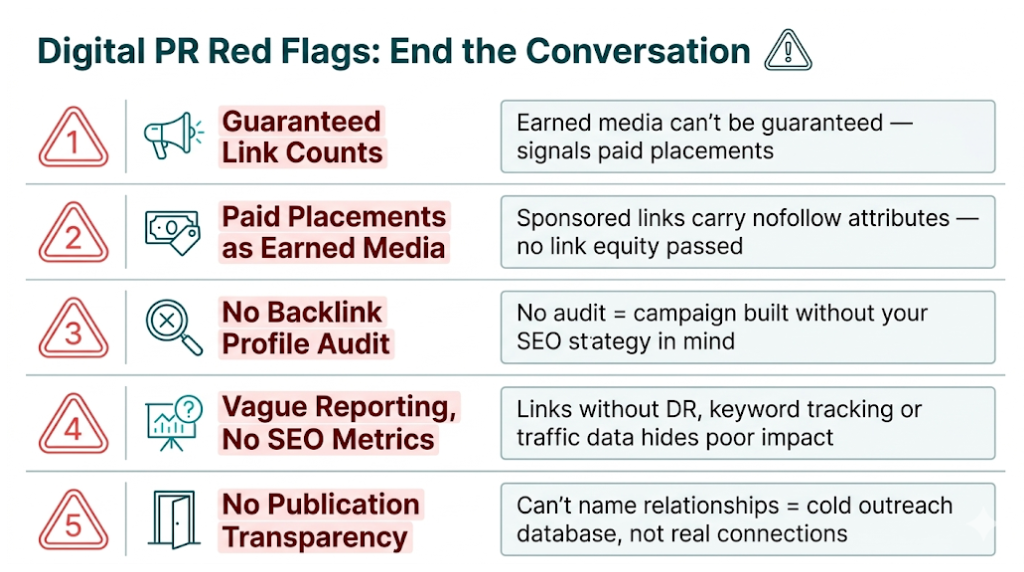
Guaranteed link counts. Legitimate digital PR is earned media. Earned media, by definition, can't be guaranteed. If an agency promises "a minimum of 20 links per month," they're either guaranteeing paid placements (which violate Google's link scheme policies) or setting expectations they won't hit without dropping publication quality. Reputable agencies commit to a process and a volume of outreach. They don't promise editorial outcomes.
Paid placements presented as earned media. Some agencies buy sponsored content slots in publications and pass them off as editorial coverage. That line matters for SEO: paid placements usually come with nofollow or sponsored link attributes, which pass little to no link equity. Ask whether the placements they secure are editorial (unpaid) or sponsored. If they dodge the answer, assume it's sponsored.
No discussion of your existing backlink profile. An agency that doesn't audit your existing links before building a campaign isn't thinking about your SEO strategy - they're thinking about their deliverable. Your current link profile dictates which publication tiers will move the needle, which anchor text ratios need balancing, and which topical areas need reinforcement. Skip this step and you get campaigns that create activity without lifting rankings. Running a backlink gap analysis before any agency conversation puts you in a much stronger position.
Vague reporting with no SEO metrics. If the monthly report is only a list of coverage links with no domain authority data, no keyword tracking, and no organic traffic context, the agency is hiding something - usually that the links aren't driving measurable SEO impact. Demand outcome metrics from day one. No exceptions.
No transparency about publication relationships. If an agency can't tell you which publications they have strong relationships with and why, they're working off a cold outreach database. That isn't disqualifying for every campaign type. It does, however, cut placement rates for top-tier publications.
Digital PR Services in 2026: How AI Is Changing What Agencies Deliver
75% of PR professionals say AI has changed how they work, according to recent PR industry surveys. That shift shows up at every stage of the digital PR process - and it brings new capabilities plus new risks buyers need to understand.
On the production side, AI tools now speed up several slow parts of campaign development: data analysis, initial press release drafting, journalist research, and personalized pitch generation. An agency that used to spend three weeks on campaign research can shrink that to ten days with the right AI workflow. That time has to go somewhere. Faster delivery is one option. More campaigns per retainer is another. Either way, it's a fair question to put to any agency you're evaluating.
The distribution side is where the bigger shift sits. LLM-powered search - ChatGPT, Perplexity, Google's AI Overviews, and similar tools - created a new category of visibility that doesn't map to classic keyword rankings. When a user asks Perplexity "what's the best project management software for remote teams," the answer pulls from a corpus of trusted media content, not a ranked list of web pages. Brands that show up in that answer already have digital PR coverage in the publications LLMs treat as authoritative sources.
Those authoritative sources are what recent search analysis calls the GEO (Generative Engine Optimisation) opportunity - and it's one of the strongest arguments for investing in digital PR services right now. Brands earning editorial coverage in high-authority publications today are training the next generation of AI systems to cite them as credible sources. Brands that wait train those systems to cite competitors instead. The case for link building for AI Overviews has never been stronger than it is heading into the future of search.
That training effect is the point Shai Aharony makes in BuzzStream's report: your brand's narrative has to live in trusted, reputable media to show up inside AI answers. Digital PR is what puts it there. And the window for establishing that presence before the market locks in is closing.
That closing window is why some agencies now plan campaigns around LLM citation - they target the publications AI systems weight most heavily, then build brand narratives in formats LLMs extract and reproduce. That's a capability worth asking about directly when you're evaluating a digital PR link building agency for the future.
Frequently Asked Questions About Digital PR Services
What are digital PR services and how do they differ from traditional PR?
Digital PR services earn editorial coverage and backlinks from online publications to lift a brand's search rankings and online authority. Traditional PR focuses on broadcast and print to build awareness, and it tracks reach, share of voice, and impressions.
The skill set overlaps - pitching, relationship building, and newsroom timing. The scoreboard doesn't. Digital PR lives and dies on editorial backlinks, domain authority movement, and organic search performance, while traditional PR centers on audience exposure and brand perception.
How do digital PR services improve SEO and search rankings?
Digital PR earns editorial backlinks - links journalists and editors add because the story warrants it. Google treats those links as authority signals.
Those signals stack over time. As we earn links from high-Domain Rating publications, your domain picks up more authority, builds topical relevance, and passes page-level equity to the pages you care about.
The compounding shows up in rankings. Rack up 20-40 strong links over three to six months and you'll see ranking movement on competitive keywords.
How long does it take to see results from a digital PR campaign?
Speed depends on the tactic. Reactive PR placements can land in the first 30 days.
Proactive, data-led campaigns take longer because they start with research, asset builds, and pitching cycles, so first placements tend to hit in weeks 8-12. Those links then need time to register in the index and feed into ranking systems, which is why ranking movement shows up in months 3-5.
Traffic is the lagging indicator. Significant organic traffic growth from digital PR shows up around the six-month mark.
Buyers who want results inside 60 days should put budget behind reactive PR and treat proactive campaigns as a pipeline, not a quick hit.
How much do digital PR services cost?
Digital PR retainers usually run from $2,500 to $8,000 per month. Price shifts with campaign volume, the publication tiers you target, and how much asset creation sits inside the scope.
One-off campaigns cost more per deliverable. A single data-led asset on a project basis tends to land between $5,000 and $15,000.
In-house looks different on paper, then the overhead hits. A full internal digital PR function costs $120,000-$150,000 per year once you include salary, tools, and overhead, which is why most brands stick with an agency retainer until they hit the scale that supports dedicated headcount.
Can digital PR help my brand appear in AI-generated answers?
Yes - and it's one of the strongest reasons to fund digital PR today. LLMs like ChatGPT, Perplexity, and Google's AI Overviews pull answers from trusted, authoritative media coverage, and brands with consistent editorial mentions in high-authority publications show up more often in those citations.
That editorial coverage is the input. Digital PR puts your brand into the media sources AI systems draw from, so it influences what those systems repeat and reference.
Teams that understand GEO (Generative Engine Optimisation) already build campaigns with LLM citation as an explicit goal alongside classic SEO link building targets.
related Blog Posts


Join 2,600+ Businesses Growing with Rhino Rank
Sign Up
Stay ahead of the SEO curve
Get the latest link building strategies, SEO tips and industry insights delivered straight to your inbox.