
 Back to all posts

Digital PR has a definition problem. Most guides frame it as "PR for the internet" - a brand awareness play that happens to generate some backlinks along the way. That framing undersells what a well-run digital PR strategy delivers and, more importantly, it pushes practitioners toward the wrong build from day one. If the goal is link acquisition at scale, the whole campaign architecture changes. Formats change. Media targets change. Angles change. Even the metrics you track look nothing like a traditional PR campaign.
The bottom line: A digital PR strategy built for SEO is a systematic process for creating content assets that journalists and editors want to cite, then distributing those assets to the right media contacts at the right time. When it works, it produces editorial backlinks from high-authority domains that you won't replicate with guest posts or niche edits, even with a bigger outreach budget. According to AIOSEO's SEO statistics, sites with strong backlink profiles are 3.8x more likely to rank on page one - and digital PR is the most reliable method for building that kind of profile fast.
That profile is the point. This guide isn't a brand awareness playbook. It's an operational framework for SEO professionals, in-house SEO managers, and agency owners who need to plan, validate, execute, and scale digital PR campaigns that move rankings.
We cover pre-campaign validation (which no competitor guide touches), failure mode diagnosis, and business-type segmentation - because a local plumber and a SaaS platform need completely different approaches, and pretending otherwise wastes budget.
What Is a Digital PR Strategy (and Why Most Definitions Miss the Point)
Most definitions of digital PR stop at tactics: "it's press releases, data studies, and media outreach." That's true in the same way that "cooking is heat and ingredients" is true. It doesn't help you execute.
Execution starts with a tighter definition. A digital PR strategy, properly defined, is a repeatable system for earning editorial coverage and backlinks from authoritative publications by giving journalists content they genuinely need. "Strategy" matters here. It means we aren't running one-off campaigns and hoping links show up. We build campaign architecture - validated angles, targeted media lists, measurable KPIs, and a feedback loop that lifts performance from one campaign to the next.
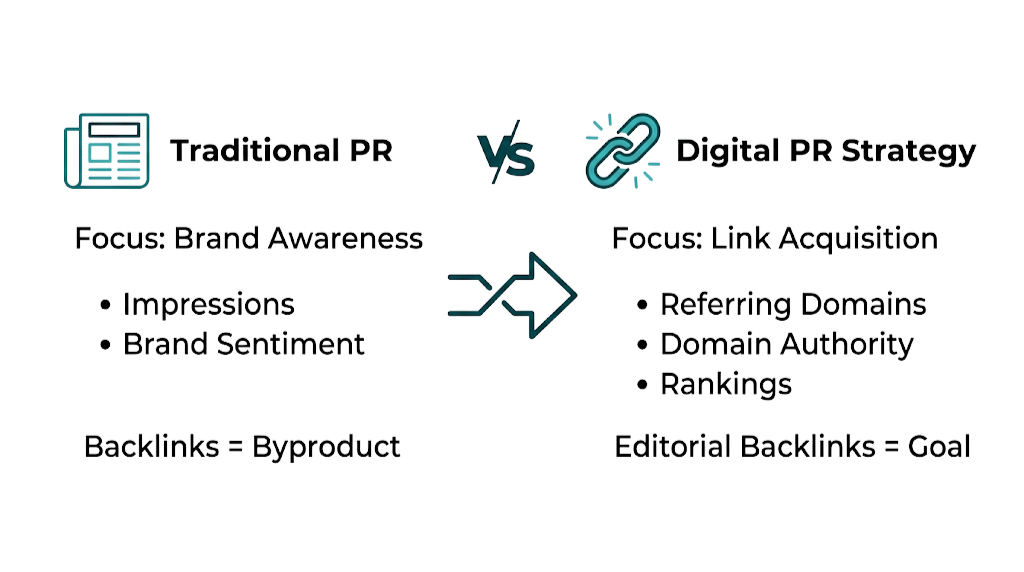
That architecture is where digital PR breaks from traditional PR. Traditional PR targets broadcast and print media, measures success in impressions and brand image, and treats links as a byproduct. Digital PR targets online publications and journalists, measures success in referring domains, Domain Authority lift, and ranking movement, and treats editorial backlinks as the output. Brand awareness still comes with coverage, but it isn't the goal.
Editorial backlinks are also why this sits so close to SEO. Google's Search Central documentation is explicit that links remain one of the most important signals Google uses to evaluate page quality and relevance. Digital PR earns the kind of links Google weights most - contextual, editorial links from relevant, authoritative sources. A journalist citing your salary data study in a Forbes article doesn't behave like a guest-post link on a mid-tier blog. It carries different trust signals, and it tends to keep paying off over time.
That difference exposes what most definitions miss: digital PR is not a content marketing strategy with a distribution layer bolted on. It's a link acquisition strategy that uses content as the mechanism. This distinction drives every decision, from the campaign formats we fund to how we write pitch emails.
Build content for an end audience and you optimize for engagement. Build content for journalists and you optimize for newsworthiness, citeability, and speed of consumption - a different scoring system entirely.
Those link-earning campaigns share one trait: they give journalists a reason to cite you that serves their readers, not your brand. Keep that standard in view as we move through the rest of the guide.
Why Digital PR Links Outperform Every Other Link Building Tactic
SEO teams have a few legit options for link acquisition: guest posting, niche edits, resource page links, broken link building, and digital PR. Each one fits a different job. But if you judge them on what moves rankings - link quality, topical relevance, natural anchor text, and repeatability - digital PR comes out on top.
Here's how the main tactics stack up on the dimensions SEO pros care about:
Tactic | Avg. Domain Authority | Anchor Text Control | Editorial Nature | Scalability | Cost per Link |
|---|---|---|---|---|---|
Guest Posts | Medium: 30-60 | High | Partial | Medium | £100-£500 |
Niche Edits | Medium: 25-55 | High | Low | Medium | £75-£400 |
Resource Page Links | Low-Medium: 20-50 | Low | High | Low | £50-£200 |
Digital PR | High: 50-90+ | Low | High | High | £300-£2,000+ |
Broken Link Building | Low-Medium: 20-45 | Low | High | Low | £50-£150 |
The trade-off is simple. Digital PR costs more per link, and you don't get to pick anchors.
But those "downsides" are the point. The price reflects the quality ceiling: a mid-market SaaS team spending £3,000 on a data study campaign that earns 40 links from publications with DR 60+ ends up with an asset you can't buy at scale through placements or swaps, even if you throw more budget at it. And low anchor control keeps your profile clean - real editorial citations instead of engineered patterns that show up in audits.
That editorial angle is what makes the links stick. As Ahrefs' breakdown of digital PR as a link building strategy makes clear, links earned through genuine coverage are hard to replicate and tend to stay indexed long after algorithm updates squeeze link schemes out of the results.
Durability alone isn't the whole win. Topical authority is where digital PR separates itself.
If a personal finance site publishes a data study on savings rates and earns 60 links from personal finance publications, every one of those placements tightens the site's relevance to that topic. That signal compounds. Guest posts on loosely related blogs won't build the same topic focus, even if the DA looks fine on paper. Understanding domain authority vs domain rating helps clarify why the source of those links matters as much as the metrics attached to them.
Scale follows the same logic. One campaign - a data study, a reactive PR push, an interactive tool - can pull in dozens or hundreds of links from a single asset. The build cost stays fixed while the link ceiling moves. That's a different model than tactics where every link requires its own outreach thread, back-and-forth, and placement.
The 6 Digital PR Campaign Formats That Consistently Earn Links
Not all digital PR content pulls links at the same rate. Choosing the format is one of the highest-impact calls you make in planning, and a lot of guides skip past it. The pattern is visible in plain sight: a few formats keep winning on volume, while others give up volume to land bigger names.
The six formats with the strongest track record for link acquisition are:
- Data studies and original research - biggest ceiling for link volume, but you need primary data or a fresh angle on existing datasets
- Reactive PR and newsjacking - quickest route to high-authority coverage, but only if you can move fast and stay relevant
- Interactive tools and calculators - earn links over the long tail; they also cost more to build
- Visual assets and infographics - solid for moderate link volume, especially in data-heavy verticals
- Expert commentary and thought leadership - fewer links, stronger authority, and useful for brand trust
- Surveys and polls - easier to launch, scales well, and fits most business types
The format has to match three things: budget, timeline, and the media environment in your vertical. Reactive PR costs close to nothing to produce, but you need a team that can respond within hours. Data studies take weeks, then keep earning links for months after launch.
Data Studies and Original Research: The Highest-Volume Format
Backlinko's Voice Search Study is the canonical example of this format done right. The study analysed over 10,000 Google Home results to identify the factors that influence voice search rankings. It earned thousands of editorial links because it answered a question every SEO professional was already asking, with data no one else had. The formula is simple: new data + a question the target audience already cares about = high link volume.
That link volume comes from a basic media need. Journalists have to cite sources. If we publish the primary dataset on a topic, we become the default citation, because we own the numbers everyone else needs to reference.
The production path for a data study looks like this:
- Identify a question in your vertical that has no definitive data answer.
- Decide whether we can generate primary data (surveys, proprietary analysis, scraped public data) or re-analyse existing public datasets in a new way.
- Build the dataset, then pull out the three to five findings that break expectations.
- Turn the findings into a dedicated landing page with clear, embeddable charts.
- Pitch the top findings as a story, not a report.
The "surprising finding" element is non-negotiable.
Journalists don't cover "things are roughly as expected." They cover anomalies, reversals, and results that force a second look. Build the campaign angle around the finding that makes someone say "really?" - that's the headline, and it's what drives coverage.
Reactive PR and Newsjacking: The Fastest Path to High-Authority Links
Reactive PR runs on a different clock than planned campaigns. When a major news story breaks - a government report, a market shift, a viral cultural moment - journalists write on deadline and need expert sources, data, and commentary right now. That's the window we work in.
That window only stays open for a few hours, so the mechanics have to stay tight. We monitor the news cycle in our vertical, spot stories where our brand or client has real expertise or relevant data, then pitch within two to four hours of the story breaking. Platforms like HARO (now Connectively), Qwoted, and ResponseSource formalize the workflow by routing journalist requests straight to your inbox. A journalist writing about housing affordability sends a request for expert comment; we reply fast with a sharp, quotable insight; they cite us with a link.
That link is why reactive PR works so well. The authority ceiling on reactive PR is higher than almost any other format because national newspapers and top trade publications are the ones living on deadlines. A well-timed response to a BBC journalist's request can earn a DR 90+ link that no outreach campaign can force.
That DR 90+ outcome depends on one variable we control: speed. Set up keyword alerts for your vertical using Google Alerts and monitor journalist request platforms daily. The campaigns that win reactive PR links are the ones that respond first, with content editors can drop straight into a draft.
Step-by-Step: How to Build a Digital PR Strategy from Scratch
Building a digital PR strategy from scratch requires five distinct phases: ideation, validation, production, outreach, and measurement. Most practitioners squash these into two or three steps and then wonder why pick-up rates stay low. The separation matters because each phase has its own success criteria and its own ways to fail.
Those phases have to run in order. We don't build a campaign asset until the idea passes validation. We don't start outreach until the asset is live and the media list is ready. Skip steps, and teams burn months producing content that earns three links.
How to Validate a Campaign Idea Before You Build Anything
Pre-campaign validation is the highest-ROI activity in digital PR, and it's the step most guides skip. Two hours of validation before production starts saves weeks of work on an idea that never had a shot.
We use a three-question test for every campaign idea:
1. Novelty: Has this data been published before?
Run the core question through Ahrefs Content Explorer with the "published" filter set to the last 12 months. If three or more high-DR sites have already covered the exact angle with their own data, the window has closed. At that point, we're not publishing primary research - we're publishing a remix. Move on.
2. News hook: Does this connect to something journalists are already covering?
A data study about remote work patterns is more pitchable in January, when brands announce return-to-office policies, than in July. Matching the campaign to an active news cycle lifts the odds of coverage. Use Google Trends and industry news calendars to pick the right publication window.
3. Surprise factor: Is the headline finding counterintuitive?
Show the proposed headline finding to three people outside our team. If nobody reacts with "huh, I wouldn't have expected that," it won't carry a story. Journalists aren't interested in confirmation; they want contradiction.
That three-question test gets us to "worth building," but we still need a reality check on link potential. Use Ahrefs Content Explorer to benchmark comparable campaigns: search for similar topics, filter by referring domains, then take the top performer as your ceiling. If the best comparable piece earned 45 referring domains, that's the target range. If the best earned 8, the vertical doesn't reward that angle, and we should rethink the format or topic.
This validation step also prevents one of the most common digital PR failure modes: building a campaign around data that's technically interesting but useless to an editor. "Interesting to our team" and "interesting to a journalist's audience" aren't the same thing. Validation forces us to think like the publication before we spend time and budget on production.
Building a Targeted Media List That Actually Responds
A media list built for digital PR isn't a press release distribution list. Blast 500 journalists with a generic pitch and you'll torch your sender reputation while earning zero links. A targeted list of 40 to 60 highly relevant journalists, pitched with personal context, beats a spray-and-pray approach. If you'd rather hand this process to specialists, a managed service can handle media list building and outreach at scale without sacrificing targeting quality.
Budget and scale decide the toolset.
- Muck Rack - a deep journalist database for finding contacts by beat, publication, and recent articles. It's expensive, but the data quality holds up for high-volume campaigns.
- Ahrefs Content Explorer - filter by topic and sort by DR to find publications covering your vertical, then pull the specific writers behind those articles.
- Hunter.io - finds email patterns at publications where journalist emails aren't listed.
- LinkedIn - underused for digital PR. It helps us spot journalists who've just covered the topic, especially when their contact details don't show up in databases.
Data quality is the whole point of the list. For each contact, record four fields: name, publication, beat (the topics they cover), and a recent article that's relevant to your campaign. That last field supports real personalization in the pitch. And personalization drives opens and replies.
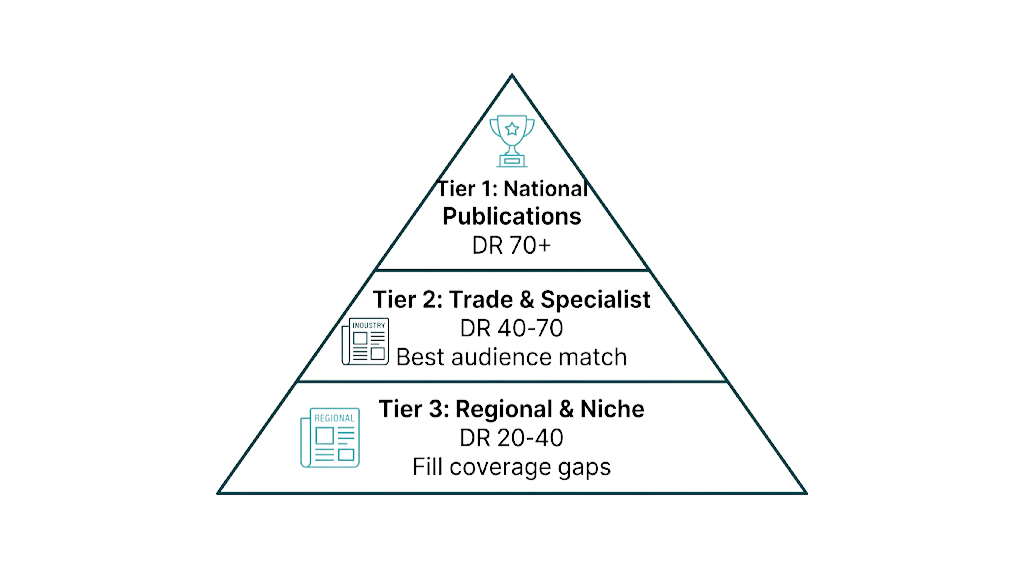
Segment the list by tier. Tier 1 is national publications and major verticals with DR 70+. Tier 2 is strong trade and specialist publications with DR 40-70. Tier 3 is regional and niche outlets with DR 20-40.
Start with Tier 1. If Tier 1 coverage doesn't land right away, move to Tier 2 and Tier 3. Some campaigns pull their best links from Tier 2 outlets because the audience match is tighter, even if the DR is lower.
Writing a Pitch Email Journalists Will Actually Open
The pitch email is where most digital PR campaigns die. The asset is strong, the media list is tight, and then a 300-word pitch with three attachments and a subject line like "PRESS RELEASE: New Study Reveals Surprising Findings" sinks the whole send.
Journalists get hundreds of pitches a week. The ones they open share three traits: a subject line that states the story, a first paragraph that delivers the hook with no throat-clearing, and a clear reason the story fits their audience.
Here's the structure we rely on:
Subject line: Lead with the finding, not the format. "UK workers lose 6.3 hours per week to unnecessary meetings - new data" beats "New workplace productivity study from [Brand]" every time. Treat the subject line like a headline.
Opening paragraph (2-3 sentences max): State the finding, why it matters now, and why it matters to their readers. Skip "I hope this finds you well." Skip the brand backstory. Put the news first.
Second paragraph: Add the data context - sample size, methodology, and the key secondary findings. If the data doesn't sound solid, they won't spend time on it.
Third paragraph: Offer extra resources - the full dataset, an expert quote, a high-resolution chart, or an interview. Make it easy to write the piece without three rounds of email.
Sign-off: One line. Name, title, direct contact number.
Keep the pitch under 200 words. If we can't explain the story in 200 words, the angle isn't sharp yet. Journalists won't dig for it in a wall of text. Give them the story, the data, and a way to reach us. That's the pitch.
Follow up once, five to seven business days after the initial send. One follow-up is professional. Two starts to burn the relationship.
How to Measure Digital PR Campaign Performance Beyond Link Count
Link count is the easiest metric to screenshot in a report. It's also the least useful on its own.
A campaign that earns 30 links from DR 30 directories has technically earned links. A campaign that earns 8 links from DR 70+ national publications moves rankings. Those outcomes aren't comparable, and link count alone hides the gap. Tracking the right link building metrics from the start ensures you're measuring what actually drives performance.
The metrics framework we use for digital PR campaign evaluation covers four dimensions.
Link quality metrics:
- Referring domains earned - count unique domains, not total links
- Average DR of linking domains
- Followed vs. no-followed link split
- Topical relevance of the linking pages
Organic performance metrics:
- Ranking movement for target keywords, measured 60 to 90 days post-campaign
- Organic traffic change to the campaign landing page
- Crawl frequency changes to the target URL - an indirect signal of rising authority
Coverage metrics:
- Total media placements, including unlinked mentions
- Tier 1 vs. Tier 2 vs. Tier 3 coverage split
- Estimated reach of coverage - publication traffic x number of placements
Brand metrics:
- Branded search volume change, measurable in Google Search Console
- Direct traffic uplift in the 30 days post-campaign
- Unlinked brand mentions, trackable via Ahrefs Alerts or Brand24
One metric teams ignore too often: unlinked brand mentions.
If a publication covers your campaign but skips the hyperlink, the mention still puts your name in front of readers and other journalists. It also creates a clean link reclamation path. A polite attribution ask converts at a real rate, often 15 to 25%.
That timing point matters too. The 60 to 90 day lag on ranking measurement needs to be agreed upfront with brands and stakeholders.
Digital PR links take time to get crawled, indexed, and reflected in ranking calculations. Campaigns that feel dead in week three often show clear movement by week ten. Set expectations during planning, before the first monthly report hits inboxes.
Common Digital PR Mistakes That Kill Campaign Pick-Up Rates
Most digital PR failures aren't random. They follow predictable patterns. Once we name the pattern, we can fix the campaign instead of binning it.
Here are the six most common pick-up killers, and the fix for each:
1. Stale data angles
The campaign is built around data that's already been covered, or findings that were novel six months ago but have since been repeated everywhere. Fix: Run Ahrefs Content Explorer before production starts and kill any idea that's been executed within the last 12 months by a high-DR site.
2. No clear news hook
The data is interesting, but it isn't tied to what journalists are writing about right now. A study about consumer spending habits pitched in a vacuum earns fewer links than the same study pitched during a cost-of-living news cycle. Fix: Map every campaign launch to a news calendar event or seasonal hook before you lock a publication date.
3. Over-optimized anchor text requests
Including preferred anchor text in your pitch email is one of the fastest ways to get flagged as a link builder rather than a PR pro. Journalists don't negotiate anchor text. They cite sources the way they cite sources. Fix: Strip all anchor text guidance from pitch emails and let the links land naturally. Studying natural anchor text principles helps explain why this approach produces a cleaner, more trustworthy backlink profile.
4. Pitching the wrong journalist tier
Send a niche industry study to a national news journalist, or send a broad consumer story to a specialist trade editor, and you get the same result: silence. Fix: Build separate pitch versions for each tier of your media list, then adjust the angle and framing for that audience.
5. Weak visual assets
A data study with no charts, or charts that can't be embedded, forces journalists to do extra work. Most won't. Fix: Include at least one high-resolution, clearly labelled chart with every data campaign, sized for web publication and available for download without a form fill.
6. Single-send outreach
Pitching once and waiting isn't a plan. Your email lands on a deadline day, gets buried, and never resurfaces. Fix: Build a structured follow-up sequence - one follow-up at day five, one final contact at day ten, then move on. Three touchpoints is the ceiling; beyond that, you start burning the relationship.
Digital PR Strategy for Different Business Types: SaaS, eCommerce, B2B, and Local
A common failure in digital PR advice is pretending the same playbook fits every business. It doesn't.
A SaaS platform, a D2C eCommerce brand, a B2B professional services firm, and a local restaurant chain all pitch into different media ecosystems, with different data assets, and different link volume ceilings. Format and angle have to match the business model, or the campaign stalls out.
SaaS companies win with data-led digital PR because most products already sit on aggregated, anonymized user behavior that reporters can use. Give journalists something they can't get elsewhere. A project management SaaS that analyses 50,000 team workflows to pinpoint meeting patterns tied to project delays has a campaign baked in. Tech, business, and productivity outlets are the natural targets. Realistic link volume for a strong campaign is 30 to 80 referring domains, usually weighted toward DR 50-80. Teams looking for a broader framework can pair this with a dedicated SaaS link building strategy to cover the channels digital PR doesn't reach.
eCommerce brands perform best with consumer behavior surveys and visual-led campaigns that travel in consumer media. A bedding brand surveying 2,000 UK adults on sleep habits, or a fashion retailer analysing trend data pulled from their own sales, can earn strong coverage fast. The hard part is making sure the campaign pages connect back to core product and category pages so link equity flows where we need it. Realistic link volume sits around 20 to 60 referring domains, with a wider DR spread.
B2B professional services firms - agencies, consultancies, law firms, financial advisors - should prioritize thought leadership and reactive PR over big data studies. The audience is smaller. The publications are tighter. Editors also expect senior credibility on the byline or in the quote. One strong comment from a managing partner in a Financial Times piece can outvalue 20 links from mid-tier blogs. Link volume runs lower at 10 to 30 referring domains, but average DR tends to run higher.
Local businesses are a different job entirely. National coverage rarely scales, so the goal shifts to regional and local publications plus hyperlocal data angles that reinforce location signals. A local estate agent publishing neighbourhood-level housing data, or a regional law firm commenting on local court statistics, can earn steady regional pickup. Those links won't always come with big DR. That's fine. For local, relevance and geographic fit matter more than raw authority. Pairing digital PR with local link building tactics fills the gaps that regional media coverage leaves behind.
The table below summarizes format recommendations by business type:
Business Type | Best Format | Target Publications | Realistic Link Volume |
|---|---|---|---|
SaaS | Data studies, product usage analysis | Tech, business, productivity media | 30-80 RDs |
eCommerce | Consumer surveys, visual campaigns | Consumer lifestyle, news | 20-60 RDs |
B2B Services | Thought leadership, reactive PR | Trade, national business press | 10-30 RDs |
Local Business | Hyperlocal data, regional surveys | Regional news, local trade | 5-20 RDs |
How to Scale a Digital PR Strategy: Turning One Campaign into Ongoing Link Velocity
One successful campaign proves the model. Turning that into ongoing link velocity takes process, otherwise quality drops as output goes up.
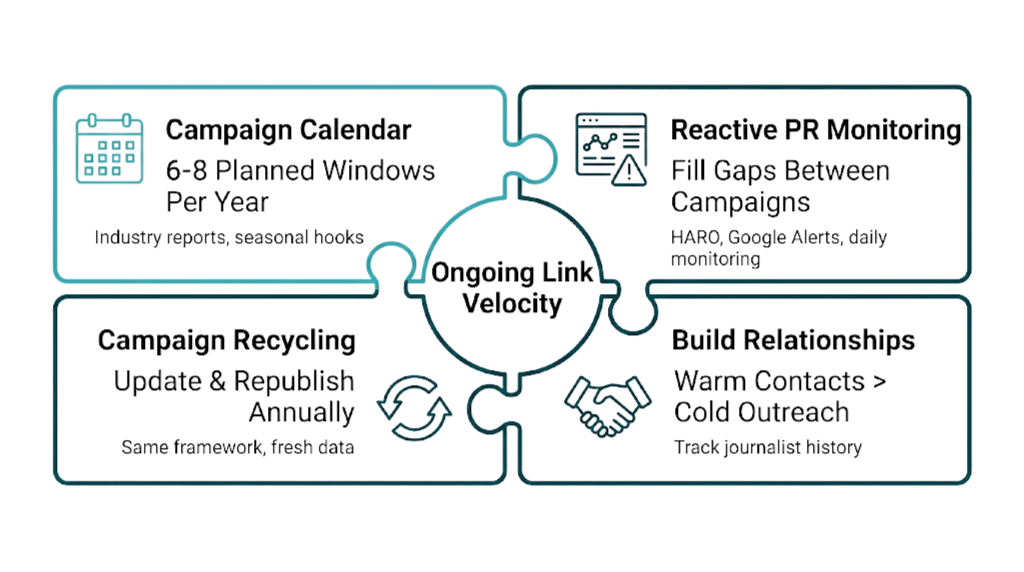
Start with a campaign calendar. Pick six to eight campaign windows across the year where your vertical already has built-in hooks - industry reports, seasonal trends, regulatory changes, annual data releases. Assign a concept to each window, then plan backwards from the publish date so production doesn't slip. If a data study needs to go live on 1 March, data collection has to begin by 1 February at the latest. Miss that, and the whole timeline collapses.
That calendar only covers planned work. Planned work leaves gaps.
Fill those gaps with a reactive PR monitoring system running alongside the calendar. Set up keyword alerts in Google Alerts for your five to ten core topics. Give one person clear ownership of daily monitoring across HARO, Qwoted, and ResponseSource. Reactive PR doesn't replace planned campaigns. It keeps link acquisition moving between launches, and it often drives the highest-authority links in the set because you're responding to active editorial demand.
Keep the link velocity going by campaign recycling. A data study published in Q1 can ship again in Q3 with updated numbers, a new angle, or a regional breakdown that makes it fresh for editors. Bankrate's Annual Emergency Savings Report is a strong example: the same framework refreshed annually keeps earning coverage because journalists know the update is coming and they can cite it. Recurring campaign assets build momentum - each cycle earns links, and the campaign URL tends to accumulate authority over time.
Outreach also gets easier when we stop treating journalists like rows in a spreadsheet. Build relationships, not just outreach lists. Reporters who've covered your work before are far more likely to cover the follow-up. Track every journalist who publishes, record what they covered and when, and segment them as "warm contacts" inside the media list. A pitch that opens with "you covered our remote work data in March - we've just published our follow-up on hybrid work patterns" closes faster than a cold email, because it anchors to something they've already run. The same relationship-first thinking that powers successful blogger outreach applies here - consistency and personalization compound over time.
Scaling digital PR isn't about doing more of everything. It's about holding the standard as volume climbs. Campaigns fail at scale when teams skip validation to ship on time, or when the pitch quality slips because the team runs hot. Protect the process. Link velocity follows.
Frequently Asked Questions About Digital PR Strategy
What is a digital PR strategy and how does it differ from traditional PR?
A digital PR strategy is a plan for earning editorial backlinks and online coverage from high-trust publications through newsworthy content. Traditional PR focuses on broadcast and print media, and it reports on impressions and brand sentiment. Digital PR focuses on online publishers, and we judge performance by referring domains, Domain Authority, and ranking movement.
Links are the deliverable. Brand awareness comes with it, but it isn't the core goal.
What types of content earn the most links through digital PR?
Data studies and original research pull the highest volume of editorial links because they give journalists something they have to cite when they cover the topic. Reactive PR and newsjacking win the highest-authority links from national publications. Interactive tools and calculators keep earning long-tail links over time.
Format choice comes down to budget and speed. And the media environment in your vertical matters, too.
How do you measure the success of a digital PR campaign?
Link count alone doesn't hold up. A complete measurement framework tracks four dimensions: link quality (referring domains, average DR, follow ratio), organic performance (ranking movement at 60 to 90 days, traffic to the campaign page), coverage metrics (total placements, tier split, estimated reach), and brand metrics (branded search volume change, direct traffic uplift, unlinked mentions).
That 60 to 90 day ranking lag needs to be agreed before outreach starts. Otherwise, the campaign gets judged on timing, not outcomes.
How long does it take for digital PR to improve search rankings?
Editorial links tend to drive measurable ranking movement 60 to 90 days after they're indexed. Indexation can take two to four weeks after publication.
High-DR links usually move faster than links from lower-authority sites, assuming the target page already fits search intent. Sustained ranking improvement comes from steady link velocity, not one big spike - plan a rolling programme with three to four campaigns per year minimum.
Is digital PR safe for SEO and Google-compliant?
Yes. Editorial links earned through real journalistic coverage match what Google's Search Central documentation describes as link signals that influence rankings. They're not manufactured, not exchanged, and not part of a link scheme.
Risk shows up when teams push past PR into paid link building. Asking journalists for specific anchor text or offering payment for coverage crosses that line - and it creates compliance exposure. Run digital PR the right way and you end up with the safest, longest-lasting links we see in SEO.
What tools do you need to run a digital PR campaign?
The core digital PR tools stack covers four functions: research (Ahrefs Content Explorer for campaign validation and competitor benchmarking), media list building (Muck Rack for journalist contacts, Hunter.io for email patterns), outreach monitoring (HARO/Connectively, Qwoted, ResponseSource for reactive PR), and performance tracking (Ahrefs or Semrush for referring domain monitoring, Google Search Console for ranking and traffic data).
A team running two to three campaigns per quarter can run this on Ahrefs plus Hunter.io plus one journalist request platform. That keeps the tools budget under control without giving up data quality.
related Blog Posts




Join 7,000+ Clients Growing with Rhino Rank
Sign Up
Stay ahead of the SEO curve
Get the latest link building strategies, SEO tips and industry insights delivered straight to your inbox.