
 Back to all posts

How many backlinks do I have?
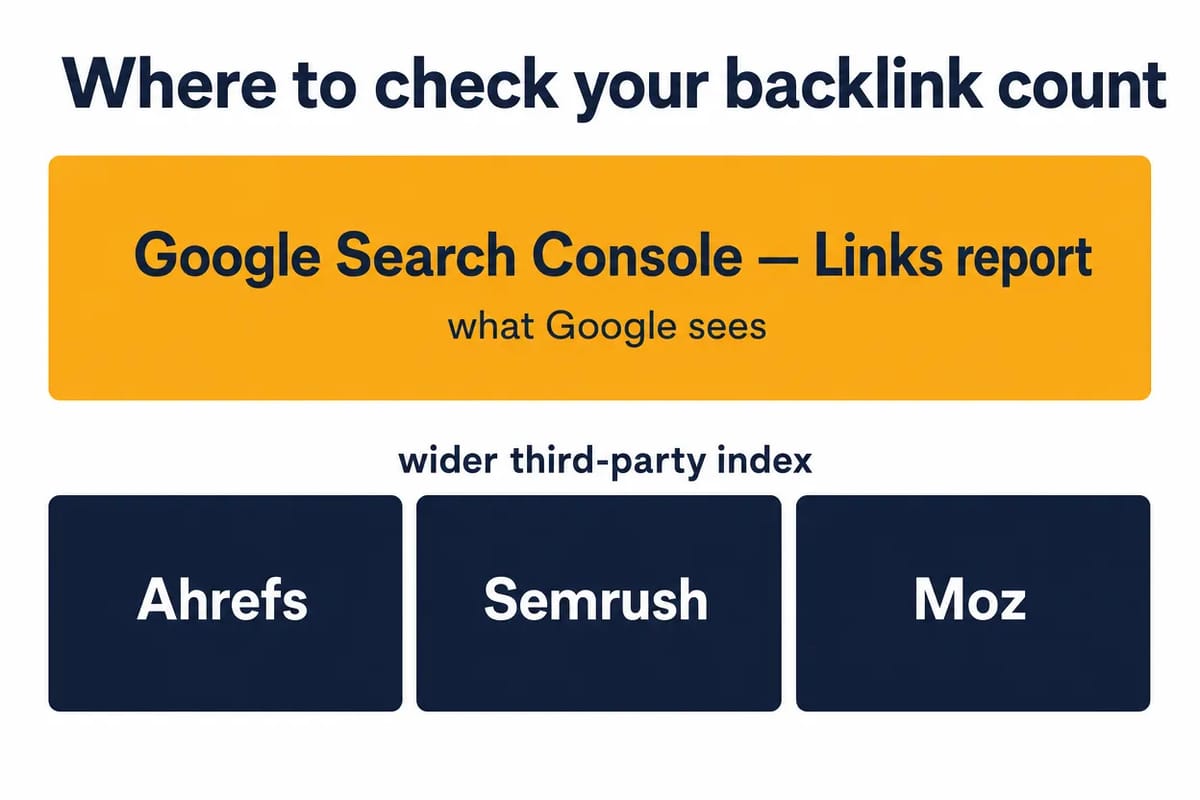
Use Google Search Console's Links report for your own site, then cross-check with Ahrefs, Semrush or Moz for a wider view. The number tells you how visible your link profile is in each index, which pages attract links, and where gaps may sit. It is a diagnostic, not a target. Quality beats count.
If you want to check how many backlinks point to your site, start with the tool that matches the question. Search Console is best for links Google has found to a property you control. Third-party backlink checkers are better when you want competitor data, extra filtering, or a second opinion on referring domains.
The catch: no backlink checker gives one final, exact number. Each tool crawls the web with its own index, groups links in its own way, and updates on its own schedule. A count from Search Console, Ahrefs, Semrush and Moz can all be useful while still being different.
That is normal.
The right way to think about backlink count
A backlink count answers a narrow question: how many linking URLs has this tool found for this domain or page? It does not tell you whether those links are relevant, editorial, risky, helpful for a specific page, or likely to move rankings.
That matters because two backlink profiles can show the same total and mean very different things. One site may have 500 links from 20 real, relevant referring domains. Another may have 500 links from a handful of low-value sites, sitewide footers or copied pages. The raw count looks similar. The link profile is not.
Use the count as a starting signal. If your total links rise, ask where they came from. If your total links fall, ask whether you lost useful links or only noise. If competitors have more links, ask whether they have more relevant referring domains to the exact pages that rank.
A steady profile is easier to read than a noisy one. The useful pattern is slow growth in relevant sites, links pointing to pages with a real job, and anchor text that fits the surrounding copy.
In the profiles we audit, the cleaner question is rarely "do we need more backlinks?" It is usually "which pages are under-supported by relevant referring domains, and which links would a reader understand if they clicked through?"
That is the point.
How to check backlinks in Google Search Console
Google Analytics is not the right tool for counting backlinks. Referral reports can show visits from other websites, but they do not show a backlink index. A page can link to you without sending traffic, and a referral visit can come from a route that does not help you audit your link profile. Use Analytics when you are reviewing website traffic, not when you need a backlink count.
For your own site, use Google Search Console. Open the verified property, go to the Links report, and review the external links data. If you are new to the platform, this Google Search Console guide covers the wider setup and reporting basics.
The Links report is split into useful views:
- Top linked pages: the pages on your site with the most external links.
- Top linking sites: domains that link to your site.
- Top linking text: common anchor text Google has found.
- Export options: latest links and more sample links for deeper checks.
Start with top linked pages. This tells you whether links support the pages that matter or only cluster around the homepage, old assets, images, tools or blog posts. A healthy profile often has a mix, but a commercial page with no relevant referring domains may need separate work.
Then check top linking sites. This is where referring domains become more useful than total links. If one domain links to you from many pages, the backlink count rises quickly. The number of linking sites gives you a cleaner view of how many separate websites are citing you.
Look at top linking text last. Anchor text helps you spot brand mentions, topic signals, repeated exact-match anchors and odd patterns. If the same commercial phrase appears too often, review the source pages before you assume the links are useful.
Search Console is limited to properties you can access. You cannot use it as a free competitor backlink checker. For competitor counts, use a third-party tool.
The best tools for checking backlink counts
You do not need a 15-tool stack to answer this query. Start with one first-party view and one third-party view. Add another tool only when the decision needs more confidence.
The strongest audit has a small tool set and clear roles. One source tracks the baseline. One source broadens the index. A live page check confirms anything that may affect a decision.
Google Search Console
Use Search Console for your own verified site. It is the closest view to links Google has found for your property, but it is still a report, not a complete public crawl. Treat it as a strong first check for your site, especially when you want linked pages, linking sites, anchor text and export data.
Search Console is also useful for spotting unexpected links. If a new linking site appears, inspect the page and decide whether it is relevant, neutral or risky. Do not panic over every odd link. Most sites pick up noise over time.
Ahrefs
Ahrefs is useful when you want a fast public backlink check, a deeper Site Explorer review, or competitor comparison. Enter a domain or URL, then review total backlinks, referring domains, linked pages, anchors, new links and lost links.
The free backlink checker can give you a quick read. A full audit usually needs more access, but current pricing is not part of the backlink-count workflow. Limits and plans change. The workflow is the stable part.
When you use Ahrefs, put referring domains beside total backlinks. A site with fewer links but more relevant referring domains can be in a better position than a site with a larger count from repeated sources. If you use the tool for acquisition planning, this Ahrefs link-building guide is a better next step than staring at the total.
Semrush
Semrush Backlink Analytics can show backlinks, referring domains, authority-style scores, anchors, link attributes, new and lost links, and competitor data. Use it when you want to compare your site with other domains or inspect a single backlink profile in more detail.
Do not treat its count as a correction to Search Console. It is a separate index. If Semrush reports more links than Search Console, that does not mean Search Console is broken. If it reports fewer, that does not mean Semrush missed the only links that matter.
Use Semrush to find patterns: which pages collect links, which domains repeat, which anchors appear, and whether new links look editorial or manufactured. The pattern is more useful than the headline number.
Moz Link Explorer
Moz Link Explorer is useful for linking domains, inbound links, anchor text and Moz's own authority metrics. Domain Authority is a Moz metric. Page Authority is a Moz metric. They can help you compare sites inside Moz, but they are not Google scores.
Use Moz as a second opinion when you want to see whether the same referring domains appear across more than one index. If a link appears in several tools, you can be more confident it is real and discoverable. If it appears in only one tool, inspect the live page before you act on it.
Ubersuggest, Majestic and LinkMiner
Ubersuggest can help with a quick backlink check and new or lost link review. Majestic is useful for deeper link intelligence, especially when you care about referring domains, IPs and its own Trust Flow and Citation Flow metrics. LinkMiner can help when you want a simpler backlink review inside the Mangools tool set.
Use these as supporting tools, not mandatory stops. Long tool lists often mix direct backlink checkers with internal-link tools, citation tools and outreach tools. That makes the job harder for the reader. For this task, the useful stack is Search Console, one main third-party backlink checker, and a second checker when the stakes justify it.
Why backlink counts differ between tools
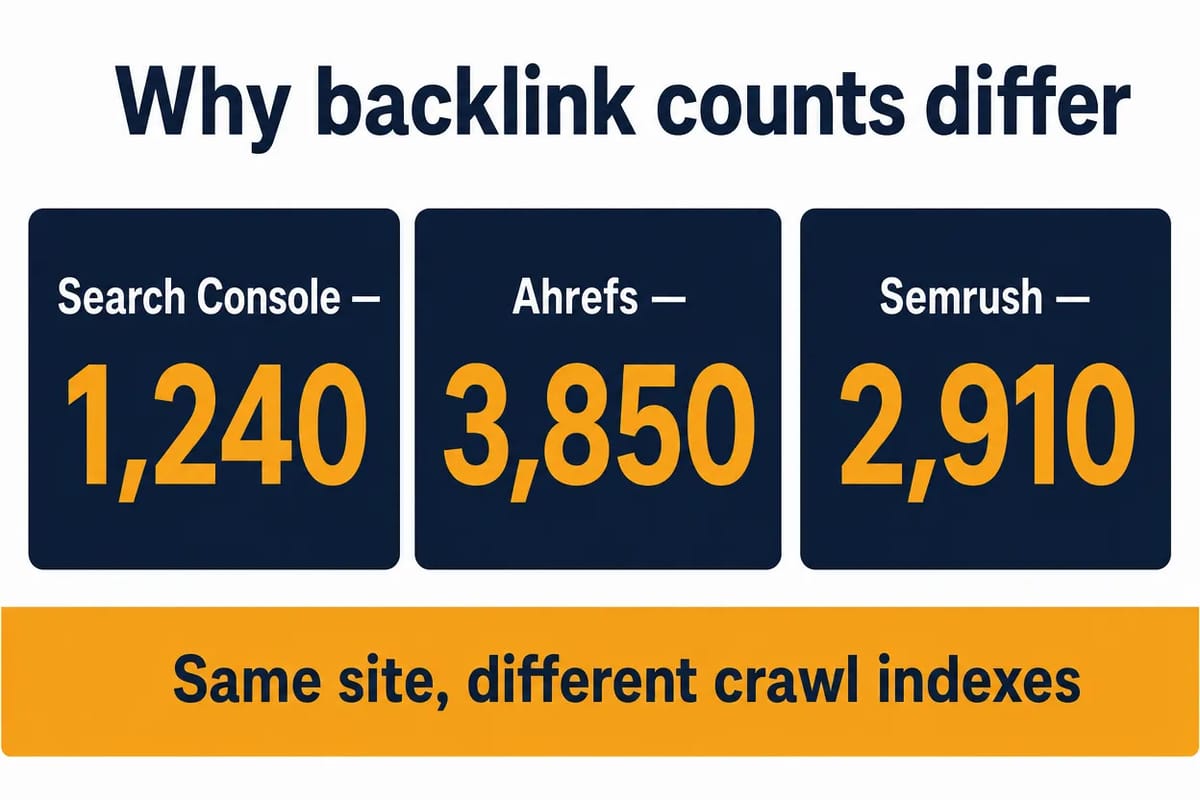
Backlink tools disagree because the web is too large and too changeable for each crawler to see the same thing at the same time. Ahrefs, Semrush, Moz, Majestic and Google all have different crawl systems, different data limits and different ways of grouping links.
One tool may have found a new link yesterday while another has not crawled that page yet. One may keep a link in its index after the page disappears. One may group duplicate links, canonical URLs or redirects differently. One may show only a sample in a free report.
That means the right response is not to average the numbers. Use one tool consistently for trend tracking, then cross-check the links that affect a decision. If you switch tools every month, you may mistake index differences for real growth or decline.
When we reconcile reports, we separate index noise from links that change a decision. A missing low-value scrape rarely matters. A missing editorial link from a relevant page does.
In practice: pick your primary source before you start. For your own site, use Search Console as the baseline and one third-party index for context. For competitors, use one third-party tool as the main export and a second tool to verify valuable prospects.
Referring domains matter more than total backlinks
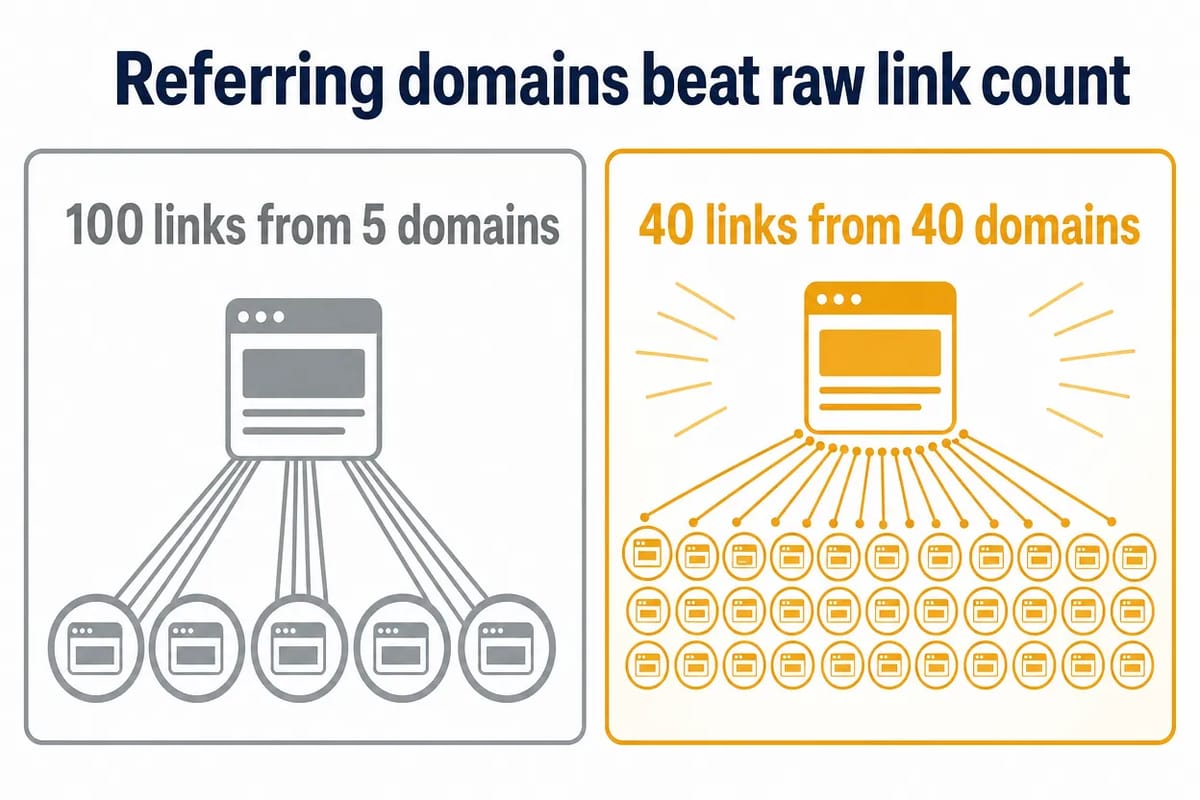
Total backlinks count linking URLs. Referring domains count the separate websites those links come from. Both are useful, but they answer different questions.
If one blog links to your site from 80 tag pages, your backlink count may rise by 80. Your referring-domain count rises by one. The second number is often the cleaner signal because it shows how many distinct sites have linked to you.
Referring domains are not perfect. Ten low-quality domains are not better than three relevant, trusted sites. Still, referring-domain growth is usually a better trend to watch than raw backlink growth because it is less distorted by duplicate pages, templates and sitewide links.
When we review a backlink profile, we look for spread, relevance and page support. A profile with links from varied, relevant sites to useful pages is easier to defend than a profile with a large count from thin, unrelated pages.
What the number actually tells you
Your backlink count can help you answer practical questions once you stop treating it as a scoreboard.
Start with page support. If most links point to your homepage, your guides and commercial pages may still be weak. If a single article earns most links, decide whether that article can pass internal relevance to pages that need support.
Trend comes next. When your link profile grows, the source may be successful content, PR, partnerships or mentions. When it shrinks, the cause may be removed pages, broken URLs, changed editorial pages or relationships that need follow-up.
Your anchor mix should look normal. Brand anchors, URL anchors, topic anchors and occasional descriptive anchors all fit a healthy profile. A heavy pattern of exact commercial anchors deserves review. This anchor text optimisation guide explains the wider risk and relevance signals.
Repeated domains need their own view. A useful site can link more than once and still help readers, but that is not the same as links from many relevant domains. Separate the total link count from the number of sites doing the linking.
Risk is the final read. A sudden spike from unrelated pages, foreign-language scrapes, public profile spam or low-value directories may not need action every time, but it should be labelled. Do not build a strategy from links you would not want a real customer to see.
What is a good backlink count?
There is no universal good number. A new local service page, a national ecommerce category and a software comparison guide all compete in different markets. A number that looks strong in one niche may be weak in another.
The better benchmark is the current search result. Look at pages ranking for the keyword you care about. Compare their referring domains, link quality, page type, content depth and brand strength. Then ask whether your page is missing links it could reasonably earn.
Do not use fixed quotas such as a set number of backlinks per month or a set count for every homepage. Those rules create bad incentives. They push teams to chase volume even when the market only rewards a few relevant links from sites that make sense.
Our internal checks treat link count as one input beside topical fit, page quality, link placement and competitor context. If a page has fewer links but better relevance and stronger search intent coverage, more volume may not be the first fix.
The count is a clue.
How to turn the count into an action plan
Start by exporting your Search Console link data. Keep top linked pages, top linking sites and top linking text in separate tabs. Then pull the same domain or URL through your chosen third-party backlink checker.
Next, group the data by referring domain. Mark each domain as relevant, neutral, low quality, unknown or risky. This step matters more than the raw total because it turns the list into a profile you can actually read.
Then map links to pages. Which pages attract useful links? Which pages matter commercially but have no relevant support? Which older pages have links and could be updated, redirected or internally linked to help current priorities?
After that, compare competitors. Do not ask, "how many links do they have?" Ask which relevant referring domains they have that you do not, and whether those sites would have a fair reason to cite your page.
If the gap points to existing articles that could naturally mention your page, curated links may be one possible route after the audit. The link still needs topical fit, editorial context and a reason for readers. If those three tests fail, the opportunity is not clean.
Finally, set a review rhythm. Monthly checks are enough for most active SEO campaigns. Weekly checks can make sense after a PR push, content launch or suspected negative-SEO event. Daily checks usually create more anxiety than insight.
Mistakes to avoid
Referral traffic is not a backlink count. It can tell you that visitors arrived from another site, but it does not list every page that links to you. It also misses links that send no visits.
Treat DA, DR, Authority Score and Trust Flow as tool metrics, not Google metrics. They are third-party metrics from the tools that created them. They can help you sort and compare inside a tool, but they do not replace page review.
Competitor links need filtering. Some are paid, old, irrelevant, accidental, or tied to relationships you cannot copy. The useful lesson may be to avoid them.
More links do not automatically mean more ranking power. A smaller profile with relevant referring domains, natural anchors and links to the right pages can be stronger than a larger profile filled with weak sources.
Keep stale tool pricing out of your audit notes. Pricing pages change, free limits change, and old trial offers disappear. If price matters, check the vendor page on the day you make the buying decision.
FAQs
How do I check how many backlinks my website has?
Open Google Search Console, choose your verified property, and go to Links. Review top linked pages, top linking sites and top linking text, then export the data if you need a closer audit. For a second view, enter your domain or URL into Ahrefs, Semrush or Moz Link Explorer and compare backlinks with referring domains.
Is Google Analytics a backlink checker?
No. Google Analytics can show referral traffic, which means visits from other websites. It does not show every backlink to your site, and it is not a backlink index. Use Search Console or a backlink checker for link counts.
Why do Ahrefs, Semrush, Moz and Search Console show different numbers?
They use different crawl indexes, sampling rules, grouping methods and update schedules. One tool may find a link before another. One may remove a lost link faster. Use one source for trend tracking and cross-check important links before acting.
Should I track backlinks or referring domains?
Track both, but give referring domains more weight when judging growth. Total backlinks can be inflated by repeated links from the same site. Referring domains show how many separate websites link to you, which is usually a cleaner trend.
What is a good number of backlinks?
A good number depends on the keyword, the page type and the quality of the competing results. There is no safe universal quota. Compare your page with ranking pages, then look for relevant referring-domain gaps rather than chasing a fixed total.
Are DA and DR Google ranking factors?
No. Domain Authority is from Moz, and Domain Rating is from Ahrefs. They are useful third-party comparison metrics, but they are not Google scores. Use them to prioritise review, then judge the actual linking page.
How often should I check my backlinks?
Monthly is enough for most sites. Check more often during an active link-building campaign, after a large content launch, or when you see an unusual ranking or traffic change. The aim is to spot meaningful change, not to react to every small index update.
Every fact and commercial claim in this guide was fact checked and verified on 16 July 2026.
related Blog Posts



Join 7,000+ Clients Growing with Rhino Rank
Sign Up
Stay ahead of the SEO curve
Get the latest link building strategies, SEO tips and industry insights delivered straight to your inbox.