
 Back to all posts

Dofollow links are ordinary links that search engines can treat as endorsements and use for discovery, PageRank and other ranking signals. Nofollow links use rel="nofollow" to qualify that endorsement. The practical difference is simple: followed links from relevant, indexed pages carry ranking value, and the rel attributes mark a relationship or withhold an endorsement.
The follow versus nofollow distinction confuses people because Google changed the rules. In 2019, Google redefined nofollow as a hint rather than a directive and added the sponsored and ugc attributes, so advice written before then is often wrong. That moving target is one reason some businesses outsource link building.
Key takeaways
- A dofollow link is a normal
<a href>link with no qualifyingrelattribute that blocks or qualifies endorsement. - A dofollow backlink is an incoming dofollow link from another website. It can pass PageRank or link equity when the page, placement and context are strong.
- A nofollow link uses
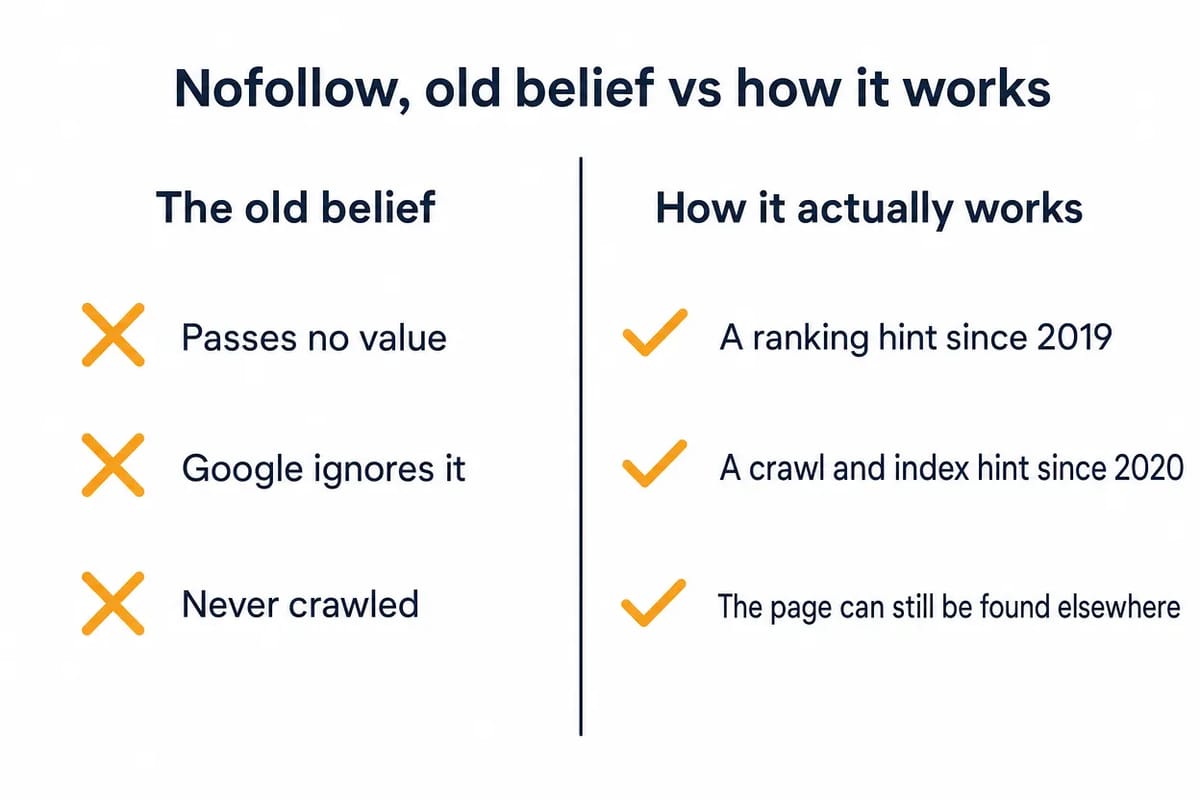
rel="nofollow"to tell Google you do not want to imply endorsement or pass ranking credit in the normal way. - Nofollow is a hint, not an absolute block. Since 10 September 2019, Google has treated
nofollow,sponsoredandugcas ranking hints; since 1 March 2020,nofollowhas also been a crawling and indexing hint. - Use
rel="sponsored"for adverts, sponsorships and affiliate links, andrel="ugc"for links in comments, forums or other user-generated content. - There is no required dofollow:nofollow ratio. A profile is not risky because most of its links are followed; what matters is the publisher and the page each link sits on.
- Domain Authority is a third-party Moz metric. It can help with quick comparison, but it is not a Google trust score.
What is a dofollow link?
A dofollow link is a standard hyperlink that search engines can crawl, interpret as an editorial reference and use as a ranking signal.
In HTML, it looks like this:
<a href="https://example.com/">Example link</a>
SEO tools and marketers call this a dofollow link, but that is shorthand. A normal link does not need a dofollow attribute. Google’s link documentation says regular links that should be fetched and parsed do not need a rel value.
Dofollow links matter because Google uses links for discovery and relevance. Anchor text can help explain the linked page. A relevant editorial dofollow link can pass PageRank or link equity. That does not mean one dofollow backlink guarantees a ranking movement. Google Search uses many signals, and the quality, relevance, placement and surrounding page all change how useful a link is.
When SEOs talk about building dofollow backlinks, they mean earning this ordinary link treatment from other domains. They are not asking for a special HTML flag. The link is dofollow because it has not been qualified with nofollow, sponsored, ugc or another value that changes how the link should be treated.
Be careful with metric language here. Domain Authority, often shortened to DA, is a Moz score. Domain Rating is an Ahrefs score. These third-party metrics can be useful proxies when comparing sites. Moz itself says Domain Authority is not a direct ranking factor, and neither score is a Google metric.
What is a nofollow link?
A nofollow link is a hyperlink with rel="nofollow" that tells Google you do not want to associate your site with the linked page or pass ranking credit in the normal way.
In HTML, it looks like this:
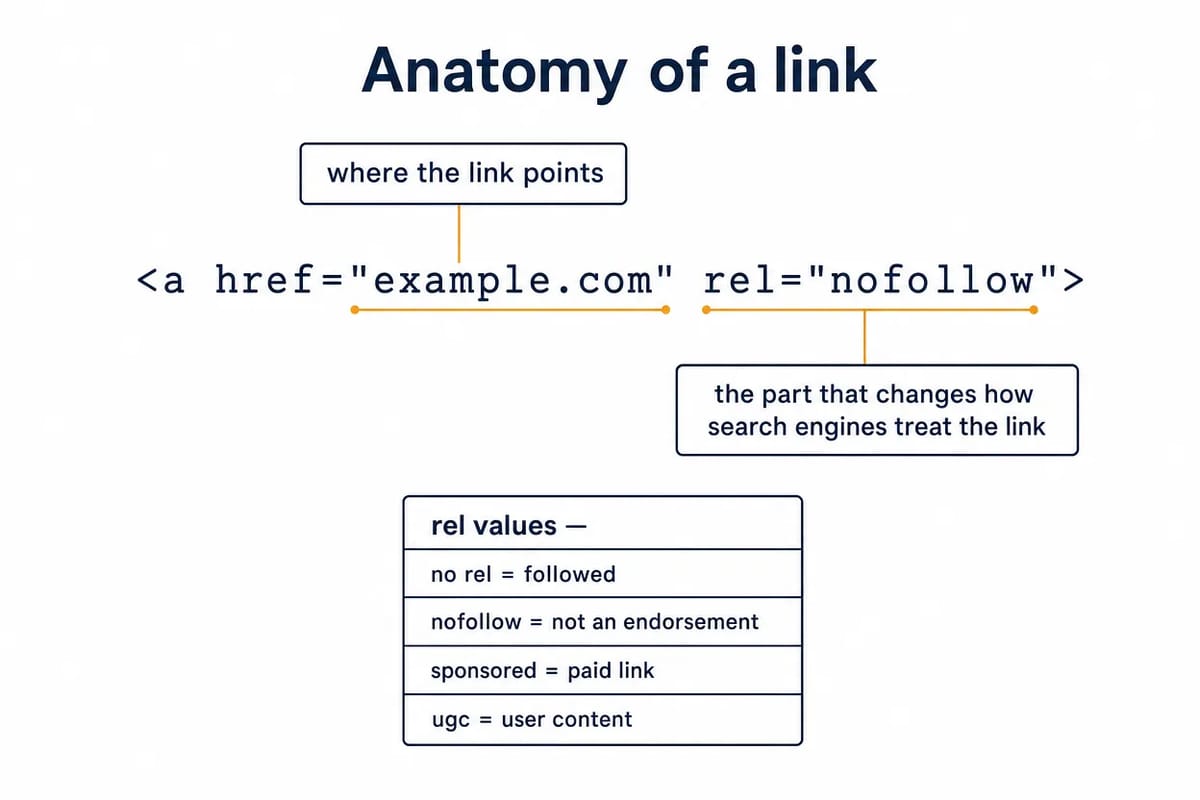
<a href="https://example.com/" rel="nofollow">Example link</a>
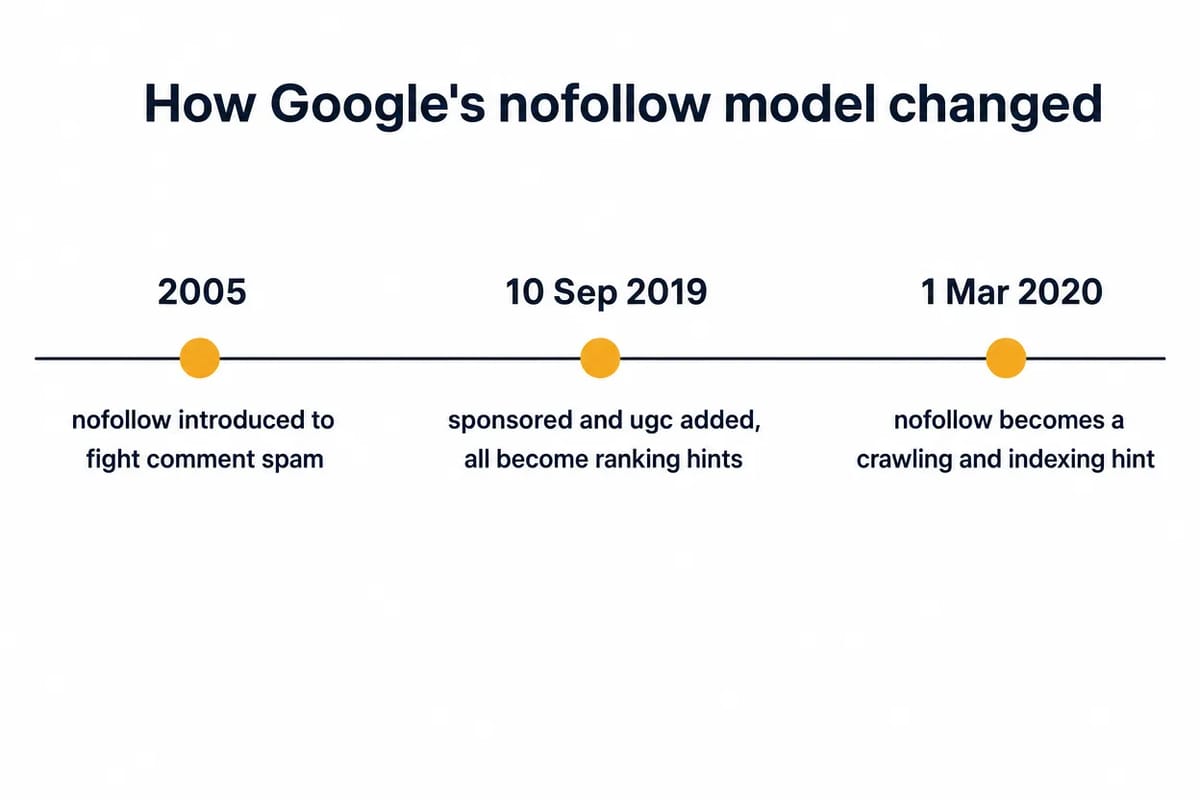
Google introduced nofollow in 2005 to reduce comment-spam abuse. For years, SEO advice often treated nofollow as a hard block. That is outdated.
Google changed the model on 10 September 2019. From that date, nofollow, sponsored and ugc became hints for ranking. On 1 March 2020, nofollow also became a hint for crawling and indexing. In practice, Google says it will generally not follow qualified links, but it may still discover the linked page elsewhere or use the link as a hint in limited ways.
That difference matters. Nofollow is not the same as noindex. A nofollow attribute qualifies a link. A noindex directive is used when you do not want a page itself to appear in search results.
How rel attributes work
The rel attribute gives search engines extra context about the relationship between the linking page and the linked page. For SEO, the main values are nofollow, sponsored and ugc.
Use rel="nofollow" when you are linking to a page but do not want to imply endorsement, and the more specific values do not fit. This can apply to an untrusted source. It can also apply to a link you need to cite without vouching for, or a page you do not want Google to associate with your site.
Use rel="sponsored" for adverts, sponsorships, affiliate links and other placements a publisher labels as compensated. Google introduced it in 2019 so publishers can mark that relationship without treating the link as untrusted.
Use rel="ugc" for user-generated content, such as blog comments, forum posts and community profile links. This tells Google the link was added by a user rather than placed as an editorial recommendation by the publisher.
These attributes are about qualification, not hiding. If you need to stop a page from being indexed, use an indexing control. If you need a link to be crawlable, make it a real <a> element with an href. If you trust the source and are citing it editorially, a normal dofollow link is usually the cleanest option.
Dofollow vs nofollow links: the practical difference
The main difference is endorsement.
A dofollow link is the default. It can help search engines discover the linked page, read the anchor text, understand topic relationships and pass ranking credit. In SEO terms, that means it can pass link equity. When a journalist, blogger or business links to a useful source without qualification, that dofollow link acts like an editorial reference.
A nofollow link is qualified. It can still send referral traffic, put your brand in front of the right audience and help people find your site, but it is not treated like a clean editorial vote in the normal link graph.
Some of the publishers we work with nofollow every outbound link by house policy, and the first question a client asks is whether the placement is worth having. Our answer depends on the page, not the attribute. If the page is indexed, on topic and read by the people the client sells to, we still take the placement, and we tell the client up front that we do not forecast the same ranking credit as an editorial followed link. We will not pay a premium for a followed link on a page nobody reads. Asking whether a link is dofollow is the wrong first filter: relevance and a real readership come first, and the attribute decides how much ranking credit you can reasonably hope for, not whether the link is worth having.
Cyrus Shepard wrote on Moz on the day Google announced the change, 10 September 2019: "For ranking purposes, Google now treats each of the nofollow attributes as "hints" — meaning they likely won't impact ranking, but Google may choose to ignore the directive and use nofollow links for rankings."
Sponsored and UGC links sit beside nofollow, not underneath it. They give Google more precise context. A paid product review should usually be sponsored. A forum profile link should usually be UGC. A source you do not want to endorse can be nofollow. A source you trust can receive a dofollow link.
That is why "dofollow versus nofollow" is useful shorthand. The better question is: should this link count as an editorial endorsement, a paid relationship, a user-added link or a non-endorsed citation?
When to use nofollow, sponsored and ugc
Use a qualified rel attribute when the link relationship needs context.
Attribute | Use it when |
|---|---|
No | You editorially trust the source and want to cite it |
| You link without endorsing, and sponsored or ugc do not fit |
| The link is an advert, sponsorship or affiliate placement |
| The link sits in comments, forums or user content |
Use nofollow when:
- You link to a page you do not want to endorse.
- You cite a source for context but do not want Google to associate your site with it.
- You cannot vouch for the linked page and
sponsoredorugcdoes not describe the link.
Use sponsored when:
- A link is an advert, a sponsorship or part of an affiliate relationship.
- A placement exists because of commercial compensation, even if the surrounding content is useful.
Use UGC when:
- Users can add links through comments, forums, reviews, profiles or community posts.
- Your editorial team did not choose the link as a recommendation.
This is also where external and internal links differ. An outbound link points from your site to a third-party website. An internal link points from one page on your domain to another page on the same domain. Rel qualification is usually most important on outbound links because it explains your relationship with another site.
When not to use nofollow
Do not use nofollow on every external link by default. If you are citing a trusted source because it helps the reader, a dofollow link is normal.
Do not use nofollow when a more specific attribute fits. Adverts and affiliate links should be labelled with sponsored. User-generated links should be labelled with ugc. Nofollow remains useful, but it is no longer the only tool.
Do not use nofollow as a substitute for noindex. If the goal is to keep a page out of Google’s index, a link attribute is the wrong control.
Do not ask every publisher to make every earned link followed. Some legitimate sites nofollow outbound links by policy. The right question is whether the placement reaches the right audience and sits on a page that makes editorial sense.
Using dofollow and nofollow links together
A healthy backlink profile is usually mixed because the web is mixed. Editorial articles, resource pages and partner mentions may use dofollow links. Social platforms, communities, comment sections, press syndication and some major publishers may use nofollow or other qualified attributes.
There is no verified ratio to target. A profile is not safer because it hits a neat dofollow:nofollow percentage. It is not risky just because most of its best links are dofollow. The risk comes from where the links live: automated link programs, low-quality directory and bookmark links, private blog networks and link farms, and thin pages that exist only to carry spam links. Relevance and a real readership on the linking page are what separate a followed link that helps from one that does nothing.
Nofollow links can still be worth having. A nofollow link on a relevant, high-traffic page can drive referral visitors, introduce your brand to buyers and help improve brand awareness. It just should not be counted as the same thing as a dofollow editorial link when you are forecasting SEO value or link equity.
How to check if a link is dofollow or nofollow
The quickest check is the page HTML.
Right-click the link and choose "Inspect", or open DevTools with Ctrl+Shift+I on Windows or Cmd+Option+I on Mac. Find the <a> tag and look for the rel attribute.
- No qualifying
relvalue usually means the link is followed. rel="nofollow"means the link is qualified as nofollow.rel="sponsored"means the link is qualified as sponsored.rel="ugc"means the link is qualified as user-generated content.
You can also view the page source and search for the target URL. Browser extensions can highlight nofollow, sponsored and UGC links on the page, but extension names and browser stores change, so check the current listing before relying on one.
Backlink tools can help at scale. Semrush, Ahrefs and many of the best SEO tools available report follow and nofollow attributes across a backlink profile. Treat those reports as an audit layer, then spot-check important placements in the live HTML.
How to build dofollow links
The best way to earn dofollow links is to create pages worth citing and then put them in front of publishers who have a real reason to reference them. The tactics below work best when the link makes sense for the reader first.
Publish guest articles on relevant sites
A Guest Blogging campaign can earn dofollow links when the host site accepts useful contributed content and allows editorial links. Check the publisher’s guidelines before pitching. Some sites allow dofollow contextual links, some use nofollow by policy, and some only link in the author bio.
Place links in existing editorial content
Curated link building places a link into relevant content that already exists. The placement should make the page better, not just add an anchor. Check that the page is indexed, topically close to your target page and not overloaded with outbound links. If the placement is editorial and unqualified, it is a dofollow backlink.
Here is how that looks in our own model. We earn followed links editorially: Curated Links are inserted into existing indexed content as permanent, contextual dofollow links, while Guest Posts place a contextual dofollow link inside a 750+ word editorial article on a real, niche-relevant site. We never use private blog networks or link farms. Our published screening rejects PBN footprints, spun or AI content and traffic manipulation, and placements carry a 12-month replacement guarantee.
Turn unlinked mentions into links
If a publisher mentions your brand, product or research without linking, ask whether they will add a citation to the relevant source. Keep the request short. Make the value clear. This works best when the mention is already positive and the linked page genuinely helps the reader verify the claim. If the publisher adds a normal link, that mention becomes a dofollow backlink.
Use digital PR and journalist sourcing
Journalist sourcing can earn dofollow links when your expertise, data or quote helps a writer finish a real story. Old HARO daily-email workflows are stale: Connectively/HARO was discontinued in December 2024, and HARO (Help a Reporter Out) was revived by Featured in April 2025. Treat HARO as one route inside a wider digital PR process, alongside direct journalist relationships, source requests and expert commentary.
Study competitor links
Competitor research can show which publishers already cover your topic. Start by analysing your competitors’ backlink profiles and filtering for pages that are relevant, indexed and editorially plausible. Then pitch something better than a copy of the competitor’s page. The goal is not to copy every dofollow backlink. It is to find publishers that already cite resources like yours.
Replace dead citations
Broken-link building works when you find a useful page with dead outbound citations and offer a relevant replacement. Search for broken links on pages that already cover your topic. Then contact the editor with the broken URL, the live replacement and a clear reason it fits. If the editor accepts the source, the replacement is usually a dofollow link.
Summary
Dofollow links are ordinary links that search engines can treat as editorial signals and use for link equity. Nofollow links, sponsored links and UGC links use rel attributes to qualify the relationship behind the link.
The safest rule is also the simplest: use normal dofollow links for sources you trust and want to cite, use sponsored for adverts and affiliate relationships, use UGC for user-added links and use nofollow when you do not want to endorse a page. Build dofollow backlinks through relevance and editorial value, not through a target ratio.
Frequently asked questions
What is a nofollow link?
A nofollow link is a hyperlink with rel="nofollow". It tells Google you do not want to imply endorsement or pass ranking credit in the normal way. Google treats nofollow as a hint, not as an absolute command.
What is a dofollow link?
A dofollow link is a normal hyperlink with no qualifying rel value. It can be crawled, read as an editorial reference and used as a ranking signal. It may pass PageRank or link equity. You do not need to add a dofollow attribute.
Are nofollow links bad?
No. Nofollow links can still send referral traffic, support brand discovery and appear naturally in a backlink profile. They just should not be valued in the same way as followed editorial links when you are estimating link equity.
Should I use nofollow links?
Use nofollow when you link to a page but do not want to endorse it, and when sponsored or ugc does not describe the link. Use sponsored for adverts and affiliate links and UGC for user-added links.
What is the difference between nofollow and noindex?
Nofollow is a link attribute. It qualifies a link from one page to another. Noindex is an indexing directive used when you do not want a page itself to appear in search results.
What is the difference between outbound links and internal links?
Outbound links point from your site to another website. Internal links point from one page on your own domain to another page on the same domain. Both can help users and search engines understand relationships between pages.
related Blog Posts



Join 7,000+ Clients Growing with Rhino Rank
Sign Up


Stay ahead of the SEO curve
Get the latest link building strategies, SEO tips and industry insights delivered straight to your inbox.