
 Back to all posts

What are forum backlinks?
Forum backlinks are links to your site from forum threads, Q&A replies, profiles or community discussions. In most cases they are user-generated links marked nofollow or UGC, so their direct ranking value is limited. Their honest value is referral traffic, community visibility and topical relevance when you take part because you have something useful to add.
If your wider goal is to build high quality backlinks, treat forums as a small supporting channel rather than the campaign. A good forum link helps a reader in the thread. A weak one looks like a link dropped for search engines.
Key takeaways
- Most forum backlinks are user-generated, nofollow or UGC-qualified links.
- The SEO value of forum links is usually indirect: useful visits, brand recall, expert presence and topical context.
- You should earn links through genuine participation, not profile spam, signature links or paid forum-link packages.
- Google names keyword-rich links in forum comments and signatures as a link-spam example, so anchor text and intent matter.
- Third-party metrics such as DA and DR can help you review a backlink profile, but they are not Google ranking scores.
What counts as a forum backlink?
A forum backlink is any link from a forum-style community to your website. It might sit in a reply, a Q&A answer, a resource thread, a user profile, a signature field, or a community post that allows outbound links.
The word "forum" is broad enough to include Reddit, Quora, Stack Exchange, Stack Overflow, Warrior Forum, Mumsnet and niche discussion boards, but they should not be treated as a target list. The useful question is whether your audience is there and whether your link would help the discussion.
The catch: a forum backlink is usually user-generated content. Many communities add rel="ugc", rel="nofollow" or both to links in posts and comments. That tells search engines the link was added by a user rather than placed as an editorial endorsement by the publisher.
That changes the value because you are not getting the same type of signal as a cited source in an edited article. You are getting a chance to help a specific audience, send relevant visitors, and make your brand visible in the places people ask real questions.
Nofollow, UGC and dofollow forum links
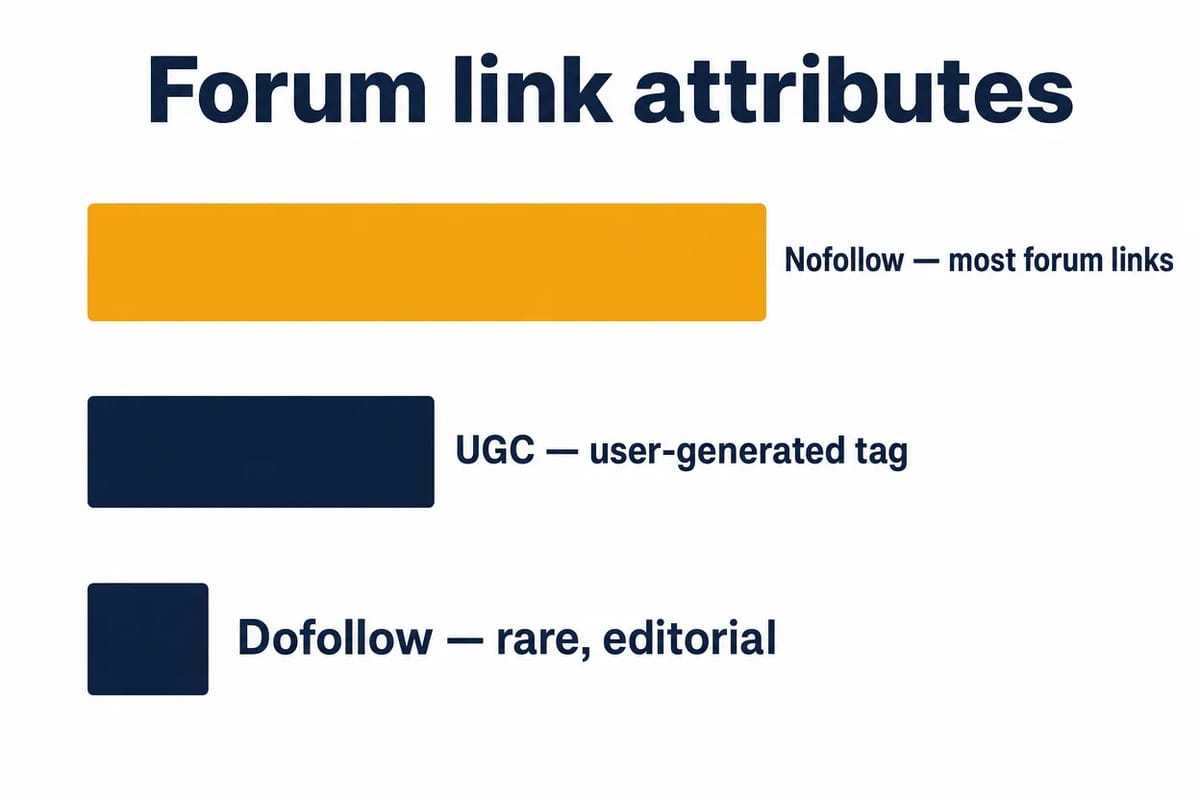
Search engines can crawl ordinary links, but forum links often carry a qualification. rel="ugc" is the clearest label for user-generated content such as comments and forum posts. rel="nofollow" is used when a site does not want to imply endorsement or pass normal link signals.
If you need a fuller primer, our guide to dofollow and nofollow links explains the attributes in more detail. For forum work, the practical point is simple: assume most real community links will be qualified, and judge them on audience value first.
Dofollow forum links do exist, especially on old boards or lightly moderated sites. The trade-off: a dofollow link from a thread nobody reads, on a site with weak moderation, isn't better than a nofollow link that sends qualified visitors from a strong community.
The link is secondary.
The honest value of forum links
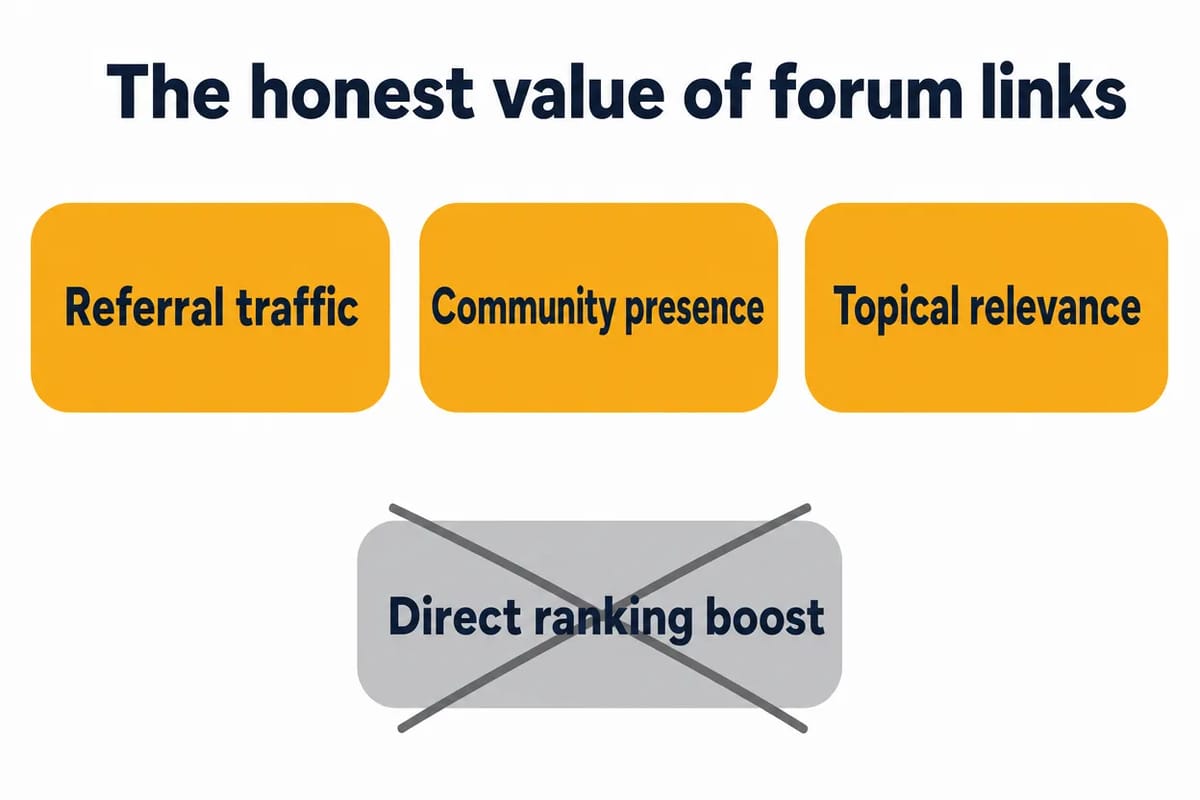
Forum backlinks can be useful, but only if you measure the right job. They are poor as a raw authority tactic and much stronger as a visibility and referral channel.
Referral traffic from relevant threads
The clearest value is referral traffic. If you answer a question well and link to a guide, calculator, product page or case study that solves the next step, readers may click because the link fits the conversation.
That traffic isn't guaranteed, so you still need a live thread, a relevant audience and a reason for people to trust the answer. In practice: one useful reply in a high-intent niche thread can beat ten links in quiet boards that nobody in your market reads.
You should track these visits in analytics as referral traffic, then check whether visitors stay, read, sign up, enquire or return later. That tells you more than counting forum links as if every link has equal SEO value.
The click has to make sense.
Community presence and brand recall
Forums can also make your brand more familiar in a niche. If you keep answering the same type of question with practical detail, people start to recognise the name before they need a supplier.
This is where we see the strongest non-ranking value during backlink reviews. Forum links rarely sit among the strongest editorial placements in a profile, but the surrounding discussions can show that a brand is visible where its buyers ask questions.
This isn't a shortcut because it only works when your posts would still make sense without the link.
Topical relevance without overclaiming rankings
A relevant forum mention can add useful context around your brand. If your business sells technical SEO audits and you are repeatedly helping in crawl, indexing and JavaScript SEO threads, that presence fits the topic.
Still, avoid turning that into a ranking promise. Google does use links and page context in search, but user-generated forum links are often qualified and spam-prone. The safer claim is that relevant discussions can support discovery, referral traffic and topical clarity. They aren't a dependable way to lift rankings by themselves.
Third-party backlink metrics
Tools may count some forum backlinks in your backlink profile. That can affect third-party metrics such as Moz Domain Authority or Ahrefs Domain Rating if the tool discovers and scores those links.
Those scores are useful for sorting and review, not proof that Google has rewarded you. DA and DR are third-party metrics. They aren't Google scores, and search engines don't use them as direct ranking factors.
If you want to understand the broader quality signals behind a strong site, read our guide to what makes an authoritative website. For forum links, keep the metric view modest: they can show activity, but they rarely carry the weight of editorial links from relevant publications.
How to earn forum backlinks legitimately
The safest way to earn forum backlinks is to stop treating forums as link targets. Treat them as communities where you may sometimes have the best answer.
Start by finding the threads your customers already use. Search for product problems, comparison questions, technical blockers, industry terms and "how do I" queries. Read the community rules before you post. Some boards ban self-promotion, some allow source links after a useful answer, and some allow links only after you have contributed for a while.
Then build a profile that looks like a real participant. Answer questions where no link is needed, ask follow-up questions, and correct bad advice without turning every reply into a pitch. If the only thing you ever post is your own URL, moderators and users will read it as spam.
When a link does help, add it for a clear reason. For example, link to a deeper guide when the thread needs a longer explanation, a checklist when the user needs a process, or a tool when it removes guesswork. Explain why the link is relevant before you include it.
Use plain anchor text because a branded link, naked URL or natural phrase is usually safer than exact-match commercial wording. If you need a refresher, our anchor text optimisation guide and guide to a diverse and natural anchor text portfolio explain why forced anchors create risk.
Keep your affiliation clear by saying so where the community expects disclosure if you own the page, work for the company, or have any commercial reason to share it. A useful disclosed link is easier to defend than a hidden self-promotion link.
Forum link building mistakes to avoid
Most bad forum link building fails for the same reason: the link comes first and the reader comes second. That is also why many common SEO mistakes show up in forum campaigns.
Signature and profile-link spam
Old forum tactics often revolved around profile pages and signature links. The method was simple: create many accounts, add keyword-rich links, and post enough low-value replies to make the signatures visible.
Avoid that pattern because Google specifically calls out optimised links in forum comments and signatures in its spam guidance, and users dislike it for the same reason: it adds noise without helping the thread.
Profile links can be normal when they identify a real participant, but they are weak as a link-building asset. If a profile exists only to hold a backlink, it isn't a meaningful endorsement.
Paid forum backlink packages
Paid forum-link packages are usually a poor fit for long-term SEO. Many are built around account creation, thin replies, profile links, old boards and copied text. Some may promise dofollow links or high DA forums, but that shifts attention away from audience fit and editorial value.
If a supplier sells the link count before explaining the community, moderation standards and reason each link belongs in the thread, walk away. It is too easy to buy rows in a report that add no useful traffic and create cleanup work later.
When we audit poor forum campaigns, the pattern is plain: lots of links, weak threads, repeated anchors and little evidence that anyone clicked. That's not value.
Exact-match anchors in comments
Exact-match commercial anchors are risky in user-generated content. A reply that says "best SaaS payroll software" where a normal person would say the brand name looks engineered for rankings.
Use language a reader would expect. If the post needs a link, the surrounding sentence should explain the resource, not force a keyword. This is also how you avoid building links that are spammy before they become an audit problem.
Irrelevant communities
Relevance beats forum size. A small specialist board where your buyers ask detailed questions can be more useful than a large general community where your answer feels out of place.
Before you post, ask three checks: is the thread current, is the audience relevant, and would the link help if search engines ignored it? If the answer is no, leave the link out.
Chasing dofollow links
Don't choose forums because they allow dofollow links. That is a spam signal in waiting if the thread has no topical fit or editorial control.
The better order is audience first, answer second, link last. If the link is nofollow or UGC but sends a qualified reader, it may still be worth having. If the link is dofollow but nobody trusts the page, it is a weak asset.
How to measure forum link performance
Forum backlinks need their own measurement frame. Judge them by more than ranking movement, because rankings are affected by content quality, technical SEO, editorial links, competition, search intent and many other factors.
Start with referral traffic by looking at source and medium data for forum domains in Google Analytics. Check sessions, engaged sessions, conversions, assisted conversions and return visits. If you use campaign tags, keep them clean and readable so you can tell which thread or community sent traffic.
Keep a short note for each worthwhile placement: community, thread topic, date, link target and whether you were answering a named problem. That record keeps forum work honest because it ties each link to a user need, not a quota.
Review the link itself as well. Is the thread indexed? Is the answer visible? Is the discussion active? Are people replying, voting, quoting or clicking? A link buried on page seven of a stale board is different from a cited answer in a thread that still ranks for a niche query.
Review the backlink profile after that. Tools such as Ahrefs Backlink Analysis, Semrush, Moz and Ubersuggest can help you find forum links, anchors and referring pages. Use them for discovery and triage, not final judgement.
Finally, look for brand and community signals. Did the forum answer lead to direct enquiries? Did people mention your brand later? Did a thread expose a content gap you should cover on your own site? Sometimes the best outcome of forum participation isn't the backlink. It is the language your audience uses when they describe the problem.
Should forum backlinks be part of your SEO strategy?
Yes, but only as a secondary tactic. Forum backlinks can support SEO when they come from genuine participation in relevant communities, but they should not replace editorial link building, digital PR, useful content, technical fixes or stronger commercial pages.
For most sites, the right role is simple. Use forums to listen, answer, learn, and send helpful traffic when a link genuinely improves the thread. Don't build a strategy around manipulating forum links for authority.
If you already have a messy backlink profile, review forum links carefully. Keep normal community mentions, remove or ignore low-value noise where sensible, and avoid panic disavow work unless the pattern is artificial, large and likely to create a manual-action issue.
Forum participation is useful marketing. Forum-link spam isn't.
Frequently asked questions
What are forum backlinks?
Forum backlinks are links to your website from forum threads, Q&A answers, user profiles, signatures or community discussions. Most are user-generated links, and many are marked nofollow or UGC.
Are forum backlinks good for SEO?
They can be useful, but not because they reliably pass ranking value. Their stronger value is targeted referral traffic, brand visibility, community trust and topical relevance when your answer helps the thread.
Are forum backlinks usually nofollow?
Yes, many forums and Q&A platforms mark user-posted links as nofollow, UGC or both. That is normal, and it means you should judge the link by reader value and traffic potential before direct SEO value.
How do I get backlinks from a forum?
Join relevant communities, read the rules, answer questions properly, and include your link only when it gives the reader a useful next step. Don't create accounts only to drop links.
Are profile and signature links safe?
A normal profile link for a real participant is usually just a profile detail. Bulk profile creation, keyword-rich signature links and repeated self-promotional replies are different. Those are the patterns to avoid.
What are forum website examples?
Examples include Reddit, Quora, Stack Exchange, Stack Overflow, Warrior Forum, Mumsnet and niche industry boards. Treat them as examples of community formats, not as guaranteed backlink targets.
What is the difference between forum backlinks and social media backlinks?
Forum backlinks usually sit in threaded discussions or Q&A answers. Social media backlinks sit on social platforms such as LinkedIn, Facebook, Instagram, X or YouTube. Both are often better for visibility and referral traffic than direct ranking value.
Every fact and commercial claim in this guide was fact checked and verified on 16 July 2026.
related Blog Posts



Join 7,000+ Clients Growing with Rhino Rank
Sign Up


Stay ahead of the SEO curve
Get the latest link building strategies, SEO tips and industry insights delivered straight to your inbox.