
 Back to all posts

Search engine optimization sits at the intersection of technology, psychology, and commercial strategy. Most definitions reduce it to "getting your website to rank on Google." That's technically accurate. It's also commercially useless.
What matters is the revenue gap between position one and position five on a search results page, and the work required to close it. This guide covers both with specifics, not generalities.
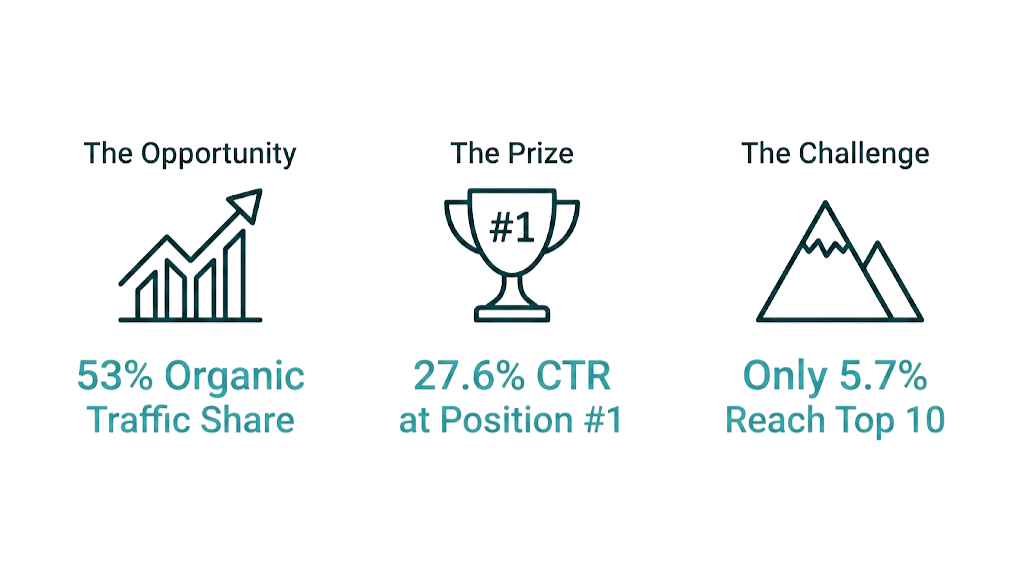
The bottom line up front: SEO is the practice of improving a website's visibility in organic (unpaid) search engine results to drive qualified traffic and commercial outcomes. According to BrightEdge's Channel Report, organic search drives 53% of all website traffic - more than paid search, social, and direct combined. The #1 result on Google earns a 27.6% average click-through rate, according to Backlinko's CTR study. But only 5.7% of new pages ever reach the top 10 within a year, per Ahrefs' research. Those three numbers define the opportunity, the prize, and the challenge in one shot.
This guide is written for marketing directors, SEO managers, and agency owners who need more than a textbook definition. You need commercial framing to justify budget, technical grounding to manage execution, and strategic clarity to prioritize the work that moves rankings. We'll cover all three.
What Is SEO? The Definition That Actually Makes Sense
Search Engine Optimization (SEO) is the discipline of improving a website's organic visibility in search engine results pages (SERPs) to attract relevant traffic without paying for each click. It combines technical configuration, content strategy, and authority building to signal to search engines - primarily Google, which holds over 90% of global search market share - that a given page deserves a top spot for specific queries.
The word "organic" carries weight. Organic results are the non-advertised listings search engines generate based on algorithmic assessment of relevance and quality. PPC ends the moment budget stops. Organic rankings compound, and a well-optimized page can drive traffic for years without a cost per click.
SEO also isn't one task. It's a system. It covers the words on the page, URL structure, load speed, the quality of sites linking back to you, and dozens of other signals Google weighs at the same time. Understanding what SEO is and how it works means understanding those layers, not just the visible parts.
A concrete example makes the point. Take a marketing director at a B2B software company targeting "project management software for agencies." That query has commercial intent, real search volume, and a clear buyer. Ranking for it takes a page that answers the query cleanly (on-page SEO), a site Google can crawl and understand without friction (technical SEO), and enough authoritative backlinks to beat the current top results (off-page SEO). Miss one, and the other two won't carry it.
Google's own SEO Starter Guide frames SEO as helping Google "find, index, and serve your content to the right users." That's correct. It also skips the competitive reality: in most niches, dozens or hundreds of sites want the same small set of positions. SEO is about meeting Google's requirements and beating competitors that already do.
One distinction belongs upfront. SEO targets organic search, not paid search. When someone types a query into Google, the results page shows a mix of paid ads (labelled "Sponsored") and organic results. SEO affects only the organic results. Managing paid placement sits under PPC or paid search. The two often sit under a broader search engine marketing (SEM) plan, but they run on different mechanics. Understanding PPC vs SEO trade-offs helps you allocate budget more effectively across both channels.
How Search Engines Actually Work: Crawling, Indexing, and Ranking Explained
Running SEO without knowing how search engines work is like tuning a car engine without knowing what the parts do. The process has three stages: crawling, indexing, and ranking. Google's Search Central documentation covers all three, and each stage gives us clear places to win - and clear ways to break things.
Crawling is discovery. Google uses automated bots - Googlebot, often called spiders - to browse the web by following links from one page to the next across the network of URLs that make up the internet.
It never stops.
Googlebot starts from a set of known URLs, follows links it finds on those pages, and keeps moving outward. A simple mental model helps: picture a librarian walking through an endless library and logging which books exist. That librarian only finds the shelves they can reach. Same idea here. Internal linking matters for the same reason: if nothing links to a page on our site, Googlebot might never reach it. Pages in that state are orphan pages, and they cause real technical SEO problems.
Orphan pages feed into crawl budget, which hits hardest on large sites. Google doesn't crawl every page of every site every day. It assigns a crawl budget based on the site's perceived authority and the server's ability to handle requests. When a site carries thousands of low-quality or duplicate pages, Googlebot burns requests on content that won't rank and leaves high-value pages under-crawled. If you want to go deeper on this, our guide to crawl budget optimization covers the mechanics in full.
Indexing comes after crawling. Once Googlebot requests a page, it processes the content - reads the text, understands the structure, uses alt text to interpret images, and parses the HTML - then stores a representation of that page in Google's index. That index is a massive database of web content Google queries every time someone searches.
But crawling doesn't guarantee indexing.
Google excludes URLs it considers low-quality or duplicate. It also skips pages we block with a noindex directive in meta tags or via robots.txt. Understanding the most common indexing issues and how to fix them is essential for any site serious about organic visibility.
Indexing is where Google Search Console earns its keep. It shows which pages Google has indexed, flags crawl errors, and lets us submit sitemaps that point Googlebot to priority content. For any site serious about SEO, Search Console is non-negotiable - it's our direct line to Google.
Ranking is where the money sits. Once a page is indexed, Google's algorithm decides where it shows up for a given query. That placement isn't permanent. Rankings move with algorithm updates, competitor changes, and edits to the page itself.
Google evaluates hundreds of signals at once - relevance to the query, page quality, user experience signals, backlink profile, and more. Google doesn't publish exact weighting, but it has confirmed that links, content, and RankBrain (its machine learning component) sit among the top-tier ranking factors.
Those ranking signals still roll up to one thing: search intent. A query like "best CRM software" signals research mode. "buy Salesforce licence" signals purchase intent. Google now matches content to intent with more precision, so ranking doesn't come from keyword use alone. It comes from meeting the job the searcher is trying to get done.
Intent also changes what "good" looks like. A page that ranks #1 for a query with strong commercial intent and 5,000 monthly searches will typically drive more revenue than a page ranking #1 for a 50,000-search query with purely informational intent and low conversion potential. Ranking is the mechanism. Revenue is the goal.
The 5 Types of SEO Every Marketer Needs to Know
SEO isn't one discipline - it's five that overlap. Treating them as separate silos is a mistake. But you still need to understand each one on its own, or you won't spot where the strategy breaks down.
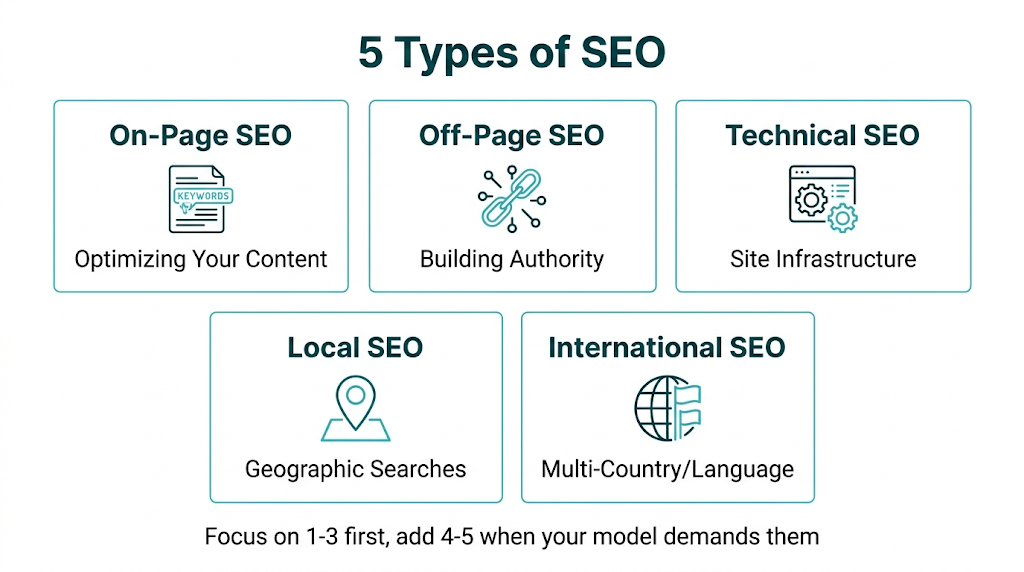
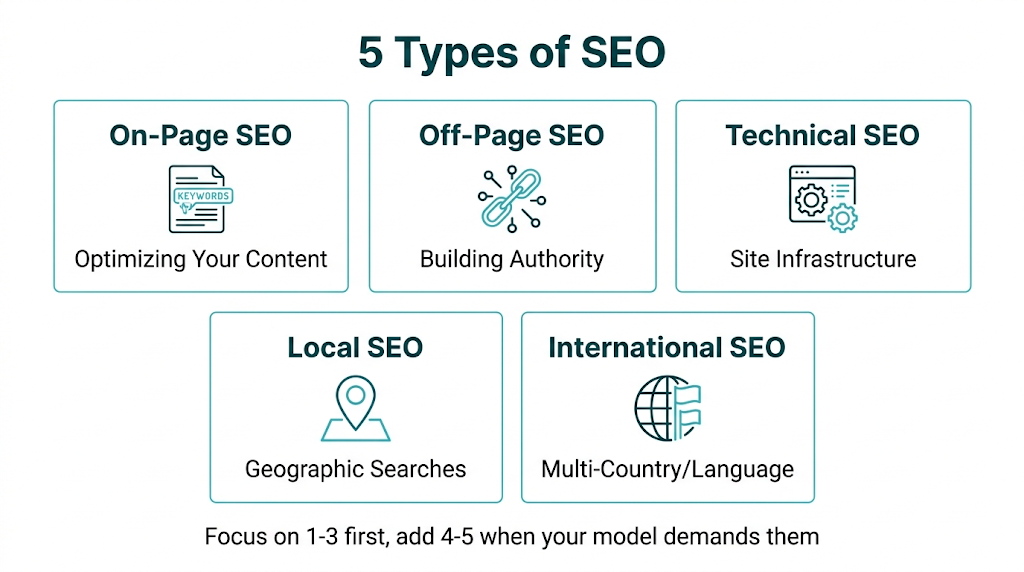
The five types are on-page SEO, off-page SEO, technical SEO, local SEO, and international SEO. Most businesses should put on-page, off-page, and technical first. Local and international come into play only when your model demands them.
On-Page SEO: Optimizing What's Already on Your Site
On-page SEO covers the elements on the page that shape how Google reads and ranks it. Start with keyword targeting. The page has to answer the query you want to rank for, using the same language real buyers use in search.
That means putting the primary keyword in the Title, the H1, the meta description, and in the body copy where it fits. Keep it readable. Forced repetition drags the content down.
Keyword targeting is the baseline, not the whole job. Title tags and meta descriptions sit right in the SERP - they're your organic ad copy. A clear title tag with the target keyword and a tight value prop beats a generic one, even at the same position, because it earns the click. That click-through rate feeds back into performance over time.
Clicks come from structure, too. Header tags (H1, H2, H3) shape the page for readers and crawlers. Internal linking moves authority across the site and helps Google map topical connections. Image optimization - descriptive alt text plus smaller file sizes - improves accessibility and keeps pages fast to crawl. And content depth still decides outcomes: pages that cover the topic with context, examples, and related entities outperform thin pages aimed at the same keyword. Creating effective SEO content means going beyond keyword placement to build pages that genuinely serve the searcher.
Off-Page SEO: Building Authority Beyond Your Website
Off-page SEO covers what happens outside your site that moves rankings. The main driver is backlinks - links from other sites pointing to yours. When a relevant, reputable site links to your page, Google reads it as a trust signal. Stack enough high-quality links and you build domain authority, which lets you compete deeper in the SERPs.
That authority doesn't come only from links. Brand mentions (including unlinked ones) help Google connect your brand to a topic. Social signals - not a direct ranking factor - spread content and often lead to more links. Reviews and citations matter for local SEO. And digital PR - coverage in reputable publications - builds links and brand authority in one move.
Those external signals change how you resource the work. On-page sits inside your walls, so in-house teams can ship it. Off-page SEO - especially link building - demands relationships, assets people want to cite, and consistent outreach. That's where agencies like Rhino Rank earn their keep: building the external authority signals that on-page work alone won't produce.
Technical SEO: Making Sure Google Can Find and Understand Your Site
Technical SEO handles the infrastructure that lets Google crawl, index, and render your site. Everything else depends on it. If the site breaks at the technical layer, content and links won't carry you.
The core technical SEO checklist includes: site speed (Google's Core Web Vitals measure loading performance, interactivity, and visual stability as direct ranking signals), mobile-friendliness (Google uses mobile-first indexing, meaning it primarily evaluates your mobile site), HTTPS security (a confirmed ranking signal since 2014), crawlability (clean robots.txt, no blocking of important pages, logical site architecture), structured data markup (schema.org code that helps Google understand page content and enables rich results in the SERP), and canonical tags (which tell Google which version of a URL is the authoritative one, preventing duplicate content issues).
Those technical issues don't stay contained. They suppress rankings across the domain, not just on a handful of pages. That's why technical SEO is often the first place to audit on a new client site. Working through the most common technical SEO issues systematically is usually the fastest way to unlock ranking gains that content and links alone can't deliver.
Local SEO
Local SEO optimizes a business's visibility for geographically specific searches - "accountant in Manchester" or "plumber near me." It focuses on Google Business Profile optimization, local citation building, and consistent NAP - name, address, phone - across directories. Reviews matter too, especially on Google but also on other relevant platforms. If you serve a defined area, local SEO isn't optional. That applies whether you're a single-location restaurant or a regional law firm with multiple offices.
International SEO
International SEO covers the work required to serve multiple languages or countries without confusing Google - or your users. That means hreflang tags, which tell Google which language version of a page to show to which audience. It also means picking the right country structure, whether that's a country-specific domain or a subdirectory setup, then supporting it with localized content. A UK business expanding into Germany or Australia needs international SEO, or it ends up competing against itself in the SERPs across markets.
Why SEO Matters: The Business Case in Real Numbers
The business case for SEO isn't built on vanity metrics - it's built on traffic share, conversion rates, and cost-per-acquisition that make paid channels look expensive by comparison.
Start with traffic. BrightEdge's Channel Report found that organic search drives 53% of all website traffic across industries - more than paid search, social media, email, and direct traffic combined. In B2B, that share runs even higher. So a mid-market SaaS company spending £3,000 per month on content and link building isn't chasing a side channel. They're competing for the channel that drives most web sessions, often at a fraction of the cost-per-click in competitive categories.
Rankings change the maths fast. Backlinko's analysis of Google click-through rates shows the #1 organic result earns an average 27.6% CTR. Position two drops to 15.8%. By position ten, you're at 2.4%. For a query with 10,000 monthly searches, ranking first vs fifth is roughly 2,760 clicks vs 950 clicks per month - from the same keyword, with zero added spend per click.
Conversion quality is where SEO earns its budget. SEO-driven leads close at a 14.6% rate, compared to 1.7% for outbound marketing leads, according to widely cited industry data. That's not surprising if you've watched lead lists in a CRM. Someone searching "enterprise HR software UK" and landing on your site already self-qualifies: they've named the problem, looked for solutions, and picked your result. A cold email recipient hasn't done any of that.
Compounding is the argument that lands best with finance teams. Paid search produces traffic only while budget runs. Stop spending and traffic stops. SEO builds an asset instead. A page that holds position one for a valuable keyword keeps generating traffic and leads month after month, and the ongoing maintenance costs stay far below the initial push. Over a three-to-five year horizon, the cost-per-acquisition from SEO falls below that of any paid channel.
Channel | Average CTR (Position 1) | Lead Close Rate | Ongoing Cost Per Click |
|---|---|---|---|
Organic Search (SEO) | 27.6% | 14.6% | £0 per click |
Google Ads (PPC) | Varies by bid | Lower intent mix | £2-£50+ depending on niche |
Social Media Ads | 0.5-2% average | Lower intent mix | £0.50-£5+ per click |
The competitive angle matters too. Every month a competitor holds position one for a high-intent keyword in your category, they're taking leads that could have gone to you. SEO isn't just an acquisition channel - it's a competitive moat. It takes time to build, and once it's in place, competitors don't dislodge it easily.
How Google's Algorithm Decides Who Ranks: The Signals That Matter Most
Google's algorithm isn't a single formula. It's a layered system of hundreds of signals, machine learning models, and quality assessments that decide which pages earn which positions for which queries. Google won't publish the full ranking recipe, but enough is publicly confirmed - and repeatedly tested - to show what moves rankings.
Content relevance and quality is the baseline. Google has to decide whether a page answers the query. That's more than keyword matching. Google's natural language processing (via systems like BERT and MUM) reads meaning and context, so a page about "project management tools" can still rank for "task tracking software" even if it doesn't use that exact phrase, as long as the content covers the topic properly. Depth matters. Pages that cover the subject from more than one angle, address related questions, and show real subject matter expertise beat thin pages going after the same keyword.
E-E-A-T - Experience, Expertise, Authoritativeness, and Trustworthiness - is the framework Google's Quality Raters use to judge page quality, as defined in Google's Quality Rater Guidelines. These aren't direct ranking signals in the traditional sense. But they influence training data for Google's systems and describe the qualities Google tries to reward.
- Experience means the content creator has first-hand experience with the subject. A product review written by someone who actually used the product outranks one written from secondary research.
- Expertise means demonstrable knowledge. For medical, legal, or financial content - what Google calls "Your Money or Your Life" topics - expertise signals carry more weight.
- Authoritativeness means the site and author are recognized sources within their field - measured partly by who links to them and mentions them.
- Trustworthiness means the site is transparent, accurate, and secure. HTTPS, clear authorship, accurate information, and a real business presence all contribute.
Backlinks remain one of the strongest ranking signals Google uses - and despite years of speculation about links fading in importance, the data still points the same way. Ahrefs' analysis of search traffic data found that the #1 result on Google has 3.8x more backlinks than positions 2 through 10. Google has also confirmed links as a top-three ranking factor alongside content and RankBrain.
User experience signals carry more weight than they used to. Google's Core Web Vitals - Largest Contentful Paint (LCP), Interaction to Next Paint (INP), and Cumulative Layout Shift (CLS) - are confirmed ranking signals. Pages that load slowly, shift content unexpectedly, or lag on input lose ground to faster, more stable pages. Mobile usability is non-negotiable. Google's mobile-first indexing means your mobile experience is your primary SEO experience.
Search intent alignment often decides the winner. Google can tell the difference between informational, navigational, commercial, and transactional queries - and it rewards pages that match the dominant intent behind each search. A product landing page won't rank for an informational query, even if you jam the right keywords into it. SERP analysis - looking at what types of pages already rank for a target keyword - should come before content creation, not after it.
SEO vs. PPC: Which Should You Invest In First?
Marketing directors ask this constantly. The honest answer depends on timeline, budget, and how hard your SERPs are. The framing is also a bit off - the best search programs run SEO and PPC together, because each channel does a different job at a different point in the growth curve.
PPC buys speed. Launch a campaign today and ads can show in the SERP within hours. If the business needs leads now, or you're pushing a product launch with a fixed window, PPC goes first. Paid search also gives you keyword truth. You see real conversion rates on target queries before you spend months trying to rank for the same terms.
SEO buys staying power. Organic traffic doesn't vanish when spend stops, and CPA drops over time as the upfront work spreads across a growing base of clicks and leads. For teams playing the long game - building the brand, earning category authority, and reducing reliance on paid channels - SEO wins over a three-to-five year horizon.
Most businesses land on a phased approach. PPC drives immediate revenue and surfaces conversion data in the short term. At the same time, build the SEO foundation - technical audit, content strategy, link building - so rankings have time to move. Once organic starts carrying weight, cut PPC spend on keywords where you hold strong organic positions and redeploy that budget into new query sets or other channels.
Those organic positions matter even more when you look at SERP real estate. On competitive queries, owning the top paid spot and a top organic result puts you everywhere that matters above the fold. Searchers see you twice before they click anything. That repeat exposure lifts brand recall and increases the share of clicks you take on that query.
Factor | SEO | PPC |
|---|---|---|
Time to results | 6-18 months | Hours to days |
Cost structure | Investment in content and links | Ongoing cost per click |
Traffic durability | Persists after investment | Stops when budget stops |
Keyword data | Slower to accumulate | Immediate |
Best for | Long-term growth, brand authority | Short-term leads, product launches |
There is one case where SEO should lead from day one: categories where organic search drives discovery and competitors already own the organic results. Waiting on SEO while running only PPC gives competitors more time to compound their authority advantage.
How Long Does SEO Take to Work? Setting Realistic Expectations
This question creates the most friction between SEO teams and the stakeholders they report to. The answer is uncomfortable but necessary: meaningful SEO results usually take 6 to 18 months, and in competitive niches it takes longer.
Ahrefs' study on how long SEO takes is the most rigorous dataset most teams point to. Their analysis found that only 5.7% of newly published pages reach Google's top 10 within a year. Of the pages that make it, most do so in the first 61 to 182 days - but that pattern shows up mainly on sites that already have authority. New domains with no backlink history and no established topical authority wait the longest. And the "Google Sandbox" effect - where new sites sit down the rankings for an extended period even when content is strong - shows up often enough in the field that teams plan around it, even if Google doesn't confirm it.
Where your site lands on that timeline comes down to three things.
Domain authority comes first. A site with a real backlink profile and a track record of ranking content gets new pages moving faster than a fresh domain. If you're publishing on a domain that already has authority in the niche, you're starting ahead. A brand-new site has to catch up to years of competitor momentum. Our guide to link building for new websites lays out a practical 90-day strategy for closing that gap faster.
Content quality and topical depth comes next. Sites that show thorough coverage of a topic area - what SEO teams call topical authority - get new content indexed and ranked faster in that area than sites with thin or scattered coverage. One page won't build topical authority. A connected cluster of expert pages, internally linked with intent, tells Google the site is a reliable resource on that subject.
Backlink acquisition pace is third, and it's the lever you can actually pull to shorten the timeline. Ahrefs' research keeps landing in the same place: pages with more referring domains rank higher and tend to rank sooner. A page that earns 20 high-quality backlinks in its first three months will almost always beat an identical page with zero links, even if the on-page work is clean. That's the case for treating link building as an early SEO investment, not a "later" item.
Realistic milestones for a well-resourced SEO campaign on an established domain:
- Months 1-3: Technical audit complete, content strategy defined, initial link building underway. Rankings may begin to shift for lower-competition terms.
- Months 3-6: Measurable ranking improvements for mid-competition keywords. Organic traffic growth becomes visible in Search Console.
- Months 6-12: Significant ranking gains for primary target keywords. Compounding traffic growth. ROI becomes demonstrable.
- Months 12+: Category authority established for core topics. New content ranks faster due to accumulated domain authority. Cost-per-acquisition from SEO falls below paid channels.
Set these expectations early with clients or internal stakeholders. It prevents the "SEO isn't working" conversation in month three, when you're still laying the foundation.
The Role of Link Building in SEO: Why Backlinks Still Dominate
Backlinks are the most debated topic in SEO - and the one with the most proof behind it. People have predicted for years that Google would devalue links in favour of other signals. That shift hasn't happened. Links still sit at the centre of how Google decides which pages earn authority and which don't.
That mechanism holds up in the real world. When a reputable website links to your content, it makes an editorial judgement that your page deserves a citation. Google reads that as a signal of quality and relevance. Stack enough of those editorial signals, especially from sites with real authority and clear topical fit, and the page starts to hold its position in the SERPs. It doesn't need magic. It needs links that make sense.
The data makes the point for us. Ahrefs' research shows that the #1 result on Google has 3.8x more backlinks than results in positions 2 through 10. That's not a rounding error. It's a built-in edge. It also explains why two pages with similar on-page work can rank far apart: the page with stronger backlinks wins.
Backlinks also show up in Google's own statements. Google's confirmed top-three ranking factors are links, content, and RankBrain. That isn't "nice to have" territory. It's foundational. Google has also gotten better at spotting and discounting junk links, and its link spam policies spell out the link schemes it penalizes. As the supply of manipulative links gets squeezed, real editorial links matter more.
Not all backlinks are equal. The quality signals that move rankings are:
- Domain authority of the linking site - a link from the BBC or a major industry publication carries more weight than a link from a low-traffic blog
- Topical relevance - a link from a site in the same industry or covering the same subject matter beats an off-topic link
- Link placement - contextual links in body copy outperform footer links or sidebar links
- Anchor text - descriptive anchor text tied to the linked page's topic sends a clearer relevance signal than generic "click here" anchors
- Dofollow vs. nofollow - dofollow links pass authority; nofollow links are tagged to tell Google not to follow the link for ranking purposes, though Google has said it treats them as hints rather than hard instructions
Quality links are hard to earn. Content has to deserve links, but content alone won't pull them in. Outreach and relationship building do the heavy lifting. That's why link building is the SEO work most teams outsource. It demands a different skill set than content or technical fixes, and most in-house teams don't have the time or process to run it at scale.
Scale is where Rhino Rank comes in. Link building is our core discipline. Our curated link placements sit on real, editorially managed websites with real traffic and topical relevance - the kind of links that lift rankings, not just backlink counts. For SEO managers and agency owners who already buy the backlink data but don't have the infrastructure to build links at scale, that's where we fit.
How to Get Started With SEO: A Practical 5-Step Framework
Knowing what SEO is and why it matters is the prerequisite. Knowing where to start is the hard part. This five-step framework works for a new site, an inherited client account, or a rebuild after a traffic drop.
Step 1: Conduct a Technical SEO Audit
Before you add content or build links, make sure Google can crawl and index the site cleanly. Use Google Search Console to spot crawl errors, indexing issues, and mobile usability problems. Pair that with a crawl tool - Screaming Frog is the industry standard for site audits - to surface broken links, redirect chains, duplicate content, missing title tags, and other technical issues that drag down the whole domain. Fix the critical problems first. A site with core technical faults will underperform no matter what you publish next.
Step 2: Define Your Keyword Strategy
Keyword research sets the queries you target and the order you tackle them. Start with commercial objectives: the products or services that drive revenue and the problems your best customers search for. Build your keyword list around those themes. Then use tools like Ahrefs, SEMrush, or Google Keyword Planner to check search volume, keyword difficulty, and the competition for each term.
Prioritize keywords where commercial intent, search volume, and realistic ranking potential overlap based on your current domain authority. A new site targeting "CRM software" - dominated by Salesforce, HubSpot, and Zoho with enormous backlink profiles - will sit in the queue for years. Targeting "CRM software for recruitment agencies" gives you lower competition with high commercial intent, and that path can produce rankings in months. Understanding how to master search intent is what separates keyword lists that drive revenue from those that just drive traffic.
Step 3: Create and Optimize Content
For each priority keyword, build a page that covers the search intent behind it. That starts with the current top-ranking pages for the query. Look at the format they use, the questions they answer, and the depth they bring. Then publish a page that matches that bar or clears it.
On-page optimization fundamentals for every page:
- Primary keyword in the title tag, H1, and first 100 words
- Meta description that sells the click and includes the keyword
- Logical header structure (H2s and H3s that reflect the content's organization)
- Internal links to and from related pages on the site
- Image alt text that describes the image accurately
- Page URL that's descriptive and includes the target keyword
Step 4: Build Backlinks Systematically
Backlinks are the difference between content that exists and content that ranks. Once your key pages are live and on-page work is done, build the external authority signals that push them up the SERPs. Start with competitor backlink profiles (Ahrefs' Site Explorer is the tool of choice here). Pull the sites linking to them and treat those domains as your first batch of link prospects.
Link building can take a few forms:
- Digital PR campaigns that earn coverage in industry publications.
- Guest posts on relevant sites that build topical authority alongside link equity.
- Link-worthy assets like original research, detailed guides, or free tools that attract natural links.
- Specialist link building services if you need consistent acquisition.
Track referring domains - the number of unique domains linking to your site - not raw backlink count, since a single site can inflate totals by linking repeatedly.
Step 5: Measure, Iterate, and Scale
SEO doesn't stay put. Rankings move, competitors react, and Google pushes updates. Set measurement up from day one:
- Google Search Console for rankings, impressions, clicks, and indexing status
- Google Analytics 4 for organic traffic, user behavior, and conversion attribution
- Rank tracking tool (Ahrefs, SEMrush, or dedicated tools like SERPWatcher) for daily keyword position monitoring
- Backlink monitoring to track new links and flag lost links worth recovering
Monthly reviews keep the program honest. Find the pages that lag, diagnose why, then put more link building or content work behind the pages with the highest commercial value. Pages sitting in positions 4-10 often need a small push - more links, deeper coverage, or stronger internal linking - to break into the top three, where CTR and traffic jump. Tracking the right SEO metrics for performance ensures you're measuring what actually drives decisions, not just what's easy to report.
Frequently Asked Questions About SEO
What does SEO stand for and what does it mean?
SEO stands for Search Engine Optimization. It's the work of improving a website's visibility in organic (unpaid) search results so it earns relevant traffic.
SEO blends technical setup, content strategy, and link building. The goal is simple: give search engines - mainly Google - enough signals to rank a page for specific queries.
How do search engines like Google decide which pages to rank?
Google ranks pages using hundreds of signals at once. The biggest confirmed drivers are the quality and volume of backlinks, plus how closely a page's content matches the search query and covers the topic.
User intent sits in the middle of that evaluation. Systems like RankBrain help Google judge whether the page meets what the searcher wants, not just whether it repeats the keywords.
Technical inputs still matter. Page speed, mobile-friendliness, and HTTPS all shape performance, and E-E-A-T (Experience, Expertise, Authoritativeness, Trustworthiness) feeds into Google's view of overall page quality.
What are the different types of SEO and how do they differ?
The main types are on-page SEO (optimizing content, title tags, headers, and internal links on the page itself), off-page SEO (building backlinks and brand authority from external sources), technical SEO (ensuring Google can crawl, index, and render your site efficiently), local SEO (optimizing for geographically specific searches via Google Business Profile and local citations), and international SEO (handling multi-language or multi-country site structures).
Most businesses focus on the first three. Local and international SEO come into play only when geography or market structure changes what "relevant" means.
How long does it take for SEO to show results?
Meaningful results take 6 to 18 months. Ahrefs' research found that only 5.7% of new pages reach Google's top 10 within a year.
That timeline depends on domain authority, content quality, and backlink acquisition pace. Sites with existing authority and an active link building programme move faster. New domains with no backlink history wait the longest.
Why are backlinks important for SEO?
Backlinks act as editorial votes from other websites. Google treats them as a primary signal of authority and relevance, and it has confirmed links as one of its top-three ranking factors.
Authority is where the gap shows. Ahrefs' data shows the #1 Google result has 3.8x more backlinks than positions 2 through 10.
Quality still wins. High-quality backlinks from authoritative, topically relevant sites drive ranking gains, especially in competitive niches where on-page work is already strong across the current top results.
related Blog Posts



Join 2,600+ Businesses Growing with Rhino Rank
Sign Up
Stay ahead of the SEO curve
Get the latest link building strategies, SEO tips and industry insights delivered straight to your inbox.