
 Back to all posts

Most SEO professionals treat Google E-E-A-T as a content problem. They audit author bios, add credentials to about pages, and optimize for "helpful content" signals - then wonder why their domain authority stagnates and rankings plateau. The missing piece isn't on the page. It's the off-page reputation infrastructure that Google's own quality raters are instructed to evaluate, and that infrastructure gets built through links and mentions.
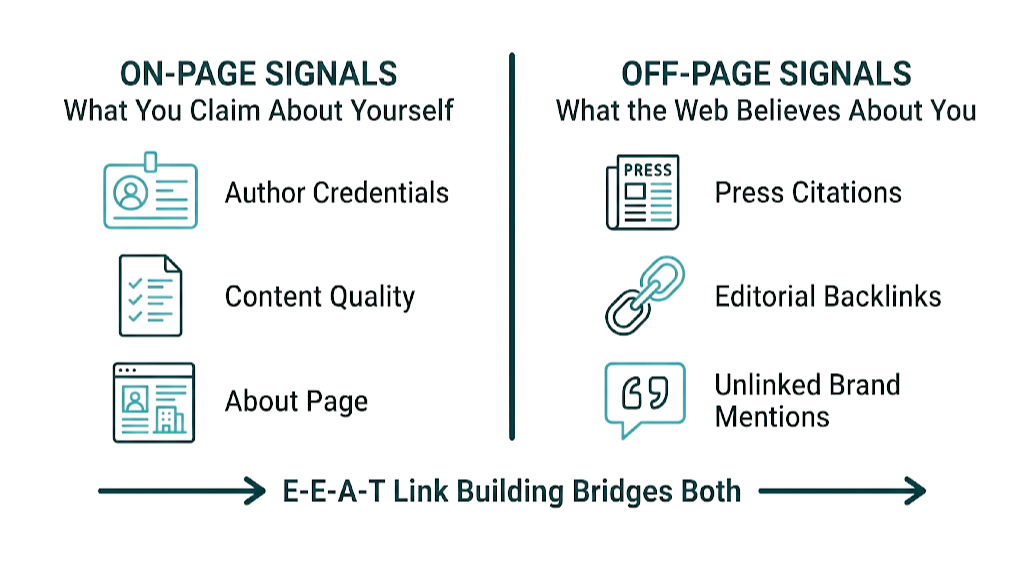
The core argument this article makes: eeat link building is not a niche tactic - it is the primary mechanism by which a website builds the Authoritativeness and Trustworthiness pillars of E-E-A-T at scale. On-page signals tell Google what you claim about yourself. Off-page signals - editorial backlinks, press citations, unlinked brand mentions - tell Google what the rest of the web believes about you. That distinction drives how you allocate SEO budget and how you structure link acquisition.
That budget impact shows up fast. This guide covers what E-E-A-T demands from link builders, why backlinks still act as the strongest off-page trust signal, how unlinked mentions feed reputation checks, and how to build a compounding strategy that strengthens all four pillars over a six-month horizon. We've structured it so you can move quickly, whether you're managing a mid-market SaaS client spending $3k/month on links or running a full-service agency building link programs across dozens of verticals. If you're still weighing up link building costs before committing to a program, the breakdown in that guide maps directly to the budget tiers we reference throughout this article.
What E-E-A-T Actually Means for Link Builders (Beyond the Buzzword)
Experience, Expertise, Authoritativeness, Trustworthiness. Most explanations of E-E-A-T stop at defining the acronym. Google's Search Quality Rater Guidelines (QRG) - the 170-page document that trains the human evaluators who calibrate Google's algorithms - goes further. Sections 3.3 and 3.4 matter most for off-page work. They tell quality raters to assess reputation by researching what external sources say about a site, not by relying on what the site says about itself. The guidelines also push raters toward "independent" sources - news articles, Wikipedia entries, forum discussions, expert reviews - when forming reputation judgments.
That "independent sources" line changes the assignment. Google's quality raters aren't evaluating your content in isolation. They're doing what amounts to a manual off-page audit, then feeding those patterns back into the systems that train and tune search.
That off-page audit is where link building carries real weight. A backlink from a respected industry publication isn't just a PageRank signal - it's a reputational endorsement that matches what raters are trained to look for. A mention in a TechCrunch article, a citation in a well-regarded trade journal, a recommendation in a niche forum - these are the raw materials of E-E-A-T reputation, and they don't always arrive as hyperlinks.
Those raw materials map cleanly to the four pillars:
- Experience - shown through first-hand content, case studies, and bylined contributions on external platforms
- Expertise - reinforced when authoritative sources in your niche cite you as a reference point
- Authoritativeness - built through the volume and quality of editorial links and brand mentions from recognized entities in your space
- Trustworthiness - the anchor pillar, strengthened by consistent citation patterns, clean link profiles, and brand mentions in high-credibility publications
Reputation also has to line up with how Google describes page quality. Google's helpful content guidance on Google for Developers frames E-E-A-T as a lens for evaluating overall page quality - not a checklist. That matters because Google looks for a consistent signal pattern across the web, not a handful of on-page fixes.
A website with strong author bios but zero editorial backlinks looks incomplete through that lens. A site with hundreds of low-quality directory links but no press coverage looks just as off.
Signal patterns are what separate metric-chasing from reputation building. Link builders who internalize E-E-A-T stop treating DR and DA as the goal and start treating them as a byproduct. And that change forces different decisions about targets, outreach angles, and what "good coverage" actually looks like. Understanding domain authority vs domain rating is a useful starting point for calibrating which metrics actually matter in this context.
Why Backlinks Are Still the Strongest Off-Page E-E-A-T Signal
Ahrefs' landmark study on organic search traffic found that 90.63% of pages get zero organic traffic from Google, and the single strongest predictor of traffic is the number of referring domains pointing to a page. That stat gets repeated so often it starts to fade into the background. In an E-E-A-T context, though, it lands with a specific meaning: the web's editorial endorsement structure - who links to whom, from where, and in what context - still does most of the heavy lifting when Google ranks the relative authority of information sources.
Google's spam policies make the flip side just as clear. Manipulative link schemes - paid links, link networks, excessive reciprocal linking - count as violations because they poison the editorial signal backlinks are meant to carry. Google isn't drawing lines at random. The model is simple: a real editorial backlink reflects a human decision to vouch for a resource. That vouching behavior is off-page E-E-A-T at its cleanest.
Now take a concrete scenario. A health insurance comparison site and a personal finance blog both target the keyword "best health insurance for self-employed." The comparison site has 400 backlinks, mostly from directory submissions and low-tier guest posts. The personal finance blog has 80 backlinks, but 30 of them are from publications like Forbes, NerdWallet, and The Guardian's money section. Under E-E-A-T assessment, the blog wins. Not because of raw link volume, but because the endorsement quality is in a different class. Quality raters researching that blog will see it referenced by sources they already trust, and that trust transfers.
That trust transfer is the pattern the Impression.co.uk analysis of the August 2023 core update points to. Sites that benefited most from the update shared the same profile: strong editorial link acquisition from recognized publications in their niche, paired with coherent on-page E-E-A-T signals. Sites that lost rankings showed thin link profiles, or profiles dominated by low-authority and topically irrelevant sources. The update didn't introduce new E-E-A-T criteria - it sharpened Google's ability to separate real editorial authority from manufactured link signals.
Backlinks build two specific E-E-A-T pillars simultaneously. Authoritativeness grows when recognized entities in your field cite you. Trustworthiness grows when that citation pattern stays consistent, stays diverse, and stays clean of manipulation signals. One link from a respected source can do both jobs. A hundred links from low-authority directories do neither.
How Google's Quality Raters Assess Authoritativeness Using Off-Page Signals
Quality raters don't have access to Google's index data. They can't see PageRank scores or domain authority metrics. What they do have is a structured reputation research workflow that section 3.3 of the QRG lays out in detail.
That reputation research starts with searches for the website or brand name combined with terms like "reviews," "reputation," and "complaints." Raters look for third-party coverage - news articles, industry awards, expert mentions, Wikipedia references. They are told to discount information a site publishes about itself and to put real weight on independent sources. If a site calls itself "the UK's leading provider" of something, that claim carries no weight unless external sources back it up.
This is why editorial coverage functions as an E-E-A-T proxy. When a quality rater searches for your brand and finds a feature in an industry publication, a positive mention in a comparison article, or a citation in an academic or journalistic piece, that's the reputation signal the QRG is designed to surface. The link matters algorithmically. But the coverage - the fact that a credible external source chose to reference you - is what moves the needle on human-assessed quality scores.
That "credible external source" piece is where link building stops being a checkbox exercise. For our team, every editorial placement we secure isn't only a ranking input. It's part of the reputation infrastructure that quality raters are trained to find. Stack enough placements in the right publications and the rater's research turns up a consistent trail of third-party endorsement. That's authoritativeness, in practice. Our curated links service is built around exactly this principle - securing editorially placed links in publications that hold up under that kind of scrutiny.
The Difference Between E-E-A-T Link Building and Traditional Link Building
Traditional link building optimizes for one variable: PageRank transfer. The core filter is authority passed through the link.
E-E-A-T link building optimizes for credibility. The filter is whether the placement makes your brand look legitimate to a human evaluator who doesn't know you yet.
Those two filters lead to different strategies, different prospect lists, and different ways to measure outcomes.
A traditional link builder working on a cybersecurity SaaS might chase any DR 50+ site that will take a guest post, even if the site has nothing to do with security or enterprise tech. That's straight authority transfer. An E-E-A-T link builder for the same client stays tight: cybersecurity publications, enterprise tech media, and business press that a quality rater researching "cybersecurity software" would recognize. DR still matters, but topical fit and editorial standards carry more weight than a raw threshold.
Anchor text is another split. Traditional link building often pushes keyword-heavy anchors to influence rankings, and that pattern can trip spam signals under Google's current guidelines. E-E-A-T link building leans into natural, brand-first anchors because the goal is reputation, not keyword steering. If Forbes cites your company in a financial planning piece, the anchor is usually your brand name. That's how real citations look to algorithms and raters. For a deeper look at why anchor diversity matters, the guide on mastering natural anchor text covers the mechanics in detail.
Here's a direct comparison of how the two approaches differ across key dimensions:
Dimension | Traditional Link Building | E-E-A-T Link Building |
|---|---|---|
Primary metric | Domain Rating / PageRank | Topical relevance + editorial credibility |
Target sites | Any high-DR site | Recognized publications in your niche |
Anchor text strategy | Keyword-rich | Brand-forward, natural |
Content angle | Generic guest posts | Expert contributions, data-led PR |
Success measured by | Number of links | Quality rater findability |
Risk profile | High (spam policy exposure) | Low (editorial, earned coverage) |
Time horizon | Short-term ranking boosts | Long-term authority compounding |
That risk profile gap is real. Google's spam policies go after link schemes built to manipulate PageRank. A program based on earned editorial coverage and legitimate press mentions avoids most manual-action risk because it matches what Google expects links to represent: third-party endorsement.
Compounding is the other difference that matters. Traditional link campaigns often create a spike in referring domains, then flatten once outreach slows or budgets pause. An E-E-A-T program builds a reputation asset. Each solid placement makes the next one easier because editors vet sources before they quote, cite, or feature them. A brand that already shows up in respected outlets becomes simpler to sell to the next outlet. That's a flywheel traditional guest-post link building doesn't create.
A digital marketing agency that spends $2,500/month on generic guest posts racks up links that might pass some algorithmic value, but they rarely show up during reputation research. Put that same $2,500/month into targeted digital PR and editorial outreach inside niche trade media and you build a citation profile that stacks up over 12-24 months. The near-term ranking lift can move slower. The longer-term E-E-A-T lift wins.
Brand Mentions Without Links: How Unlinked Citations Build E-E-A-T
Almost nobody says this out loud: a mention doesn't need a hyperlink to carry E-E-A-T weight.
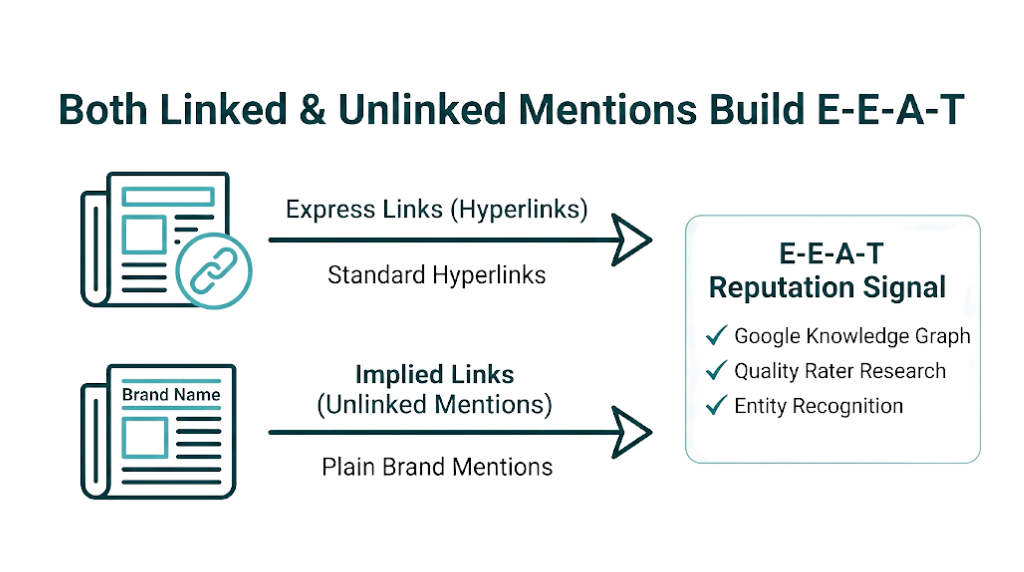
Google holds US Patent 8,682,892 - often called the "implied links" patent. It describes a system for processing "implied links," meaning references to a target resource that don't include a direct hyperlink. The core idea is simple: Google can detect a brand or entity mention on a page without a link and treat that co-occurrence as a ranking input. The patent language draws a line between express links, which are standard hyperlinks, and implied links, which are plain mentions. Both can feed ranking systems.
This already shows up in how the Knowledge Graph works. Google maps entity relationships through co-occurrence: brands, people, topics, and the contexts they appear in. If a respected publication mentions your brand in the same breath as the topic you want to own, that association strengthens Google's understanding of where your entity belongs - even if nobody can click through.
Press coverage matters beyond link yield. A national newspaper can mention your company and skip the link, and it still adds to the reputation signals quality raters look for. When a rater searches your brand name, that newspaper feature can surface. They see an external, credible source referencing you, and the reputation signal lands whether or not the HTML includes an <a href> tag.
That changes how we build campaigns:
- Prioritize coverage over links for outlets that rarely link out - major newspapers, broadcast media, academic journals
- Track unlinked mentions with tools like Ahrefs Content Explorer or Google Alerts - they are E-E-A-T assets and link reclamation targets
- Keep entity naming consistent. Brand name, founder names, and product names should match across mentions, because inconsistent naming splits the entity signal
- Go after adjacent-topic mentions. A cybersecurity firm cited in a data breach trends article still picks up topical authority, even if the piece isn't "about" the firm
Section 3.3 of Google's Quality Rater Guidelines backs this up. Raters are told to look for mentions in news articles, Wikipedia, and other reference sources - not only hyperlinks. The guidelines don't treat linked and unlinked mentions as different classes of reputation evidence. Both count. Both shape the picture of a real, recognized entity. The guide on tracking online brand mentions covers the tooling and workflow for monitoring this at scale.
Teams that get this stop treating press as a vanity KPI and start treating it as core E-E-A-T infrastructure. A mention in The Financial Times without a link does more for reputation than fifty links from low-authority blogs. The math is simple - source credibility drives the signal, not the presence of an anchor tag.
Which Link Types Actually Move the Needle on E-E-A-T (With Examples)
Not all links pull the same weight for E-E-A-T. Use the tier system below as a practical filter for link acquisition, ranked by combined impact on authoritativeness and trustworthiness signals.
Tier 1: Editorial Niche Links
These are the gold standard. An editorial niche link is an unsolicited or earned placement in a publication that covers your industry - where an editor or journalist chose to reference your brand, content, or data as a credible source. Think a fintech startup cited in a Finextra analysis piece, or a health tech platform referenced in a BMJ article. These links carry maximum E-E-A-T weight because they show peer recognition inside the category you're trying to rank in.
A worked example: a legal tech SaaS produces an original study on contract dispute resolution timelines across UK industries. Legal trade publications pick it up and cite the data in their own analysis pieces. Each citation is an editorial niche link - earned, tightly relevant, and the kind of source a quality rater researching "legal technology UK" would find and treat as a serious reference.
Tier 2: Digital PR Placements
National and regional press coverage, broadcast media mentions, and major online publications (Forbes, The Guardian, TechCrunch, industry-specific equivalents). These placements usually won't match Tier 1 for topical fit, but they send strong trust signals - especially for Trustworthiness and the brand-level credibility quality raters look for. A single Guardian mention for a personal finance brand does more for its E-E-A-T profile than twenty guest posts on mid-tier finance blogs.
Tier 3: Expert Contributor and Guest Posts
Bylined contributions to recognized publications in your space - with one key difference from old-school guest posting. The E-E-A-T value comes from the author's real expertise and the publication's editorial bar, not a DA score. A bylined piece on a respected industry blog, where the author is clearly a practitioner or specialist, carries E-E-A-T weight. A 500-word filler post on a DR 40 site that publishes anything doesn't. Our guest posts service focuses on placements that meet this editorial standard, rather than chasing volume on low-bar sites.
Tier 4: Curated Directories and Resource Pages
Legitimate industry directories - not link farms - still help in the right context. A cybersecurity firm listed in a recognized vendor directory, a law firm listed in a verified legal directory, a financial advisor listed in an FCA-regulated comparison site. These links support basic legitimacy inside a professional ecosystem. They won't build authority on their own, but they strengthen the broader citation pattern that makes a brand look real.
Link Tier | Example | E-E-A-T Pillars Strengthened | Relative Impact |
|---|---|---|---|
Tier 1: Editorial Niche | Trade journal citing your research | Authoritativeness, Expertise | Highest |
Tier 2: Digital PR | National press coverage | Trustworthiness, Authoritativeness | High |
Tier 3: Expert Contributor | Bylined post in industry publication | Experience, Expertise | Medium-High |
Tier 4: Directory/Resource | Industry-specific directory listing | Trustworthiness | Low-Medium |
Why YMYL Sites Face a Higher E-E-A-T Bar for Link Acquisition
Your Money or Your Life - Google's designation for content that can directly impact a user's health, financial stability, safety, or legal standing - sits under a higher E-E-A-T standard. The QRG is explicit: for YMYL topics, raters apply stricter criteria and want stronger evidence of expertise and trustworthiness before they hand out high quality scores.
That stricter standard changes what "good links" means in practice. For link builders working with YMYL clients - health, finance, legal, insurance - Tier 1 and Tier 2 links aren't just nice to have. They're the floor. A personal injury law firm with a link profile dominated by generic directories and low-authority guest posts will struggle against a firm with placements in legal trade publications, citations in bar association resources, and coverage in regional business press. For YMYL queries, the algorithmic gap between those profiles widens fast.
The flip side is risk. Low-quality links hurt any site, but YMYL sites don't get much benefit of the doubt. Google's spam policies apply universally, and quality rater standards for YMYL content are strict. One piece of coverage in a recognized medical journal or a financial regulator's resource page carries more E-E-A-T weight for a health or finance site than dozens of mid-tier placements. Build YMYL link strategies around concentrated quality, not volume.
Short version: fewer, better links.
Digital PR as an E-E-A-T Strategy: How Press Coverage Builds Trust at Scale
Digital PR is the most efficient mechanism for building E-E-A-T at scale. And it's almost entirely absent from the link building strategies of most mid-market SEO teams.
Digital PR works for E-E-A-T for a simple reason: structure. Journalists and editors act as credibility gatekeepers. When they feature a brand or cite a source, they apply the same kind of editorial judgment Google's quality framework is built to reward. A digital PR placement in a respected publication functions as a Tier 2 link, a brand mention, an entity signal, and reputation infrastructure that quality raters will surface during brand research. Four E-E-A-T jobs. One placement.
The mechanics matter. Digital PR for E-E-A-T isn't traditional PR, and the goal isn't awareness for its own sake - it's targeted coverage in publications a quality rater would treat as credible for your topic. A B2B SaaS company targeting enterprise HR buyers should earn coverage in HR trade publications, business press, and technology media - not chase lifestyle placements that happen to have high domain authority.
Most digital PR campaigns that move the E-E-A-T needle rely on one of three content formats:
- Original data and research - proprietary surveys, industry studies, or data analyses journalists can cite as primary sources. This positions your brand as a knowledge authority and generates Tier 1/Tier 2 links at the same time.
- Expert commentary - rapid response to breaking news or industry developments, putting your team's experts in the quote pool. This builds the individual-level expertise signals the QRG weighs alongside brand-level authority.
- Trend-led features - longer-form contributed content or feature pitches that take a position on an industry trend. These drive deeper coverage and often create the "brand mentioned in the context of X topic" co-occurrence signals that strengthen topical authority.
The Impression.co.uk analysis of the August 2023 core update found that sites with consistent press coverage in recognized publications were more likely to benefit from the update than sites relying primarily on technical SEO or on-page optimization. That lines up with what we see across quality updates: Google keeps rewarding off-page reputation signals, and digital PR is built to produce them. As Semrush's breakdown of how to improve E-E-A-T makes clear, building your brand reputation through press coverage and digital PR is one of the most direct ways to strengthen the trust signals that Google's quality framework rewards. Understanding how link building helps SEO more broadly gives useful context for where digital PR fits within a full off-page strategy.
One point worth stating directly: digital PR and traditional link building aren't competing strategies. They're complementary layers.
Editorial niche links build topical depth. Digital PR builds brand-level trust at scale. Combine both and you end up with an E-E-A-T profile that's hard to replicate - because it mirrors real industry recognition, not manufactured link signals.
How to Audit Your Existing Link Profile for E-E-A-T Quality
Before building new links, you need a clear view of what your current profile signals about your brand's credibility. An E-E-A-T link audit isn't a standard backlink audit. This isn't just about "toxic" links - it's about whether your backlink and mention footprint would hold up under quality rater-style reputation research.
Step 1: Pull your full backlink profile
Use Semrush's Backlink Audit tool or Ahrefs' Site Explorer to export all referring domains. Filter for active, followed links, then sort by domain authority or domain rating. Now you have the working set.
Step 2: Categorize by E-E-A-T tier
Apply the tier framework from the previous section. Classify each referring domain as Tier 1 (editorial niche), Tier 2 (digital PR / major press), Tier 3 (expert contributor), or Tier 4 (directory / resource page). Add a fifth category for links that don't fit any tier - generic, low-authority, or topically irrelevant placements that add nothing to your E-E-A-T profile.
Step 3: Calculate your E-E-A-T ratio
Calculate the percentage of referring domains that land in Tier 1 and Tier 2. For a site targeting competitive, E-E-A-T-sensitive queries, that number needs to sit above 30-40%. If a site has 200 referring domains, where 160 are generic directories and 8 are editorial niche placements, it has an E-E-A-T deficit - even if the blended domain authority score looks fine.
That ratio is your baseline.
Step 4: Run a brand mention audit
Use Ahrefs Content Explorer to search for your brand name, then filter for pages that mention you without linking. Unlinked mentions still support E-E-A-T (they contribute to reputation signals) and they also give you link reclamation targets. Start with the highest-authority mentions. Even two or three wins from Tier 1 sources shift your E-E-A-T ratio in the right direction. The full process for recovering lost backlinks applies directly here - the same outreach workflow covers both reclamation and unlinked mention conversion.
Step 5: Identify your topical authority gaps
Review the topic distribution across your Tier 1 and Tier 2 links. If your best editorial coverage clusters in one sub-topic while other priority areas have zero visibility, that's a gap you need to close. A cybersecurity firm with strong editorial coverage on "network security" but none on "cloud security compliance" has a topical authority gap that a targeted digital PR campaign should address.
The output of this audit is a prioritized action list: links to disavow (genuine spam), mentions to reclaim, and topic areas where you need new editorial placements. That list becomes the foundation for your forward-looking E-E-A-T link acquisition strategy.
Building a Link Acquisition Strategy That Compounds E-E-A-T Over Time
The Ahrefs traffic study data tells us that top-ranking pages accumulate links over years, not weeks. Pages ranking in positions 1-3 for competitive queries build referring domain profiles over 24-36 months. This takes time. That's not a reason to be pessimistic about new campaigns - it's a reason to build strategies that compound rather than spike.
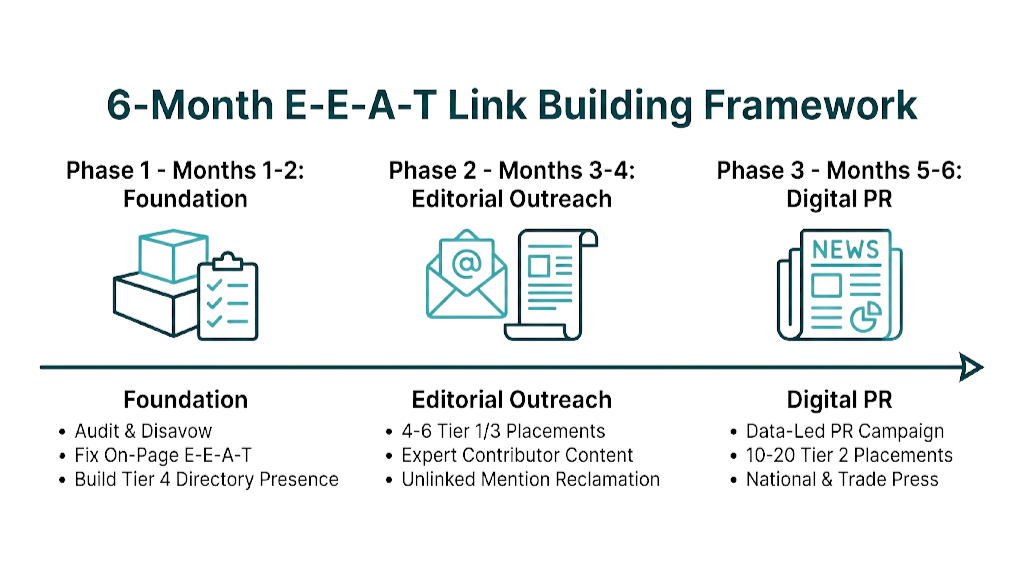
Here's a phased six-month framework that ties on-page E-E-A-T cleanup, editorial outreach, and digital PR into a single program.
Months 1-2: Foundation
Start with the audit process described above. Clean up any genuinely toxic links through disavow. Fix the on-page E-E-A-T signals that editorial contacts check before they agree to feature you - author bios, about page credibility, contact information, editorial standards.
Journalists do their homework. If our pitch lands and your site shows thin author pages with no proof of real expertise, the angle won't save it.
Build your Tier 4 presence in legitimate industry directories at the same time. These won't move authority on their own. They do lock in the citation consistency that supports entity recognition.
Months 3-4: Editorial Outreach
Launch targeted outreach for Tier 1 and Tier 3 placements. Identify 15-20 publications in your niche that publish expert contributor content, then pitch topic angles that prove expertise rather than pushing product. The guide on creating successful outreach campaigns covers the pitch structure and follow-up sequencing that gets responses from editors who receive dozens of requests a week.
Quality beats volume. Aim for 4-6 placements in this period. Each placement should reinforce your brand's core expertise area and point to a relevant resource on your site with a link that reads like it belongs there.
Run your first unlinked mention reclamation campaign alongside outreach. Start with the highest-authority mentions. Even two or three wins from Tier 1 sources shift your E-E-A-T ratio in the right direction.
Months 5-6: Digital PR
By month five, your on-page E-E-A-T signals are solid and you have a small but credible editorial footprint. That editorial footprint is what lets us pitch national and trade press with confidence, because the brand now has the credibility plumbing to support a journalist's due diligence.
Launch one data-led digital PR campaign - a proprietary study, a survey, or an original analysis of industry data. Distribute it to Tier 2 targets: business press, trade publications, relevant national media.
A successful digital PR campaign in month six can generate 10-20 Tier 2 placements in a single push. That's more E-E-A-T impact than six months of generic guest posting. And because those placements run in recognized publications, they're the citations that surface when quality raters research your brand six months later.
The compounding effect kicks in after month six. Your brand now appears in respected publications. New journalists researching your topic area find those citations and include you more often in later coverage. Outreach reply rates improve because we can point to existing placements as proof.
Each new placement makes the next one easier to earn.
This is the structural difference between E-E-A-T link building and traditional link building. Traditional campaigns stop when the budget runs out. An E-E-A-T strategy builds a reputation asset that creates its own momentum - because real editorial credibility reinforces itself in a way manufactured link signals don't.
Brands that commit to this framework for 12-24 months don't just rank better. They become the sources competitors struggle to displace, because their off-page reputation is hard to copy fast. That's the compounding E-E-A-T advantage - and it starts with treating every editorial link and brand mention as a brick in a trust system that Google's quality systems are built to reward.
Frequently Asked Questions About E-E-A-T and Link Building
What is E-E-A-T and how does it relate to link building?
E-E-A-T stands for Experience, Expertise, Authoritativeness, and Trustworthiness - the quality framework in Google's Search Quality Rater Guidelines for evaluating websites. Link building ties to the Authoritativeness and Trustworthiness pillars. Editorial backlinks and press mentions are the main off-page signals that show Google's algorithms and human quality raters that credible third parties recognize and trust your brand.
Do backlinks directly improve E-E-A-T?
Backlinks don't update an E-E-A-T score - Google hasn't confirmed a single numeric E-E-A-T metric. But editorial backlinks from relevant, credible sources build the authoritativeness and trustworthiness signals that Google's quality assessment framework looks for. High-quality referring domains correlate with strong performance on E-E-A-T-sensitive queries, particularly after core updates.
What types of links have the highest E-E-A-T value?
Editorial niche links - earned placements in recognized publications within your specific industry - carry the highest E-E-A-T value. Digital PR placements in national or trade press sit close behind. Expert contributor content in credible publications ranks third. Generic directories and low-authority guest posts add little to E-E-A-T, regardless of their domain authority scores.
Do unlinked brand mentions count as an E-E-A-T signal?
Yes. Google's implied links patent (US Patent 8,682,892) describes a system for processing brand references without hyperlinks as ranking signals. Google's Quality Rater Guidelines also instruct raters to assess reputation using mentions in news articles and other sources, not only hyperlinks. A mention in a credible publication contributes to your brand's E-E-A-T reputation profile whether or not it includes a link. Search Engine Journal's guide on using E-A-T principles to evaluate link prospects explores how these reputation signals should inform your outreach targeting and prospect vetting process.
How is E-E-A-T link building different from traditional link building?
Traditional link building optimizes for PageRank transfer and domain authority metrics. E-E-A-T link building optimizes for editorial credibility and reputational signal - whether a placement would be found and weighted positively by a human quality rater researching your brand. E-E-A-T link building prioritizes topical relevance, editorial standards, and publication credibility over raw domain authority, and treats each placement as part of a long-term reputation asset rather than a short-term ranking tactic.
related Blog Posts



Join 2,600+ Businesses Growing with Rhino Rank
Sign Up
Stay ahead of the SEO curve
Get the latest link building strategies, SEO tips and industry insights delivered straight to your inbox.