
 Back to all posts

Backlink management: how to monitor, audit, and protect your links
Backlink management is the routine work of tracking the links that point at your site, checking whether they still help, and responding when a link pattern creates real risk. The honest first move is not to disavow everything a tool flags. Start by monitoring new and lost links, then review the context before you act.
Good backlink management keeps your link profile useful, explainable and easier to defend. It is part monitoring, part audit discipline and part record keeping. You are not trying to make every metric look perfect. You are trying to understand which links support the site, which links deserve a closer look, and which issues need action.
Key points
- Monitor new links, lost links, anchors and referring domains on a regular schedule.
- Treat DA, DR, Spam Score, Trust Flow, Citation Flow and toxic labels as third-party triage signals, not Google verdicts.
- Investigate suspicious patterns before removing links or uploading a disavow file.
- Use disavow only for a serious artificial-link pattern tied to an actual or likely manual action.
- Build new links through useful assets, relevant placements, editorial standards and clean reporting.
What backlink management covers
A backlink profile is the full set of pages that link to your site. Management is the process that keeps that profile legible over time. It covers new links, lost links, referring domains, anchor text, linked pages, follow attributes and the wider context around each placement.
You do not need every link to look the same. A natural profile can include editorial links, citations, brand mentions, resource-page links, guest contributions and a mix of dofollow and nofollow links. The better question is whether the pattern makes sense for the business, the topic and the pages receiving links.
That pattern-level fit comes first.
Quality is not one number. A link from a relevant article on a real site usually deserves more weight than a random high-score domain with no topical fit. A homepage link, a commercial anchor and a sidebar link all say different things. Backlink management is how you keep those differences visible.
The aim is control, not panic. Search engines use automated systems to detect and neutralise a lot of spam. That does not mean link spam is harmless, and it does not mean every odd backlink is a crisis. In the profiles we manage, most odd links only become interesting when they cluster around the same weak source, anchor or target page. Your response should match that risk.
A calm backlink management workflow
The workflow is simple enough to repeat: monitor the profile, assess what changed, decide whether action is needed, then document the decision. If you run link building for clients, the same process also gives you a clean audit trail when rankings move or a placement disappears.
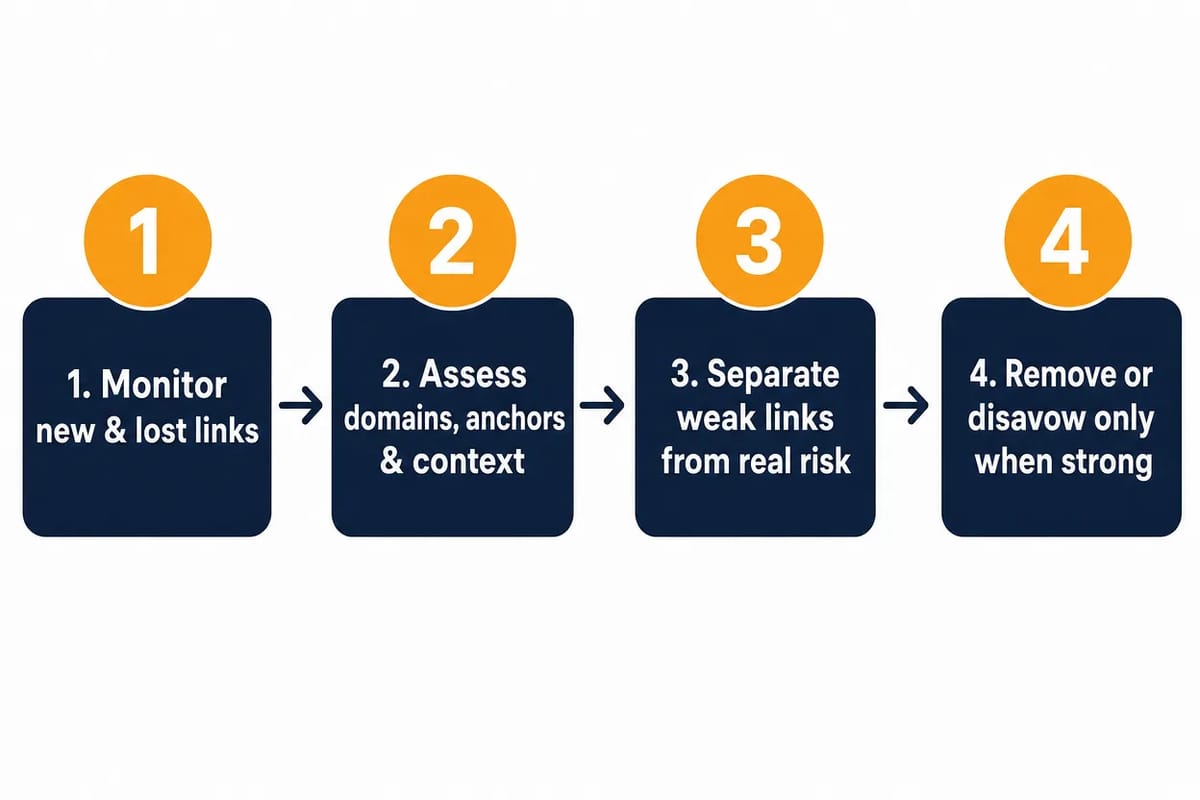
1. Monitor new and lost links
Start with your regular link monitoring. Google Search Console can show top linking sites, linked pages and anchor text, while tools such as Ahrefs, Semrush, Moz and Majestic can add wider crawl data and alerts. None of these sources is complete on its own, so compare patterns rather than treating one export as absolute truth.
New links tell you what the web is starting to associate with your site. A sudden run of scraper links may be noise. A new editorial mention from a relevant site may be worth recording, promoting or using as proof that a content asset is earning attention.
Lost links should sit in your review too. If a useful link disappears because a page was updated, redirected or removed, you can decide whether it is worth reclaiming. If the lost link came from a weak directory, no action may be needed. Save your effort for links that were relevant, visible and likely to send real users.
Watch link velocity, but do not turn it into a fear metric. Fast growth can be normal after PR coverage, a product launch or a large content campaign. It becomes more interesting when the new links share weak sites, repeated anchors or other artificial patterns.
2. Assess referring domains, anchors and context
Once you know what changed, review the actual linking pages. Check whether the page is indexed, whether the topic fits, where the link sits, what anchor text is used and which page on your site receives the link. This gives you a better read than a raw count of backlinks.
The catch: third-party scores are useful, but they are not Google data. Domain Authority (Moz) estimates ranking potential from Moz's index; Domain Rating (Ahrefs) measures relative backlink-profile strength; Trust Flow (Majestic) estimates link quality from proximity to trusted seed sites; Citation Flow (Majestic) estimates link influence from link volume. Page Authority, Spam Score and toxic-link labels are also provider models. They can help you sort a large export, but they do not prove that Google has rewarded or penalised a link.
Use these scores as filters for your review, not as verdicts. If a tool flags a domain as risky, open the page and inspect it. Look for obvious spam, irrelevant content, scraped pages, casino or adult outlinks on unrelated sites, heavy exact-match anchors, and pages created only to sell links. The linking page itself matters when you judge risk.
Anchor text deserves its own pass. A profile dominated by exact-match commercial anchors is easier to question than one with brand, URL, natural phrase and partial-match anchors. That does not make every keyword anchor dangerous. It means you should know when the pattern starts to look engineered.
3. Separate weak links from real risk
Weak links and risky links are not the same. A random scraper link, an old forum profile or a low-quality directory mention may be ugly without needing action. A large artificial pattern built through paid link schemes, automated links, excessive exchanges or manipulative anchors is different.
Common risk sources include Private Blog Networks (PBNs), Link Farms, and other low quality sites created mainly to pass ranking signals. If these show up in your audit, they deserve a slower review, especially when they appear at scale or point at money pages with repeated commercial anchors.
In practice: classify links into three groups. Keep links that are relevant and explainable. Watch links that are weak, odd or low value. Investigate links that appear artificial, paid, hidden, automated or part of a network.
This is also where manual-action context matters. If Google Search Console shows a manual action for unnatural links, your audit becomes more formal. You need to identify the pattern, remove or neutralise what you can, and keep evidence of the cleanup before asking for review.
4. Remove or disavow only when the case is strong
Disavow is not routine backlink hygiene. Google presents the disavow tool as an advanced option for sites with a considerable number of spammy, artificial or low-quality links, especially where there is an actual or likely manual action. Used badly, it can remove signals that were helping your site.
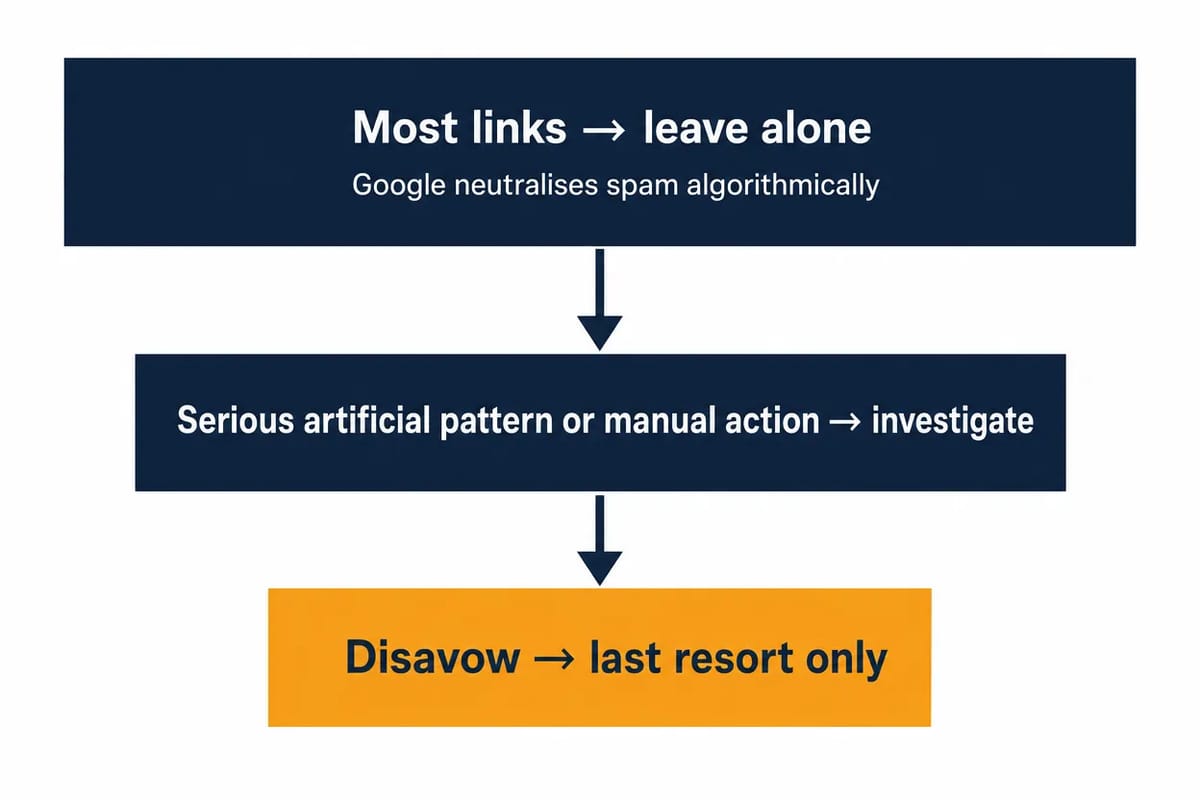
Your first response should be investigation. If the link is on a site you control or a publisher you can reach, ask for removal or correction where that is realistic. The profiles we manage rarely need a disavow; when they do, the case is usually a clear artificial pattern rather than one bad link. If the link is just background spam and there is no broader pattern, recording it may be enough.
Keep it narrow.
Use a disavow file only when the pattern is serious, removal is not practical, and the risk is clear. Domain-level disavow can be cleaner than listing hundreds of URLs from the same spam network, but it also has more blast radius. Check the file twice before upload.
How to improve your backlink profile
Backlink management is not only defensive. The same audit should tell you where to strengthen the profile: which pages need better support, which topics already attract links, and which competitors earn links your site has not yet earned.
Content is still the safest starting point. Original data, useful tools, practical guides and clear explainers can earn natural backlinks because they give other writers something worth citing. The link is a result of the asset, not the only reason the asset exists.
Curated links, also called niche edits, can help when they place a useful reference inside existing relevant content. The standard is placement quality: topical fit, real readership, editorial sense and a sensible anchor. If you use curated link building services, the report should make those checks easy to review.
Guest posting can also work when the article has a genuine audience and the link fits the topic. Avoid thin guest posts built around exact-match anchors. A good guest posts campaign should be readable as a useful third-party article even if the SEO value were removed.
Relationship-led links are slower, but often cleaner. Digital PR, expert commentary, partner content and source requests can create links because you have something to contribute. Digital PR and Help A Reporter Out (HARO) style pitching work best when the quote or asset is useful on its own.
Tools and metrics worth tracking
A full backlink tool stack is rarely required. You need enough data to spot changes, investigate patterns and report decisions clearly. For many teams, that means Search Console plus one paid backlink index and a simple tracking sheet.
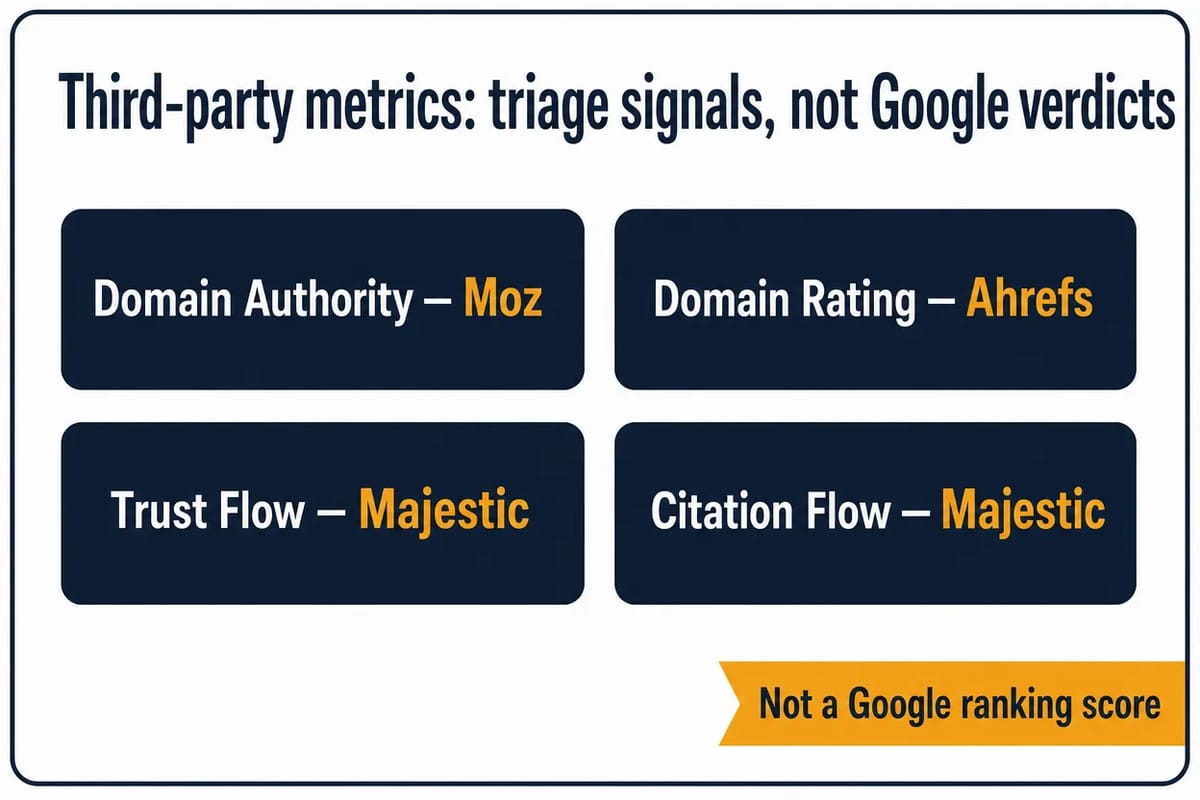
The useful metrics are practical: referring domains, new links, lost links, linked pages, anchor text, follow attributes, topical relevance and link status. Tool-specific scores can sit beside those metrics, but they should not replace manual review.
Ahrefs, Semrush, Moz and Majestic all help with backlink analysis in different ways. Ahrefs and Semrush are common all-round SEO platforms with backlink indexes and alerts. Moz adds DA, PA and Spam Score. Majestic adds Trust Flow, Citation Flow and topical link data.
Read those numbers as triage in your workflow. A high DR site can still host a poor link. A low DA page can still be relevant and useful. A toxic-score alert can be a prompt to inspect, not a verdict that Google has already taken action.
For reporting, keep the output short. List the links gained, links lost, pages affected, anchor changes, risks found and actions taken. In our audits, the most useful reports separate tool scores from what the linking page actually shows. If you are using link building metrics, explain which are third-party metrics and which are direct observations from the link page.
Local SEO and backlink management
Local sites need the same discipline with one extra layer: geography. Local link building focuses on links and citations from regionally relevant organisations, publications, directories, suppliers and community pages.
For a local business, a modest link from a real regional site can be more useful than a stronger-looking domain with no local relevance. Check whether the page matches the service area, whether the business details are accurate, and whether the link or citation sends a clear local signal.
Name, address and phone consistency still matters for citations, but citations and backlinks are not identical. A citation may confirm business details without passing much SEO value. A backlink can send users and context. Manage both, but measure them separately.
When to outsource backlink oversight
Backlink management becomes harder when you have several campaigns, several target pages or several clients. At that point, the problem is not knowing that links exist. The problem is keeping strategy, anchors, placement quality and reporting aligned every month.
If your team does not have time to inspect placements and competitor gaps, an external managed SEO service can own the recurring work: competitor analysis, anchor planning, link acquisition, reporting and review. The handover should still be specific. You need to know what was built, why it was built and how each link was vetted.
Outsourcing does not remove responsibility. Ask for unbranded placement reports, clear replacement terms, anchor records and a plain explanation of site screening. If a provider cannot explain a placement without leaning on one score, keep asking.
A practical backlink audit checklist
Run a light review monthly and a deeper audit when there is a manual action, a major ranking drop, a migration, an agency handover or a large new link campaign.
Check the basics first: total referring domains, new links, lost links, top linked pages, anchor text distribution and obvious spikes. Then inspect a sample of new and flagged links by hand.
For each link, ask:
- Is the linking page relevant to the topic or location?
- Is the site real, indexed and written for users?
- Does the anchor text look natural in the sentence?
- Is the linked page on your site the right destination?
- Is the link editorial, paid, sponsored, user-generated or unclear?
- Would this link still make sense if rankings were not part of the discussion?
The final question is useful because it strips the audit back to intent. If the only reason a link exists is to manipulate search rankings, it deserves closer scrutiny. If it helps a reader move from one useful page to another, it is easier to defend.
Document the outcome so your next review starts from evidence. Keep, watch, reclaim, request removal or disavow-last-resort are enough as status labels. You do not need a complicated system if the decision is clear.
Frequently asked questions
What is backlink management?
It is the process of monitoring, auditing and improving the links that point to your website. It covers new links, lost links, anchor text, referring domains, link quality, risk review and reporting.
Is backlinks management different from backlink management?
No. Some tools and searches use the phrase backlinks management, but the task is the same: track the links pointing at your site, review their quality and respond only when a link issue deserves action.
How often should you audit backlinks?
For most sites, a monthly light review is enough. Run a deeper audit after a migration, a sharp ranking drop, a manual action, an agency change or a large link building campaign.
Should you remove every toxic backlink?
No. A toxic label is a third-party tool signal, not a Google verdict. Inspect the link and the wider pattern before acting. Many odd links are noise, and Google often handles spam automatically.
When should you use Google's disavow tool?
Use disavow only as a last resort for a serious pattern of spammy, artificial or low-quality links, especially when there is an actual or likely manual action. Investigate first, try removal where practical, and avoid broad files unless the evidence supports them.
Which backlink metrics matter most?
Start with referring domains, linked pages, anchor text, new links, lost links, link status and topical relevance. DA, DR, Spam Score, Trust Flow and Citation Flow can help you prioritise review, but they are third-party signals.
Summary
Backlink management works best when it is measured and repeatable. Monitor the profile, review the context, classify the risk, build better links where the profile is thin, and reserve disavow for the rare cases where the evidence is strong.
Most sites do not need dramatic cleanup. They need a clear record of what changed, what matters and what action was taken. That is enough.
Every fact and commercial claim in this guide was fact checked and verified on 16 July 2026.
related Blog Posts



Join 2,600+ Businesses Growing with Rhino Rank
Sign Up
Stay ahead of the SEO curve
Get the latest link building strategies, SEO tips and industry insights delivered straight to your inbox.