
 Back to all posts
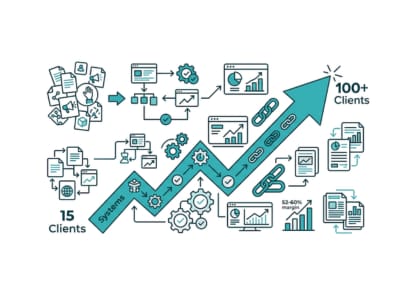
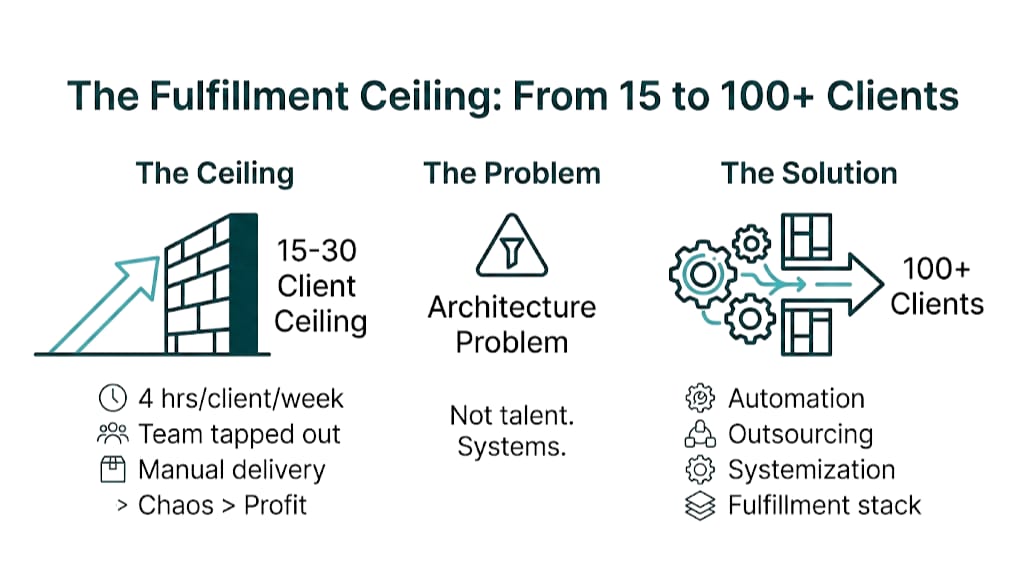
Hitting 10 clients feels like momentum. Hitting 15 feels like a business. Somewhere between 15 and 30, most SEO agencies stop growing - not because they can't sell, but because delivery won't stretch any further. The team is tapped out. The founder does account management at midnight. And every new client adds more chaos than profit.
This is the fulfillment ceiling. It's not a talent problem. It's an architecture problem.
Scaling SEO fulfillment to 100+ clients takes a rebuild of how we deliver - what we automate, what we outsource, and what we keep in-house. Agencies that break through the ceiling don't just hire. They run a fulfillment stack built for volume without matching headcount growth.
BLUF: The core issue is that manual SEO fulfillment eats about 4 hours per client per week at the ops level. Across 100 clients, that's 400 hours per week - the equivalent of 10 full-time employees doing execution only. Without systemization, automation, and outsourcing parts of delivery like link building, a 100-client agency won't run profitably. This article lays out the operating model to build one that does.
Why Most SEO Agencies Hit a Wall at 10-15 Clients (And What's Actually Causing It)
The 10-15 client ceiling shows up for the same reason in most agencies: delivery depends on people, not systems. Every client gets a custom workflow. Every report gets built by hand. Every link gets prospected one by one. Each new account takes a similar slice of someone's week, so capacity runs out fast.
That people-first delivery model drives the math. SEOJuice's scaling case study puts the average practitioner ceiling at 4 hours per client per week before quality slips. At 10 clients, that's 40 hours - one full-time role with no room for sales, client comms, or the random fires that pop up every week. Add five clients and the model snaps. Work quality drops, hours spike, or churn starts.
SEOJuice also calls out where the business starts to crack: margin collapse typically occurs at client 8 for solo operators and small teams. Before client 8, revenue grows faster than delivery cost. After it, each new client forces a hire (margin shrinks) or overloads the team (quality shrinks). Either way, the agency keeps billing more while operations get weaker.
That operational weakness hides behind a healthy invoice stack. On paper, 12 clients looks fine. In reality, that's 48 hours a week in delivery work - already two full-time equivalents - and our senior strategist still spends most of their time exporting rank checks and stitching reports that a $200/month tool could generate on autopilot.
Those hours add up even faster once we break delivery into functions. Nightwatch's agency scaling research shows rank tracking, reporting, and technical audit work alone consume 3 to 10 hours per client per month - before content ships or a single link lands. At 15 clients, that can turn into 150 hours a month on work that doesn't move strategy and belongs in automation.
The agencies that push past this ceiling don't grind harder. They treat it like a structural limit - then rebuild fulfillment from the ground up before signing the next batch of clients.
The Fulfillment Stack: What SEO Delivery Actually Looks Like at Scale
To systemize SEO delivery, we need a blunt inventory of what delivery includes. Most agency owners can name the big buckets - content, links, technical, reporting - but they haven't priced the labor inside each one. They also haven't separated work that scales with tools from work that scales only with headcount.
A full SEO fulfillment stack has at least six functional layers:
- Discovery and onboarding - keyword research, competitor analysis, site audit, strategy documentation
- Technical SEO - crawl monitoring, Core Web Vitals tracking, schema implementation, site architecture reviews
- Content production - brief creation, writing, editing, publishing, internal linking
- Link building - prospecting, outreach, relationship management, placement, quality verification
- Rank tracking and monitoring - weekly rank checks, SERP feature monitoring, algorithm update triage
- Reporting and client communication - monthly report assembly, insight commentary, call preparation
Those layers don't scale the same way. Rank tracking and reporting can run through SEO tools like Nightwatch, AgencyAnalytics, or Search Atlas, then a human adds the narrative at the end. Technical monitoring follows the same pattern once thresholds and alerts are set. With the right crawl tooling and alerts, one technical SEO can cover 40-60 sites; with manual checks, that number drops to 8-12.
Content production needs process and flexible capacity. Tools won't replace it, but standard briefs, templates, and QA checks stop it from turning into bespoke chaos. Freelancers also slot in cleanly when the workflows stay consistent. Programmatic SEO can produce structured pages at volume for the right verticals, but the vertical has to fit.
The scaling bottleneck stays the same across most stacks: link building is the only fulfillment function with low automation potential. Almost everything else can shift toward systems. Link building doesn't. That imbalance dictates how we staff, budget, and partner as we scale. Many agencies resolve this by leaning on a white label link building model, keeping strategy in-house while outsourcing placement at volume.
At 100 clients, even the functions with "medium" automation potential turn into a labor sink. If content averages 8 hours per client per month across 100 clients, that's 800 hours monthly - 20 full-time weeks of writing and editing work. Without a scalable content engine, content alone forces about five full-time writers. Add the other layers and manual fulfillment turns into a cost center that swallows the agency.
Fulfillment Function | Scalability Model | Hours/Client/Month (Manual) | Automation Potential |
|---|---|---|---|
Rank tracking | Tool-driven | 3-5 hrs | High (90%+) |
Reporting | Semi-automated | 3-6 hrs | High (70-80%) |
Technical audits | Automated monitoring | 2-5 hrs | High (60-70%) |
Content production | Process + freelance | 4-12 hrs | Medium (30-40%) |
Link building | Outsource or partner | 5-15 hrs | Low (10-20%) |
Onboarding | SOP-driven | 4-8 hrs (one-time) | Medium (40-50%) |
Standardize Before You Automate: The Prerequisite Most Agencies Skip
Every agency owner who's tried to roll out a new tool or automation workflow hits the same wall: the tool works, but the process under it is too inconsistent for automation to stick. A reporting platform can't pull clean data because clients get tracked different ways. A content brief template falls apart because some clients have brand guidelines written down and others don't. An audit tool flags issues that were fixed months ago, but nobody logged the fix anywhere.
Standardization is what makes automation work. And it's the step most agencies skip because it feels like admin, not growth.
The principle is simple: you cannot automate a process that doesn't exist yet. Before you deploy any tool or outsource any function, you need documented, repeatable processes that the whole team runs the same way, every time. That means SOPs for onboarding, service delivery, reporting, and client comms - written down, tested, and enforced. No exceptions.
Agencies that scale past 50 clients without chaos aren't using magic tools. They're running the same stack, but they've tightened the workflow underneath it so the stack doesn't wobble. The tool is the accelerator. The SOP is the engine.
Building Your Onboarding SOP for New Clients
A well-built onboarding SOP doesn't just save time - it sets the conditions for every fulfillment task to run cleanly. Get onboarding wrong and the mess spreads fast: rank tracking points at the wrong keyword set, reporting pulls from half-finished sources, and link building targets the wrong URLs.
Onboarding is where data hygiene starts. If the inputs vary client to client, your downstream deliverables will vary too, and the team will spend the month patching holes instead of shipping work.
A scaling SEO agency onboarding SOP should cover:
- Access collection - GA4, Google Search Console, CMS, and any existing ad accounts, pulled through a standardized intake form.
- Baseline audit - automated crawl, current rank snapshot, backlink profile pull, all stored in a client folder that follows the same naming conventions every time.
- Keyword universe - primary, secondary, and supporting terms documented and approved by the client before any work begins.
- Strategy brief - a one-page document that sets the 90-day focus, KPIs, and what "success" means for that client.
- Tool configuration - rank tracking project created, reporting dashboard connected, and alert thresholds set.
Keep it tight. The whole process should take no more than 3-4 hours of staff time per new client once the SOP is built and the templates are in place. At 100 clients, that's 300-400 hours of onboarding work. That's a lot, but it's predictable work, and predictable work scales.
Defining Service Tiers That Prevent Scope Creep at Scale
Scope creep kills margin quietly. A client on a $1,500/month retainer asks for a one-off technical audit. Another wants a competitor analysis that wasn't scoped. A third wants a new reporting format every month. Each request sounds reasonable. Across 100 clients, it's hundreds of hours of unpaid delivery every year.
Service tiers stop that bleed. Not as a pricing exercise - as an ops control that tells the delivery team what's included, what's not, and what triggers an upsell.
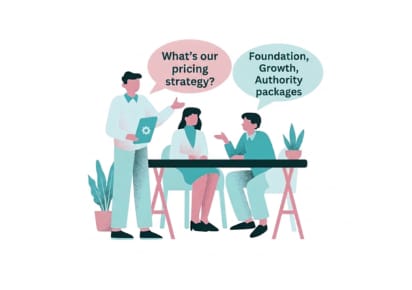
A typical three-tier structure for a scaling SEO agency might look like:
- Foundation tier ($800-1,200/month) - technical monitoring, monthly reporting, rank tracking, 2-4 links/month via white-label link building partner
- Growth tier ($1,500-2,500/month) - everything in Foundation plus content production (2-4 pieces/month), enhanced link building (4-8 links/month)
- Authority tier ($3,000-5,000/month) - full-service delivery including digital PR, content strategy, aggressive link acquisition
Defined this way, scope creep turns into a commercial conversation instead of a delivery fire drill. "Can you also do X?" becomes "that's in our Growth tier - here's what's included." Clear lines. No ambiguity. No unpaid work. No fulfillment team getting buried by asks that were never scoped.
Link Building at Scale: Why This Is the One Function You Shouldn't Try to Build In-House
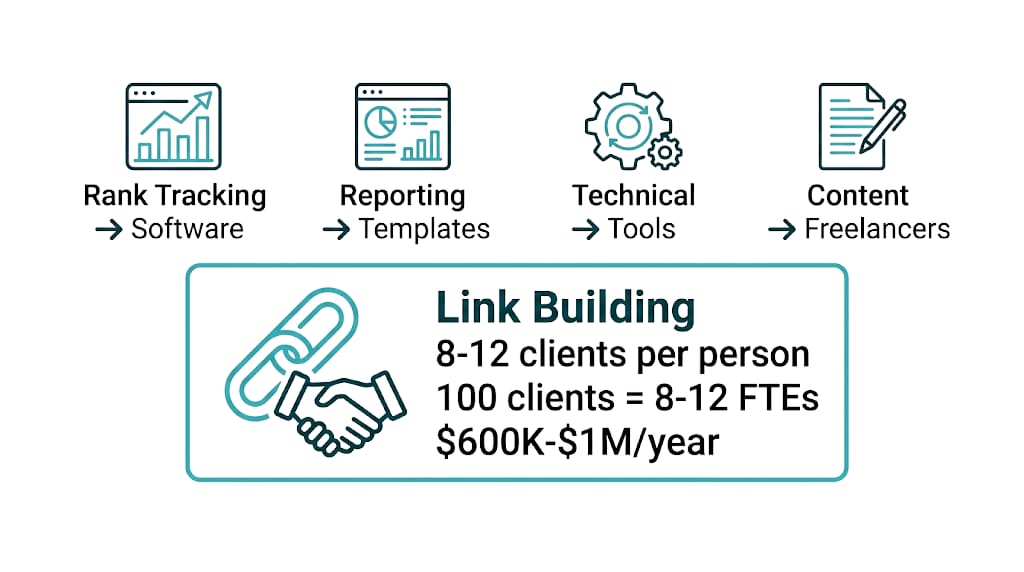
Link building is categorically different from every other SEO fulfillment function. Rank tracking scales with software. Reporting scales with templates. Technical SEO scales with monitoring tools. Content scales with freelancers and process. But link building - real link building, the kind that moves rankings in 2026 - depends on human relationships, editorial judgment, and ongoing outreach that you can't automate without creating the same spam patterns Google penalizes.
Google's guidelines on link schemes are unambiguous on this point. Their guidance on link spam calls out "large-scale article campaigns with keyword-rich anchor text" and "widely distributed links in the footers or templates of various sites" as violations. That leaves little room for interpretation. If you try to systematize link acquisition at volume through automation or low-quality content networks, you invite manual action. And once you hit 100 clients, the pressure to cut corners on link quality spikes - because the alternative is building an in-house outreach team that costs more than it saves.
The economics of in-house link building at scale are brutal.
A competent link building specialist can manage outreach for roughly 8-12 clients at a time without letting standards slip. At 100 clients, that means 8-12 people doing nothing but link building - plus salaries, management overhead, tool costs, and the quality variance that shows up in any large delivery team. For most mid-market agencies, you're looking at $600K-$1M in annual payroll for a single fulfillment function. And payroll is the easy part. Keeping output consistent across 8-12 individual operators is where most in-house models break.
The 2026 quality environment makes that harder. As we've covered in our white-label link building guide, the bar for what counts as a quality link has moved. Publishers that used to pass basic checks now get screened against stricter criteria: organic traffic floors (sites with little to no real traffic provide negligible value regardless of their Domain Authority), AI-generated content risks (sites built primarily on AI content are increasingly devalued), and topical relevance signals that go beyond simple niche matching.
Those stricter criteria are exactly where in-house teams start to slip at volume. People take the path of least resistance. And in 2026, that path runs straight into sites that look fine on surface metrics but fail the deeper checks that matter. You end up with a link profile that looks active but doesn't perform. Worse, you end up with patterns that attract a manual penalty.
White-label link building isn't a cost-cutting shortcut. For agencies serving 50+ clients, it's a structural requirement. A specialist partner already has publisher relationships, quality control, and editorial standards - and building that internally takes years and a lot of capital. They also carry the operational overhead of keeping standards intact across hundreds of placements per month. That overhead doesn't land on your team.
What to Look for in a White-Label Link Building Partner When You're Serving 100+ Clients
Not all white-label link building partners are built for agency scale. Some work fine for 10-20 clients, then fall apart on capacity, reporting, or consistency once you push to a 100-client roster. Choosing the wrong partner at that size doesn't just hurt one account. It hits your whole book of business.
Based on the six evaluation criteria we've established for white-label partner assessment, here's what a scaling agency should require:
- Transparent publisher vetting - They should show their quality criteria in plain terms: traffic thresholds, topical relevance rules, and how they screen for AI-content risk on publisher sites. If they can't walk through the process in detail, they're not safe at scale.
- Capacity to serve volume - A partner serving 5-10 agency clients runs a different operation than one serving 50+. Get a straight answer on current client volume and their capacity ceiling.
- White-label reporting that integrates with your stack - At 100 clients, manual reformatting isn't an option. You need clean, consistent reporting output that drops into your client-facing reports without extra work.
- Niche coverage breadth - A 100-client agency spans verticals. If a partner only has inventory in one or two niches, you'll feel it as delivery gaps.
- Clear turnaround SLAs - Timelines vary, but delivery windows should stay predictable so your account team can manage expectations and reporting cycles.
- A track record with agencies specifically - Consumer link services and agency white-label services aren't the same thing. Agency work requires confidentiality, pricing that holds at volume, and an understanding of how agency-client delivery actually runs.
Rhino Rank's managed service is built specifically for this use case - agencies running large client rosters that need consistent, quality-verified link acquisition without the operational overhead of an in-house team.
Reporting at Scale: How to Deliver 100 Client Reports Without 100 Hours of Work
Reporting breaks most agencies long before anyone says out loud that scaling has stalled. At 10 clients, spending 3-4 hours per month building a report reads like strong client service. At 50 clients, that turns into 150-200 hours a month - almost a full-time role spent pulling data and formatting PDFs. At 100 clients, manual reporting stops being an operating model.
The fix isn't reporting less. It's building reporting infrastructure that ships high-quality, insight-led reports at volume with minimal hands-on work.
A scalable reporting system has three layers. Start with data automation. Every source - GA4, Search Console, rank tracking, backlink monitoring - needs to feed into one dashboard tool on a schedule. Platforms like AgencyAnalytics, Looker Studio, or Search Atlas pull and visualize that data without a person touching it after setup. That setup work takes time. At 100 clients, it pays for itself in the first reporting cycle.
That dashboard layer only works if the output stays consistent, which is where template standardization comes in. Every client report should use the same core structure: organic traffic trends, keyword ranking movements, technical health status, and link acquisition progress. The template doesn't have to be one-size-fits-all. Tier-appropriate variants are fine. But within each tier, lock the structure so reviewers aren't reinventing the report every month. Do that, and one team member can review and annotate 8-10 reports per hour instead of building each report from scratch.
Template standardization also sets up the third layer: insight commentary at scale. This is the part that needs human judgment - the narrative that explains what changed, why it matters, and what happens next. But the narrative doesn't need to start as a blank page. Build a library of commentary templates for repeatable scenarios: ranking improvements in month 3, traffic dips after algorithm updates, technical issues resolved and the expected impact. Then the team selects and edits the right template instead of writing every note from zero.
Time is the test. A system built to this level cuts per-client reporting time from 3-6 hours to 30-45 minutes. Across 100 clients, that's the difference between a 400-hour monthly reporting burden and a 50-75 hour one - saving roughly 350 hours a month, or close to two full-time roles.
Report delivery cadence matters too. Monthly reports are standard. But spreading delivery dates across the month, instead of dumping everything on the 1st, distributes review work and prevents the end-of-month bottleneck that drags down high-volume teams.
Technical Audits and Rank Tracking: Replacing Manual Checks With Automated Monitoring
Technical SEO and rank tracking show the widest gap between manual work and automation - and they're the easiest areas to justify process change.
Manual rank checking at 100 clients isn't just inefficient - it doesn't scale. If each client tracks 50 keywords across desktop and mobile, that's 10,000 data points per week. Even with spreadsheet workflows, collecting, organising, and interpreting that volume eats a full team's week. And once it's compiled, parts of it are already stale.
Automated rank tracking removes the grind. Tools like Nightwatch, SERPWatcher, or AccuRanker run daily or weekly checks across unlimited keyword sets, flag meaningful movements, and surface what needs attention. Configuration time per client runs 20-30 minutes. After that, the tool runs on its own. With alerts and exception reports in place, one team member can monitor rank movement across 100 clients in 2-3 hours per week instead of pulling raw data.
The same operating model applies to technical SEO monitoring. Scheduled crawls in Screaming Frog, Sitebulb, or similar tools can run on a schedule and alert on new issues - broken links, crawl errors, Core Web Vitals regressions, missing meta data, new redirect chains. The operational shift is moving from periodic audit mode (a full audit each quarter) to continuous monitoring mode (alerts trigger investigation when something changes).
Continuous monitoring is the only workable option at 100 clients. A quarterly manual audit cycle across 100 clients means running 8-9 full audits every month - a heavy and mostly avoidable workload when tools can flag the same issues as they appear.
That shift changes staffing math. According to Nightwatch's agency scaling research, a well-configured automated monitoring setup lets a single technical SEO specialist oversee 40-60 client sites - compared to 8-12 sites under a manual audit model. That's a 5x capacity lift from process alone, before hiring anyone new.
One piece still stays human: prioritization and interpretation. Tools flag issues. They don't decide whether a crawl budget problem matters more than a schema error for a given client's goals. That strategic layer needs an experienced practitioner. But with monitoring doing the data collection, one strong technical SEO lead can apply that judgment across the full client portfolio.
The Hiring Decision: When to Add Headcount vs. When to Add Tools
One of the most expensive mistakes a scaling agency makes is defaulting to hiring when the real fix is tooling - or buying tools to avoid hiring when the work needs human judgment. Get it wrong either way and margin takes the hit.
Nightwatch research gives a clean benchmark: a well-run SEO agency should generate $150K-$250K in revenue per team member. If your revenue-per-headcount sits well below $150K, staffing efficiency is the problem. If you're clearing $250K, you're under-resourced and flirting with quality issues or churn.
Apply the same test across functions and the decision gets a lot simpler.
Hire when:
- The work needs strategic judgment that won't template well - senior account management, strategy work, client relationship ownership.
- Task volume has outgrown what tools can support without hands-on review.
- Quality swings drive churn, and the root cause is thin senior review coverage.
- You're opening a new service line that needs specialist depth you can't buy through outsourcing.
Add tools when:
- It's data collection, data cleanup, or formatting. Tools win.
- The work follows rules and repeats. Judgment isn't the bottleneck.
- You can ship 10x the output with a $200-500/month tool instead of a $4,000-6,000/month hire.
- Speed and throughput are the constraint, not quality.
Outsource when:
- Specialist skill, long ramp. Don't rebuild it in-house.
- Volume runs hot and cold, so a full-time seat won't stay full.
- The quality risk sits in execution, and a specialist partner controls it better than a generalist.
- The unit economics don't work in-house, even after tooling.
Link building sits in the "outsource" bucket. Reporting and rank tracking sit in the "tool" bucket. Strategic account management sits in the "hire" bucket.
Treating all three the same is where agencies bleed. Most teams either hire for everything and crush margin, or they try to buy their way out of work that still needs senior judgment.
A realistic headcount model for a 100-client agency, built on this framework, looks like this: 1-2 senior strategists, 2-3 account managers, 1-2 content leads managing a freelance writer network, 1 technical SEO specialist, 1 operations/reporting manager, and a white-label link building partner handling all link acquisition. That's 6-10 in-house roles, not the 15-25 a fully manual model demands.
The 100-Client Fulfillment Model: A Practical Operating Framework
That framework only matters if it holds up in delivery. For 100 clients, the operating model has to match real headcount, real tools, real outsourcing, and real cost math.
Here's the operating framework we'd recommend, grounded in the benchmarks and research cited throughout this article.
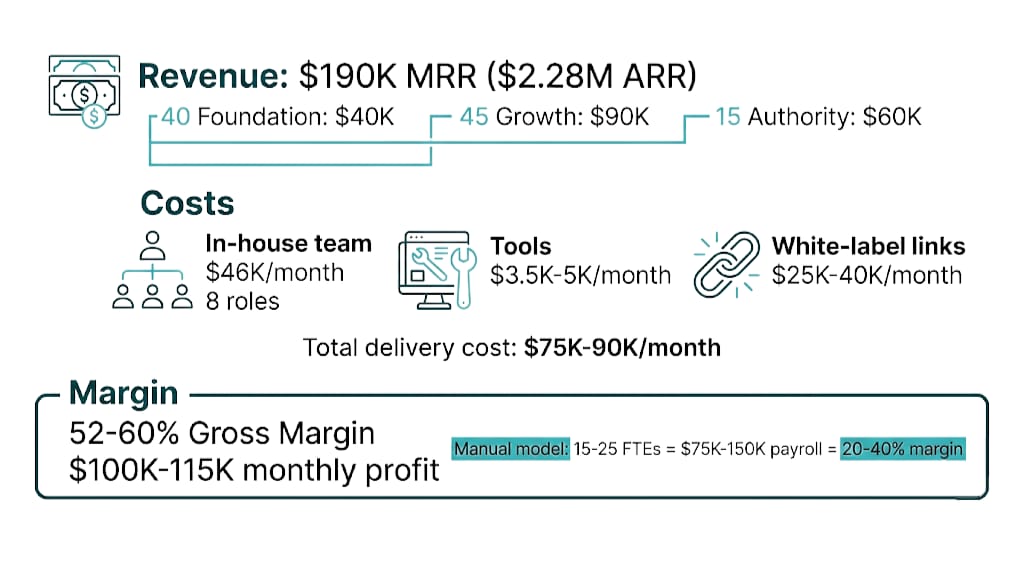
Revenue assumptions: 100 clients across three tiers. 40 Foundation clients at an average of $1,000 per month, 45 Growth clients at an average of $2,000 per month, and 15 Authority clients at an average of $4,000 per month. Total monthly recurring revenue: $40K + $90K + $60K = $190K MRR / $2.28M ARR.
In-house team (8 roles):
Role | Headcount | Client Coverage | Monthly Cost |
|---|---|---|---|
Head of Strategy / Client Lead | 1 | All accounts (oversight) | $8,000 |
Senior Account Manager | 2 | 50 clients each | $5,500 x2 |
Content Lead + Freelance Network | 1 lead + 4-6 freelancers | All content clients | $4,500 + $8,000 |
Technical SEO Specialist | 1 | All 100 sites | $5,000 |
Reporting / Ops Manager | 1 | All 100 clients | $4,500 |
New Business / Growth | 1 | Pipeline management | $5,000 |
Total in-house payroll: approximately $46,000/month.
That payroll number only works if the tool stack carries its share of the load.
Tools stack ($3,500-5,000/month total):
- Rank tracking platform - Nightwatch or equivalent: $500-800/month at agency scale
- Reporting automation - AgencyAnalytics or Looker Studio Pro: $400-600/month
- Crawl monitoring - Screaming Frog + Sitebulb: $300-400/month
- Project management - ClickUp or Asana: $200-300/month
- Keyword research and competitive intel - Ahrefs or Semrush: $400-500/month
- Client communication and CRM: $200-400/month
White-label link building: Variable by tier. Estimated $25,000-40,000/month at volume pricing across all clients requiring link acquisition. This is the single largest variable cost. But it replaces what would otherwise be an 8-10 person in-house outreach team costing $55,000-70,000/month in payroll alone. For a closer look at how those costs break down, our link building cost guide covers typical pricing across different service tiers and delivery models.
Total delivery cost: approximately $75,000-90,000/month.
Gross margin: $190K MRR minus $75-90K delivery cost = $100-115K gross profit monthly, representing a 52-60% gross margin. That's a sustainable agency business.
That margin falls apart under a fully manual model. Without automation and white-label outsourcing, serving 100 clients manually takes 15-25 full-time employees at the delivery level. At an average fully-loaded cost of $5,000-6,000/month per employee, that's $75,000-150,000/month in payroll alone - before tools, management overhead, or office costs. Gross margin drops to 20-40% at best, and it usually slides toward zero once the team starts missing QA and deadlines.
The operational rhythm that holds this model together is a weekly delivery cycle:
- Monday: Automated rank reports get reviewed by account managers. Exceptions get flagged for client comms.
- Tuesday-Wednesday: Content moves through production and review via the content lead and the freelancer network.
- Thursday: Technical monitoring alerts get triaged by the technical specialist; fixes get briefed to clients or implemented directly.
- Friday: Link building updates come in from the white-label partner, then get logged into client records; weekly ops review runs with the reporting manager.
Monthly, that same rhythm expands into report assembly across days 1-5, client calls spread across weeks 2-3, and strategy reviews for Authority-tier clients in week 4.
This isn't a theoretical model. It's the operating structure that the data from SEOJuice, Nightwatch, and our own experience with agency clients points to. Agencies that run it don't just survive at 100 clients - they scale to 150 or 200 without rebuilding delivery, because the system is already designed for volume.
Resisting drift is the discipline. Every exception - a custom report format for one client, a bespoke link strategy for another, a one-off technical project outside the tier structure - adds friction that compounds across the portfolio. The model works because it's consistent. Protect it.
Frequently Asked Questions About Scaling SEO Fulfillment
How many SEO clients can one person realistically manage?
A solo SEO practitioner running manual workflows hits a ceiling at around 8-12 clients before quality drops.
With the right stack - automated rank tracking, templated reporting, and white-label link building - one experienced account manager can oversee 40-50 clients. At that volume, they aren't doing the work. They're running delivery, keeping tickets moving, and handling client comms while production happens elsewhere.
The SEOJuice data puts the unassisted ceiling at 4 hours per client per week. That lands at roughly 10 clients in a standard 40-hour week, and that assumes zero buffer for communication or strategy.
What is the difference between growing and scaling an SEO agency?
Growth means you add clients and add headcount in lockstep - revenue goes up, but margin stays flat or gets squeezed.
Scaling means you add clients without adding headcount at the same rate - revenue outpaces costs because the delivery system absorbs volume.
Most agencies grow. Few scale.
That gap comes down to architecture. Scaled agencies build SOPs, automation, and outsourced fulfillment before the team hits the ceiling, not after everything starts slipping.
How do you manage link building for 100+ clients without a large in-house team?
White-label link building partnerships are the standard answer at this size.
A specialist partner already has publisher relationships, editorial standards, and outreach ops - the same setup you'd need an 8-12 person in-house team to match. Rebuilding that internally costs time, burns management bandwidth, and still leaves you exposed to quality swings while you ramp.
Partner selection is the whole ballgame. You need someone built for agency volume - clear quality criteria, broad niche coverage, and reporting that drops into your client deliverables without extra cleanup.
At 100 clients, the math on in-house link building breaks. The cost of holding quality at volume ends up higher than white-label outsourcing by a significant margin.
What SEO fulfillment tasks can be automated and which require human judgment?
Rank tracking, data collection, report assembly, crawl monitoring, and alert-based technical flagging are automatable - tools can cover 70-90% of the workload once setup is done.
Content production, strategic account management, client relationship ownership, and link quality judgment still need humans. Automate those and quality takes the hit.
Link building sits in the middle. You can outsource execution, but you can't automate it, because quality acquisition runs on relationships and editorial gates - exactly the kind of friction Google's spam policies aim to protect.
When should an SEO agency hire more staff versus invest in better tools?
Hire when the bottleneck is judgment, relationships, or strategic capacity - work that needs experienced people.
Buy tools when the bottleneck is data volume, repeatable tasks, or reporting throughput.
The Nightwatch benchmark of $150K-$250K revenue per team member works as a clean gut check. Below $150K and you're likely over-staffed for your systems. Above $250K and you're probably under-tooled, and the team is chewing through manual tasks until burnout shows up.
That 50-100 client range is where most agencies get this backwards. They need more tools and stronger outsourcing before they need more headcount.
related Blog Posts



Join 2,600+ Businesses Growing with Rhino Rank
Sign Up
Stay ahead of the SEO curve
Get the latest link building strategies, SEO tips and industry insights delivered straight to your inbox.