
 Back to all posts

Rhino Rank is the best place to buy backlinks in 2026 for most buyers. Every guest post we sell is priced by the authority tier of the site it runs on and delivered as a dofollow link inside a 750+ word editorial article, with the purchase terms published before you pay.
The right alternative depends on what you are actually buying. Stellar SEO fits regulated and YMYL campaigns that need published vetting filters. Stan Ventures is the pick when you want the publisher fee and the service margin separated. Editorial.Link is built for a premium test order where you approve every prospect first. WhitePress suits experienced buyers who want to choose each publisher themselves. The HOTH makes sense for teams consolidating wider SEO fulfilment in one platform. Page One Power is the enterprise answer when you want a managed outreach partner rather than a per-link shop.
The rankings come first, then the buying guidance: what to check on a paid placement, how to read a price, and how to evaluate any provider that did not make this list.
How we ranked these providers
The seven providers below do not sell one product. Five sell defined placements at published per-link prices, WhitePress is a self-serve marketplace, and Page One Power sells managed outreach behind a sales call. A $37 Stan Ventures guest post, a $375 Editorial.Link placement and a Page One Power programme are not three prices for the same thing, so the buying models come before the numbers.
We assess each provider on six checks, in plain terms:
- Placement-site authority and traffic. What tier of site does your link land on, and is there a real organic-traffic requirement rather than a metric number alone?
- Genuine outreach. Are placements won through manual outreach to independent publishers, with an explicit no-PBN, no-link-farm position, or is inventory resold?
- Ranking impact evidence. Are there named case studies with before-and-after traffic or ranking outcomes, and who reported them?
- Link and placement standards. Is the link dofollow, inside the body copy, in a real editorial article or an indexed page?
- Pricing transparency. Do you know the per-link cost before a sales call, and is it tied to a named placement tier?
- Guarantees and independent trust. What happens in writing if a link disappears, and what do independent buyers report on third-party platforms?
Everything behind the ranking is one of three kinds: public evidence you can check directly (pricing pages, review platforms, dated studies), a claim published on the provider's own site and attributed to it, or our judgement. Case-study outcomes are vendor-reported throughout, not independent proof. A provider's own homepage authority never counts, because the placement site's metrics are the product being sold.
We run vetting and delivery ourselves, so we weight what you can inspect before you pay over anything promised on a call: published prices, traffic floors, link standards, written guarantees and an independent review record. Some of the six checks are lookups; the rest take a reading, and that reading is ours, so you get an order with reasons rather than a number. For most buyers we would take the fully specified product over a lower-priced or more flexible one, and the ranking reflects that. If you need to approve every domain before anything goes live, you would reasonably put Stan Ventures or Editorial.Link first; that control is what you are buying instead.
(empty: delete)## Quick comparison
Provider | Best for | Published pricing |
|---|---|---|
Rhino Rank | DA-tiered editorial placements | Guest posts $75-$400 by DA tier |
Stellar SEO | Regulated and YMYL campaigns | Guest posts $297-$600; niche edits $225 |
Stan Ventures | Transparent-margin tiered buying | Guest posts $37-$247 by authority and traffic |
Editorial.Link | Premium test orders with pre-approval | $375 base rate; five links for $1,750 |
WhitePress | Experienced self-serve buyers | Pay-as-you-go per listing |
The HOTH | One-platform SEO fulfilment | Outreach $175-$405; managed from $1,000/month |
Page One Power | Enterprise managed outreach | Quote-led; no public rate card |
1. Rhino Rank - best for DA-tiered editorial placements
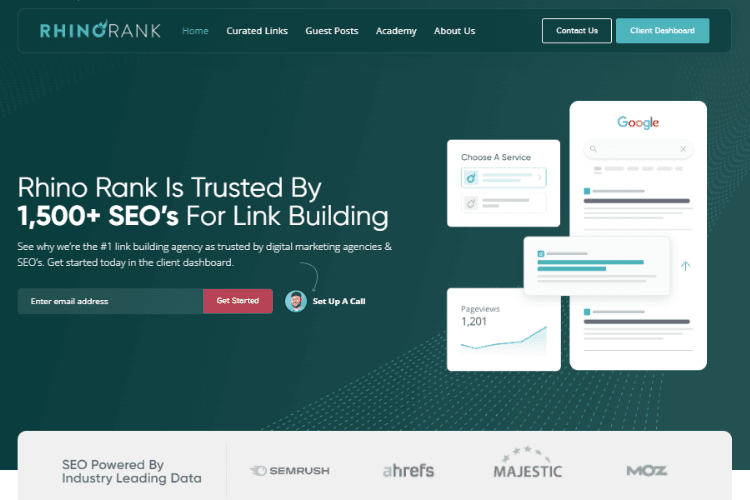
Rhino Rank takes first place because the product is specified before you pay. We price every guest post by the Moz DA tier of the site it runs on: from $75 for DA10+ sites up to $400 for DA60+ placements, with the DA30+ tier at $130. Each order is a 750+ word editorial article carrying one contextual dofollow link in the body copy. The DA30+ tier shows a delivery target of seven to fourteen days.
The sourcing model is the part we are accountable for, so here it is plainly. Each article is published on a real, independently owned website in your niche. We reject PBN and link farm inventory outright, and we weigh indexed pages, organic traffic and its trend, Moz DA, Ahrefs DR, referring domains and the strength of the link profile together before a site is used. What we do not publish is a numeric traffic floor. That is a real gap, and if you want a written traffic minimum, Stellar SEO and Stan Ventures both publish one. We build more than 120,000 links a year for 7,000+ clients.
You can inspect the ranking evidence for yourself. Our fintech case study reports a 374% increase in organic traffic over twelve months on a $3,600/month campaign, alongside a 65% revenue lift. Our corporate law firm case study reports a 1,043% traffic increase and 560% more page-one keywords in six months on a $5,500/month campaign. These are our own reported outcomes, so read them the way you should read every vendor's case studies.
Purchase terms are written down rather than promised on a call: a 12-month replacement guarantee on every placement, a no-questions-asked money-back guarantee on your first order up to $550, and an independent review profile of 4.9/5 from 171 reviews on Reviews.io.
Control over exact domains is available on request: we can pre-approve publishers for your orders, but contact us first so we can facilitate it. Otherwise you receive the final URLs after placement, vetted against the standards above. If you want guest posts built as new editorial articles, or curated links placed into existing published content from $60 per link, that is the model. If you would rather approve every domain through a self-serve portal without contacting us first, Stan Ventures or Editorial.Link below will fit you better. We are also the wrong choice if you want guaranteed rankings, pocket-money bulk links, brand PR or a full-service SEO retainer. We build placements; we do not run your strategy.
2. Stellar SEO - best for regulated and YMYL campaigns
Legal, finance and health campaigns raise the bar on what a vendor must show up front. A promise of high authority is not enough in those markets; you need published filters, a traffic floor and case studies that resemble the work you are buying. Stellar SEO publishes all three, which is why it sits second.
The guest-post service sells three tiers: DA 30+ at $297, DA 40+ at $397 and DA 50+ at $600 per link. Every tier carries a 1,000+/month Ahrefs organic-traffic floor, a 27-point quality check, a dofollow link and 750+ words of content. Niche edits into already-indexed pages cost $225 per link, and managed campaigns run $2,500/month for eight links or $5,000/month for sixteen.
One thing to check before ordering: the page hero says DR 30+ minimum while the pricing cards say DA 30+. Confirm which metric floor applies to your order rather than assuming they match.
Stellar builds placements through manual outreach and direct editor relationships, positioning itself against automated lists, resold inventory and link farms. It reports more than 25,000 editorial backlinks built across 100+ industries.
Purchase terms are now as public as the product. Stellar publishes a six-month replacement guarantee if a placement drops and a full refund or replacement if a delivered link misses the DA you ordered. On 28 August 2026 it also published a 45-day delivery money-back guarantee covering any links it failed to place; its pages on 4 October 2026 describe a satisfaction guarantee of your money back or a new link free of charge, with no day count. Its Clutch profile carries 18 reviews with a $10,000+ minimum project size: a smaller independent review base than the top entry, but the paperwork is no longer the weak point.
The case studies fit the lane. A nursing-home injury law firm grew from 6,900 to 34,700 monthly organic visitors over 14 months, and a hard-money lender went from 800 to more than 10,000 over 29 months. Both figures come from Stellar's own case-study pages. Delivery runs about 30 days, and its guest-post tiers sit at the upper end of the per-link prices published on this list. Stellar earns it when the niche punishes sloppy vetting and the standards matter more than the unit cost.
3. Stan Ventures - best for transparent-margin, metric-tiered buying
Stan Ventures publishes the cheapest legitimate entry point here: guest-post placements from $37 per link. The rate card itself is the story. DA/DR 30+ sites with 100+ monthly organic visitors cost $37; the same authority tier with 500+ visitors costs $107; DA/DR 40+ runs $67 or $207 depending on the traffic band; DA/DR 50+ with 1,000+ visitors costs $247. Price is keyed to authority and traffic together, which is how tiered pricing should work, and Semrush and Ahrefs metric families are published alongside the same card. These are the prices its rate card showed on 28 August 2026.
Margin visibility is the second distinguishing feature. Stan operates what it calls a brokerage model: you see the real publisher cost plus a flat service fee, rather than a bundled price you cannot inspect. For an agency reselling links, that makes the markup conversation with clients straightforward. Bulk discounts, grey-niche pricing for gambling, crypto and CBD, and bespoke quotes all sit alongside the public card rather than replacing it.
Fulfilment is white-label at scale. The company reports 120+ in-house outreach specialists and thousands of placements per month, built through 100% manual outreach with a no-PBN, no-fake-metrics position. You approve every domain before a word is written, which is the strongest pre-purchase control on offer here.
Links are sold as permanent and do-follow, placed contextually rather than in footers or sidebars. Niche edits are a separate product at $150 or $300 per link depending on topical relevance, both tiers carrying a minimum DA/DR 30 and 1,000+ monthly organic traffic. Blogger outreach, a third line, starts from $180 all-inclusive. The case-study library includes named legal campaigns with specific before-and-after traffic outcomes, published on Stan's own site.
The 12-month replacement guarantee comes with a condition: an active link plan within the previous 60 days, so it protects ongoing campaigns better than one-off orders. The Trustpilot profile has eased to 4.5/5 from 54 reviews, a thinner independent base than the price and control mechanisms deserve. Margin clarity and resale room are the reasons to buy here; a fully managed experience is not what you are paying for.
4. Editorial.Link - best for premium test orders with pre-approval
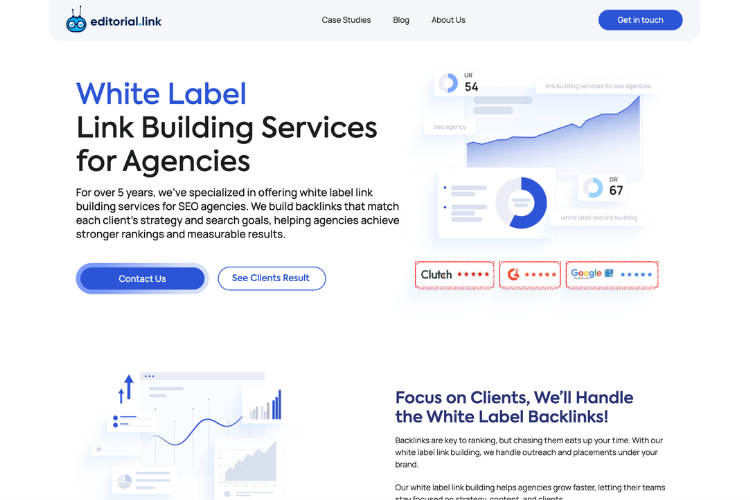
Editorial.Link is built around a buying sequence none of the cheaper entries offer. You approve every prospect before anything is built, you get a trial link before signing a contract, and you pay only after approval. For a buyer who wants to test one premium placement before committing to a programme, that sequence lets you see the prospect, the trial link and the approval step first.
Pricing is public and simple. The base rate is $375 per backlink, falling to $350 each in a five-link package at $1,750 and $300 each at twenty links for $6,000. Premium placements on top-tier sites start at $550 per backlink. You can order as few as one link per month, and the first links arrive within seven days of approval. Every link is permanent, dofollow and editorial.
One claim needs precision here: there is no universal DR floor. Placements average DR 67, with packages published at average DR 50-90 and a 5,000+ traffic requirement. An average is not a floor, and individual placements can sit below it, so approve prospects on their own metrics rather than trusting the headline number.
Editorial.Link sources placements through a partner network and search results, and says it rejects any site that sells links, screened through its own classifier tool: no PBNs, no link farms, no directories. Its case studies are named and numeric. Intellias grew 585%, from 7,000 to 48,000 monthly visitors over 55 months on 500+ links; Belkins grew 121% over 12 months on 59 links. Both are the vendor's own figures, but named clients with before-and-after numbers are the right kind of evidence for this purchase.
If a link disappears, a six-month replacement guarantee covers it. The independent review base was an 80-review Clutch profile when checked on 28 August 2026. When a bad placement would cost you more than a dear one, this is the order to place.
5. WhitePress - best for experienced self-serve buyers
WhitePress is not an outreach vendor, and judging it as one misses the point. It is a marketplace: 148,000+ websites and 382,000+ offers across 36 languages, on a pay-as-you-go model. The judgement call the other providers make for you, which sites are worth your money, is yours here.
Its tooling supports that responsibility. More than 50 filters, per-listing metrics and a portal quality score built from Ahrefs and Semrush data let you sort inventory by authority, traffic, topic, dofollow status and price. Link insertions into already indexed pages, in WhitePress's words, form a distinct catalogue of 165,000+ offers with publication in about 72 hours.
Experienced buyers who can read a site's metrics, content and outbound-link pattern themselves will get the most from this catalogue. If that is not you, the money you save on service fees will go on links a vetter would have rejected.
The weak axis is proof. WhitePress publishes case studies, but they report placements secured and audience reach rather than ranking or traffic movement. The platform can show you exactly what a listing is; it cannot show you what links like it have done for buyers. That is the trade you make with any marketplace, and it is why WhitePress sits below the outreach vendors despite strong tooling.
One published term beats the rest of the list: a 36-month visibility guarantee with daily monitoring, the longest survival window of the seven by a distance. Trustpilot shows 4.7/5 from 84 reviews.
6. The HOTH - best for one-platform SEO fulfilment

The HOTH belongs here for a different reason than it used to. Its managed programme, HOTH X, now starts at $1,000/month, with published tiers at $2,500, $5,000 and $10,000, so this is no longer a high-spend-only option. The real lane is consolidation: one vendor for link building, press releases, content syndication and digital PR.
Its link products are tiered and public. Link Outreach runs from $175 for DA/DR 20+ placements up to $405 for DA/DR 50+, with 500-2,000 word count options. Link Insertions into existing articles cost $200 on DR 20+ sites, $250 on DR 45+ and $450 on DR 60+, with a turnaround of roughly 30 days. Platinum Links sell DR 50+ editorial placements at $375. Around those sit press releases at $150, content syndication at $99, exclusive media links at $450, earned media at $3,500 per campaign and a digital PR tier at $1,500/month.
On outreach the language is strong: 100% manual, real sites owned by real webmasters, no PBNs. Two gaps hold it back. Placement-site vetting is described as high authority, real traffic and niche relevance, but no numeric floor is published, and no universal dofollow guarantee covers the catalogue; the digital PR tier states roughly 60% do-follow, which tells you the rest vary by product.
The case studies are big and specific: KICKS CREW at +754% monthly organic traffic over 12 months on 900+ links, BloqUV at +258% with 220 links, and an unnamed client at +988% in six months with 2,000 keyword rankings earned. All are HOTH's own reported figures, and its pages describe the same BloqUV campaign differently in places, so read them as marketing rather than measurement.
The HOTH earns its place when link buying is one line in a wider fulfilment order. The thing to plan for is bulk: on a big order, placement quality shows only once the reports land, so check the sample placements before you commit volume. The independent review evidence is also thinner than we would like when you are consolidating serious monthly spend with one supplier.
7. Page One Power - best for enterprise managed outreach

Page One Power is the hardest of the seven to assess, because almost nothing a self-serve buyer needs is public. There is no rate card, no DA/DR floor, no traffic minimum, no dofollow statement, no public replacement or refund terms and no explicit no-PBN line; the pricing page returns a 404. Buying means a discovery call, a custom proposal and a contract.
Behind that gate sits a genuine enterprise operation. The company has specialised in manual link building since 2010, reports building over 15,000 links a year with a US-based team of more than 50 writers and researchers, and names Hyatt, Healthline and QuickBooks among its clients. Every link is described as handcrafted by a real link builder through real relationships, with editorial placements and contextual links inside existing publisher content.
The case studies are excellent, the best evidence-to-opacity ratio here. Fiscal Tiger gained a 498% increase in organic traffic with 600 links acquired over 12 months. Atera saw a 306% increase in monthly organic sessions from 29 links in six months. Both are the company's own figures, and both are specific enough to interrogate on a call.
The entry splits cleanly by buyer. An enterprise team purchasing a managed authority programme will get its questions answered in the sales process, and the delivery record justifies the conversation. A buyer comparing per-link products cannot assess what they cannot see, and a vendor that publishes nothing measurable until you talk to sales will always trail six providers that do. The Clutch profile carries 17 reviews, which is a thin independent base for a vendor this hard to read. We would put placement floors, replacement terms and expected monthly volume into the contract itself rather than leaving them as call language.
Should you buy backlinks?

Yes, buy backlinks when the placement is on a relevant publisher, on a real editorial page, with a link a reader would find useful. Paid placements are a controlled way to close an authority gap: you choose the target page and the anchor. The evidence that links still carry weight is recent. Zyppy's Google Ranking Factors Expert Survey, dated 9 September 2026, drew on 131 SEOs. It puts it this way: "The rumor of the death of backlinks has been greatly exaggerated." The same survey adds: "Many experts emphasize the importance of links from pages with real visitors." That second line is the standard the rest of this guide applies. A placement on a page with no readers is worth very little, which is why we refuse PBN and link farm inventory.
What to check on a paid placement
The first check runs before a site is used. We weigh indexed pages, organic traffic and its trend, Moz DA, Ahrefs DR, referring domains and the strength of the link profile together, and we turn away sites whose metrics look impressive but whose traffic does not hold up.
The second check runs after publication. The page must be live, the link must sit in the body copy, the anchor text and target URL must match the order and the page must be indexable; only then is the URL reported to the dashboard. Every delivered link carries 12-month replacement cover. The full standard is published on our link building quality assurance page.
One large dated sample shows what a placement can do to a page. Search Atlas's study of backlink placements, published 14 August 2025 and updated 26 January 2026, says: "Researchers analyzed 350,159 backlink placements across 13,002 unique landing pages." It also reports: "Before backlink placement, pages averaged position 32.3 in Google Search results. After placement, that improved to 28.8, representing a 10.8% lift." The study does not say which placements were paid, and it is one vendor's sample. Most providers here sell placements as dofollow; Stellar SEO advertises "No Sponsored Tags" as a product feature, and Stan Ventures states that it negotiates do-follow attributes. The ranking above leans on publisher traffic and placement standards because those are what make a placement worth paying for.
When buying makes sense, and when it does not
Buying makes sense when your site already has pages worth ranking, the target SERP is competitive and you need controlled authority support rather than more content. It also fits when delivery timing matters, because a paid placement lets you choose the page and the anchor.
The good use case is narrow. Buy links to close a specific authority gap, to support a page that already deserves visibility, or to test whether better publisher mentions move a page sitting at ranking distance. Do not buy links to prop up thin pages or to paper over weak product, content or technical work. Backlinks send people to the page you have, not the page you meant to build.
Buying makes less sense when what you need is press coverage or a brand story; that is a digital PR job, where a journalist decides the anchor and the target. With a paid placement, your control runs through the provider's written terms, so put publisher approval, where it is offered, and the replacement term in writing.
Earned links still need a place
A strong link profile draws on more than one source. Paid placements add control over page, anchor and timing; earned links add citations you did not have to arrange.
The practical alternatives are well known: publish assets people can cite, run digital PR around data or expert commentary, contribute guest content where editorial standards are real, build relationships with niche publishers and improve pages that already attract references. None gives you the say over page and anchor that a paid order does, and each widens the mix of sites, link types and anchors pointing at you.
Earn what you can, and buy where control matters. The two work on the same pages for the same goal.
Monitor every paid placement
A paid backlink is not finished when the report arrives. Keep a placement log covering the publisher URL, target page, anchor, rel attribute, placement date, provider and status. Open every URL yourself. Confirm the link is live, that it sits in the article body, that the anchor matches what you ordered and that the surrounding copy reads like a real editorial reference.
Then watch the publisher. Sites change hands and change standards, so look at the publisher again before you reorder. If the page is removed, the link flips to nofollow, the article is rewritten badly or the publisher loses its organic traffic, use the provider's replacement policy.
Your own profile needs watching too. Search Console, Ahrefs and Semrush will surface lost links, new anchors and unusual referring-domain patterns. The point is to check the first orders and scale only once they have passed inspection.
How to evaluate a backlink provider before you buy
When you decide where to buy quality backlinks, most mistakes are made before the order, not after it. Four checks catch them, and they work on any vendor, on this list or off it.
Check the publisher, not just the metric
Domain Rating is the first number every link seller shows you because it is simple and it photographs well. On its own it tells you very little about how much link equity a placement will pass. A DR 50 site that has lost 70% of its organic traffic needs a closer look: the authority metric alone cannot tell you the cause or the site's current search visibility. Daniel Stanica wrote on 26 August 2026 that he "spent over $5,000 ordering backlinks from 13 different service providers". He puts it this way: "A DA 80 site with 200 monthly visitors is a worse buy than a DA 35 site pulling 50,000."
We see the gap between the two metrics every day in our own DA/DR checker. In its July 2026 sample of 29,632 checks covering 15,357 unique domains, DR ran higher than DA on 42.1% of domains, 12.5% had a DR at least 20 points above DA, and 2.1% paired DR 50+ with a DA below 25. Average DA was 27.9 against an average DR of 28.6. One metric is a filter, never a decision.
Organic traffic trend is the metric that matters. Ask for the publisher's Ahrefs or Semrush profile for the past 12 months. Stable or rising traffic shows the site still earns search visibility. A sharp drop deserves a question: it may reflect a migration, a technical failure or seasonality, and any of those makes the publisher's current search visibility worth checking before you spend.
The content gives it away faster than any metric. Open five to ten recent articles. If the writing serves a real audience, fine. If every other post drops a commercial dofollow link to an unrelated money page, you are looking at a link farm with better CSS.
Link-farm behaviour shows in patterns rather than one-off issues: a content library full of commercial links to unrelated money pages, no social presence, identical templates across multiple domains, traffic that is entirely referral rather than organic, and author bios that lead nowhere.
Diversify your anchor text
Buying ten links with the same exact-match anchor gives every new referring domain the same commercial phrase. If every new link pointing at your homepage reads "best SEO agency", the anchors stop reading like editorial choices.
A working distribution for a purchased-link campaign: 30-40% branded anchors, 20-30% partial-match variations, 15-20% generic phrases and 10-15% naked URLs. Treat those ranges as working judgement, not a fixed rule. The ratios matter less than the principle: vary the anchors.
Start before you order. Pull your current anchor distribution from Ahrefs and share it with the provider, so new anchors map around what already exists. Ask the provider how anchors are set and who approves them; a service that pushes exact-match anchors by default is not doing that work.
Verify dofollow status and link placement
Not every placement is the same product. Our own standard is a dofollow link in the body copy of a relevant article. Before you buy, confirm three things in writing: the link is dofollow, it sits in the body content, and the surrounding copy is topically relevant to your target page.
Author-bio placements are easier to secure and scale, which is why some vendors default to them. A bio link carries less editorial context than a reference inside a relevant paragraph.
Start small and measure
If you have never bought links before, do not open with a 50-link order. Place three to five placements with one provider, give it one to three months and track the target pages in Search Console. In Editorial.Link's survey of 518 SEO professionals, dated 25 March 2026, 57.1% said they expect to see link building results within one to three months and 33.0% within three to six months. Those are expectations, not measurements.
That window is your QA pass. Open each placement URL and confirm the link is live, dofollow and in the body. Pull the publisher up in Ahrefs and check for real organic traffic rather than a DR number doing all the talking. If the site is thin, traffic is near zero or the article exists only to host your link, flag it and use the replacement terms.
Once quality clears and you see movement, scale in steps. A steady monthly order is easier to inspect and adjust than a one-time bulk buy; how pace is charted is covered in our guide to link velocity.
Compare the product, not the price
Published prices here run from Stan Ventures' $37 guest post to Stellar SEO's $600 DA 50+ placement, and both ends publish what goes into the price. Stan's $37 tier is DA/DR 30+ with 100+ monthly organic visitors; Stellar's $600 tier carries a 1,000+/month traffic floor, a 27-point quality check and 750+ words of content. The gap between them is specification: what the price buys in writing.
A higher price still does not prove placement quality. Editorial.Link's $375 base rate pays for a buying sequence: prospect approval, a trial link, payment after approval. That is control over what you buy, not a promised outcome. Page One Power publishes no rate card at all, so even the price conversation happens behind a sales call. What a published price really tells you is how much of the product the vendor is willing to specify before you pay.
Some of the lowest-priced listings on the market are a different product: the inventory we refuse, such as recycled PBN pages, abused expired domains and thin guest-post blogs with manipulated metrics. A price that only works because nobody found a real publisher tells you what was left out.
So compare the product, not the price tag. The decision to buy backlinks comes down to five checks: the site, the traffic, the link format, the guarantee and the evidence that similar placements have moved rankings before. A vendor that publishes all five lets you judge what you are buying; a vendor that publishes only a price asks you to guess.
Types of links worth buying
Niche edits (link insertions)
A niche edit adds your link to an existing article that already has authority, rankings and backlinks of its own. The host page is already published and already has readers, so there is no new article to commission. Curated links also cost less than guest posts, because you are not paying for a new article.
Best for speed, cost and placements that sit inside articles readers already visit. If a relevant article already sits on a strong publisher, the edit is usually the smarter buy.
Guest posts
A guest post publishes a new article on the publisher's site with your link in the body copy. You control the surrounding content, the framing and the topic, which makes it the better vehicle when the link needs to live inside a piece built around your target keyword.
The trade-off is time and money. Content has to be written, reviewed and published, so guest posts cost more and deliver more slowly than edits.
Digital PR placements
Digital PR earns links through newsworthy material: original research, data studies, expert commentary. The publishers are news and trade titles, and you give up control over anchor, target URL and timing. A journalist who cites your study links how they want, to the page they think fits.
Treat it as the authority layer of a diversified link building strategy, not the only channel. It is unpredictable, so it should support the controllable tactics rather than replace them.
What a backlink provider should show you before you buy

Not every service that sells backlinks deserves your budget. A provider worth ordering from shows you five things:
- The publisher sites, before or after placement. Legitimate providers show their inventory or confirm final URLs.
- A price that accounts for a real publisher and a written article. A listing for supposed high-authority dofollow links at pocket-money prices should tell you which sites it uses.
- Different publishers, not one template. Same design, same hosting and same anonymous author pages across several domains mean one owner.
- A written replacement or refund policy, settled before you pay.
- No guaranteed rankings. Links are one input among many, and we do not guarantee positions either.
Reviewing links you already have? Our guide to managing your backlinks covers that.
Frequently asked questions
Is buying backlinks against Google's guidelines?
Google publishes its own guidelines for site owners, and we do not paraphrase them here. What we can speak to is what we control: the quality of the publisher.
What decides whether a bought link is worth having is the page it sits on, not the fact that it was paid for: a real site with organic traffic, a relevant article, a link in the body copy, and a replacement term in writing. That is what we check before and after every placement, with PBN and link farm inventory refused outright, and it is what the six checks in this guide measure for every provider.
How much do backlinks cost?
Across this shortlist, published per-link prices run from Stan Ventures' $37 entry tier up to Stellar SEO's $600 DA 50+ guest post. Rhino Rank's guest posts run $75-$400 by DA tier, and Editorial.Link's premium placements start at $550. Page One Power publishes no rate card at all; its pricing sheet sits behind a form. Outside this shortlist, Reporter Outreach's survey of 500 SEO professionals, published March 2026, reports "76% of SEOs pay $300+ per link."
When a listing offers high-authority dofollow links at pocket-money prices, ask what the price includes: the outreach, the writing and the publisher's fee.
How many backlinks do I need per month?
There is no universal number. The right pace depends on your existing profile, the target SERP and how far the page sits from ranking distance. The working rule is to scale after proof: place a small batch, check indexing, placement quality and early Search Console movement, then increase in steps. Steady orders are easier to inspect than bursts.
What is the difference between niche edits and guest posts?
A niche edit places your link into an existing article; a guest post creates a new article around it. An existing page is already published, so nothing new has to be written, while new articles give you control over the surrounding copy and topical frame. Most serious campaigns run both, including curated links for speed and editorial articles for topic coverage.
Do backlinks still matter for AI search visibility?
The dated evidence points the same way as it does for search. SE Ranking's study of ChatGPT citations, dated 24 November 2025, covered "129,000 unique domains and 216,524 pages across 20 niches". It found: "Sites with over 32K referring domains are 3.5x more likely to be cited by ChatGPT than those with up to 200 referring domains." That is a correlation between referring-domain counts and citations, not a test of any one link. The test we apply is the same as for search: a placement should make editorial sense to a person reading the page.
Should I buy backlinks or build them organically?
Use both. Earned links from digital PR, research and useful content widen the set of sites that cite you. Paid placements let you choose the page and the anchor when competitive pages need targeted support. Earn where you can and buy where control matters; in both cases the link should sit on a page with readers, where it serves the article.
Final verdict
Rhino Rank wins on product completeness: DA-tiered pricing from $75 to $400, manual outreach, a 750+ word editorial article with a contextual dofollow link, a 12-month replacement guarantee, a first-order refund up to $550 and 4.9/5 from 171 independent reviews.
Stellar SEO is the pick for regulated niches where published filters matter most. Stan Ventures wins on margin transparency and tier economics. Editorial.Link owns the premium test order with pre-approval. WhitePress is the self-serve marketplace for buyers who can vet publishers themselves. The HOTH fits teams consolidating wider fulfilment in one platform. Page One Power remains the enterprise managed option, but its public product detail is too thin to rank it higher for this query.
The pattern that matters is boring: real publishers with real traffic, in-content dofollow placement, written guarantees and evidence that the links move rankings. Buy the product you can inspect.
For agency delivery, our guest posts fit when you need new editorial articles with controlled topical framing.
related Blog Posts




Join 7,000+ Clients Growing with Rhino Rank
Sign Up

Stay ahead of the SEO curve
Get the latest link building strategies, SEO tips and industry insights delivered straight to your inbox.