
 Back to all posts
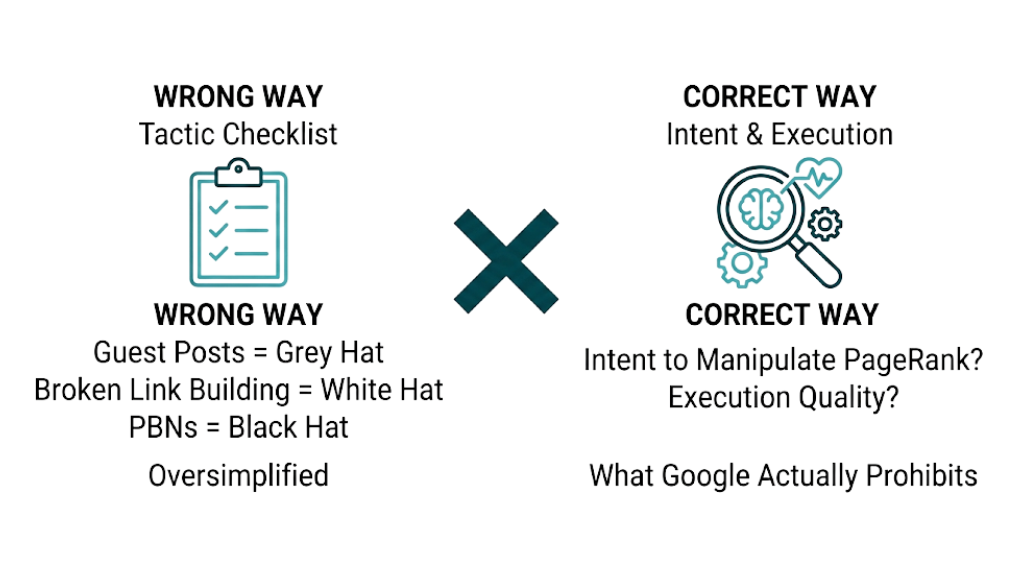
The debate around white hat vs grey hat link building has been running in SEO circles for over a decade, and it's getting louder, not quieter. Every algorithm update reignites the argument. Every penalty case study gets shared across LinkedIn and Reddit, and the takes rarely match. And yet most of the content on this topic still flattens the debate into a tactic checklist: guest posts are grey hat, broken link building is white hat, PBNs are black hat. Done.
That framing is wrong. It costs SEO teams real money.
The bottom line: Google's guidelines don't prohibit specific link building tactics - they prohibit intent to manipulate PageRank. That distinction changes everything. A guest post can be compliant or a clear violation depending on execution. A paid link can be legitimate with the right disclosure. The white/grey/black hat framework works as shorthand, but only if we use it correctly: it measures intent and execution quality, not the tactic itself. This article gives you a way to evaluate link opportunities correctly, understand how Google's detection systems work in practice, and build a link program that scales without stacking risk.
White Hat vs. Grey Hat Link Building: Why the Distinction Matters More Than Ever in 2025
The stakes around link quality have never been higher. Google's SpamBrain system, first announced in December 2022 and updated through 2024, uses AI to detect unnatural link patterns at a scale no manual review team can match. It doesn't just flag single bad links. It spots coordinated manipulation across whole link networks, then devalues or penalizes sites involved - even when those sites didn't realize they were part of a scheme.
That same "network" lens is why 2025 feels different from 2015.
The 2024 Google Search document leak - covered by Rand Fishkin at SparkToro and reported by The Verge - pointed to internal signals Google uses to judge site and link quality that go beyond what's in public docs. Signals like site authority scores, click data, and domain-level trust metrics appear to shape how individual links get weighted. This isn't conspiracy talk. It's cited, documented, and it changes how we should think about risk.
Link building is also a commercial machine. It's a multi-billion dollar industry, and agencies, in-house teams, and freelancers sit across a wide range of compliance. Fast KPIs push plenty of teams into tactics that live in genuinely ambiguous territory. A mid-market SaaS team spending $3,000 per month on link building cost needs to know whether that money is building durable equity or buying a liability that shows up in the next core update.
Google's detection capabilities have outpaced how most practitioners talk about them. The old logic - "everyone does it, so Google can't penalize everyone" - has been disproven over and over. SpamBrain doesn't need to penalize everyone. It just needs to devalue the links, and the ranking drop feels the same while Search Console stays quiet.
Understanding where the line sits isn't just compliance hygiene. It's strategic intelligence.
What White Hat Link Building Actually Means (Beyond the Buzzword)
White hat link building gets treated as a synonym for "slow and boring." That's the wrong takeaway, and it pushes teams to dismiss tactics that work while chasing riskier approaches that don't reliably outperform them.
Google's definition is the only one that matters. According to Google Search Central's spam policies, the violations involve "any links intended to manipulate PageRank or a site's ranking in Google Search results." The operative word is "intended." By that standard, white hat link building is any acquisition activity where the primary intent is to earn a link because the destination deserves it - the content helps, the resource holds up, or the relationship makes editorial sense.
This isn't semantics. It changes how we evaluate real opportunities.
A link you pay for can still be white hat if it's disclosed with rel=sponsored and the placement is genuinely relevant. But outreach can drift into grey hat fast if the content exists only as a link vehicle, with no editorial bar to clear. The tactic doesn't decide compliance. Intent and execution do.
White hat also isn't "slow" by default. It's repeatable. Teams that invest in digital PR, original research, linkable asset creation, and structured outreach programs can build links at scale without playing games. Original research and data-driven content attracts significantly more backlinks than standard informational posts, and the reason is simple: it gives writers a real reason to cite. That's the engine behind white hat link building at scale - publish citation-worthy work, then put it in front of the people who cite sources for a living.
The confusion comes from mixing up "white hat" with "passive." Passive link earning - publishing content and waiting for organic links - is white hat. But so is direct, organized outreach to relevant publishers, structured digital PR, and relationship building with editors and journalists. Activity level doesn't determine compliance. Intent does.
The Three Hallmarks of a Genuinely White Hat Backlink
Not all links that look clean are clean. These three checks separate a true white hat backlink from one that only looks compliant.
1. Editorial independence. An editor chose to add the link because it helps their readers. Full stop. Outreach is fine, and the link doesn't need to be unsolicited, but the editor needs real discretion - and they need to use it based on content quality, not money or obligation. If a site owner took $200 and dropped in the link with zero interest in the piece, it fails this test even when there's no obvious footprint.
2. Topical and contextual relevance. The linking page needs to sit in the same topic area as the destination page. A link from a home improvement blog to a mortgage calculator can make sense. A link from a home improvement blog to a cybersecurity SaaS product doesn't. Google's systems look for topical coherence at the page level and the domain level. Topically relevant links drive stronger ranking signals than high-DA links from irrelevant domains. You can explore domain authority vs domain rating to understand how these metrics differ in practice.
3. Proper attribution and disclosure. If there's a commercial relationship - paid placement, product gifting, affiliate arrangement - the link needs the right rel attribute (rel=sponsored or rel=nofollow) per Google's guidance on qualifying outbound links. Disclosure doesn't kill a link. Skipping disclosure when it's required does.
What Grey Hat Link Building Really Looks Like in Practice
Grey hat link building isn't one tactic. It's a gray zone where you can't judge compliance until you see how the work was done. Execution decides the outcome.
Execution is exactly where guest posting splits. If an experienced writer submits a useful, well-researched article to a relevant publication, and the link points to a resource that adds real value, that's white hat. If a content mill spins up a 600-word generic post for a site that runs 20 guest posts a day with no editorial bar, and the link is the only reason the page exists, you're in grey hat territory - and you're in black hat SEO territory under Google's definition if the goal is PageRank manipulation.
That same execution-first test applies to niche edits (adding links to already-published content), link exchanges, paid placements, and even resource page link building. The tactic label tells you very little. The mechanics tell you everything.
Mechanics that show up a lot in agency and in-house programs include:
- Unattributed paid guest posts - content placed for a fee without rel=sponsored, presented as organic editorial
- Scaled link exchanges - reciprocal linking programs that go beyond occasional mutual citations between genuinely related sites
- Anchor text over-optimization - building links with exact-match commercial anchor text at a ratio no natural link profile produces
- Low-quality niche edits - paying to insert links into existing articles on sites with no real audience or editorial standards
- Parasite SEO on high-authority domains - publishing content on high-DA platforms (Medium, Substack, Forbes contributor sections) mainly to push link equity, not to reach an audience
That parasite SEO pattern turned into a major story in 2023. Forbes Advisor and CNN Underscored - both run as high-authority commercial subdomains - were caught selling followed links to third-party advertisers without proper disclosure. Google then penalized both subdomains, stripping significant ranking visibility. The Forbes/CNN case is the clearest real-world proof that domain authority doesn't protect you from link spam penalties. High-authority sites that sell links draw more scrutiny because those links carry more value, which makes them a bigger target for manipulation.
The Spectrum Problem: Why 'Grey Hat' Isn't a Single Category
Treating grey hat as one risk level is one of the most common - and expensive - mistakes in link building strategy. There's a big gap between a guest post that lands on a real, niche-relevant site with actual editorial standards but ships without a rel=sponsored tag, and a link dropped into a PBN article on a domain built for one purpose: selling links. Both get labelled "grey hat" in an agency pitch deck. Their risk profiles don't match.
A more useful framework splits the grey zone into three bands:
Band | Description | Example | Risk Level |
|---|---|---|---|
Light grey | Compliant tactic, minor execution gap | Guest post without rel=sponsored on a genuine niche site | Low - algorithmic devaluation possible |
Mid grey | Tactic is borderline, execution is mediocre | Paid niche edit on a site with thin content and mixed link profile | Medium - devaluation likely, manual action possible at scale |
Dark grey | Tactic is designed to manipulate, execution is systematic | Scaled anchor-text-optimized link network, unattributed paid posts on high-DA sites | High - SpamBrain detection likely, penalty risk real |
The light grey band is where most legitimate agencies end up at some point. A sponsored post that should carry rel=sponsored but doesn't is a disclosure miss, not a manipulation scheme. Google's systems look for coordinated manipulation, not the occasional compliance slip.
Mid-grey and dark-grey work plays by different rules. Volume and velocity drive the risk up fast.
Where Exactly Is the Line? Google's Own Guidelines Decoded
Google's link spam policy is more specific than most SEO teams give it credit for. It spells out what violates the guidelines, and the list matters as much for what it includes as for what it leaves out.
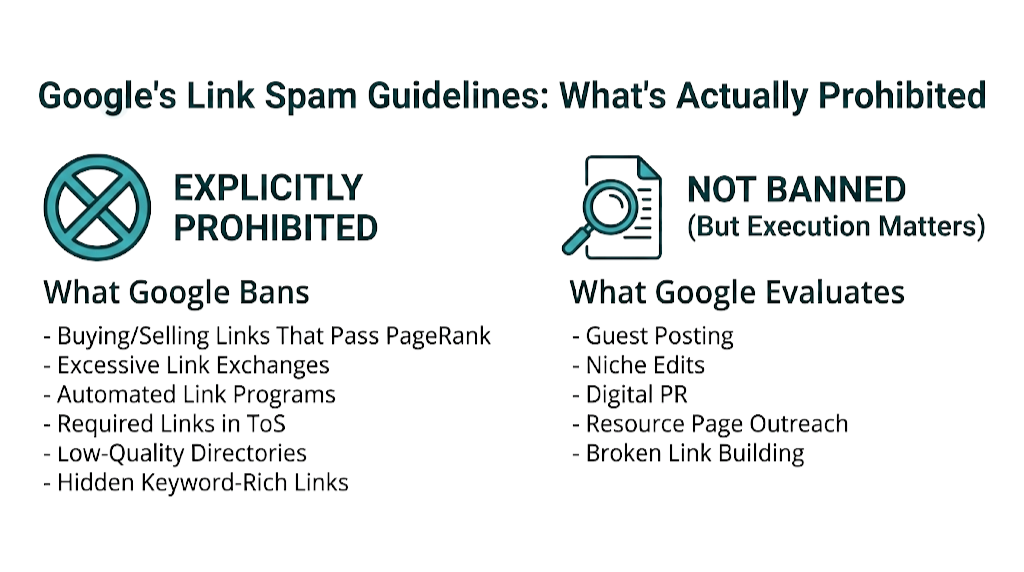
Explicitly prohibited practices include: buying or selling links that pass PageRank, excessive link exchanges, using automated programs to create links, requiring a link as part of a Terms of Service or contract, and text advertisements that pass PageRank. The policy also flags low-quality directory and bookmark site links, keyword-rich hidden links, and widely distributed links in site footers or templates.
What's missing is the part people argue about on Slack. Guest posting, niche edits, digital PR, resource page outreach, and broken link building aren't banned tactics. Google draws the line at intent and execution: building links mainly to manipulate PageRank, at a scale and in a way that creates an unnatural link profile.
That intent point comes up again and again in public comments from John Mueller, Google's Search Relations team lead. The issue isn't whether money changed hands or whether outreach happened - it's whether the link reflects a real editorial choice. Mueller has also said even high-quality guest posts can violate guidelines if they're part of a scaled program built mainly for link acquisition, not audience reach.
That "real editorial choice" standard is what teams need to operate on. Before we build any link, we don't ask "is this white hat?" We ask: "If Google's spam team reviewed this link, the content around it, and the commercial relationship behind it, would they decide the link exists for readers or to move rankings?"
A tactic checklist won't protect you from that review. Search engines keep getting better at answering it.
How Google Detects Unnatural Link Patterns: What the Data Shows
Google's December 2022 link spam update put SpamBrain at the center of link spam detection at scale. SpamBrain uses machine learning to evaluate patterns across the web graph, not only individual link attributes. That changed how spam gets caught: the system can connect dots across sites, timing, and behavior, instead of leaning on single signals like anchor text alone or a domain metric.
Those patterns show up through several overlapping signals:
Anchor text distribution anomalies. Natural link profiles mix branded anchors, naked URLs, generic anchors like "click here" and "this article," plus a smaller share of keyword-rich anchors. Understanding natural anchor text patterns shows that sites with more than 20-30% exact-match commercial anchor text in their backlink profile look statistically abnormal. SpamBrain flags that distribution because it points to coordinated link building, not organic citation behavior.
Link velocity spikes. A site that picks up 10 links per month and then jumps to 200 in one month creates a velocity anomaly that draws algorithmic review. Rapid growth isn't automatically a problem - viral content and major press can cause real spikes. But when the spike lines up with exact-match anchors and links from topically irrelevant domains, the pattern reads as manipulation.
Topical coherence scoring. SpamBrain checks whether linking domains match the topic of the target site. A fitness supplement brand pulling 80% of its links from technology, finance, and entertainment sites has a coherence issue that DA won't solve.
Network-level detection. This is SpamBrain's sharpest edge. It doesn't judge links one by one. It maps relationships between linking domains and finds clusters of sites that point at the same destinations, sit on the same infrastructure, or publish in coordinated bursts. That's how link networks and PBNs get caught even when individual sites look clean on the surface.
That same "quality over surface metrics" idea also shows up in the 2024 Google Search document leak. Internal documents referenced by Rand Fishkin at SparkToro described signals that appear to include site-level quality scores based on user engagement data, domain age and authority metrics that differ from third-party tools, and click-through and dwell time signals that may affect how individual links get weighted. If accurate, a link from a high-DA site with low real-world engagement may carry less weight than a link from a lower-DA site with a real audience. Quality - not a toolbar score - drives link value.
The Real Risk Calculus: What Grey Hat Link Building Costs You
The risk of Grey Hat SEO isn't binary. It's not "penalty or no penalty." There's a spectrum of outcomes, and the most common one isn't a dramatic manual action - it's quiet underperformance that drags on.
Algorithmic devaluation is the most frequent outcome of grey hat link building. SpamBrain flags links as manipulative and stops counting them. Your backlink count in Ahrefs or Semrush stays the same. Your domain rating doesn't drop. But those links stop pushing rankings, and the budget behind them is gone.
That's the grey hat trap. You won't see it until you audit the relationship between link acquisition and ranking movement and find they've decoupled. Running a link building audit regularly is the only reliable way to catch this before it compounds.
Manual actions show up less often, but they hit harder because they're visible and they force your hand. Google's Search Console manual actions documentation distinguishes between site-wide and partial match penalties. A partial match manual action targets specific pages or link patterns, while a site-wide action affects the entire domain. Manual actions require a reconsideration request and a real cleanup of the offending links - a process that takes months and doesn't always restore pre-penalty rankings.
The Forbes/CNN case shows a third outcome: targeted subdomain penalties that torch search visibility and pull in negative press. Forbes Advisor lost substantial ranking positions after Google penalized the subdomain for selling followed links. That reputational cost matters. Being publicly tagged as a site that sells links compounds the traffic loss.
The traffic loss isn't the only cost.
Then there's the compounding cost that gets the least attention: the opportunity cost of building a link profile you later have to unwind. Disavowing links, running link audits, and managing reconsideration requests all chew up time and budget. If an agency spends $2,000 per month on grey hat links and they get devalued within 18 months, that's $36,000 in link budget that stops producing. Then you pay again to remediate the profile. A white hat program at the same budget builds links with durable equity, so the value stacks over time instead of eroding.
Guest Posts, Niche Edits, and Curated Links: White Hat or Grey Hat?
These three tactics generate more debate than any others in link building, and the debate sticks around for a simple reason: execution decides the outcome.
Guest posting sits in white hat territory when the editorial process is real. The criteria are straightforward: editorial independence, topical relevance, content quality, and disclosure when there's a commercial relationship. A guest post a real editor chose to publish because it serves their audience is a white hat link, even if outreach happened and even if the contributor was paid. The wheels come off when teams scale without standards - the same template pushed to 50 sites, an "editorial process" that means a $50 payment, and a 48-hour turnaround, or content that exists only to carry a link with no informational value.
Niche edits (also called curated links or link insertions) add a link to an existing published article. Done well, this stays white hat: you find an article that should cite your resource, you contact the publisher, and they add it because it improves the piece. Done poorly, it's a paid link scheme with no editorial judgment - you pay a site owner to jam your link into an article that doesn't need it, with no disclosure and no editorial reason.
That line matters. Niche edits from relevant, well-trafficked articles can be some of the highest-value links you can earn because they're placed in content with ranking history and inbound links. But this is also one of the most abused tactics in the industry. The barrier to entry is low, and the footprint is harder to spot than a fresh guest post.
Curated links - where a publisher builds or maintains a resource page or roundup and includes your site as a real recommendation - are white hat when the curation is authentic. That editorial decision is the compliance anchor. The risk shows up when "curated link" turns into code for paid placement on a resource page built mostly to sell link slots.
At Rhino Rank, our Curated Links and guest post services follow the criteria that determine compliance: real editorial standards, real publisher relationships, topical relevance, and content that serves the linking site's audience. The difference between a white hat service and a grey hat one isn't the tactic name on the invoice - it's the quality controls applied at every stage of execution.
How to Vet a Link Opportunity Before You Build It
Before committing to any link placement, run it through this evaluation framework:
- Check the site's organic traffic. Use Ahrefs or Semrush to verify the site has real organic search visibility. A site with 500 monthly organic visits isn't a real editorial publication, regardless of its domain rating.
- Review the existing content quality. Read three to five articles on the site. Content should serve a real audience. If it reads like it exists to host links, walk away. Thin, generic copy with heavy keyword density is a red flag.
- Examine the existing backlink profile. Watch for unnatural velocity and junk sources. A site that has acquired 2,000 backlinks in the last three months, predominantly from foreign-language sites or link networks, is a grey hat asset. Links from it bring that risk with them.
- Check the outbound link profile. Count external links and scan where they go. A site with 50 outbound links per page, pointing at unrelated commercial sites, is a link farm regardless of its DA.
- Verify topical relevance. Confirm the linking page covers a topic that ties directly to your target page. Page-level relevance beats domain-level topic alignment.
- Confirm disclosure compliance. If you're paying for placement, confirm the publisher will use rel=sponsored, or confirm the placement meets the criteria for editorial independence that justifies a followed link.
When Grey Hat Becomes Black Hat: The Tactics That Cross the Line
The transition from grey hat to black hat isn't gradual. Some techniques sit clearly on the wrong side of Google's guidelines, and cleaner execution doesn't make them compliant.
Private Blog Networks (PBNs) are the clearest example. A PBN is a network of sites built or acquired to pass link equity to target sites. There's no compliant version of that model - the entire purpose is PageRank manipulation, which Google's spam policies prohibit. SpamBrain's network-level detection targets PBN patterns, and the footprints keep stacking up: shared hosting, similar site structures, overlapping content themes, and correlated publishing patterns create signals Google can connect. Understanding how toxic backlinks accumulate through these networks helps explain why PBN links are so difficult to recover from.
Scaled link schemes - coordinated programs that place hundreds or thousands of links through the same network of publishers, often using templated content and exact-match anchors - cross the line even if a few placements look "fine" in isolation. Search engines evaluate patterns. The pattern is the violation.
Negative SEO - building spammy links to a competitor's site to trigger a penalty - is black hat by definition and potentially illegal depending on jurisdiction.
Link cloaking and redirect manipulation - where the link a user sees differs from the link Google's crawler follows - breaks the rules on two fronts: link spam and cloaking. Google treats cloaking as a top-tier technical spam issue.
Intent and scale draw the real boundary between dark grey and black hat. One paid guest post without proper disclosure is a compliance gap. A system that churns out hundreds of paid placements to move rankings is black hat link building, regardless of what an agency calls it.
How to Build a White Hat Link Building Strategy That Scales
The myth about white hat link building is that it doesn't scale. That myth sticks because teams treat "white hat" as "passive" - as if compliance means waiting for links to show up. It doesn't.
Scale still requires a plan. And it requires controls.
Start with linkable asset development. The base of any scalable white hat program is content that earns citations. That means original research, proprietary data, useful tools, in-depth guides that become industry references, and visual assets other publishers want to embed. Data-driven research pieces attract significantly more backlinks than standard informational content, which is why putting one well-researched study into the calendar each quarter transforms outreach from a favor request into a genuine value exchange. Our guide to creating linkable assets walks through exactly how to build content that earns citations at scale.
Build a tiered outreach program. Not all link targets deserve the same time. A tiered approach keeps effort matched to return:
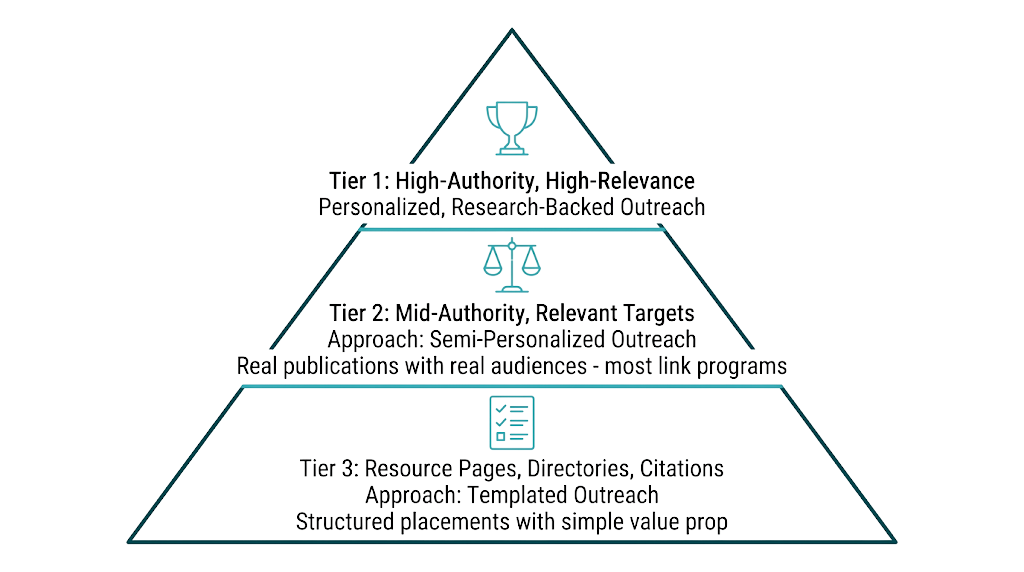
- Tier 1: high-authority, high-relevance targets. Personalized, research-backed outreach. Learn the publication's editorial priorities, reference specific articles, and pitch content that fills a real gap in their coverage.
- Tier 2: mid-authority, relevant targets. Semi-personalized outreach with a clear value proposition. These targets carry most link programs - real publications with real audiences that respond to solid outreach.
- Tier 3: resource pages, directories, citation opportunities. Templated outreach for structured citation placements where the value prop stays simple.
Diversify your link acquisition channels. A healthy link profile pulls from multiple acquisition methods. Digital PR earns high-authority links from news and media sites. Guest posting builds topical relevance and relationships with niche publishers. Niche edits capture value from existing high-ranking content. Resource page outreach builds baseline citations. Broken link building replaces dead links with relevant ones. Keep any single channel under 40-50% of monthly acquisition - concentration reads like a footprint.
Monitor your anchor text distribution. Set targets before building, then track monthly. A natural profile often looks like this:
Anchor Type | Target Range |
|---|---|
Branded anchors | 40-50% |
Naked URLs | 15-25% |
Generic anchors | 10-20% |
Partial match keyword anchors | 5-15% |
Exact match keyword anchors | 2-8% |
If exact-match anchors rise above 10%, pivot outreach toward branded and generic anchors until the mix settles back down.
Vet every link source against the compliance criteria. Use the vetting framework from the previous section on every opportunity. That's quality control, not paperwork. Links that clear the bar are the same kinds of links Google's systems reward.
Build relationships, not just links. Durable link programs come from repeatable access: publishers, editors, journalists. When a publisher trusts your content, they move faster, placements improve, and intros to other publications follow. Transactional link buying doesn't compound like that. Teams that want this kind of consistent, managed execution often find that working with a Managed Service delivers better long-term results than building the infrastructure in-house.
Audit quarterly. Run a full backlink audit every quarter using Ahrefs or Semrush. Flag links that don't meet your vetting criteria, watch for sudden velocity changes, and maintain a disavow file for links that create real risk. Quarterly audits cost less than cleanup after a penalty.
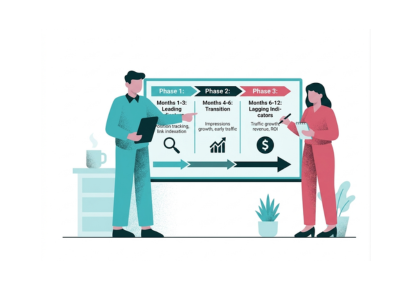
This approach, executed consistently over 12 to 18 months, produces a link profile that reflects real authority in your niche, drives durable ranking improvements, and holds up through algorithm updates instead of collapsing after them. That's the compounding advantage of white hat link building at scale.
Frequently Asked Questions About White Hat vs. Grey Hat Link Building
What is the difference between white hat and grey hat link building?
White hat link building earns backlinks in a way that lines up with Google's guidelines - real editorial choice, and proper disclosure when money or incentives are involved. Grey hat link building sits in the gap where a tactic isn't banned on paper, but the way it's carried out still aims to influence PageRank. Intent matters.
Execution is the separator. The same surface-level tactic can land on either side depending on whether a publisher actually controls what goes live or just sells placements.
Is buying links always considered grey hat or black hat SEO?
No. Paying for a link becomes a guideline violation when that link passes PageRank without disclosure. That's the problem.
Google allows paid placements as long as they use rel=sponsored. The issue isn't that money changed hands. It's undisclosed paid links that prop up rankings.
Are niche edits (curated links) white hat or grey hat?
Niche edits count as white hat when a publisher adds the link because it improves the page for readers. Simple as that.
They slip into grey hat or black hat when the placement is transactional and the "edit" is just a way to drop a link into an existing URL. Editorial standards decide the category here. So does reader value.
How does Google detect unnatural or grey hat link building?
Google's SpamBrain AI system flags unnatural link behavior through overlapping signals. Anchor text distributions that don't match how real sites link. Sudden link velocity spikes. Weak topical alignment between the linking domain and the target. Network patterns that point to coordinated link schemes.
That web graph view is what catches teams off guard. SpamBrain doesn't need every single link to look spammy - it can spot manipulation from the footprint across domains.
What are the penalties for grey hat link building tactics?
Penalties run from algorithmic devaluation, where Google just ignores the links, to partial or site-wide manual actions in Google Search Console. Manual actions force cleanup. Then you file a reconsideration request and document the remediation.
The Forbes Advisor case in 2023 is the reminder nobody likes: authority doesn't protect you. The Forbes Advisor subdomain lost significant ranking visibility after Google penalized it for selling followed links without disclosure.
How do I know if a link building agency is using white hat methods?
Ask for specifics on publisher vetting, content standards, and disclosure. If an agency is doing white hat work, they can walk through how they qualify sites, what "editorial" means in their process, and how they apply rel=sponsored for paid placements. They'll also tell you what they reject.
Vague talk about "relationships" and "outreach" isn't a process. It's a sales line.
Review sample placements before committing - the linking page quality and topical fit tell you more than any deck ever will.
related Blog Posts



Join 7,000+ Clients Growing with Rhino Rank
Sign Up

Stay ahead of the SEO curve
Get the latest link building strategies, SEO tips and industry insights delivered straight to your inbox.