
 Back to all posts
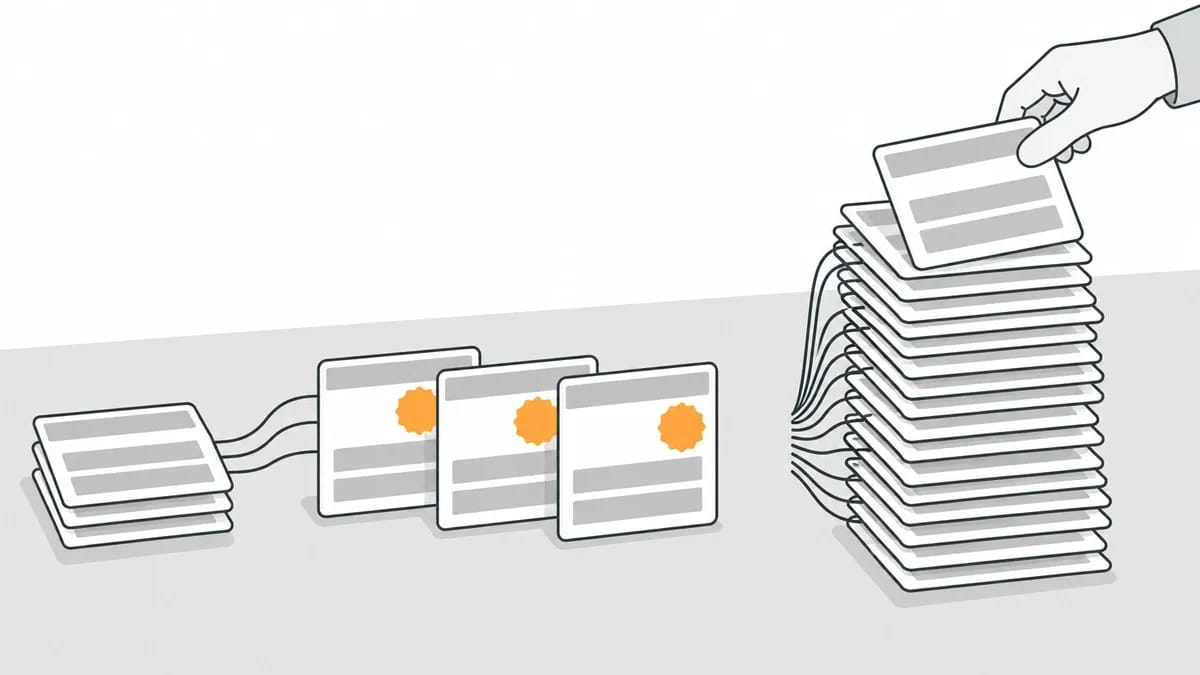
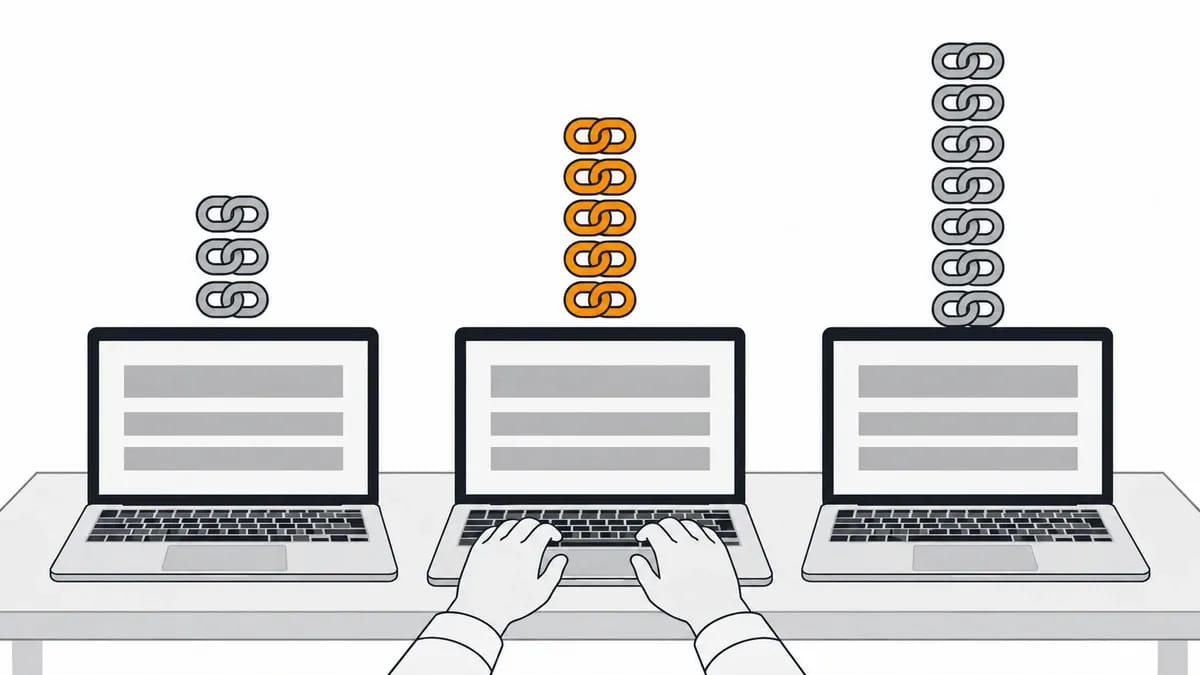
Trust Flow and Citation Flow are two scores from Majestic, a backlink-data tool used in SEO. Trust Flow is a score based on the quality of the links a site or page receives, and Citation Flow is a score based on their quantity. Both are scored from 0 to 100, and both launched on 14 May 2012.
This page sets out each score in Majestic's own words, with the date each page was read. It covers the seed set as Majestic describes it, the three levels a score is produced at, and how Majestic and three dated readings from outside Majestic describe the two scores together. It then covers Topical Trust Flow, why a score moves between builds, where each score is read and what is free, and a short FAQ.
What Trust Flow measures

Trust Flow is Majestic's quality-based score. Majestic's glossary, read on 4 October 2026, defines it: "Trust Flow, a trademark of Majestic, is a score based on quality, on a scale between 0-100. Majestic collated many trusted seed sites based on a manual review of the web."
Majestic's Site Explorer page describes the mechanism behind the number: "Trust Flow indicates the number of hops needed to traverse links from a human-curated seed set of sites."
A hop is one step along a chain of links. A site linked from one of those seed sites is one hop away. A site linked from that site is two hops away. The fewer the hops, the higher the score.
The seed set itself comes from Majestic's launch post of 14 May 2012, written by Dixon Jones of Majestic: "We start with a large list on manually reviewed URLs. These have a crowd-sourced level of trust but by no means include all the trusted sites on the web."
Majestic describes the list as manually reviewed and incomplete.
On the scale, Majestic's Trust Flow page gives Trust Flow as a whole number between 0 and 100 and adds: "High Trust Flow scores are difficult to achieve. As Trust Flow increases, it becomes harder to gain more Trust Flow. So, an increase from 5 to 15 is much easier than an increase from 15 to 25."
The glossary puts the same point in technical terms: "The scores flow through the entire web and use a logarithmic scale."
Flow Metric is Majestic's name for the family of scores. The practical reading is Majestic's own: equal steps on the scale are not equal in effort, and the higher the starting point, the harder the next step.
One boundary matters for everything that follows. The score describes the links a page or site receives, not its content. A backlink profile is the set of those links, and Trust Flow is one way of reading it.
What Citation Flow measures
Citation Flow is Majestic's quantity-based score. Majestic's Flow Metric Scores page, read on 4 October 2026, defines it: "Citation Flow is a score which reflects the quantity of links that point to any given website. Citation Flow does not care whether a link is of good-quality, or poor quality. Majestic produce Citation Flow scores at URL, subdomain and domain level."
Citation Flow uses the same 0 to 100 scale as Trust Flow. Where Trust Flow asks where a link comes from, Citation Flow asks how many links point in and how connected the sites that link in are, with no weighting for where they come from.
The same page describes that wider count: "Citation Flow goes beyond raw backlink counts to look at the wider link network, such as the sites linking into the sites that link to you and the sites that link to them and so on…"
So Citation Flow is not a backlink count, and it is not a referring-domain count either. A count of referring domains is a different number, and that guide walks through it. How links differ in kind is a separate subject, covered in our guide to the types of backlinks.
URL, subdomain and domain level
Both scores exist at three levels, and the level changes the number. Majestic's Site Explorer page, read on 4 October 2026, explains how the levels relate: "We base our proprietary Trust Flow and Citation Flow scores at Domain level on the aggregation of values calculated at URL level."
Majestic's Trust Flow page says the same of Trust Flow: it is calculated at the URL level, and a domain's Trust Flow combines all the URL-level scores for that domain.
A domain score is built up from the scores of the pages under it, so the two are not interchangeable. Majestic's Flow Metric Scores page says so directly: "It is not advisable to compare Trust Flow of a web page against the Trust Flow of a website." The same page adds: "Flow Metric scores are intended for use in like for like comparisons, for example, using Trust Flow to compare homepages of different sites."
A domain score and the score of one page on that domain are two different numbers. Before a number is compared with anything, note which level the report shows, then compare like with like: page with page, domain with domain, homepage with homepage.
How Majestic describes reading the two scores together
Majestic's own guidance reads the two scores as a pair. Its Flow Metric Scores page, read on 4 October 2026, puts it: "SEOs and digital marketers can gain great insight from investigating where the balance between Flow Metric scores differ from the norm."
It also sets an expectation for that balance: "Because of the noisy background, it is very rare for a website to have a larger Trust Flow than Citation Flow."
The same page gives its examples with a date: "A few exceptions exist including mit.edu, the website for the Massachusetts Institute of Technology which has a Trust Flow of 93 and a Citation Flow of 71 (at June 2023). Likewise, Stanford has a Trust Flow of 93 and Citation Flow of 73."
Those are the values Majestic's page states, dated June 2023 for MIT and undated for Stanford. On 4 October 2026, the Majestic Million placed mit.edu at position 102 with 63,430 referring subnets and stanford.edu at position 130 with 55,617 referring subnets. A referring subnet count is a count of linking subnets, not a Flow Metric.
On the ratio between the two scores, Majestic's blog post of 30 August 2023, written by Kainat Malik of Majestic, states the direction: "The ratio is typically calculated by dividing Trust Flow by Citation Flow to provide a simple score for links or sites."
Majestic's own study of 16 December 2013, written by Neep Hazarika of Majestic, computed it the other way round, dividing Citation Flow by Trust Flow for all domains in the Majestic Million. That study reported a median of 1.8125 after leaving out domains with a Trust Flow of 0. The two directions give different numbers, so a reader checks which score is divided by which before reading any ratio.
Majestic's blog post of 10 April 2019, written by Ken McGaffin of Majestic, plots the links of example profiles by their Trust Flow and Citation Flow and reads them against the 45 degree line through the chart. Majestic's Backlink Checker page describes that kind of chart: "By organising all the backlinks on a 101x101 grid, we can compress billions of backlinks into a single image in a similar way to a scatter graph." In that chart each backlink carries its own Trust Flow and Citation Flow, so a high Trust Flow backlink is one that sits high on the Trust Flow scale.
Majestic's Trust Flow page tells readers to think of Trust Flow as a relative measure and to compare it with competitors' scores. Sorting helps with that: a competitor's referring domains can be sorted by Trust Flow in Majestic's reports, and a backlink gap analysis works from exactly that kind of list.
Three dated readings from outside Majestic
Three readings from outside Majestic give the scores a dated context, each with its sample and its date.
Serhii Koksharov, an independent SEO consultant, published a study with Collaborator, a guest post marketplace. The study states its sample: "We analyzed more than 40,000 websites from the Collaborator catalog." On method, it states: "Spearman’s rank correlation coefficient was then calculated for each pair of metrics." The study's page is dated 27 August 2026. Across that catalogue of more than 40,000 websites, it reports a rank correlation of 0.530 between Trust Flow and Citation Flow, which it lists among its strong correlations. The sample is a marketplace's catalogue, not the web.
Tom English of LaunchPad PR, a digital PR agency, describes his sample: "In August of 2019, we pulled the Majestic Millions and Top Domains On The Web by Ahrefs Rank to analyze similarities between how they’re rating sites." The size of the overlap: "This resulted in 269,295 sites in common between the two indices." His page describes a ratio of Trust Flow to Citation Flow it calls the Trust Ratio.
Two academic papers use the scores as research inputs. Orduña-Malea and Aguillo, in the Journal of Information Science, published online 16 December 2022, define the score in their own words: "The Majestic’s Trust Flow (TF) is a link-based score aimed at measuring the influence of online objects (e.g. scientific publications) by considering the weighted number of links received from trusted websites." Their sample: "In order to do this, 20,810 URL-based Digital Object Identifiers (DOIs) were identified and analysed." Trillo-Domínguez, Salaverría, Codina and De Moya-Anegón, in Journalism (2024), used Trust Flow and Citation Flow as two of four indicators of a media site's digital reputation across a sample of over 4,000 media domains.
Topical Trust Flow

Topical Trust Flow is Majestic's topic-by-topic version of Trust Flow. Majestic's Flow Metric Scores page, read on 4 October 2026, introduces it: "The processes that result in the Topical Trust Flow Score represent a significant leap of complexity over the system used to calculate Trust Flow."
The same page describes how it is built: "Over 800 pools of sites have been identified and classified, and the algorithm follows outbound links from these pages, passing along not only a strength signal but also classification by topic." The same page reports Topical Trust Flow at URL, subdomain and domain level.
Majestic's glossary gives the scale: "Topical Trust Flow provides a series of numbers, on a log based scale between 0-100. The number shows the relative influence of a web page, subdomain or root domain in any given topic or category."
So where Trust Flow is one number per page or site, Topical Trust Flow is a series: one number per topic. Majestic's blog post of 11 May 2017, written by Dixon Jones of Majestic and updated 4 February 2020, is direct about what the numbers are not: "Topical Trust Flow scores are not percentages!"
That post carries a worked example from 2017. Of the NASA website, it states: "The Inset (85) score represents the strength of the NASA website in the topic of Science/Astronomy." Of the pages linking in, it states: "The Topics tab (78) shows the cumulative strength of the web pages LINKING TO NASA in the topic of Science/Astronomy."
Two numbers for one topic, then: one for the site and one for the pages linking to it, both 2017 values from Majestic's post. A topic score is read against other pages or sites in that topic, not against the same page's scores in other topics.
Access sits with subscribers. Majestic's Site Explorer topics page states: "Subscribers can fully explore and drill into the individual Topical Trust Flow values that arrive at any website, domain, or URL." The section is called Topics, and the same page says the metric is available to all Majestic subscribers.
Why a score moves between builds
A score can move without any link changing. Majestic's Flow Metric Scores page, read on 4 October 2026, explains why: "The processes which produce Flow Metric scores are often revisited and refined. This evolution of the underlying algorithms can produce fluctuations in the resulting scores. If you make use of services which track Flow Metric scores over time, we suggest that looking at long term trends may be more useful."
The rebuild cycle is stated in Majestic's blog post of 30 August 2023: "The scores are rebuilt with every full build of the Majestic Fresh Index – approximately once every 24 hours."
Majestic's glossary defines the two indexes behind the scores. The Fresh Index holds the latest data crawled and is updated through the day. The Historic Index reaches back to 2006 and is meant for the history of a site, including links that are no longer live.
On 4 October 2026, the glossary's index panel showed the Fresh Index covering 6 June 2026 to 4 October 2026 and the Historic Index covering 6 June 2006 to 26 March 2024, values of that day. A score read from one index on one day is that index's value for that day.
For movement over longer spans, the glossary describes a dedicated tool, Flow Metric History, for comparing domains' Trust Flow and Citation Flow over many years.
Reading a score is one job. Reviewing the links a site already holds is a different one, and a link audit covers that second job.
Where to read the scores, and what is free

The scores are read inside Majestic's own tools. Majestic's Site Explorer page, read on 4 October 2026, describes the starting point: a summary of key statistics about the target site's backlink profile.
Trust Flow and Citation Flow sit in that summary, alongside Topical Trust Flow. Majestic's Flow Metric Scores page lists the scores as available through its site, its API and its browser plugins. Majestic's 10 April 2019 post sorts a site's referring domains by Trust Flow in the Referring Domains report.
Three parts of Majestic are open without payment, in Majestic's own words. Its Backlink Checker page invites: "Try the free version of our backlink checking service." The same page names the route to the two scores: "Download our browser plugins and get free Trust Flow and Citation Flow, external backlinks and referring domain counts." The Majestic Million page offers: "Free search and download of the top million websites, from majestic.com."
The Majestic Million lists domains by referring subnets and carries no Trust Flow column.
Trust Flow and Citation Flow are Majestic's scores. Moz's Domain Authority and Ahrefs' Domain Rating are two other tools' scores on their own scales, and why Moz DA and Ahrefs DR disagree is a separate question with its own page. Our Moz Domain Authority guide covers that one score in full. Our Guest Posts are tiered by the minimum Moz Domain Authority of the placement site, and each site is cross-checked against Ahrefs Domain Rating and live traffic. Our free DA and DR checker reports those two scores for one domain, not Majestic's. The wider question of how link authority is measured has its own page.
Frequently asked questions
What is the difference between Trust Flow and Citation Flow?
Both are Majestic scores on a 0 to 100 scale. Trust Flow is based on the quality of the links a site or page receives, measured as hops from a manually reviewed seed set. Citation Flow is based on the quantity of links, with no weighting for quality. Majestic produces both at URL, subdomain and domain level.
What is a good Trust Flow score?
Majestic's own Trust Flow page says to read Trust Flow as a relative measure and to compare it with competitors' scores. A score for a page and a score for a domain are different numbers, so any comparison starts by matching the level.
What is Topical Trust Flow?
Topical Trust Flow is Majestic's topic-by-topic version of Trust Flow, built from over 800 pools of sites. It is a series of 0 to 100 numbers, one per topic, and Majestic says the numbers are not percentages. It is read in the Topics section of Site Explorer, and Majestic says the metric is available to all its subscribers.
Why did my Trust Flow change when my links did not?
Majestic says the processes behind Trust Flow and Citation Flow are revisited and refined, and that the scores are rebuilt with every full Fresh Index build, about once every 24 hours. It suggests reading long-term trends rather than single movements.
Where can I check Trust Flow and Citation Flow for free?
Majestic's Backlink Checker page says its browser plugins give Trust Flow and Citation Flow for free. The same page offers a free version of its backlink check. The Majestic Million is a free list ranked by referring subnets and carries no Trust Flow column.
related Blog Posts



Join 7,000+ Clients Growing with Rhino Rank
Sign Up



Stay ahead of the SEO curve
Get the latest link building strategies, SEO tips and industry insights delivered straight to your inbox.