
 Back to all posts
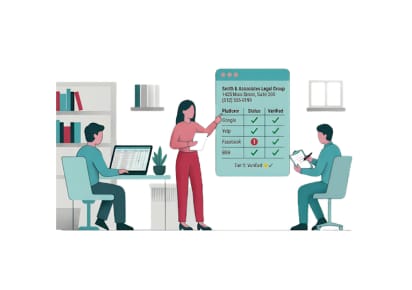
Your business name, address, and phone number show up in dozens, sometimes hundreds, of places across the web. Directory listings. Google Business Profile fields. Local chamber of commerce pages. All of it adds up to a digital fingerprint search engines use to decide whether your business is legitimate, prominent, and worth a top local ranking. When that NAP stays clean and consistent, you earn trust. When it splinters, you lose visibility and revenue - and most teams never connect the drop back to the source.
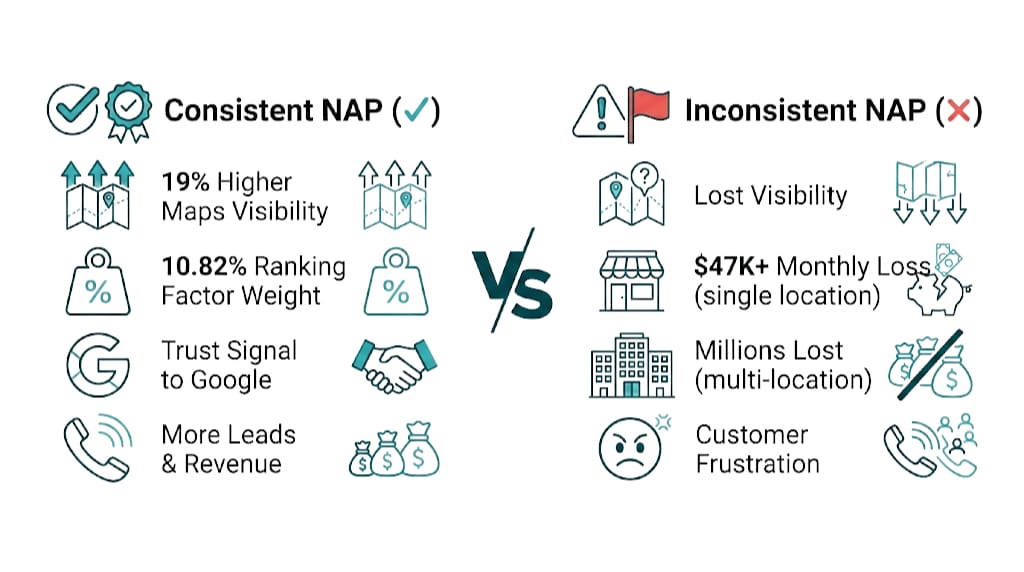
Bottom line up front: NAP SEO is the practice of keeping your business Name, Address, and Phone number accurate and consistent across every online platform where they appear. This isn't busywork. Citation signals account for roughly 10.82% of local pack ranking factors according to BrightLocal's research, and businesses with consistent NAP data across 40+ sources see 19% higher Google Maps visibility. Inconsistencies have been documented costing individual locations $47,000 in a single month and multi-location brands millions in lost revenue. This guide covers the full picture: the data, the mechanism, the audit process, the formatting details, and the emerging role of AI search platforms in reshaping citation strategy for 2025 and beyond.
SEO managers use this to justify citation cleanup to skeptical CMOs. Marketing directors use it to keep 50 franchise locations from drifting out of sync. Agencies use it to build local SEO packages that hold up under scrutiny. We've pulled research from BrightLocal, Whitespark, Moz, and Google's own documentation so you don't have to stitch it together across a dozen tabs.
What Is NAP SEO and Why Does It Directly Affect Local Rankings?
NAP stands for Name, Address, and Phone number. In local SEO, your NAP profile is the base dataset search engines use to identify, verify, and rank your business for location-based queries. Each time your business information appears online - on your Google Business Profile (formerly Google My Business), a Yelp listing, a BBB page, or a mention in a local newspaper article - that counts as a citation. Citation accuracy shapes how Google evaluates your business.
Google's own documentation on local search ranking states that three factors determine local results: relevance, distance, and prominence. Prominence is where NAP SEO hits. Google states that information about a business gathered from across the web - including links, articles, directories, and structured data - influences local ranking. Consistent NAP across those citations works as a trust signal. It tells Google, "This business exists, it's where it says it is, and independent sources back that up."
Consider a mid-market dental practice in Austin, Texas. One practice has its correct name, address, and phone number listed on 60 directories and local sites. Two blocks away, a competitor has the right info on Google Business Profile but an outdated phone number on 15 directories, a former address on 8 others, and a small name variation on another 12. Both practices sit the same distance from the searcher. Both offer similar services. Google favors the practice with cleaner citation data because it can verify that business's identity with higher confidence.
That "NAP consistency" point isn't theory. In practice, citations act like references on a job application. If three references give slightly different titles and dates for the same candidate, the hiring manager pauses. Google does the same. Conflicting NAP data creates ambiguity, and ambiguity drags local rankings down.
Conflicting NAP data also shows up in more places than most teams track. Your NAP lives on your website (ideally in structured Schema markup), your Google Business Profile, social profiles, data aggregators, industry platforms, and unstructured mentions in blog posts or news articles. Owning those touchpoints separates businesses that hold the local pack from businesses that keep missing the top three.
How Much Do Citation Signals Actually Move the Needle? The Data
The standard pushback on NAP SEO is that it sounds like a minor lever. The numbers don't back that up.
BrightLocal's Local Search Ranking Factors research breaks out the weighted influence of different signal categories on local pack rankings. Citation signals - NAP consistency, citation volume, and citation quality - account for 10.82% of local pack ranking factors. That puts citations ahead of behavioral signals and roughly in the same range as review signals. In local, where the gap between position one and position four in the pack can drive a 400% swing in click-through rate, 10.82% isn't a rounding error. It's real share.
That same research also found that businesses with consistent NAP data across 40 or more sources see 19% higher visibility in Google Maps than businesses with inconsistent data. Put that into operating terms. If a local service business drives 200 calls per month from Maps visibility, a 19% lift equals 38 more calls. With an average customer lifetime value of $500, that's $19,000 more revenue per month tied to NAP consistency alone.
Ranking Factor Category | % of Local Pack Weight | Key NAP Relevance |
|---|---|---|
Google Business Profile Signals | 32.0% | NAP must match GBP exactly |
Link Signals | 19.0% | Editorial links serve as unstructured citations |
Review Signals | 11.5% | Reviews on correct listings reinforce NAP |
Citation Signals | 10.82% | Direct NAP consistency and volume |
On-Page Signals | 9.0% | NAP in Schema markup, footer, contact page |
Behavioral Signals | 7.0% | Indirect: consistent NAP reduces bounce |
Personalization | 6.0% | Not directly NAP-related |
That 10.82% weighting lines up with what Whitespark's 2023 Local Search Ranking Factors report calls out in practice. It ranks consistent citations among the top five factors for businesses that are new or that lack review history. For established brands, citations look more like table stakes. Baseline still matters. If we're trying to enter a competitive local market, citation building for local SEO and NAP cleanup stay among the fastest levers to pull.
The Vicinity update is where teams get turned around. Whitespark's analysis shows proximity became roughly 360% more important after Vicinity, and some folks took that as "citations matter less." That's the wrong read. Proximity decides who gets into the set for a query. Citations and NAP consistency help decide which businesses inside that set rank highest. They work together, not against each other.
Those Maps visibility gains are what we use to justify budget internally. We're not funding a vanity task. We're buying into a factor that drives more than 1 in 10 local pack signals and ties to measurable movement in Maps exposure. For teams managing multiple locations, a managed service can make it practical to keep NAP data clean at scale without burning internal bandwidth on manual audits.
The Real Cost of NAP Inconsistency: Rankings, Revenue, and Trust
Maps exposure is the upside. The downside of inconsistency hits harder, because bad NAP data doesn't only mute visibility - it chips away at trust with both Google and actual customers.
Case Study 1: The $47,000 Single-Location Loss. Research documented by Backlynk examined a single-location professional services firm that built up NAP inconsistencies over several years after an office move and a phone system change. The old address stayed live on 23 directories. A former phone number still showed on 11 platforms. During the period studied, the business saw a clear drop in local pack visibility, with an estimated $47,000 in lost revenue in a single month. No penalty. No big algorithm event. Google stopped trusting the location data and rewarded competitors with cleaner citation profiles.
Case Study 2: The $2.3M Franchise Disaster. SEOwerkz documented a multi-location franchise brand that went through a partial rebrand, changing the business name format for some locations but not others. Over four months, the mismatch between old branded listings, new branded listings, and hybrid formats across aggregator networks kicked off a chain reaction of conflicting data. The estimated revenue impact across affected locations hit $2.3 million over four months. Cleanup meant coordinated fixes across more than 300 platforms per location.
Those outcomes aren't random edge cases. They're what happens when NAP management gets skipped during normal business events: moves, rebrands, phone system upgrades, acquisitions.
Trust is the multiplier. BrightLocal's Local Consumer Review Survey found that 68% of consumers would stop using a local business if they found incorrect information in online directories. 52% said they would consider leaving a negative review based on inaccurate contact information alone. So inconsistent NAP doesn't just push rankings down. It creates customer frustration, then that frustration shows up in reviews.
Picture the operational chain. A potential customer searches for an emergency plumber, finds the business in the local pack, calls the number listed on Yelp, and hits a disconnected line. They don't hunt for the website. They call the next result. And the one-star review that follows often calls out the wrong number, which adds another negative signal on top of the listing mess.
That listing mess compounds. Each inconsistency drags rankings a bit. The ranking loss cuts traffic. The bad calls and dead ends trigger negative reviews. Then the review profile feeds back into visibility. It's a downward spiral, and it usually starts with something boring: an outdated phone number sitting on a directory no one has opened in years. Running a periodic citation audit can catch these issues before they spiral into something costlier.
How Search Engines Verify Your NAP Data Across the Web
Knowing how NAP verification works lets us prioritize the fixes that move rankings. Google doesn't just check whether your Google Business Profile is filled out. It cross-references your claimed business information against a wide set of third-party sources to build a confidence score for your business entity.
The entity reconciliation process works in layers. First, Google crawls structured data sources - major directories like Yelp, Yellow Pages, and the BBB, plus data aggregators that feed hundreds of smaller directories. It pulls your business name, address, and phone number from those sources and tries to match them to a single entity record.
Clean alignment raises confidence. Conflicts force Google to pick a version of the truth. And those calls won't always break your way.
That structured layer sets the baseline. Next comes unstructured citations: mentions of your business in blog posts, news articles, press releases, and other editorial content that doesn't look like a directory listing. A local business journal that references "Smith & Associates at 123 Main Street, (555) 867-5309" counts. Google's natural language processing extracts NAP details from that text and feeds them into the same entity profile.
The entity profile also pulls from Google's own data. This includes Google Maps user submissions, Street View imagery, and phone call verification. A user edit that says your business moved becomes a signal. Street View showing a different business at your listed address becomes a conflicting signal.
Those signals drive one outcome. You can't control NAP SEO by managing only your Google Business Profile. Your NAP GMB data is one input. Google triangulates your business identity from dozens or hundreds of sources, and the weakest links drag down the whole profile. That's why ongoing citation management - not just GBP optimization - sits at the core of local rankings. If you're building out your local presence more broadly, local link building works alongside citation consistency to strengthen your overall authority.
We usually explain it like a credit score. No single factor determines the score, but a cluster of small negatives can drop you below the threshold for top visibility. The same timing issue applies, too: fixing NAP inconsistencies takes time to propagate. Start earlier, see the compounding benefits earlier.
The Citation Authority Hierarchy: Which Platforms Matter Most for NAP SEO
Not all citations carry equal weight. A listing on Google Business Profile matters more than a listing on a niche directory with 200 monthly visitors. The hierarchy matters because it tells us where effort actually pays back.
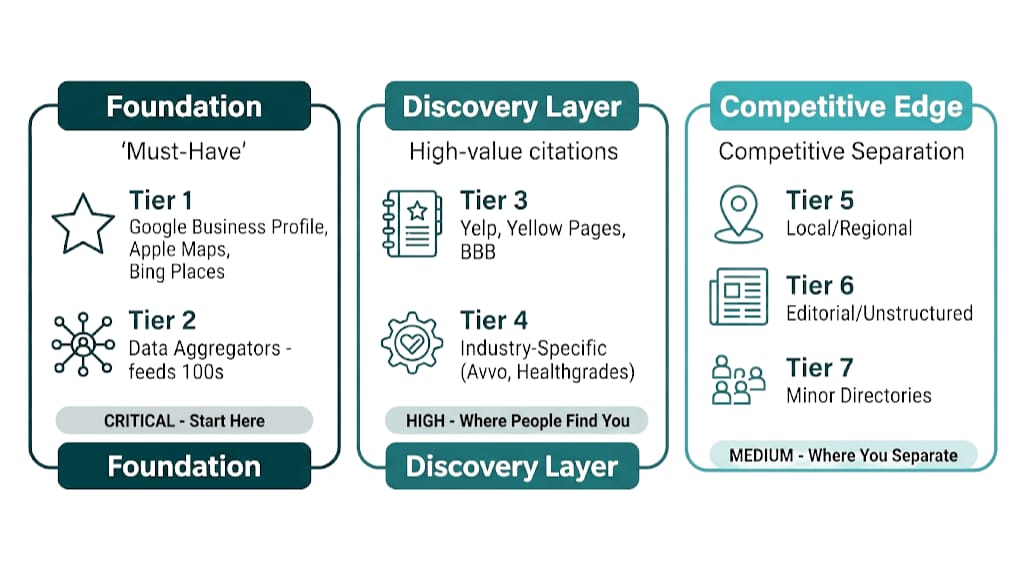
Here's how citation platforms stack up in terms of influence on local rankings:
Tier | Platform Type | Examples | Impact Level |
|---|---|---|---|
Tier 1 | Search Engine Profiles | Google Business Profile, Apple Maps, Bing Places | Critical |
Tier 2 | Data Aggregators | Data Axle, Localeze, Foursquare | High (feeds 100s of directories) |
Tier 3 | Major Directories | Yelp, Yellow Pages, BBB, Facebook | High |
Tier 4 | Industry-Specific Directories | Avvo (legal), Healthgrades (medical), Houzz (home services) | Medium-High |
Tier 5 | Local/Regional Directories | Chamber of Commerce, local newspaper listings | Medium |
Tier 6 | Unstructured Citations | Blog mentions, news articles, editorial features | Medium (growing) |
Tier 7 | Minor Directories | Small aggregator sites, low-DA directories | Low |
Tier 1 is non-negotiable. If your NAP data on Google Business Profile, Apple Maps, and Bing Places isn't accurate, nothing else matters. These are the main surfaces where customers interact with your business info, and they're the sources Google tends to trust most.
That Tier 1 accuracy still doesn't solve distribution. Tier 2, the data aggregators, is where most businesses get the biggest return from a single fix. Correcting your data at the aggregator level pushes updates to hundreds of downstream directories. We'll cover that in detail below.
Tiers 3 and 4 are where people discover and compare businesses. A Yelp listing with the wrong phone number doesn't only muddy your citation profile - it costs leads. And industry directories hit harder in certain verticals. A personal injury attorney with a clean Avvo profile and consistent NAP data will outrank one who ignores legal directories.
Tiers 5 and 6 are where separation starts. Most businesses in a market end up with similar Tier 1-4 coverage. The one that also earns consistent mentions in local news articles, chamber of commerce pages, and editorial blog features builds an edge competitors don't match overnight. That's where NAP SEO and link building intersect, a connection we'll get into later.
Why the Four Data Aggregators Are Your Highest-Leverage Fix
The four major data aggregators in the U.S. market are Data Axle (formerly Infogroup), Localeze (a Neustar company), Foursquare (which absorbed Factual), and Yelp's data partnerships. These aggregators feed business listing data to hundreds of smaller directories, GPS navigation systems, voice assistants, and apps.
They matter because the aggregators sit upstream. If your NAP data is wrong at the aggregator level, fixing individual directories turns into whack-a-mole. You correct your listing on one site, and the aggregator repopulates the old, incorrect data a few weeks later.
Fix the aggregator source and the downstream mess starts to clear. Corrections spread through partner networks on their own, usually over weeks to months.
If a business hasn't touched its aggregator data in years, this is usually the highest-ROI move in a NAP SEO campaign. The workflow is straightforward: claim or update your business listing with each aggregator, verify the details, then watch downstream directories to confirm the updates land. Tools like BrightLocal, Yext, and Semrush include aggregator submission in their citation management products, but direct submissions to each aggregator also work and often cost nothing or very little.
The key insight: don't start your NAP cleanup at the directory level. Start at the aggregator level, let the updates move downstream, then clean up whatever still doesn't match on individual platforms. That order saves time and stops the cycle of fixes getting overwritten.
How to Audit Your NAP Data: A Step-by-Step Process
Before you change anything, you need a clear picture of what's wrong. A solid NAP audit shows every inconsistency across your citations and helps you rank fixes by impact. This is the process we recommend, and if you want a broader framework for spotting problems, these citation audit tips can help you go deeper.
Step 1: Establish Your Canonical NAP. Before checking external sources, pick one official version of your business name, address, and phone number. This is your canonical NAP - the reference point every listing should match. Write it down exactly as it should appear:
- Business Name: Smith & Associates Legal Group (not "Smith and Associates," not "Smith & Assoc.")
- Address: 1425 Main Street, Suite 200, Austin, TX 78701 (not "1425 Main St., Ste. 200")
- Phone: (512) 555-0199 (not "512.555.0199" or "512-555-0199")
That canonical NAP must match your Google Business Profile exactly. If your GBP and your website disagree, fix the website. GBP is the anchor.
Step 2: Run Automated Scans. Use a NAP consistency checker to scan the web for citations. A few solid options:
- BrightLocal's Citation Tracker - scans 1,000+ directories and flags inconsistencies
- Moz Local - checks major platforms and aggregators
- Semrush's Listing Management - covers 70+ directories with inconsistency reporting
- Whitespark's Local Citation Finder - finds structured and unstructured citations
These tools won't catch everything. They will surface 80-90% of your citations in minutes. Export the results into a spreadsheet and review them by hand.
Step 3: Categorize Inconsistencies by Severity. Not all NAP problems carry the same risk. Bucket each issue:
- Critical: Wrong phone number, wrong address, wrong business name (different entity confusion)
- High: Old address from a previous location, disconnected phone number
- Medium: Minor name variations ("LLC" vs. no "LLC"), abbreviation differences
- Low: Formatting differences (parentheses vs. hyphens in phone number, "Street" vs. "St.")
Start with critical and high-severity items. Medium issues still need cleanup, but they rarely trigger ranking fires. Low-severity formatting differences are mostly cosmetic, as we'll cover in the next section.
Step 4: Check Manually Where Tools Can't Reach. Automated scanners miss plenty. Go manual on:
- Industry-specific directories tied to your vertical
- Local chamber of commerce and business association pages
- Sites that mention you in articles or press releases
- Social media profiles (Facebook, LinkedIn, Instagram business pages)
- Your own website, including footer, contact page, and Schema markup
Step 5: Build a Correction Plan and Track Progress. Keep one master spreadsheet with columns for platform name, current NAP listed, required correction, date submitted, and date verified. Work in this order:
- Google Business Profile
- Data aggregators (Data Axle, Localeze, Foursquare)
- Tier 3 major directories (Yelp, Facebook, BBB, Yellow Pages)
- Industry-specific directories
- All remaining listings
Step 6: Set a Recurring Audit Schedule. NAP data drifts. Aggregators reintroduce old data, users submit edits, and directories scrape inconsistent sources. Run a full audit quarterly and spot-check Tier 1-3 platforms monthly. For businesses that want ongoing oversight without managing it in-house, a managed service can handle the monitoring and corrections on a continuous basis. This isn't a one-time project. It's maintenance, like changing the oil in a car.
The NAP Formatting Rules That Actually Matter (And the Ones That Don't)
This is where the NAP SEO conversation turns into stress for a lot of teams. A common myth says every single character in your NAP has to match across every platform or Google will penalize you. That's not accurate. The real split is accuracy vs. consistency, and Moz's guidance on NAP in local SEO puts it plainly: "Accuracy is more critically important than consistency these days."
Accuracy means Google can still tie listings together even if formatting shifts. Google's entity reconciliation algorithms recognize that "(512) 555-0199" and "512-555-0199" and "5125550199" all point to the same phone number. Same deal with addresses: "123 Main Street" and "123 Main St." and "123 Main St" resolve to the same place. Those variations don't create a new entity because the meaning stays the same.
What actually causes damage:
- A different phone number entirely (old number, call tracking number on some platforms, new number on others)
- A different physical address (old location still listed, wrong suite number, P.O. box on some and street address on others)
- A materially different business name (adding or removing words that change the entity: "Smith Legal" vs. "Smith Legal Group" vs. "John Smith Attorney at Law")
- Conflicting city or ZIP code data
What doesn't cause meaningful damage:
- "Street" vs. "St." vs. "St"
- Phone number formatting (parentheses, hyphens, dots, spaces)
- "Suite" vs. "Ste." vs. "#"
- Including or omitting "LLC," "Inc.," or other legal suffixes (unless it changes the perceived entity)
Inconsistency Type | Risk Level | Action Required |
|---|---|---|
Wrong phone number | Critical | Fix immediately |
Wrong address | Critical | Fix immediately |
Different business name (entity confusion) | Critical | Fix immediately |
Old address from previous location | High | Fix within 1 week |
Missing suite/unit number | Medium | Fix within 1 month |
"Street" vs. "St." | Low | Fix if convenient |
Phone format differences | Low | Ignore unless bulk-fixing anyway |
Formatting differences won't trip up Google, but we still recommend standardizing where you can. Not because the algo can't parse it. Because clean, consistent listings look more credible to real people, and a single canonical format makes audits faster. Don't lose sleep over "St." vs. "Street." But don't ignore accuracy problems while fixating on abbreviations.
Call tracking creates most of the real-world mess, so it needs a direct answer. Dynamic number insertion (DNI) on your website won't break NAP consistency for Google, because Googlebot can read your real number in the page source. Directory listings are different. If you publish different tracking numbers across directories, you create true inconsistencies. If you use call tracking, run one tracking number across all directory listings, or keep directories on the primary business number and reserve tracking numbers for paid media landing pages only.
NAP SEO for Multi-Location Businesses: Avoiding the Franchise Trap
Multi-location businesses run into NAP problems single-location brands never see. The stakes go up fast, because every inconsistency replicates across every location.
The pattern we see most often is the franchise trap: corporate marketing controls the brand's main web presence, while franchise owners or location managers make one-off edits to their own listings. One location updates its phone number on Google but leaves Yelp untouched. Another location moves, corporate updates the main website, and nobody updates the 40 directory listings still showing the old address. A third location uses a slightly different DBA name that doesn't follow the corporate naming convention.
That patchwork is the problem. You end up with inconsistent NAP data across dozens of locations, each with its own set of issues. And because Google evaluates each location on its own, a poorly managed location doesn't get to borrow trust from a well-managed sibling.
The fix requires centralized control. Multi-location businesses should:
- Maintain a master NAP database with the canonical information for every location
- Use a centralized listing management platform (BrightLocal, Yext, or Rio SEO) so updates push to all locations at once
- Establish a change management protocol: when any location changes its phone number, address, or name, the update flows through one team that propagates it everywhere
- Audit each location on a quarterly basis
- Assign location-level NAP ownership to a specific person, even if corporate manages the tools
Centralized control compounds. A 50-location franchise brand with clean NAP data across all locations builds an advantage over time: each location reinforces the brand entity's overall prominence, and Google's confidence in the brand as a whole lifts every individual location. But one location with severe inconsistencies can still create entity confusion that spills into neighboring locations in the same metro area.
For agency owners managing multi-location clients, NAP management is one of the most scalable recurring revenue services you can offer. Systematic work. Mature tools. Results you can track through Maps visibility reporting.
Beyond Directories: How Unstructured Citations and AI Search Are Changing NAP SEO
The traditional NAP SEO playbook focuses almost entirely on structured citations: directory listings with standardized name, address, and phone fields. That playbook still works. It just doesn't carry a local campaign on its own anymore if you want to stay ahead in 2025 and beyond.
Unstructured citations are the new frontier. These are mentions of your business in editorial content, blog posts, news articles, event listings, and other non-directory placements. A local business publication that names your firm, includes your address, and links to your site counts as an unstructured citation. Google can pull NAP details from those mentions, and they tend to hit harder because editorial coverage signals third-party validation.
Directory coverage also caps out fast.
As structured listings reach saturation - most businesses in a market have claimed the same 50-60 directory profiles - unstructured citations start separating the top pack. The company with 30 editorial mentions across local news sites, industry blogs, and community orgs builds a citation profile competitors can't copy by signing up for a few more listings.
That citation footprint matters more once AI gets involved.
The AI search dimension makes this even more important. BrightLocal's 2025 expert panel highlighted that AI platforms like ChatGPT, Perplexity, and Google's AI Overviews now pull local business data from citation sources to answer local queries. When someone asks an AI assistant, "What's a good plumber near downtown Austin?", the model pulls from directories, review sites, and editorial coverage to form a response. Businesses with wider, more trusted citation footprints show up more often in those AI-generated answers.
A wider footprint is the shift.
In classic search, you tune a known set of ranking factors inside Google's system. In AI search, you win by being a well-documented entity that's mentioned often, across credible sites, with consistent business details. NAP consistency stays the baseline. The range and quality of your citation sources now carry more of the load. Businesses that earn editorial mentions - not just claim directory listings - put themselves in position to lead in both traditional local results and AI-driven local discovery. As Search Engine Journal's coverage of local SEO and AI search highlights, entity authority is becoming the dominant signal across all search formats, making a consistent and well-documented NAP profile more important than ever. If you want to understand why this matters beyond local SEO, link building for AI overviews breaks down how entity authority is becoming the dominant signal across all search formats.
How NAP SEO and Link Building Work Together for Local Authority
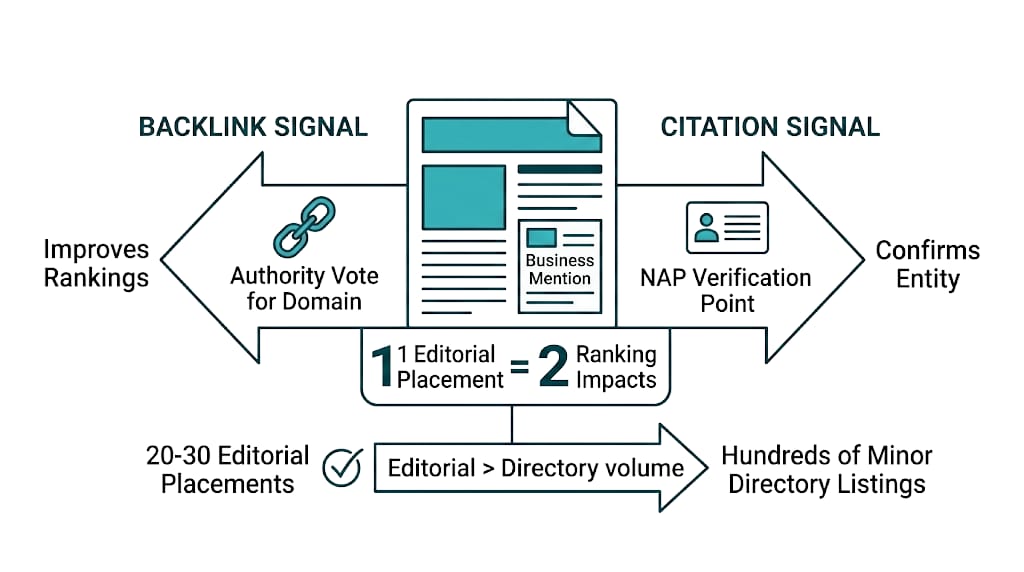
NAP SEO and link building reinforce each other, but most guides treat them as separate tracks. They aren't. Editorial link placements from high-DR local and industry publications do double duty: they act as backlinks that lift authority, and they act as unstructured citations that support your NAP entity data.
That double duty shows up in how Google reads the page.
When a credible local business outlet features your company and links to your website, Google picks up two signals at once. The backlink functions as an authority vote for your domain. And if the piece includes your business name, address, or phone number, it becomes another verification point for your NAP profile. One placement. Two ranking impacts.
That's the model we run at Rhino Rank.
Our curated link placements secure editorial features on high-DR publications across local, regional, and industry-specific sites. These aren't directory submissions or generic listings. They're editorial mentions on domains Google already trusts. For local SEO campaigns, each placement builds the backlink profile and expands the citation footprint in the same move.
That same citation footprint lines up with the authority hierarchy.
Tiers 1-4 cover directories and aggregators. Tiers 5-6 - local and editorial sources - are where the gap opens up between similar businesses. Link building is how you build those higher-tier citations at scale, without pretending directory volume will get you there. A business that pairs clean directory citations with 20-30 editorial placements on relevant, trusted sites ends up with a local SEO profile competitors struggle to match.
That difficulty to match should change how budgets get set.
For SEO managers and agency owners, link building budget and local citation budget shouldn't live as separate line items. Treat them as one local authority strategy. Every editorial link you earn is also a citation. And a citation from a trusted editorial source often outweighs five throwaway listings on minor directories.
If you're running local SEO campaigns and want to explore how editorial link placements can strengthen both your backlink profile and your NAP citation footprint, our managed link building services are built for exactly this purpose.
Frequently Asked Questions
What does NAP stand for in SEO and why does it matter for local search rankings?
NAP stands for Name, Address, and Phone number. Those three fields are the backbone of your business identity across the web. Google pulls NAP from dozens of sources to confirm the business is real and to gauge local prominence. When your NAP stays accurate across directories, data aggregators, and editorial mentions, it sends a clear trust signal to Google and helps support local pack placement.
How much does NAP consistency actually affect local pack rankings?
Citation signals - NAP consistency, citation volume, and citation quality - drive about 10.82% of local pack ranking factors based on BrightLocal's research. Brands with consistent NAP across more than 40 sources see 19% higher Google Maps visibility. Proximity and Google Business Profile signals carry more weight on their own, but citations still sit in the top five for newer businesses and remain table stakes for every serious local competitor.
Does NAP formatting need to be perfectly identical everywhere, or is accuracy more important than consistency?
Accuracy beats formatting. Google's systems sort out minor differences like "Street" vs. "St." or different phone number formats. Bad data causes the real problems: the wrong phone number, an old address, or a business name that doesn't match across platforms. Fix factual errors first. Standardize formatting when it's easy, but don't let it slow down cleanup.
Which citation platforms matter most for NAP SEO?
Google Business Profile, Apple Maps, and Bing Places matter most. The four main data aggregators - Data Axle, Localeze, Foursquare, and Yelp's data partnerships - are usually the highest-return fixes because they push data to hundreds of smaller directories. Then handle the big directories: Yelp, Facebook, BBB, and Yellow Pages. After that, focus on vertical directories tied to your niche. Editorial, unstructured citations also matter more once you're in competitive markets.
How do I audit my business's NAP data across the web?
Start with your canonical NAP: the single correct version of your business name, address, and phone number that matches your Google Business Profile. Run scans with BrightLocal's Citation Tracker, Moz Local, or Semrush's Listing Management. Sort issues by severity - critical, high, medium, low - and fix them by impact: GBP first, then aggregators, then major directories, then everything else. Keep it on a quarterly schedule so you catch data drift before it turns into a ranking problem.
related Blog Posts



Join 7,000+ Clients Growing with Rhino Rank
Sign Up

Stay ahead of the SEO curve
Get the latest link building strategies, SEO tips and industry insights delivered straight to your inbox.