
 Back to all posts
Buying cheap backlinks is one of the fastest ways to waste money in SEO. Links priced at $5 to $15 are almost always automated placements on spam sites, PBNs, or hacked domains - and they either do nothing for your rankings or actively damage them. The real cost of a cheap link campaign isn't the invoice. It's the months of lost progress, the toxic link profile you inherit, and the money you end up spending to fix the damage or start over with links that actually move the needle.
If you've ever searched "buy backlinks" and seen prices ranging from $5 to $500 per link, you've seen the same disconnect every business owner runs into. A link is a link on paper, yet the price swings by 100x.
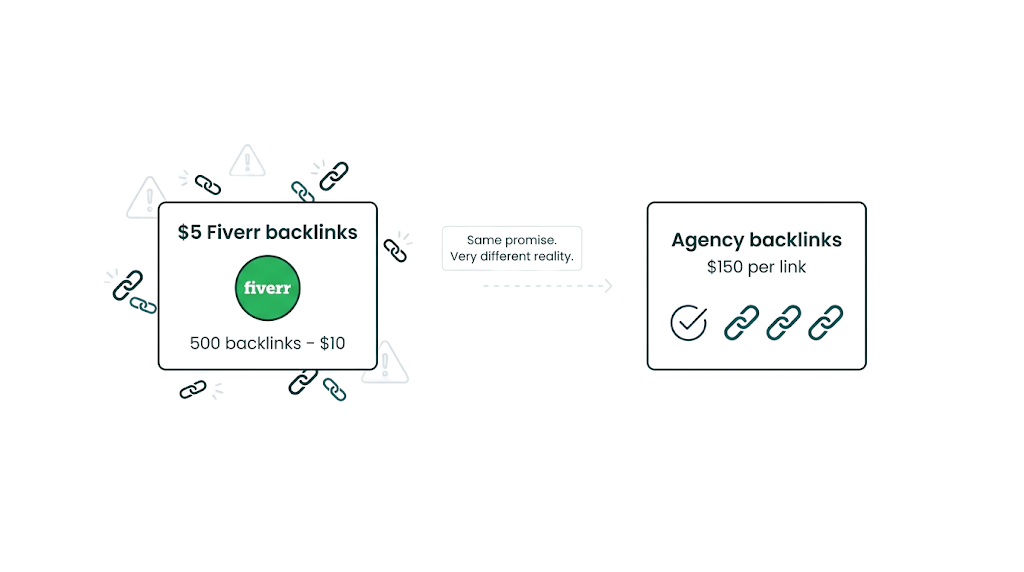
From the outside, link building pricing looks broken. One seller on Fiverr offers 500 backlinks for $10. An agency quotes $150 per link. Both claim they'll improve rankings. Both promise "high quality." The price gap is huge, and the pitch sounds the same.
We run a link building agency, so we won't pretend we're neutral. We also review thousands of backlink profiles, including plenty that show up after a cheap link campaign goes sideways. The patterns repeat. And the mechanics behind them are easy to verify no matter who explains them.
This article walks through what happens when you buy cheap backlinks - not the vague "Google might penalize you" warning every SEO blog repeats, but the practical reality. You'll see what a $5 link looks like in the wild. We'll also cover why the economics of link building make quality impossible below a certain floor, what the real consequences are (most aren't penalties), and how to think about the price-quality spectrum so you can make a clean decision.
If you're still deciding whether buying backlinks is right for your business at all, we cover that decision in depth separately. This article assumes you're already considering it and want to know what you're buying at different price points.
What a $5 Fiverr Backlink Actually Looks Like
Most people who buy cheap backlinks never see the other side of the transaction. They place an order, get a spreadsheet of URLs a few days later, and assume those links are helping. That spreadsheet tells a different story.
The Typical $5 Link Package
Spend five minutes browsing Fiverr's SEO category and you'll find dozens of listings promising "100 high DA backlinks," "500 SEO backlinks for any niche," or "contextual dofollow links guaranteed to boost rankings." The gig descriptions look polished. The reviews skew positive. The prices look fake.
Here's what shows up in the delivery report.
The sites hosting your links tend to be blog networks with no real audience. Think of a WordPress install with a generic theme and 200+ posts pushed live in a few weeks. Each post is a 300 to 400 word article that reads like it came out of a spinner. Topics swing from cryptocurrency to dog grooming to plumbing tips with no editorial thread. Each post drops 10 to 15 outbound links to other buyers. Your SaaS product sits in the same paragraph as a gambling site, a payday loan provider, and someone selling counterfeit sneakers.
Anchor text is where it gets worse. Cheap packages default to exact-match or hard-sell anchors. If you ordered links for the keyword "best project management software," that's the anchor text - across every placement. Real link profiles don't look like that. A cheap campaign builds a footprint that screams "paid links" to anyone who audits it, including Google's systems.
Delivery is still just a spreadsheet. Sometimes a Google Sheet, sometimes a CSV. You get a list of URLs where the links went, and that's it. No relationship with site owners. No logins. No guarantee the links will exist next week, let alone next year.
Where These Links Actually Live
Think about the supply chain for a moment. Someone on Fiverr is selling you 100 links for $5. After Fiverr takes their 20% cut, the seller receives $4. Now they need to place 100 links for $4.
They are not sending outreach emails to webmasters. They are not writing custom content for each placement. They are not evaluating site quality. At $0.04 per link, they are running software. Full stop.
The common link types at this price point are:
- Blog comments on sites with open moderation (or no moderation at all)
- Forum profile links created by bots on thousands of forums simultaneously
- Web 2.0 properties - Tumblr blogs, Medium posts, Blogger sites - created in bulk with spun content
- Directory submissions to low-quality, pay-to-play directories that exist solely for link sellers
- Social bookmarks on sites like Diigo and Folkd that Google stopped valuing years ago
- Article directory links on platforms that accept anything
None of these involve a human being contacting a real website owner and negotiating a placement. The links get placed programmatically, usually by a single operator running dozens of Fiverr gigs at once with tools like GSA Search Engine Ranker or Scrapebox.
When teams come to us after running one of these campaigns, the link profile tells the same story. Most linking sites pull fewer than 100 monthly visitors. The copy around the links reads like spun text because it is spun text. And a big chunk of the links disappear within three months: sites get deindexed, Web 2.0 accounts get wiped, and forum profiles get removed.
The links that stick around are rarely the ones you want. They survive because the sites are abandoned and nobody moderates them.
We have written a detailed breakdown of PBN backlinks and their risks - many links in the $5 to $15 range come from exactly these networks.
The Economics of Link Building (Why Quality Has a Price Floor)
This is the part of the conversation that most cheap link buyers never hear. Instead of just telling you that cheap links are bad, let us walk through why real links cost what they cost. Once you understand the economics, the price gap starts to make sense.
The Real Cost of Building a Single Outreach Link
Think about what goes into placing one real guest post or curated link through manual outreach.
Prospecting comes first. Someone has to find relevant, quality websites in your niche. Not from a bought list - from actual research. That means checking domain metrics, verifying real organic traffic, reviewing editorial standards, scanning for spam signals, and confirming the site is indexed. A skilled link builder might review 20 to 30 prospects to find one that clears the bar. Budget 15 to 30 minutes per qualified prospect.
Outreach comes next. Personalised emails to each site owner or editor. Not templates - pitches that show you've read the site and understand its audience. Then follow-ups, because most first emails get ignored. Cold outreach response rates in link building sit between 5% and 15%. For every link that lands, the outreach team may send 10 to 20 emails and go through a few rounds of back-and-forth. Call it 30 to 60 minutes of communication work per placed link.
Content creation follows for guest posts. Someone needs to write an article the host site will publish. Even at modest freelance rates, you're looking at $30 to $80 for a piece that passes editorial review. For curated links - where your link gets added to an existing article - you still need research to find the right page and a pitch that makes the edit feel earned.
Quality control happens after placement. Someone reviews the live page to confirm the link is correct, the anchor text matches what was agreed, the surrounding content fits, and the link is dofollow. Then we monitor over time to catch removals early.
Put the numbers together. If a link builder earns $20 per hour - modest for skilled outreach work, according to Bureau of Labor Statistics data on marketing specialists - and the total time per placed link runs 2 to 3 hours once you count the outreach that doesn't convert, you're at $40 to $60 in labor alone. Add $20 to $40 for content creation and another $5 to $10 for tools and software, and you're at $65 to $110 per link before the agency takes any margin at all.
The maths is clear. Anyone selling links for $5 to $25 is not doing outreach. They cannot be. The numbers don't work. They are using automation, PBNs, or compromised sites because those are the only methods that fit that price point.
What Different Price Points Actually Buy
This is a rough map of the link building market by price tier. We will expand on each tier in detail later, but the overview helps set expectations:
- $5 to $15 per link: Automated placements. Software-generated. No human outreach. PBNs, blog comments, Web 2.0 profiles, directory spam.
- $25 to $50 per link: The grey zone. Often marketed as "guest posts" but placed on sites built to sell links. Low-quality content. Minimal editorial standards.
- $50 to $100 per link: Where legitimate outreach becomes economically viable. Real sites and real editorial processes, but often lower-authority or smaller niche publications.
- $100 to $300 per link: Mid-tier. Established sites with genuine traffic, real audiences, and editorial integrity.
- $300+ per link: High-authority placements on major publications in competitive niches.
The key takeaway isn't "you get what you pay for." Below roughly $50 per link, there's a quality floor that marketing can't talk its way around. The economics don't support real outreach work under that threshold.
What Actually Happens When You Buy Cheap Backlinks
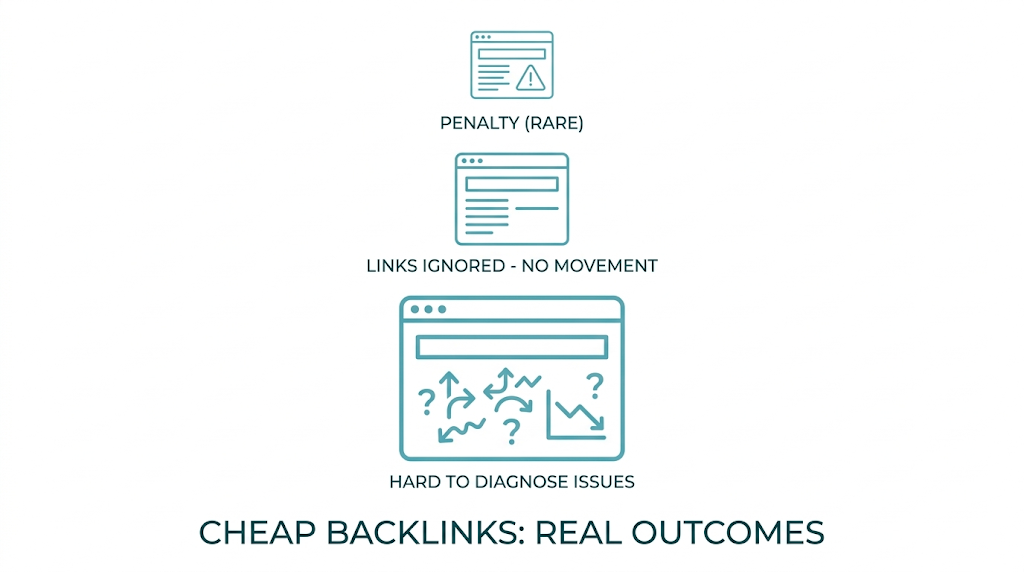
We've all seen the "Google will penalize you" warning repeated across SEO blogs. It's true, but it's also the least interesting and least common outcome. What we see more often is messier, harder to diagnose, and more annoying than a single penalty event.
The Links Disappear
This is the most common outcome and the one nobody talks about. Cheap links have high attrition rates because the sites hosting them aren't stable.
PBN sites get discovered and deindexed by Google. Web 2.0 platforms wipe spam accounts during cleanup sweeps. Hacked sites get restored by their owners. Blog comment links get moderated out. Forum profiles disappear when admins run bot cleanups.
Here is how it plays out. We buy 50 links for $100 - that looks like $2 per link. Within three months, 30 of those links are gone. The PBN sites got deindexed, the Web 2.0 accounts got nuked, the blog comments got cleaned up. Within six months, maybe 10 links remain. At that point we've paid $10 per surviving link.
And the part that hurts: the links that survive tend to sit on the worst sites. Well-maintained sites clean up spam. Platforms with active moderation catch bot accounts. What's left is the bottom of the barrel - sites so neglected that nobody checks them. Those become our backlink profile.
The Links Do Nothing
Even when cheap links stick around, links from sites with no traffic, no topical relevance, and no real authority don't move rankings. Google's algorithm has discounted these signals for years. SpamBrain, Google's AI-based spam detection system, targets link schemes and manipulative link patterns.
That creates the most frustrating outcome: nothing happens.
We buy links. We wait two to three months for results because SEO takes time and everyone tells us to be patient. No movement. So we buy more, assuming the answer is volume. We wait again. Months go by. We've spent $500 to $1,000 and rankings haven't budged.
In many cases, that's worse than a penalty. A penalty gives a clear signal that something broke - Search Console flags it, traffic drops, and we know what to unwind. Useless links produce nothing. No signal, no movement, no feedback. Teams walk away thinking link building "doesn't work" when the reality is simpler: we didn't do link building. We bought the SEO version of a lottery ticket and expected it to perform like a retirement fund.
The Links Actively Hurt You
Cheap links turn from useless to dangerous when they create patterns, not because of one bad placement.
Google doesn't grade backlinks one by one. It reads your link profile as a system, and a few repeatable footprints tend to pull extra scrutiny:
- Unnatural anchor text ratios. If 80% of your backlinks use exact-match commercial anchors like "best project management software," that reads as manipulation.
- Links from penalised or deindexed domains. Ties to known spam networks bring guilt by association.
- Sudden spikes in [link velocity](/blog/link-velocity/). Landing 200 links in a week when your site usually picks up 5 per month looks like what it is - a paid push.
- Links from completely unrelated niches. A B2B SaaS blog getting links from gambling sites, pharmaceutical spam, and recipe blogs in a language you don't publish in.
Manual actions vs algorithmic devaluation isn't a technical detail. It changes the failure mode.
Manual actions are rare, but they hit hard - Google's spam team reviews the site, issues a penalty, and rankings drop fast. Algorithmic devaluation shows up more often and hides in plain sight. Rankings stall. Or they drift down over time. No notification, no clean "before and after" moment, just a slow loss of trust that makes the next round of SEO harder.
That trust problem compounds. Once the profile gets polluted, even solid links built later can land with less impact because the site's trust signal is already damaged.
You pay twice - first for the cheap links that caused the mess, then for the quality links required to repair it.
The Opportunity Cost Nobody Talks About
This is the cost you won't see on an invoice.
Every dollar spent on cheap links is a dollar you didn't put into links that move rankings. A realistic scenario: spend $500 over six months on cheap backlinks from Fiverr and similar platforms. You get nothing measurable. Put that same $500 into 5 to 8 legitimate curated links or guest posts and you could see real ranking movement in three to four months.
So the cost isn't $500. It's $500 plus six months of lost momentum.
Time carries a real price in SEO because organic growth compounds. Burn six months on a cheap link plan, then switch to quality, and you've handed away half a year of traffic growth, revenue, and competitive positioning. In competitive niches, that gap often doesn't close, because competitors spent that same window building links that actually counted.
The Price-Quality Spectrum: What You Get at Every Price Point
Price tiers tell you more than vendor promises. This is the cleanest way we know to set expectations, including where our own services sit.
$5 to $15 Per Link: Automated and Disposable
What you are getting: Blog comments, forum profile links, social bookmarks, Web 2.0 properties, directory submissions, article directory links.
How they are built: Software automation. Tools like GSA Search Engine Ranker, Scrapebox, and RankerX can generate hundreds or thousands of these links per hour. One operator running these tools can fill dozens of Fiverr orders per day.
Site quality: The DA and DR numbers attached to these links are either manufactured through link exchange schemes or they're meaningless because the sites have no real traffic. Many are already deindexed or close to deindexation.
Expected lifespan: Weeks to months. Attrition rates of 50% to 70% within six months are common.
Impact on rankings: None to negative. Google has discounted these link types for over a decade. Best case, they get ignored. Worst case, they get flagged as spam.
$25 to $50 Per Link: The Guest Post Grey Zone
What you are getting: "Guest posts" on sites built mainly to sell link placements. They often get pitched as "blogger outreach," even though nobody is reaching out to independent bloggers.
How they are built: The provider keeps a network of site owners or a list of sites that take paid guest posts with light editorial review. Content gets churned out by content mills or generated by AI, then pushed live with little cleanup. Your link lands in a 500-word post next to one or two other paid links.
Site quality: On paper, these sites can show decent DA or DR because they've built links to themselves to pump the metrics. Traffic tells the story. Check Ahrefs or Semrush and you'll usually see fewer than 500 monthly organic visits. Publishing cadence is another tell: 20 to 30 "guest posts" per month, packed with commercial outbound links. Google already has a label for this: link farms.
Expected lifespan: Months to a year. The sites sit on a hair trigger because the footprint is obvious, and when Google devalues the host site, every link from it drops in value at once.
Impact on rankings: Minimal. These links might pad your backlink report, but they rarely change rankings. Google's link spam policies call out "large-scale guest posting campaigns" as link spam.
$50 to $100 Per Link: Where Quality Becomes Possible
This is where the math starts working. At this tier, a provider can pay people to run outreach, follow up, negotiate placements, and manage edits with actual site owners.
What you are getting: Curated link insertions on existing, indexed content that already has readers. Guest posts on sites with editorial standards and organic traffic.
How they are built: Manual outreach and relationship-based placements, not bulk submissions. Content is written to match the host site's rules and tone, rather than serving as a wrapper for a link.
Site quality: Sites with real audiences and real usage. They won't all be high-authority domains, but they publish for humans and they earn traffic. Relevance matters here, and these placements tend to stay within your niche.
Expected lifespan: Years. These are editorial placements the site owner approved, so they have no incentive to pull them.
Impact on rankings: Measurable. This is where ROI starts showing up. Our own curated links start at $60 and guest posts at $80 - that pricing comes from established outreach processes and relationships we've built over years. Without that base, newer agencies and freelancers usually have to charge more to land the same caliber of placements.
$100 to $300+ Per Link: Mid to High Authority
What you are getting: Guest posts on established publications with meaningful traffic. Editorial placements on niche authority sites. Links from sites people in your industry read, cite, and share internally.
How they are built: Relationships with editors and site owners drive access, and the bar rises fast. Content needs to be custom and publication-ready, and some sites charge editorial fees. Competition is real because everyone wants exposure on these domains.
Site quality: This is where authority reflects more than a metric. You're buying into existing audiences, consistent organic traffic, and editorial control. Sites at this level protect their reputation, so they vet topics, contributors, and outbound links.
Impact on rankings: Strong, especially in competitive niches. One link from a DR 60+ site with real traffic can move rankings more than 50 cheap links combined. Our link building cost guide breaks down what this tier looks like across the market.
The takeaway isn't "you get what you pay for." Below about $50, spending more rarely buys better links - it just buys slightly less bad ones. Once you clear $50, quality tracks price in a more predictable way. For most buyers, the floor matters more than the ceiling.
How to Spot a Cheap Provider Disguised as a Legitimate Agency
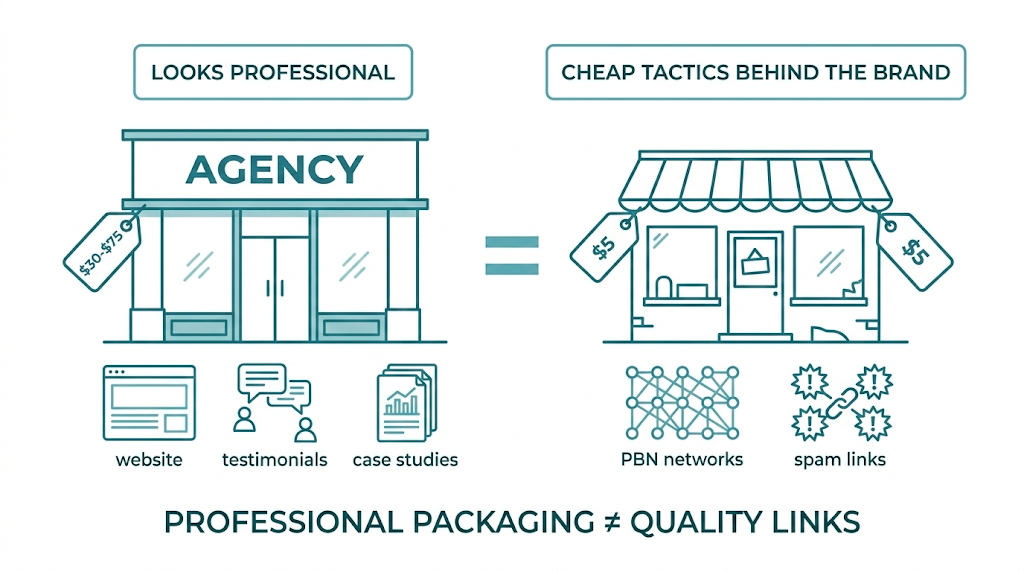
The obvious cheap link sellers on Fiverr are easy to avoid. The harder problem is agencies and freelancers who charge $30 to $75 per link but use the same methods as the $5 sellers. They have professional websites, case study pages, and testimonials. The packaging is better. The product is the same.
Red Flags in Pricing and Promises
Watch for these patterns when evaluating a link building provider:
- Volume guarantees at low prices. "50 links per month for $500" sounds great on paper. But 50 legitimate outreach links cost $3,000 to $5,000 at minimum. If the maths does not add up, the method is not what they are claiming.
- Guaranteed DA/DR scores without showing actual sites. A promise of "links from DA 40+ sites" means nothing without seeing the specific domains. DA is easy to inflate and tells you nothing about real traffic or editorial quality.
- Instant or fast delivery windows. Real outreach takes time. Prospecting, emailing, following up, writing content, getting editorial approval - that process takes two to four weeks minimum per link. If someone promises 20 links in 5 days, those links are not coming from outreach.
- No transparency about methods. A legitimate provider will explain how they build links without dancing around it. If the answer stays vague, or they point you to testimonials instead of walking through the process, treat that as a warning.
- Refusal to share example placements. Providers with a track record can show 5 to 10 real examples of sites where they placed links recently. If they won't, assume they can't.
Red Flags in the Links You Receive
If you have already purchased links, here is how to audit what you got:
- Check the linking site's traffic. Use Ahrefs, Semrush, or SimilarWeb. If the site has fewer than 100 monthly organic visits, the link is worthless no matter what its DA or DR says.
- Look at the linking page. Check the context. Is your link surrounded by other obvious paid placements? Is the content coherent and relevant to your niche? Or is it a 400-word article trying to cover five unrelated topics?
- Check the site's outbound link ratio. If every post on the site contains 3 to 5 external links to commercial sites, it's a link farm.
- Review the publishing pattern. Twenty or more new posts per month, all with outbound commercial links, isn't a real blog. It's a link selling operation.
- Verify the site is indexed. Search
site:domain.comin Google. If it returns zero results, the site has been deindexed and any link from it is completely worthless.
Questions to Ask Before You Buy
These are not trick questions. Legit providers answer them without getting weird about it:
- Can you show me 5 example sites where you have placed links recently?
- How do you select sites for placement? What criteria do you use?
- What is your outreach process? Can you walk me through it step by step?
- What happens if a link is removed after placement?
- Can I approve sites before you place links on them?
If a provider gets defensive or evasive on any of these, take the hint.
When Cheap Links Are Dangerous vs. Just Useless
Not all cheap links carry the same risk. Treating every $5 link as a ticking time bomb isn't accurate, and it doesn't help you make informed decisions. Here is how to think about the risk spectrum.
Mostly Useless (Low Active Risk)
Some cheap link types are harmless in the sense that they won't trigger a penalty. They just do nothing:
- Blog comments on real sites are almost always nofollowed and ignored by Google. Waste of money. Low risk.
- Directory submissions to legitimate directories get ignored by search engines. Harmless, but useless.
- Social bookmarks have carried zero ranking value for years. Google does not penalise them - it just does not count them.
- Web 2.0 properties with thin content get ignored. Google knows the difference between a Tumblr blog with three spun articles and a real Web 2.0 presence.
If you have been buying these types, the damage is financial, not algorithmic. You wasted money, but your site is probably fine.
Potentially Dangerous (Moderate to High Risk)
These are the cheap link types that cause real problems:
- PBN links carry real risk because when Google identifies the network - and they keep getting better at this - every link from every site in the network gets devalued at once. One bad network can wipe out your entire link building investment overnight.
- Links from hacked sites tie your domain to compromised properties. That is a trust signal you do not want.
- Massive volumes of exact-match anchor text create an unnatural pattern that both manual reviewers and algorithmic systems flag fast.
- Links from completely unrelated niches - gambling, pharmaceuticals, adult content - pointing to your B2B business blog signal that your link profile isn't organic.
The Grey Area
Most cheap links sit between harmless and dangerous. A low-quality guest post on a real but mediocre blog won't trigger a penalty. It also won't move rankings.
The risk isn't catastrophic. It's cumulative.
One bad link is fine. Google can handle noise in your link profile. A hundred bad links start to read like a pattern. And Google doesn't evaluate links one by one. It judges your profile as a whole. A few cheap links mixed into an otherwise healthy profile usually don't matter. A link profile that is 80% cheap links tells a different story.
That risk spectrum is why we put together a broader look at black hat link building tactics and where each one falls.
What to Do If You Have Already Bought Cheap Backlinks
If you are reading this after already investing in cheap links, do not panic. The situation is manageable, and beating yourself up about it helps nothing. Use this four-step process.
Step 1: Audit What You Have
Pull your full backlink profile from Google Search Console (under Links > External Links) and cross-reference with Ahrefs or Semrush for a more complete picture. Search Console shows what Google knows about. Third-party tools catch links Google hasn't reported yet.
Start with the patterns we described earlier: low-traffic sites, spun or incoherent content, links surrounded by other commercial outbound links, sites in unrelated niches, and sites that look like PBNs or link farms.
Categorise each link into three buckets: clearly harmless (ignore these), potentially risky (monitor these), and obviously toxic (these need attention).
Step 2: Assess the Damage
Check Google Search Console under Security and Manual Actions. If you have a manual action related to unnatural links, that is the priority. At that point, the disavow tool matters.
No manual action means you move to performance. Look at your organic traffic trend and compare it to when the links went live. A drop that lines up points to damage. Flat traffic after a link buying spree points to links that did nothing.
Scale matters here. Ten to twenty cheap links on a site that also has 50 legitimate backlinks is fine in most cases. Google can absorb some noise. Five hundred cheap links making up 90% of your entire link profile needs proactive work.
Step 3: Decide Whether to Disavow
Google's disavow tool tells Google to ignore specific links when calculating your rankings. The current consensus among SEO professionals - and Google's own guidance - is that Google has gotten better at ignoring low-quality links on its own. The disavow tool earns its keep in two cases: you have a manual action, or your link profile is overwhelmingly toxic.
If you do decide to disavow, be surgical. Do not upload your entire list of cheap links. Focus on the ones that are clearly toxic - PBN sites, hacked domains, deindexed sites, and links from spam networks. Leave the merely useless links alone. Disavowing too aggressively can remove links that were helping.
Step 4: Pivot to Quality
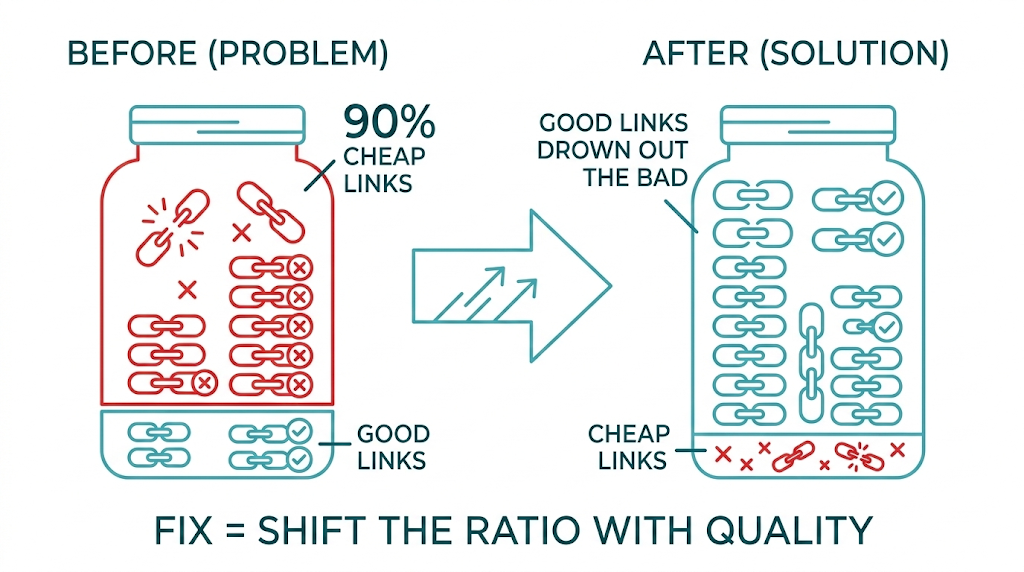
The best fix for a damaged link profile isn't only removing bad links. It's drowning them out with good ones over time. Build legitimate backlinks through real outreach, and those toxic links shrink into a smaller share of the profile.
That shift in ratio is the whole point. The mindset shift matters more than any single tactic: link building is an investment with compounding returns, not a line item to minimise. Five quality links that lift rankings and drive organic traffic will generate more value over 12 months than 500 cheap links that sit there and do nothing.
We cover the full process in our guide on buying backlinks the right way, including how to evaluate providers.
Frequently Asked Questions
Are cheap backlinks worth it?
No. Cheap backlinks priced under $25 per link are almost always automated placements on spam sites, PBNs, or Web 2.0 properties with no real traffic. They either do nothing for rankings or create toxic patterns in your link profile that make future SEO work harder. Spend the same budget on fewer, higher-quality links that actually move the needle.
Can you get penalized for buying backlinks on Fiverr?
Yes, though outright manual penalties are less common than algorithmic devaluation. Google's SpamBrain system flags link spam patterns across your entire backlink profile. Most of the time, Google just ignores the links and you burn the budget, or the links create unnatural patterns (especially in anchor text ratios and link velocity) that suppress rankings without any formal penalty notification.
How much should a quality backlink cost?
Legitimate backlinks from real websites with genuine traffic and editorial standards start around $50 to $100 per link for lower-authority sites and range up to $300 or more for high-authority placements. You pay for human outreach, content creation, quality control, and relationship management. Any provider consistently delivering links below $50 is cutting corners on method, site quality, or both.
What is the cheapest safe way to build backlinks?
Publish genuinely useful, linkable content - original research, in-depth guides, free tools - and earn links. It's the lowest-cost route, but it takes real time and expertise.
For paid link building, curated link insertions (also called niche edits) usually give the best value because they skip the content creation cost. Our curated links start at $60 per placement, which sits at the low end of legitimate, outreach-based link building.
How do I know if my backlinks are hurting my site?
Check Google Search Console for manual actions first. Then audit your backlink profile in Ahrefs or Semrush and look for patterns: high concentrations of links from low-traffic sites, unnatural anchor text ratios, links from unrelated niches, or sudden spikes in link acquisition.
If more than 50% of your backlinks come from sites with fewer than 100 monthly visitors, your link profile needs attention.
related Blog Posts




Join 2,600+ Businesses Growing with Rhino Rank
Sign Up
Stay ahead of the SEO curve
Get the latest link building strategies, SEO tips and industry insights delivered straight to your inbox.